Pharmacists
Pharmacy
•The Art of preparing and
dispensing drugs.
•A place where drugs are sold; a
drug store.
• History of Career
• Expected Duties and
Physical Demands
• Training and
Education
• Personal Qualities
• Skill Measurement
• Code of Ethics
• Earnings/Benefi
ts
• Future outlook
• Bibliography
• Dates back to medieval times with
priests
• Origin of the word “pharmacy” come
from the Greek
• As much as 80,000 years ago people
of Paleolithic period were interested
in flora.
• It is hard to say when it started exactly
– It existed in a rudimentary form long before the word
existed.
• Combining different agents(compounding) was
considered an art form by priests and doctors.
• First known chemical process was carried out by
the artisans of Mesopotamia, Egypt, and China.
• Theories often involved magic, but developed
mathematical, astronomical, and cosmological
ideas.
• The first culture to consider ideas
scientifically was the Greeks.
– Made logical speculations rather than relying
on myth.
• Pharmacy began to develop as a profession
separate from medicine in the 18th
century.
– 1821 the first school of pharmacy was
established.
• Industrial Revolution
– Rapid change from hand methods to machine
methods of production that characterized
industrial revolution.
• Large scale drug manufacturing was big in
society;many machines and patents
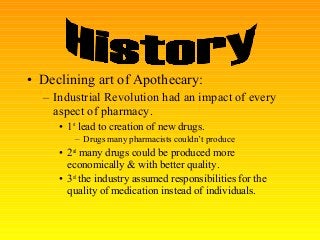
• Declining art of Apothecary:
– Industrial Revolution had an impact of every
aspect of pharmacy.
• 1st
lead to creation of new drugs.
– Drugs many pharmacists couldn’t produce
• 2nd
many drugs could be produced more
economically & with better quality.
• 3rd
the industry assumed responsibilities for the
quality of medication instead of individuals.
• The Community Pharmacy
– 19th
century didn’t see the end of compounding.
• Its estimated the 80% of prescriptions dispensed in
1920’s were still compounded.
– They used chemicals purchased to make own
prescriptions.
– Called to provide first aid and medicines for
common aliments Ex: Burns, frostbite,
poisoning etc.
• Graph for 50 years
Between 1920-1971.
Dispensing and compounding of
medications
1
2
3
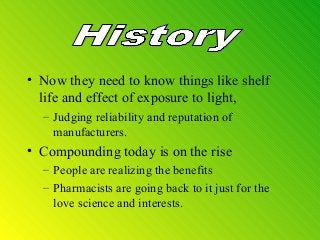
• Now they need to know things like shelf
life and effect of exposure to light,
– Judging reliability and reputation of
manufacturers.
• Compounding today is on the rise
– People are realizing the benefits
– Pharmacists are going back to it just for the
love science and interests.
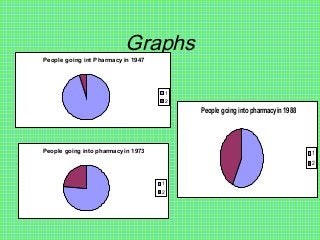
Graphs
People going int Pharmacy in 1947
1
2
People going into pharmacy in 1973
1
2
People going into pharmacyin 1988
1
2
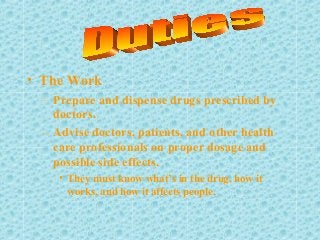
• The Work
– Prepare and dispense drugs prescribed by
doctors.
– Advise doctors, patients, and other health
care professionals on proper dosage and
possible side effects.
• They must know what’s in the drug, how it
works, and how it affects people.
• Purchase medical supplies
• Answer customer questions
• Go with doctors and hospital
staff on rounds
• Advise patients on medical
equipment and over-the-
counter medication
• HELP PATIENTS GET WELL
• May work in a hospital, clinic, or drug
store
• Constantly learning and studying about
properties & side effects of new drugs.
• Communicate with doctors & patients
• Most work a standard work week
• Best job opportunities go to people with
best grades
– Lower grades will get you a job, however,
maybe part time
• Companies want people who graduate at
the top of the class.
• Fierce competition
Education
• Bachelor’s degree is being phased out
– Instead schools offer a doctor of
pharmacy (PharmD).
• Bachelor’s degrees will not be
awarded after 2005
Education-
Classes
• College Prep
– English
– Math
– Science
– Good written and verbal communication
skills
Education-
Classes
• College requirements
– 2 years of pre-pharmacy courses
– 4 years of professional programs leading to
PharmD.
• Courses include Biology, Chemistry, Calculus,
English, Speech and General Education.
• Electives
– Community pharmacy, hospital pharmacy,
marketing, pediatrics and geriatrcs.
Personal Qualities
• Have a good memory
• Enjoy learning about new medications &
treatments
• Be trustworthy & detail oriented
• Good communication skills
• Good problem solving abilities
• Enjoy people
Personality Qualities
Personality Matches Personality Misses
Analytical Creative
Detailed Emotional
Focused Disorganized
*I want some one who is kind and caring, who shows an interest in
me and my well being.
Skill Measurement
• Board Exams
– NAPLAX
– Federal Law Exam
– Each States test
• 30 hours of CEU’s every 2 years
• Renew State License every year
• A pharmacist respects the covenantal relationship
between the patient and pharmacist
• They promote the good of every patient in a
caring, compassionate, and confidential way
• The place concern for the well-being of the patient
• They respect the autonomy & dignity of each
patient.
• They act with honesty & integrity in professional
relationships
• They maintain professional competence
• They respect the values & abilities of colleagues
and other health care professionals
• They serve individual, community, and societal
needs
• They seek justice in the distribution of health
resources
– Very similar to many peoples morals.
Earnings/Benefits
Average
Earning
Average
Hourly Rate
$69,440 $33.39
California Pharmacist-
Staff average-$90,000-100,000 per
year
Manager- $100,000-150,000
Owner - $100,000-???
Pros Cons
Good Salaries Long Hours
Wide variety of
Careers
Potential Restlessness
Options
• INCREASING
NEED!!!!!
2000
workforce
2000-2010
Growth
Rate
217,000 24.3%
Other Places of Work
• Armed Services
• Community pharmacy
• Drug Research & Development
• Sales & Marketing
Armed Forces
• Air force
• Army
• Coast Guard
• Navy
*You need a 4
year college
degree in
pharmacy and
a state license
to practice
pharmacy.
• http://www.iit.edu/departments/csep/Public
WWW/codes/coe/American
%20Pharmaceutic…
• http://www.lindsaydrug.com/newhist.htm
• http://usa.cx.bridges.com/student/DisplayAr
ticle.do?
dt=Career+Information&dn=Pharmacist
• http://www.uspharmd.com/rxpharmacist.htm
• http://www.uspharmd.com/rxpharmacist2.htm
• http://www.uspharmd.com/rxpharmacist3.htm
• http://www.pharmacists-recruitment-
int.com/Pharmacits-
Recruitment/Professinal_Requirements.html
• Kevin House-interview
• http://www.op.nysed.gov/pharm.htm
• http://www.ask.com/-pictures

Pharmacy history

  • 1.
  • 2.
    Pharmacy •The Art ofpreparing and dispensing drugs. •A place where drugs are sold; a drug store.
  • 3.
    • History ofCareer • Expected Duties and Physical Demands • Training and Education • Personal Qualities • Skill Measurement • Code of Ethics
  • 4.
    • Earnings/Benefi ts • Futureoutlook • Bibliography
  • 5.
    • Dates backto medieval times with priests • Origin of the word “pharmacy” come from the Greek • As much as 80,000 years ago people of Paleolithic period were interested in flora.
  • 6.
    • It ishard to say when it started exactly – It existed in a rudimentary form long before the word existed. • Combining different agents(compounding) was considered an art form by priests and doctors. • First known chemical process was carried out by the artisans of Mesopotamia, Egypt, and China. • Theories often involved magic, but developed mathematical, astronomical, and cosmological ideas.
  • 7.
    • The firstculture to consider ideas scientifically was the Greeks. – Made logical speculations rather than relying on myth. • Pharmacy began to develop as a profession separate from medicine in the 18th century. – 1821 the first school of pharmacy was established.
  • 8.
    • Industrial Revolution –Rapid change from hand methods to machine methods of production that characterized industrial revolution. • Large scale drug manufacturing was big in society;many machines and patents
  • 9.
    • Declining artof Apothecary: – Industrial Revolution had an impact of every aspect of pharmacy. • 1st lead to creation of new drugs. – Drugs many pharmacists couldn’t produce • 2nd many drugs could be produced more economically & with better quality. • 3rd the industry assumed responsibilities for the quality of medication instead of individuals.
  • 10.
    • The CommunityPharmacy – 19th century didn’t see the end of compounding. • Its estimated the 80% of prescriptions dispensed in 1920’s were still compounded. – They used chemicals purchased to make own prescriptions. – Called to provide first aid and medicines for common aliments Ex: Burns, frostbite, poisoning etc.
  • 11.
    • Graph for50 years Between 1920-1971. Dispensing and compounding of medications 1 2 3
  • 12.
    • Now theyneed to know things like shelf life and effect of exposure to light, – Judging reliability and reputation of manufacturers. • Compounding today is on the rise – People are realizing the benefits – Pharmacists are going back to it just for the love science and interests.
  • 13.
    Graphs People going intPharmacy in 1947 1 2 People going into pharmacy in 1973 1 2 People going into pharmacyin 1988 1 2
  • 14.
    • The Work –Prepare and dispense drugs prescribed by doctors. – Advise doctors, patients, and other health care professionals on proper dosage and possible side effects. • They must know what’s in the drug, how it works, and how it affects people.
  • 15.
    • Purchase medicalsupplies • Answer customer questions • Go with doctors and hospital staff on rounds • Advise patients on medical equipment and over-the- counter medication • HELP PATIENTS GET WELL
  • 16.
    • May workin a hospital, clinic, or drug store • Constantly learning and studying about properties & side effects of new drugs. • Communicate with doctors & patients • Most work a standard work week
  • 17.
    • Best jobopportunities go to people with best grades – Lower grades will get you a job, however, maybe part time • Companies want people who graduate at the top of the class. • Fierce competition
  • 18.
    Education • Bachelor’s degreeis being phased out – Instead schools offer a doctor of pharmacy (PharmD). • Bachelor’s degrees will not be awarded after 2005
  • 19.
    Education- Classes • College Prep –English – Math – Science – Good written and verbal communication skills
  • 20.
    Education- Classes • College requirements –2 years of pre-pharmacy courses – 4 years of professional programs leading to PharmD. • Courses include Biology, Chemistry, Calculus, English, Speech and General Education. • Electives – Community pharmacy, hospital pharmacy, marketing, pediatrics and geriatrcs.
  • 21.
    Personal Qualities • Havea good memory • Enjoy learning about new medications & treatments • Be trustworthy & detail oriented • Good communication skills • Good problem solving abilities • Enjoy people
  • 22.
    Personality Qualities Personality MatchesPersonality Misses Analytical Creative Detailed Emotional Focused Disorganized *I want some one who is kind and caring, who shows an interest in me and my well being.
  • 23.
    Skill Measurement • BoardExams – NAPLAX – Federal Law Exam – Each States test • 30 hours of CEU’s every 2 years • Renew State License every year
  • 24.
    • A pharmacistrespects the covenantal relationship between the patient and pharmacist • They promote the good of every patient in a caring, compassionate, and confidential way • The place concern for the well-being of the patient • They respect the autonomy & dignity of each patient. • They act with honesty & integrity in professional relationships
  • 25.
    • They maintainprofessional competence • They respect the values & abilities of colleagues and other health care professionals • They serve individual, community, and societal needs • They seek justice in the distribution of health resources – Very similar to many peoples morals.
  • 26.
    Earnings/Benefits Average Earning Average Hourly Rate $69,440 $33.39 CaliforniaPharmacist- Staff average-$90,000-100,000 per year Manager- $100,000-150,000 Owner - $100,000-???
  • 27.
    Pros Cons Good SalariesLong Hours Wide variety of Careers Potential Restlessness Options
  • 28.
  • 29.
    Other Places ofWork • Armed Services • Community pharmacy • Drug Research & Development • Sales & Marketing
  • 30.
    Armed Forces • Airforce • Army • Coast Guard • Navy *You need a 4 year college degree in pharmacy and a state license to practice pharmacy.
  • 31.
    • http://www.iit.edu/departments/csep/Public WWW/codes/coe/American %20Pharmaceutic… • http://www.lindsaydrug.com/newhist.htm •http://usa.cx.bridges.com/student/DisplayAr ticle.do? dt=Career+Information&dn=Pharmacist
  • 32.
    • http://www.uspharmd.com/rxpharmacist.htm • http://www.uspharmd.com/rxpharmacist2.htm •http://www.uspharmd.com/rxpharmacist3.htm • http://www.pharmacists-recruitment- int.com/Pharmacits- Recruitment/Professinal_Requirements.html • Kevin House-interview
  • 33.