





COLLABORATION IN NURSING
Mathew Varghese V
MSN(RAK),FHNP (CMC Vellore),CPEPC
Nursing officer
AIIMS Delhi
1
mathewvmaths@yahoo.co.in
INTRODUCTION
 The nursing profession is faced with increasingly
complex health care issues driven by technological
and medical advancements, an ageing population,
increased numbers of people living with chronic
disease, and spiraling costs.
 Collaboration is a substantive idea repeatedly
discussed in health care circles.
 Though the benefits are well validated,
collaboration is seldom practiced.
2
mathewvmaths@yahoo.co.in
MEANING
 The word collaboration is derived from the Latin
word ‘co’ and ‘laborare’ which mean “work
together.”
 That means the interaction among two or more
individuals
 Collaboration encompass a variety of actions such
as
 Communication,
 Information sharing,
 Coordination,
 Cooperation,
 problem solving,
 negotiation 3
mathewvmaths@yahoo.co.in
DEFINITIONS
 Collaboration is the most formal inter
organizational relationship involving shared
authority and responsibility for planning,
implementation, and evaluation of a joint effort -
Hord, 1986
 Collaborative care ‘as partnership relationship
between doctors, nurses and other health care
providers with patients and their families’ -
Virginia Henderson
4
mathewvmaths@yahoo.co.in
OBJECTIVES OF COLLABORATION
 Provide client-directed and client-centered care
using a multidisciplinary, integrated, participative
framework
 Enhance continuity across continum of care
 Improve client and family satisfaction with care
 Provide quality, cost effective, research based care
 Promote mutual respect, communication
 Develop interdependent
5
mathewvmaths@yahoo.co.in
NEED FOR COLLABORATION IN
HEALTH CARE SERVICES
Consumer wants and needs
 Health care consumers are demanding
comprehensive, holistic and compassionate health
care that is also affordable.
 They want expert, humanistic care that integrate
the available technology and provide information
and services related to health promotion and illness
prevention.
 Previously people expected a physician to make
decision about their care: today however
consumers expect to be involved in making any
decision 6
mathewvmaths@yahoo.co.in
SELF HELP INITIATIVE
 Today many individuals seek answers for acute and
chronic health problems through non traditional
approaches to health care.
 Alternative medicines and support groups are
among two of the most popular self help choices.
 The most commonly used therapies are relaxation
techniques, chiropractic treatment, massage
imagery, spiritual healing etc.
7
mathewvmaths@yahoo.co.in
CHANGING DEMOGRAPHY AND EPIDEMIOLOGY
 The growing number of older adult combined with
the fact that the average older adult has three or
more chronic conditions, will greatly influence the
health care system and the insurer in the future.
 Closely related to various epidemiology influence
posted by chronic illness.
8
mathewvmaths@yahoo.co.in
HEALTH CARE ACCESS
 Several alternative health care delivery systems
have been implemented to control cost.
9
mathewvmaths@yahoo.co.in
TECHNOLOGY ADVANCES
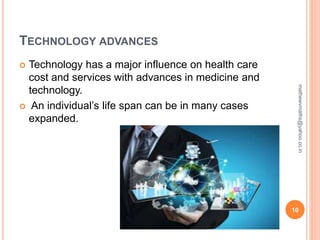
 Technology has a major influence on health care
cost and services with advances in medicine and
technology.
 An individual’s life span can be in many cases
expanded.
10
mathewvmaths@yahoo.co.in
NEED FOR COLLABORATION BETWEEN
EDUCATION AND SERVICES
 The gap between nursing practice and education has its
historical roots in the separation of nursing schools from the
control of hospitals to which they were attached.
 At the time when schools of nursing were operated by
hospitals, it was students who largely staffed the wards and
learned the practice of nursing under the guidance of the
nursing staff.
 However, under the then prevailing circumstances, service
needs often took precedence over student’s learning needs.
 The creation of separate institutions for nursing education with
independent administrative structures, budget and staff was
therefore considered necessary in order to provide an
effective educational environment towards enhancing students
learning experiences and laying the foundation for further
educational development
11
mathewvmaths@yahoo.co.in
NEED FOR COLLABORATION BETWEEN
EDUCATION AND SERVICES
 While separation was beneficial in advancing
education, it has also had adverse effects.
 Under the divided system, the nurse educators are
no longer the practicing nurses in the wards.
 As a result, they are no longer directly in the
delivery of nursing services nor are they
responsible for quality of care provided in the
clinical settings used for student’s learning.
 The practicing nurses have little opportunity to
share their practical knowledge with students and
no longer share the responsibility for ensuring
relevance of the training that the students receive
12
mathewvmaths@yahoo.co.in
NEED FOR COLLABORATION BETWEEN
EDUCATION AND SERVICES
 As the gap between education and practice has
widened,there are now significant differences between
what is taught in the classroom and what is practiced in
the service settings
 Most nursing leaders also assert that something has
been lost with the move from hospital based schools of
nursing to the collegiate setting.
 The familiar observation that graduate nurses can
"theorize but not catheterize" reflects the concern that
graduate nurses often lack practical skills despite their
significant knowledge of nursing process and theory.
 Nursing educators know that development of technical
expertise in the modern hospital is possible only through
on-the-job exposure to the latest equipment and medical
interventions.
13
mathewvmaths@yahoo.co.in
NEED FOR COLLABORATION BETWEEN
EDUCATION AND SERVICES
 Schools of nursing have tried to bridge this gap using
state-of-the-art simulation laboratories, supervised
clinical experiences in the hospital, and summer
internships
 The hospital industry has also recognized the need to
support a graduate nurse with additional training.
 As a result, graduate nurses are required to attend an
orientation to the hospital and have additional
supervised practice before they can function
independently in the hospital.
 The cost of orienting a new nursing graduate is
significant, particularly with high levels of nursing
turnover (Reiter, Young, & Adamson, 2007). 14
mathewvmaths@yahoo.co.in
PRINCIPLES OF COLLABORATION – ART-533
A
1. Asserts, attitudes and values that each potential
partner brings
2. Accountability to each other
3. Agreements to be mutual and documented
4. Acknowledgement of each other contribution
5. Achievements monitored
15
mathewvmaths@yahoo.co.in
ART - 533
 R
1. Reciprocal benefits
2. Respect for each partners
3. Responsibilities-well defined and agreed upon
16
mathewvmaths@yahoo.co.in
ART -533
T
 Time and timing
 Tact and talent
 Trust
17
mathewvmaths@yahoo.co.in
CHARACTERISTIC OF
COLLABORATION
 Joint venture
 Co operative endeavor
 Willing participation
 Shared planning and decision making
 Team approach
 Contribution of expertise
 Shared responsibility
 Non hierarchal relationship
 Shared power (based on knowledge and expertise)
18
mathewvmaths@yahoo.co.in
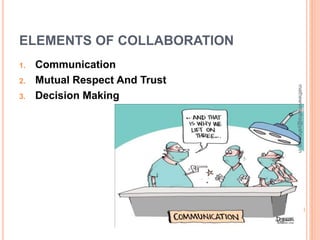
ELEMENTS OF COLLABORATION
1. Communication
2. Mutual Respect And Trust
3. Decision Making
19
mathewvmaths@yahoo.co.in
NURSE AS A COLLABORATOR
OR TYPES OF NURSING COLLABRATION
 With nurse colleagues
 Shares personal expertise with other nurses and
elicits the expertise of others to ensure quality client
care.
 Develops a sense of trust and mutual respect with
peers that recognize their unique contribution.
20
mathewvmaths@yahoo.co.in
NURSE AS A COLLABORATOR
 With other health care professionals
 Share health care responsibilities in exploring
options, setting goals, and making decision with
clients and families
 Listens to each individuals views
 Participate in collaborative interdisciplinary
research to increase knowledge of clinical problems
or situation
21
mathewvmaths@yahoo.co.in
NURSE AS A COLLABORATOR
 With professional nursing organizations
 Seeks opportunities to collaborate with and within
professional organizations.
 Serves on committee in state and national nursing
organizations or specialty groups
 Supports professional organizations in political
action to create solutions for professional and
health care concerns
22
mathewvmaths@yahoo.co.in
NURSE AS A COLLABORATOR
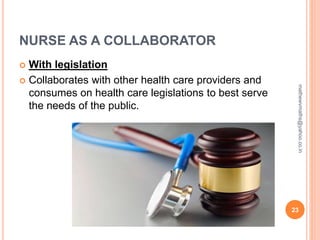
 With legislation
 Collaborates with other health care providers and
consumes on health care legislations to best serve
the needs of the public.
23
mathewvmaths@yahoo.co.in
COLLABORATION ISSUES WITHIN
NURSING
Collaboration and the nursing shortage
 For the practicing Nursing, staffing is an issue of
both professional and personal concern.
 Inappropriate staffing levels can not only threaten
patient health and safety, and lead to greater
complexity of care, but also impact on Nurses
health and safety by increasing nurse pressure,
fatigue, injury rate, and ability to provide safe care.
 This stress can lead to ineffective collaboration
work among the nurses.
24
mathewvmaths@yahoo.co.in
COLLABORATION ISSUES WITHIN
NURSING
Mandatory Overtime
 Staff nurses across the world are reporting a
dramatic increase in the use of mandatory overtime
as a staffing tool.
 This dangerous staffing practice, in part due to a
nursing shortage, is having a negative impact on
patient care, fostering medical errors, and driving
nurses away from the bedside.
25
mathewvmaths@yahoo.co.in
COLLABORATION ISSUES WITHIN
NURSING
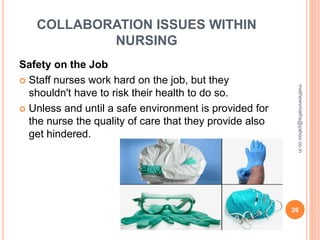
Safety on the Job
 Staff nurses work hard on the job, but they
shouldn't have to risk their health to do so.
 Unless and until a safe environment is provided for
the nurse the quality of care that they provide also
get hindered.
26
mathewvmaths@yahoo.co.in
COLLABORATION ISSUES WITHIN
NURSING
Workplace bullying
 Workplace bullying is a serious issue effecting the
nursing profession.
 It is defined as any type of repetitive abuse in which
the victim of the bulling behavior suffer verbal
abuse, threats, humiliating or intimidating behaviors
or behavior by the perpetrator that interfere with his
or her job performance and are meant to place risk.
27
mathewvmaths@yahoo.co.in
COLLABORATION ISSUES WITHIN
NURSING
Lack of respect
 Nursing can be a gratifying profession; however, nurses
continue to experience lack of respect from their
patients, doctors, administrators, and even from their
coworkers.
 Medscape’s online survey (2011) reported that 31.4
percent of the respondents interviewed identified "lack of
respect from other healthcare providers/non-nurses" as
being one of the most distressing job factors .”
 Also, in an ANA 2011 Health and Safety Survey, physical
assault and verbal abuse were shown to have gone
down but the issue still remains to be a big concern.

28
mathewvmaths@yahoo.co.in
LACK OF RESPECT
 RNs in theurvey reported that “on-the-job assault” was
one of their top-three safety concerns.
 The survey reported that within a 12-month period, 11
percent of RNs were physically assaulted and 52
percent were either threatened or verbally abused.
 Many cases go unreported because some feel that this
problem is just part of their job.
 Many of the problems in nursing are due to the lack of
legislation to address these issues.
 Because the health care industry is constantly evolving
due to health reform, more problems will continue to
emerge.
29
mathewvmaths@yahoo.co.in
COLLABORATION ISSUES WITHIN
NURSING
 Regulatory barrier
 Societies of medical profession continue to try limit
advanced practice through legislative and
regulatory reforms.
 Legislation and regulation have been barrier to the
implementation of collaborative role.
 Collaboration cannot be mandated. It is a process
that develop over the time
30
mathewvmaths@yahoo.co.in
COLLABORATION ISSUES OUTSIDE
NURSING
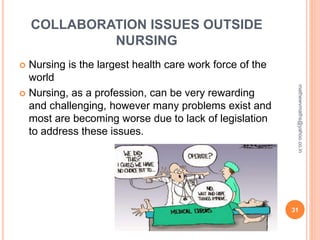
 Nursing is the largest health care work force of the
world
 Nursing, as a profession, can be very rewarding
and challenging, however many problems exist and
most are becoming worse due to lack of legislation
to address these issues.
31
mathewvmaths@yahoo.co.in
DISCIPLINARY DIFFERENCE
 Often clinicians differ in their basic philosophy of
care.
 In earlier days it was practiced as physician
supervise advanced nursing practice.
 But now the view advanced that supervision
precludes the development of a collaborative
relationship and that physicians not fully supervise
nurse but works in collaboration with them rather
than supervision there should be preferably the
scope of autonomous nursing management and
identify high risk population within a particular
population or practice. 32
mathewvmaths@yahoo.co.in
MEETING PATIENT EXPECTATIONS
 In one out of three patients who stayed in a hospital
at least one night, reported that “nurses weren't
available when needed or didn't respond quickly to
requests for help." (IN USA)
 Meeting patient expectations is hard enough as it is
and some people fear it may worsen as healthcare
and the elderly population increases.
 They also worry that nurses will be stretched too
thinly and may not be able to achieve the needs
and demands for their patients.
33
mathewvmaths@yahoo.co.in
LACK OF RESPECT
34
mathewvmaths@yahoo.co.in
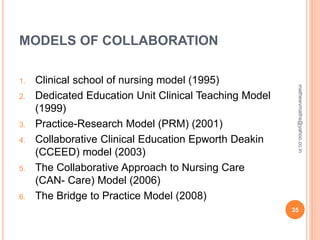
MODELS OF COLLABORATION
1. Clinical school of nursing model (1995)
2. Dedicated Education Unit Clinical Teaching Model
(1999)
3. Practice-Research Model (PRM) (2001)
4. Collaborative Clinical Education Epworth Deakin
(CCEED) model (2003)
5. The Collaborative Approach to Nursing Care
(CAN- Care) Model (2006)
6. The Bridge to Practice Model (2008)
35
mathewvmaths@yahoo.co.in
CONCLUSION
 All the models pursue collaboration as a means of
developing trust, recognizing the equal value of
stakeholders and bringing mutual benefit to both
partners in order to promote high quality research,
continued professional education and quality health
care.
 Application of these models can reduce the
perceived gap between education and service in
nursing thereby can help in the development of
competent and efficient nurses for the betterment of
nursing profession
36
mathewvmaths@yahoo.co.in
37
mathewvmaths@yahoo.co.in
38
mathewvmaths@yahoo.co.in

Collabration in nursing ppt

  • 1.
    COLLABORATION IN NURSING MathewVarghese V MSN(RAK),FHNP (CMC Vellore),CPEPC Nursing officer AIIMS Delhi 1 mathewvmaths@yahoo.co.in
  • 2.
    INTRODUCTION  The nursingprofession is faced with increasingly complex health care issues driven by technological and medical advancements, an ageing population, increased numbers of people living with chronic disease, and spiraling costs.  Collaboration is a substantive idea repeatedly discussed in health care circles.  Though the benefits are well validated, collaboration is seldom practiced. 2 mathewvmaths@yahoo.co.in
  • 3.
    MEANING  The wordcollaboration is derived from the Latin word ‘co’ and ‘laborare’ which mean “work together.”  That means the interaction among two or more individuals  Collaboration encompass a variety of actions such as  Communication,  Information sharing,  Coordination,  Cooperation,  problem solving,  negotiation 3 mathewvmaths@yahoo.co.in
  • 4.
    DEFINITIONS  Collaboration isthe most formal inter organizational relationship involving shared authority and responsibility for planning, implementation, and evaluation of a joint effort - Hord, 1986  Collaborative care ‘as partnership relationship between doctors, nurses and other health care providers with patients and their families’ - Virginia Henderson 4 mathewvmaths@yahoo.co.in
  • 5.
    OBJECTIVES OF COLLABORATION Provide client-directed and client-centered care using a multidisciplinary, integrated, participative framework  Enhance continuity across continum of care  Improve client and family satisfaction with care  Provide quality, cost effective, research based care  Promote mutual respect, communication  Develop interdependent 5 mathewvmaths@yahoo.co.in
  • 6.
    NEED FOR COLLABORATIONIN HEALTH CARE SERVICES Consumer wants and needs  Health care consumers are demanding comprehensive, holistic and compassionate health care that is also affordable.  They want expert, humanistic care that integrate the available technology and provide information and services related to health promotion and illness prevention.  Previously people expected a physician to make decision about their care: today however consumers expect to be involved in making any decision 6 mathewvmaths@yahoo.co.in
  • 7.
    SELF HELP INITIATIVE Today many individuals seek answers for acute and chronic health problems through non traditional approaches to health care.  Alternative medicines and support groups are among two of the most popular self help choices.  The most commonly used therapies are relaxation techniques, chiropractic treatment, massage imagery, spiritual healing etc. 7 mathewvmaths@yahoo.co.in
  • 8.
    CHANGING DEMOGRAPHY ANDEPIDEMIOLOGY  The growing number of older adult combined with the fact that the average older adult has three or more chronic conditions, will greatly influence the health care system and the insurer in the future.  Closely related to various epidemiology influence posted by chronic illness. 8 mathewvmaths@yahoo.co.in
  • 9.
    HEALTH CARE ACCESS Several alternative health care delivery systems have been implemented to control cost. 9 mathewvmaths@yahoo.co.in
  • 10.
    TECHNOLOGY ADVANCES  Technologyhas a major influence on health care cost and services with advances in medicine and technology.  An individual’s life span can be in many cases expanded. 10 mathewvmaths@yahoo.co.in
  • 11.
    NEED FOR COLLABORATIONBETWEEN EDUCATION AND SERVICES  The gap between nursing practice and education has its historical roots in the separation of nursing schools from the control of hospitals to which they were attached.  At the time when schools of nursing were operated by hospitals, it was students who largely staffed the wards and learned the practice of nursing under the guidance of the nursing staff.  However, under the then prevailing circumstances, service needs often took precedence over student’s learning needs.  The creation of separate institutions for nursing education with independent administrative structures, budget and staff was therefore considered necessary in order to provide an effective educational environment towards enhancing students learning experiences and laying the foundation for further educational development 11 mathewvmaths@yahoo.co.in
  • 12.
    NEED FOR COLLABORATIONBETWEEN EDUCATION AND SERVICES  While separation was beneficial in advancing education, it has also had adverse effects.  Under the divided system, the nurse educators are no longer the practicing nurses in the wards.  As a result, they are no longer directly in the delivery of nursing services nor are they responsible for quality of care provided in the clinical settings used for student’s learning.  The practicing nurses have little opportunity to share their practical knowledge with students and no longer share the responsibility for ensuring relevance of the training that the students receive 12 mathewvmaths@yahoo.co.in
  • 13.
    NEED FOR COLLABORATIONBETWEEN EDUCATION AND SERVICES  As the gap between education and practice has widened,there are now significant differences between what is taught in the classroom and what is practiced in the service settings  Most nursing leaders also assert that something has been lost with the move from hospital based schools of nursing to the collegiate setting.  The familiar observation that graduate nurses can "theorize but not catheterize" reflects the concern that graduate nurses often lack practical skills despite their significant knowledge of nursing process and theory.  Nursing educators know that development of technical expertise in the modern hospital is possible only through on-the-job exposure to the latest equipment and medical interventions. 13 mathewvmaths@yahoo.co.in
  • 14.
    NEED FOR COLLABORATIONBETWEEN EDUCATION AND SERVICES  Schools of nursing have tried to bridge this gap using state-of-the-art simulation laboratories, supervised clinical experiences in the hospital, and summer internships  The hospital industry has also recognized the need to support a graduate nurse with additional training.  As a result, graduate nurses are required to attend an orientation to the hospital and have additional supervised practice before they can function independently in the hospital.  The cost of orienting a new nursing graduate is significant, particularly with high levels of nursing turnover (Reiter, Young, & Adamson, 2007). 14 mathewvmaths@yahoo.co.in
  • 15.
    PRINCIPLES OF COLLABORATION– ART-533 A 1. Asserts, attitudes and values that each potential partner brings 2. Accountability to each other 3. Agreements to be mutual and documented 4. Acknowledgement of each other contribution 5. Achievements monitored 15 mathewvmaths@yahoo.co.in
  • 16.
    ART - 533 R 1. Reciprocal benefits 2. Respect for each partners 3. Responsibilities-well defined and agreed upon 16 mathewvmaths@yahoo.co.in
  • 17.
    ART -533 T  Timeand timing  Tact and talent  Trust 17 mathewvmaths@yahoo.co.in
  • 18.
    CHARACTERISTIC OF COLLABORATION  Jointventure  Co operative endeavor  Willing participation  Shared planning and decision making  Team approach  Contribution of expertise  Shared responsibility  Non hierarchal relationship  Shared power (based on knowledge and expertise) 18 mathewvmaths@yahoo.co.in
  • 19.
    ELEMENTS OF COLLABORATION 1.Communication 2. Mutual Respect And Trust 3. Decision Making 19 mathewvmaths@yahoo.co.in
  • 20.
    NURSE AS ACOLLABORATOR OR TYPES OF NURSING COLLABRATION  With nurse colleagues  Shares personal expertise with other nurses and elicits the expertise of others to ensure quality client care.  Develops a sense of trust and mutual respect with peers that recognize their unique contribution. 20 mathewvmaths@yahoo.co.in
  • 21.
    NURSE AS ACOLLABORATOR  With other health care professionals  Share health care responsibilities in exploring options, setting goals, and making decision with clients and families  Listens to each individuals views  Participate in collaborative interdisciplinary research to increase knowledge of clinical problems or situation 21 mathewvmaths@yahoo.co.in
  • 22.
    NURSE AS ACOLLABORATOR  With professional nursing organizations  Seeks opportunities to collaborate with and within professional organizations.  Serves on committee in state and national nursing organizations or specialty groups  Supports professional organizations in political action to create solutions for professional and health care concerns 22 mathewvmaths@yahoo.co.in
  • 23.
    NURSE AS ACOLLABORATOR  With legislation  Collaborates with other health care providers and consumes on health care legislations to best serve the needs of the public. 23 mathewvmaths@yahoo.co.in
  • 24.
    COLLABORATION ISSUES WITHIN NURSING Collaborationand the nursing shortage  For the practicing Nursing, staffing is an issue of both professional and personal concern.  Inappropriate staffing levels can not only threaten patient health and safety, and lead to greater complexity of care, but also impact on Nurses health and safety by increasing nurse pressure, fatigue, injury rate, and ability to provide safe care.  This stress can lead to ineffective collaboration work among the nurses. 24 mathewvmaths@yahoo.co.in
  • 25.
    COLLABORATION ISSUES WITHIN NURSING MandatoryOvertime  Staff nurses across the world are reporting a dramatic increase in the use of mandatory overtime as a staffing tool.  This dangerous staffing practice, in part due to a nursing shortage, is having a negative impact on patient care, fostering medical errors, and driving nurses away from the bedside. 25 mathewvmaths@yahoo.co.in
  • 26.
    COLLABORATION ISSUES WITHIN NURSING Safetyon the Job  Staff nurses work hard on the job, but they shouldn't have to risk their health to do so.  Unless and until a safe environment is provided for the nurse the quality of care that they provide also get hindered. 26 mathewvmaths@yahoo.co.in
  • 27.
    COLLABORATION ISSUES WITHIN NURSING Workplacebullying  Workplace bullying is a serious issue effecting the nursing profession.  It is defined as any type of repetitive abuse in which the victim of the bulling behavior suffer verbal abuse, threats, humiliating or intimidating behaviors or behavior by the perpetrator that interfere with his or her job performance and are meant to place risk. 27 mathewvmaths@yahoo.co.in
  • 28.
    COLLABORATION ISSUES WITHIN NURSING Lackof respect  Nursing can be a gratifying profession; however, nurses continue to experience lack of respect from their patients, doctors, administrators, and even from their coworkers.  Medscape’s online survey (2011) reported that 31.4 percent of the respondents interviewed identified "lack of respect from other healthcare providers/non-nurses" as being one of the most distressing job factors .”  Also, in an ANA 2011 Health and Safety Survey, physical assault and verbal abuse were shown to have gone down but the issue still remains to be a big concern.  28 mathewvmaths@yahoo.co.in
  • 29.
    LACK OF RESPECT RNs in theurvey reported that “on-the-job assault” was one of their top-three safety concerns.  The survey reported that within a 12-month period, 11 percent of RNs were physically assaulted and 52 percent were either threatened or verbally abused.  Many cases go unreported because some feel that this problem is just part of their job.  Many of the problems in nursing are due to the lack of legislation to address these issues.  Because the health care industry is constantly evolving due to health reform, more problems will continue to emerge. 29 mathewvmaths@yahoo.co.in
  • 30.
    COLLABORATION ISSUES WITHIN NURSING Regulatory barrier  Societies of medical profession continue to try limit advanced practice through legislative and regulatory reforms.  Legislation and regulation have been barrier to the implementation of collaborative role.  Collaboration cannot be mandated. It is a process that develop over the time 30 mathewvmaths@yahoo.co.in
  • 31.
    COLLABORATION ISSUES OUTSIDE NURSING Nursing is the largest health care work force of the world  Nursing, as a profession, can be very rewarding and challenging, however many problems exist and most are becoming worse due to lack of legislation to address these issues. 31 mathewvmaths@yahoo.co.in
  • 32.
    DISCIPLINARY DIFFERENCE  Oftenclinicians differ in their basic philosophy of care.  In earlier days it was practiced as physician supervise advanced nursing practice.  But now the view advanced that supervision precludes the development of a collaborative relationship and that physicians not fully supervise nurse but works in collaboration with them rather than supervision there should be preferably the scope of autonomous nursing management and identify high risk population within a particular population or practice. 32 mathewvmaths@yahoo.co.in
  • 33.
    MEETING PATIENT EXPECTATIONS In one out of three patients who stayed in a hospital at least one night, reported that “nurses weren't available when needed or didn't respond quickly to requests for help." (IN USA)  Meeting patient expectations is hard enough as it is and some people fear it may worsen as healthcare and the elderly population increases.  They also worry that nurses will be stretched too thinly and may not be able to achieve the needs and demands for their patients. 33 mathewvmaths@yahoo.co.in
  • 34.
  • 35.
    MODELS OF COLLABORATION 1.Clinical school of nursing model (1995) 2. Dedicated Education Unit Clinical Teaching Model (1999) 3. Practice-Research Model (PRM) (2001) 4. Collaborative Clinical Education Epworth Deakin (CCEED) model (2003) 5. The Collaborative Approach to Nursing Care (CAN- Care) Model (2006) 6. The Bridge to Practice Model (2008) 35 mathewvmaths@yahoo.co.in
  • 36.
    CONCLUSION  All themodels pursue collaboration as a means of developing trust, recognizing the equal value of stakeholders and bringing mutual benefit to both partners in order to promote high quality research, continued professional education and quality health care.  Application of these models can reduce the perceived gap between education and service in nursing thereby can help in the development of competent and efficient nurses for the betterment of nursing profession 36 mathewvmaths@yahoo.co.in
  • 37.
  • 38.