R. RUPPA MERCY
M.Sc NURSING 1ST YEAR

 Derived from a latin word collaborare, ‘to work together’
 It encompasses a variety of actions such as shared planning,
decision making, responsibility, accountability,
communication, trust, mutual understanding, respect,
coordination, cooperation, problem solving and negotiation.
INTRODUCTION

Collaborative care ‘as partnership relationship between doctors,
nurses and other health care providers with patients and their
families’
-VIRGINIA HENDERSON
Collaboration is ‘Nurses and physicians cooperatively working
together, sharing responsibility for solving problems and making
decisions to formulate and carry out plans for patient care’
-BAGGS AND SCHMITT,1988
DEFINITION

 Decreasing gap between nursing education and nursing
services.
 Graduate nurses often lack practical skills
 A partnership between nursing educators and hospital
nursing personnel is essential to meet this challenge.
NEED FOR
COLLABORATION

 To seek creative, integrated solution where need and goal of
both the sides are important commitment and consensual
decision.
 To learn to grow through co – operative problem solving
resulting in greater understanding and empathy.
 To identify, share and merge vastly different views.
 To be honest about work through difficult emotional issue
interfering with morale, productivity and growth.
OBJECTIVES

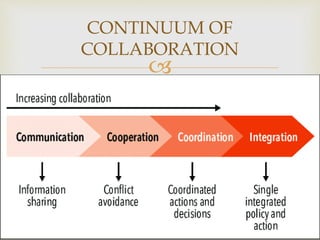
CONTINUUM OF
COLLABORATION

A stands for
 Asserts, attitudes and values that each potential partner brings.
 Accountability to each other
 Agreements to be mutual and documented
 Acknowledgement of each other contribution
 Achievements monitored
R stands for
 Reciprocal benefits
 Respect for each partners
 Responsibilities – well defined and agreed upon
T stands for
 Time and timing
 Tact and talent
 Trust
PRINCIPLES OF
COLLABORATION

 SHARED GOALS:
The nurse, clients and others involved in the collaborative effort
or partnership recognize specific reasons for entering into the
relationship.
 MUTUAL PARTNERSHIP:
Collaboration involves a reciprocal exchange in which team
players discuss their intended involvement and contribution.
 MAXIMIZED USE OF RESOURCES:
The use of community resources.
CHARACTERISTICS

 CLEAR RESPONSIBILITIES:
Each member is the partnership plays a specific role with
related tasks. Effective collaboration clearly designates what
each member will do to accomplish the identified goals.
 SET BOUNDARIES:
It is determining the condition under which it occurs and when
it will be terminated.
Contd…

 BEGINNING PHASE:
When the team relationship is just being established.
 MIDDLE PHASE:
When relationship works
 TERMINATION PHASE:
When the relationship ends.
PHASES

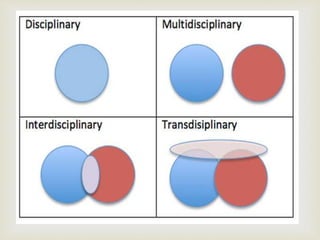
 Interdisciplinary: the combining of two or more disciplines,
professions, departments in regard to practice, research,
education, and/or theory.
 Multidisciplinary:the multidisciplinary team
 Transdisciplinary: multiple disciplines sharing together their
knowledge and skills across traditional disciplinary boundaries
in accomplishing tasks or goals
 Inter professional collaboration: “interactions of two or more
disciplines involving professionals who work together, with
intention, mutual respect, and commitments for the sake of a
more adequate response to a human problem”
TYPES OF
COLLABORATION

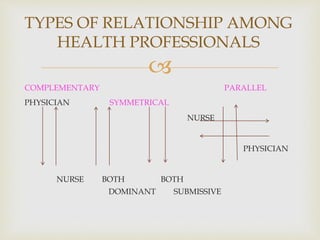
COMPLEMENTARY PARALLEL
PHYSICIAN SYMMETRICAL
NURSE
PHYSICIAN
NURSE BOTH BOTH
DOMINANT SUBMISSIVE
TYPES OF RELATIONSHIP AMONG
HEALTH PROFESSIONALS

 With nurse colleagues
 With other healthcare professionals
 With professional nursing organizations
 With legislations
NURSE AS A
COLLABORATOR

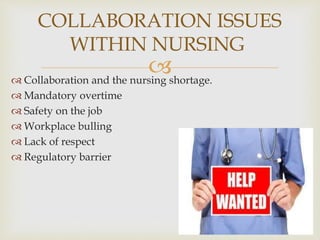
 Collaboration and the nursing shortage.
 Mandatory overtime
 Safety on the job
 Workplace bulling
 Lack of respect
 Regulatory barrier
COLLABORATION ISSUES
WITHIN NURSING

 Disciplinary differences
 Meeting patients expectations
 Lack of respect
 Problems with nursing informatics
 Organizational barriers
COLLABORATION ISSUES
OUTSIDE NURSING

 In 1995
 Encompasses the highest level of academic and clinical
nursing research and education.
 This was the concept of visionary nurses from both La Trobe
and The Alfred Clinical School of Nursing University.
 The development of the Clinical School offers benefits to both
hospital and university.
Clinical school of nursing
model

 In 1999
 In this model a partnership of nurse executives, staff nurses
and faculty transformed patient care units into environments of
support for nursing students and staff nurses
 Staff nurses assumed the role of nursing instructors. Results
showed high student and nurse satisfaction and a marked
increase in clinical capacity that allowed for increased
enrollment
Dedicated Education Unit
Clinical Teaching Model

 In 2001
 It is an innovative collaborative partnership agreement
between Fremantle Hospital and Health Service and Curtin
University of Technology in Perth, Western Australia.
 This model encouraged a close working relationship between
registered nurses and academics, and has also facilitated strong
links at the health service with the Nursing Research and
Evaluation Unit, medical staff and other allied health
professionals.
Practice-Research Model
(PRM)

 In 2003
 Epworth Hospital and Deakin University ran a collaborative
project (2003) funded by the National Safety and Quality
Council to improve the support base for new graduates while
managing the quality of patient care delivery.
 The Collaborative Clinical Education Epworth Deakin
(CCEED) model developed to facilitate clinical learning,
promote clinical scholarship and build nurse workforce
capability.
Collaborative Clinical Education
Epworth Deakin (CCEED) model

 In this model students practice and learn on a nursing unit,
each following an individual set rotation and choosing their
learning assignment( and therefore the Registered Nurse with
whom they partner), according to their learning plans.
COLLABORATION LEARNING
UNIT(BRITISH COLUMBIA)

 In 2006
 The PRIMARY goal was to design an educationally dense,
practice based experience to socialize second-degree students
to the role of professional nurse.
 A SECONDARY goal was to enhance and support the
professional and career development of unit-based nurses.
The Collaborative Approach to
Nursing Care (CAN- Care) Model

 In 2008
 The Bridge to Practice model is distinctly different from other
clinical models. First, students complete all of their clinical
experiences in one participating hospital.
 Second, one full-time teaching faculty serves as a liaison for
each bridge hospital and serve as a resource for not only the
clinical associates but also for the hospital nursing staff.
 Third, students are actively involved in selecting their clinical
placements
The Bridge to Practice Model

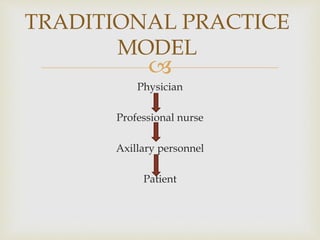
Physician
Professional nurse
Axillary personnel
Patient
TRADITIONAL PRACTICE
MODEL

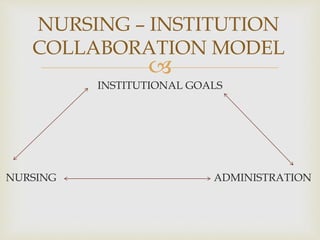
INSTITUTIONAL GOALS
NURSING ADMINISTRATION
NURSING – INSTITUTION
COLLABORATION MODEL

.
NURSE – COMMUNITY
COLLABORATION
CONSUMER
NURSE
SCHOOL
SYSTEM

.
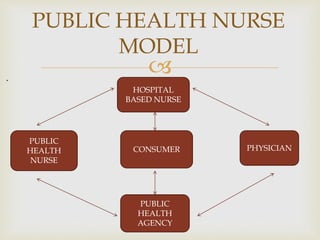
PUBLIC HEALTH NURSE
MODEL
HOSPITAL
BASED NURSE
CONSUMER
PUBLIC
HEALTH
AGENCY
PUBLIC
HEALTH
NURSE
PHYSICIAN

Application of these models can reduce the perceived gap
between education and service in nursing thereby can help in
the development of competent and efficient nurses for the
betterment of nursing profession.
CONCLUSION
COLLABORATIVE ISSUES AND MODELS IN NURSING

COLLABORATIVE ISSUES AND MODELS IN NURSING

  • 1.
    R. RUPPA MERCY M.ScNURSING 1ST YEAR
  • 3.
      Derived froma latin word collaborare, ‘to work together’  It encompasses a variety of actions such as shared planning, decision making, responsibility, accountability, communication, trust, mutual understanding, respect, coordination, cooperation, problem solving and negotiation. INTRODUCTION
  • 4.
     Collaborative care ‘aspartnership relationship between doctors, nurses and other health care providers with patients and their families’ -VIRGINIA HENDERSON Collaboration is ‘Nurses and physicians cooperatively working together, sharing responsibility for solving problems and making decisions to formulate and carry out plans for patient care’ -BAGGS AND SCHMITT,1988 DEFINITION
  • 5.
      Decreasing gapbetween nursing education and nursing services.  Graduate nurses often lack practical skills  A partnership between nursing educators and hospital nursing personnel is essential to meet this challenge. NEED FOR COLLABORATION
  • 6.
      To seekcreative, integrated solution where need and goal of both the sides are important commitment and consensual decision.  To learn to grow through co – operative problem solving resulting in greater understanding and empathy.  To identify, share and merge vastly different views.  To be honest about work through difficult emotional issue interfering with morale, productivity and growth. OBJECTIVES
  • 7.
  • 8.
     A stands for Asserts, attitudes and values that each potential partner brings.  Accountability to each other  Agreements to be mutual and documented  Acknowledgement of each other contribution  Achievements monitored R stands for  Reciprocal benefits  Respect for each partners  Responsibilities – well defined and agreed upon T stands for  Time and timing  Tact and talent  Trust PRINCIPLES OF COLLABORATION
  • 9.
      SHARED GOALS: Thenurse, clients and others involved in the collaborative effort or partnership recognize specific reasons for entering into the relationship.  MUTUAL PARTNERSHIP: Collaboration involves a reciprocal exchange in which team players discuss their intended involvement and contribution.  MAXIMIZED USE OF RESOURCES: The use of community resources. CHARACTERISTICS
  • 10.
      CLEAR RESPONSIBILITIES: Eachmember is the partnership plays a specific role with related tasks. Effective collaboration clearly designates what each member will do to accomplish the identified goals.  SET BOUNDARIES: It is determining the condition under which it occurs and when it will be terminated. Contd…
  • 11.
      BEGINNING PHASE: Whenthe team relationship is just being established.  MIDDLE PHASE: When relationship works  TERMINATION PHASE: When the relationship ends. PHASES
  • 12.
      Interdisciplinary: thecombining of two or more disciplines, professions, departments in regard to practice, research, education, and/or theory.  Multidisciplinary:the multidisciplinary team  Transdisciplinary: multiple disciplines sharing together their knowledge and skills across traditional disciplinary boundaries in accomplishing tasks or goals  Inter professional collaboration: “interactions of two or more disciplines involving professionals who work together, with intention, mutual respect, and commitments for the sake of a more adequate response to a human problem” TYPES OF COLLABORATION
  • 14.
     COMPLEMENTARY PARALLEL PHYSICIAN SYMMETRICAL NURSE PHYSICIAN NURSEBOTH BOTH DOMINANT SUBMISSIVE TYPES OF RELATIONSHIP AMONG HEALTH PROFESSIONALS
  • 15.
      With nursecolleagues  With other healthcare professionals  With professional nursing organizations  With legislations NURSE AS A COLLABORATOR
  • 16.
      Collaboration andthe nursing shortage.  Mandatory overtime  Safety on the job  Workplace bulling  Lack of respect  Regulatory barrier COLLABORATION ISSUES WITHIN NURSING
  • 17.
      Disciplinary differences Meeting patients expectations  Lack of respect  Problems with nursing informatics  Organizational barriers COLLABORATION ISSUES OUTSIDE NURSING
  • 19.
      In 1995 Encompasses the highest level of academic and clinical nursing research and education.  This was the concept of visionary nurses from both La Trobe and The Alfred Clinical School of Nursing University.  The development of the Clinical School offers benefits to both hospital and university. Clinical school of nursing model
  • 21.
      In 1999 In this model a partnership of nurse executives, staff nurses and faculty transformed patient care units into environments of support for nursing students and staff nurses  Staff nurses assumed the role of nursing instructors. Results showed high student and nurse satisfaction and a marked increase in clinical capacity that allowed for increased enrollment Dedicated Education Unit Clinical Teaching Model
  • 22.
      In 2001 It is an innovative collaborative partnership agreement between Fremantle Hospital and Health Service and Curtin University of Technology in Perth, Western Australia.  This model encouraged a close working relationship between registered nurses and academics, and has also facilitated strong links at the health service with the Nursing Research and Evaluation Unit, medical staff and other allied health professionals. Practice-Research Model (PRM)
  • 23.
      In 2003 Epworth Hospital and Deakin University ran a collaborative project (2003) funded by the National Safety and Quality Council to improve the support base for new graduates while managing the quality of patient care delivery.  The Collaborative Clinical Education Epworth Deakin (CCEED) model developed to facilitate clinical learning, promote clinical scholarship and build nurse workforce capability. Collaborative Clinical Education Epworth Deakin (CCEED) model
  • 24.
      In thismodel students practice and learn on a nursing unit, each following an individual set rotation and choosing their learning assignment( and therefore the Registered Nurse with whom they partner), according to their learning plans. COLLABORATION LEARNING UNIT(BRITISH COLUMBIA)
  • 25.
      In 2006 The PRIMARY goal was to design an educationally dense, practice based experience to socialize second-degree students to the role of professional nurse.  A SECONDARY goal was to enhance and support the professional and career development of unit-based nurses. The Collaborative Approach to Nursing Care (CAN- Care) Model
  • 26.
      In 2008 The Bridge to Practice model is distinctly different from other clinical models. First, students complete all of their clinical experiences in one participating hospital.  Second, one full-time teaching faculty serves as a liaison for each bridge hospital and serve as a resource for not only the clinical associates but also for the hospital nursing staff.  Third, students are actively involved in selecting their clinical placements The Bridge to Practice Model
  • 27.
  • 28.
     INSTITUTIONAL GOALS NURSING ADMINISTRATION NURSING– INSTITUTION COLLABORATION MODEL
  • 29.
  • 30.
     . PUBLIC HEALTH NURSE MODEL HOSPITAL BASEDNURSE CONSUMER PUBLIC HEALTH AGENCY PUBLIC HEALTH NURSE PHYSICIAN
  • 31.
     Application of thesemodels can reduce the perceived gap between education and service in nursing thereby can help in the development of competent and efficient nurses for the betterment of nursing profession. CONCLUSION