NURSING
PRACTICE
www.drjayeshpatidar.blogspot.com
 DEFINITION
Nursing practice is
defined as ―Nursing as the diagnosis &
treatment of human responses to actual &
potential health problems.‖ A.N.A.
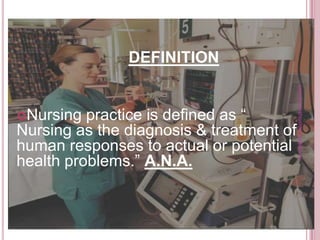
Nursing practice is defined as ―
Nursing as the diagnosis & treatment of
human responses to actual or potential
health problems.‖ A.N.A.
DEFINITION
www.drjayeshpatidar.blogspot.in
Advanced nursing practice is an
umbrella term describing an
advanced level of clinical nursing
practice that maximizes the use of
graduate educational preparation
,in depth nursing knowledge
&expertise in meeting the health
needs of
individuals, families, groups, comm
unities & populations. C.N.A.
DEFINITION
Advanced nursing practice is an
umbrella term describing an advanced
level of clinical nursing practice that
maximizes the use of graduate
educational preparation ,in depth
nursing knowledge &expertise in
meeting the health needs of
individuals, families, groups, communiti
es & populations. C.N.A.
DEFINITION
www.drjayeshpatidar.blogspot.in
DEFINITION
It involves:
 Analyzing synthesizing knowledge.
 Understanding, interpreting &
applying nursing theory &
research.
 Developing & advancing nursing
knowledge & the profession as a
whole.
www.drjayeshpatidar.blogspot.in
CHARACTERISTICS
In advanced nsg. Practice nurses
build on their expertise in a specialty
area, integrating & consistently
displaying the following features &
characteristics. 1]
Provision of effective & efficient care
delivered with high degree of
autonomy to an identified population.
2] Demonstration of leadership &
initiation of change to improve client
organization & system outcomes.
www.drjayeshpatidar.blogspot.in
CHARACTERISTICS
3] Deliberate, purposeful & integrated
use of in depth nursing knowledge .
4] Depth &breadth of knowledge that
draws on a wide range of strategies to
meet the needs of clients & to improve
quality of care.
5] Ability to explain & apply the
theoretical, empirical, ethical &
experimental foundations of nursing.
www.drjayeshpatidar.blogspot.in
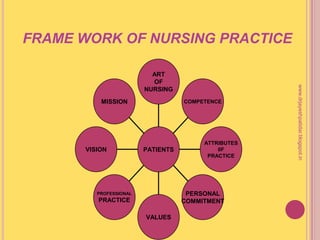
FRAME WORK OF NURSING PRACTICE
MISSION
VISION
PROFESSIONAL
PRACTICE
VALUES
PERSONAL
COMMITMENT
ATTRIBUTES
0F
PRACTICE
COMPETENCE
ART
OF
NURSING
PATIENTS
www.drjayeshpatidar.blogspot.in
THE ART OF NURSING
Nurses demonstrate
ethical, insightful, caring practice by
focusing on the health & wellbeing of
individuals, families,& communities in
health &during episode of illness.
Professional nursing practice is
grounded in the art of
nursing, described as taking a
holistic, client centered, being caring &
ethical in interactions.
www.drjayeshpatidar.blogspot.in
COMPETENCE
 Nurses competence is grounded
upon nursing theory, scientific
knowledge & experience.
It is reflected in every day practice.
Professional practice demands
competence is relation to knowledge &
technical skills.
www.drjayeshpatidar.blogspot.in
ATTRIBUTES OF PRACTICE
Autonomous professional practice in
nsg. Requires taking personal
responsibility for excellence in practice
& effective collaboration with
multidisciplinary team members in
meeting the health needs of the
population.
Professional practice reflects a
particular approach to one’s work with
collaboration by far the most salient
characteristic.
www.drjayeshpatidar.blogspot.in
PERSONAL COMMITMENT
 Nurses demonstrate commitment to the
profession by valuing nurses & nsg.
Contributing to the advancement of the
profession & continually striving for
excellence in patient care.
 This element of professional
practice, respondents referred to the
importance of having confidence in action&
sound understanding of the boundaries &
limitations of nsg. Practice.
www.drjayeshpatidar.blogspot.in
VALUES & PROFESSIONAL
PRACTICE
The frame work is congruent with the
values of the nurse as like
Honesty, integrity, dignity, trust, respec
t, responsiveness, creativity learning.
The framework reinforces the
prerequisites for the promotion of
safe, competent & ethical nursing
practice that are inherent in the
standards of practice & code of
conduct of the registered nurse.
www.drjayeshpatidar.blogspot.in
VISION & MISSION
 Vision for nursing is excellent health
care through professional nursing
practice.
 Nurses are committed to professional
nursing practice that promotes
quality, family centered care & efficient
&effective delivery of integrated
services provided in collaboration with
community partners &members of the
multidisciplinary health care team.
www.drjayeshpatidar.blogspot.in
SCOPE
Providing comprehensive nursing
assessment of the health status of the
client.
Collaborating with a health care team to
develop an integrated client centered
health care plan.
Developing plan of nsg. Strategies to
integrated client centered health care plan.
www.drjayeshpatidar.blogspot.in
SCOPE
Delegating & assigning nsg. Interventions
to implement the plan of care.
Providing for the maintenance of safe &
effective nsg. Care rendered directly or
indirectly. Promoting a safe & therapeutic
environment.
Providing health teaching &counseling to
promote attention &maintain optimum level
of health.
Advocate to client.
www.drjayeshpatidar.blogspot.in
SCOPE
Evaluating responses to interventions
& the effectiveness of the plan of care.
Communicating &collaborating with
other health care professionals.
Acquiring & applying critical new
knowledge & technologies of practice.
Teaching the theory &practice of nsg.
www.drjayeshpatidar.blogspot.in
SCOPE
Participating in the development of
policies.
Allowing for the advancement of
nursing &midwifery practice.
Allowing education providers to
incorporate the guiding principals to
expand the scope of practice.
Integrating the development of nsg.
Policy.
www.drjayeshpatidar.blogspot.in
SCOPE
In three tier health care delivery
system, health is concern of all.
It is not only for sick & disabled, but for
healthy beings as well.
People seek health care not only in
crisis, but for anticipated potential risks
also.
In primary health care concept, nurse
performs in expanded role-disease
protection, prevention, rehabilitation, c
ommunity health, referral services etc.
www.drjayeshpatidar.blogspot.in
FUTURE TRENDS IN NURSING
Expansion of employment
opportunities
Nursing’s public perception
Nursing’s impact on polities & health
policy.
Characteristic of population
www.drjayeshpatidar.blogspot.in
EXPANSION OF EMPLOYMENT
OPPORTUNITIES
Nursing practice trends includes a
growing variety of employment setting
in which nurses have greater
independence, autonomy & respect as
a member of health care team.
Nursing roles to continue to expand &
develop broadening the focus of nsg.
Care & providing a more holistic & all
encompassing domain.
www.drjayeshpatidar.blogspot.in
TRENDS
 Nursing therapies are not only
drawing from traditional nursing &
medicine ,spiritual & emotional
realms but also expanding in to
alternative therapies such as healing
touch, massage therapy & use of
natural herbs & vitamins.
www.drjayeshpatidar.blogspot.in
NURSING’S PUBLIC PERCEPTIONS
 Any member of society who has
been ill, hospitalized or visited an
emergency department has
experienced nursing care.
 Nursing is a pivotal health care
profession as front line health care
provider’s nurses practice in all health
care settings & constitute the largest
number of professionals.
www.drjayeshpatidar.blogspot.in
TRENDS
Nurses are essential to provide
skilled specialized, knowledgeable
care, to improve the health status
of the public & to ensure
safe, effective quality care.
www.drjayeshpatidar.blogspot.in
NURSING’S IMPACT ON POLITICS &
HEALTH POLICY
Nurses involvement in politics is receiving
greater emphasis in nursing
curricula, professional organizations &
health care settings.
Political activism & commitment are a part
of professionalism however & politics are
an important aspect of the delivery of
health care.
www.drjayeshpatidar.blogspot.in
TRENDS
The plan for reform focuses on primary
health care services & the promotion
,restoration & maintenance of health
www.drjayeshpatidar.blogspot.in
CHARACTERISTIC OF POPULATION
Patterns of nursing care should change in
positive way to meet the new trends & new
situations as they arise.
Birth rate, mortality &morbidity rate are in
descending trend while life span &
longevity show opposite trend. This is
demographic transition.
Geriatric problem is serious. Industrial &
occupational health problems are in front
step.
www.drjayeshpatidar.blogspot.in
CHARACTERISTIC OF POPULATION
Needs of population are also changing
its dimentions.This is epidemiological
transition.
So nursing practices are also searching
ways to take responsibilities of these
new &different health problems.
Much more wider role of nurses are in
pipeline with the changing outlook of
society.
www.drjayeshpatidar.blogspot.in
ALTERNATIVE MODALITIES OF CARE
Reflexology
Reiki
Rolfing
Alexander technique
Aroma therapy
Bioenergetics
Polarity therapy
Hydrotherapy
www.drjayeshpatidar.blogspot.in
ALTERNATIVE SYSTEMS OF HEALTH
CARE
AYURVEDA
SIDDHA
UNANI
HOMEOPATHY
NATUROPATHY&YOGA
ACCUPRESSURE
&ACCUPUNCTURE
TELE MEDICINE(MODERN
METHOD)
www.drjayeshpatidar.blogspot.in
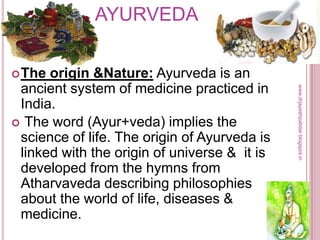
AYURVEDA
The origin &Nature: Ayurveda is an
ancient system of medicine practiced in
India.
 The word (Ayur+veda) implies the
science of life. The origin of Ayurveda is
linked with the origin of universe & it is
developed from the hymns from
Atharvaveda describing philosophies
about the world of life, diseases &
medicine.
www.drjayeshpatidar.blogspot.in
AYURVEDA
Around 1000BC,the comprehensive
documentation of the knowledge of Ayurveda
was done by Charak in charaka samihita &
by sushruta in sushruta samihita.Charaka
samhita is the treatise on medicine &
sushruta samhita is the treatise on surgery.
Theoretical basis:-The practice of Ayurveda is
based on the theory of punch mahabhutas.
Diagnosis & treatment:-Diagnosis in
Ayurveda system is done on the basis of
history taking & examination of
pulse, urine, faces, tongue, eyes etc.
www.drjayeshpatidar.blogspot.in
AYURVEDA
Treatment includes preventive &
curative measures.
Specialties:-Ayurveda developed eight
branches of specialties during charak
& sushruta period.
Education & research work
Practice & Drugs standards.
www.drjayeshpatidar.blogspot.in
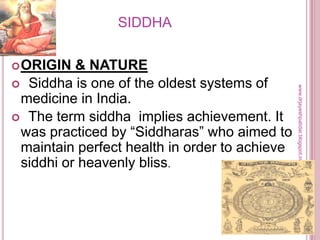
SIDDHA
ORIGIN & NATURE
 Siddha is one of the oldest systems of
medicine in India.
 The term siddha implies achievement. It
was practiced by ―Siddharas‖ who aimed to
maintain perfect health in order to achieve
siddhi or heavenly bliss.
www.drjayeshpatidar.blogspot.in
SIDDHA
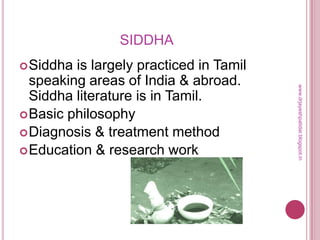
Siddha is largely practiced in Tamil
speaking areas of India & abroad.
Siddha literature is in Tamil.
Basic philosophy
Diagnosis & treatment method
Education & research work
www.drjayeshpatidar.blogspot.in
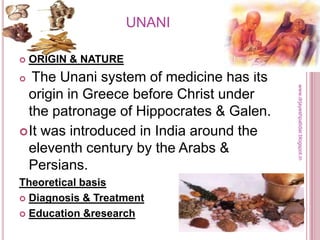
UNANI
 ORIGIN & NATURE
 The Unani system of medicine has its
origin in Greece before Christ under
the patronage of Hippocrates & Galen.
It was introduced in India around the
eleventh century by the Arabs &
Persians.
Theoretical basis
 Diagnosis & Treatment
 Education &research
www.drjayeshpatidar.blogspot.in
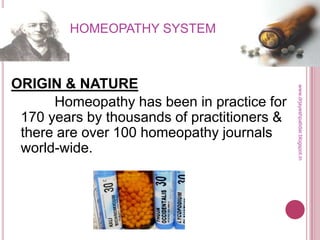
HOMEOPATHY SYSTEM
ORIGIN & NATURE
Homeopathy has been in practice for
170 years by thousands of practitioners &
there are over 100 homeopathy journals
world-wide.
www.drjayeshpatidar.blogspot.in
HOMEOPATHY SYSTEM
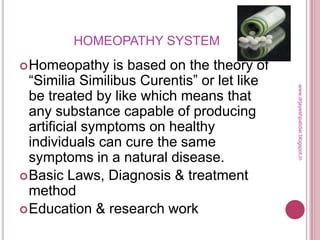
Homeopathy is based on the theory of
―Similia Similibus Curentis‖ or let like
be treated by like which means that
any substance capable of producing
artificial symptoms on healthy
individuals can cure the same
symptoms in a natural disease.
Basic Laws, Diagnosis & treatment
method
Education & research work
www.drjayeshpatidar.blogspot.in
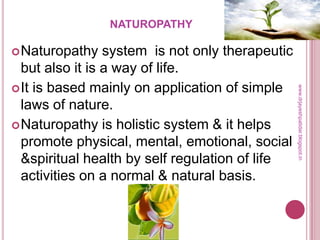
NATUROPATHY
Naturopathy system is not only therapeutic
but also it is a way of life.
It is based mainly on application of simple
laws of nature.
Naturopathy is holistic system & it helps
promote physical, mental, emotional, social
&spiritual health by self regulation of life
activities on a normal & natural basis.
www.drjayeshpatidar.blogspot.in
NATUROPATHY
The advocates of naturopathy pay
particular attention to regulation of
eating & living habits, adoption of
purificatory measures, use of
hydrotherapy, cold packs, mud packs,
baths, massage & a variety of
methods/measures based on various
innovations depending upon the
disease & its root causations.
Educational programmes
www.drjayeshpatidar.blogspot.in
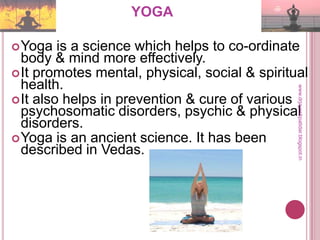
YOGA
Yoga is a science which helps to co-ordinate
body & mind more effectively.
It promotes mental, physical, social & spiritual
health.
It also helps in prevention & cure of various
psychosomatic disorders, psychic & physical
disorders.
Yoga is an ancient science. It has been
described in Vedas.
www.drjayeshpatidar.blogspot.in
YOGA
It consists of eight components.
these are
 Restraint in every sphere of life;
 Austerity in every sphere of life;
 Maintaining physical posture;
 Breathing exercises;
 Restraining of sense of organs;
 Contemplation;
 Mediation;
 Samadhi.
 These yogic practices have potential for
improvement of personal & social behavior.
www.drjayeshpatidar.blogspot.in
ACCUPRESSURE
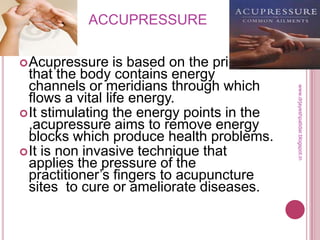
Acupressure is based on the principal
that the body contains energy
channels or meridians through which
flows a vital life energy.
It stimulating the energy points in the
,acupressure aims to remove energy
blocks which produce health problems.
It is non invasive technique that
applies the pressure of the
practitioner’s fingers to acupuncture
sites to cure or ameliorate diseases.
www.drjayeshpatidar.blogspot.in
ACCUPRESSURE
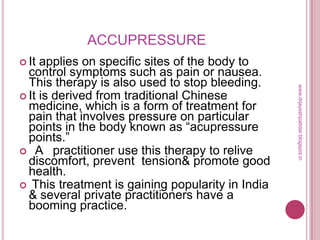
 It applies on specific sites of the body to
control symptoms such as pain or nausea.
This therapy is also used to stop bleeding.
 It is derived from traditional Chinese
medicine, which is a form of treatment for
pain that involves pressure on particular
points in the body known as ―acupressure
points.‖
 A practitioner use this therapy to relive
discomfort, prevent tension& promote good
health.
 This treatment is gaining popularity in India
& several private practitioners have a
booming practice.
www.drjayeshpatidar.blogspot.in
ACCUPUNCTURE
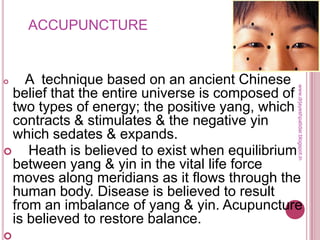
 A technique based on an ancient Chinese
belief that the entire universe is composed of
two types of energy; the positive yang, which
contracts & stimulates & the negative yin
which sedates & expands.
 Heath is believed to exist when equilibrium
between yang & yin in the vital life force
moves along meridians as it flows through the
human body. Disease is believed to result
from an imbalance of yang & yin. Acupuncture
is believed to restore balance.

www.drjayeshpatidar.blogspot.in
ACCUPUNCTURE
 Long, fine needles inserted through the skin
at specific acupuncture sites, along the
meridians ,to cure disease associated with
each site. In the past the needles were often
twisted now they may be stimulated with a
weak electrical current.
 It is used for the treatment of chronic pain
conditions such as
arthritis, bursitis, headache, athletic
injuries, post traumatic & post surgical
pain, immune function, dysfunction such as
psoriasis, allergies
&asthma, alcoholism, addition smoking &
eating disorders.
www.drjayeshpatidar.blogspot.in
TELE-MEDICINE
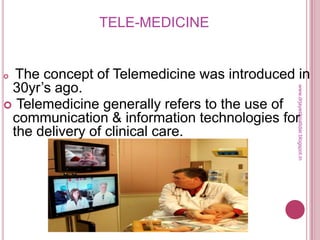
 The concept of Telemedicine was introduced in
30yr’s ago.
 Telemedicine generally refers to the use of
communication & information technologies for
the delivery of clinical care.
www.drjayeshpatidar.blogspot.in
TELE-MEDICINE
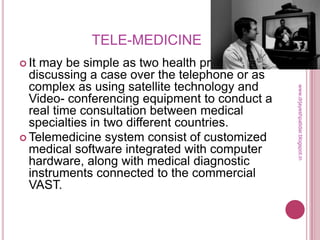
 It may be simple as two health professionals
discussing a case over the telephone or as
complex as using satellite technology and
Video- conferencing equipment to conduct a
real time consultation between medical
specialties in two different countries.
 Telemedicine system consist of customized
medical software integrated with computer
hardware, along with medical diagnostic
instruments connected to the commercial
VAST.
www.drjayeshpatidar.blogspot.in
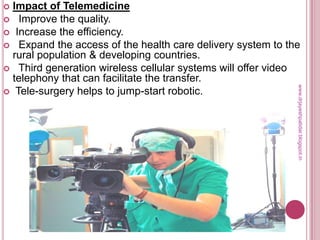
 Impact of Telemedicine
 Improve the quality.
 Increase the efficiency.
 Expand the access of the health care delivery system to the
rural population & developing countries.
 Third generation wireless cellular systems will offer video
telephony that can facilitate the transfer.
 Tele-surgery helps to jump-start robotic.
www.drjayeshpatidar.blogspot.in
COMPLIMENTARY THERAPIES
Herbalism
Osteopathy
Spiritual healing
Hypnotherapy
Music therapy
Dance therapy
Art therapy
Biofeedback
Relaxation therapy
www.drjayeshpatidar.blogspot.in
EXPANDED AND EXTENDED ROLE OF
NURSE
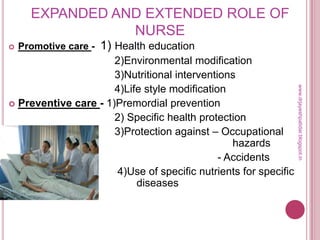
 Promotive care - 1) Health education
2)Environmental modification
3)Nutritional interventions
4)Life style modification
 Preventive care - 1)Premordial prevention
2) Specific health protection
3)Protection against – Occupational
hazards
- Accidents
4)Use of specific nutrients for specific
diseases
www.drjayeshpatidar.blogspot.in
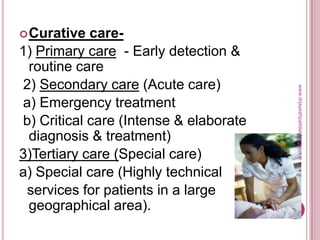
Curative care-
1) Primary care - Early detection &
routine care
2) Secondary care (Acute care)
a) Emergency treatment
b) Critical care (Intense & elaborate
diagnosis & treatment)
3)Tertiary care (Special care)
a) Special care (Highly technical
services for patients in a large
geographical area).
www.drjayeshpatidar.blogspot.in
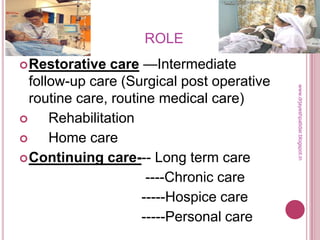
ROLE
Restorative care —Intermediate
follow-up care (Surgical post operative
routine care, routine medical care)
 Rehabilitation
 Home care
Continuing care--- Long term care
----Chronic care
-----Hospice care
-----Personal care
www.drjayeshpatidar.blogspot.in
BIBLIOGRAPHY
 Stanhope M, Lancaster J. community health
nursing. Fifth edition .Mosby;1996.
 Joan L Crfasfa, Barbara Parker. Conceptual
Foundations of professional nursing practice;
copy right 1991 by mosbe year book.
 Soreson, Luckmanns. Basic nursing. A psycho
physiologic approach 3rd edition, Verobynrac
bolande Page no.38-41.
 JB Lippincot. Textbook of Basic nursing.6th
edition. Caroline Bunkar Rosdahl.
 Kozier,Erbblais, Wilkinson. Fundamentals of
nursing.8th edition, Page no.284-94.
 Potter Perry. Fundamentals of nursing.6th
edition,Mosby2005.
www.drjayeshpatidar.blogspot.in
BIBLIOGRAPHY
 Kamlam,Community Health Nursing
Principles & Practices. Reprint 2004,page
no.689-700.
 Prospectus & syllabus of Educational
Programmes;Naturopathy,2008-2009.
 The Nursing Journal of India, Vol. XCIX
No:12, Dec 2008.
 www.google.com
www.drjayeshpatidar.blogspot.in
THE END
www.drjayeshpatidar.blogspot.in

Nursing practice

  • 1.
  • 2.
     DEFINITION Nursing practiceis defined as ―Nursing as the diagnosis & treatment of human responses to actual & potential health problems.‖ A.N.A. Nursing practice is defined as ― Nursing as the diagnosis & treatment of human responses to actual or potential health problems.‖ A.N.A. DEFINITION www.drjayeshpatidar.blogspot.in
  • 3.
    Advanced nursing practiceis an umbrella term describing an advanced level of clinical nursing practice that maximizes the use of graduate educational preparation ,in depth nursing knowledge &expertise in meeting the health needs of individuals, families, groups, comm unities & populations. C.N.A. DEFINITION Advanced nursing practice is an umbrella term describing an advanced level of clinical nursing practice that maximizes the use of graduate educational preparation ,in depth nursing knowledge &expertise in meeting the health needs of individuals, families, groups, communiti es & populations. C.N.A. DEFINITION www.drjayeshpatidar.blogspot.in
  • 4.
    DEFINITION It involves:  Analyzingsynthesizing knowledge.  Understanding, interpreting & applying nursing theory & research.  Developing & advancing nursing knowledge & the profession as a whole. www.drjayeshpatidar.blogspot.in
  • 5.
    CHARACTERISTICS In advanced nsg.Practice nurses build on their expertise in a specialty area, integrating & consistently displaying the following features & characteristics. 1] Provision of effective & efficient care delivered with high degree of autonomy to an identified population. 2] Demonstration of leadership & initiation of change to improve client organization & system outcomes. www.drjayeshpatidar.blogspot.in
  • 6.
    CHARACTERISTICS 3] Deliberate, purposeful& integrated use of in depth nursing knowledge . 4] Depth &breadth of knowledge that draws on a wide range of strategies to meet the needs of clients & to improve quality of care. 5] Ability to explain & apply the theoretical, empirical, ethical & experimental foundations of nursing. www.drjayeshpatidar.blogspot.in
  • 7.
    FRAME WORK OFNURSING PRACTICE MISSION VISION PROFESSIONAL PRACTICE VALUES PERSONAL COMMITMENT ATTRIBUTES 0F PRACTICE COMPETENCE ART OF NURSING PATIENTS www.drjayeshpatidar.blogspot.in
  • 8.
    THE ART OFNURSING Nurses demonstrate ethical, insightful, caring practice by focusing on the health & wellbeing of individuals, families,& communities in health &during episode of illness. Professional nursing practice is grounded in the art of nursing, described as taking a holistic, client centered, being caring & ethical in interactions. www.drjayeshpatidar.blogspot.in
  • 9.
    COMPETENCE  Nurses competenceis grounded upon nursing theory, scientific knowledge & experience. It is reflected in every day practice. Professional practice demands competence is relation to knowledge & technical skills. www.drjayeshpatidar.blogspot.in
  • 10.
    ATTRIBUTES OF PRACTICE Autonomousprofessional practice in nsg. Requires taking personal responsibility for excellence in practice & effective collaboration with multidisciplinary team members in meeting the health needs of the population. Professional practice reflects a particular approach to one’s work with collaboration by far the most salient characteristic. www.drjayeshpatidar.blogspot.in
  • 11.
    PERSONAL COMMITMENT  Nursesdemonstrate commitment to the profession by valuing nurses & nsg. Contributing to the advancement of the profession & continually striving for excellence in patient care.  This element of professional practice, respondents referred to the importance of having confidence in action& sound understanding of the boundaries & limitations of nsg. Practice. www.drjayeshpatidar.blogspot.in
  • 12.
    VALUES & PROFESSIONAL PRACTICE Theframe work is congruent with the values of the nurse as like Honesty, integrity, dignity, trust, respec t, responsiveness, creativity learning. The framework reinforces the prerequisites for the promotion of safe, competent & ethical nursing practice that are inherent in the standards of practice & code of conduct of the registered nurse. www.drjayeshpatidar.blogspot.in
  • 13.
    VISION & MISSION Vision for nursing is excellent health care through professional nursing practice.  Nurses are committed to professional nursing practice that promotes quality, family centered care & efficient &effective delivery of integrated services provided in collaboration with community partners &members of the multidisciplinary health care team. www.drjayeshpatidar.blogspot.in
  • 14.
    SCOPE Providing comprehensive nursing assessmentof the health status of the client. Collaborating with a health care team to develop an integrated client centered health care plan. Developing plan of nsg. Strategies to integrated client centered health care plan. www.drjayeshpatidar.blogspot.in
  • 15.
    SCOPE Delegating & assigningnsg. Interventions to implement the plan of care. Providing for the maintenance of safe & effective nsg. Care rendered directly or indirectly. Promoting a safe & therapeutic environment. Providing health teaching &counseling to promote attention &maintain optimum level of health. Advocate to client. www.drjayeshpatidar.blogspot.in
  • 16.
    SCOPE Evaluating responses tointerventions & the effectiveness of the plan of care. Communicating &collaborating with other health care professionals. Acquiring & applying critical new knowledge & technologies of practice. Teaching the theory &practice of nsg. www.drjayeshpatidar.blogspot.in
  • 17.
    SCOPE Participating in thedevelopment of policies. Allowing for the advancement of nursing &midwifery practice. Allowing education providers to incorporate the guiding principals to expand the scope of practice. Integrating the development of nsg. Policy. www.drjayeshpatidar.blogspot.in
  • 18.
    SCOPE In three tierhealth care delivery system, health is concern of all. It is not only for sick & disabled, but for healthy beings as well. People seek health care not only in crisis, but for anticipated potential risks also. In primary health care concept, nurse performs in expanded role-disease protection, prevention, rehabilitation, c ommunity health, referral services etc. www.drjayeshpatidar.blogspot.in
  • 19.
    FUTURE TRENDS INNURSING Expansion of employment opportunities Nursing’s public perception Nursing’s impact on polities & health policy. Characteristic of population www.drjayeshpatidar.blogspot.in
  • 20.
    EXPANSION OF EMPLOYMENT OPPORTUNITIES Nursingpractice trends includes a growing variety of employment setting in which nurses have greater independence, autonomy & respect as a member of health care team. Nursing roles to continue to expand & develop broadening the focus of nsg. Care & providing a more holistic & all encompassing domain. www.drjayeshpatidar.blogspot.in
  • 21.
    TRENDS  Nursing therapiesare not only drawing from traditional nursing & medicine ,spiritual & emotional realms but also expanding in to alternative therapies such as healing touch, massage therapy & use of natural herbs & vitamins. www.drjayeshpatidar.blogspot.in
  • 22.
    NURSING’S PUBLIC PERCEPTIONS Any member of society who has been ill, hospitalized or visited an emergency department has experienced nursing care.  Nursing is a pivotal health care profession as front line health care provider’s nurses practice in all health care settings & constitute the largest number of professionals. www.drjayeshpatidar.blogspot.in
  • 23.
    TRENDS Nurses are essentialto provide skilled specialized, knowledgeable care, to improve the health status of the public & to ensure safe, effective quality care. www.drjayeshpatidar.blogspot.in
  • 24.
    NURSING’S IMPACT ONPOLITICS & HEALTH POLICY Nurses involvement in politics is receiving greater emphasis in nursing curricula, professional organizations & health care settings. Political activism & commitment are a part of professionalism however & politics are an important aspect of the delivery of health care. www.drjayeshpatidar.blogspot.in
  • 25.
    TRENDS The plan forreform focuses on primary health care services & the promotion ,restoration & maintenance of health www.drjayeshpatidar.blogspot.in
  • 26.
    CHARACTERISTIC OF POPULATION Patternsof nursing care should change in positive way to meet the new trends & new situations as they arise. Birth rate, mortality &morbidity rate are in descending trend while life span & longevity show opposite trend. This is demographic transition. Geriatric problem is serious. Industrial & occupational health problems are in front step. www.drjayeshpatidar.blogspot.in
  • 27.
    CHARACTERISTIC OF POPULATION Needsof population are also changing its dimentions.This is epidemiological transition. So nursing practices are also searching ways to take responsibilities of these new &different health problems. Much more wider role of nurses are in pipeline with the changing outlook of society. www.drjayeshpatidar.blogspot.in
  • 28.
    ALTERNATIVE MODALITIES OFCARE Reflexology Reiki Rolfing Alexander technique Aroma therapy Bioenergetics Polarity therapy Hydrotherapy www.drjayeshpatidar.blogspot.in
  • 29.
    ALTERNATIVE SYSTEMS OFHEALTH CARE AYURVEDA SIDDHA UNANI HOMEOPATHY NATUROPATHY&YOGA ACCUPRESSURE &ACCUPUNCTURE TELE MEDICINE(MODERN METHOD) www.drjayeshpatidar.blogspot.in
  • 30.
    AYURVEDA The origin &Nature:Ayurveda is an ancient system of medicine practiced in India.  The word (Ayur+veda) implies the science of life. The origin of Ayurveda is linked with the origin of universe & it is developed from the hymns from Atharvaveda describing philosophies about the world of life, diseases & medicine. www.drjayeshpatidar.blogspot.in
  • 31.
    AYURVEDA Around 1000BC,the comprehensive documentationof the knowledge of Ayurveda was done by Charak in charaka samihita & by sushruta in sushruta samihita.Charaka samhita is the treatise on medicine & sushruta samhita is the treatise on surgery. Theoretical basis:-The practice of Ayurveda is based on the theory of punch mahabhutas. Diagnosis & treatment:-Diagnosis in Ayurveda system is done on the basis of history taking & examination of pulse, urine, faces, tongue, eyes etc. www.drjayeshpatidar.blogspot.in
  • 32.
    AYURVEDA Treatment includes preventive& curative measures. Specialties:-Ayurveda developed eight branches of specialties during charak & sushruta period. Education & research work Practice & Drugs standards. www.drjayeshpatidar.blogspot.in
  • 33.
    SIDDHA ORIGIN & NATURE Siddha is one of the oldest systems of medicine in India.  The term siddha implies achievement. It was practiced by ―Siddharas‖ who aimed to maintain perfect health in order to achieve siddhi or heavenly bliss. www.drjayeshpatidar.blogspot.in
  • 34.
    SIDDHA Siddha is largelypracticed in Tamil speaking areas of India & abroad. Siddha literature is in Tamil. Basic philosophy Diagnosis & treatment method Education & research work www.drjayeshpatidar.blogspot.in
  • 35.
    UNANI  ORIGIN &NATURE  The Unani system of medicine has its origin in Greece before Christ under the patronage of Hippocrates & Galen. It was introduced in India around the eleventh century by the Arabs & Persians. Theoretical basis  Diagnosis & Treatment  Education &research www.drjayeshpatidar.blogspot.in
  • 36.
    HOMEOPATHY SYSTEM ORIGIN &NATURE Homeopathy has been in practice for 170 years by thousands of practitioners & there are over 100 homeopathy journals world-wide. www.drjayeshpatidar.blogspot.in
  • 37.
    HOMEOPATHY SYSTEM Homeopathy isbased on the theory of ―Similia Similibus Curentis‖ or let like be treated by like which means that any substance capable of producing artificial symptoms on healthy individuals can cure the same symptoms in a natural disease. Basic Laws, Diagnosis & treatment method Education & research work www.drjayeshpatidar.blogspot.in
  • 38.
    NATUROPATHY Naturopathy system isnot only therapeutic but also it is a way of life. It is based mainly on application of simple laws of nature. Naturopathy is holistic system & it helps promote physical, mental, emotional, social &spiritual health by self regulation of life activities on a normal & natural basis. www.drjayeshpatidar.blogspot.in
  • 39.
    NATUROPATHY The advocates ofnaturopathy pay particular attention to regulation of eating & living habits, adoption of purificatory measures, use of hydrotherapy, cold packs, mud packs, baths, massage & a variety of methods/measures based on various innovations depending upon the disease & its root causations. Educational programmes www.drjayeshpatidar.blogspot.in
  • 40.
    YOGA Yoga is ascience which helps to co-ordinate body & mind more effectively. It promotes mental, physical, social & spiritual health. It also helps in prevention & cure of various psychosomatic disorders, psychic & physical disorders. Yoga is an ancient science. It has been described in Vedas. www.drjayeshpatidar.blogspot.in
  • 41.
    YOGA It consists ofeight components. these are  Restraint in every sphere of life;  Austerity in every sphere of life;  Maintaining physical posture;  Breathing exercises;  Restraining of sense of organs;  Contemplation;  Mediation;  Samadhi.  These yogic practices have potential for improvement of personal & social behavior. www.drjayeshpatidar.blogspot.in
  • 42.
    ACCUPRESSURE Acupressure is basedon the principal that the body contains energy channels or meridians through which flows a vital life energy. It stimulating the energy points in the ,acupressure aims to remove energy blocks which produce health problems. It is non invasive technique that applies the pressure of the practitioner’s fingers to acupuncture sites to cure or ameliorate diseases. www.drjayeshpatidar.blogspot.in
  • 43.
    ACCUPRESSURE  It applieson specific sites of the body to control symptoms such as pain or nausea. This therapy is also used to stop bleeding.  It is derived from traditional Chinese medicine, which is a form of treatment for pain that involves pressure on particular points in the body known as ―acupressure points.‖  A practitioner use this therapy to relive discomfort, prevent tension& promote good health.  This treatment is gaining popularity in India & several private practitioners have a booming practice. www.drjayeshpatidar.blogspot.in
  • 44.
    ACCUPUNCTURE  A techniquebased on an ancient Chinese belief that the entire universe is composed of two types of energy; the positive yang, which contracts & stimulates & the negative yin which sedates & expands.  Heath is believed to exist when equilibrium between yang & yin in the vital life force moves along meridians as it flows through the human body. Disease is believed to result from an imbalance of yang & yin. Acupuncture is believed to restore balance.  www.drjayeshpatidar.blogspot.in
  • 45.
    ACCUPUNCTURE  Long, fineneedles inserted through the skin at specific acupuncture sites, along the meridians ,to cure disease associated with each site. In the past the needles were often twisted now they may be stimulated with a weak electrical current.  It is used for the treatment of chronic pain conditions such as arthritis, bursitis, headache, athletic injuries, post traumatic & post surgical pain, immune function, dysfunction such as psoriasis, allergies &asthma, alcoholism, addition smoking & eating disorders. www.drjayeshpatidar.blogspot.in
  • 46.
    TELE-MEDICINE  The conceptof Telemedicine was introduced in 30yr’s ago.  Telemedicine generally refers to the use of communication & information technologies for the delivery of clinical care. www.drjayeshpatidar.blogspot.in
  • 47.
    TELE-MEDICINE  It maybe simple as two health professionals discussing a case over the telephone or as complex as using satellite technology and Video- conferencing equipment to conduct a real time consultation between medical specialties in two different countries.  Telemedicine system consist of customized medical software integrated with computer hardware, along with medical diagnostic instruments connected to the commercial VAST. www.drjayeshpatidar.blogspot.in
  • 48.
     Impact ofTelemedicine  Improve the quality.  Increase the efficiency.  Expand the access of the health care delivery system to the rural population & developing countries.  Third generation wireless cellular systems will offer video telephony that can facilitate the transfer.  Tele-surgery helps to jump-start robotic. www.drjayeshpatidar.blogspot.in
  • 49.
    COMPLIMENTARY THERAPIES Herbalism Osteopathy Spiritual healing Hypnotherapy Musictherapy Dance therapy Art therapy Biofeedback Relaxation therapy www.drjayeshpatidar.blogspot.in
  • 50.
    EXPANDED AND EXTENDEDROLE OF NURSE  Promotive care - 1) Health education 2)Environmental modification 3)Nutritional interventions 4)Life style modification  Preventive care - 1)Premordial prevention 2) Specific health protection 3)Protection against – Occupational hazards - Accidents 4)Use of specific nutrients for specific diseases www.drjayeshpatidar.blogspot.in
  • 51.
    Curative care- 1) Primarycare - Early detection & routine care 2) Secondary care (Acute care) a) Emergency treatment b) Critical care (Intense & elaborate diagnosis & treatment) 3)Tertiary care (Special care) a) Special care (Highly technical services for patients in a large geographical area). www.drjayeshpatidar.blogspot.in
  • 52.
    ROLE Restorative care —Intermediate follow-upcare (Surgical post operative routine care, routine medical care)  Rehabilitation  Home care Continuing care--- Long term care ----Chronic care -----Hospice care -----Personal care www.drjayeshpatidar.blogspot.in
  • 53.
  • 54.
  • 55.
    BIBLIOGRAPHY  Stanhope M,Lancaster J. community health nursing. Fifth edition .Mosby;1996.  Joan L Crfasfa, Barbara Parker. Conceptual Foundations of professional nursing practice; copy right 1991 by mosbe year book.  Soreson, Luckmanns. Basic nursing. A psycho physiologic approach 3rd edition, Verobynrac bolande Page no.38-41.  JB Lippincot. Textbook of Basic nursing.6th edition. Caroline Bunkar Rosdahl.  Kozier,Erbblais, Wilkinson. Fundamentals of nursing.8th edition, Page no.284-94.  Potter Perry. Fundamentals of nursing.6th edition,Mosby2005. www.drjayeshpatidar.blogspot.in
  • 56.
    BIBLIOGRAPHY  Kamlam,Community HealthNursing Principles & Practices. Reprint 2004,page no.689-700.  Prospectus & syllabus of Educational Programmes;Naturopathy,2008-2009.  The Nursing Journal of India, Vol. XCIX No:12, Dec 2008.  www.google.com www.drjayeshpatidar.blogspot.in
  • 57.