INTRODUCTION TO NABH &
NURSING EXCELLENCE
CERTIFICATION
MATHEW VARGHESE V
MSN(RAK),FHNP (CMC Vellore),CCEPC,CSTPN
Nursing officer
AIIMS Delhi
WHAT IS NABH?
 Full form of NABH is National Accreditation Board
for Hospitals & Healthcare Providers
 It is an accreditation body or certification body for
ensuring quality of health care services
 It is a constituent board of Quality Council of India,
set up to establish and operate accreditation
programme for healthcare organizations.
OVERVIEW OF NABH
 10 chapters
 100 standards
 683 objective elements
 Each accreditation standard is a statement of an
expectation or requirement which makes it possible
to deliver quality care.
 Objective element are sub components of
standards.
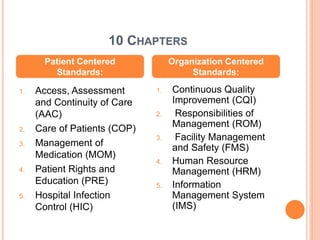
10 CHAPTERS
1. Access, Assessment
and Continuity of Care
(AAC)
2. Care of Patients (COP)
3. Management of
Medication (MOM)
4. Patient Rights and
Education (PRE)
5. Hospital Infection
Control (HIC)
1. Continuous Quality
Improvement (CQI)
2. Responsibilities of
Management (ROM)
3. Facility Management
and Safety (FMS)
4. Human Resource
Management (HRM)
5. Information
Management System
(IMS)
Patient Centered
Standards:
Organization Centered
Standards:
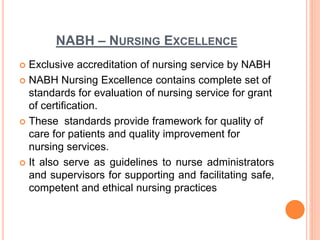
NABH – NURSING EXCELLENCE
 Exclusive accreditation of nursing service by NABH
 NABH Nursing Excellence contains complete set of
standards for evaluation of nursing service for grant
of certification.
 These standards provide framework for quality of
care for patients and quality improvement for
nursing services.
 It also serve as guidelines to nurse administrators
and supervisors for supporting and facilitating safe,
competent and ethical nursing practices
BENEFITS TO THE CLIENTS
 Good health outcomes.
 Client satisfaction.
 Value for money
 Less frustration.
 No Medical Errors
BENEFITS TO THE HEALTH INSTITUTION
 Patients become more satisfied with the services.
 More patients may use our services.
 The environment will become clean and beautiful.
 The facility will have a good reputation.
BENEFITS TO THE HEALTH INSTITUTION
 This certification programme stimulates continuous
improvement
 It enables Hospital in demonstrating commitment
to quality care.
 It raises community confidence in the services
provided by the hospital
 It also provides opportunity to healthcare unit to
benchmark with the best.
BENEFITS FOR NURSING STAFF
 An environment that recognizes and rewards
competence
 Professional growth and development by
educational opportunities and support
 A structure that encourages decision making at the
bedside over clinical issues
 High job satisfaction
 Low turnover and more stability
BENEFITS FOR NURSING STAFF
 Focus on professional autonomy
 Enhanced Interdisciplinary collaboration
 Professional growth opportunities
 Leadership opportunities
 Opportunity to practice professional nursing with strong
interdisciplinary teamwork that support autonomous
practice of nursing
 A culture that supports you to be the best nurse you can
be!
NABH -NURSING EXCELLENCE
07 chapters
48 standards
216 objective elements
OUTLINE OF NABH NURSING EXCELLENCE
CHAPTERS
1. Nursing Resource Management (NRM).
2. Nursing Care of Patient (NCP).
3. Management of Medication (MOM).
4. Education, Communication and Guidance
(ECG).
5. Infection Control Practices (ICP).
6. Empowerment and Governance (EG).
7. Nursing Quality Indicators (NQI).
CHAPTER 1
NURSING RESOURCE MANAGEMENT
(NRM)
 NRM.1: The organization has a documented system of
nursing resource planning
 NRM.2: The organization has structures and processes for
induction and for enhancing the transition of novices to
competent nursing professionals.
 NRM.3: The organization has processes in place for induction
training, In-service education and Continuous Nursing
Education (CNE) programmes and for documentation of the
same in the personal files.
 NRM.4: There is a process for credentialing and privileging of
nursing professionals, permitted to provide patient care
without supervision.
NURSING RESOURCE MANAGEMENT
(NRM)
 NRM.7: There is an established process in place to
identify and manage problems related to
incompetent, unsafe or unprofessional conduct.
 NRM.8: The organization demonstrates workplace
safety for nursing professionals (including change
rooms, washrooms & dining facilities).
 NRM.9: The organization has a documented and
established grievance handling system.
CHAPTER 2
NURSING CARE OF PATIENTS (NCP)
 NCP.1: A Nursing Manual shall be established and
reviewed periodically as defined by HCO
 NCP.2: The initial assessment shall be done by the
nursing professionals in predetermined format at
prescribed time and/or as per the needs of the patients.
 NCP.3: The reassessment shall be done by the nursing
professionals in a predetermined format at prescribed
time.
NURSING CARE OF PATIENTS (NCP)
 NCP.4: For provision of nursing care, appropriate
number of nursing professionals shall be
maintained as per workload.
 NCP.5: The nursing care planned and provided by
the nursing professionals is recorded.
 NCP.6: The nursing care is individualized to
address the needs of patient and family.
NURSING CARE OF PATIENTS (NCP)
 NCP.7: Information is exchanged and documented
during each staffing shift, between shifts, and during
transfers between units/departments.
 NCP.8: There shall be established policies and protocols
for vascular access devices. (VADs).
 NCP.9: The nursing care of inpatients shall be
supervised by senior nursing professionals.
 NCP.10: The nursing care of vulnerable patients (elderly,
children, physically and/or mentally challenged) shall be
supervised by senior nursing professionals.
NURSING CARE OF PATIENTS (NCP)
 NCP.11: The nursing care of patients under
restraints (physical and/or chemical) shall be
supervised by senior nursing professionals.
 NCP.12: Appropriate pain management practices
shall be supervised by senior nursing professionals.
 NCP.13: Appropriate end of life care shall be
provided to patients needing the same by the
nursing professionals.
CHAPTER 3
MANAGEMENT OF MEDICATION
(MOM)
 MOM.1: Indenting of required medication and
stores will be done and supervised by nursing staff
made responsible for this function. Storage of
medication in the wards and other therapeutic
areas shall be supervised by responsible nursing
professionals.
 MOM.2: The dispensing, administration and
accounting of medicines shall be carried out by the
concerned personnel and should be appropriately
supervised by senior nursing staff.
MANAGEMENT OF MEDICATION
(MOM)
 MOM.3: The monitoring of patients after medication
administration is supervised by responsible
personnel.
 MOM.4: The nursing professionals must report near
misses, medication errors and adverse drug events
as per the policy of the HCO for analysis by the
appropriate staff predefined and identified by the
HCO. Feedback is provided to staff which includes
the results of analysis and recommended
preventive measures for implementation by the
nursing staff wherever appropriate
MANAGEMENT OF MEDICATION
(MOM)
 MOM.5: The organization shall ensure that it has a
policy on verbal orders which will be applicable to
doctors, nursing professionals and technicians
uniformly.
CHAPTER 4
EDUCATION, COMMUNICATION AND GUIDANCE
(ECG)
 ECG.1: The organization shall ensure that nursing
professionals are trained in communication skills.
 ECG.2: Nursing professionals are aware of their
responsibility in protecting patient rights.
 ECG3: Nursing professionals communicate as and
when required with relevant team members to achieve
continuity of care.
 ECG.4: Patient and family are educated where essential
and in case of any change in nursing care plan.
CHAPTER 5
INFECTION CONTROL PRACTICES
(ICP)
 ICP.1: Infection control nurse (s) shall be
designated by the organization
 ICP.2: Nursing professionals shall adhere to
standard precautions and hand hygiene guidelines
at all times.
 ICP.3: The nursing professionals shall adhere to
handling, storage and disposal of bio medical waste
as per the bio medical waste management Act,
1998
INFECTION CONTROL PRACTICES
(ICP)
 ICP.4: The designated nursing staff shall perform
surveillance activities to capture and monitor
infection control and prevention data.
 ICP.5: Isolation (barrier and reverse barrier nursing)
practices shall be supervised by senior nursing
professionals.
 ICP.6: Infection Control Nurse maintains records of
all occupational injuries and pre- and post exposure
prophylaxis.
CHAPTER 6
EMPOWERMENT AND GOVERNANCE (EG)
 EG.1: The responsibilities of those responsible for
nursing management are defined.
 EG.2: The Head of the Nursing service ensures
that suitable mechanisms exist to govern the
nursing Service.
 EG.3: Nursing professionals are involved and
participate in decision making related to
organization and nursing services.
EMPOWERMENT AND GOVERNANCE
(EG)
 EG.4: The Management empowers nursing staff.
 EG.5: The organization has an established
process for proactive risk assessment and error
management.
 EG.6: The infection control programme is
supported by the management and includes
training of staff.
CHAPTER 7
NURSING QUALITY INDICATORS
(NQI)
 NQI.1: There is a structured quality improvement and continuous
monitoring program for nursing service.

 NQI.2: The organization identifies key indicators to monitor the
structures, processes and outcomes, which are used as tools for
continual improvement for nursing service.
 NQI.3: The nursing quality improvement programme is supported
by the management.
 NQI.4: There is an established system for nursing audit.
 NQI.5: Incidents, complaints and feedback from nursing
professionals are collected and analysed to ensure continual
quality improvement.
PREPARING FOR NURSING
EXCELLENCE CERTIFICATION
 Strong Commitment
 A definite plan of action – Strategy
 An official nomination of Nursing Excellence programme
Coordinator (Preferably from nursing)
 Procure a copy of Nursing Excellence standards
 Self-assessment against NABH standards at least 3
months before submission of application is must
Introduction to NABH - Nursing Excellence

Introduction to NABH - Nursing Excellence

  • 1.
    INTRODUCTION TO NABH& NURSING EXCELLENCE CERTIFICATION MATHEW VARGHESE V MSN(RAK),FHNP (CMC Vellore),CCEPC,CSTPN Nursing officer AIIMS Delhi
  • 2.
    WHAT IS NABH? Full form of NABH is National Accreditation Board for Hospitals & Healthcare Providers  It is an accreditation body or certification body for ensuring quality of health care services  It is a constituent board of Quality Council of India, set up to establish and operate accreditation programme for healthcare organizations.
  • 3.
    OVERVIEW OF NABH 10 chapters  100 standards  683 objective elements  Each accreditation standard is a statement of an expectation or requirement which makes it possible to deliver quality care.  Objective element are sub components of standards.
  • 4.
    10 CHAPTERS 1. Access,Assessment and Continuity of Care (AAC) 2. Care of Patients (COP) 3. Management of Medication (MOM) 4. Patient Rights and Education (PRE) 5. Hospital Infection Control (HIC) 1. Continuous Quality Improvement (CQI) 2. Responsibilities of Management (ROM) 3. Facility Management and Safety (FMS) 4. Human Resource Management (HRM) 5. Information Management System (IMS) Patient Centered Standards: Organization Centered Standards:
  • 5.
    NABH – NURSINGEXCELLENCE  Exclusive accreditation of nursing service by NABH  NABH Nursing Excellence contains complete set of standards for evaluation of nursing service for grant of certification.  These standards provide framework for quality of care for patients and quality improvement for nursing services.  It also serve as guidelines to nurse administrators and supervisors for supporting and facilitating safe, competent and ethical nursing practices
  • 6.
    BENEFITS TO THECLIENTS  Good health outcomes.  Client satisfaction.  Value for money  Less frustration.  No Medical Errors
  • 7.
    BENEFITS TO THEHEALTH INSTITUTION  Patients become more satisfied with the services.  More patients may use our services.  The environment will become clean and beautiful.  The facility will have a good reputation.
  • 8.
    BENEFITS TO THEHEALTH INSTITUTION  This certification programme stimulates continuous improvement  It enables Hospital in demonstrating commitment to quality care.  It raises community confidence in the services provided by the hospital  It also provides opportunity to healthcare unit to benchmark with the best.
  • 9.
    BENEFITS FOR NURSINGSTAFF  An environment that recognizes and rewards competence  Professional growth and development by educational opportunities and support  A structure that encourages decision making at the bedside over clinical issues  High job satisfaction  Low turnover and more stability
  • 10.
    BENEFITS FOR NURSINGSTAFF  Focus on professional autonomy  Enhanced Interdisciplinary collaboration  Professional growth opportunities  Leadership opportunities  Opportunity to practice professional nursing with strong interdisciplinary teamwork that support autonomous practice of nursing  A culture that supports you to be the best nurse you can be!
  • 11.
    NABH -NURSING EXCELLENCE 07chapters 48 standards 216 objective elements
  • 12.
    OUTLINE OF NABHNURSING EXCELLENCE CHAPTERS 1. Nursing Resource Management (NRM). 2. Nursing Care of Patient (NCP). 3. Management of Medication (MOM). 4. Education, Communication and Guidance (ECG). 5. Infection Control Practices (ICP). 6. Empowerment and Governance (EG). 7. Nursing Quality Indicators (NQI).
  • 13.
    CHAPTER 1 NURSING RESOURCEMANAGEMENT (NRM)  NRM.1: The organization has a documented system of nursing resource planning  NRM.2: The organization has structures and processes for induction and for enhancing the transition of novices to competent nursing professionals.  NRM.3: The organization has processes in place for induction training, In-service education and Continuous Nursing Education (CNE) programmes and for documentation of the same in the personal files.  NRM.4: There is a process for credentialing and privileging of nursing professionals, permitted to provide patient care without supervision.
  • 14.
    NURSING RESOURCE MANAGEMENT (NRM) NRM.7: There is an established process in place to identify and manage problems related to incompetent, unsafe or unprofessional conduct.  NRM.8: The organization demonstrates workplace safety for nursing professionals (including change rooms, washrooms & dining facilities).  NRM.9: The organization has a documented and established grievance handling system.
  • 15.
    CHAPTER 2 NURSING CAREOF PATIENTS (NCP)  NCP.1: A Nursing Manual shall be established and reviewed periodically as defined by HCO  NCP.2: The initial assessment shall be done by the nursing professionals in predetermined format at prescribed time and/or as per the needs of the patients.  NCP.3: The reassessment shall be done by the nursing professionals in a predetermined format at prescribed time.
  • 16.
    NURSING CARE OFPATIENTS (NCP)  NCP.4: For provision of nursing care, appropriate number of nursing professionals shall be maintained as per workload.  NCP.5: The nursing care planned and provided by the nursing professionals is recorded.  NCP.6: The nursing care is individualized to address the needs of patient and family.
  • 17.
    NURSING CARE OFPATIENTS (NCP)  NCP.7: Information is exchanged and documented during each staffing shift, between shifts, and during transfers between units/departments.  NCP.8: There shall be established policies and protocols for vascular access devices. (VADs).  NCP.9: The nursing care of inpatients shall be supervised by senior nursing professionals.  NCP.10: The nursing care of vulnerable patients (elderly, children, physically and/or mentally challenged) shall be supervised by senior nursing professionals.
  • 18.
    NURSING CARE OFPATIENTS (NCP)  NCP.11: The nursing care of patients under restraints (physical and/or chemical) shall be supervised by senior nursing professionals.  NCP.12: Appropriate pain management practices shall be supervised by senior nursing professionals.  NCP.13: Appropriate end of life care shall be provided to patients needing the same by the nursing professionals.
  • 19.
    CHAPTER 3 MANAGEMENT OFMEDICATION (MOM)  MOM.1: Indenting of required medication and stores will be done and supervised by nursing staff made responsible for this function. Storage of medication in the wards and other therapeutic areas shall be supervised by responsible nursing professionals.  MOM.2: The dispensing, administration and accounting of medicines shall be carried out by the concerned personnel and should be appropriately supervised by senior nursing staff.
  • 20.
    MANAGEMENT OF MEDICATION (MOM) MOM.3: The monitoring of patients after medication administration is supervised by responsible personnel.  MOM.4: The nursing professionals must report near misses, medication errors and adverse drug events as per the policy of the HCO for analysis by the appropriate staff predefined and identified by the HCO. Feedback is provided to staff which includes the results of analysis and recommended preventive measures for implementation by the nursing staff wherever appropriate
  • 21.
    MANAGEMENT OF MEDICATION (MOM) MOM.5: The organization shall ensure that it has a policy on verbal orders which will be applicable to doctors, nursing professionals and technicians uniformly.
  • 22.
    CHAPTER 4 EDUCATION, COMMUNICATIONAND GUIDANCE (ECG)  ECG.1: The organization shall ensure that nursing professionals are trained in communication skills.  ECG.2: Nursing professionals are aware of their responsibility in protecting patient rights.  ECG3: Nursing professionals communicate as and when required with relevant team members to achieve continuity of care.  ECG.4: Patient and family are educated where essential and in case of any change in nursing care plan.
  • 23.
    CHAPTER 5 INFECTION CONTROLPRACTICES (ICP)  ICP.1: Infection control nurse (s) shall be designated by the organization  ICP.2: Nursing professionals shall adhere to standard precautions and hand hygiene guidelines at all times.  ICP.3: The nursing professionals shall adhere to handling, storage and disposal of bio medical waste as per the bio medical waste management Act, 1998
  • 24.
    INFECTION CONTROL PRACTICES (ICP) ICP.4: The designated nursing staff shall perform surveillance activities to capture and monitor infection control and prevention data.  ICP.5: Isolation (barrier and reverse barrier nursing) practices shall be supervised by senior nursing professionals.  ICP.6: Infection Control Nurse maintains records of all occupational injuries and pre- and post exposure prophylaxis.
  • 25.
    CHAPTER 6 EMPOWERMENT ANDGOVERNANCE (EG)  EG.1: The responsibilities of those responsible for nursing management are defined.  EG.2: The Head of the Nursing service ensures that suitable mechanisms exist to govern the nursing Service.  EG.3: Nursing professionals are involved and participate in decision making related to organization and nursing services.
  • 26.
    EMPOWERMENT AND GOVERNANCE (EG) EG.4: The Management empowers nursing staff.  EG.5: The organization has an established process for proactive risk assessment and error management.  EG.6: The infection control programme is supported by the management and includes training of staff.
  • 27.
    CHAPTER 7 NURSING QUALITYINDICATORS (NQI)  NQI.1: There is a structured quality improvement and continuous monitoring program for nursing service.   NQI.2: The organization identifies key indicators to monitor the structures, processes and outcomes, which are used as tools for continual improvement for nursing service.  NQI.3: The nursing quality improvement programme is supported by the management.  NQI.4: There is an established system for nursing audit.  NQI.5: Incidents, complaints and feedback from nursing professionals are collected and analysed to ensure continual quality improvement.
  • 28.
    PREPARING FOR NURSING EXCELLENCECERTIFICATION  Strong Commitment  A definite plan of action – Strategy  An official nomination of Nursing Excellence programme Coordinator (Preferably from nursing)  Procure a copy of Nursing Excellence standards  Self-assessment against NABH standards at least 3 months before submission of application is must