COLLABORATION ISSUES
AND MODELS WITHIN
AND OUTSIDE NURSING
Sangeetha Antoe
M.Sc (N)
SANGEETHA ANTOE

2
INTRODUCTION
• Derived from a latin word collaborare, ‘to labor
together’
• To collaborate is to ‘work jointly with others or
together’
• In olden days nurses was seen as providing

assistance to the physician. The
term
Handmaiden is used to describe this role

SANGEETHA ANTOE

3
DEFINITIONS
• Colaborative care ‘as partnership relationship
between doctors, nurses and other health care
providers with patients and their families’
-Virginia Henderson
• Collaboration is ‘Nurses and physicians
cooperatively
working
together,
sharing
responsibility for solving problems and making
decisions to formulate and carry out plans for
patient care’
-Baggs and schmitt,1988
SANGEETHA ANTOE

4
OBJECTIVES
• Provide client-directed and client-centered care
using a multidisciplinary, integrated, participative
framework
• Enhance continuity across continum of care
• Improve client and family satisfaction with care
• Provide quality, cost effective, research based care
• Promote mutual respect, communication
• Develop interdependent

SANGEETHA ANTOE

5
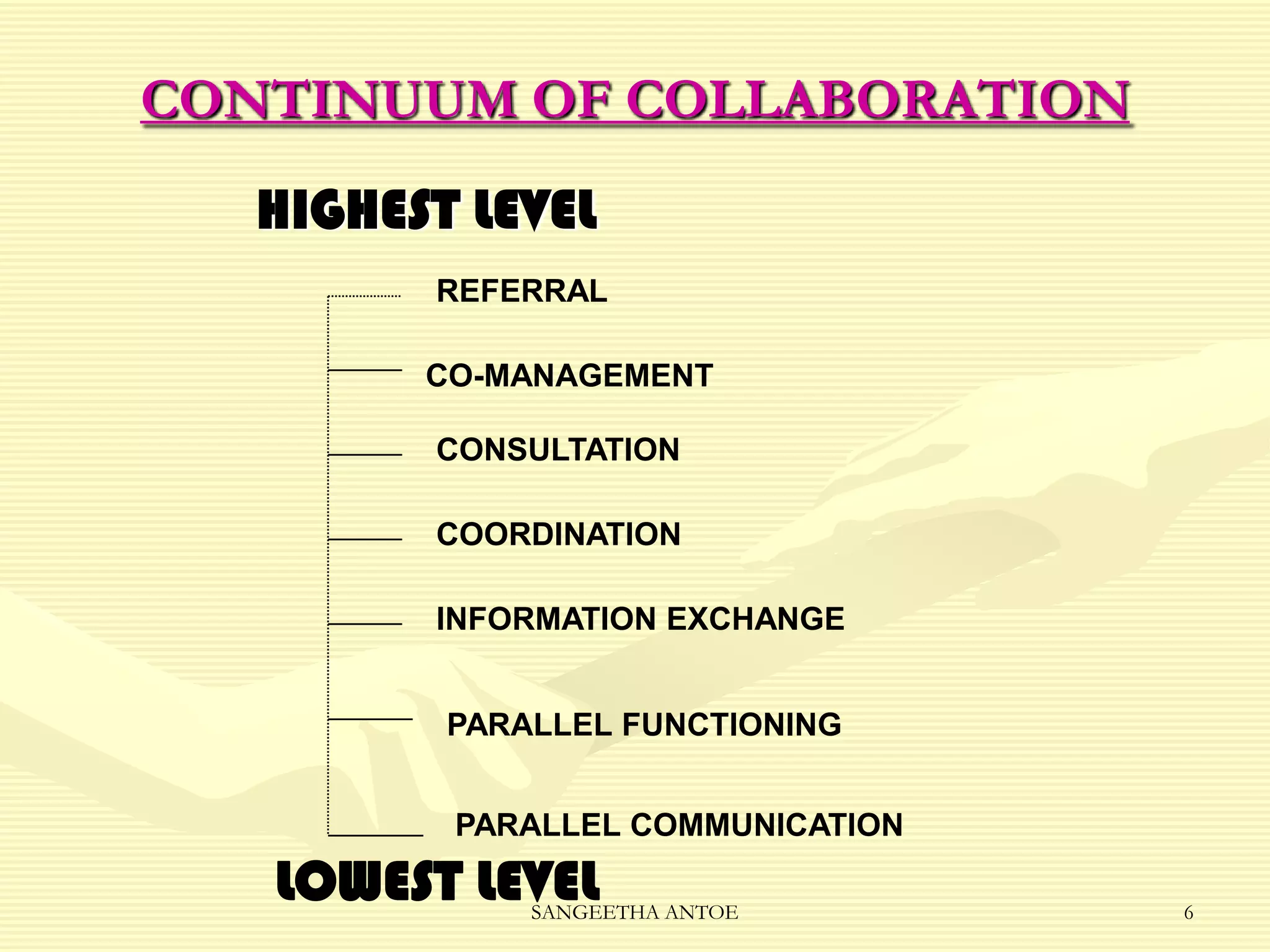
CONTINUUM OF COLLABORATION
HIGHEST LEVEL
REFERRAL
CO-MANAGEMENT
CONSULTATION

COORDINATION
INFORMATION EXCHANGE
PARALLEL FUNCTIONING
PARALLEL COMMUNICATION

LOWEST LEVEL

SANGEETHA ANTOE

6
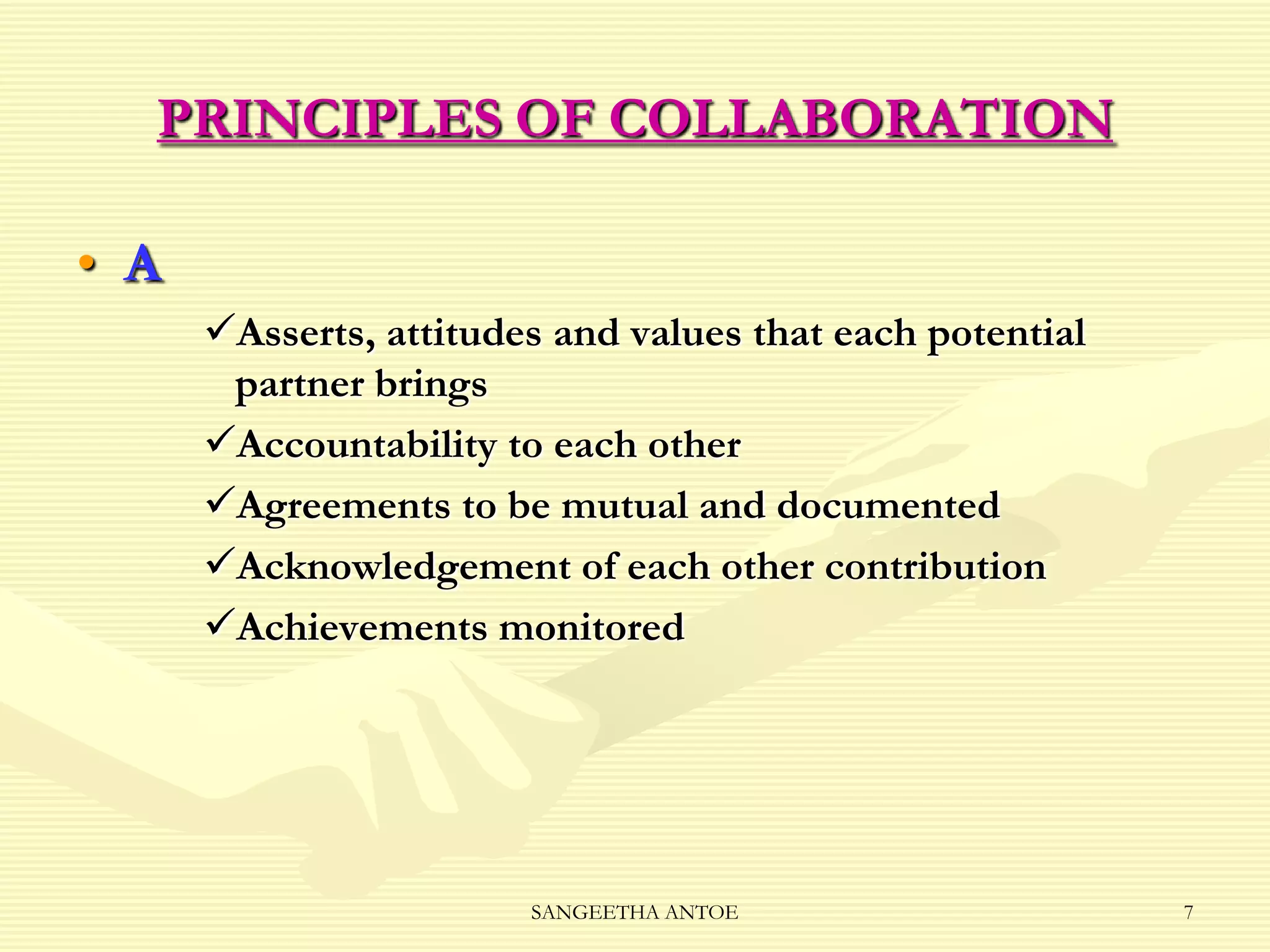
PRINCIPLES OF COLLABORATION
• A
Asserts, attitudes and values that each potential
partner brings
Accountability to each other
Agreements to be mutual and documented
Acknowledgement of each other contribution
Achievements monitored

SANGEETHA ANTOE

7
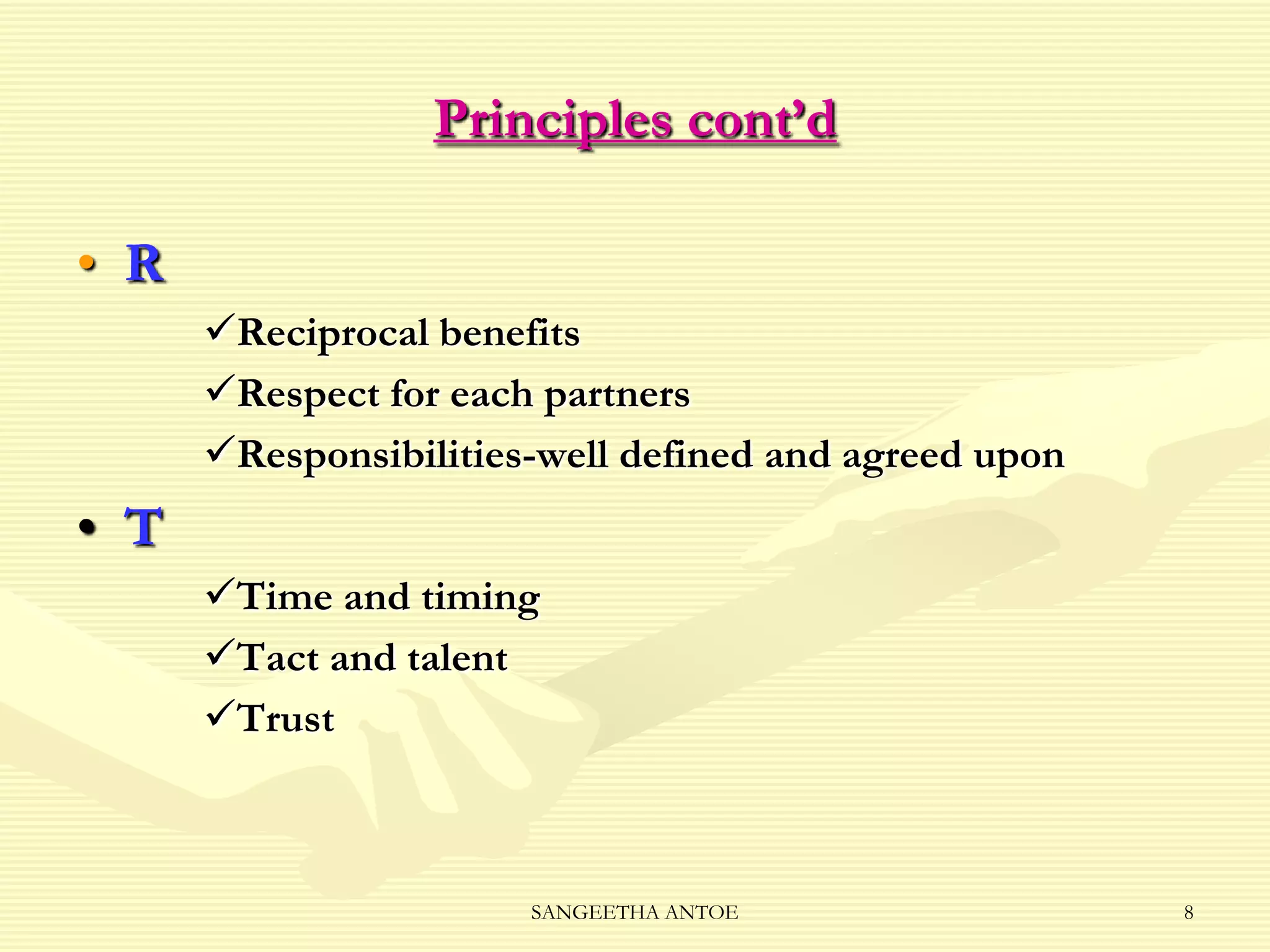
Principles cont’d
• R
Reciprocal benefits
Respect for each partners
Responsibilities-well defined and agreed upon

• T
Time and timing
Tact and talent
Trust

SANGEETHA ANTOE

8
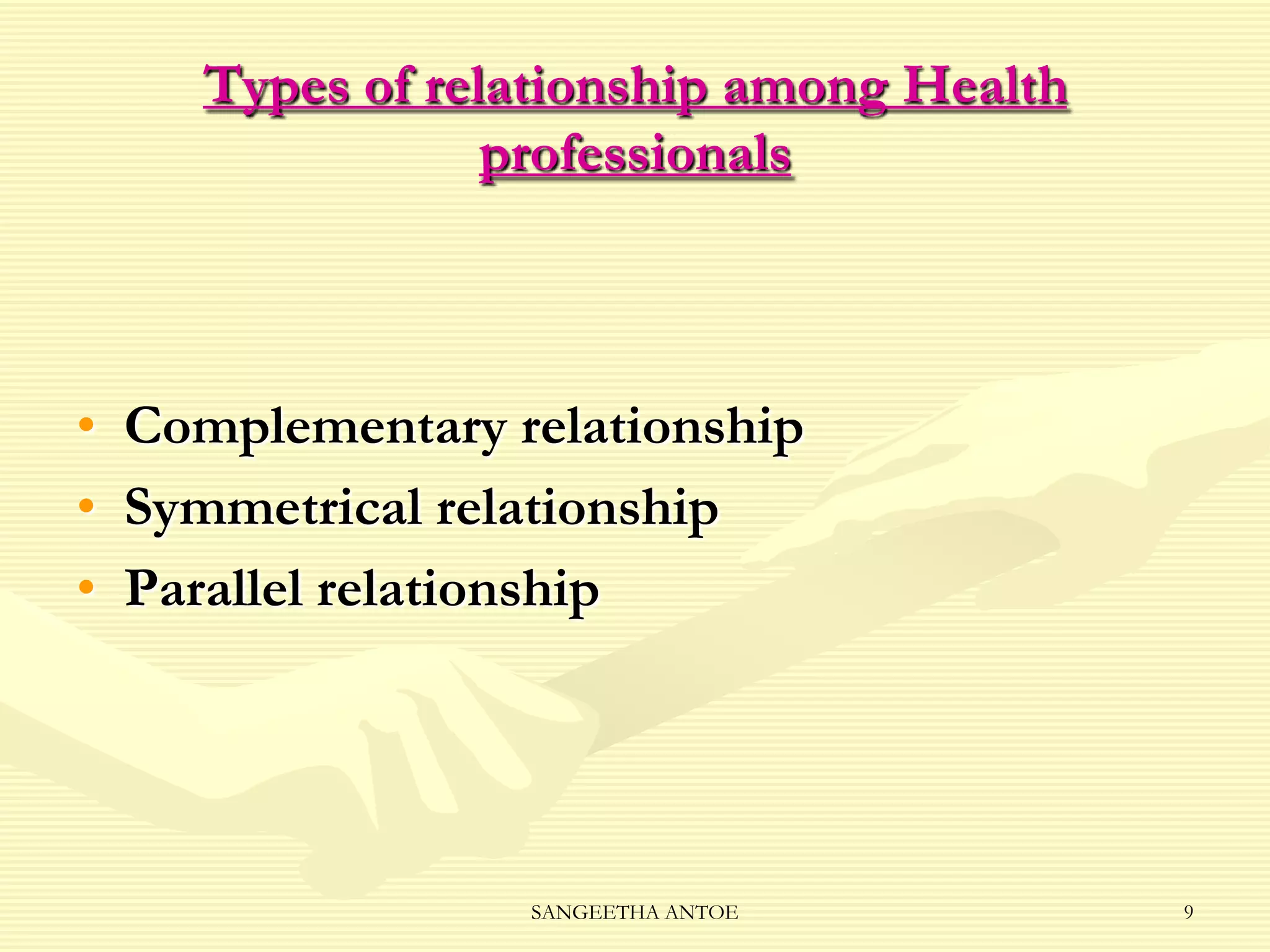
Types of relationship among Health
professionals

• Complementary relationship
• Symmetrical relationship
• Parallel relationship

SANGEETHA ANTOE

9
Complementary relationship
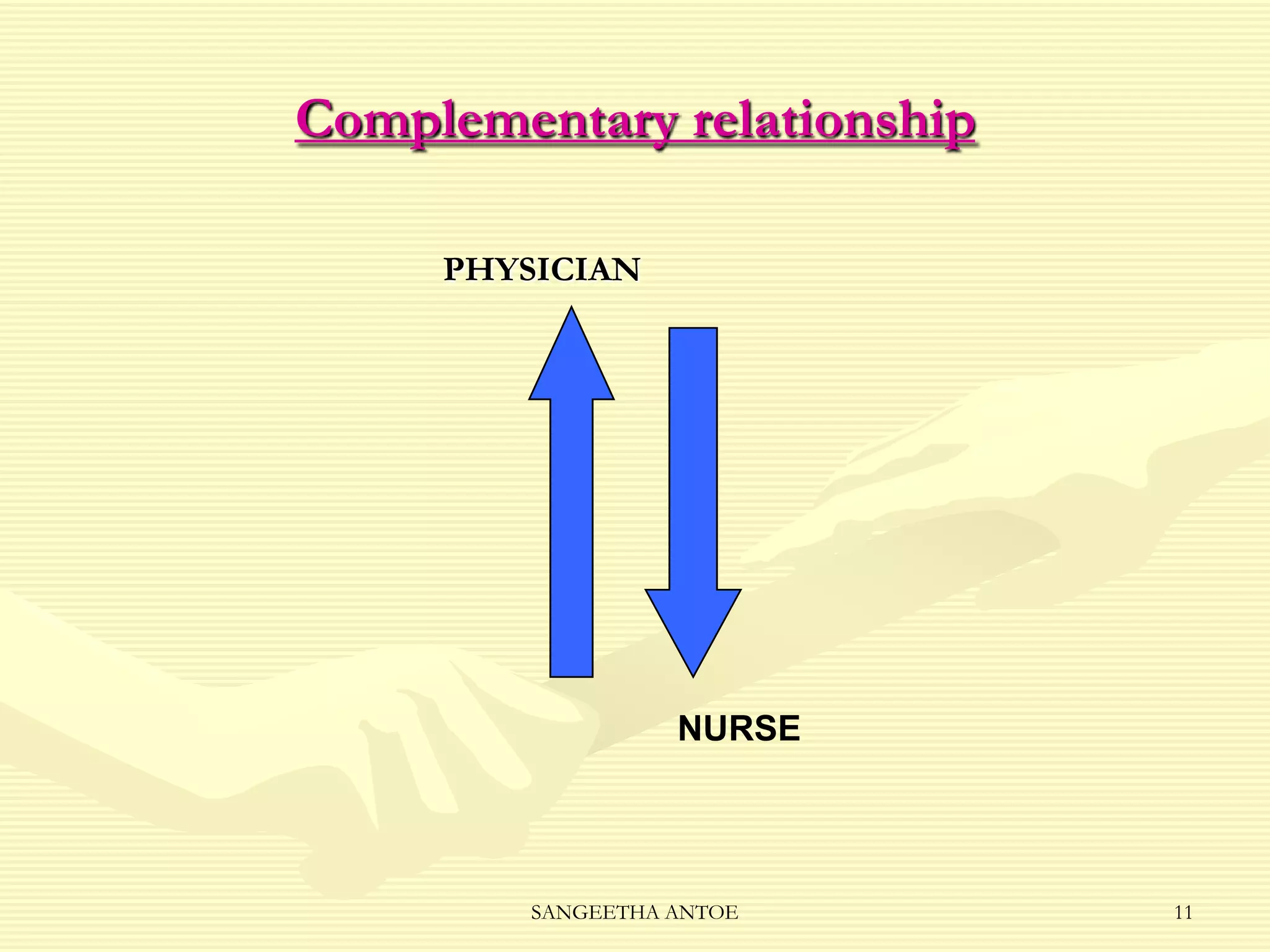
• One person is dominant and the other is
submissive
• Control is not divided equally between the two
participants
• Relationships are stable and predictable also
inhibit creativity and independent thinking

SANGEETHA ANTOE

10
Complementary relationship
PHYSICIAN

NURSE

SANGEETHA ANTOE

11
Symmetrical relationship
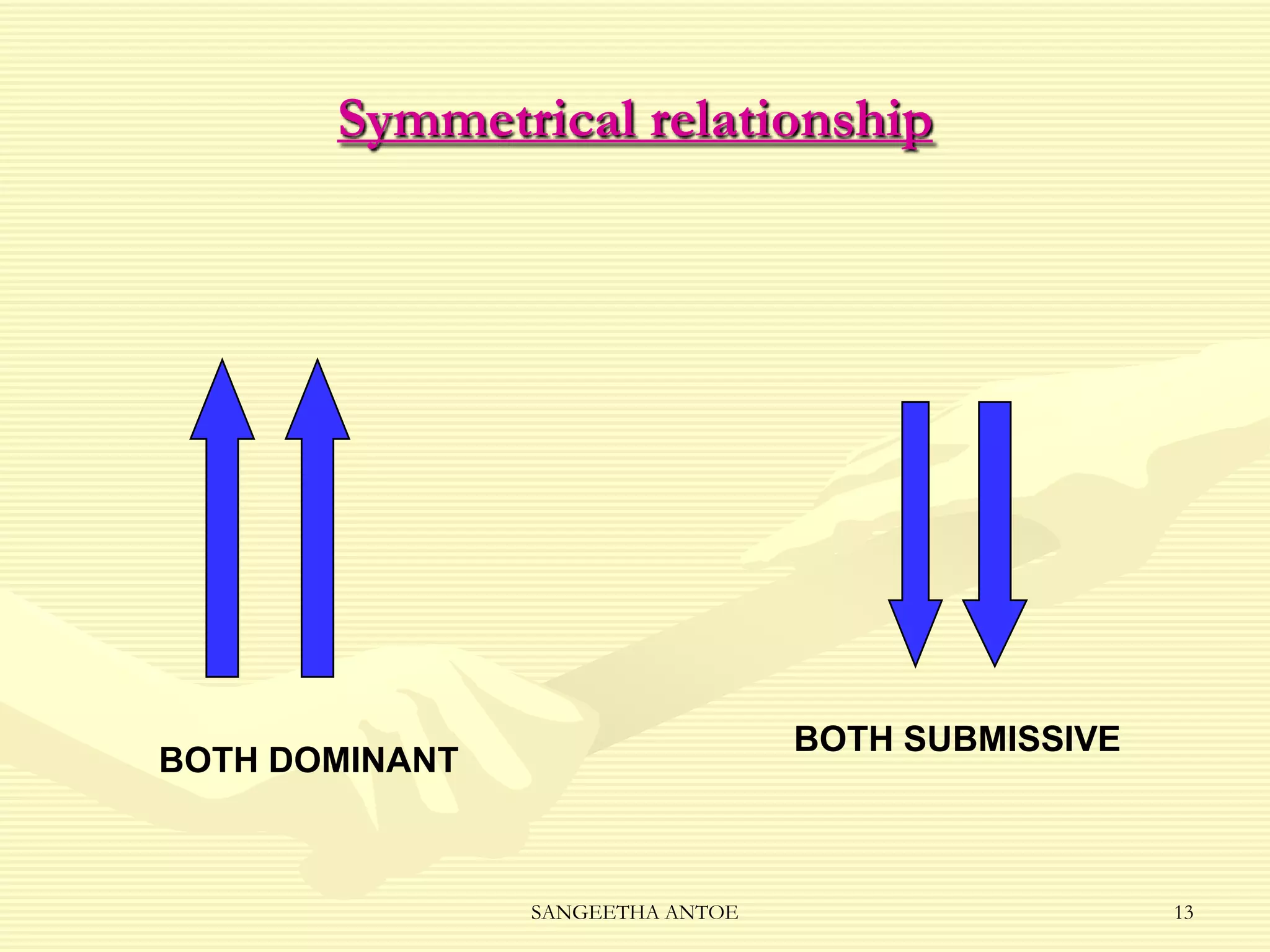
• Control is more evenly distributed between the two
participants
• Free to express their opinions
• Power struggles occurs when participants compete
to acquire or give up control

SANGEETHA ANTOE

12
Symmetrical relationship

BOTH SUBMISSIVE

BOTH DOMINANT

SANGEETHA ANTOE

13
Parallel relationship
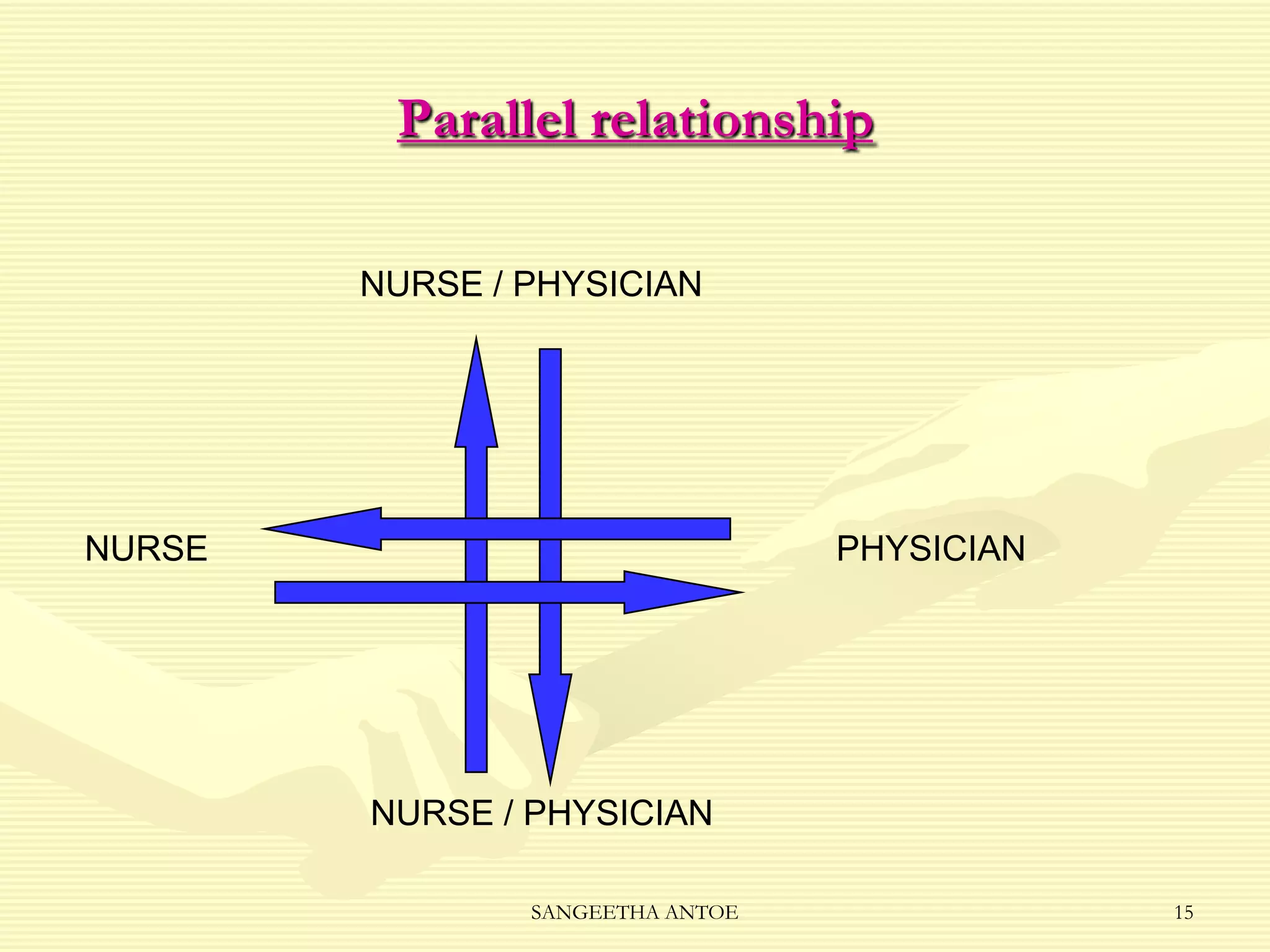
• Control moves back and forth between the
two participants
• Participants take turns holding and giving
control, depending on the circumstances,
rather than competing for control
• Effective and flexible communication

SANGEETHA ANTOE

14
Parallel relationship
NURSE / PHYSICIAN

NURSE

PHYSICIAN

NURSE / PHYSICIAN
SANGEETHA ANTOE

15
COLLABORATIVE
MODELS
Traditional Practice
Model
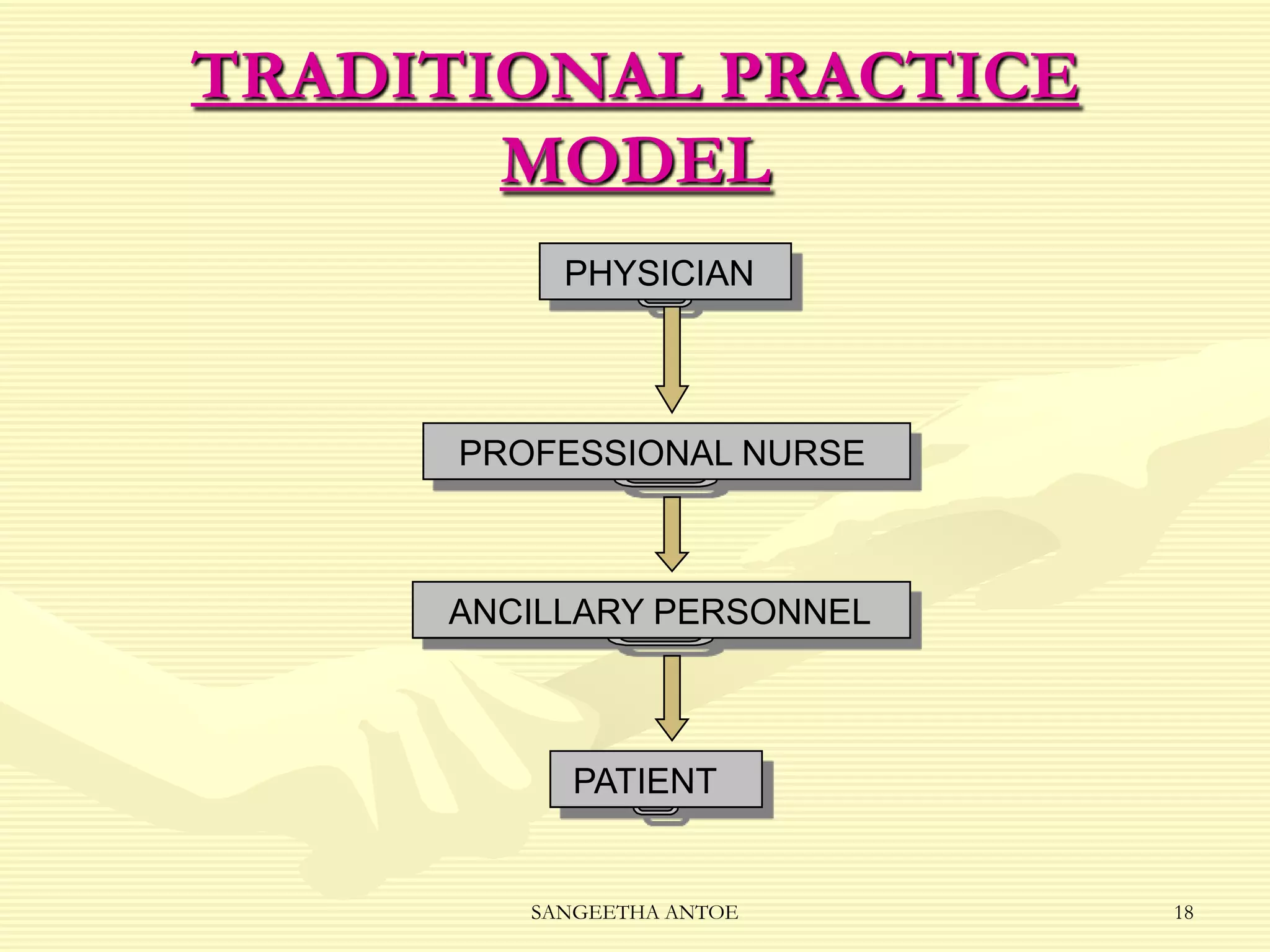
TRADITIONAL PRACTICE
MODEL
PHYSICIAN

PROFESSIONAL NURSE

ANCILLARY PERSONNEL

PATIENT

SANGEETHA ANTOE

18
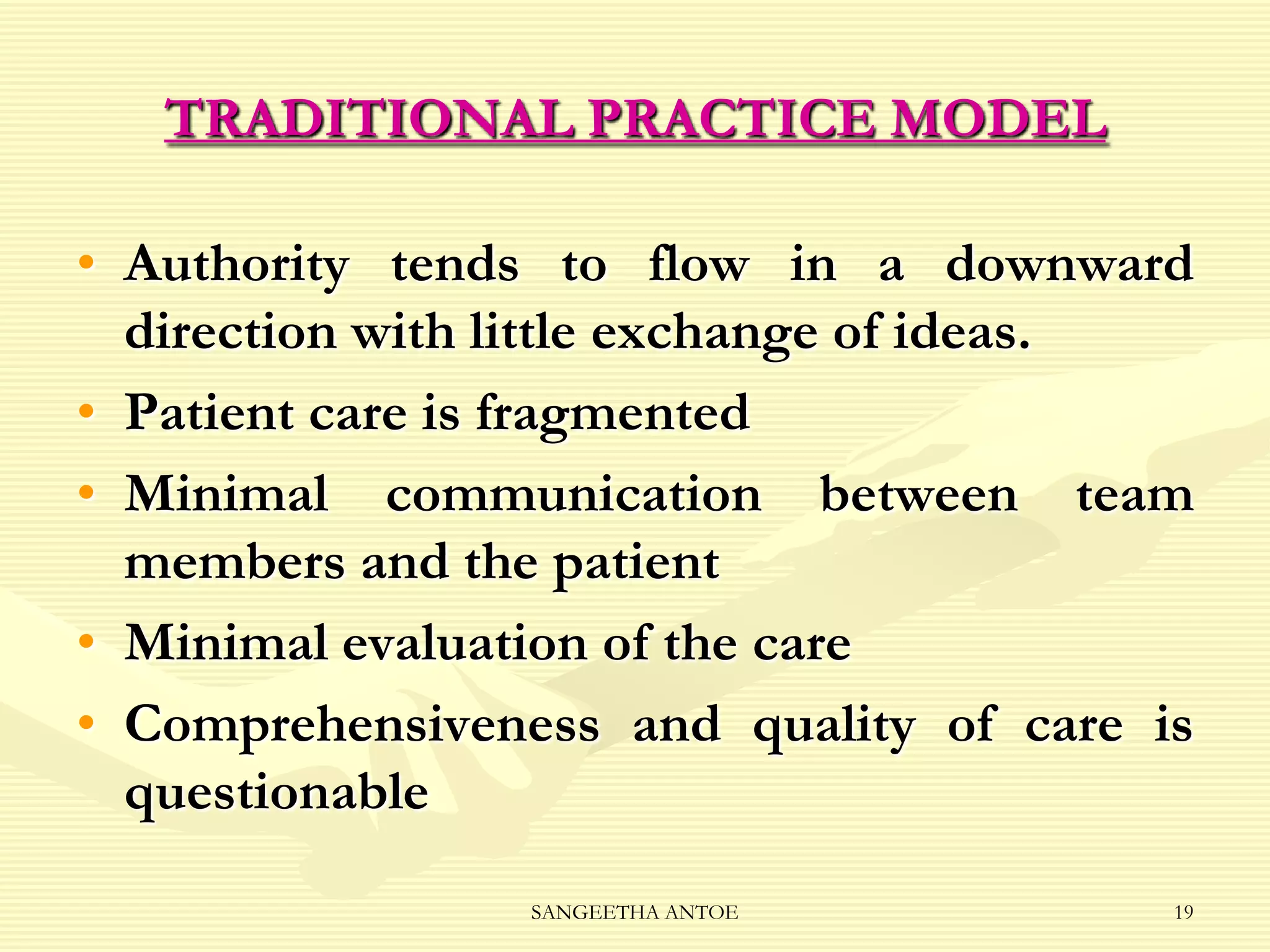
TRADITIONAL PRACTICE MODEL
• Authority tends to flow in a downward
direction with little exchange of ideas.
• Patient care is fragmented
• Minimal communication between team
members and the patient
• Minimal evaluation of the care
• Comprehensiveness and quality of care is
questionable
SANGEETHA ANTOE

19
NURSING –
INSTITUTION
COLLABORATION
MODEL
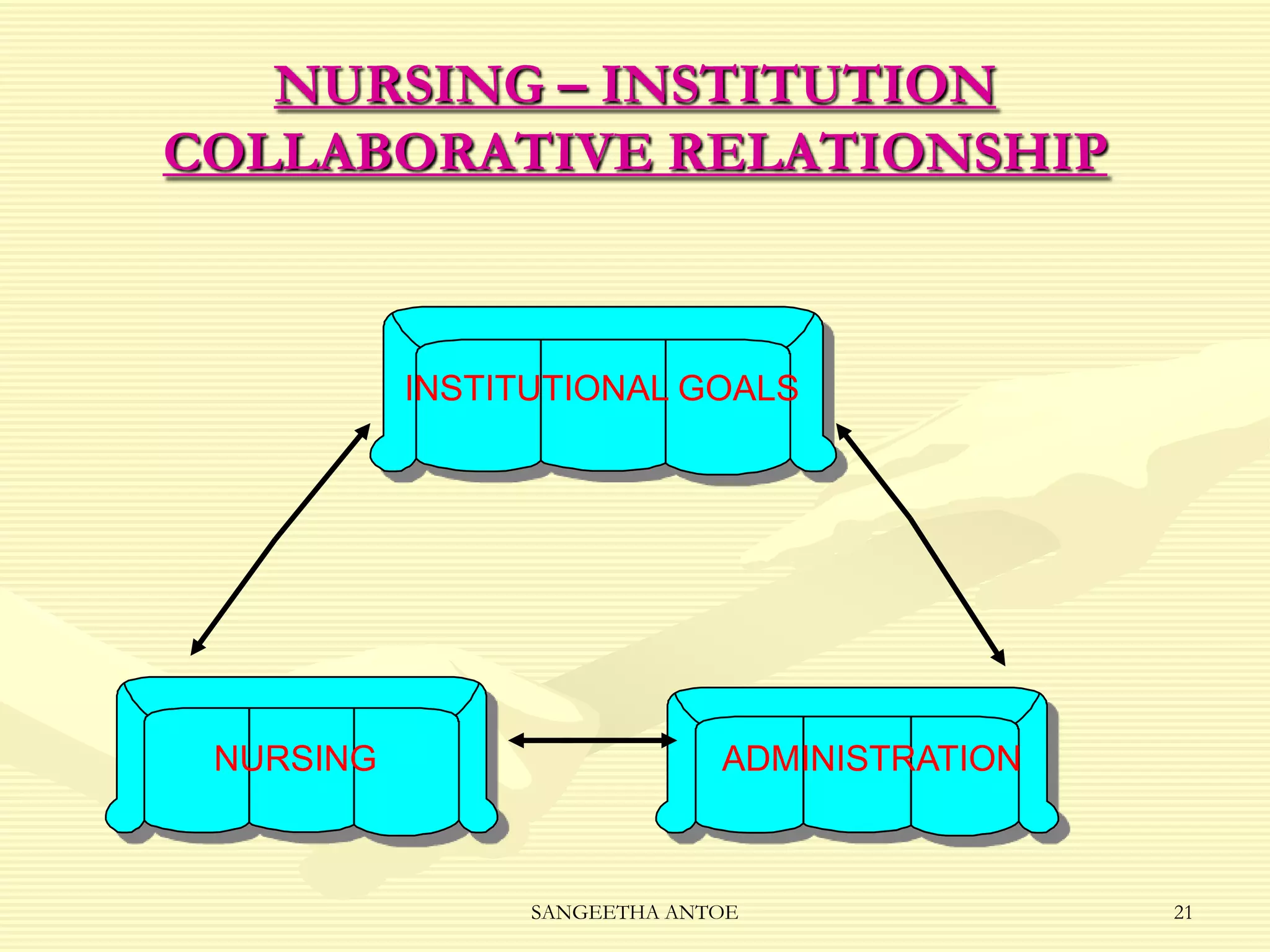
NURSING – INSTITUTION
COLLABORATIVE RELATIONSHIP

INSTITUTIONAL GOALS

NURSING

ADMINISTRATION

SANGEETHA ANTOE

21
Nursing – Institution Collaboration
model
•

COLLABORATION
LEVEL

AT

CLINICAL

PRACTICE

The staff Nurse collaborate with other staff Nurses to
1. Develop the plan of care
2. Provide the care in an integrated and comprehensive
manner
3. Evaluate the outcome of care

SANGEETHA ANTOE

22
• COLLABORATION WITH NURSE EDUCATOR
The clinical nurse specialist collaborate with
Nurse educator to develop a curriculum that is more
appropriate to health care needs and to day-to-day clinical
practice situation

SANGEETHA ANTOE

23
• COLLABORATION WITH NURSE RESEARCHER
Communication between nurse researcher and Nurses
in clinical practice , that Nursing care problems and issues
can be approached and solved systematically

SANGEETHA ANTOE

24
PUBLIC HEALTH
NURSE MODEL
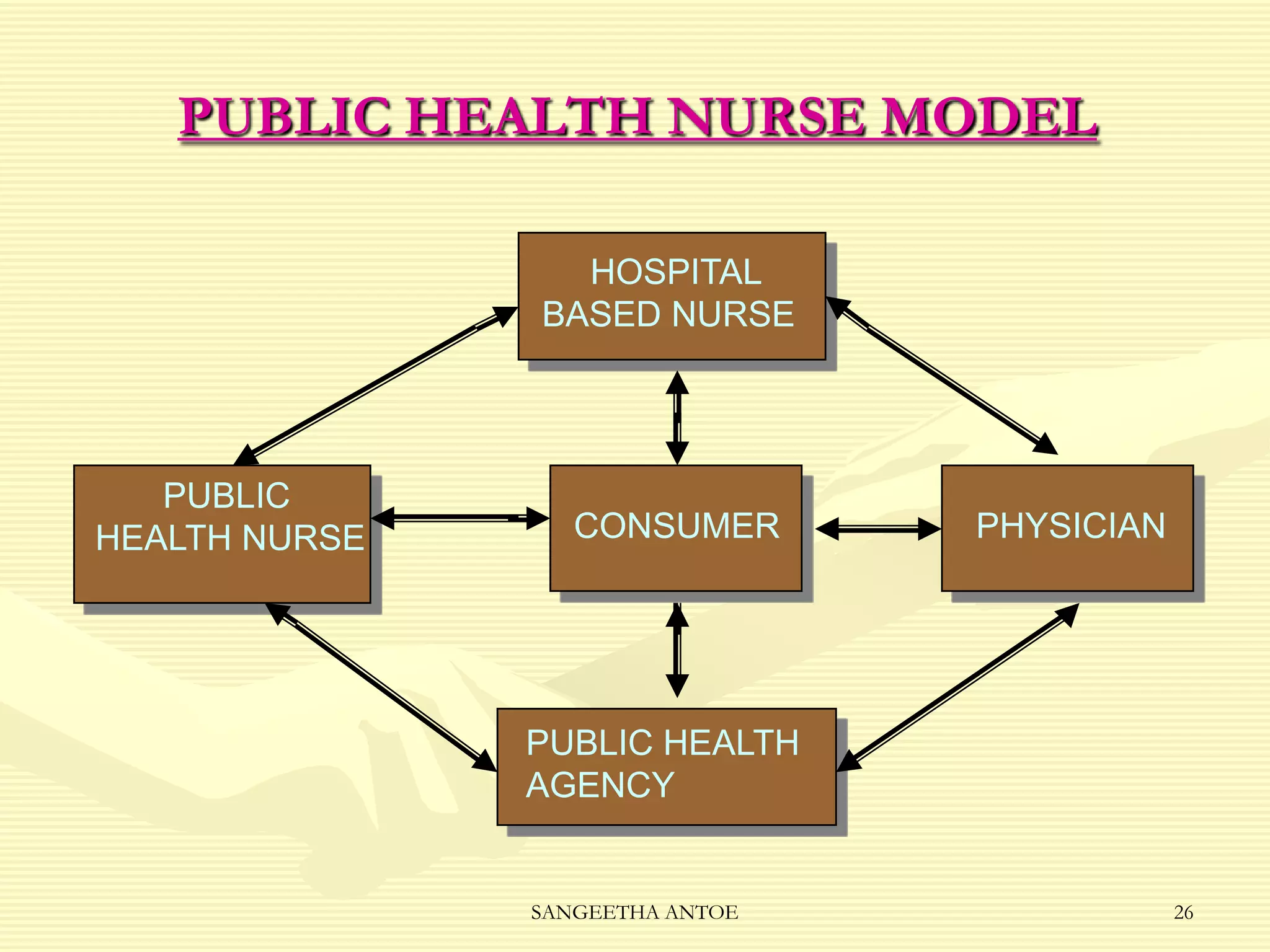
PUBLIC HEALTH NURSE MODEL
HOSPITAL
BASED NURSE

PUBLIC
HEALTH NURSE

CONSUMER

PHYSICIAN

PUBLIC HEALTH
AGENCY

SANGEETHA ANTOE

26
•

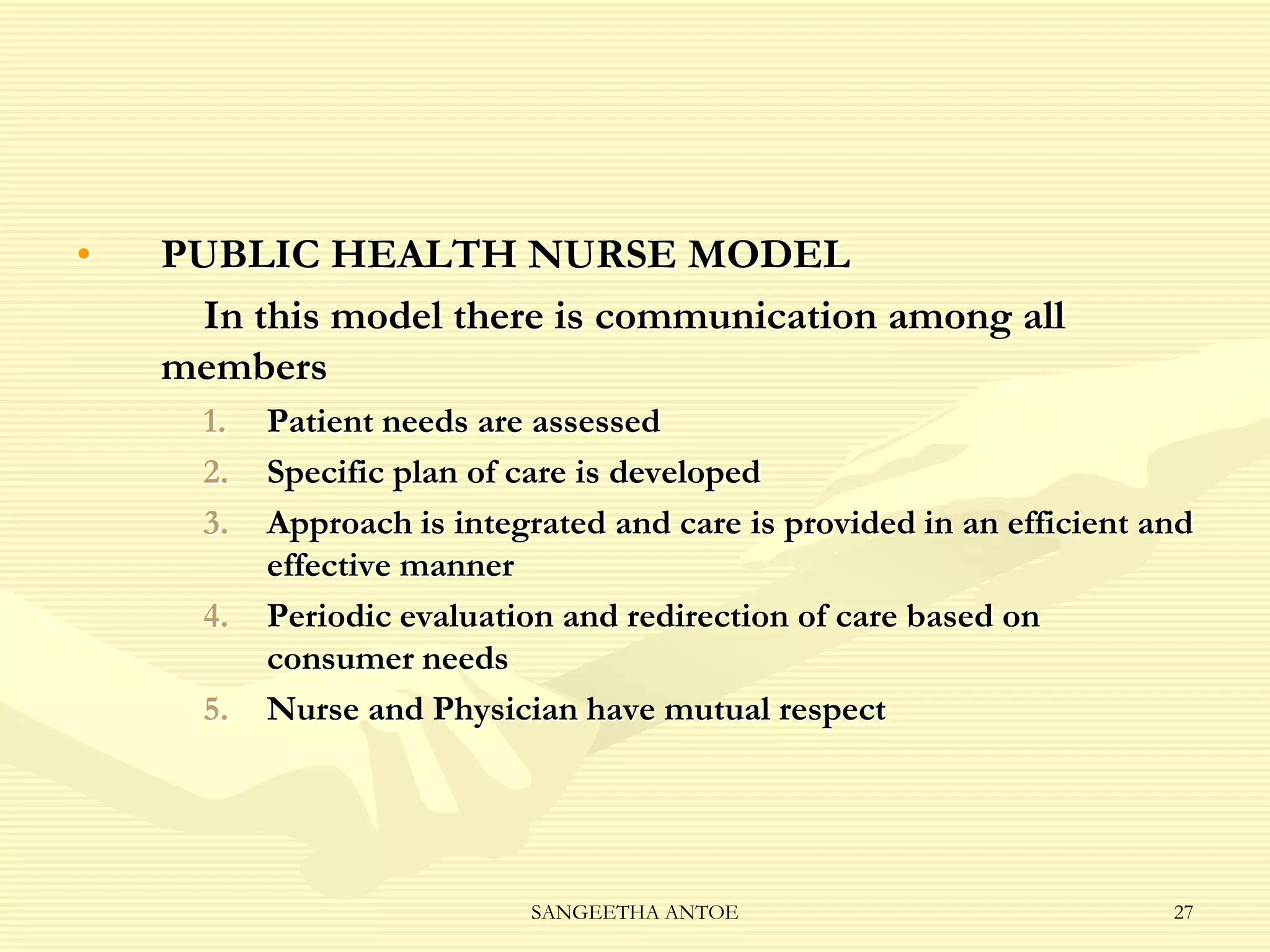
PUBLIC HEALTH NURSE MODEL
In this model there is communication among all
members
1.
2.
3.
4.
5.

Patient needs are assessed
Specific plan of care is developed
Approach is integrated and care is provided in an efficient and
effective manner
Periodic evaluation and redirection of care based on
consumer needs
Nurse and Physician have mutual respect

SANGEETHA ANTOE

27
NURSE COMMUNITY
COLLABORATION
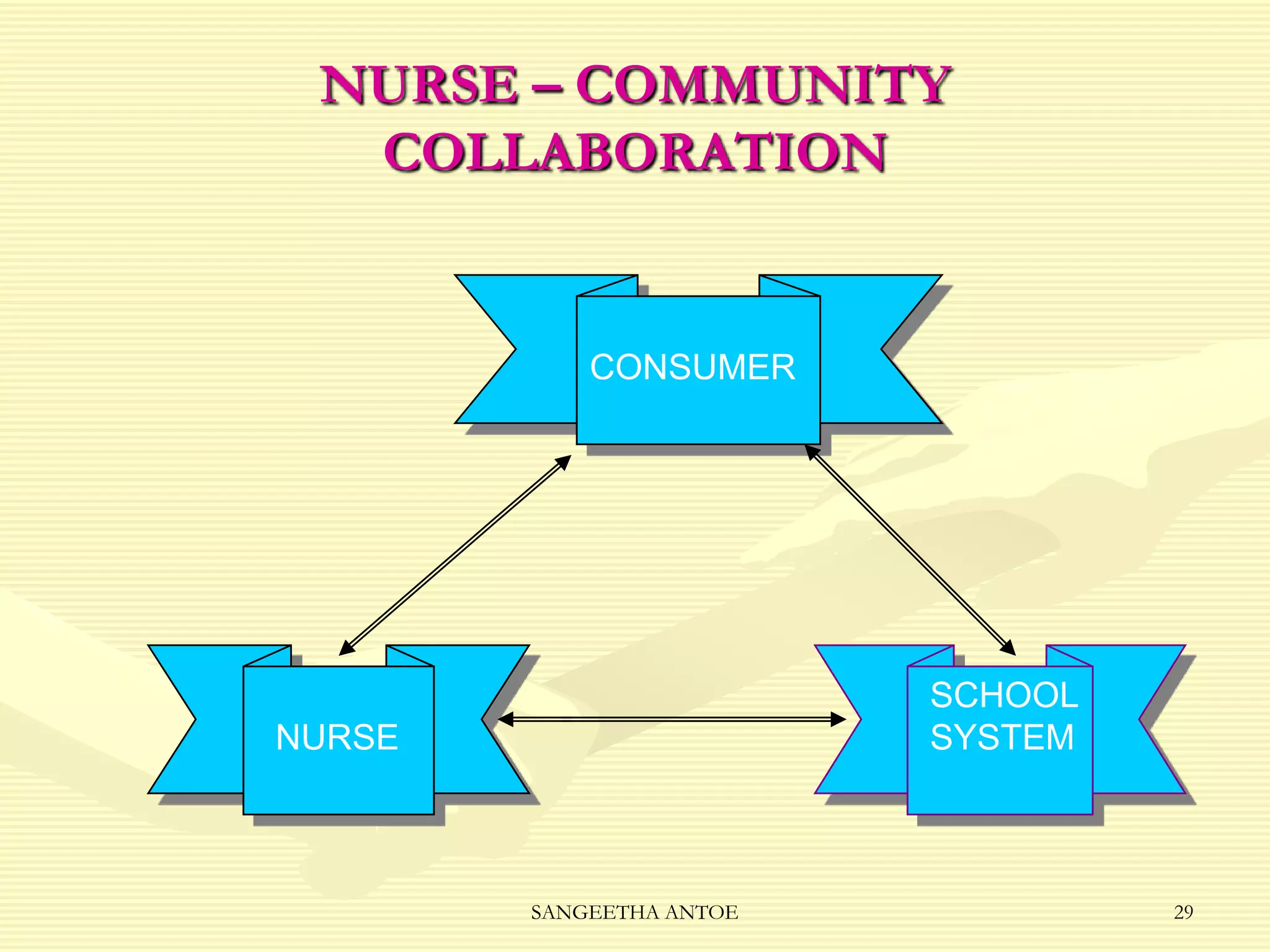
NURSE – COMMUNITY
COLLABORATION

CONSUMER

SCHOOL
SYSTEM

NURSE

SANGEETHA ANTOE

29
Nurse community collaboration
• Nurse collaborates with other agencies or institution in the
community
• Care is provided in a comprehensive manner
• Quality is maintained
• Professionals derive satisfaction as their individual skills
and expertise are appropriately used

SANGEETHA ANTOE

30
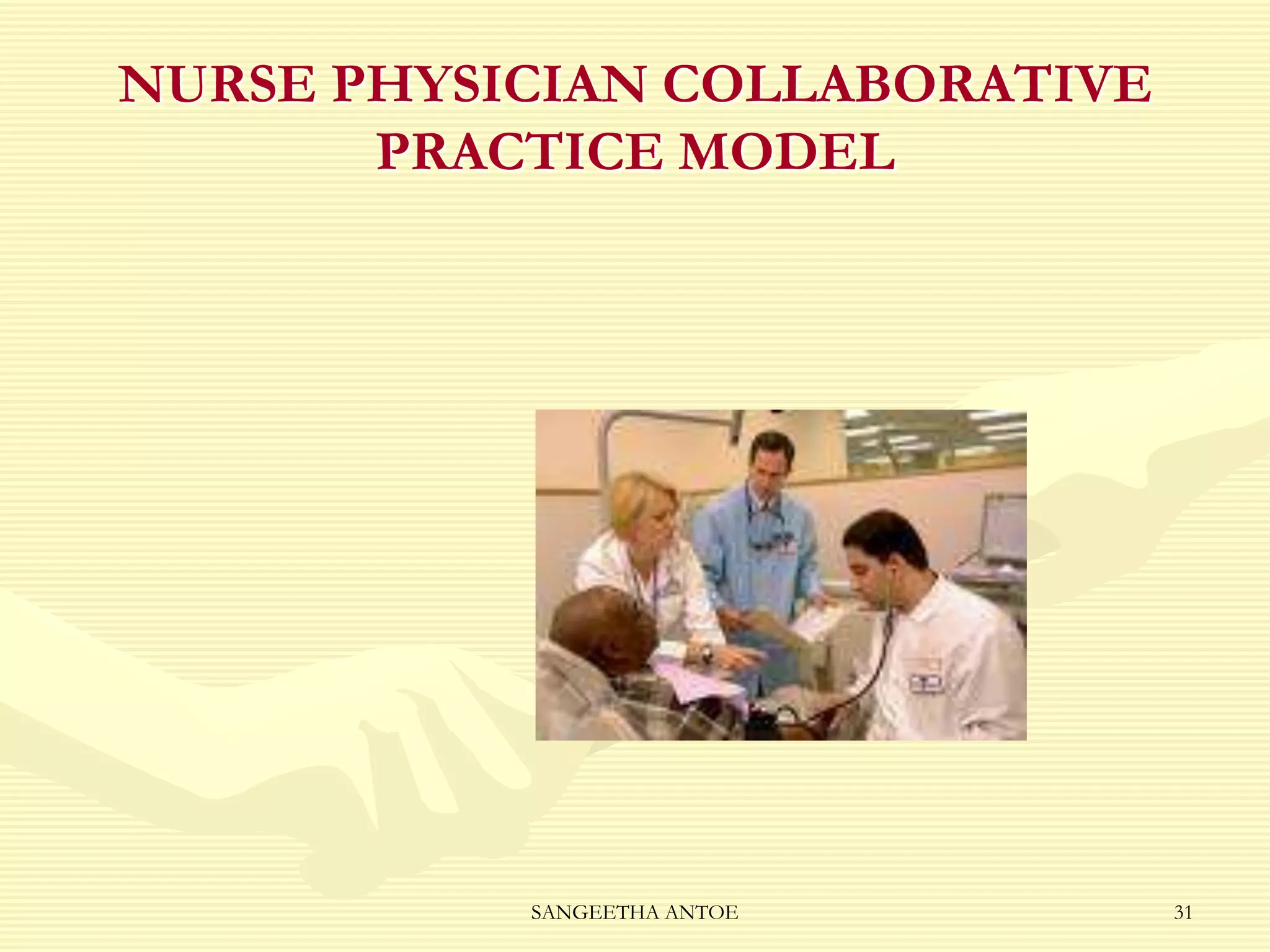
NURSE PHYSICIAN COLLABORATIVE
PRACTICE MODEL

SANGEETHA ANTOE

31
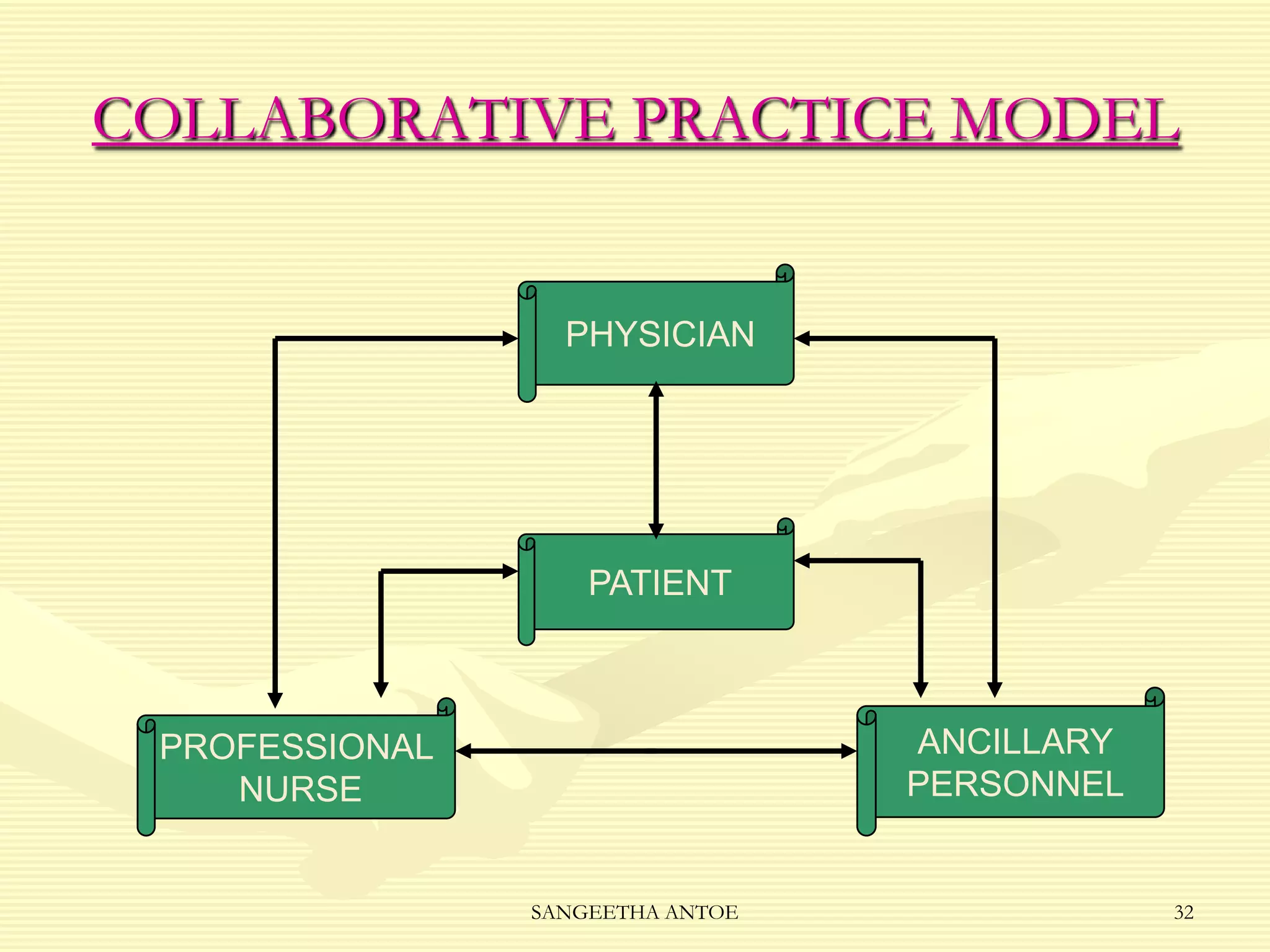
COLLABORATIVE PRACTICE MODEL

PHYSICIAN

PATIENT

ANCILLARY
PERSONNEL

PROFESSIONAL
NURSE

SANGEETHA ANTOE

32
Cont’d
• Began in 1970s
• Within a decentralized organizational structure,
Nurses and Physicians functions collaboratively in
making clinical decisions
• Collaboration resulted in increased quality of care,
patient and care provider satisfaction and decreased
length of stay
• TEAM NURSING- it is important for team leaders
to regularly participate in Physician rounds
• PRIMARY
NURSINGphysician
should
communicate either with each primary Nurse who is
assuming care for the client on that day

SANGEETHA ANTOE

33
• HOME CARE- the staff should be able to work together on
decisions regarding client care
• Physician are invited to attend practice committees when
clinical problems are addressed and to present timely inservice programs on new medical procedures or research
findings

SANGEETHA ANTOE

34
RESEARCH FINDINGS
• Done in 1970 by National Joint practice
Commission (NJPC)
• Recommendations
1. Encouragement of nurses individual clinical
decision making
2. Primary nursing
3. Integrated patient record
4. Joint practice committee
SANGEETHA ANTOE

35
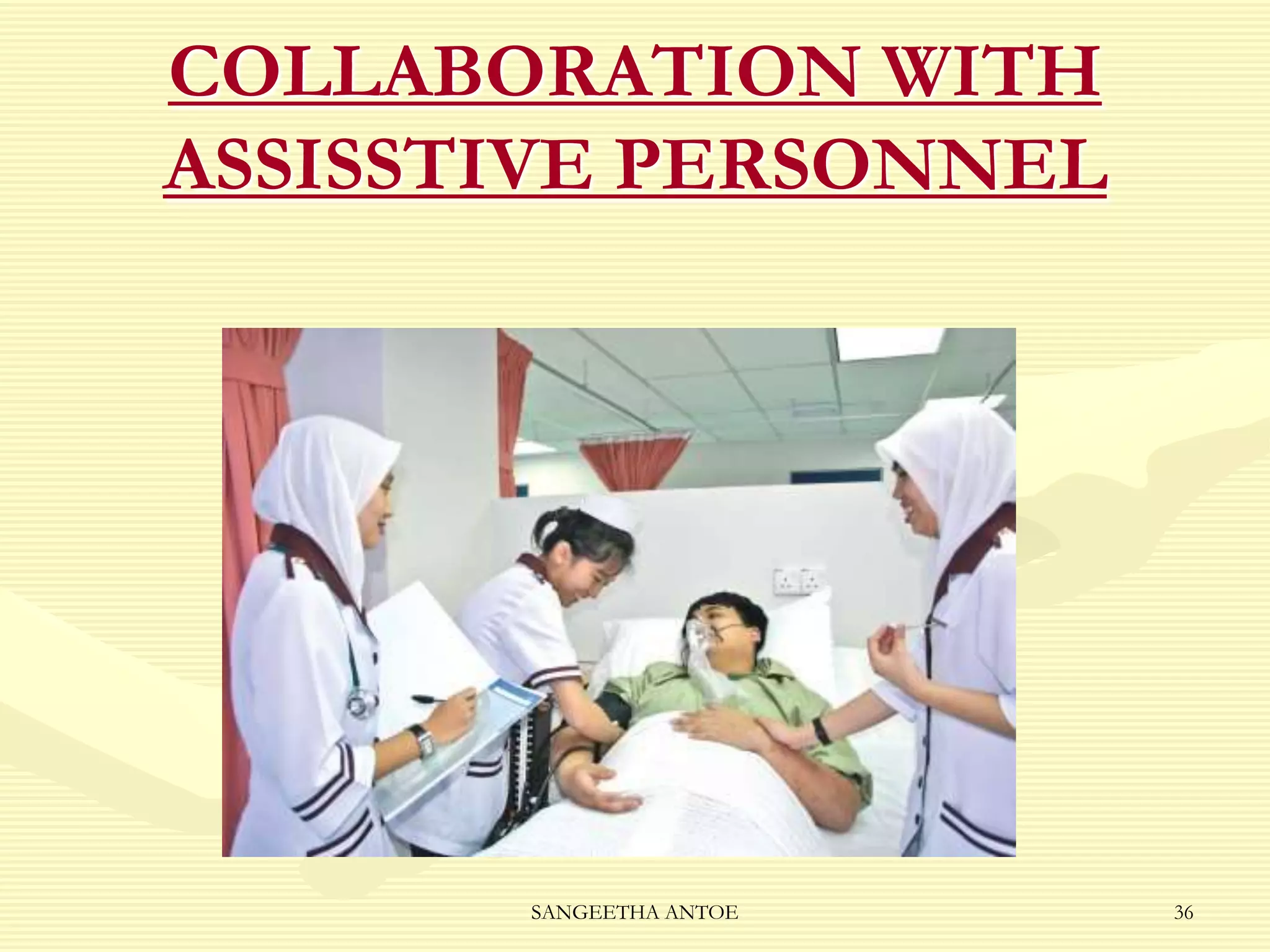
COLLABORATION WITH
ASSISSTIVE PERSONNEL

SANGEETHA ANTOE

36
COLLABORATION WITH ASSISTIVE
PERSONNEL
• Relationships between Registered Nurses and unlicensed
assistive personnel affect the quality of care
• BARRIERS:
Language
Cultural difference
Beliefs, value
Poor team work
Reduced job satisfaction

SANGEETHA ANTOE

37
RESEARCH FINDINGS
• By Hayes(1994) on team building sessions with Registered nurses
and unlicensed personnel
• Purpose to identify and align work related relationship needs
• Findings-unlicensed personnel needs appreciation and respect
from RN

SANGEETHA ANTOE

38
INTERDISCIPLINARY
COLLABORATION

SANGEETHA ANTOE

39
INTERDISCIPLINARY COLLABORATION
• Efficiency in health care delivery brings all
members of the Health care team together
• It involves more than one disciplines
• Staff must recognize the importance of prompt
referrals and timely communication with other
Health professionals
• During collaboration Nurse includes the
client, family and members of health team
• Nurse reviews previous clinical experiences and
priorities to select Nursing interventions
SANGEETHA ANTOE

40
RESEARCH FINDINGS
• Sommers,l.Marton(2000) on Physician ,Nurse and social worker
collaboration in primary care for chronically ill seniors
• Cohort study of 543 patients
• Readmission in the intervention group decreased and the control
group readmission rate increased
• Visit to the physician increased in control group and decreased in
intervention group
• Seniors in the intervention group engaged in an increased
number of social activities compared to the control group

SANGEETHA ANTOE

41
COLLABORATION IN
ADVANCED NURSING
PRACTICE
COLLABORATION IN ADVANCED
PRACTICE NURSING
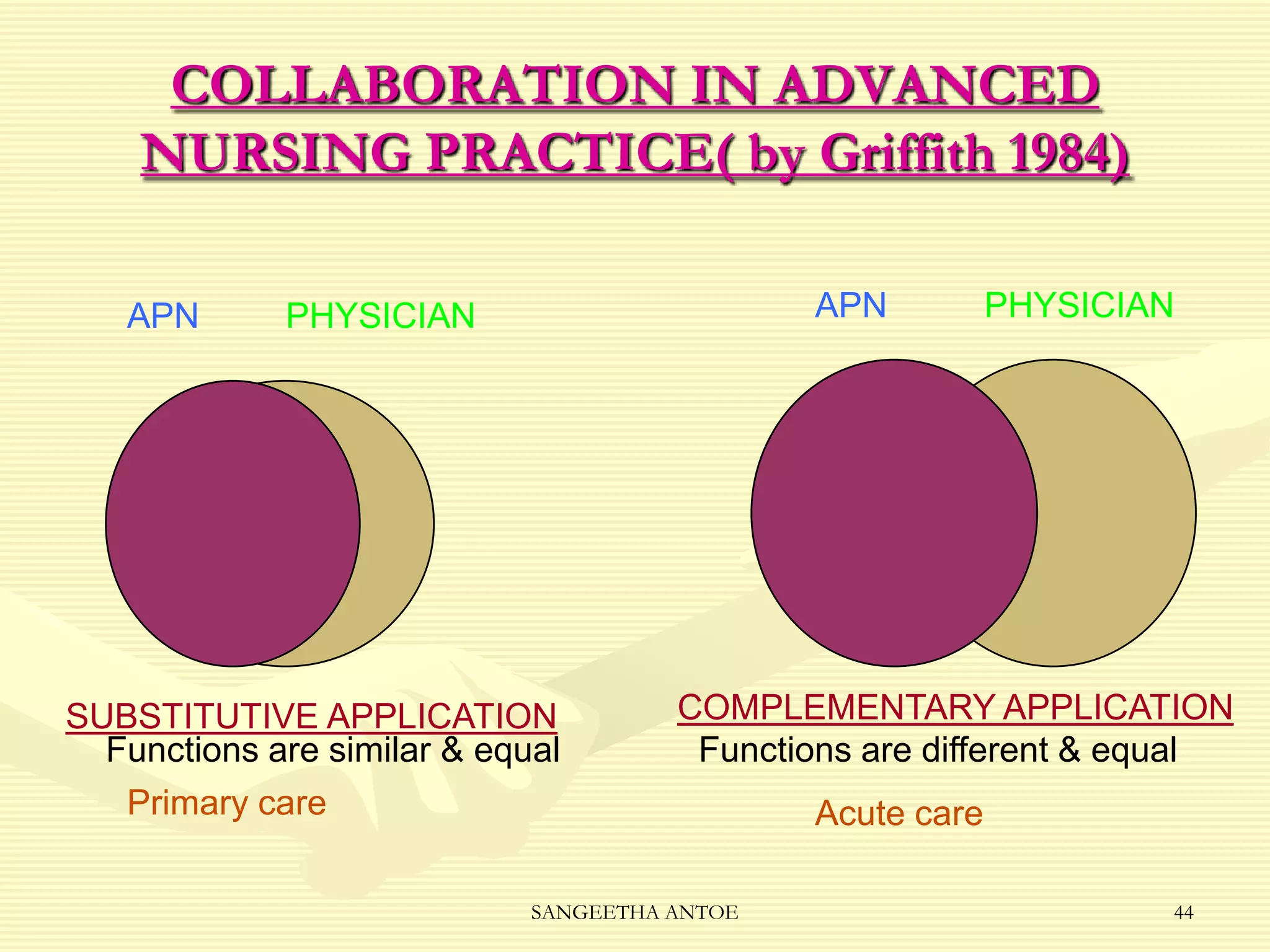
• Collaboration of the Nurse practitioner with the Physician
occurs for those patient needs that are not within the Nurse
practitioner’s scope of practice

SANGEETHA ANTOE

43
COLLABORATION IN ADVANCED
NURSING PRACTICE( by Griffith 1984)
APN

APN

PHYSICIAN

SUBSTITUTIVE APPLICATION
Functions are similar & equal
Primary care

PHYSICIAN

COMPLEMENTARY APPLICATION
Functions are different & equal

SANGEETHA ANTOE

Acute care
44
COLLABORATIVE
LEARNING UNIT
MODEL
COLLABORATIVE LEARNING UNIT
MODEL
• Staff ,student and faculty work together to create a
positive learning environment and provide high
quality patient care
• Increases Nursing students opportunities and
exposure to clinical situations
• Bridge the gap between academic and clinical
expectations
• Provide increased professional development and
socialization
• Increase instructor availability and staff on the
clinical unit
SANGEETHA ANTOE

46
COLLABORTIVE TEAM
APPROACH

SANGEETHA ANTOE

47
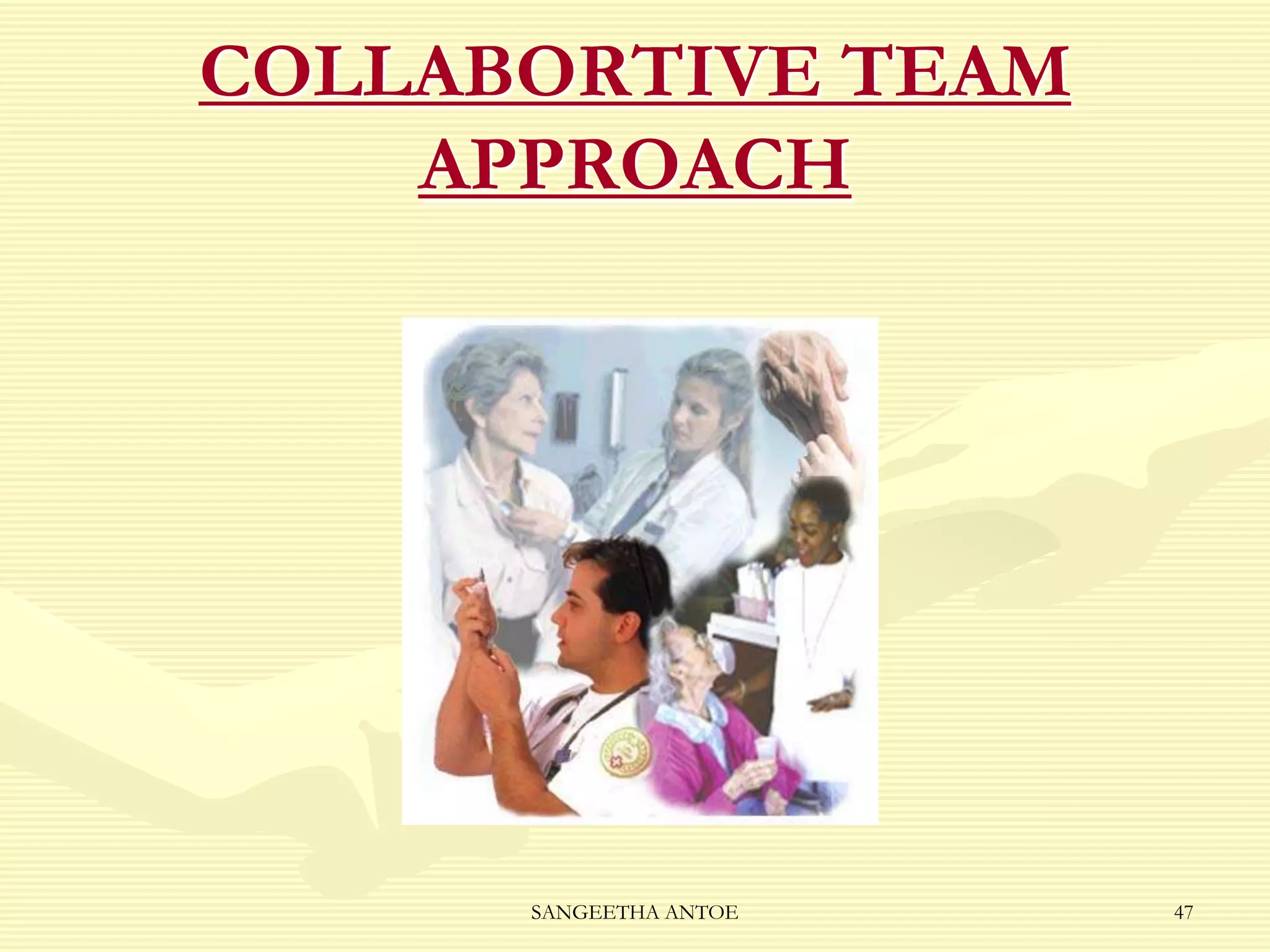
COLLABORATIVE TEAM APPROACH
• It improves communication
• Enable practitioners to address complex
clinical cases from different perspectives
• Improve
productivity
by
avoiding
duplication
• Includes multiple discipline such as
Physician,
nurses,
social
workers,
administratiors, ethicists, clergy
• Eg: diabetes patient
SANGEETHA ANTOE

48
CASE WESTERN
RESERVE UNIVERSITY
MODEL
CASE WESTERN RESERVE UNIVERSITY
MODEL
• Based on the concept of academic leadership for Nursing
• Pilot project in 1960
• SPECIFIC OBJECTIVES:
Improve the quality of patient care
Enhance the learning climate for Nursing students and staff
Promote a spirit of inquiry and the development of research in
Nursing
Promote interprofessional collaboration
Improve the utilization of Nurse’s time and talents

SANGEETHA ANTOE

50
Cont’d
• It was designed to change the organization of Nursing
service to a decentralized pattern similar to the
organizational structure in the School of Nursing, with a
head of Nursing for each institution rather than an overall
head
• JOINT APPOINTMENTS:
1.
2.

3.

Shared appointment-chairperson=director of each clinical
speciality, faculty=nurse clinician appointee
Faculty associate appointment-dean=administrative associate in
hospital
Clinical appointment

SANGEETHA ANTOE

51
UNIVERSITY OF
ROCHESTER MODEL
UNIVERSITY OF ROCHESTER MODEL
• Initiated in 1972
• The head of Nursing service serves as both of the
Dean of the school of Nursing and Director of
Nursing services
• The school of Nursing has overall responsibility
for the delivery and quality of Nursing care
• The head of Nursing is responsible for providing
academic leadership, assuming administrative
responsibilities in both the University and the
Medical center and formulating top level policies
for program for education, practice and research
SANGEETHA ANTOE

53
RUSH UNIVERSITY
MODEL
RUSH UNIVERSITY MODEL
• Head of Nursing serves as both Dean of college of
Nursing & Vice President for Nursing affairs at the
Medical center
• Assisted by Associate Deans & chair person
• Chair person is responsible for integrating Nursing
care, Nursing education & Research
• Faculty serves as classroom and clinical teacher
and also consultant to Nursing staff and as role
model for patient care, Research and
interdisciplinary collaboration
SANGEETHA ANTOE

55
Collaboration skill

SANGEETHA ANTOE

56
COLLABORATION SKILLS
• Willingness to work together
• Readiness to collaborate through education, maturity &
prior experience
• Understands their own limits & their discipline’s
boundaries
• Communicates effectively
• Trust one another
• Committed to working together

SANGEETHA ANTOE

57
Collaboration skill cont’d
•
•
•
•
•
•

Flat organizational structure
Support to act autonomously
Recognition of team accomplishment
Co-operation
Valuing of knowledge & expertise rather than titles or roles
Creativity & shared vision

SANGEETHA ANTOE

58
NURSE AS A COLLABORATOR
•

WITH CLIENTS
–
–
–
–

Acknowledge, supports and encourages in health
care decisions
Encourages client autonomy
Helps to set mutually agreed goals
Provides client consultation

SANGEETHA ANTOE

59
Cont’d
• WITH PEERS
Shares personal expertise with other nurses
Ensure quality client care
Develops a sense of trust and mutual respect

• WITH
OTHER
PROFESSINAL

HEALTH

Recognizes the contribution
Listens to others view
Shares health care responsibilities
Participates in collaborative
research
SANGEETHA ANTOE

CARE

interdisciplinary

60
Cont’d
• WITH
PROFESSIOANAL
ORGANIZATIONS

NURSING

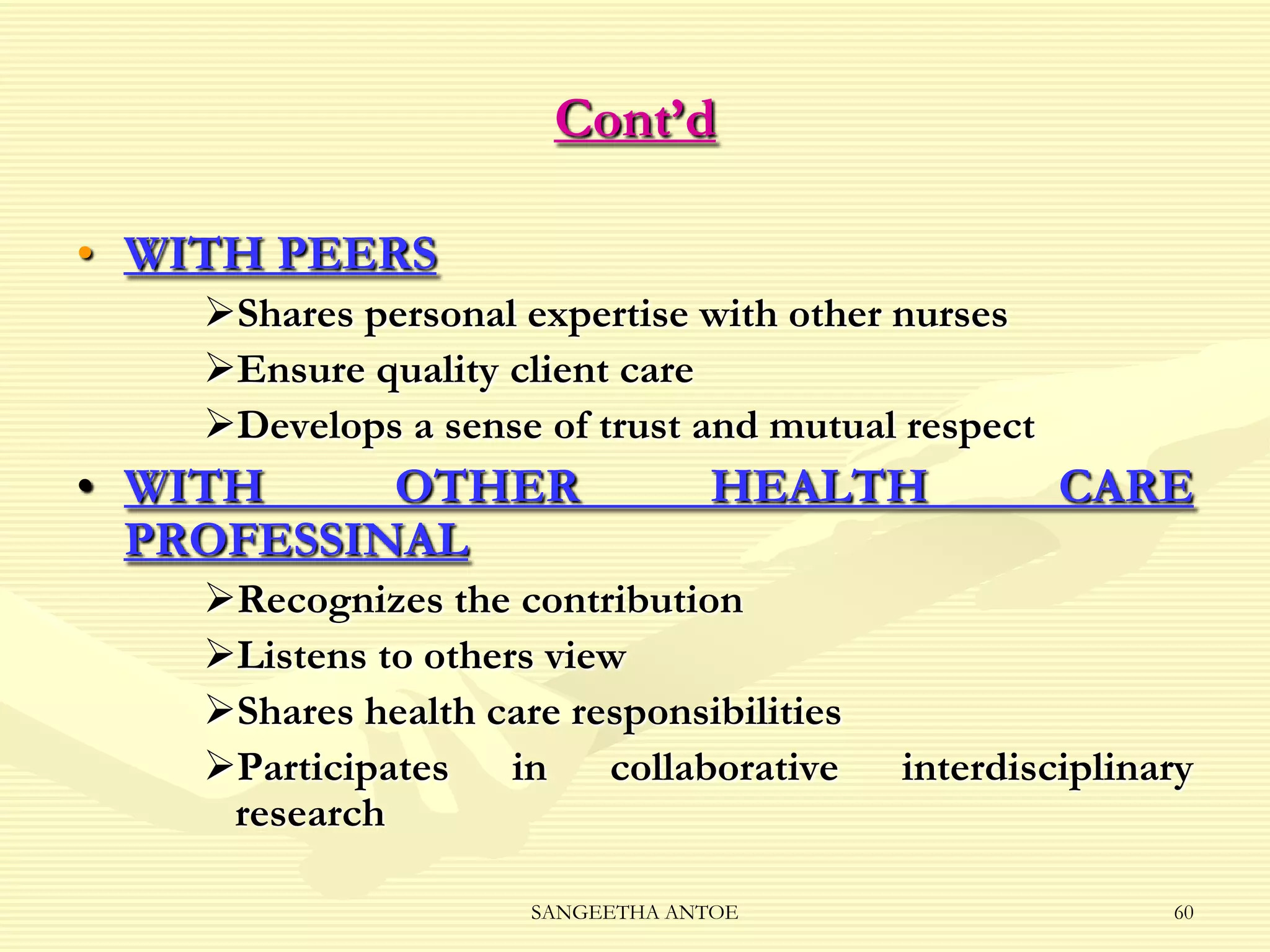
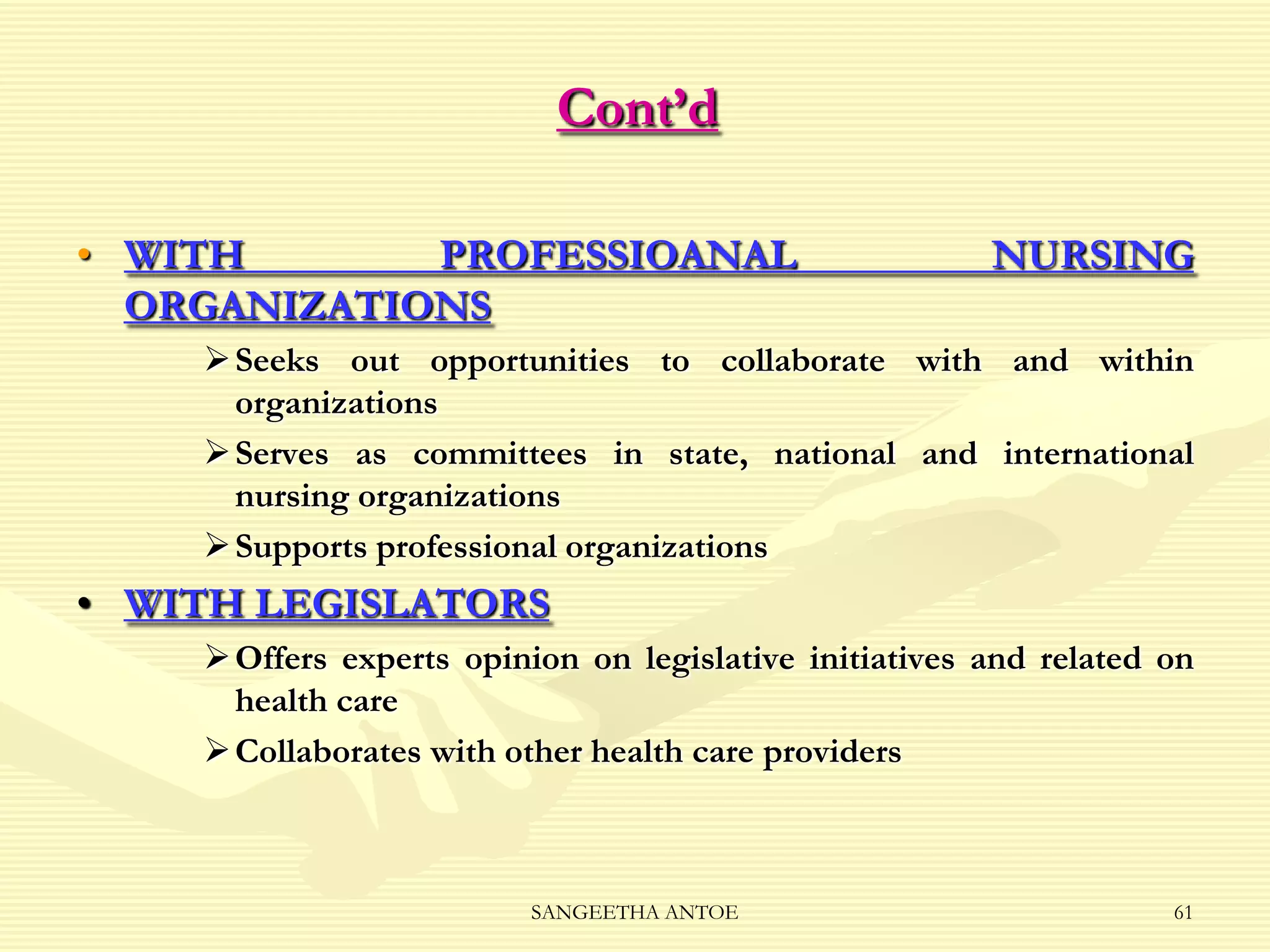
 Seeks out opportunities to collaborate with and within
organizations
 Serves as committees in state, national and international
nursing organizations
 Supports professional organizations

• WITH LEGISLATORS
 Offers experts opinion on legislative initiatives and related on
health care
 Collaborates with other health care providers

SANGEETHA ANTOE

61
Self assessment

SANGEETHA ANTOE

62
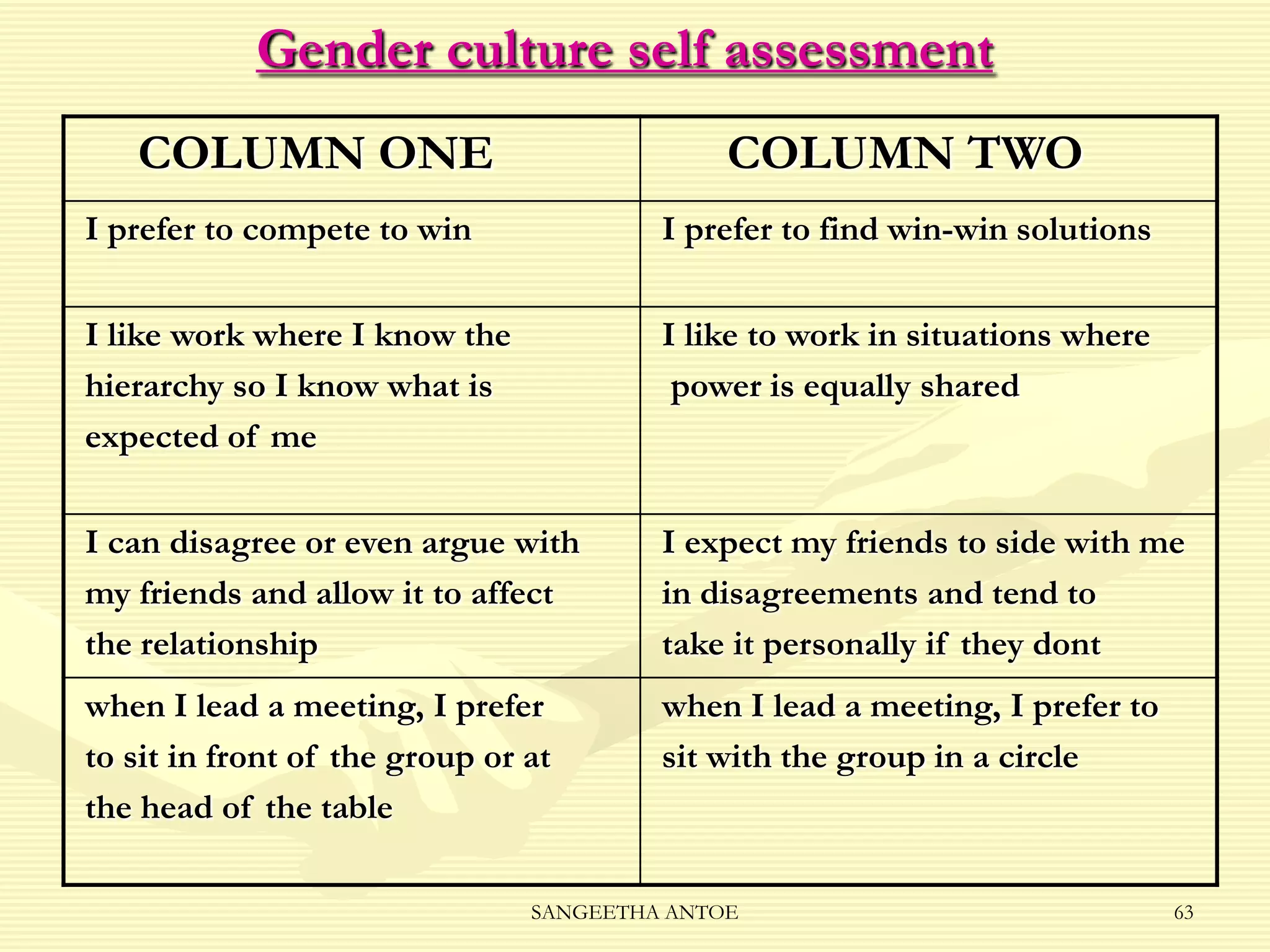
Gender culture self assessment
COLUMN ONE

COLUMN TWO

I prefer to compete to win

I prefer to find win-win solutions

I like work where I know the
hierarchy so I know what is
expected of me

I like to work in situations where
power is equally shared

I can disagree or even argue with
my friends and allow it to affect
the relationship

I expect my friends to side with me
in disagreements and tend to
take it personally if they dont

when I lead a meeting, I prefer
to sit in front of the group or at
the head of the table

when I lead a meeting, I prefer to
sit with the group in a circle

SANGEETHA ANTOE

63
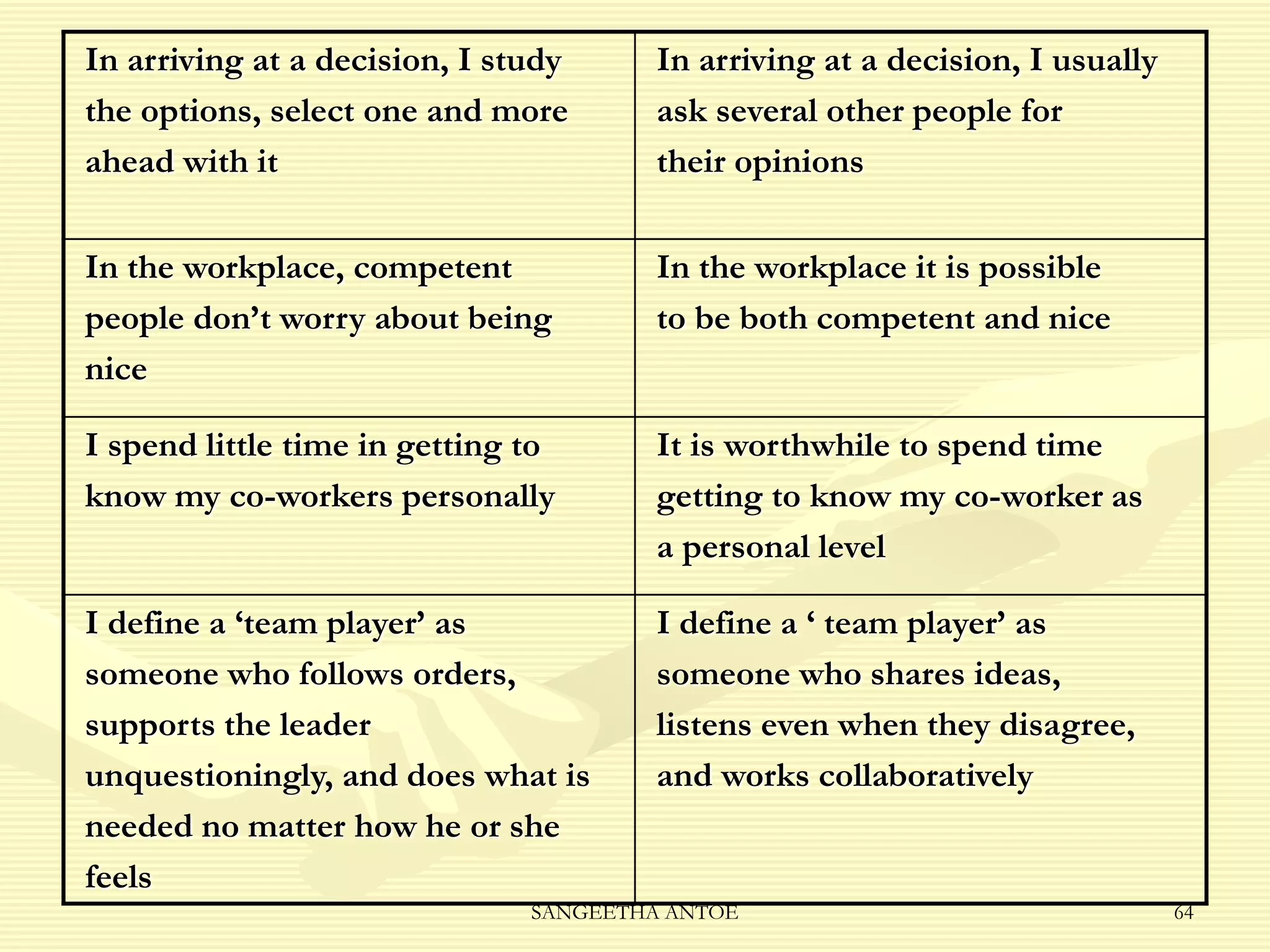
In arriving at a decision, I study
the options, select one and more
ahead with it

In arriving at a decision, I usually
ask several other people for
their opinions

In the workplace, competent
people don’t worry about being
nice

In the workplace it is possible
to be both competent and nice

I spend little time in getting to
know my co-workers personally

It is worthwhile to spend time
getting to know my co-worker as
a personal level

I define a ‘team player’ as
someone who follows orders,
supports the leader
unquestioningly, and does what is
needed no matter how he or she
feels

I define a ‘ team player’ as
someone who shares ideas,
listens even when they disagree,
and works collaboratively

SANGEETHA ANTOE

64
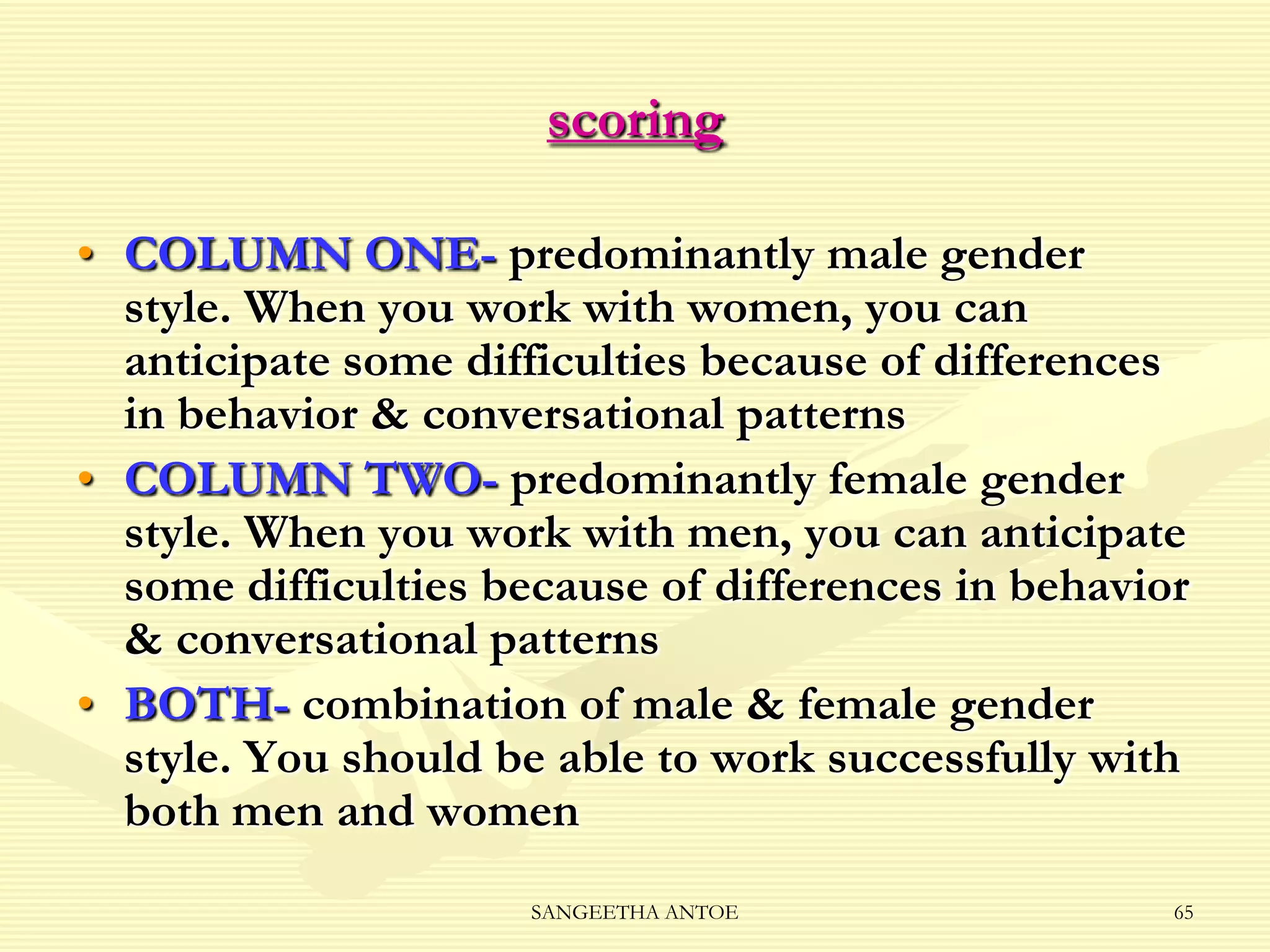
scoring
• COLUMN ONE- predominantly male gender
style. When you work with women, you can
anticipate some difficulties because of differences
in behavior & conversational patterns
• COLUMN TWO- predominantly female gender
style. When you work with men, you can anticipate
some difficulties because of differences in behavior
& conversational patterns
• BOTH- combination of male & female gender
style. You should be able to work successfully with
both men and women
SANGEETHA ANTOE

65
SANGEETHA ANTOE

66

Collaboration issues and models within and outside nursing

  • 1.
    COLLABORATION ISSUES AND MODELSWITHIN AND OUTSIDE NURSING Sangeetha Antoe M.Sc (N)
  • 2.
  • 3.
    INTRODUCTION • Derived froma latin word collaborare, ‘to labor together’ • To collaborate is to ‘work jointly with others or together’ • In olden days nurses was seen as providing assistance to the physician. The term Handmaiden is used to describe this role SANGEETHA ANTOE 3
  • 4.
    DEFINITIONS • Colaborative care‘as partnership relationship between doctors, nurses and other health care providers with patients and their families’ -Virginia Henderson • Collaboration is ‘Nurses and physicians cooperatively working together, sharing responsibility for solving problems and making decisions to formulate and carry out plans for patient care’ -Baggs and schmitt,1988 SANGEETHA ANTOE 4
  • 5.
    OBJECTIVES • Provide client-directedand client-centered care using a multidisciplinary, integrated, participative framework • Enhance continuity across continum of care • Improve client and family satisfaction with care • Provide quality, cost effective, research based care • Promote mutual respect, communication • Develop interdependent SANGEETHA ANTOE 5
  • 6.
    CONTINUUM OF COLLABORATION HIGHESTLEVEL REFERRAL CO-MANAGEMENT CONSULTATION COORDINATION INFORMATION EXCHANGE PARALLEL FUNCTIONING PARALLEL COMMUNICATION LOWEST LEVEL SANGEETHA ANTOE 6
  • 7.
    PRINCIPLES OF COLLABORATION •A Asserts, attitudes and values that each potential partner brings Accountability to each other Agreements to be mutual and documented Acknowledgement of each other contribution Achievements monitored SANGEETHA ANTOE 7
  • 8.
    Principles cont’d • R Reciprocalbenefits Respect for each partners Responsibilities-well defined and agreed upon • T Time and timing Tact and talent Trust SANGEETHA ANTOE 8
  • 9.
    Types of relationshipamong Health professionals • Complementary relationship • Symmetrical relationship • Parallel relationship SANGEETHA ANTOE 9
  • 10.
    Complementary relationship • Oneperson is dominant and the other is submissive • Control is not divided equally between the two participants • Relationships are stable and predictable also inhibit creativity and independent thinking SANGEETHA ANTOE 10
  • 11.
  • 12.
    Symmetrical relationship • Controlis more evenly distributed between the two participants • Free to express their opinions • Power struggles occurs when participants compete to acquire or give up control SANGEETHA ANTOE 12
  • 13.
  • 14.
    Parallel relationship • Controlmoves back and forth between the two participants • Participants take turns holding and giving control, depending on the circumstances, rather than competing for control • Effective and flexible communication SANGEETHA ANTOE 14
  • 15.
    Parallel relationship NURSE /PHYSICIAN NURSE PHYSICIAN NURSE / PHYSICIAN SANGEETHA ANTOE 15
  • 16.
  • 17.
  • 18.
  • 19.
    TRADITIONAL PRACTICE MODEL •Authority tends to flow in a downward direction with little exchange of ideas. • Patient care is fragmented • Minimal communication between team members and the patient • Minimal evaluation of the care • Comprehensiveness and quality of care is questionable SANGEETHA ANTOE 19
  • 20.
  • 21.
    NURSING – INSTITUTION COLLABORATIVERELATIONSHIP INSTITUTIONAL GOALS NURSING ADMINISTRATION SANGEETHA ANTOE 21
  • 22.
    Nursing – InstitutionCollaboration model • COLLABORATION LEVEL AT CLINICAL PRACTICE The staff Nurse collaborate with other staff Nurses to 1. Develop the plan of care 2. Provide the care in an integrated and comprehensive manner 3. Evaluate the outcome of care SANGEETHA ANTOE 22
  • 23.
    • COLLABORATION WITHNURSE EDUCATOR The clinical nurse specialist collaborate with Nurse educator to develop a curriculum that is more appropriate to health care needs and to day-to-day clinical practice situation SANGEETHA ANTOE 23
  • 24.
    • COLLABORATION WITHNURSE RESEARCHER Communication between nurse researcher and Nurses in clinical practice , that Nursing care problems and issues can be approached and solved systematically SANGEETHA ANTOE 24
  • 25.
  • 26.
    PUBLIC HEALTH NURSEMODEL HOSPITAL BASED NURSE PUBLIC HEALTH NURSE CONSUMER PHYSICIAN PUBLIC HEALTH AGENCY SANGEETHA ANTOE 26
  • 27.
    • PUBLIC HEALTH NURSEMODEL In this model there is communication among all members 1. 2. 3. 4. 5. Patient needs are assessed Specific plan of care is developed Approach is integrated and care is provided in an efficient and effective manner Periodic evaluation and redirection of care based on consumer needs Nurse and Physician have mutual respect SANGEETHA ANTOE 27
  • 28.
  • 29.
  • 30.
    Nurse community collaboration •Nurse collaborates with other agencies or institution in the community • Care is provided in a comprehensive manner • Quality is maintained • Professionals derive satisfaction as their individual skills and expertise are appropriately used SANGEETHA ANTOE 30
  • 31.
  • 32.
  • 33.
    Cont’d • Began in1970s • Within a decentralized organizational structure, Nurses and Physicians functions collaboratively in making clinical decisions • Collaboration resulted in increased quality of care, patient and care provider satisfaction and decreased length of stay • TEAM NURSING- it is important for team leaders to regularly participate in Physician rounds • PRIMARY NURSINGphysician should communicate either with each primary Nurse who is assuming care for the client on that day SANGEETHA ANTOE 33
  • 34.
    • HOME CARE-the staff should be able to work together on decisions regarding client care • Physician are invited to attend practice committees when clinical problems are addressed and to present timely inservice programs on new medical procedures or research findings SANGEETHA ANTOE 34
  • 35.
    RESEARCH FINDINGS • Donein 1970 by National Joint practice Commission (NJPC) • Recommendations 1. Encouragement of nurses individual clinical decision making 2. Primary nursing 3. Integrated patient record 4. Joint practice committee SANGEETHA ANTOE 35
  • 36.
  • 37.
    COLLABORATION WITH ASSISTIVE PERSONNEL •Relationships between Registered Nurses and unlicensed assistive personnel affect the quality of care • BARRIERS: Language Cultural difference Beliefs, value Poor team work Reduced job satisfaction SANGEETHA ANTOE 37
  • 38.
    RESEARCH FINDINGS • ByHayes(1994) on team building sessions with Registered nurses and unlicensed personnel • Purpose to identify and align work related relationship needs • Findings-unlicensed personnel needs appreciation and respect from RN SANGEETHA ANTOE 38
  • 39.
  • 40.
    INTERDISCIPLINARY COLLABORATION • Efficiencyin health care delivery brings all members of the Health care team together • It involves more than one disciplines • Staff must recognize the importance of prompt referrals and timely communication with other Health professionals • During collaboration Nurse includes the client, family and members of health team • Nurse reviews previous clinical experiences and priorities to select Nursing interventions SANGEETHA ANTOE 40
  • 41.
    RESEARCH FINDINGS • Sommers,l.Marton(2000)on Physician ,Nurse and social worker collaboration in primary care for chronically ill seniors • Cohort study of 543 patients • Readmission in the intervention group decreased and the control group readmission rate increased • Visit to the physician increased in control group and decreased in intervention group • Seniors in the intervention group engaged in an increased number of social activities compared to the control group SANGEETHA ANTOE 41
  • 42.
  • 43.
    COLLABORATION IN ADVANCED PRACTICENURSING • Collaboration of the Nurse practitioner with the Physician occurs for those patient needs that are not within the Nurse practitioner’s scope of practice SANGEETHA ANTOE 43
  • 44.
    COLLABORATION IN ADVANCED NURSINGPRACTICE( by Griffith 1984) APN APN PHYSICIAN SUBSTITUTIVE APPLICATION Functions are similar & equal Primary care PHYSICIAN COMPLEMENTARY APPLICATION Functions are different & equal SANGEETHA ANTOE Acute care 44
  • 45.
  • 46.
    COLLABORATIVE LEARNING UNIT MODEL •Staff ,student and faculty work together to create a positive learning environment and provide high quality patient care • Increases Nursing students opportunities and exposure to clinical situations • Bridge the gap between academic and clinical expectations • Provide increased professional development and socialization • Increase instructor availability and staff on the clinical unit SANGEETHA ANTOE 46
  • 47.
  • 48.
    COLLABORATIVE TEAM APPROACH •It improves communication • Enable practitioners to address complex clinical cases from different perspectives • Improve productivity by avoiding duplication • Includes multiple discipline such as Physician, nurses, social workers, administratiors, ethicists, clergy • Eg: diabetes patient SANGEETHA ANTOE 48
  • 49.
  • 50.
    CASE WESTERN RESERVEUNIVERSITY MODEL • Based on the concept of academic leadership for Nursing • Pilot project in 1960 • SPECIFIC OBJECTIVES: Improve the quality of patient care Enhance the learning climate for Nursing students and staff Promote a spirit of inquiry and the development of research in Nursing Promote interprofessional collaboration Improve the utilization of Nurse’s time and talents SANGEETHA ANTOE 50
  • 51.
    Cont’d • It wasdesigned to change the organization of Nursing service to a decentralized pattern similar to the organizational structure in the School of Nursing, with a head of Nursing for each institution rather than an overall head • JOINT APPOINTMENTS: 1. 2. 3. Shared appointment-chairperson=director of each clinical speciality, faculty=nurse clinician appointee Faculty associate appointment-dean=administrative associate in hospital Clinical appointment SANGEETHA ANTOE 51
  • 52.
  • 53.
    UNIVERSITY OF ROCHESTERMODEL • Initiated in 1972 • The head of Nursing service serves as both of the Dean of the school of Nursing and Director of Nursing services • The school of Nursing has overall responsibility for the delivery and quality of Nursing care • The head of Nursing is responsible for providing academic leadership, assuming administrative responsibilities in both the University and the Medical center and formulating top level policies for program for education, practice and research SANGEETHA ANTOE 53
  • 54.
  • 55.
    RUSH UNIVERSITY MODEL •Head of Nursing serves as both Dean of college of Nursing & Vice President for Nursing affairs at the Medical center • Assisted by Associate Deans & chair person • Chair person is responsible for integrating Nursing care, Nursing education & Research • Faculty serves as classroom and clinical teacher and also consultant to Nursing staff and as role model for patient care, Research and interdisciplinary collaboration SANGEETHA ANTOE 55
  • 56.
  • 57.
    COLLABORATION SKILLS • Willingnessto work together • Readiness to collaborate through education, maturity & prior experience • Understands their own limits & their discipline’s boundaries • Communicates effectively • Trust one another • Committed to working together SANGEETHA ANTOE 57
  • 58.
    Collaboration skill cont’d • • • • • • Flatorganizational structure Support to act autonomously Recognition of team accomplishment Co-operation Valuing of knowledge & expertise rather than titles or roles Creativity & shared vision SANGEETHA ANTOE 58
  • 59.
    NURSE AS ACOLLABORATOR • WITH CLIENTS – – – – Acknowledge, supports and encourages in health care decisions Encourages client autonomy Helps to set mutually agreed goals Provides client consultation SANGEETHA ANTOE 59
  • 60.
    Cont’d • WITH PEERS Sharespersonal expertise with other nurses Ensure quality client care Develops a sense of trust and mutual respect • WITH OTHER PROFESSINAL HEALTH Recognizes the contribution Listens to others view Shares health care responsibilities Participates in collaborative research SANGEETHA ANTOE CARE interdisciplinary 60
  • 61.
    Cont’d • WITH PROFESSIOANAL ORGANIZATIONS NURSING  Seeksout opportunities to collaborate with and within organizations  Serves as committees in state, national and international nursing organizations  Supports professional organizations • WITH LEGISLATORS  Offers experts opinion on legislative initiatives and related on health care  Collaborates with other health care providers SANGEETHA ANTOE 61
  • 62.
  • 63.
    Gender culture selfassessment COLUMN ONE COLUMN TWO I prefer to compete to win I prefer to find win-win solutions I like work where I know the hierarchy so I know what is expected of me I like to work in situations where power is equally shared I can disagree or even argue with my friends and allow it to affect the relationship I expect my friends to side with me in disagreements and tend to take it personally if they dont when I lead a meeting, I prefer to sit in front of the group or at the head of the table when I lead a meeting, I prefer to sit with the group in a circle SANGEETHA ANTOE 63
  • 64.
    In arriving ata decision, I study the options, select one and more ahead with it In arriving at a decision, I usually ask several other people for their opinions In the workplace, competent people don’t worry about being nice In the workplace it is possible to be both competent and nice I spend little time in getting to know my co-workers personally It is worthwhile to spend time getting to know my co-worker as a personal level I define a ‘team player’ as someone who follows orders, supports the leader unquestioningly, and does what is needed no matter how he or she feels I define a ‘ team player’ as someone who shares ideas, listens even when they disagree, and works collaboratively SANGEETHA ANTOE 64
  • 65.
    scoring • COLUMN ONE-predominantly male gender style. When you work with women, you can anticipate some difficulties because of differences in behavior & conversational patterns • COLUMN TWO- predominantly female gender style. When you work with men, you can anticipate some difficulties because of differences in behavior & conversational patterns • BOTH- combination of male & female gender style. You should be able to work successfully with both men and women SANGEETHA ANTOE 65
  • 66.