




Ms. Sucheta Panchal
COLLABORATION MODELS
&
COLLABORATIVE ISSUES
๏ƒฎ Definition of collaboration
๏ƒฎ Objectives of collaboration
๏ƒฎ Types of collaboration
๏ƒฎ Need of collaboration
๏ƒฎ Models of Collaboration: Education & Service
๏ƒฎ Collaborative issues
๏ƒฎ Role of a nurse administration in collaboration
OUTLINE
๏ƒฎ To understand the concept of collaboration in
nursing.
๏ƒฎ To know about the existing models of
collaboration.
๏ƒฎ To identify the benefits of collaboration in
nursing academics and practice.
๏ƒฎ To encounter with the collaborative issues.
๏ƒฎ To understand their own role in collaboration
OBJECTIVES
"Collaboration is the most formal inter
organizational relationship involving shared
authority and responsibility for planning,
implementation, and evaluation of a joint
effortโ€
Hord, 1986
COLLABORATION
" Collaboration is as a mutually beneficial
and well-defined relationship entered
into by two or more organizations to
achieve common goalsโ€.
Mattessich, Murray & Monsey (2001)
COLLABORATION
COLLABORATIVE TEACHING
When two or more educators take
responsibility for planning, teaching,
and monitoring the success of learners
in a class
TYPES OF
COLLABORATION
Interdisciplinary
Multidisciplinary
Transdisciplinary
Interprofessional
NEED FOR
COLLABORATION
BETWEEN
EDUCATION & SERVICE
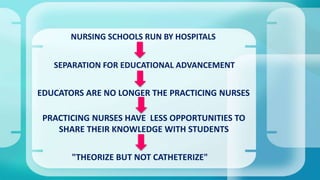
NURSING SCHOOLS RUN BY HOSPITALS
SEPARATION FOR EDUCATIONAL ADVANCEMENT
EDUCATORS ARE NO LONGER THE PRACTICING NURSES
PRACTICING NURSES HAVE LESS OPPORTUNITIES TO
SHARE THEIR KNOWLEDGE WITH STUDENTS
"THEORIZE BUT NOT CATHETERIZE"
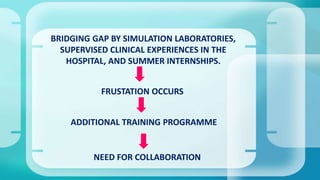
BRIDGING GAP BY SIMULATION LABORATORIES,
SUPERVISED CLINICAL EXPERIENCES IN THE
HOSPITAL, AND SUMMER INTERNSHIPS.
FRUSTATION OCCURS
ADDITIONAL TRAINING PROGRAMME
NEED FOR COLLABORATION
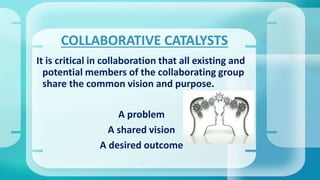
It is critical in collaboration that all existing and
potential members of the collaborating group
share the common vision and purpose.
A problem
A shared vision
A desired outcome
COLLABORATIVE CATALYSTS
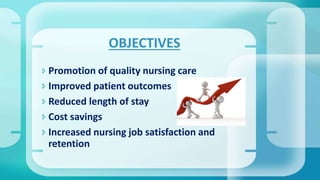
๏ƒฎ Promotion of quality nursing care
๏ƒฎ Improved patient outcomes
๏ƒฎ Reduced length of stay
๏ƒฎ Cost savings
๏ƒฎ Increased nursing job satisfaction and
retention
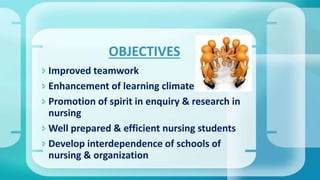
OBJECTIVES
๏ƒฎ Improved teamwork
๏ƒฎ Enhancement of learning climate
๏ƒฎ Promotion of spirit in enquiry & research in
nursing
๏ƒฎ Well prepared & efficient nursing students
๏ƒฎ Develop interdependence of schools of
nursing & organization
OBJECTIVES
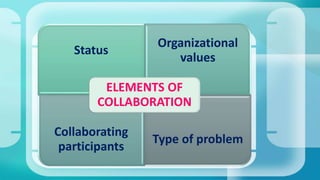
Status
Organizational
values
Collaborating
participants
Type of problem
ELEMENTS OF
COLLABORATION
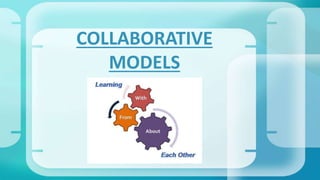
COLLABORATIVE
MODELS
1. CLINICAL SCHOOL OF
NURSING MODEL
(1995)
๏ƒฎInitiative: Nurses from both La
Trobe and The Alfred Clinical
School of Nursing University.
๏ƒฎEstablishment of the Clinical School
in February, 1995.
๏ƒฎVISION: The close and continuing
link between the theory and
practice of nursing at all levels
๏ƒฎBENEFITS:
โ€ขBrings academic staff to the hospital
โ€ขOpportunities for exchange of ideas with
clinical nurses
โ€ขIncreased opportunities for clinical
nursing research.
โ€ขMany educational openings for expert
clinical nurses to involve with the
university's academic program
2.DEDICATED EDUCATION
UNIT CLINICAL TEACHING
MODEL
(1999)
๏ƒฎCONCEPT:
A partnership of nurse executives, staff
nurses and faculty transformed patient
care units into environments of support for
nursing students and staff nurses while
continuing the critical work of providing
quality care to acutely ill adults.
๏ƒฎSTRATEGIES:
๏ƒฎVarious methods were used to obtain
formative data
๏ƒฎstaff nurses assumed the role of nursing
instructors.
๏ƒฎKey Features:
๏ƒฎUses existing resources
๏ƒฎSupports the professional development
of nurses
๏ƒฎPotential recruiting and retention tool
๏ƒฎAllows for the clinical education of
increased numbers of students
๏ƒฎKey Features:
๏ƒฎExclusive use of the clinical unit by
School of Nursing
๏ƒฎUse of staff nurses who want to teach as
clinical instructors
๏ƒฎPreparation of clinical instructors for
their teaching role through collaborative
staff and faculty development activities
3. Research Joint
Appointments
(Clinical Chair)
(2000)
๏ƒฎDEFINED BY:
Lantz et al. (1994), as โ€œa formalized
agreement between two institutions
where an individual holds a position in
each institution and carries out specific
and defined responsibilitiesโ€
๏ƒฎGOAL: To use the implementation of
research findings for improving critical
thinking and clinical decision-making of
nurses.
๏ƒฎSTRATEGY: Researcher is a faculty member
at the educational institution for
conducting research and with an interest in
developing a research programme in the
clinical setting.
๏ƒฎ KEY FEATURES:
๏ƒฎ The Director of Nursing Research, provides
education regarding research and assists with
the conduct of research in the practice
setting.
๏ƒฎ She/he also lectures or supervises in the
educational institution.
๏ƒฎ Salary and benefits are shared between the
two organizations
๏ƒฎ OUTCOMES:
๏ƒฎ The educational institution becomes more in
touch with the real world
๏ƒฎ More readily able to identify research
questions potential to make a difference to
quality of consumer care delivery.
๏ƒฎ Increase in collaborative relationship with the
service provider for long term workforce
planning.
๏ƒฎOUTCOMES:
๏ƒฎmore explicit focus on directly linking the
education setting to the clinical context.
๏ƒฎIncreased staff involvement in
professional activities
๏ƒฎImproved access and support to external
research project funding
4. Practice-Research
Model
(PRM)
(2001)
๏ƒฎAn innovative collaborative partnership
agreement between fremantle hospital
and health service and Curtin university of
technology in Perth, Western Australia.
๏ƒฎEnhances communication between
educational and health services, but
fosters the development of nursing
research and knowledge.
๏ƒฎ GOAL:
๏ƒฎ encourage a close working relationship
between registered nurses and academics
๏ƒฎ facilitates strong links at the health service
with the Nursing Research and Evaluation
Unit, medical staff and other allied health
professionals.
๏ƒฎ PROCESS: The development of a Practice- Research
Model (PRM) of collaboration.
๏ƒฎOBJECTIVES:
๏ƒฎ To encourage nursing staff to reflect on current
nursing practice in order to develop meaningful
research proposals
๏ƒฎ To teach staff the research process via research
experience
๏ƒฎ To enable nursing staff to have a key role in the
professional development of other staff via the
dissemination of research and quality improvement
findings
๏ƒฎ To plan and implement changes to practice based
on research evidence.
๏ƒฎSTRATEGIES:
๏ƒฎNurse Research Consultant
๏ƒฎJournal clubs
๏ƒฎOUTCOMES: overall the partnership
between registered nurses and
academics in the pursuit of research to
support clinical practice has been the
highlight.
5.Collaborative Clinical
Education Epworth Deakin
(CCEED) model
(2003)
๏ƒฎEpworth Hospital and Deakin
University ran a collaborative project
(2003) funded by the National Safety
and Quality Council
๏ƒฎAIM: In an effort to improve the
quality of new graduate transition
๏ƒฎGOALS:
๏ƒฎTo facilitate clinical learning
๏ƒฎTo promote clinical scholarship
๏ƒฎTo build nurse workforce capability.
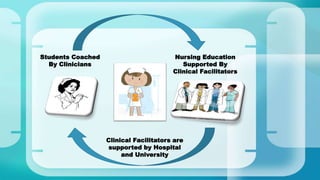
Students Coached
By Clinicians
Nursing Education
Supported By
Clinical Facilitators
Clinical Facilitators are
supported by Hospital
and University
๏ƒฎThe CCEED undergraduate program sees
๏ƒฎ undergraduate nursing students
attending lectures at Deakin University
in the traditional manner
๏ƒฎcompleting all tutorials, clinical learning
laboratories and clinical placements at
Epworth Hospital throughout their
three year course.
๏ƒฎOUTCOME: increased integration between
hospital and university to enhance clinical
education
๏ƒฎNursing education supported by Clinical
Facilitators
๏ƒฎClinical facilitators are supported by
Hospital administration and university
๏ƒฎStudents coached by Nurse Clinician
๏ƒฎRESULT: Studentsโ€™ learning objectives
were met and satisfaction was high.
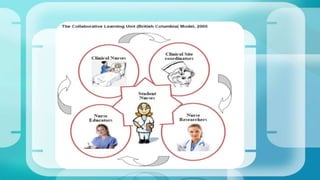
6.The Collaborative Learning Unit
(British Columbia) Model
2005
Collaborative Learning Unit is a
nursing unit where all members of
the staff, together with students
and faculty, work together to
create a positive learning
environment and provide high
quality nursing care.
๏ƒฎModel of practice education for
nursing
๏ƒฎBased on the โ€˜Dedicated Education
Unitsโ€™ concept developed, successfully
implemented, and researched in
Australia.
๏ƒฎGOAL: Students practice and learn in a
nursing unit
๏ƒฎFollowing an individual set
rotation
๏ƒฎchoosing their learning
assignment according to their
learning plans with RNs
๏ƒฎFOCUS ON:
๏ƒฎstudent responsibility for self-guiding,
and for communicating their learning
plan with faculty and clinical nurses
๏ƒฎCLU also has the ability to provide
practice experiences for a larger
number of students.
๏ƒฎOUTCOME: CLU concept bridges a
perceived gap between academic and
clinical expectations.
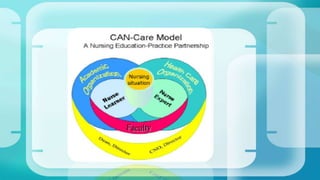
7.The Collaborative Approach to
Nursing Care
(CAN- Care) Model
(2006)
๏ƒฎChristine E. Lynn College of Nursing,
Florida Atlantic University
๏ƒฎFOCUS ON: Academic and practice leaders
work together to promote the education,
recruitment and retention of nurses at all
stages of their career.
๏ƒฎGOAL:
๏ƒฎdesign an educationally dense
๏ƒฎpractice- based experience to socialize
second-degree students to the role of
professional nurse.
๏ƒฎenhance and support the professional
and career development of unit-based
nurses.
8.The Bridge to Practice
Model
(2008)
๏ƒฎThe Bridge to Practice model proposed by
Catholic University of America, school of
Nursing (2008), uses a cohort approach in
which students complete medical-surgical
clinical nursing education at the same
facility.
๏ƒฎParticipating students undergo 415 hours of
clinical experiences (nine academic credits)
focused on medical-surgical nursing.
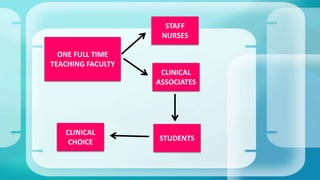
ONE FULL TIME
TEACHING FACULTY
STUDENTS
STAFF
NURSES
CLINICAL
ASSOCIATES
CLINICAL
CHOICE
๏ƒฎEMPHASIZE ON:
๏ƒฎContinuity of education
๏ƒฎprofessional incentives for hospital
nurses to participate in nursing
education.
๏ƒฎ continuing education credits
๏ƒฎ A tuition discount for graduate courses
๏ƒฎCHALLENGES:
๏ƒฎrecruitment of interested senior clinical
nurses
๏ƒฎretention of clinical liaison faculty
๏ƒฎmanagement
Collaboration of Nursing
Education & Service
in India
Dual role model in NIMHANS
๏ƒฎFollowing the amalgamation of 1974
๏ƒฎfaculty of the nursing department
๏ƒฎproviding clinical services
๏ƒฎconducting teaching programs.
Dual role model in NIMHANS
๏ƒฎIn 1975, all the Grade II nursing
superintendents working in the hospital
were designated tutors to maintain
uniformity in the department.
๏ƒฎCombined workshops were conducted
under the guidance of WHO consultant
Mrs. Morril
Dual role model in NIMHANS
๏ƒฎThe Head of the Department of Nursing
was given the responsibility for both.
๏ƒฎOUTCOMES:
๏ƒฎraised the quality of patient care
๏ƒฎimproved the quality of learning
experiences for nursing students
๏ƒฎIntegrative Service-Education approach in
CMC Vellore College of Nursing
๏ƒฎNurse educators are practicing in the
wards or directly involving in the
delivery of nursing services.
๏ƒฎ A pilot study on bridging the gap between
education and service in select institutions like
one ward of AIIMS.
๏ƒฎ The project was successful
๏ƒฎ Patients and medical personnel appreciated
the move but it required financial resources to
replicate this process.
GOVERNMENT INITIATIVES
SCOPE
OF
COLLABORATION
๏ƒฎ Substantive idea repeatedly discussed in health
care circles.
๏ƒฎ Benefits are well validated
๏ƒฎ Seldom practiced
COLLABORATIVE ISSUES
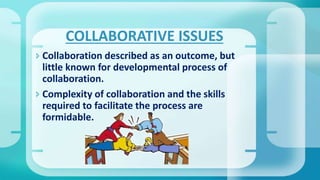
๏ƒฎ Collaboration described as an outcome, but
little known for developmental process of
collaboration.
๏ƒฎ Complexity of collaboration and the skills
required to facilitate the process are
formidable.
COLLABORATIVE ISSUES
Inclusionary process with
continuous engagement that
reinforces commitment,
recognizing the building of
relationships as fundamental to the
success of collaborations.
POINT TO NOTE
๏ƒฎ Technological
๏ƒฎ Medical advancements
๏ƒฎ An ageing population
๏ƒฎ Increased numbers of people living with chronic
disease
๏ƒฎ Spiraling costs
COLLABORATIVE ISSUES
๏ƒฎ Development of Formal System
๏ƒฎ Joint Activities
๏ƒฎ Invite for academic/social events
๏ƒฎ Interchange of careers
๏ƒฎ Recognition of nursing services & education
personnel
ROLE OF NURSE ADMINISTRATION
IN COLLABORATION
๏ƒฎConduct IPR workshops
๏ƒฎOrganize ward conferences,
rounds
๏ƒฎStaff conferences
๏ƒฎNursing staff dialogue
๏ƒฎSensitize students
ROLE OF NURSE ADMINISTRATION
IN COLLABORATION
๏ƒฎ Tutor experiences
๏ƒฎ Nursing educators practice skill
๏ƒฎ Involvement of senior nursing
staffs
๏ƒฎ Opportunity for academic training
๏ƒฎ Conduction of training workshops
ROLE OF NURSE ADMINISTRATION
IN COLLABORATION
๏ƒฎ Catherine Malloy & Francis T. Donahue. (2004). Collaboration projects
between nursing education and service. Nurse Education Today. 19(6), 368-
77
๏ƒฎ Cowen.P.S & Moorhead.S(2006). Current Issues in Nursing. 7 th Ed.,
Missouri, Mosby Inc., 105-122
๏ƒฎ Dileep Kumar, T (2010). Quality of nursing education: Right of every student.
The Nursing Journal of India. Cl(1), 12
๏ƒฎ Downie.J et al.(2001). Research model for collaborative partnership. Journal
of Royal College of Nursing, Australia. 8(4). 27-32
๏ƒฎ Feltz, Joan, Tom Robin. (2000). Linking practice and education. Journal of
Nursing Administration. 30(9), 405-07
๏ƒฎ Fowler, J., Hardy.J., & Howrath.T. (2006). Trialing collaborative nursing
models of care: The impact of change. Australian Journal of Advanced
Nursing. 24(1). 24-28
BIBLIOGRAPHY
๏ƒฎ Hannah Dean and Jan L. Lee (1995). Service and education: Forging
Partnership. Nursing Otulook, 43(3), 119-23
๏ƒฎ Patterson.M, & Gandjen. C (2008). The bridge to practice model: A
collaborative program designed for clinical experiences in baccalaureate
Nursing. Nurse Economics. 26(5). 302-306
๏ƒฎ Raines.A.D (2006). An innovative model of practice- based learning.
International Journal of Nursing Education Scholarship. 3(1). 20-26
๏ƒฎ Sherry P. Palmer, et al. (2005). Nursing education and service collaboration:
Making difference in the clinical learning environment. The Journal of
Continuing Nursing Education, 36(6). 123-28
๏ƒฎ http://www.sasnet.lu.se/institutions/department-nursing-science-karlstad-
university
๏ƒฎ http://www.slideshare.net/jusnaturale/collaboration-30100865
๏ƒฎ http://myorgbio.org/aiims-life-cycle-collaboration-model/
BIBLIOGRAPHY
--An effective collaboration is
characterized by building and sustaining
โ€œwin-winโ€ relationships--
Collaboration issues & models in nursing

Collaboration issues & models in nursing

  • 1.
    Ms. Sucheta Panchal COLLABORATIONMODELS & COLLABORATIVE ISSUES
  • 2.
    ๏ƒฎ Definition ofcollaboration ๏ƒฎ Objectives of collaboration ๏ƒฎ Types of collaboration ๏ƒฎ Need of collaboration ๏ƒฎ Models of Collaboration: Education & Service ๏ƒฎ Collaborative issues ๏ƒฎ Role of a nurse administration in collaboration OUTLINE
  • 3.
    ๏ƒฎ To understandthe concept of collaboration in nursing. ๏ƒฎ To know about the existing models of collaboration. ๏ƒฎ To identify the benefits of collaboration in nursing academics and practice. ๏ƒฎ To encounter with the collaborative issues. ๏ƒฎ To understand their own role in collaboration OBJECTIVES
  • 4.
    "Collaboration is themost formal inter organizational relationship involving shared authority and responsibility for planning, implementation, and evaluation of a joint effortโ€ Hord, 1986 COLLABORATION
  • 5.
    " Collaboration isas a mutually beneficial and well-defined relationship entered into by two or more organizations to achieve common goalsโ€. Mattessich, Murray & Monsey (2001) COLLABORATION
  • 6.
    COLLABORATIVE TEACHING When twoor more educators take responsibility for planning, teaching, and monitoring the success of learners in a class
  • 7.
  • 8.
  • 9.
  • 10.
    NURSING SCHOOLS RUNBY HOSPITALS SEPARATION FOR EDUCATIONAL ADVANCEMENT EDUCATORS ARE NO LONGER THE PRACTICING NURSES PRACTICING NURSES HAVE LESS OPPORTUNITIES TO SHARE THEIR KNOWLEDGE WITH STUDENTS "THEORIZE BUT NOT CATHETERIZE"
  • 11.
    BRIDGING GAP BYSIMULATION LABORATORIES, SUPERVISED CLINICAL EXPERIENCES IN THE HOSPITAL, AND SUMMER INTERNSHIPS. FRUSTATION OCCURS ADDITIONAL TRAINING PROGRAMME NEED FOR COLLABORATION
  • 12.
    It is criticalin collaboration that all existing and potential members of the collaborating group share the common vision and purpose. A problem A shared vision A desired outcome COLLABORATIVE CATALYSTS
  • 13.
    ๏ƒฎ Promotion ofquality nursing care ๏ƒฎ Improved patient outcomes ๏ƒฎ Reduced length of stay ๏ƒฎ Cost savings ๏ƒฎ Increased nursing job satisfaction and retention OBJECTIVES
  • 14.
    ๏ƒฎ Improved teamwork ๏ƒฎEnhancement of learning climate ๏ƒฎ Promotion of spirit in enquiry & research in nursing ๏ƒฎ Well prepared & efficient nursing students ๏ƒฎ Develop interdependence of schools of nursing & organization OBJECTIVES
  • 15.
  • 16.
  • 17.
    1. CLINICAL SCHOOLOF NURSING MODEL (1995)
  • 18.
    ๏ƒฎInitiative: Nurses fromboth La Trobe and The Alfred Clinical School of Nursing University. ๏ƒฎEstablishment of the Clinical School in February, 1995.
  • 19.
    ๏ƒฎVISION: The closeand continuing link between the theory and practice of nursing at all levels
  • 20.
    ๏ƒฎBENEFITS: โ€ขBrings academic staffto the hospital โ€ขOpportunities for exchange of ideas with clinical nurses โ€ขIncreased opportunities for clinical nursing research. โ€ขMany educational openings for expert clinical nurses to involve with the university's academic program
  • 21.
  • 22.
    ๏ƒฎCONCEPT: A partnership ofnurse executives, staff nurses and faculty transformed patient care units into environments of support for nursing students and staff nurses while continuing the critical work of providing quality care to acutely ill adults.
  • 23.
    ๏ƒฎSTRATEGIES: ๏ƒฎVarious methods wereused to obtain formative data ๏ƒฎstaff nurses assumed the role of nursing instructors.
  • 24.
    ๏ƒฎKey Features: ๏ƒฎUses existingresources ๏ƒฎSupports the professional development of nurses ๏ƒฎPotential recruiting and retention tool ๏ƒฎAllows for the clinical education of increased numbers of students
  • 25.
    ๏ƒฎKey Features: ๏ƒฎExclusive useof the clinical unit by School of Nursing ๏ƒฎUse of staff nurses who want to teach as clinical instructors ๏ƒฎPreparation of clinical instructors for their teaching role through collaborative staff and faculty development activities
  • 26.
  • 27.
    ๏ƒฎDEFINED BY: Lantz etal. (1994), as โ€œa formalized agreement between two institutions where an individual holds a position in each institution and carries out specific and defined responsibilitiesโ€
  • 28.
    ๏ƒฎGOAL: To usethe implementation of research findings for improving critical thinking and clinical decision-making of nurses. ๏ƒฎSTRATEGY: Researcher is a faculty member at the educational institution for conducting research and with an interest in developing a research programme in the clinical setting.
  • 29.
    ๏ƒฎ KEY FEATURES: ๏ƒฎThe Director of Nursing Research, provides education regarding research and assists with the conduct of research in the practice setting. ๏ƒฎ She/he also lectures or supervises in the educational institution. ๏ƒฎ Salary and benefits are shared between the two organizations
  • 30.
    ๏ƒฎ OUTCOMES: ๏ƒฎ Theeducational institution becomes more in touch with the real world ๏ƒฎ More readily able to identify research questions potential to make a difference to quality of consumer care delivery. ๏ƒฎ Increase in collaborative relationship with the service provider for long term workforce planning.
  • 31.
    ๏ƒฎOUTCOMES: ๏ƒฎmore explicit focuson directly linking the education setting to the clinical context. ๏ƒฎIncreased staff involvement in professional activities ๏ƒฎImproved access and support to external research project funding
  • 32.
  • 33.
    ๏ƒฎAn innovative collaborativepartnership agreement between fremantle hospital and health service and Curtin university of technology in Perth, Western Australia. ๏ƒฎEnhances communication between educational and health services, but fosters the development of nursing research and knowledge.
  • 34.
    ๏ƒฎ GOAL: ๏ƒฎ encouragea close working relationship between registered nurses and academics ๏ƒฎ facilitates strong links at the health service with the Nursing Research and Evaluation Unit, medical staff and other allied health professionals. ๏ƒฎ PROCESS: The development of a Practice- Research Model (PRM) of collaboration.
  • 35.
    ๏ƒฎOBJECTIVES: ๏ƒฎ To encouragenursing staff to reflect on current nursing practice in order to develop meaningful research proposals ๏ƒฎ To teach staff the research process via research experience ๏ƒฎ To enable nursing staff to have a key role in the professional development of other staff via the dissemination of research and quality improvement findings ๏ƒฎ To plan and implement changes to practice based on research evidence.
  • 36.
    ๏ƒฎSTRATEGIES: ๏ƒฎNurse Research Consultant ๏ƒฎJournalclubs ๏ƒฎOUTCOMES: overall the partnership between registered nurses and academics in the pursuit of research to support clinical practice has been the highlight.
  • 37.
    5.Collaborative Clinical Education EpworthDeakin (CCEED) model (2003)
  • 38.
    ๏ƒฎEpworth Hospital andDeakin University ran a collaborative project (2003) funded by the National Safety and Quality Council ๏ƒฎAIM: In an effort to improve the quality of new graduate transition
  • 39.
    ๏ƒฎGOALS: ๏ƒฎTo facilitate clinicallearning ๏ƒฎTo promote clinical scholarship ๏ƒฎTo build nurse workforce capability.
  • 40.
    Students Coached By Clinicians NursingEducation Supported By Clinical Facilitators Clinical Facilitators are supported by Hospital and University
  • 41.
    ๏ƒฎThe CCEED undergraduateprogram sees ๏ƒฎ undergraduate nursing students attending lectures at Deakin University in the traditional manner ๏ƒฎcompleting all tutorials, clinical learning laboratories and clinical placements at Epworth Hospital throughout their three year course.
  • 42.
    ๏ƒฎOUTCOME: increased integrationbetween hospital and university to enhance clinical education ๏ƒฎNursing education supported by Clinical Facilitators ๏ƒฎClinical facilitators are supported by Hospital administration and university ๏ƒฎStudents coached by Nurse Clinician
  • 43.
    ๏ƒฎRESULT: Studentsโ€™ learningobjectives were met and satisfaction was high.
  • 44.
    6.The Collaborative LearningUnit (British Columbia) Model 2005
  • 45.
    Collaborative Learning Unitis a nursing unit where all members of the staff, together with students and faculty, work together to create a positive learning environment and provide high quality nursing care.
  • 46.
    ๏ƒฎModel of practiceeducation for nursing ๏ƒฎBased on the โ€˜Dedicated Education Unitsโ€™ concept developed, successfully implemented, and researched in Australia.
  • 47.
    ๏ƒฎGOAL: Students practiceand learn in a nursing unit ๏ƒฎFollowing an individual set rotation ๏ƒฎchoosing their learning assignment according to their learning plans with RNs
  • 49.
    ๏ƒฎFOCUS ON: ๏ƒฎstudent responsibilityfor self-guiding, and for communicating their learning plan with faculty and clinical nurses ๏ƒฎCLU also has the ability to provide practice experiences for a larger number of students.
  • 50.
    ๏ƒฎOUTCOME: CLU conceptbridges a perceived gap between academic and clinical expectations.
  • 51.
    7.The Collaborative Approachto Nursing Care (CAN- Care) Model (2006)
  • 52.
    ๏ƒฎChristine E. LynnCollege of Nursing, Florida Atlantic University ๏ƒฎFOCUS ON: Academic and practice leaders work together to promote the education, recruitment and retention of nurses at all stages of their career.
  • 53.
    ๏ƒฎGOAL: ๏ƒฎdesign an educationallydense ๏ƒฎpractice- based experience to socialize second-degree students to the role of professional nurse. ๏ƒฎenhance and support the professional and career development of unit-based nurses.
  • 55.
    8.The Bridge toPractice Model (2008)
  • 56.
    ๏ƒฎThe Bridge toPractice model proposed by Catholic University of America, school of Nursing (2008), uses a cohort approach in which students complete medical-surgical clinical nursing education at the same facility. ๏ƒฎParticipating students undergo 415 hours of clinical experiences (nine academic credits) focused on medical-surgical nursing.
  • 57.
    ONE FULL TIME TEACHINGFACULTY STUDENTS STAFF NURSES CLINICAL ASSOCIATES CLINICAL CHOICE
  • 58.
    ๏ƒฎEMPHASIZE ON: ๏ƒฎContinuity ofeducation ๏ƒฎprofessional incentives for hospital nurses to participate in nursing education. ๏ƒฎ continuing education credits ๏ƒฎ A tuition discount for graduate courses
  • 59.
    ๏ƒฎCHALLENGES: ๏ƒฎrecruitment of interestedsenior clinical nurses ๏ƒฎretention of clinical liaison faculty ๏ƒฎmanagement
  • 60.
  • 61.
    Dual role modelin NIMHANS ๏ƒฎFollowing the amalgamation of 1974 ๏ƒฎfaculty of the nursing department ๏ƒฎproviding clinical services ๏ƒฎconducting teaching programs.
  • 62.
    Dual role modelin NIMHANS ๏ƒฎIn 1975, all the Grade II nursing superintendents working in the hospital were designated tutors to maintain uniformity in the department. ๏ƒฎCombined workshops were conducted under the guidance of WHO consultant Mrs. Morril
  • 63.
    Dual role modelin NIMHANS ๏ƒฎThe Head of the Department of Nursing was given the responsibility for both. ๏ƒฎOUTCOMES: ๏ƒฎraised the quality of patient care ๏ƒฎimproved the quality of learning experiences for nursing students
  • 64.
    ๏ƒฎIntegrative Service-Education approachin CMC Vellore College of Nursing ๏ƒฎNurse educators are practicing in the wards or directly involving in the delivery of nursing services.
  • 65.
    ๏ƒฎ A pilotstudy on bridging the gap between education and service in select institutions like one ward of AIIMS. ๏ƒฎ The project was successful ๏ƒฎ Patients and medical personnel appreciated the move but it required financial resources to replicate this process. GOVERNMENT INITIATIVES
  • 66.
  • 67.
    ๏ƒฎ Substantive idearepeatedly discussed in health care circles. ๏ƒฎ Benefits are well validated ๏ƒฎ Seldom practiced COLLABORATIVE ISSUES
  • 68.
    ๏ƒฎ Collaboration describedas an outcome, but little known for developmental process of collaboration. ๏ƒฎ Complexity of collaboration and the skills required to facilitate the process are formidable. COLLABORATIVE ISSUES
  • 69.
    Inclusionary process with continuousengagement that reinforces commitment, recognizing the building of relationships as fundamental to the success of collaborations. POINT TO NOTE
  • 70.
    ๏ƒฎ Technological ๏ƒฎ Medicaladvancements ๏ƒฎ An ageing population ๏ƒฎ Increased numbers of people living with chronic disease ๏ƒฎ Spiraling costs COLLABORATIVE ISSUES
  • 71.
    ๏ƒฎ Development ofFormal System ๏ƒฎ Joint Activities ๏ƒฎ Invite for academic/social events ๏ƒฎ Interchange of careers ๏ƒฎ Recognition of nursing services & education personnel ROLE OF NURSE ADMINISTRATION IN COLLABORATION
  • 72.
    ๏ƒฎConduct IPR workshops ๏ƒฎOrganizeward conferences, rounds ๏ƒฎStaff conferences ๏ƒฎNursing staff dialogue ๏ƒฎSensitize students ROLE OF NURSE ADMINISTRATION IN COLLABORATION
  • 73.
    ๏ƒฎ Tutor experiences ๏ƒฎNursing educators practice skill ๏ƒฎ Involvement of senior nursing staffs ๏ƒฎ Opportunity for academic training ๏ƒฎ Conduction of training workshops ROLE OF NURSE ADMINISTRATION IN COLLABORATION
  • 74.
    ๏ƒฎ Catherine Malloy& Francis T. Donahue. (2004). Collaboration projects between nursing education and service. Nurse Education Today. 19(6), 368- 77 ๏ƒฎ Cowen.P.S & Moorhead.S(2006). Current Issues in Nursing. 7 th Ed., Missouri, Mosby Inc., 105-122 ๏ƒฎ Dileep Kumar, T (2010). Quality of nursing education: Right of every student. The Nursing Journal of India. Cl(1), 12 ๏ƒฎ Downie.J et al.(2001). Research model for collaborative partnership. Journal of Royal College of Nursing, Australia. 8(4). 27-32 ๏ƒฎ Feltz, Joan, Tom Robin. (2000). Linking practice and education. Journal of Nursing Administration. 30(9), 405-07 ๏ƒฎ Fowler, J., Hardy.J., & Howrath.T. (2006). Trialing collaborative nursing models of care: The impact of change. Australian Journal of Advanced Nursing. 24(1). 24-28 BIBLIOGRAPHY
  • 75.
    ๏ƒฎ Hannah Deanand Jan L. Lee (1995). Service and education: Forging Partnership. Nursing Otulook, 43(3), 119-23 ๏ƒฎ Patterson.M, & Gandjen. C (2008). The bridge to practice model: A collaborative program designed for clinical experiences in baccalaureate Nursing. Nurse Economics. 26(5). 302-306 ๏ƒฎ Raines.A.D (2006). An innovative model of practice- based learning. International Journal of Nursing Education Scholarship. 3(1). 20-26 ๏ƒฎ Sherry P. Palmer, et al. (2005). Nursing education and service collaboration: Making difference in the clinical learning environment. The Journal of Continuing Nursing Education, 36(6). 123-28 ๏ƒฎ http://www.sasnet.lu.se/institutions/department-nursing-science-karlstad- university ๏ƒฎ http://www.slideshare.net/jusnaturale/collaboration-30100865 ๏ƒฎ http://myorgbio.org/aiims-life-cycle-collaboration-model/ BIBLIOGRAPHY
  • 76.
    --An effective collaborationis characterized by building and sustaining โ€œwin-winโ€ relationships--

Editor's Notes

  • #4ย Latin word Co + laborare= โ€œwork togetherโ€ The interaction among two or more individuals, Collaboratin is a directed working practice where by involved individuals work together to a common purpose to achieve benefits Cooperation Collegiality Joint practice VARIETY OF ACTIONS Communication Information sharing Coordination Cooperation Problem solving Negotiation Goal formulation
  • #5ย Collaboration is a directed working practice where involved individuals work together to a common purpose to achieve benefits
  • #8ย Interdisciplinary Multidisciplinary Transdisciplinary Interprofessional
  • #10ย The gap between nursing practice and education has its historical roots in the separation of nursing schools from the control of hospitals to which they were attached.
  • #11ย At the time when schools of nursing were operated by hospital, it was the students who largely staffed the wards and learned the practice of nursing under the guidance of the nursing staff. However, service needs often took precedence over studentsโ€™ learning needs. While this separation has been beneficial in advancing nursing education, it has also had adverse effects. Under the divided system, the nurse educators are no longer the practicing nurses in the wards or directly involved in the delivery of nursing services, nor responsible for the quality of care provided in the clinical settings used for studentsโ€™ learning. The practicing nurses have little opportunity to share their practical knowledge with students and no longer share the responsibility for ensuring the relevance of the training that the students receive.
  • #12ย As the gap between education and practice has widened, there are now significant differences between what is taught in the classroom and what is practiced in the service settings. The need for greater collaboration between nursing education and services calls for urgent attention.
  • #13ย Several catalysts may initiate collaboration โ€“ a problem, a shared vision, a desired outcome, to name a few. Regardless of what the catalyst may be, it is essential to move from problem driven to vision driven, from muddled roles and responsibilities to defined relationships, and from activity driven to outcomes.
  • #14ย A collaborative outcome is the development of integrative solutions that go beyond an individual vision to a productive resolution that could not be accomplished by any single person or organization
  • #17ย The nursing literature presents several collaborative models that have emerged between educational institutions and clinical agencies as a means to integrate education, practice and research initiatives (Boswell & Cannon, 2005; McKenna & Roberts, 1998; Acorn, 1990), as well as, providing a vehicle by which the theory -clinical practice gap is bridged and best practice outcomes are achieved (Gerrish & Clayton, 2004; Gaskill et al., 2003)
  • #37ย NRC: mentor and consultant on issues related to research, methodology publications and dissemination. 'Journal Clubs' were established in the community health service on a monthly basis. The Nurse Research Consultant then worked with staff to identify, plan and implement changes to practice based on research evidence.
  • #53ย Christine E. Lynn College of Nursing, Florida Atlantic University, was awarded a grant from Tenet HealthCare Foundation to initiate an Accelerated Second-degree BSN Program, the idea emerged
  • #55ย student comes to know the organizational context of nursing practice, the multifaceted role of professional nurses, and assumes responsibility for coming to know the meaning of nursing in each unique situation. focus from the more traditional role of faculty being in control of the teaching of studentโ€™s activities moves from the demonstration of discrete skills and prescribed outcomes to an immersion into the professional nurse role, learning to hear and respond to patient needs, and to provide nursing care to achieve quality outcomes. The unit-based nurse acquires new skills in mentoring, exposure to evidenced based practice, and to theoretical knowledge through association with the college.
  • #58ย STRATEGIES: students complete all of their clinical experiences in one participating hospital. one full-time teaching faculty serves as a liaison for each bridge hospital. students are actively involved in selecting their clinical placements. Students must apply for clinical placement in the hospital of their choice via a clinical application form. Clinical placement decisions are based on academic performance and maturational level.
  • #59ย Planned incentives include the rewarding of hospital nurses with continuing education credits for participation in the short-term training on educational methodology and approaches
  • #60ย Planned incentives include the rewarding of hospital nurses with continuing education credits for participation in the short-term training on educational methodology and approaches
  • #71ย The nursing profession is faced with increasingly complex health care issues driven by