PATTERNS OF NURSING CARE DELIVERY
SYSTEM IN INDIA
PRINCY FRANCIS M
I yr MSc (N)
JMCON
DEFINITION
The nursing care delivery system means “the
process of delivering care to the client by
combining various aspects of nursing service
which will fit to various patient care settings to
produce a common outcome of delivering
quality care and meeting the needs of clients”.
ELEMENTS
Clinical decision making
Work allocation
Communication
Management
Coordination
PRINCIPLES OF NURSING CARE
DELIVERY
Holistic approach is used to identify nursing care needs.
Nursing care is based on a helping relationship.
It is the unique function of nurse to provide nursing care according
to client s needs.
The aspect of patient care has to be initiated and controlled by
nurse.
There should be justification for selecting each delivery system.
Before planning care organizational polices to be considered.
Factors influencing nursing care delivery system
Availability of adequate staff in words or units.
Patient census.
Extend of staff deficiency.
Organizational policies regarding its practice.
Patient preference for care.
Availability of skilled staff.
Factors influencing nursing care delivery system
cont…
Opportunities for continuing and in-service education for
the staff.
Budget of the organization.
Socioeconomic condition of the patient.
Organizations mission.
Patient and community needs.

methods
1.Traditional methods
# Case method
# Functional method
# Team method
# Modular nursing
# Primary nursing method
2. Advanced methods
# Case Management
# Critical pathway
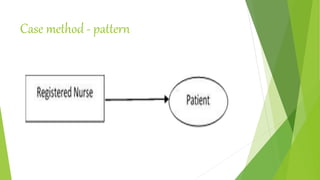
Case method
Oldest method
Total patient care method
Total responsibility of meeting patient need
is of nurse on duty
Assignment of one or more clients to a
nurse for a specific period of time
Case method - principles
 Accountability of care planning
 Continuity
 Co-ordination
 Documentation
 Nursing process
 Cost effectiveness
Case method - pattern
Case method - Merits
 The nurse can see better an attend to the total needs of
clients.(physical , emotional, medical regimen, teaching)
 Continuity of care can be facilitated with care
 Rapport can be build.
 Client may feel more secure.
 Educational needs can be monitored.
 Family and friends become well known by nurse and get
more involved in the care of the client.
 Workload can be equally divided among staffs.
 Nurses are accountable for their function.
Case method - demerits
 The greatest disadvantage is when the nurse is
inadequately trained or prepared to provide total care to
the patients.
 Nurses are not enough to comply the demand of this
model: cost effectiveness should be considered.
 This method has to be modified is nonprofessional health
workers are to be used.
 It is difficult for nurses to use this method to become
involved in long term planning and evaluation of care
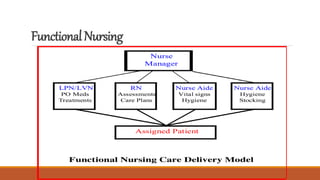
Functionalnursing
 1930, USA
Functional nursing is a method of providing patient care by
which each licensed and unlicensed staff members perform
specific tasks for a large group of patients.
Task method
Good for long term care setting with improved coordination,
care planning and communication.
FunctionalNursing
FunctionalNursing-MERITS
The person can be skilled in the assigned task, it can be
efficient and economical.
The best use of persons aptitudes and experience and desires.
Saves time
Easy to organise the work
Useful in emergency
FunctionalNursing-DEMERITS
Clients can become impersonal, accomplished and
fragmented
Tremendous risk in diminishing continuity of care.
Staff may have very little motivation to develop self and
others, as work becomes monotonous
Clients may feel insecure not knowing who their staff is .
It is difficult to establish clients priorities
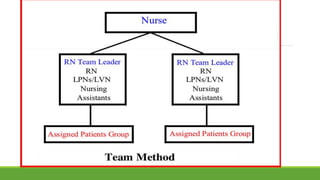
TEAM NURSING
1950’s
A nursing team made up of professional nurses, nursing
auxillaries and nursing aids. They can work together co-
operatively under a well qualified team leader to provide a
range of nursing services which may vary from the simple
to the most complex nursing functions.
TEAM NURSING
The spectrum of nursing functions includes
Simple nursing functions - nursing aides
Intermediate nursing functions - trained nursing personnel.
Professional functions - a nurse with professional nursing education
background.
Better coordination, supervision and efficiency. Potential for high quality
care.
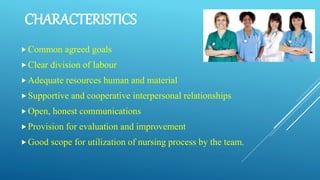
CHARACTERISTICS
Common agreed goals
Clear division of labour
Adequate resources human and material
Supportive and cooperative interpersonal relationships
Open, honest communications
Provision for evaluation and improvement
Good scope for utilization of nursing process by the team.
ADVANTAGES
High-quality, comprehensive care with a high
proportion of ancillary staff.
Team members participate in decision making
and contribute their own expertise.
DISADVANTAGES
No direct care may be given by the team member.
Individual members may not have comprehensive knowledge
about the patient as a whole due to lack of communication
Team members may become too much dependent on the leader for
the decision making.
Nursing care may become fragmented.
Continuity suffers if daily team assignments vary
Team leader should have good leadership skills.
Insufficient time for planning and communication
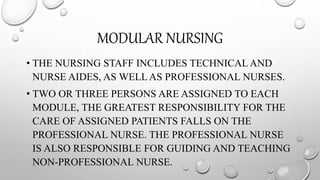
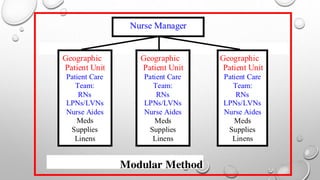
MODULAR NURSING
• THE NURSING STAFF INCLUDES TECHNICAL AND
NURSE AIDES, AS WELLAS PROFESSIONAL NURSES.
• TWO OR THREE PERSONS ARE ASSIGNED TO EACH
MODULE, THE GREATEST RESPONSIBILITY FOR THE
CARE OF ASSIGNED PATIENTS FALLS ON THE
PROFESSIONAL NURSE. THE PROFESSIONAL NURSE
IS ALSO RESPONSIBLE FOR GUIDING AND TEACHING
NON-PROFESSIONAL NURSE.
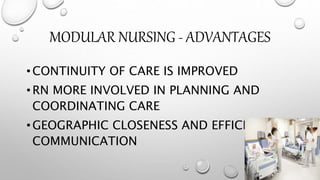
MODULAR NURSING - ADVANTAGES
•CONTINUITY OF CARE IS IMPROVED
•RN MORE INVOLVED IN PLANNING AND
COORDINATING CARE
•GEOGRAPHIC CLOSENESS AND EFFICIENT
COMMUNICATION
MODULAR NURSING - DISADVANTAGES
•INCREASED COSTS TO STOCK EACH
MODULE
•LONG CORRIDORS NOT CONDUCIVE TO
MODULAR NURSING.
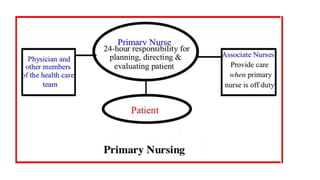
PRIMARY NURSING METHOD
 Comprehensive, continuous and coordinated nursing
process for meeting the total needs of each patient.
 Primary nursing concept was to promote individualized
nursing care and to make qualified registered nurses
assume responsibilities for nursing care provided to
patients .
 One registered nurse is responsible for patient care over
24 hours period , 7 days a week from the time the patient
CONCEPT OF PRIMARY NURSING
 Patient assessment by a primary nurse
 Complete communication of care given in the nursing staff daily
reporting method.
 Discharge planning including teaching, family involvement and
appropriate references.
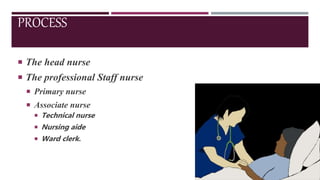
PROCESS
 The head nurse
 The professional Staff nurse
 Primary nurse
 Associate nurse
 Technical nurse
 Nursing aide
 Ward clerk.
ADVANTAGES
 High-quality, holistic patient care
 Establish rapport with patient
 RN feels challenged and rewarded
 Increased communication with physician and other health care provider
 Works with professional staff
 Autonomy, Motivation.
DISADVANTAGES
 RN may be inexperienced and lack of autonomy.
 RN must accept 24-hour responsibility
 More RNs needed; not cost-effective
Case management method
• Case management is a process of monitoring an
individual patient’s health care by the case manager, for
the purpose of maximizing positive outcomes and
containing costs
• Quality of care plus cost.
• From the diagnostic phase through
hospitalization, rehabilitation and back to home
care.
• Planning, implementing, coordinating and
evaluating care for the patient throughout the
period of illness
• plans are made in advance for the next needed
step.
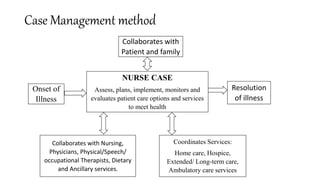
Case Management method
Collaborates with
Patient and family
NURSE CASE
Assess, plans, implement, monitors and
evaluates patient care options and services
to meet health
Onset of
Illness
Collaborates with Nursing,
Physicians, Physical/Speech/
occupational Therapists, Dietary
and Ancillary services.
Resolution
of illness
Coordinates Services:
Home care, Hospice,
Extended/ Long-term care,
Ambulatory care services
advantages
a) For the patient:
- standardized patient care outcomes for each patient.
- early patient discharge
- Using the fewest possible appropriate health care resources .
- Facilitating the continuity of patient care
b) For the nurse:
- Enhancing nurse’s professional development and job satisfaction.
- Facilitating the transfer of knowledge of expert clinical staff of novice staff
disadvantages
• lack of administrative support.
• Expensive
• client focused and outcome oriented
• Facilitates and promotes co-ordination of cost- effective care
• It is a professionally autonomous role that requires expert
clinical knowledge and decision-making skills.
Critical pathway
• Clinical pathways/ care pathways /critical pathways/ integrated care
pathways/care maps
• Manage the quality in healthcare concerning the standardization of
care processes
• Clinical pathways promote organized and efficient patient care based
on evidence based practice.
• Clinical pathways optimize outcomes in the acute care and home care
settings.
Progressive patient care
• Medical /surgical care is delivered in various areas or units
according to the health status of the patient.
• Principal Elements
• Intensive / critical care
• Intermediate care
• Convalescent and self care
• Long term care
• Home care
• Ambulatory care
Benefits
• specialized attention
• Patient gets assistance in making adjustment to hospital , home and
community
• effective use of special skills and abilities of nurses
• Quantity of nursing services can be increased by use of semi-skilled
staff
• Quality nursing can be improved
• efficient use of highly skilled, personnel and expensive high tech
equipment
• continuity of care.
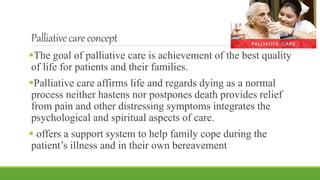
Palliativecare concept
The goal of palliative care is achievement of the best quality
of life for patients and their families.
Palliative care affirms life and regards dying as a normal
process neither hastens nor postpones death provides relief
from pain and other distressing symptoms integrates the
psychological and spiritual aspects of care.
 offers a support system to help family cope during the
patient’s illness and in their own bereavement
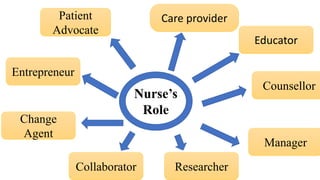
Counsellor
Educator
Manager
Researcher
Change
Agent
Entrepreneur
Patient
Advocate
Care provider
Collaborator
JOURNAL ABSTRACT
• The Effects of the Primary Nursing Care Model: A
Systematic Review
Since the 1980s, the primary nursing model has gained
increasing prominence. The study aims to describe the effects
of the primary nursing model for patients, their family
members, nursing staff and the care organization. Based on
the findings of this review, it seems that the primary nursing
model may have beneficial effects for patients in the contexts
of care , it seems to add to patient satisfaction with care and
reduce health problems.
JOURNAL ABSTRACT CONT….
It is also possible that the model contributes to nurses’
increased sense of job control and autonomy. There is also
preliminary evidence that the costs of the primary nursing
model are lower than those of the team nursing model. In the
future, family members will be increasingly involved in patient
care, and therefore it is important to understand how nursing
under the primary nursing model supports the coping of the
patient’s family members during periods of hospitalization.
JOURNAL ABSTRACT CONT….
• Team Nursing : A collaborative approach improves patient care
This article describes an evidence based project to improve the
delivery of care and patient and staff satisfaction with team nursing.
The primary benefit of this approach is that pairing nurses provides a
resource and supplement to patient care. The results of a baseline
survey to evaluate staff satisfaction and morale indicated staff
members were dissatisfied because of a lack of team work and
support from peers in patient care. Believing that poor nurse
satisfaction is related to undesirable patient outcomes and decreased
quality of care, the authors of article , who were the stakeholders,
decided that a team nursing model of care would be implemented
Assignment
Write an assignment on “Patterns of Nursing
care delivery system in ICU’s”.
Bibliography
• Basheer PS, Khan YS. A concise textbook of advanced nursing
practice. Bangalore: EMMESS medical Publishers; 2012.
• Soni S .Ttextbook of advanced nursing practice. India: Jaypee
Publication; 2013.
• Basvanthappa BT. Nursing Administration. Second edition. India:
Jaypee Publication; 2009.
• Dickerson J, Latina A. Team Nursing: a collaborative approach
improves patient care. Nursing 2017. Volume 47 (issue 10); 16-17.
Nursing care delivery

Nursing care delivery

  • 2.
    PATTERNS OF NURSINGCARE DELIVERY SYSTEM IN INDIA PRINCY FRANCIS M I yr MSc (N) JMCON
  • 3.
    DEFINITION The nursing caredelivery system means “the process of delivering care to the client by combining various aspects of nursing service which will fit to various patient care settings to produce a common outcome of delivering quality care and meeting the needs of clients”.
  • 4.
    ELEMENTS Clinical decision making Workallocation Communication Management Coordination
  • 5.
    PRINCIPLES OF NURSINGCARE DELIVERY Holistic approach is used to identify nursing care needs. Nursing care is based on a helping relationship. It is the unique function of nurse to provide nursing care according to client s needs. The aspect of patient care has to be initiated and controlled by nurse. There should be justification for selecting each delivery system. Before planning care organizational polices to be considered.
  • 6.
    Factors influencing nursingcare delivery system Availability of adequate staff in words or units. Patient census. Extend of staff deficiency. Organizational policies regarding its practice. Patient preference for care. Availability of skilled staff.
  • 7.
    Factors influencing nursingcare delivery system cont… Opportunities for continuing and in-service education for the staff. Budget of the organization. Socioeconomic condition of the patient. Organizations mission. Patient and community needs.
  • 8.
    methods 1.Traditional methods # Casemethod # Functional method # Team method # Modular nursing # Primary nursing method 2. Advanced methods # Case Management # Critical pathway
  • 9.
    Case method Oldest method Totalpatient care method Total responsibility of meeting patient need is of nurse on duty Assignment of one or more clients to a nurse for a specific period of time
  • 10.
    Case method -principles  Accountability of care planning  Continuity  Co-ordination  Documentation  Nursing process  Cost effectiveness
  • 11.
  • 12.
    Case method -Merits  The nurse can see better an attend to the total needs of clients.(physical , emotional, medical regimen, teaching)  Continuity of care can be facilitated with care  Rapport can be build.  Client may feel more secure.  Educational needs can be monitored.  Family and friends become well known by nurse and get more involved in the care of the client.  Workload can be equally divided among staffs.  Nurses are accountable for their function.
  • 13.
    Case method -demerits  The greatest disadvantage is when the nurse is inadequately trained or prepared to provide total care to the patients.  Nurses are not enough to comply the demand of this model: cost effectiveness should be considered.  This method has to be modified is nonprofessional health workers are to be used.  It is difficult for nurses to use this method to become involved in long term planning and evaluation of care
  • 14.
    Functionalnursing  1930, USA Functionalnursing is a method of providing patient care by which each licensed and unlicensed staff members perform specific tasks for a large group of patients. Task method Good for long term care setting with improved coordination, care planning and communication.
  • 15.
  • 16.
    FunctionalNursing-MERITS The person canbe skilled in the assigned task, it can be efficient and economical. The best use of persons aptitudes and experience and desires. Saves time Easy to organise the work Useful in emergency
  • 17.
    FunctionalNursing-DEMERITS Clients can becomeimpersonal, accomplished and fragmented Tremendous risk in diminishing continuity of care. Staff may have very little motivation to develop self and others, as work becomes monotonous Clients may feel insecure not knowing who their staff is . It is difficult to establish clients priorities
  • 18.
    TEAM NURSING 1950’s A nursingteam made up of professional nurses, nursing auxillaries and nursing aids. They can work together co- operatively under a well qualified team leader to provide a range of nursing services which may vary from the simple to the most complex nursing functions.
  • 19.
    TEAM NURSING The spectrumof nursing functions includes Simple nursing functions - nursing aides Intermediate nursing functions - trained nursing personnel. Professional functions - a nurse with professional nursing education background. Better coordination, supervision and efficiency. Potential for high quality care.
  • 20.
    CHARACTERISTICS Common agreed goals Cleardivision of labour Adequate resources human and material Supportive and cooperative interpersonal relationships Open, honest communications Provision for evaluation and improvement Good scope for utilization of nursing process by the team.
  • 22.
    ADVANTAGES High-quality, comprehensive carewith a high proportion of ancillary staff. Team members participate in decision making and contribute their own expertise.
  • 23.
    DISADVANTAGES No direct caremay be given by the team member. Individual members may not have comprehensive knowledge about the patient as a whole due to lack of communication Team members may become too much dependent on the leader for the decision making. Nursing care may become fragmented. Continuity suffers if daily team assignments vary Team leader should have good leadership skills. Insufficient time for planning and communication
  • 24.
    MODULAR NURSING • THENURSING STAFF INCLUDES TECHNICAL AND NURSE AIDES, AS WELLAS PROFESSIONAL NURSES. • TWO OR THREE PERSONS ARE ASSIGNED TO EACH MODULE, THE GREATEST RESPONSIBILITY FOR THE CARE OF ASSIGNED PATIENTS FALLS ON THE PROFESSIONAL NURSE. THE PROFESSIONAL NURSE IS ALSO RESPONSIBLE FOR GUIDING AND TEACHING NON-PROFESSIONAL NURSE.
  • 26.
    MODULAR NURSING -ADVANTAGES •CONTINUITY OF CARE IS IMPROVED •RN MORE INVOLVED IN PLANNING AND COORDINATING CARE •GEOGRAPHIC CLOSENESS AND EFFICIENT COMMUNICATION
  • 27.
    MODULAR NURSING -DISADVANTAGES •INCREASED COSTS TO STOCK EACH MODULE •LONG CORRIDORS NOT CONDUCIVE TO MODULAR NURSING.
  • 28.
    PRIMARY NURSING METHOD Comprehensive, continuous and coordinated nursing process for meeting the total needs of each patient.  Primary nursing concept was to promote individualized nursing care and to make qualified registered nurses assume responsibilities for nursing care provided to patients .  One registered nurse is responsible for patient care over 24 hours period , 7 days a week from the time the patient
  • 29.
    CONCEPT OF PRIMARYNURSING  Patient assessment by a primary nurse  Complete communication of care given in the nursing staff daily reporting method.  Discharge planning including teaching, family involvement and appropriate references.
  • 30.
    PROCESS  The headnurse  The professional Staff nurse  Primary nurse  Associate nurse  Technical nurse  Nursing aide  Ward clerk.
  • 32.
    ADVANTAGES  High-quality, holisticpatient care  Establish rapport with patient  RN feels challenged and rewarded  Increased communication with physician and other health care provider  Works with professional staff  Autonomy, Motivation.
  • 33.
    DISADVANTAGES  RN maybe inexperienced and lack of autonomy.  RN must accept 24-hour responsibility  More RNs needed; not cost-effective
  • 34.
    Case management method •Case management is a process of monitoring an individual patient’s health care by the case manager, for the purpose of maximizing positive outcomes and containing costs • Quality of care plus cost.
  • 35.
    • From thediagnostic phase through hospitalization, rehabilitation and back to home care. • Planning, implementing, coordinating and evaluating care for the patient throughout the period of illness • plans are made in advance for the next needed step.
  • 36.
    Case Management method Collaborateswith Patient and family NURSE CASE Assess, plans, implement, monitors and evaluates patient care options and services to meet health Onset of Illness Collaborates with Nursing, Physicians, Physical/Speech/ occupational Therapists, Dietary and Ancillary services. Resolution of illness Coordinates Services: Home care, Hospice, Extended/ Long-term care, Ambulatory care services
  • 37.
    advantages a) For thepatient: - standardized patient care outcomes for each patient. - early patient discharge - Using the fewest possible appropriate health care resources . - Facilitating the continuity of patient care b) For the nurse: - Enhancing nurse’s professional development and job satisfaction. - Facilitating the transfer of knowledge of expert clinical staff of novice staff
  • 38.
    disadvantages • lack ofadministrative support. • Expensive • client focused and outcome oriented • Facilitates and promotes co-ordination of cost- effective care • It is a professionally autonomous role that requires expert clinical knowledge and decision-making skills.
  • 39.
    Critical pathway • Clinicalpathways/ care pathways /critical pathways/ integrated care pathways/care maps • Manage the quality in healthcare concerning the standardization of care processes • Clinical pathways promote organized and efficient patient care based on evidence based practice. • Clinical pathways optimize outcomes in the acute care and home care settings.
  • 40.
    Progressive patient care •Medical /surgical care is delivered in various areas or units according to the health status of the patient. • Principal Elements • Intensive / critical care • Intermediate care • Convalescent and self care • Long term care • Home care • Ambulatory care
  • 41.
    Benefits • specialized attention •Patient gets assistance in making adjustment to hospital , home and community • effective use of special skills and abilities of nurses • Quantity of nursing services can be increased by use of semi-skilled staff • Quality nursing can be improved • efficient use of highly skilled, personnel and expensive high tech equipment • continuity of care.
  • 42.
    Palliativecare concept The goalof palliative care is achievement of the best quality of life for patients and their families. Palliative care affirms life and regards dying as a normal process neither hastens nor postpones death provides relief from pain and other distressing symptoms integrates the psychological and spiritual aspects of care.  offers a support system to help family cope during the patient’s illness and in their own bereavement
  • 43.
  • 44.
    JOURNAL ABSTRACT • TheEffects of the Primary Nursing Care Model: A Systematic Review Since the 1980s, the primary nursing model has gained increasing prominence. The study aims to describe the effects of the primary nursing model for patients, their family members, nursing staff and the care organization. Based on the findings of this review, it seems that the primary nursing model may have beneficial effects for patients in the contexts of care , it seems to add to patient satisfaction with care and reduce health problems.
  • 45.
    JOURNAL ABSTRACT CONT…. Itis also possible that the model contributes to nurses’ increased sense of job control and autonomy. There is also preliminary evidence that the costs of the primary nursing model are lower than those of the team nursing model. In the future, family members will be increasingly involved in patient care, and therefore it is important to understand how nursing under the primary nursing model supports the coping of the patient’s family members during periods of hospitalization.
  • 46.
    JOURNAL ABSTRACT CONT…. •Team Nursing : A collaborative approach improves patient care This article describes an evidence based project to improve the delivery of care and patient and staff satisfaction with team nursing. The primary benefit of this approach is that pairing nurses provides a resource and supplement to patient care. The results of a baseline survey to evaluate staff satisfaction and morale indicated staff members were dissatisfied because of a lack of team work and support from peers in patient care. Believing that poor nurse satisfaction is related to undesirable patient outcomes and decreased quality of care, the authors of article , who were the stakeholders, decided that a team nursing model of care would be implemented
  • 47.
    Assignment Write an assignmenton “Patterns of Nursing care delivery system in ICU’s”.
  • 48.
    Bibliography • Basheer PS,Khan YS. A concise textbook of advanced nursing practice. Bangalore: EMMESS medical Publishers; 2012. • Soni S .Ttextbook of advanced nursing practice. India: Jaypee Publication; 2013. • Basvanthappa BT. Nursing Administration. Second edition. India: Jaypee Publication; 2009. • Dickerson J, Latina A. Team Nursing: a collaborative approach improves patient care. Nursing 2017. Volume 47 (issue 10); 16-17.