Presenter:
Mr. Mahesh Chand
Lecturer
M.Sc Nursing
Independent Nurse Practice (INP)
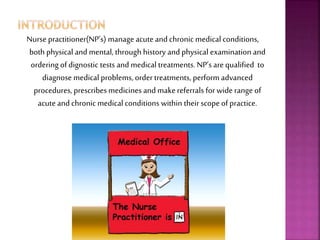
Nurse practitioner(NP’s) manage acuteand chronic medical conditions,
both physical and mental, through history and physical examination and
ordering of dignostic tests and medical treatments. NP’s arequalified to
diagnose medical problems, ordertreatments, perform advanced
procedures, prescribes medicines and makereferrals for wide range of
acute and chronic medical conditions within their scope of practice.
In additionto buildingupon and
expandingtheir nursing
knowledge andskills,the
nurse practitioneralsolearns
medicine and uses medical
diagnoses andmedical
treatments in their practice.
Nurse Practitioners:
a) A nurse practitioner (NP) is defined as, “ an advanced
practice registered nurse (APRN) who hascompleted
graduate level education ( either a master of nursing or
doctor of nursing practice degree).
b) Nurse practitioner (NP) are registered nurses who have
graduate level nursing preparations asa nurse practitioners
at the masters or doctoral level and perform comprehensive
assessments and promote health and the prevention of
illness and injury”
An INP is defined as, “A registered nurse who provides
professionals nursingservices as a proprietor of a
business, through direct patientcare,
education,research, administrationor consultation.”
In 1985, a smallgroup of visionaries convened under
an apple tree in Pennsylvania to address the growing
needs for NP’s of all specialities to have a unified
voice. Theyestablished AANP to fillthatneed and
become “ the voice of the nurse practitioner”.
These perceptive leaders recognised thatnational
action was essentialto securing therelevence and
durability of NP role.
 The AANP hasflorished and now represents the
interestof over 205,000 NP’s.
The INP for years registered nurses traditionally
worked in hospitals, in healthcare institutions,public
healthsettings, research and government services,
wherethey have significantcontact and professional
interactions primarily withother healthcare
professionals.
1965: Dr. Loretta ford and Dr. Henry silver develop the
first Nurse Practitioner(NP)program at theuniversity
of Colorado.
1967: Boston college initiatesone of theearliest master’s
programs for NP’s.
1971: One of the first family NP programme , PRIMEX opens its
doors at the university of washington.
1973: More than65 NP programs exists in U.S.
1974: The American Nurses Association (ANA) develops the
Council Of Primary Care Nurse Practitioners, helping
legitimize the role.
The Burlington Randomized trialstudy finds that NP’s make
appropriate referrals when medical intervention is necessary.
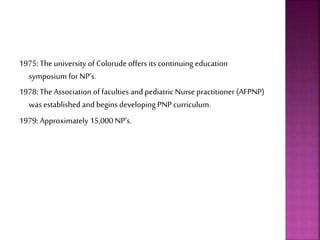
1975: The university of Colorude offers its continuing education
symposium for NP’s.
1978: The Association of faculties and pediatric Nurse practitioner (AFPNP)
was established and begins developing PNP curriculum.
1979: Approximately 15,000 NP’s.
1980:Morethan200 NPprogrammeortrackswereavailabletostudents.
NursePractitionerAssociationforcontinuingeducation(NPACE) wasestablished.
Guidelines forfamilyNursePractitionerCurriculumPlanningis publishedafterfive years
ofdevelopment theuniversityofNewMexico.
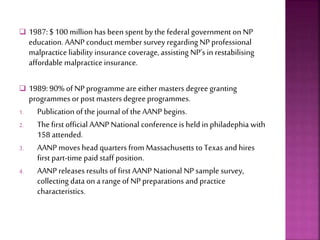
 1987: $ 100 million has beenspent by the federal government on NP
education. AANP conduct member survey regardingNP professional
malpractice liability insurance coverage,assisting NP’s in restabilising
affordable malpractice insurance.
 1989: 90% of NP programme are either masters degreegranting
programmes or post masters degreeprogrammes.
1. Publication of the journal of the AANP begins.
2. Thefirst official AANP National conferenceis held in philadephia with
158 attended.
3. AANP moveshead quarters from Massachusetts to Texas and hires
first part-time paid staff position.
4. AANP releases results of first AANP National NP sample survey,
collecting data on a rangeofNP preparations and practice
characteristics.
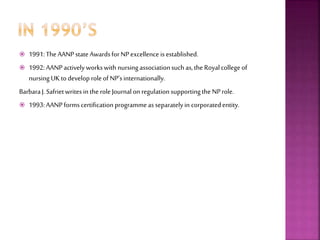
 1991:The AANPstateAwardsforNPexcellence is established.
 1992:AANPactively workswith nursingassociationsuch as,the Royalcollege of
nursing UKtodevelop roleofNP’sinternationally.
BarbaraJ.Safrietwritesin theroleJournalon regulationsupportingthe NProle.
 1993:AANPformscertificationprogrammeas separatelyin corporatedentity.
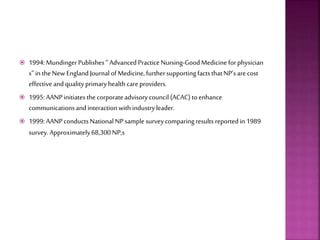
 1994:MundingerPublishes“Advanced PracticeNursing-GoodMedicine forphysician
s”in theNewEnglandJournalofMedicine, furthersupportingfactsthatNP’sarecost
effectiveandqualityprimaryhealthcareproviders.
 1995:AANPinitiatesthe corporateadvisorycouncil (ACAC) toenhance
communicationsandinteractionwith industryleader.
 1999:AANPconductsNationalNPsample surveycomparingresults reportedin 1989
survey. Approximately68,300NP;s
 2000:AANPinitiatesthe fellows programmeshostsfirstinternationalNPconferencein
U.S. AndcreatesthePolitical ActionCommittee(PAC).
 2002:AANPhas13,500individual membersand70groupmembers.
 2003:AANPmembership survey is conducted.AANPhas14,500individualmembers
and74groupmembers. Approximately97,000NP’sin theU.S(AANP).
 2004:The AmericanAssociationofcolleges of nursing(AACN) publishesposition
paperonDoctorateofnursingpractice.AANP conductsnationalNP samplesurvey.
Approximately106,000NP’sin theU.S. (AANP).
 2005:AANPcelebrates 20yearsasthe oldestandlargest nationalorganizationforNP’s
ofall specialities.NP;scelebrates 40yearsofpractice.
 2006:AANPconductseducationalneedsassessmentssurvey. AANPfellows(FAANP)
launchesthe membership programme.
 2007:conduct2007AANP NationalNPincome survey.
 2009: Distribute : “Did you know?” AANP video showcasing
the role of the NP.
Video is distributed to public televisions stations in all50 states
and 400 times in many of the top 200 markers on networks such
asCNN fox news, discovery and is distributed internationalto
voice of America with a daily viewing audience of 96 million
people airing in 200 cities and 127 countries.
Product advertorial open letter to president Obama and
members of congress highlighting NP’s asprimary care
providers.
The letter runs in rollcallpublication that is distributed to elected
officals in D.C. Approximately 130,000 NP’s.
 2010: AANP attends president Obama’s white house for briefing on
health carereform legislation.
 AANP celebrates 25th anniversary. AANP has 28,000 individual members
and 151 groups (As of May 2010).
 2013: on 1 June 2013.
the american academy of nurse practitioners (Founded in1965)
and the american college of nurse practitioners (Founded in
1995) came together to form the american associationof nurse
proffessional membership organization for NP’s of all
specialities.
Nursepractitionerscanbeeducatedandnationallycertifiedin areasof:
• Family health paediatric (FNP) including paediatric acute/ chronic care
• Paediatric critical care
• Paediatric oncology
• General paediatric (PNP)
• Neonatology (NNP)
• Gerontology (GNP)
• Women health(WHNP)
• Psychiatric and Mental health(PMHNP)
• Acutecare (ACNP), adult health(ANP)
• Oncology
• Emergency
• Occupational health
Registered nurses initiallytrained at the associatedegree or
diploma level often must first complete B.sc nursing and enter
various programmes offering an M.Sc nursing programme.
The settingfor nurse practitioners to provide care, NP’s
are employed within several specialities:
Neonatology
Nurse midwifery
Paediatrics
School health
Familyand adulthealth
Womens health
Mentalhealth
Home care
Geriatrics and acute care.
NP’s focus largely on:
• Health maintenance
• Disease prevention
• Counselling and
• Patients education
However, they are fully qualified to be involved in patient
diagnosis and treatment, which also includes same prescriptive
authority. Scope of an NP’s practice varies depending upon state
regulations.
 NP’s are uniquely focused on “caring” asopposed “curing”.
 NP’s combine nursing education and experience with through
education in medical care for their speciality care
 They takethe “whole person” into account, not just the
immediate ailment.
 NP’s provide patient centered care.
 They are specifically trained to educate and support
individuals and families, helping them change behaviours and
make informed, individualschoices about their health and
their healthcare.
 NP’s provide high quality, cost effective care.
one study compare the cost of care for two primary care
problems and found thatthe cost care given by NP’s was20%
less thanthe cost of care given by physicians.
NP’s practice in collaboration with physician, which means that the
collaborating physician agrees to acceptreferrals from the NP and will be
available for consultation as needed.
 Morethan148,000NP’spracticing.
18%in rural.
 89%preparedin primarycare.
 43%hold hospitalprivileges.
 Mean full timebasesalaryfor2011:
$91,310withaverageincome $98,760.
Issues:
1. lackofunderstandingofthe nursepractitionerrole.
2. Endorsement
3. Conflictofinterest.
4. Public perception.
5. Advertising.
6. Attitudetowardsthe independentnursepractitioner.
7. Lackofcarrier advancement.
8. Prescriptiveauthority.
9. Scopeofprofessionalpractice.
10. fees.
1. Policy
2. Allowing staff to develop Proffessional autonomy.
3. Involving staff in alldecisions.
4. Establishing collaborative procedures between staff and
management.
5. Making availablework environment structures.
6. Characteristicsof the transformational leadership style.
7. Psychological stage.
8. Professional knowledge, accountability.
9. Education.
10. Responsibility to carry their scopes of practice.
1. Nursing education must prepare qualified nurses to respond
to changes in health care goal of the nationspopulations.
2. The philosophy underlying nursing is crucial for modifing
the practice in the new era.
3. There should be change in self change in relationships with
others & change in behaviour.
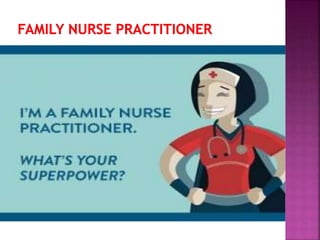
Family nurse practitioner are subset of nurse practitioners who
specialised in all issues of health surrounding the family and
often with anemphasis on education and preventive or
remediative self care.
In essence “family care” is a broad term thatcovers a wide range
of medical concerns and embassies fulllife care for allfamily
members from the very young to the very elderly and
everyone in between.
Family nurse practitioner can offer most services that are
traditionally offered by physicians, asa result of the advanced
standing in terms of education and practical experience.
Which includes : ability to write prescription aswell ascovering a
broader scope of practice such as diagnostic procedures and
physical examinations.
 Thefamily nurse practitioner provides direct patient clinical carein an
ambulatory settings.
 Theyprovidehealth maintenance exams with appropriate patient
education for all age group , including well child exams, adolescent exam
and sports physical & adult physicals including pap and pelvic
examination.
 Theyperform pregnancy confirmation and introduction of pregnant
patient into the prenatal care in coordination with physicians.
 Patient education is provided in different settings and as perageand
condition appropriate.
 Theyperform system examination of patients with specific acute
complaints or stable chronic illness, initiate treatment for identified
conditions accordingto written protocol and work closely with clinic.
Physicians in reffering patients with significant abnormal findings.
 Education can bedone 1:1 orin a group, including parenting, perinatal,
family plannig, preventing health and disease specific(Eg. DM,HTN)
 Thenurse provides assistance to the medical directoron epidemiological
issues pertinent to the health centre.
 They maintainchart documentation, tracking and reporting
systems as indicated for continuity of care.
 Participate in the on callschedule asappropriate and as a
assigned by the medical director.
 The family nurse practitioner is a preceptor to nurse
practitioner students asappropriate to level of experience as a
nurse practitioner.
• Entry level competencies of the family nurse practitioner are
derived of direct and stimulated experience.
• Family nurse practitioners are committed to familyoriented
health care.
• A skilledfamily nurse practitioner should demonstrate
competence the following domains:
The domain requires for the nurse to be able to provide an
assessment of patients healthstatus. In this role, they must be
capable of using contemporary theories and clinicalknowledge
successfullmanagement involves healthpromotion and
protection, disease prevention & treatment.
As their directcare nurse, they need to
demonstrate a personableapproachin delivering
care competencies in thisdomainaddressthe
importanceof personal interactionin the patients
outcome.
These compentenciesquestion theirability to convey
knowledge.Functioningas a coach or a teacher
requirs skills of interpret and personalize therapies.
The role of NPis to implementthe best care to patients,
the advancements of theprofession and the
enhancement ofdirect care & management.A nurse
practitionermustdemonstratea commitmentto the
professional role.
These compentencies question the role they will
have in successfully overseeing situations and
directing the delivery outcomes.
this is done to assure the quality of care.
The nurses ability to provide competent care delivered
withrespect to cultural and spiritual beliefs to patients
from diverse cultures is questioned.
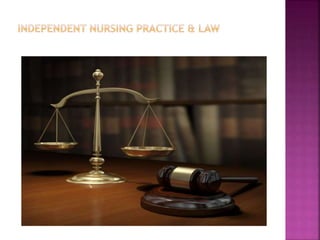
Law is the kingsof kings& it controls every aspects of life.
The main aim of law is to ensure discipline & to make every
individual accountablefor public good.
Right to life is the first human right on the earth & it is protected
by every constitution across the world .
Right to health isa part of Right to life & is recognized under
various international supreme court judgements.
Establishing an independent nursing practice is an
opportunity to obtain greater autonomy in
nursing practice and to focus on a particular
population on healthcare venue.
It is significant development for nurses making the
best use of their knowledge and skills & ensuring
improved access for patients service.
1. Leadership challengeto work independently.
2. Access to medical services in power communities where
general physiciansare not available.
3. Pre, post and current clinicalspecial supervision & services.
4. Quickmedical treatment.
5. Excellence& quality standard of care
1. Lackofunderstandingofmajor medical diagnosis.
2. Conflictofinterest withdoctors.
3. Accountability& responsilitytowardspublic.
4. Fee & licence toopenclinics.
5. Medical malpractice& legal liability.
NP have long been lauded in the literature with respect to the
high quality of patient care & cost effectiveness.
However, they lackbasic freedom & financialautonomy.
Their services are considered as bonded labour & subordinate to
medical practitioners. Independent practice is as hope for
liberation.
a] Doctors vsNurses
b] Limitation on scopeofpractice
c] Denial of hospital privilege
d] Reimbursement of fees.
There is a need for comprehensive legislation & guidelines to
protect the interest of nurses & public at large.
 1] Rush & negligent act
2] Public health
3] Safety
4] Tax liability
1] Constitution of india
2] Indian panel code
3] Consumer protection act
4] Indian nursing council act
5] Prevention of sex determination act
6] Transplantation of human organ act ,
1994.
The best protection from any legal laibility
is knowledge of law and strict adherence
to the norm laid down by law.
1] Licence to practice, renewal and registration
2] Proper documentation
3] Working within the limits laid down by law with due careand caution
4] Counselling within the area of specialization
5] Medical assistance by experts
6] Insurance coverage & financialmanagement
7] Taxpayment
8] Informed consent
9] Adherence to professional regulation
10] Honesty , Sincerity & good governance in practice
Independent nursing practice isa step towards liberation &
insuring dignity to the profession of nursing. It will ensure
financialautonomy and uplift the profession of nursing.
Nursing practice is noble idea for upliftment of nursing
profession but with a rider of caution that healthis more
important than money. Strict adherence to legal norms
ensures peace of mind & prosperity.
1] Shebeer.P.Basheer, S.Yaseen Khan, Aconsise Textbook of
Advanced Nursing Practice , Emmess Medical Publishers.
Edition 2012 Page no:- 694-699
2] www.independent nurse.co.uk
3]JE Helms, Journal of Nursing Education , 2006- search
proquest.com
4] SN Hesse-Biber, Pleary-2010-books.google.com
5] Magzine of NationalConference on independent Nurse
Practice organized by BVDU,CON,Sangli
THANKYOU

Independent nurse practice

  • 1.
    Presenter: Mr. Mahesh Chand Lecturer M.ScNursing Independent Nurse Practice (INP)
  • 2.
    Nurse practitioner(NP’s) manageacuteand chronic medical conditions, both physical and mental, through history and physical examination and ordering of dignostic tests and medical treatments. NP’s arequalified to diagnose medical problems, ordertreatments, perform advanced procedures, prescribes medicines and makereferrals for wide range of acute and chronic medical conditions within their scope of practice.
  • 3.
    In additionto buildinguponand expandingtheir nursing knowledge andskills,the nurse practitioneralsolearns medicine and uses medical diagnoses andmedical treatments in their practice.
  • 4.
    Nurse Practitioners: a) Anurse practitioner (NP) is defined as, “ an advanced practice registered nurse (APRN) who hascompleted graduate level education ( either a master of nursing or doctor of nursing practice degree). b) Nurse practitioner (NP) are registered nurses who have graduate level nursing preparations asa nurse practitioners at the masters or doctoral level and perform comprehensive assessments and promote health and the prevention of illness and injury”
  • 5.
    An INP isdefined as, “A registered nurse who provides professionals nursingservices as a proprietor of a business, through direct patientcare, education,research, administrationor consultation.”
  • 6.
    In 1985, asmallgroup of visionaries convened under an apple tree in Pennsylvania to address the growing needs for NP’s of all specialities to have a unified voice. Theyestablished AANP to fillthatneed and become “ the voice of the nurse practitioner”. These perceptive leaders recognised thatnational action was essentialto securing therelevence and durability of NP role.  The AANP hasflorished and now represents the interestof over 205,000 NP’s.
  • 7.
    The INP foryears registered nurses traditionally worked in hospitals, in healthcare institutions,public healthsettings, research and government services, wherethey have significantcontact and professional interactions primarily withother healthcare professionals.
  • 8.
    1965: Dr. Lorettaford and Dr. Henry silver develop the first Nurse Practitioner(NP)program at theuniversity of Colorado. 1967: Boston college initiatesone of theearliest master’s programs for NP’s.
  • 9.
    1971: One ofthe first family NP programme , PRIMEX opens its doors at the university of washington. 1973: More than65 NP programs exists in U.S. 1974: The American Nurses Association (ANA) develops the Council Of Primary Care Nurse Practitioners, helping legitimize the role. The Burlington Randomized trialstudy finds that NP’s make appropriate referrals when medical intervention is necessary.
  • 10.
    1975: The universityof Colorude offers its continuing education symposium for NP’s. 1978: The Association of faculties and pediatric Nurse practitioner (AFPNP) was established and begins developing PNP curriculum. 1979: Approximately 15,000 NP’s.
  • 11.
    1980:Morethan200 NPprogrammeortrackswereavailabletostudents. NursePractitionerAssociationforcontinuingeducation(NPACE) wasestablished. GuidelinesforfamilyNursePractitionerCurriculumPlanningis publishedafterfive years ofdevelopment theuniversityofNewMexico.
  • 12.
     1987: $100 million has beenspent by the federal government on NP education. AANP conduct member survey regardingNP professional malpractice liability insurance coverage,assisting NP’s in restabilising affordable malpractice insurance.  1989: 90% of NP programme are either masters degreegranting programmes or post masters degreeprogrammes. 1. Publication of the journal of the AANP begins. 2. Thefirst official AANP National conferenceis held in philadephia with 158 attended. 3. AANP moveshead quarters from Massachusetts to Texas and hires first part-time paid staff position. 4. AANP releases results of first AANP National NP sample survey, collecting data on a rangeofNP preparations and practice characteristics.
  • 13.
     1991:The AANPstateAwardsforNPexcellenceis established.  1992:AANPactively workswith nursingassociationsuch as,the Royalcollege of nursing UKtodevelop roleofNP’sinternationally. BarbaraJ.Safrietwritesin theroleJournalon regulationsupportingthe NProle.  1993:AANPformscertificationprogrammeas separatelyin corporatedentity.
  • 14.
     1994:MundingerPublishes“Advanced PracticeNursing-GoodMedicineforphysician s”in theNewEnglandJournalofMedicine, furthersupportingfactsthatNP’sarecost effectiveandqualityprimaryhealthcareproviders.  1995:AANPinitiatesthe corporateadvisorycouncil (ACAC) toenhance communicationsandinteractionwith industryleader.  1999:AANPconductsNationalNPsample surveycomparingresults reportedin 1989 survey. Approximately68,300NP;s
  • 15.
     2000:AANPinitiatesthe fellowsprogrammeshostsfirstinternationalNPconferencein U.S. AndcreatesthePolitical ActionCommittee(PAC).  2002:AANPhas13,500individual membersand70groupmembers.  2003:AANPmembership survey is conducted.AANPhas14,500individualmembers and74groupmembers. Approximately97,000NP’sin theU.S(AANP).
  • 16.
     2004:The AmericanAssociationofcollegesof nursing(AACN) publishesposition paperonDoctorateofnursingpractice.AANP conductsnationalNP samplesurvey. Approximately106,000NP’sin theU.S. (AANP).  2005:AANPcelebrates 20yearsasthe oldestandlargest nationalorganizationforNP’s ofall specialities.NP;scelebrates 40yearsofpractice.
  • 17.
     2006:AANPconductseducationalneedsassessmentssurvey. AANPfellows(FAANP) launchesthemembership programme.  2007:conduct2007AANP NationalNPincome survey.
  • 18.
     2009: Distribute: “Did you know?” AANP video showcasing the role of the NP. Video is distributed to public televisions stations in all50 states and 400 times in many of the top 200 markers on networks such asCNN fox news, discovery and is distributed internationalto voice of America with a daily viewing audience of 96 million people airing in 200 cities and 127 countries. Product advertorial open letter to president Obama and members of congress highlighting NP’s asprimary care providers. The letter runs in rollcallpublication that is distributed to elected officals in D.C. Approximately 130,000 NP’s.
  • 19.
     2010: AANPattends president Obama’s white house for briefing on health carereform legislation.  AANP celebrates 25th anniversary. AANP has 28,000 individual members and 151 groups (As of May 2010).
  • 20.
     2013: on1 June 2013. the american academy of nurse practitioners (Founded in1965) and the american college of nurse practitioners (Founded in 1995) came together to form the american associationof nurse proffessional membership organization for NP’s of all specialities.
  • 21.
    Nursepractitionerscanbeeducatedandnationallycertifiedin areasof: • Familyhealth paediatric (FNP) including paediatric acute/ chronic care • Paediatric critical care • Paediatric oncology • General paediatric (PNP) • Neonatology (NNP)
  • 22.
    • Gerontology (GNP) •Women health(WHNP) • Psychiatric and Mental health(PMHNP) • Acutecare (ACNP), adult health(ANP) • Oncology • Emergency • Occupational health
  • 23.
    Registered nurses initiallytrainedat the associatedegree or diploma level often must first complete B.sc nursing and enter various programmes offering an M.Sc nursing programme.
  • 24.
    The settingfor nursepractitioners to provide care, NP’s are employed within several specialities: Neonatology Nurse midwifery Paediatrics School health Familyand adulthealth Womens health Mentalhealth Home care Geriatrics and acute care.
  • 25.
    NP’s focus largelyon: • Health maintenance • Disease prevention • Counselling and • Patients education However, they are fully qualified to be involved in patient diagnosis and treatment, which also includes same prescriptive authority. Scope of an NP’s practice varies depending upon state regulations.
  • 26.
     NP’s areuniquely focused on “caring” asopposed “curing”.  NP’s combine nursing education and experience with through education in medical care for their speciality care  They takethe “whole person” into account, not just the immediate ailment.  NP’s provide patient centered care.  They are specifically trained to educate and support individuals and families, helping them change behaviours and make informed, individualschoices about their health and their healthcare.  NP’s provide high quality, cost effective care.
  • 27.
    one study comparethe cost of care for two primary care problems and found thatthe cost care given by NP’s was20% less thanthe cost of care given by physicians.
  • 28.
    NP’s practice incollaboration with physician, which means that the collaborating physician agrees to acceptreferrals from the NP and will be available for consultation as needed.
  • 29.
     Morethan148,000NP’spracticing. 18%in rural. 89%preparedin primarycare.  43%hold hospitalprivileges.  Mean full timebasesalaryfor2011: $91,310withaverageincome $98,760.
  • 30.
    Issues: 1. lackofunderstandingofthe nursepractitionerrole. 2.Endorsement 3. Conflictofinterest. 4. Public perception. 5. Advertising. 6. Attitudetowardsthe independentnursepractitioner. 7. Lackofcarrier advancement. 8. Prescriptiveauthority. 9. Scopeofprofessionalpractice. 10. fees.
  • 33.
    1. Policy 2. Allowingstaff to develop Proffessional autonomy. 3. Involving staff in alldecisions. 4. Establishing collaborative procedures between staff and management. 5. Making availablework environment structures. 6. Characteristicsof the transformational leadership style. 7. Psychological stage. 8. Professional knowledge, accountability. 9. Education. 10. Responsibility to carry their scopes of practice.
  • 34.
    1. Nursing educationmust prepare qualified nurses to respond to changes in health care goal of the nationspopulations. 2. The philosophy underlying nursing is crucial for modifing the practice in the new era. 3. There should be change in self change in relationships with others & change in behaviour.
  • 36.
    Family nurse practitionerare subset of nurse practitioners who specialised in all issues of health surrounding the family and often with anemphasis on education and preventive or remediative self care.
  • 37.
    In essence “familycare” is a broad term thatcovers a wide range of medical concerns and embassies fulllife care for allfamily members from the very young to the very elderly and everyone in between.
  • 38.
    Family nurse practitionercan offer most services that are traditionally offered by physicians, asa result of the advanced standing in terms of education and practical experience. Which includes : ability to write prescription aswell ascovering a broader scope of practice such as diagnostic procedures and physical examinations.
  • 39.
     Thefamily nursepractitioner provides direct patient clinical carein an ambulatory settings.  Theyprovidehealth maintenance exams with appropriate patient education for all age group , including well child exams, adolescent exam and sports physical & adult physicals including pap and pelvic examination.  Theyperform pregnancy confirmation and introduction of pregnant patient into the prenatal care in coordination with physicians.
  • 40.
     Patient educationis provided in different settings and as perageand condition appropriate.  Theyperform system examination of patients with specific acute complaints or stable chronic illness, initiate treatment for identified conditions accordingto written protocol and work closely with clinic. Physicians in reffering patients with significant abnormal findings.
  • 41.
     Education canbedone 1:1 orin a group, including parenting, perinatal, family plannig, preventing health and disease specific(Eg. DM,HTN)  Thenurse provides assistance to the medical directoron epidemiological issues pertinent to the health centre.
  • 42.
     They maintainchartdocumentation, tracking and reporting systems as indicated for continuity of care.  Participate in the on callschedule asappropriate and as a assigned by the medical director.  The family nurse practitioner is a preceptor to nurse practitioner students asappropriate to level of experience as a nurse practitioner.
  • 43.
    • Entry levelcompetencies of the family nurse practitioner are derived of direct and stimulated experience. • Family nurse practitioners are committed to familyoriented health care. • A skilledfamily nurse practitioner should demonstrate competence the following domains:
  • 44.
    The domain requiresfor the nurse to be able to provide an assessment of patients healthstatus. In this role, they must be capable of using contemporary theories and clinicalknowledge successfullmanagement involves healthpromotion and protection, disease prevention & treatment.
  • 45.
    As their directcarenurse, they need to demonstrate a personableapproachin delivering care competencies in thisdomainaddressthe importanceof personal interactionin the patients outcome.
  • 46.
    These compentenciesquestion theirabilityto convey knowledge.Functioningas a coach or a teacher requirs skills of interpret and personalize therapies.
  • 47.
    The role ofNPis to implementthe best care to patients, the advancements of theprofession and the enhancement ofdirect care & management.A nurse practitionermustdemonstratea commitmentto the professional role.
  • 48.
    These compentencies questionthe role they will have in successfully overseeing situations and directing the delivery outcomes.
  • 49.
    this is doneto assure the quality of care.
  • 50.
    The nurses abilityto provide competent care delivered withrespect to cultural and spiritual beliefs to patients from diverse cultures is questioned.
  • 52.
    Law is thekingsof kings& it controls every aspects of life. The main aim of law is to ensure discipline & to make every individual accountablefor public good. Right to life is the first human right on the earth & it is protected by every constitution across the world . Right to health isa part of Right to life & is recognized under various international supreme court judgements.
  • 53.
    Establishing an independentnursing practice is an opportunity to obtain greater autonomy in nursing practice and to focus on a particular population on healthcare venue. It is significant development for nurses making the best use of their knowledge and skills & ensuring improved access for patients service.
  • 54.
    1. Leadership challengetowork independently. 2. Access to medical services in power communities where general physiciansare not available. 3. Pre, post and current clinicalspecial supervision & services. 4. Quickmedical treatment. 5. Excellence& quality standard of care
  • 55.
    1. Lackofunderstandingofmajor medicaldiagnosis. 2. Conflictofinterest withdoctors. 3. Accountability& responsilitytowardspublic. 4. Fee & licence toopenclinics. 5. Medical malpractice& legal liability.
  • 56.
    NP have longbeen lauded in the literature with respect to the high quality of patient care & cost effectiveness. However, they lackbasic freedom & financialautonomy. Their services are considered as bonded labour & subordinate to medical practitioners. Independent practice is as hope for liberation.
  • 57.
    a] Doctors vsNurses b]Limitation on scopeofpractice c] Denial of hospital privilege d] Reimbursement of fees.
  • 58.
    There is aneed for comprehensive legislation & guidelines to protect the interest of nurses & public at large.
  • 59.
     1] Rush& negligent act 2] Public health 3] Safety 4] Tax liability
  • 60.
    1] Constitution ofindia 2] Indian panel code 3] Consumer protection act 4] Indian nursing council act 5] Prevention of sex determination act 6] Transplantation of human organ act , 1994.
  • 61.
    The best protectionfrom any legal laibility is knowledge of law and strict adherence to the norm laid down by law.
  • 62.
    1] Licence topractice, renewal and registration 2] Proper documentation 3] Working within the limits laid down by law with due careand caution 4] Counselling within the area of specialization 5] Medical assistance by experts
  • 63.
    6] Insurance coverage& financialmanagement 7] Taxpayment 8] Informed consent 9] Adherence to professional regulation 10] Honesty , Sincerity & good governance in practice
  • 64.
    Independent nursing practiceisa step towards liberation & insuring dignity to the profession of nursing. It will ensure financialautonomy and uplift the profession of nursing. Nursing practice is noble idea for upliftment of nursing profession but with a rider of caution that healthis more important than money. Strict adherence to legal norms ensures peace of mind & prosperity.
  • 65.
    1] Shebeer.P.Basheer, S.YaseenKhan, Aconsise Textbook of Advanced Nursing Practice , Emmess Medical Publishers. Edition 2012 Page no:- 694-699 2] www.independent nurse.co.uk 3]JE Helms, Journal of Nursing Education , 2006- search proquest.com 4] SN Hesse-Biber, Pleary-2010-books.google.com 5] Magzine of NationalConference on independent Nurse Practice organized by BVDU,CON,Sangli
  • 66.