Presented by-
Surendra Digrawal
M.Sc Nursing Prev.year
At the end of the class students will be able to
understand-
 Define tele-medicine
 • Aim and Objectives
 • Function of tele-medicine
 • Types Of Telemedicine
 • Equipments
 • Staffing
 Application and areas
 • Benefits Of Telemedicine
 • Future Of Telemedicine
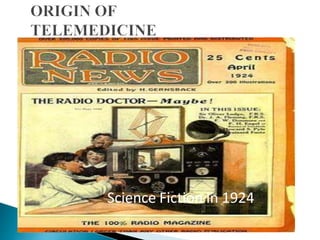
Science Fiction in 1924
Dr. Jay Sanders MD
President and CEO of The
Global Telemedicine Group
First setup of telemedicine
Boston Logan Airport to
Massachusetts General Hospital
1967
 Telemedicine is the exchange of medical information
from one location to another using electronic
communication, which improves patient health status.
 To deliver specialized medical care and advice with
in reach of patient at distant places
OBJECTIVES
• To provide specialized medical advice
• To monitor patient condition.
• To guide other medical staff about treatment.
procedure.
• Share patient data among institutions for
research purpose.
• Video Conferencing between patient and specialist
doctors
• Video conferencing between different specialist
and other healthcare professionals.
• Monitoring patient vitals and statistics in ICU.
• Security in data connection
• Transfer of Patient’s medical data among hospitals
• Storage of information
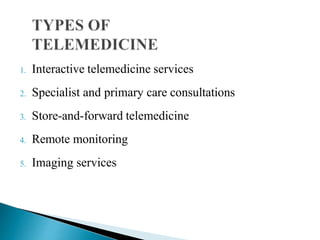
1. Interactive telemedicine services
2. Specialist and primary care consultations
3. Store-and-forward telemedicine
4. Remote monitoring
5. Imaging services
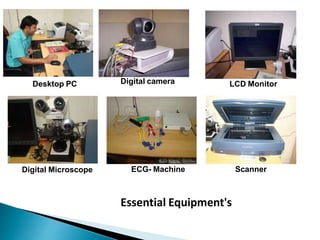
LCD Monitor
ECG- Machine
Digital camera
Digital Microscope Scanner
Desktop PC
Essential Equipment's
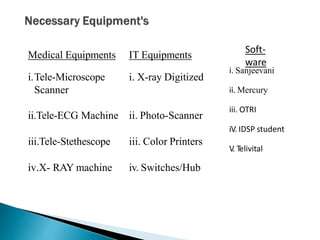
Medical Equipments IT Equipments
i.Tele-Microscope i. X-ray Digitized
Scanner
ii.Tele-ECG Machine ii. Photo-Scanner
iii.Tele-Stethescope iii. Color Printers
iv.X- RAY machine iv. Switches/Hub
Soft-
ware
i. Sanjeevani
ii. Mercury
iii. OTRI
iV. IDSP student
V
. Telivital
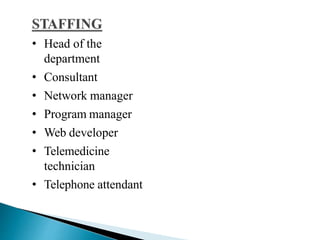
• Head of the
department
• Consultant
• Network manager
• Program manager
• Web developer
• Telemedicine
technician
• Telephone attendant
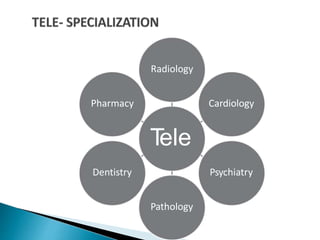
T
ele
Radiology
Cardiology
Psychiatry
Pathology
Dentistry
Pharmacy
1. Window to expertise care
2. Economic for hospital and patient
3. Reduce the stress in patient and relatives
4. Save travel time of specialist and patient
5. Good for education and research purpose
 Disturbance in internet
 The cost is too high.
 Technology is being misused.
 Privacy issue
 Disadvantages compared to face to face interactions.
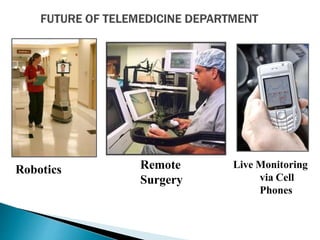
Robotics Remote
Surgery
Live Monitoring
via Cell
Phones
 Telemedicine is the exchange of medical information
from one place to another. Telemedicine allows health
care professionals to evaluate, diagnose and treat
patients at a distance using telecommunication
technology.
 Telemedicine will soon be just another way to see a
health care professional, just as seeing friends and
family while talking to them on the phone is
becoming common place.
 Write a short note on tele-medicine.
 Navdeep Kaur Brar’s “Textbook of Advance Nursing
Practice”, Jaypee Brothers Medical Publishers (P)
Ltd, page- 190-195.
 EMMESS, “A concise Textbook of Advance Nursing
Practice”, 1st edition, EMMESS Medical Publisher,
page- 163-168.
 Shebber .P. Basheer, ‘A concice text book of
Advance Nursing Practice”, 1st edition, 2013,
EMMESS medical publication, Banglore, Page no.
110-112.


TELEMEDICINE topic in advance nursing practice

  • 1.
  • 2.
    At the endof the class students will be able to understand-  Define tele-medicine  • Aim and Objectives  • Function of tele-medicine  • Types Of Telemedicine  • Equipments  • Staffing  Application and areas  • Benefits Of Telemedicine  • Future Of Telemedicine
  • 3.
  • 4.
    Dr. Jay SandersMD President and CEO of The Global Telemedicine Group First setup of telemedicine Boston Logan Airport to Massachusetts General Hospital 1967
  • 5.
     Telemedicine isthe exchange of medical information from one location to another using electronic communication, which improves patient health status.
  • 6.
     To deliverspecialized medical care and advice with in reach of patient at distant places
  • 7.
    OBJECTIVES • To providespecialized medical advice • To monitor patient condition. • To guide other medical staff about treatment. procedure. • Share patient data among institutions for research purpose.
  • 8.
    • Video Conferencingbetween patient and specialist doctors • Video conferencing between different specialist and other healthcare professionals. • Monitoring patient vitals and statistics in ICU. • Security in data connection • Transfer of Patient’s medical data among hospitals • Storage of information
  • 9.
    1. Interactive telemedicineservices 2. Specialist and primary care consultations 3. Store-and-forward telemedicine 4. Remote monitoring 5. Imaging services
  • 10.
    LCD Monitor ECG- Machine Digitalcamera Digital Microscope Scanner Desktop PC Essential Equipment's
  • 11.
    Medical Equipments ITEquipments i.Tele-Microscope i. X-ray Digitized Scanner ii.Tele-ECG Machine ii. Photo-Scanner iii.Tele-Stethescope iii. Color Printers iv.X- RAY machine iv. Switches/Hub Soft- ware i. Sanjeevani ii. Mercury iii. OTRI iV. IDSP student V . Telivital
  • 12.
    • Head ofthe department • Consultant • Network manager • Program manager • Web developer • Telemedicine technician • Telephone attendant
  • 13.
  • 14.
    1. Window toexpertise care 2. Economic for hospital and patient 3. Reduce the stress in patient and relatives 4. Save travel time of specialist and patient 5. Good for education and research purpose
  • 15.
     Disturbance ininternet  The cost is too high.  Technology is being misused.  Privacy issue  Disadvantages compared to face to face interactions.
  • 16.
  • 17.
     Telemedicine isthe exchange of medical information from one place to another. Telemedicine allows health care professionals to evaluate, diagnose and treat patients at a distance using telecommunication technology.
  • 18.
     Telemedicine willsoon be just another way to see a health care professional, just as seeing friends and family while talking to them on the phone is becoming common place.
  • 19.
     Write ashort note on tele-medicine.
  • 20.
     Navdeep KaurBrar’s “Textbook of Advance Nursing Practice”, Jaypee Brothers Medical Publishers (P) Ltd, page- 190-195.  EMMESS, “A concise Textbook of Advance Nursing Practice”, 1st edition, EMMESS Medical Publisher, page- 163-168.  Shebber .P. Basheer, ‘A concice text book of Advance Nursing Practice”, 1st edition, 2013, EMMESS medical publication, Banglore, Page no. 110-112. 