
KEY CONCEPTS IN
SELECTION AND USE OF
MEDIA IN EDUCATION
PRESENTER
MATHEW VARGHESE V
MSN FHNP CCEPC CSTPN
INSTRUCTIONAL MEDIA
INTRODUCTION
 There is a famous Chinese proverb which says “What I hear
I forget, what I see I remember, what I do
I understand “.
 Different types of instructional media enhances clarity in communication.
 It increases forcefulness of subject being learned or taught. Instructional
technology involves integration of men, machines materials and ideas
INSTRUCTIONAL MEDIA
Definitions
 Media are generally defined as the means by which information is
conveyed from one place to another.
 It refers to all the aids or vehicles by which information is communicated.
 Instructional media are information carriers designed specifically to fulfill
objectives in a teaching-learning situation.
Definitions….
 According to Azikiwe (2007), Instructional media cover
whatever the teacher uses to involve all the five senses of
sight, hearing, touch, smell and taste while presenting
his/her lessons.
 Adegun (1997) says instructional media are things which
are intended to help the teacher to teach more effectively
and enable the students to learn more readily.
DEFINITION OF A V AIDS
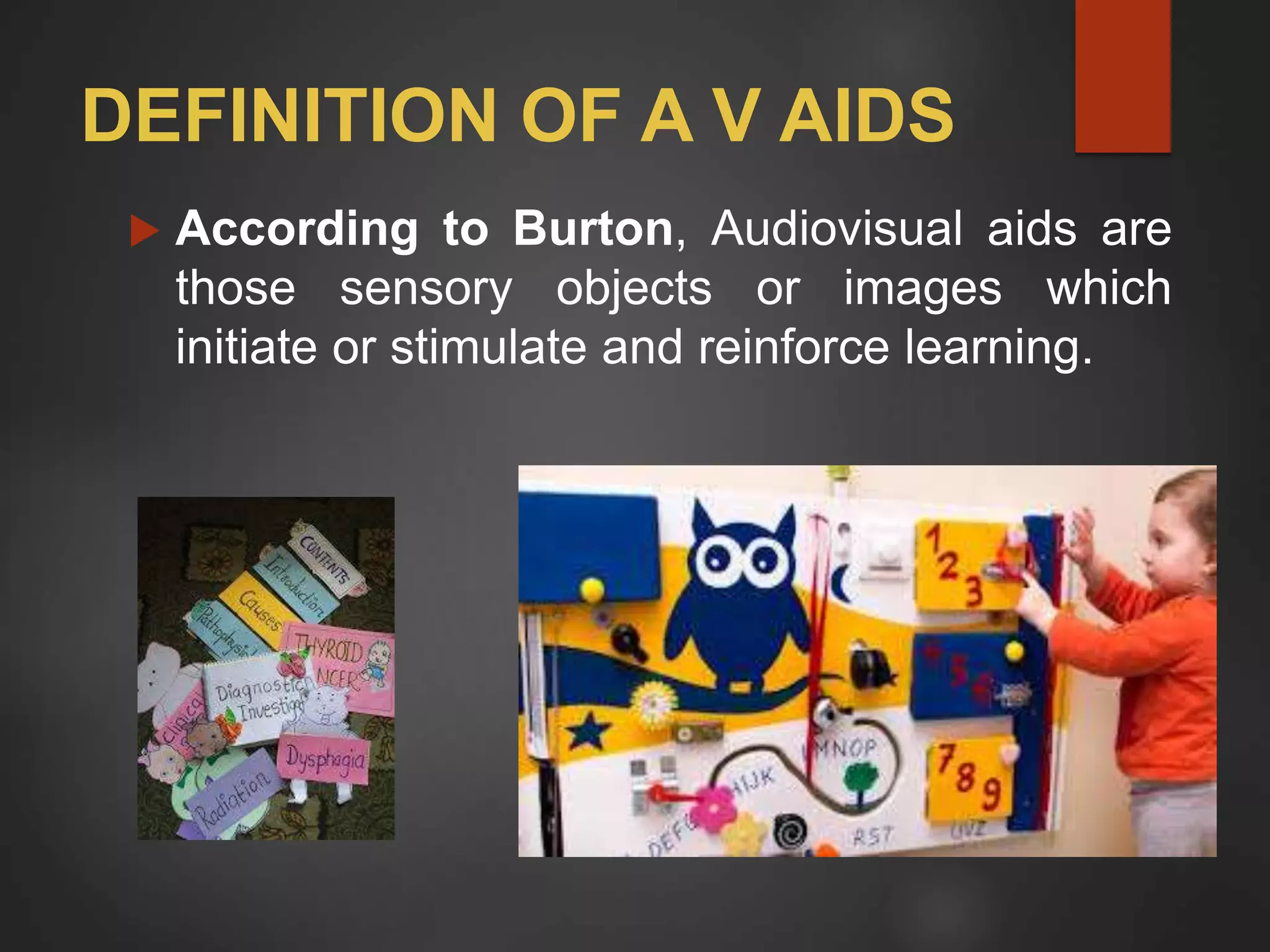
 According to Burton, Audiovisual aids are
those sensory objects or images which
initiate or stimulate and reinforce learning.
PURPOSES
 To provide basis for more effective perceptual and conceptual
learning.
 To increase the meaningfulness of abstract content.
 To stimulate thinking and motivate action.
 To initiate and sustain attention.
 To provide concreteness, realism in teaching experience
 To gain practical skill.
 To bring remote event in the class
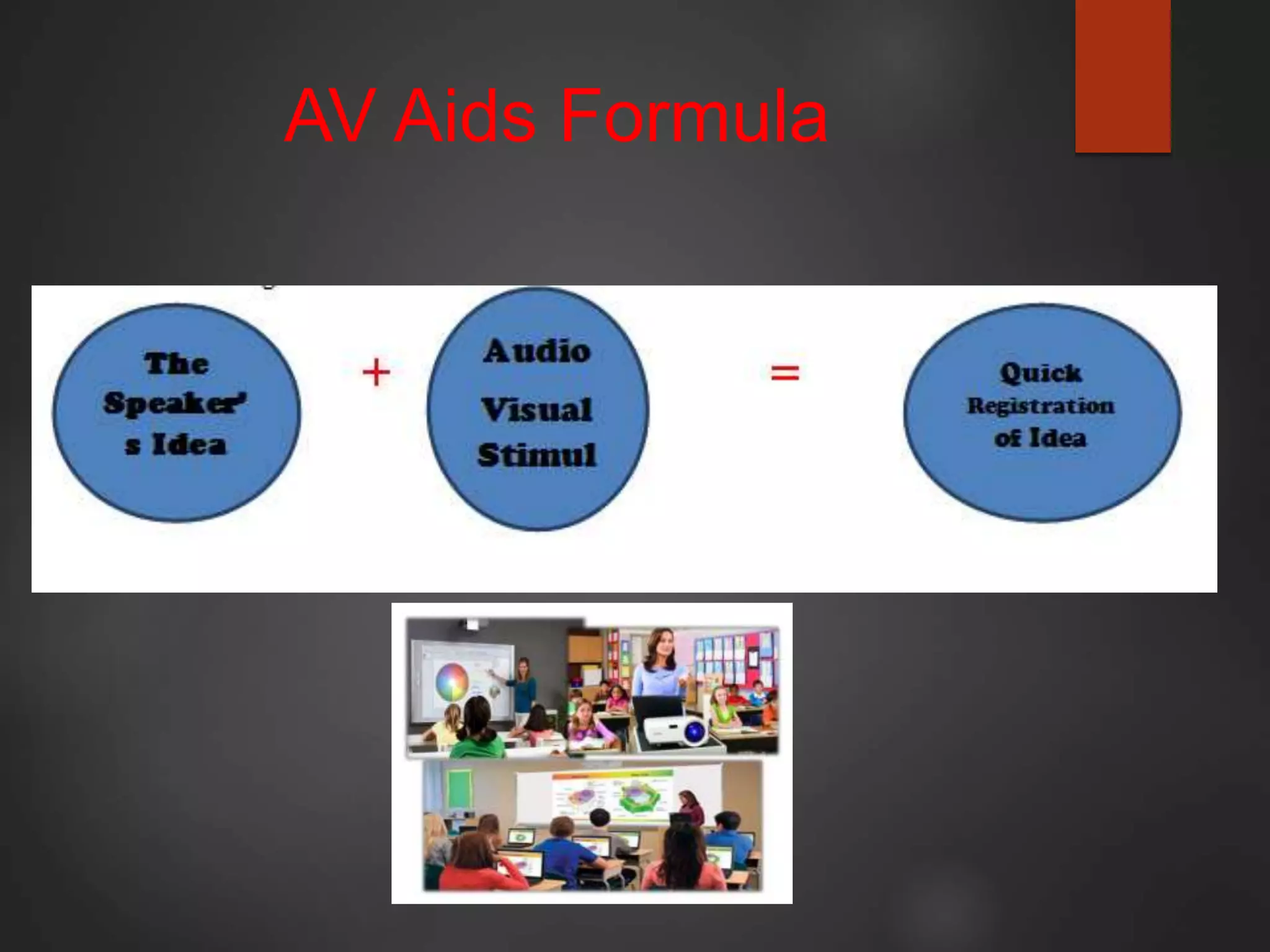
AV Aids Formula
Concepts for selection and use
 It should be systematically well planned so that ,suitable
media for a particular group of students as per learning
objectives can be selected and used
 Teacher should think judiciously while planning their lesson
about the use of media
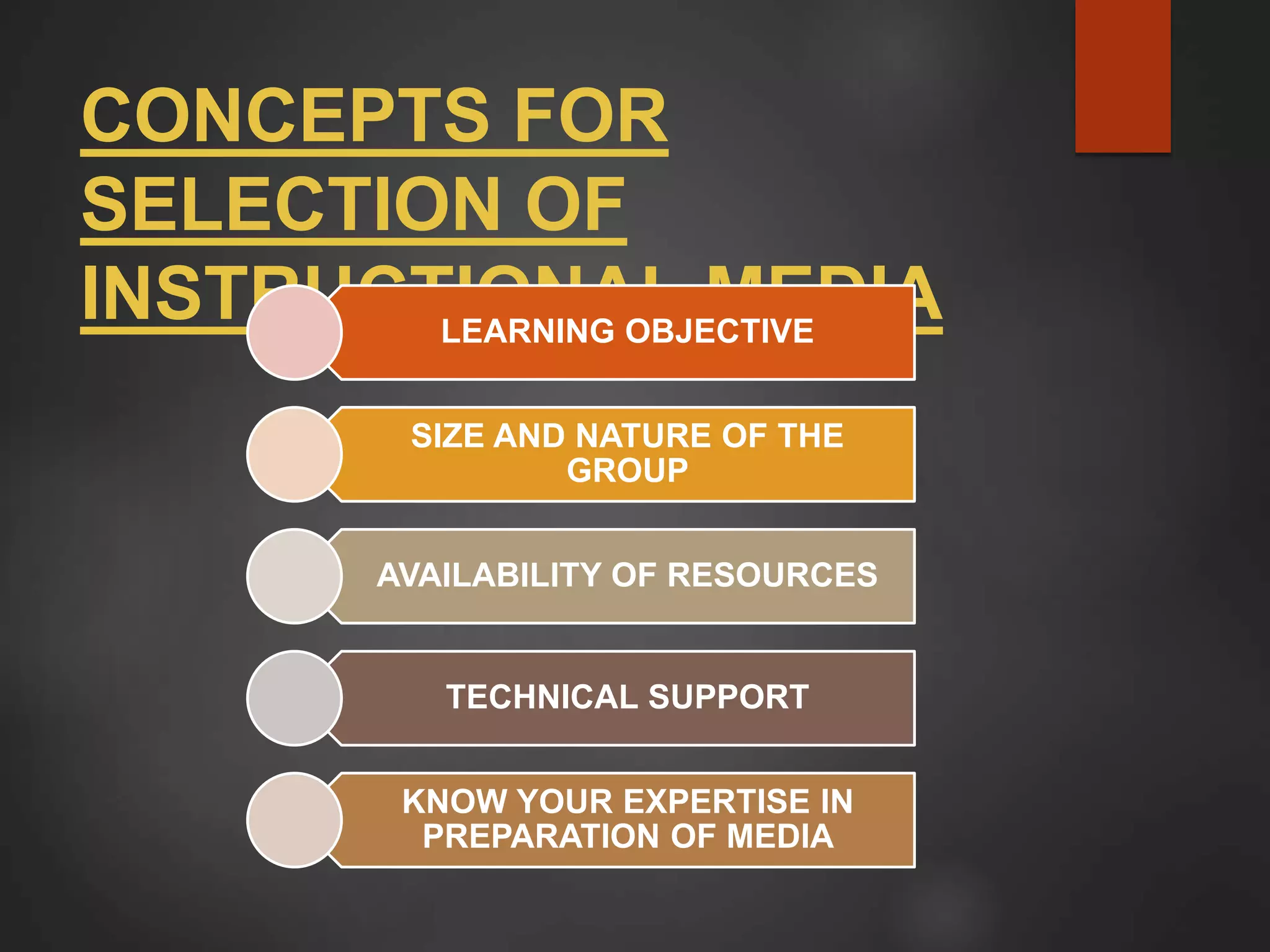
CONCEPTS FOR
SELECTION OF
INSTRUCTIONAL MEDIA
LEARNING OBJECTIVE
SIZE AND NATURE OF THE
GROUP
AVAILABILITY OF RESOURCES
TECHNICAL SUPPORT
KNOW YOUR EXPERTISE IN
PREPARATION OF MEDIA
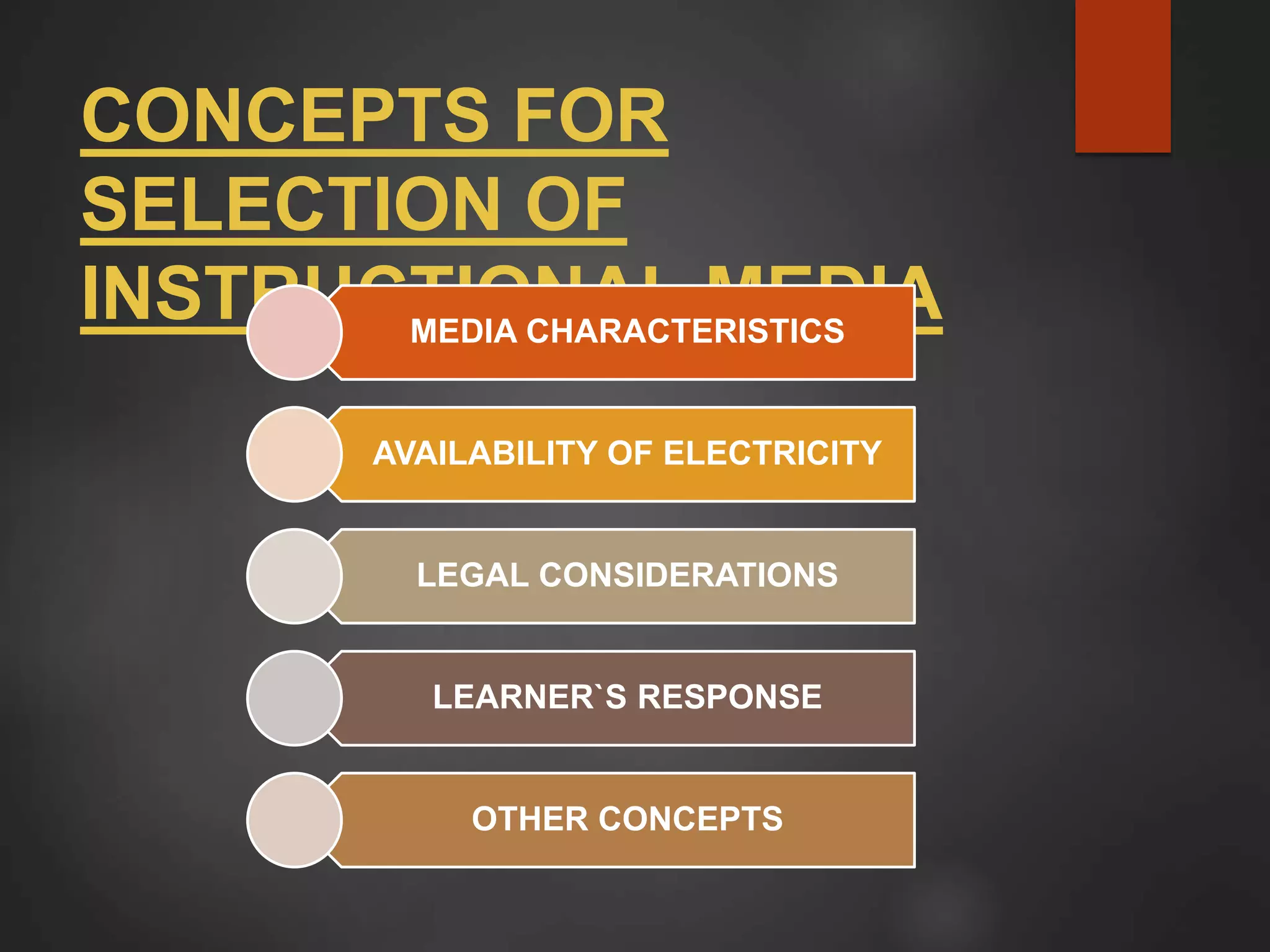
CONCEPTS FOR
SELECTION OF
INSTRUCTIONAL MEDIA
MEDIA CHARACTERISTICS
AVAILABILITY OF ELECTRICITY
LEGAL CONSIDERATIONS
LEARNER`S RESPONSE
OTHER CONCEPTS
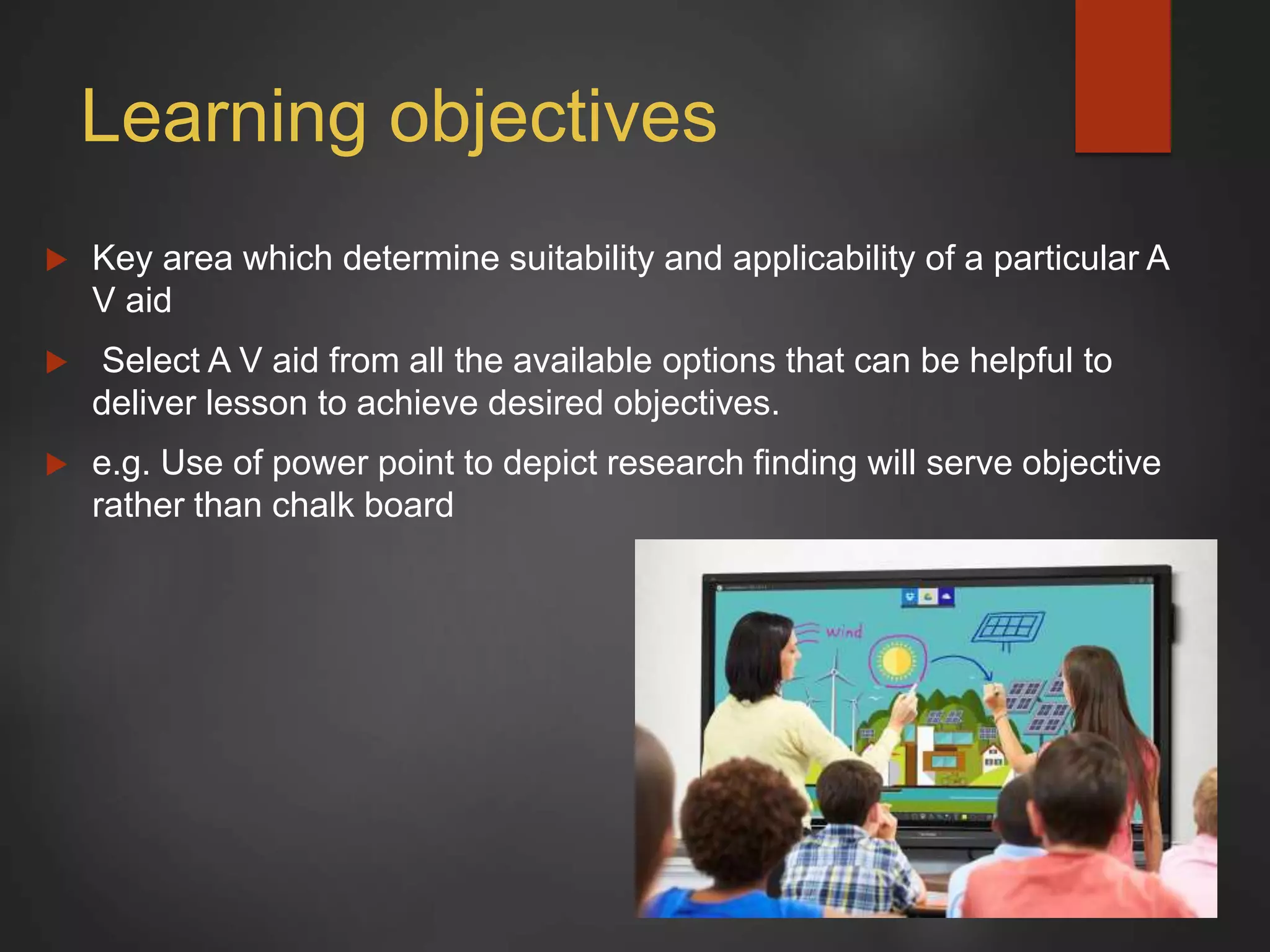
Learning objectives
 Key area which determine suitability and applicability of a particular A
V aid
 Select A V aid from all the available options that can be helpful to
deliver lesson to achieve desired objectives.
 e.g. Use of power point to depict research finding will serve objective
rather than chalk board
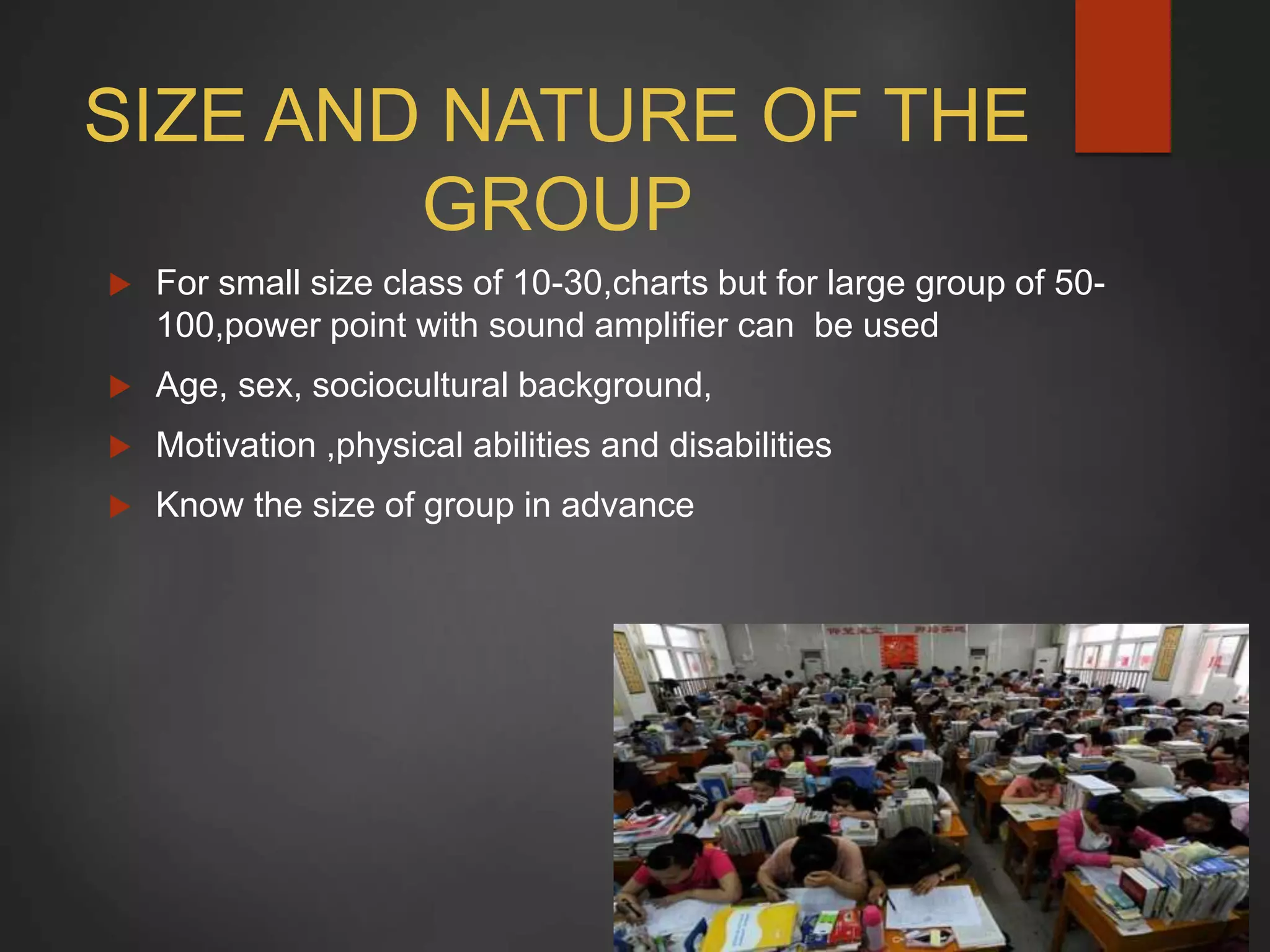
SIZE AND NATURE OF THE
GROUP
 For small size class of 10-30,charts but for large group of 50-
100,power point with sound amplifier can be used
 Age, sex, sociocultural background,
 Motivation ,physical abilities and disabilities
 Know the size of group in advance
Availability of resources
 Teacher has to explore the available resources in the college
 In resource limited settings you could not plan for costly media
 .It is better to use economical media
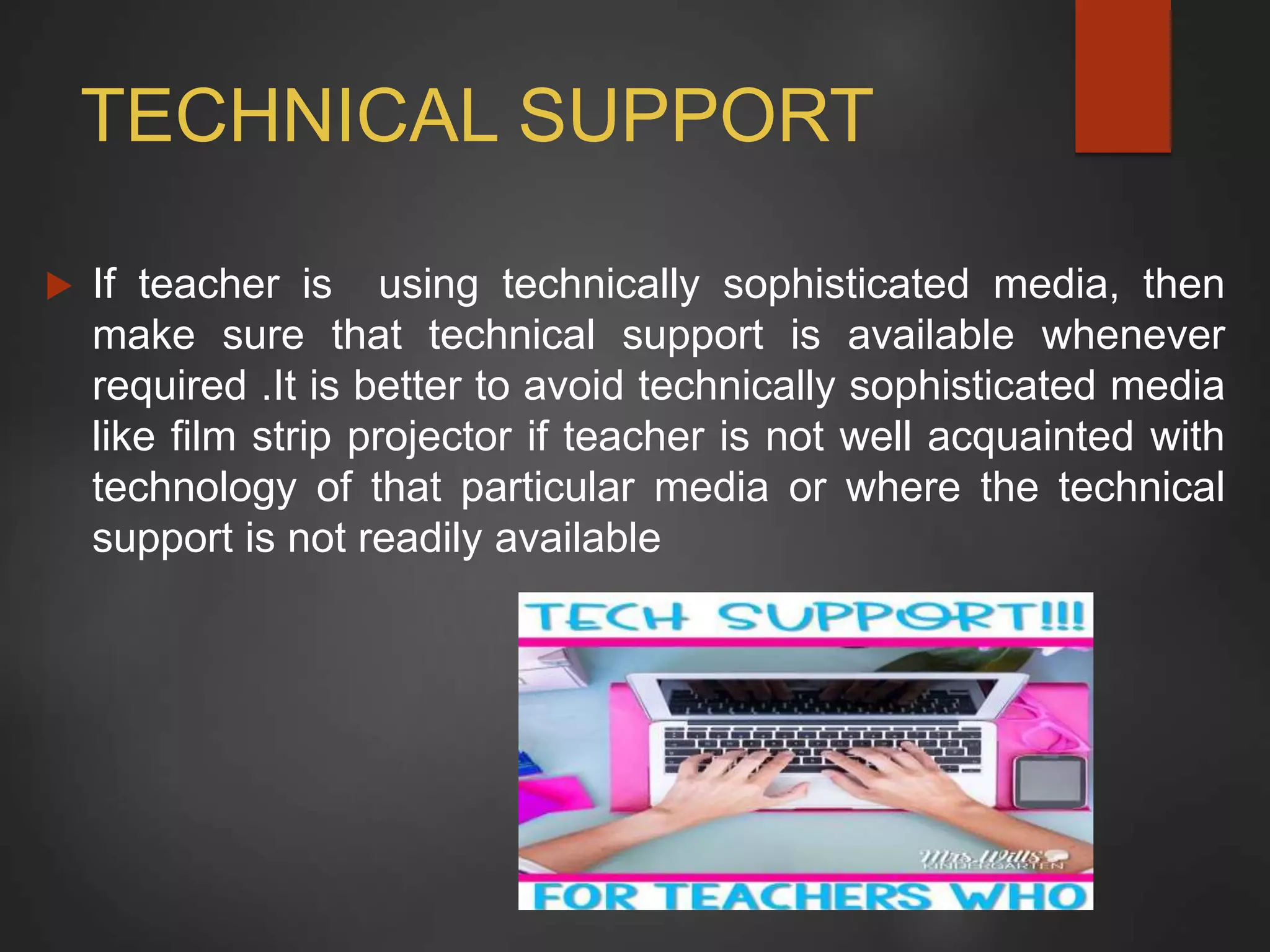
TECHNICAL SUPPORT
 If teacher is using technically sophisticated media, then
make sure that technical support is available whenever
required .It is better to avoid technically sophisticated media
like film strip projector if teacher is not well acquainted with
technology of that particular media or where the technical
support is not readily available
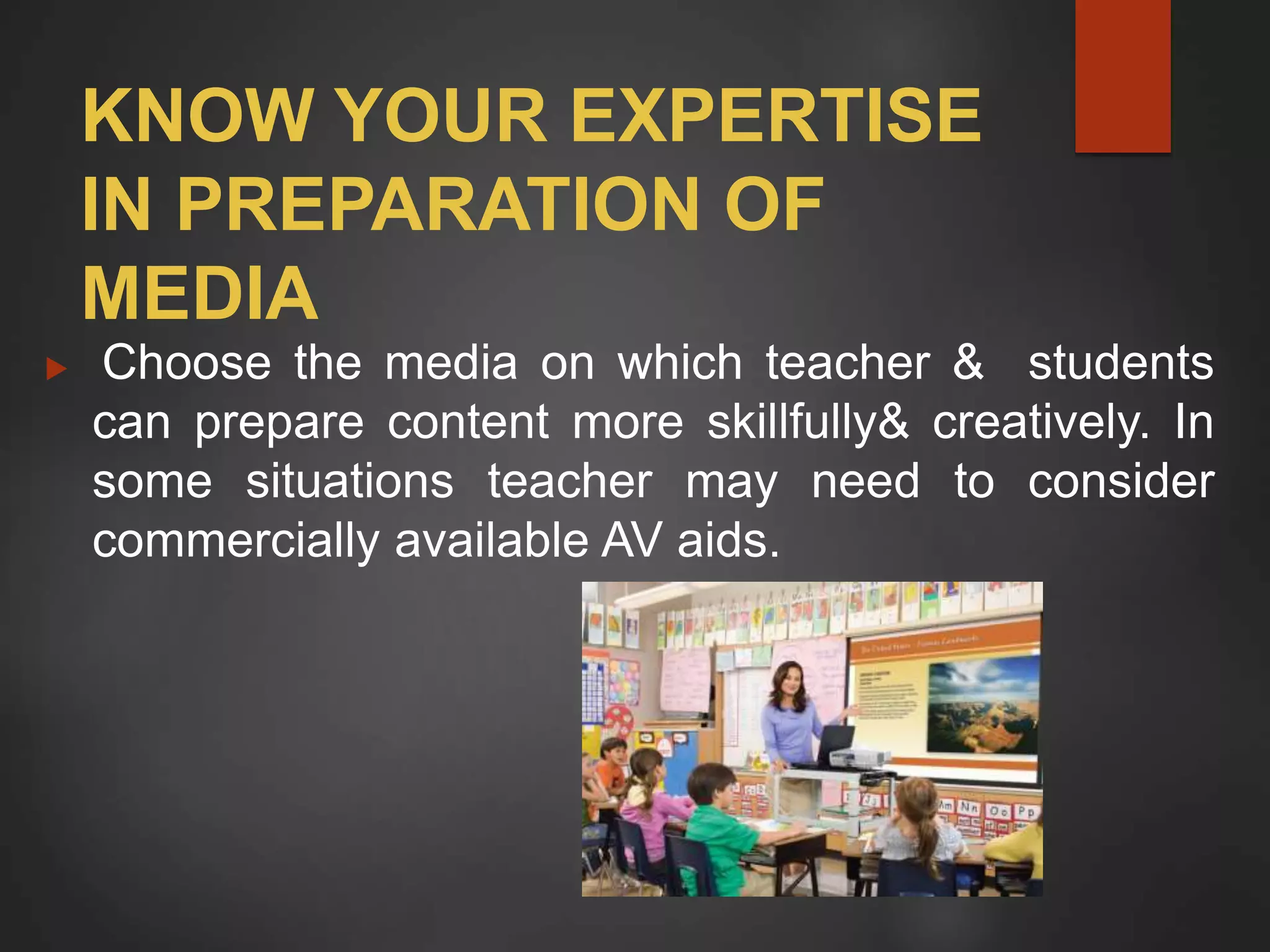
KNOW YOUR EXPERTISE
IN PREPARATION OF
MEDIA
 Choose the media on which teacher & students
can prepare content more skillfully& creatively. In
some situations teacher may need to consider
commercially available AV aids.
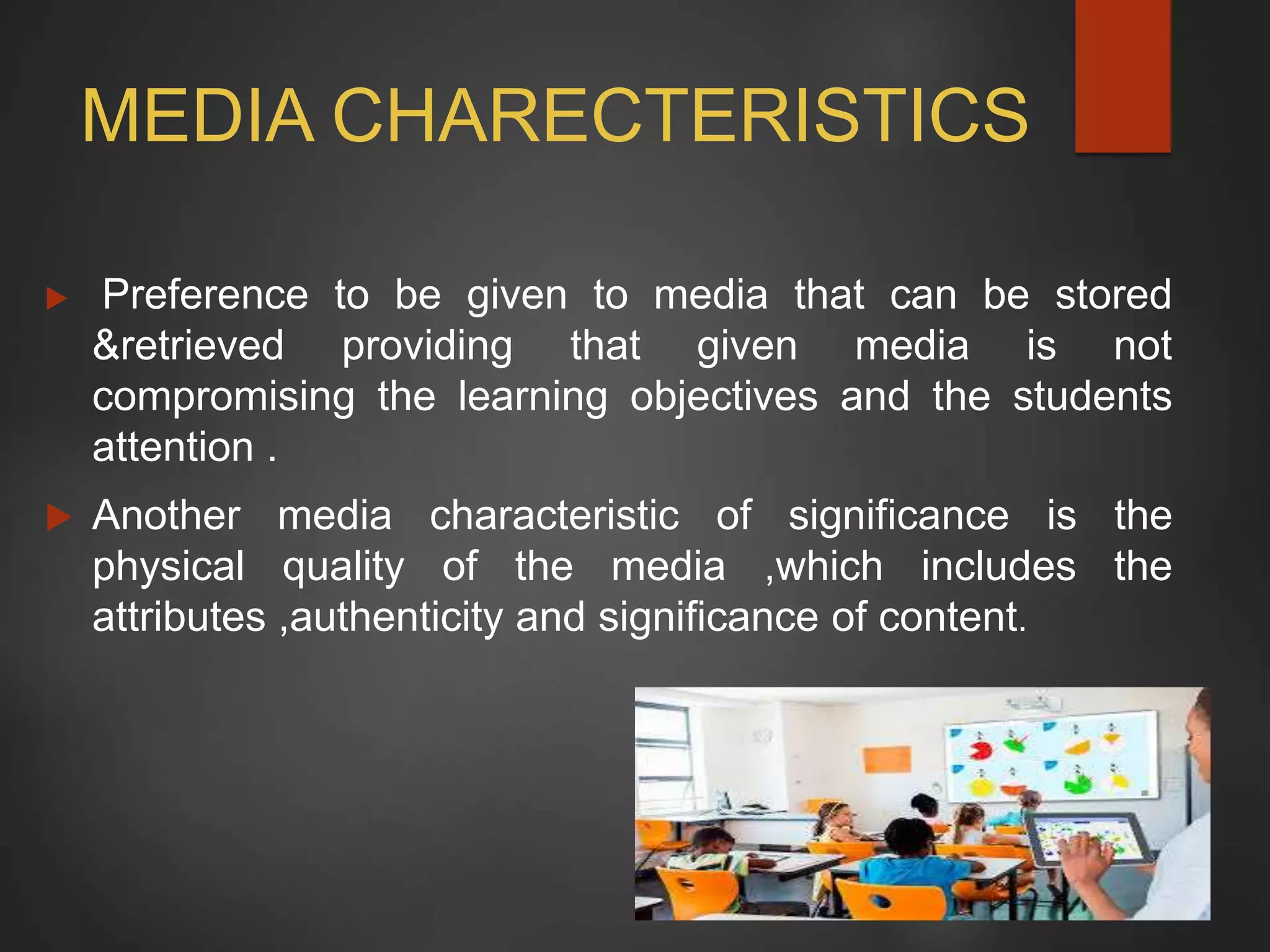
MEDIA CHARECTERISTICS
 Preference to be given to media that can be stored
&retrieved providing that given media is not
compromising the learning objectives and the students
attention .
 Another media characteristic of significance is the
physical quality of the media ,which includes the
attributes ,authenticity and significance of content.
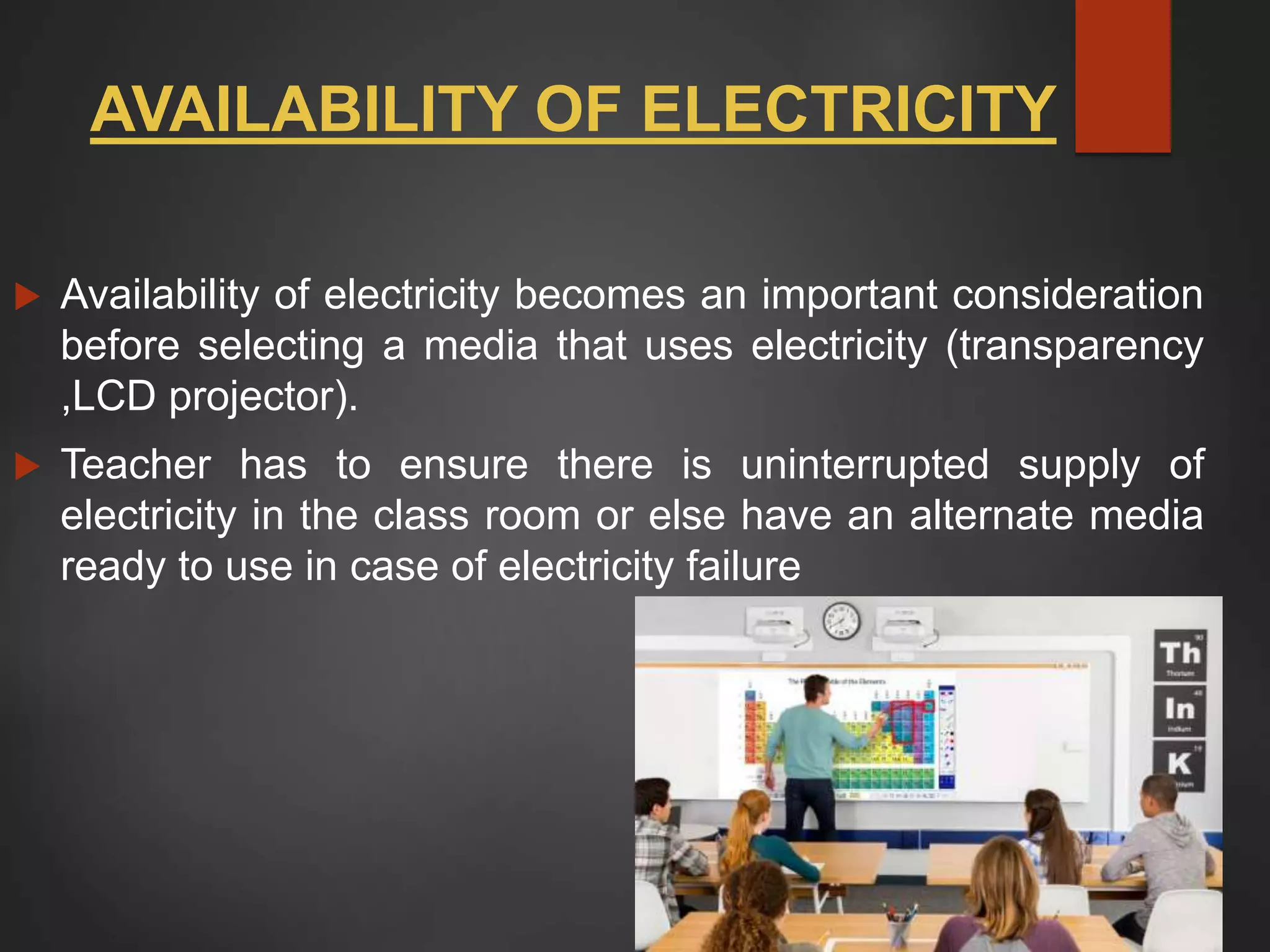
AVAILABILITY OF ELECTRICITY
 Availability of electricity becomes an important consideration
before selecting a media that uses electricity (transparency
,LCD projector).
 Teacher has to ensure there is uninterrupted supply of
electricity in the class room or else have an alternate media
ready to use in case of electricity failure
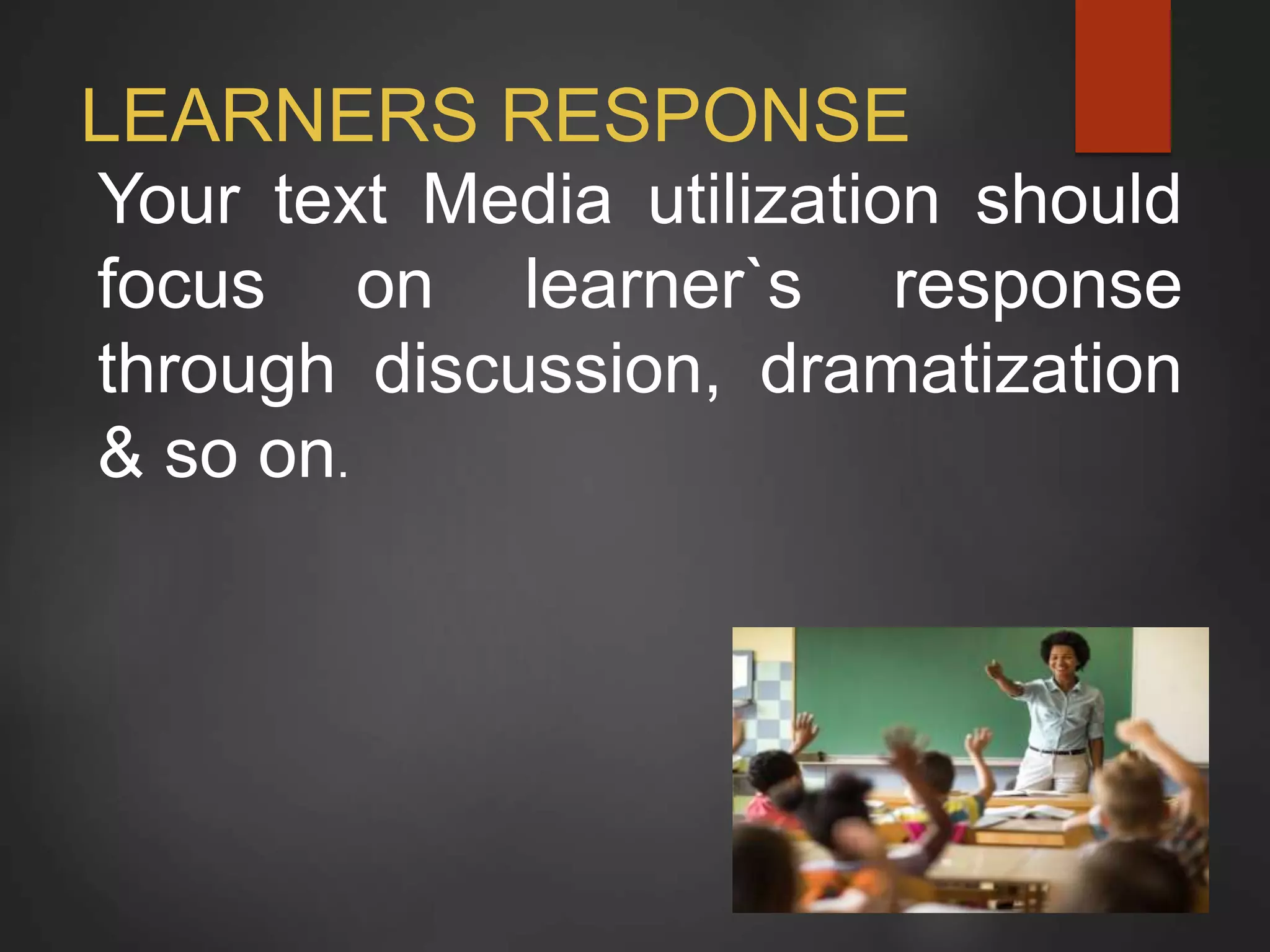
LEARNERS RESPONSE
Your text Media utilization should
focus on learner`s response
through discussion, dramatization
& so on.
LEGAL CONSIDERATIONS
 Legal aspects should be considered in the production
and the utilization of educational communications
media and this is particularly important where AV
materials are prepared by the author It is advisable to
get the permission in writing to avoid possible legal
involvement
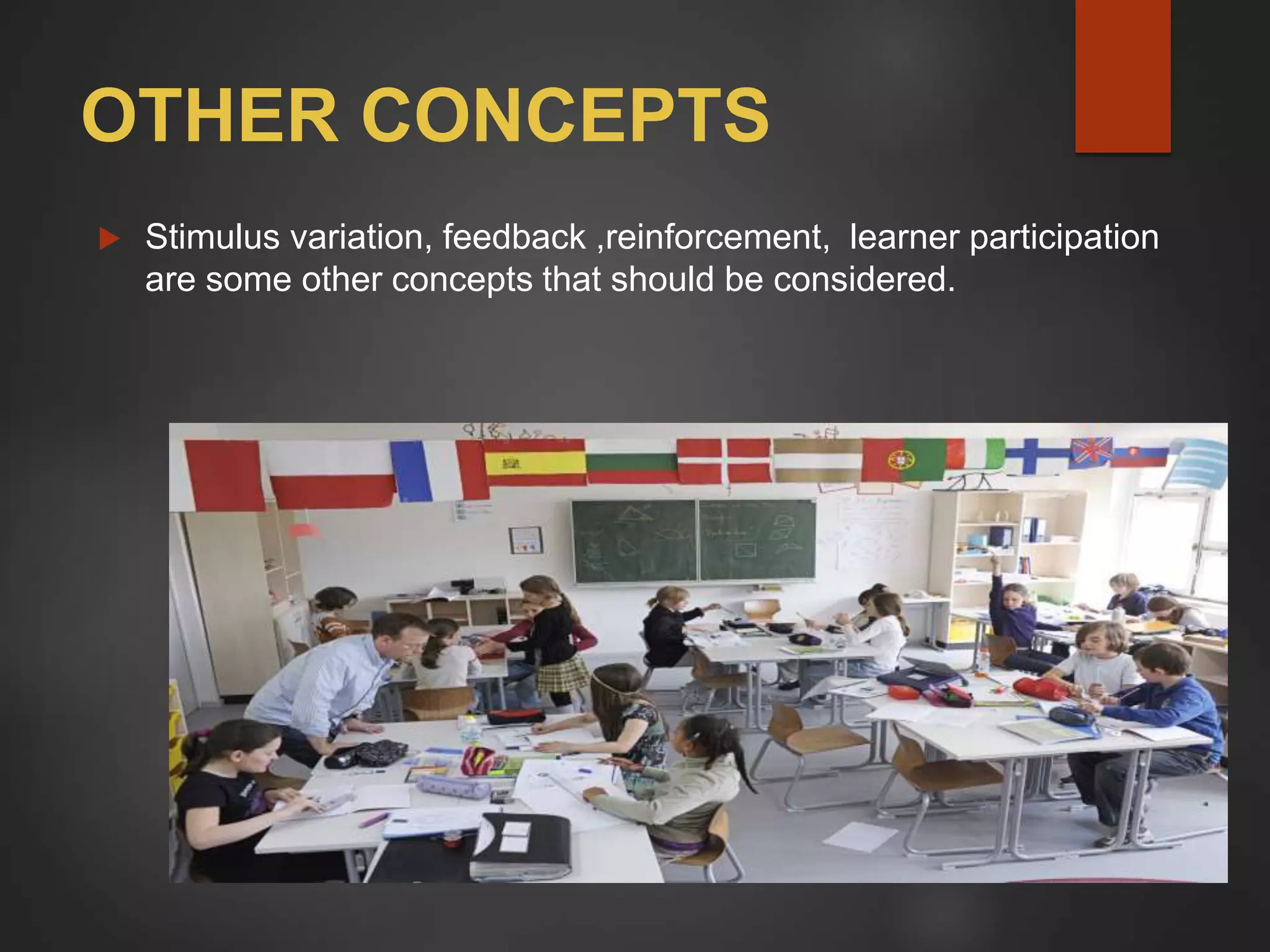
OTHER CONCEPTS
 Stimulus variation, feedback ,reinforcement, learner participation
are some other concepts that should be considered.
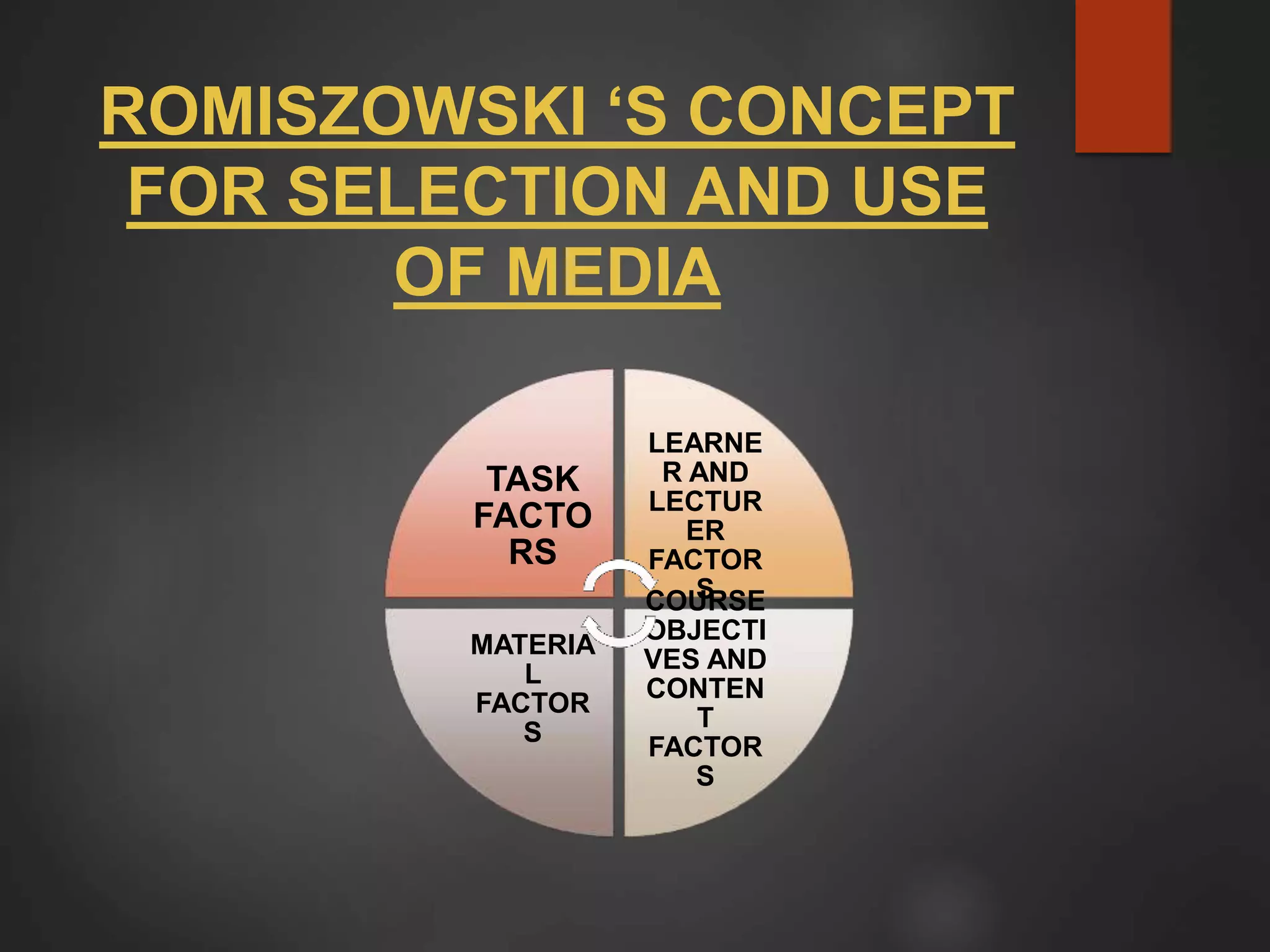
ROMISZOWSKI ‘S CONCEPT
FOR SELECTION AND USE
OF MEDIA
TASK
FACTO
RS
LEARNE
R AND
LECTUR
ER
FACTOR
S
COURSE
OBJECTI
VES AND
CONTEN
T
FACTOR
S
MATERIA
L
FACTOR
S
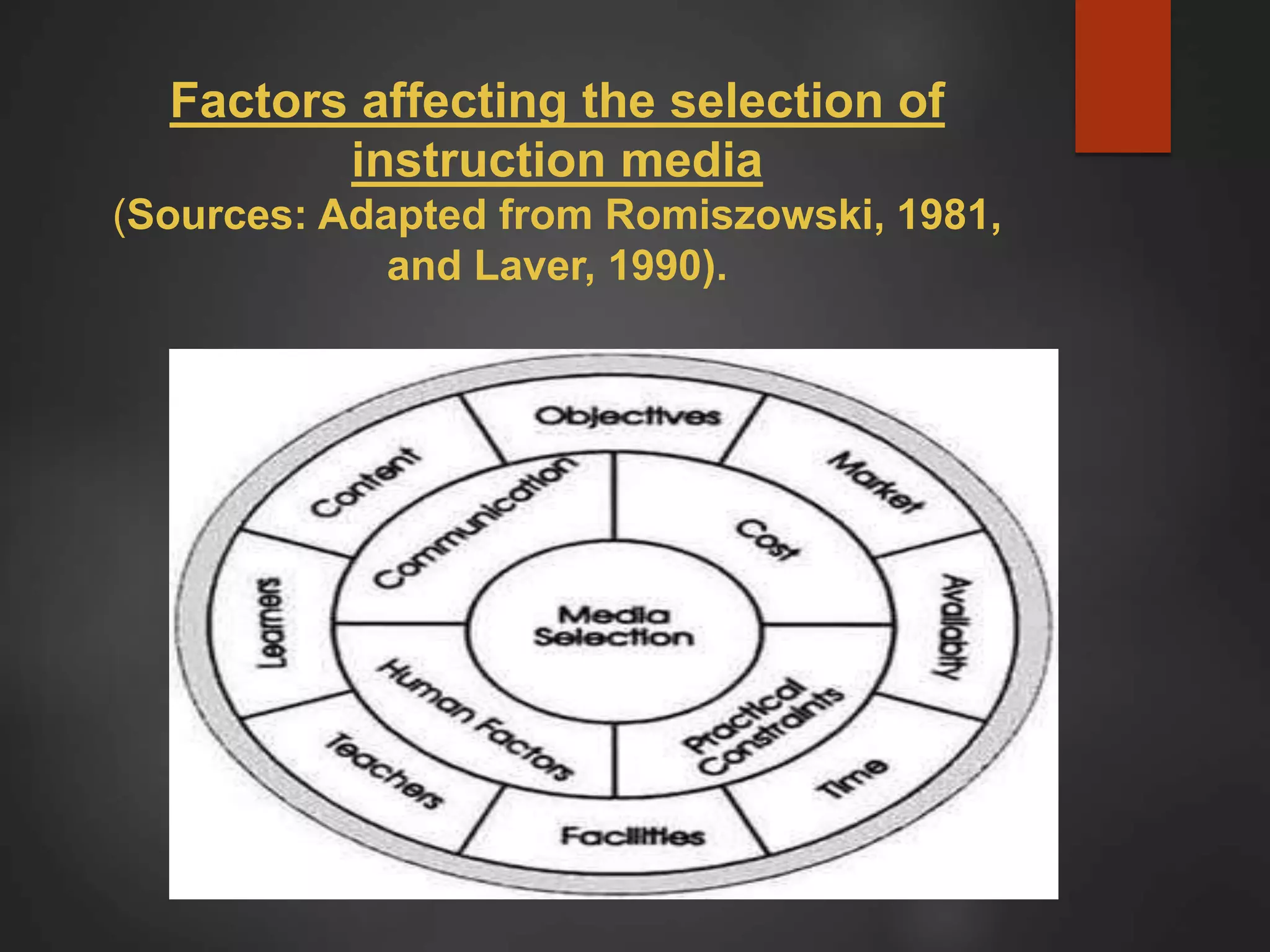
Factors affecting the selection of
instruction media
(Sources: Adapted from Romiszowski, 1981,
and Laver, 1990).
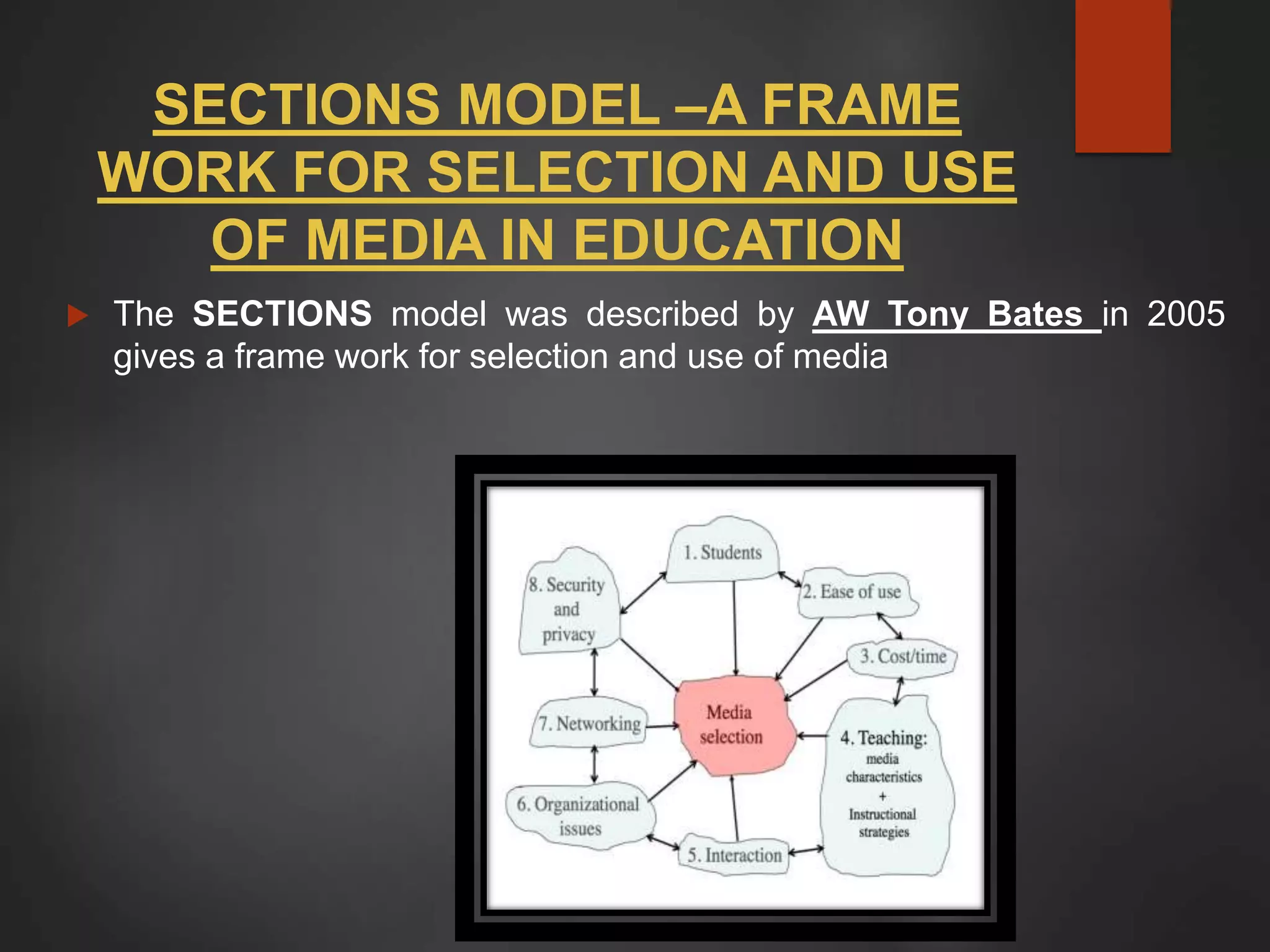
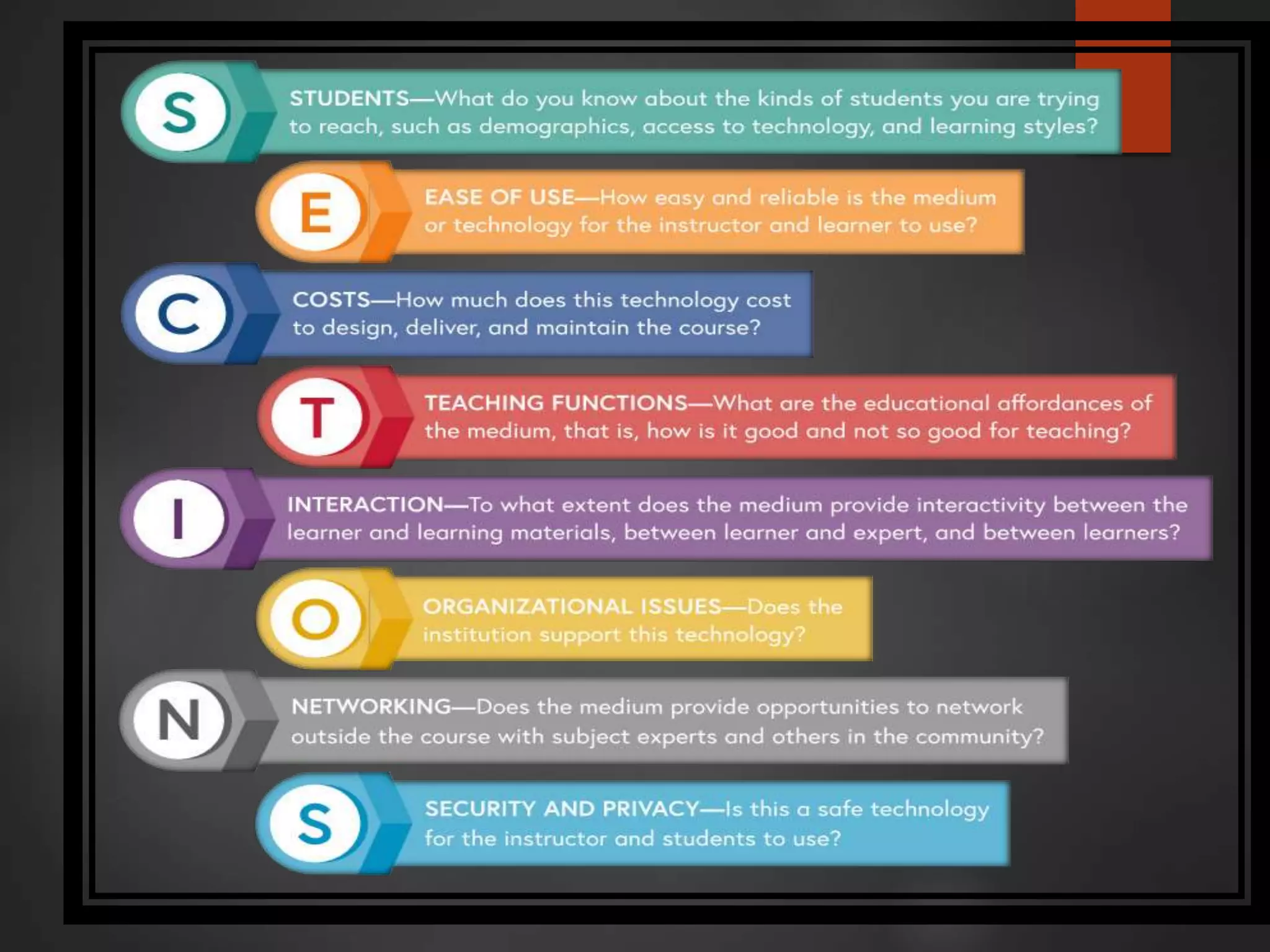
SECTIONS MODEL –A FRAME
WORK FOR SELECTION AND USE
OF MEDIA IN EDUCATION
 The SECTIONS model was described by AW Tony Bates in 2005
gives a frame work for selection and use of media
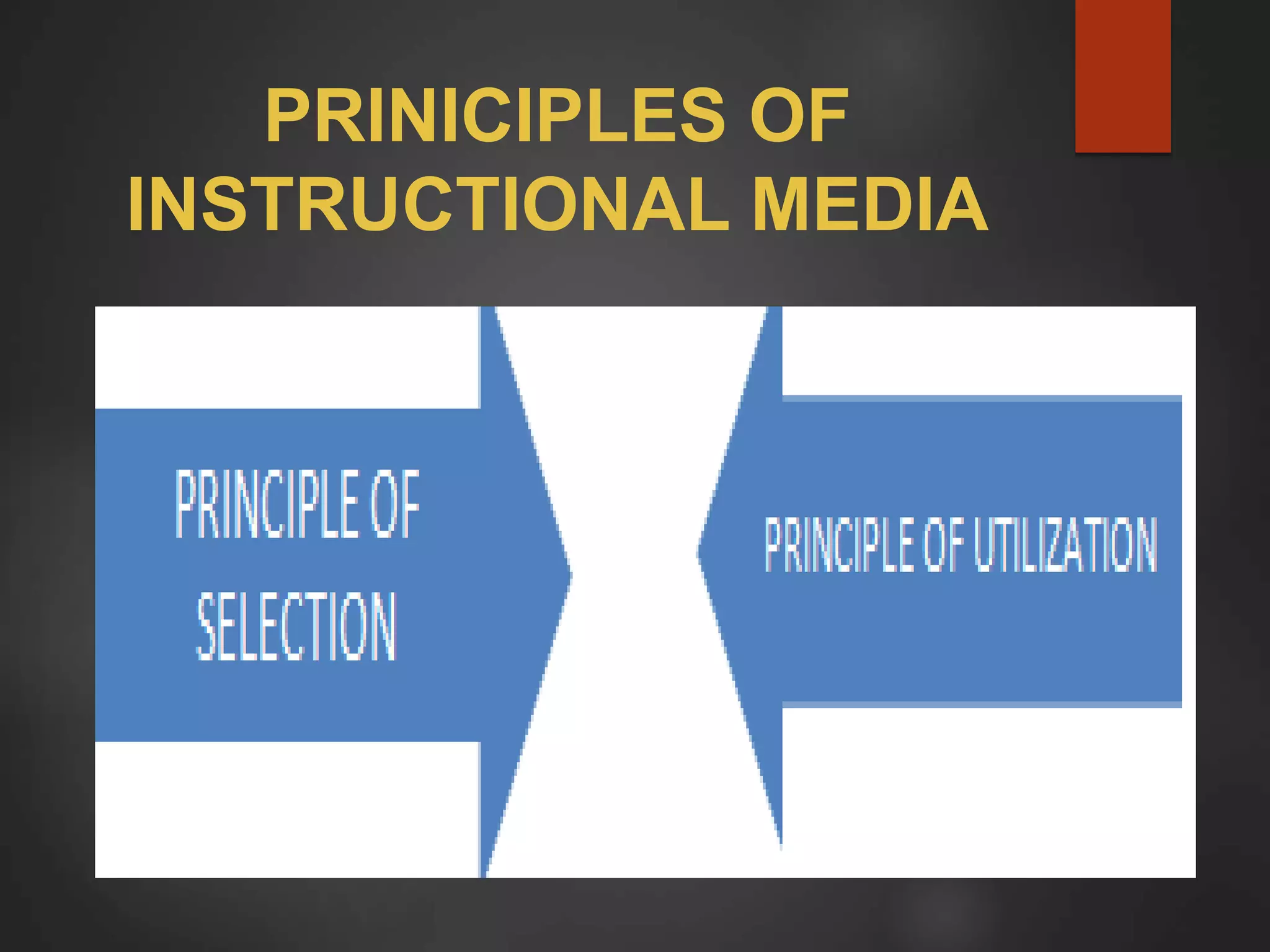
PRINICIPLES OF
INSTRUCTIONAL MEDIA
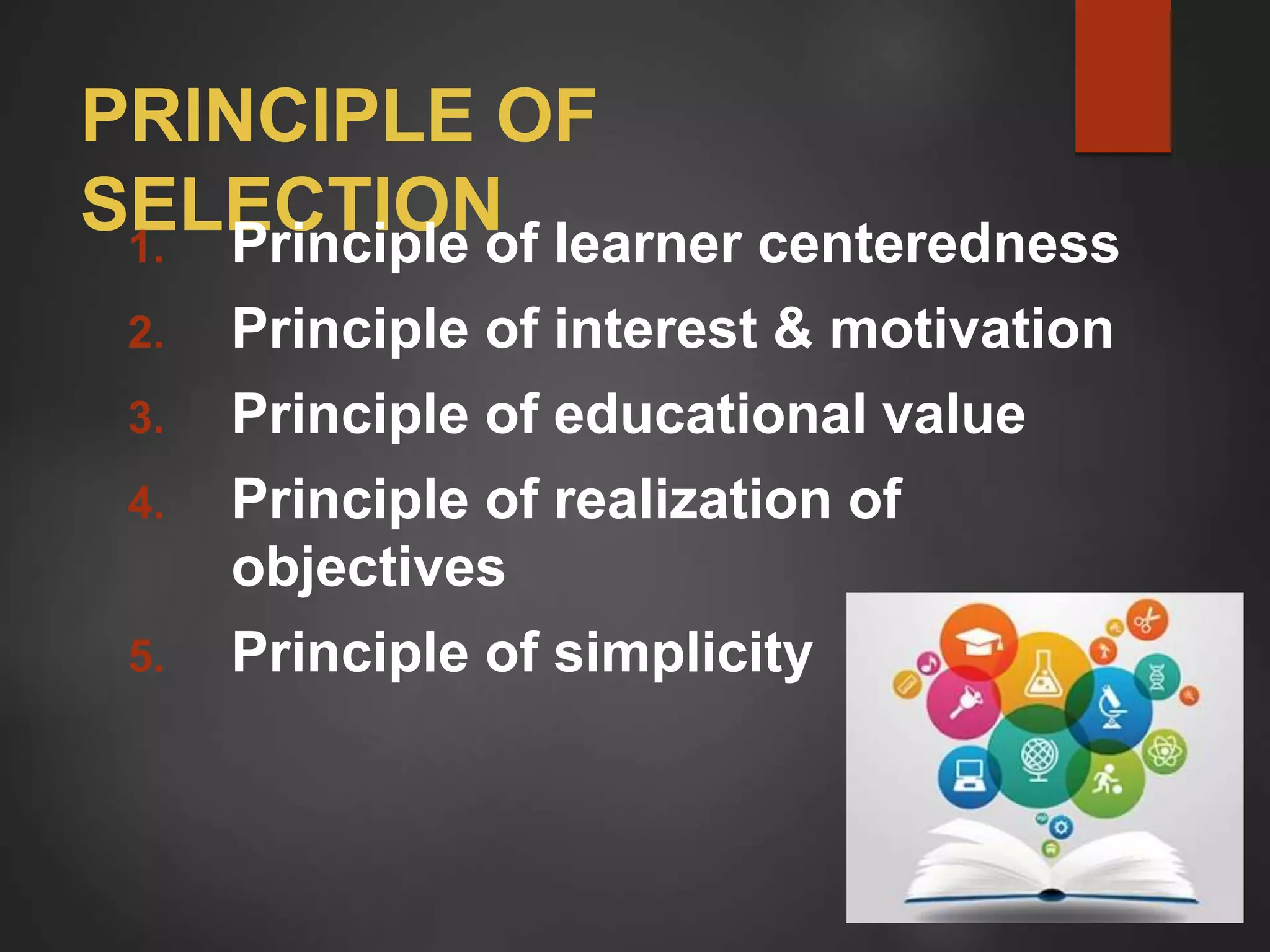
PRINCIPLE OF
SELECTION
1. Principle of learner centeredness
2. Principle of interest & motivation
3. Principle of educational value
4. Principle of realization of
objectives
5. Principle of simplicity
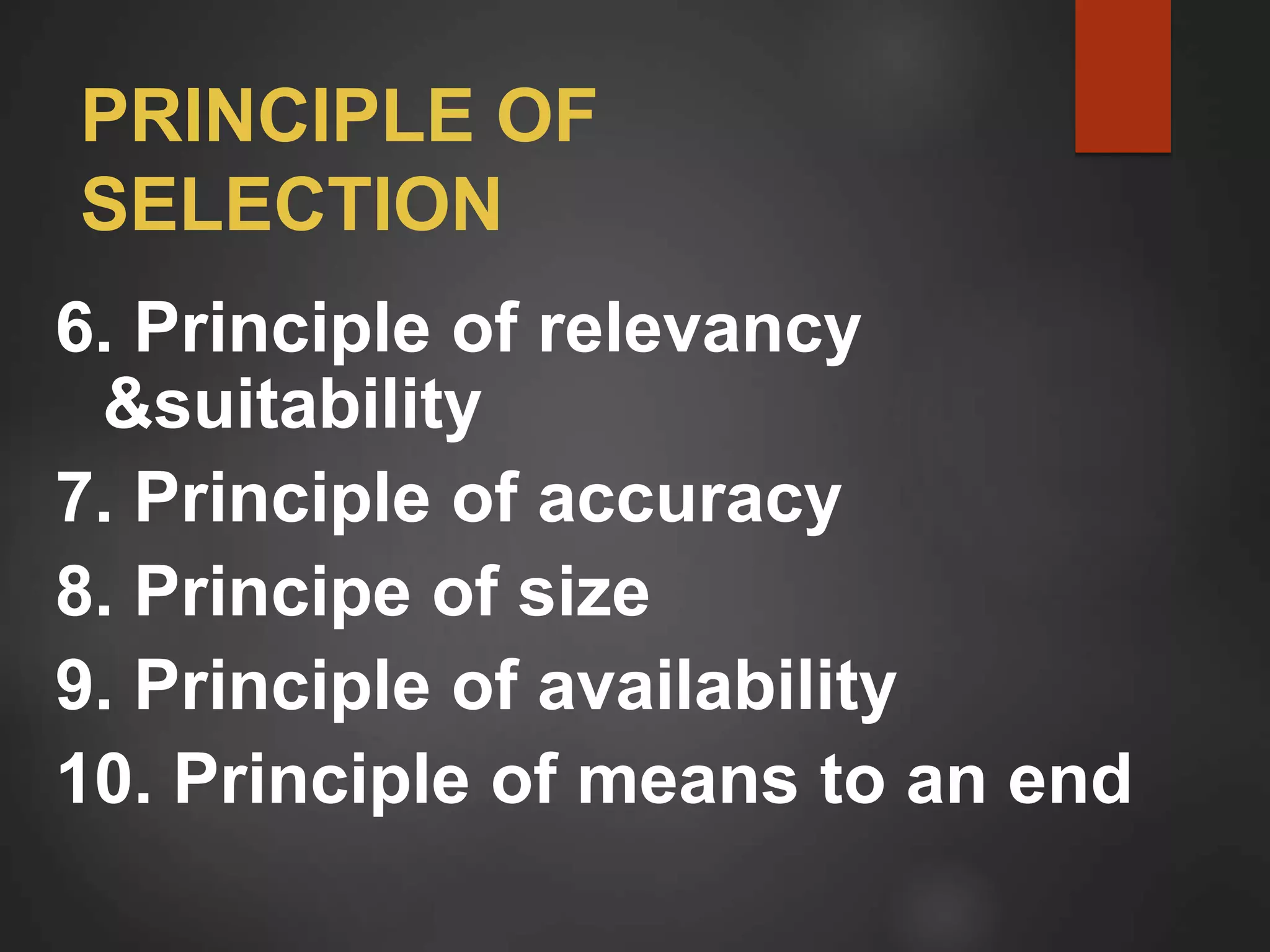
PRINCIPLE OF
SELECTION
6. Principle of relevancy
&suitability
7. Principle of accuracy
8. Principe of size
9. Principle of availability
10. Principle of means to an end
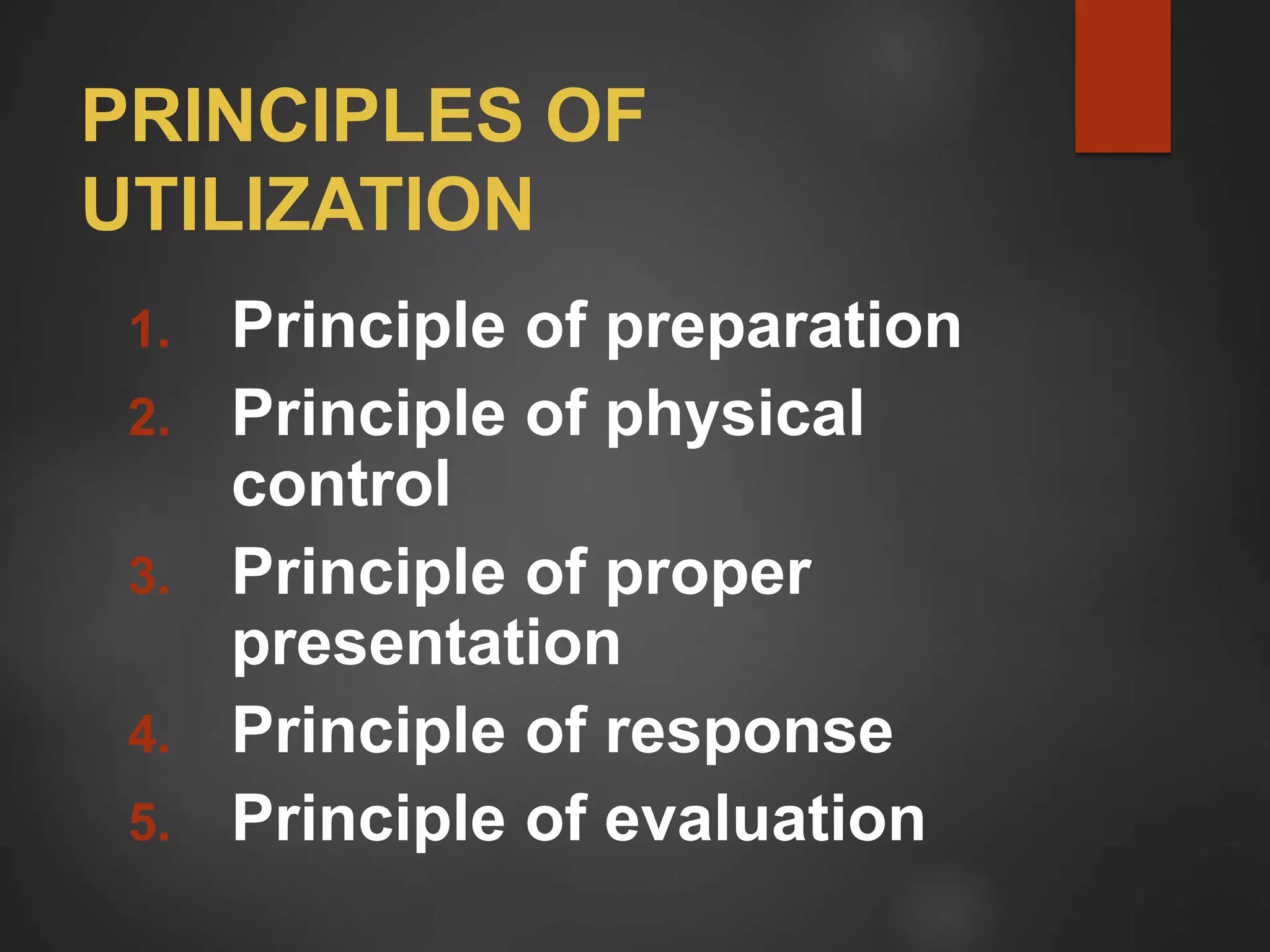
PRINCIPLES OF
UTILIZATION
1. Principle of preparation
2. Principle of physical
control
3. Principle of proper
presentation
4. Principle of response
5. Principle of evaluation
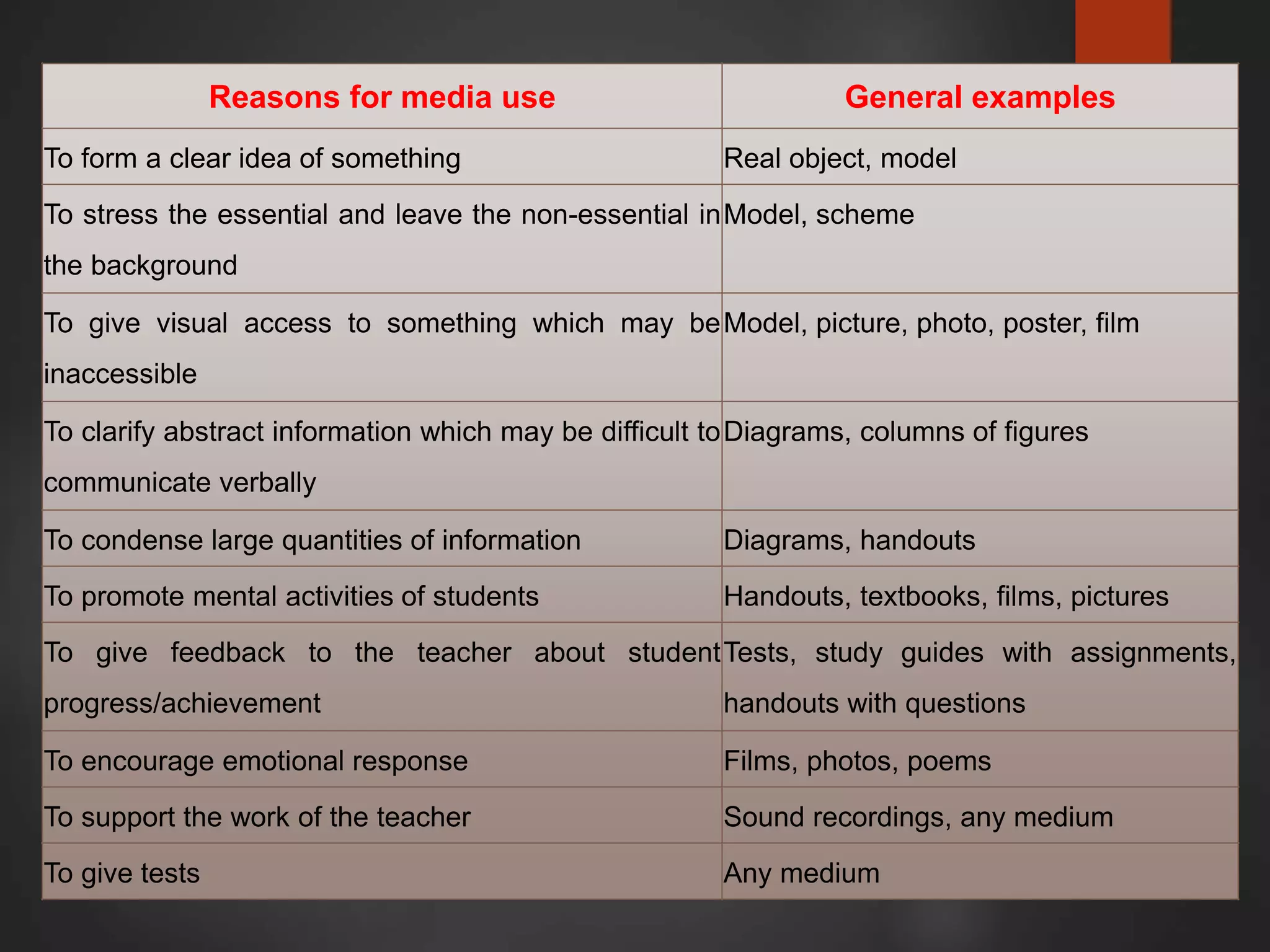
USES OF MEDIA
Reasons for media use General examples
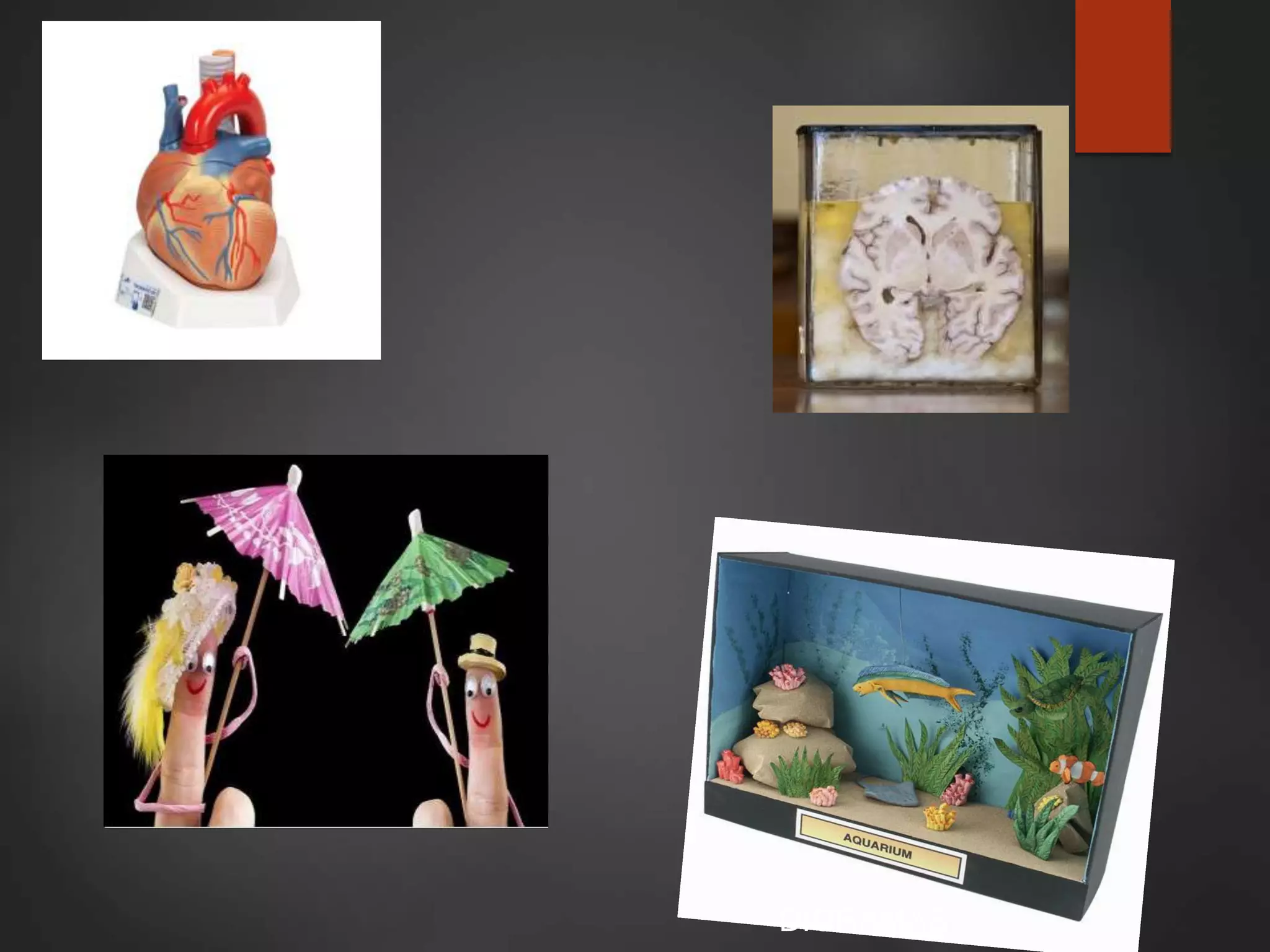
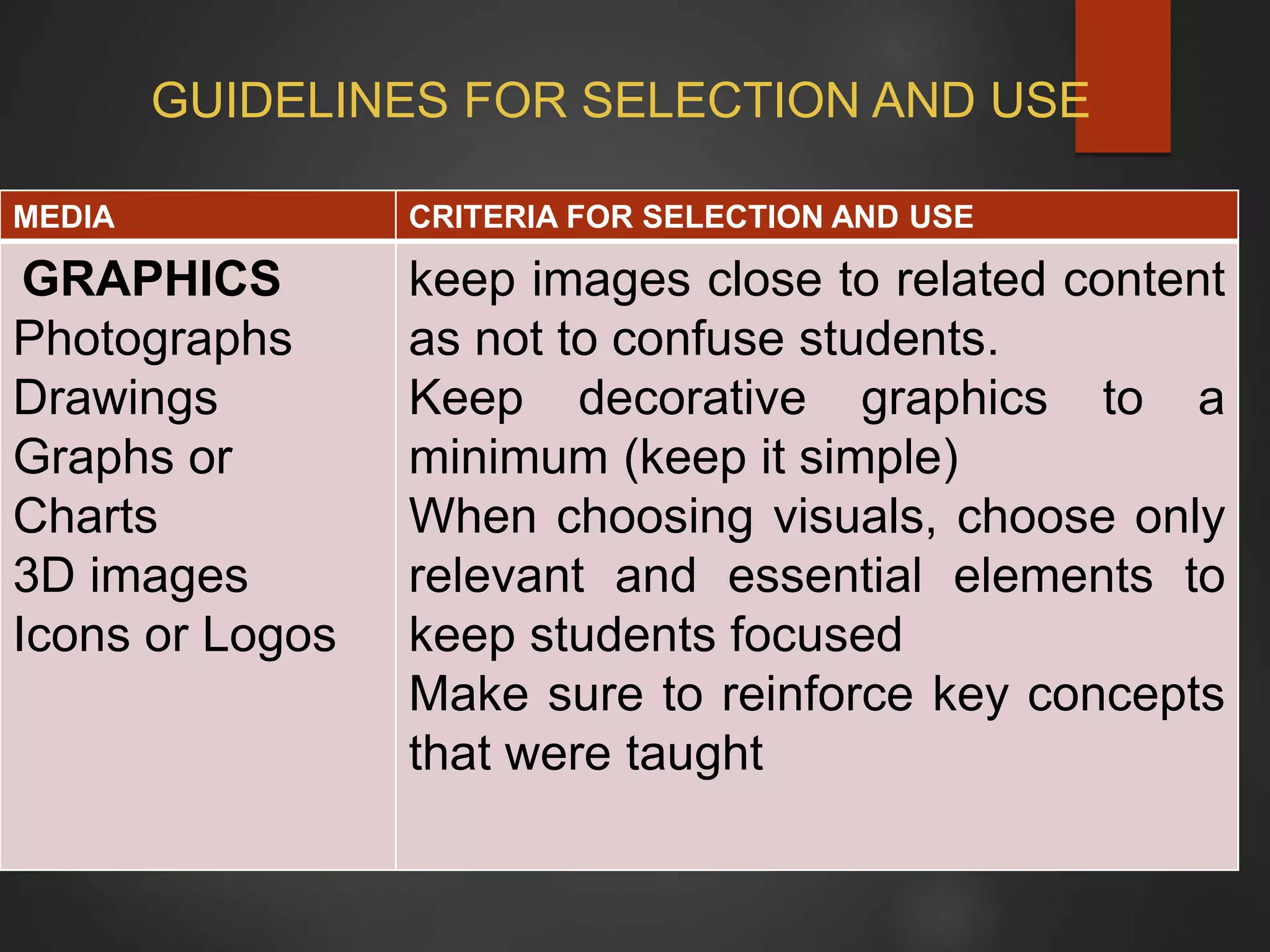
To form a clear idea of something Real object, model
To stress the essential and leave the non-essential in
the background
Model, scheme
To give visual access to something which may be
inaccessible
Model, picture, photo, poster, film
To clarify abstract information which may be difficult to
communicate verbally
Diagrams, columns of figures
To condense large quantities of information Diagrams, handouts
To promote mental activities of students Handouts, textbooks, films, pictures
To give feedback to the teacher about student
progress/achievement
Tests, study guides with assignments,
handouts with questions
To encourage emotional response Films, photos, poems
To support the work of the teacher Sound recordings, any medium
To give tests Any medium
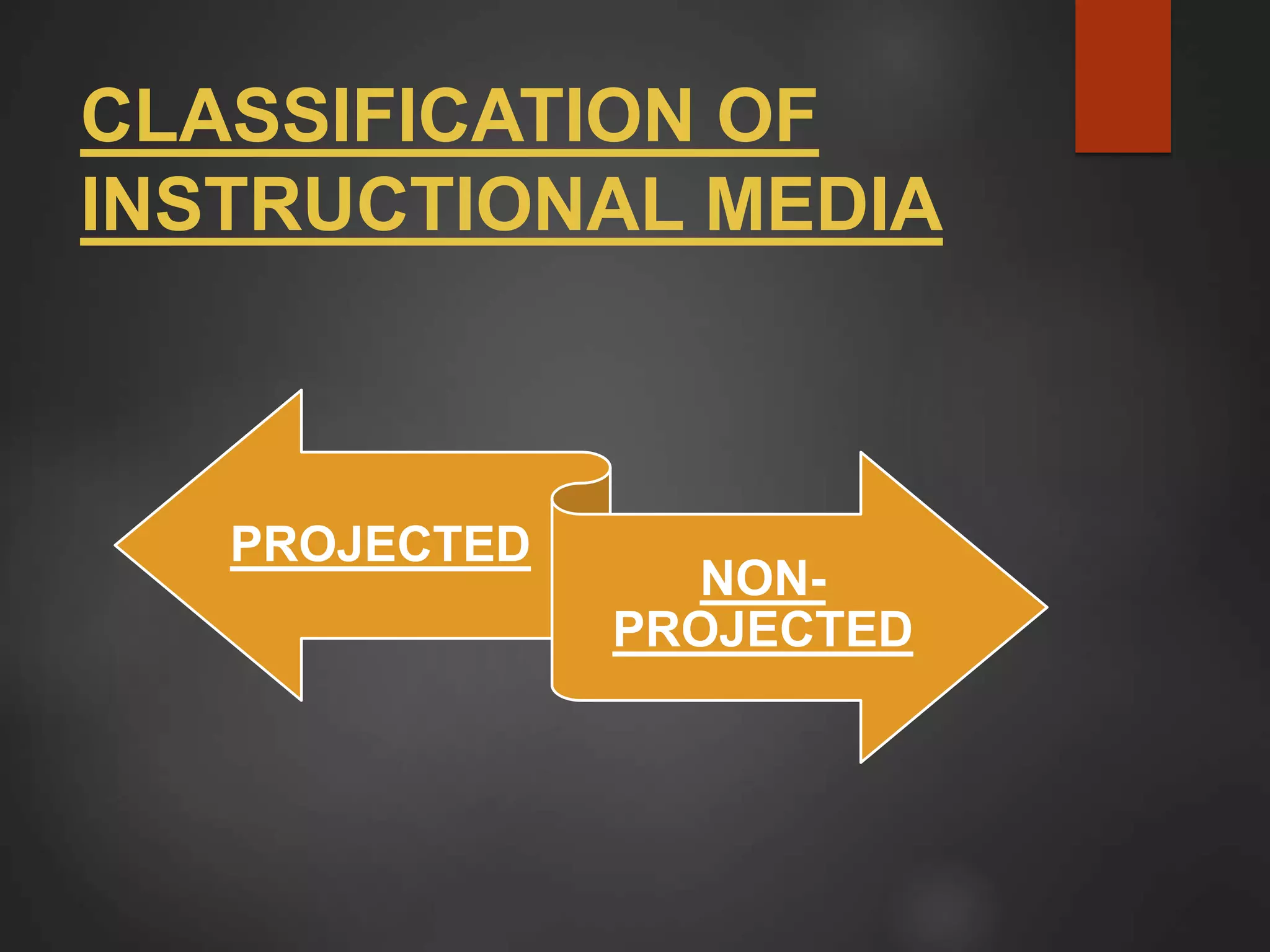
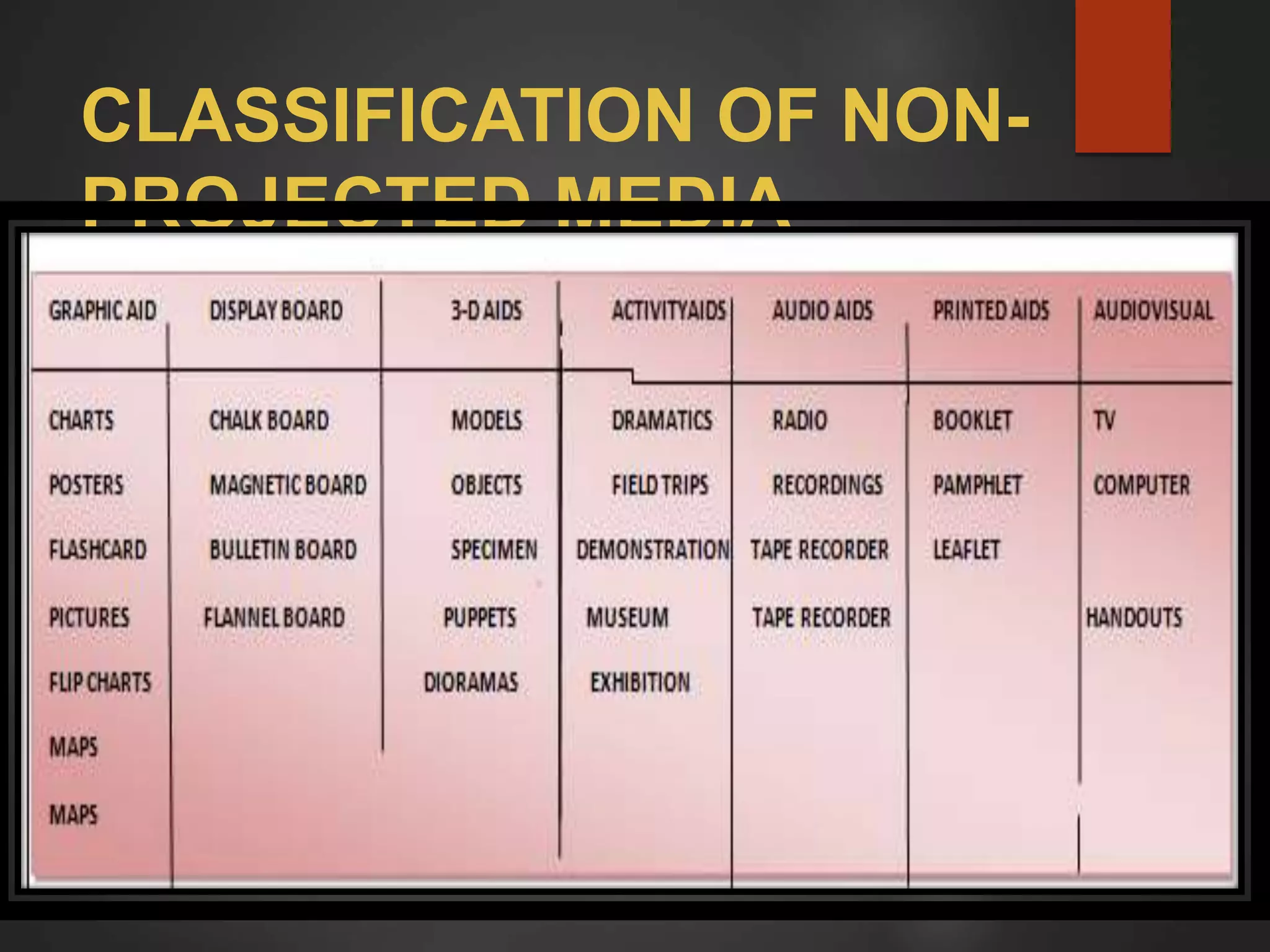
CLASSIFICATION OF
INSTRUCTIONAL MEDIA
PROJECTED
NON-
PROJECTED
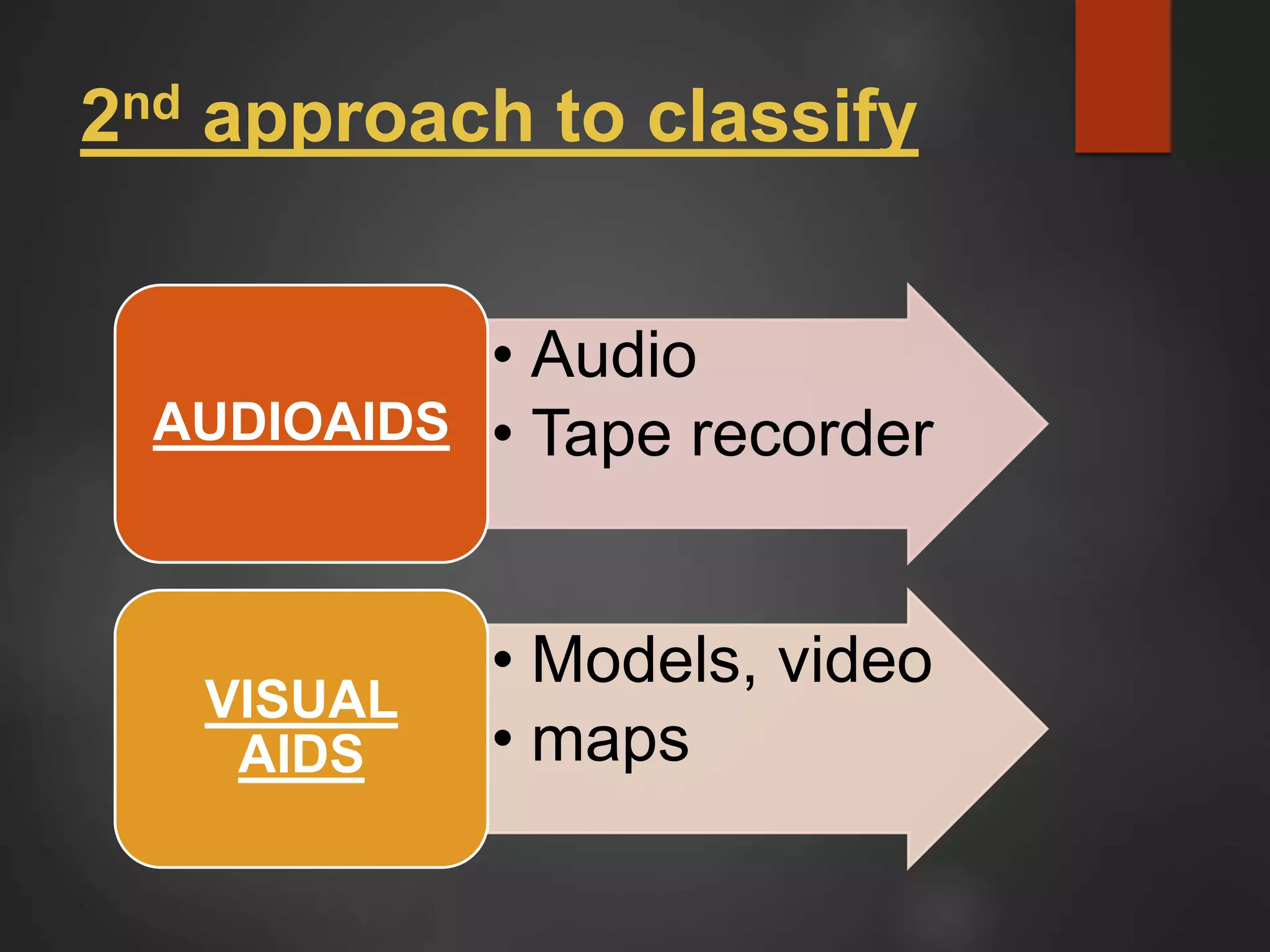
2nd approach to classify
• Audio
• Tape recorder
AUDIOAIDS
• Models, video
• maps
VISUAL
AIDS
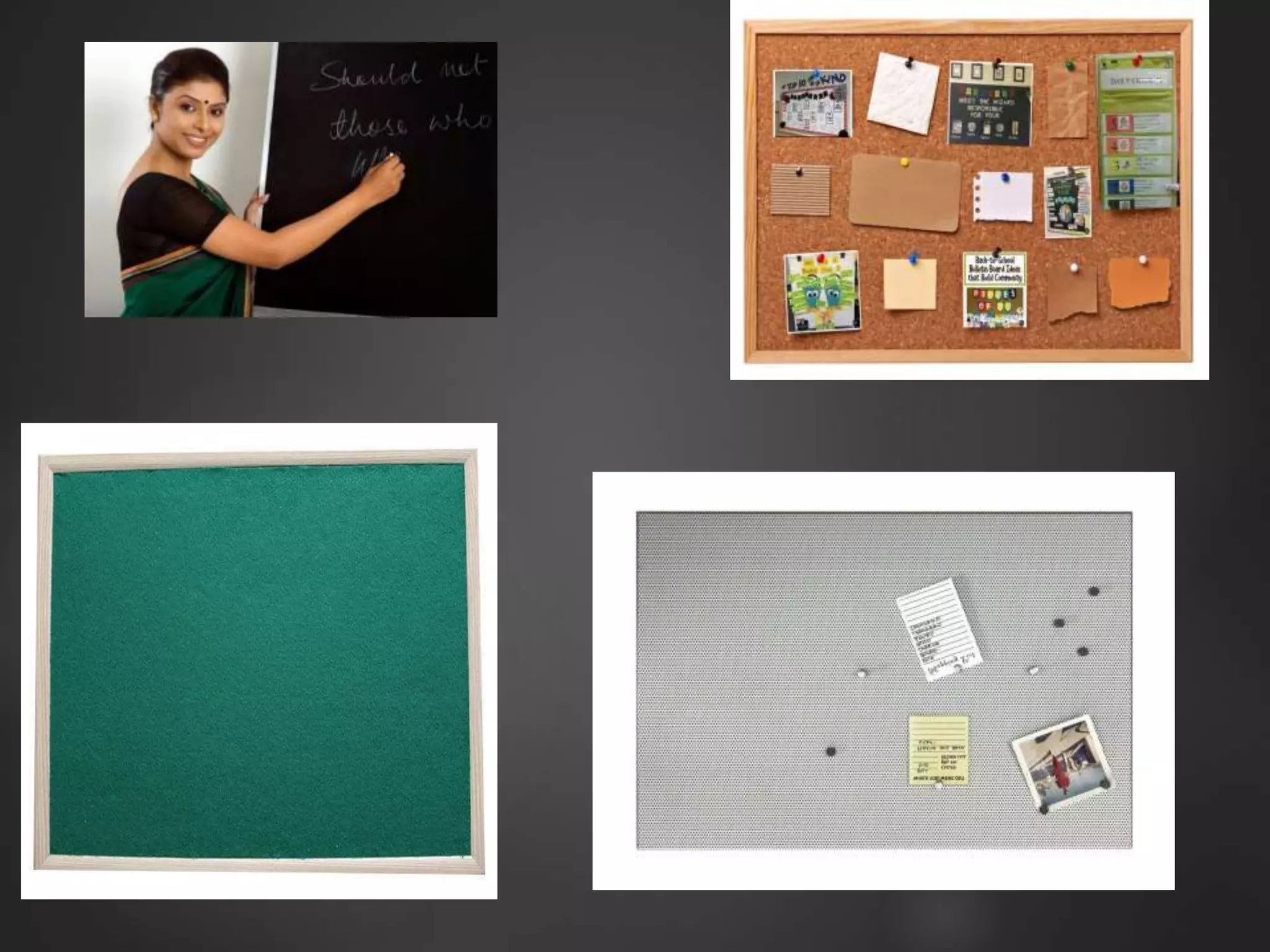
CLASSIFICATION OF NON-
PROJECTED MEDIA
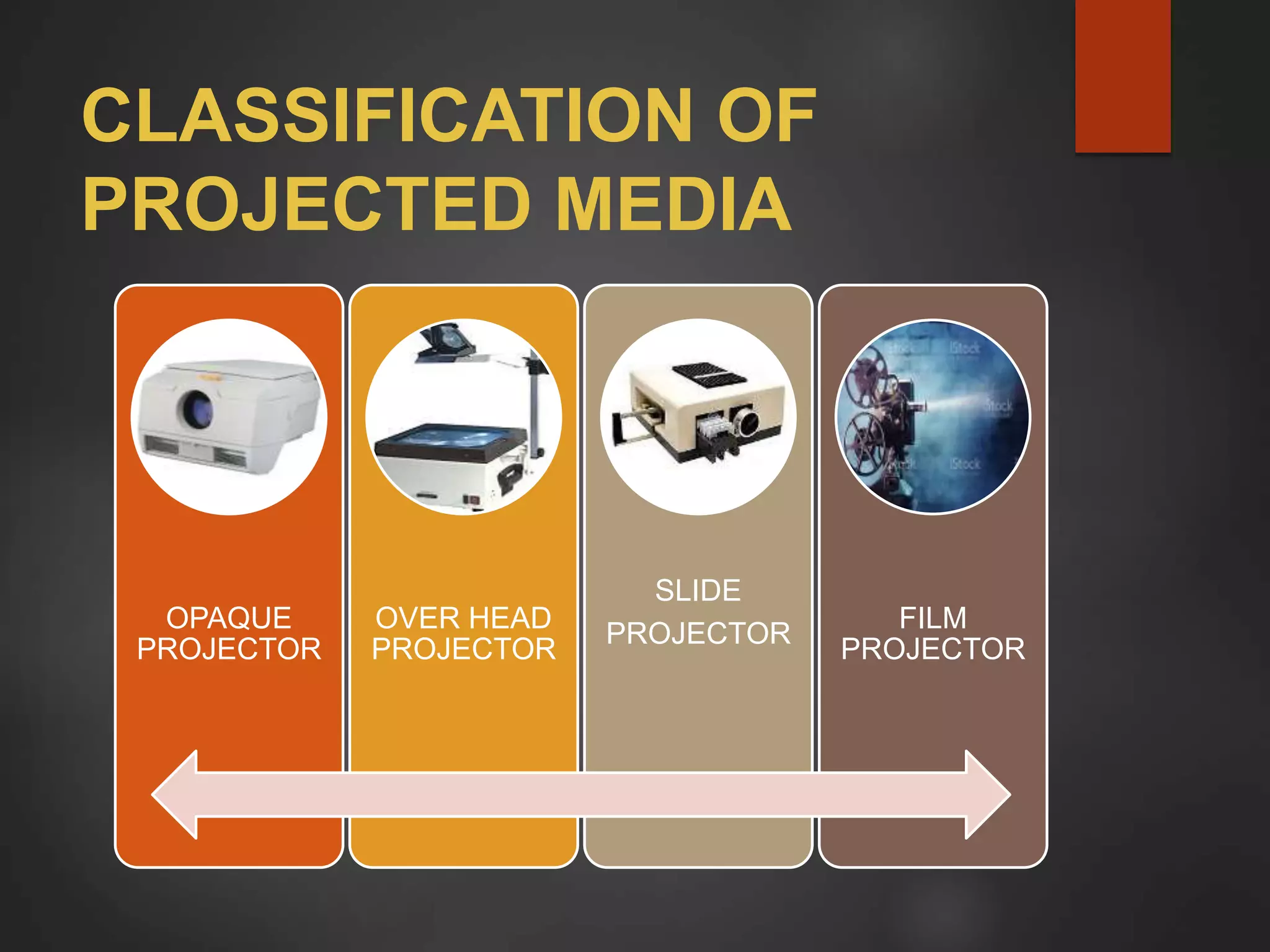
CLASSIFICATION OF
PROJECTED MEDIA
OPAQUE
PROJECTOR
OVER HEAD
PROJECTOR
SLIDE
PROJECTOR
FILM
PROJECTOR
NON PROJECTED MEDIAS
 Non projected media means the pictures that are not projected and
which are for the use of a small group of people
Principles of Non projected media
 It should be self –explanatory
 It should contain one idea at a time.
 It should be simple to understand
 It should be done with attractive colours
 It should be easy to handle
 It should be placed in an area ,which can be visualized by all
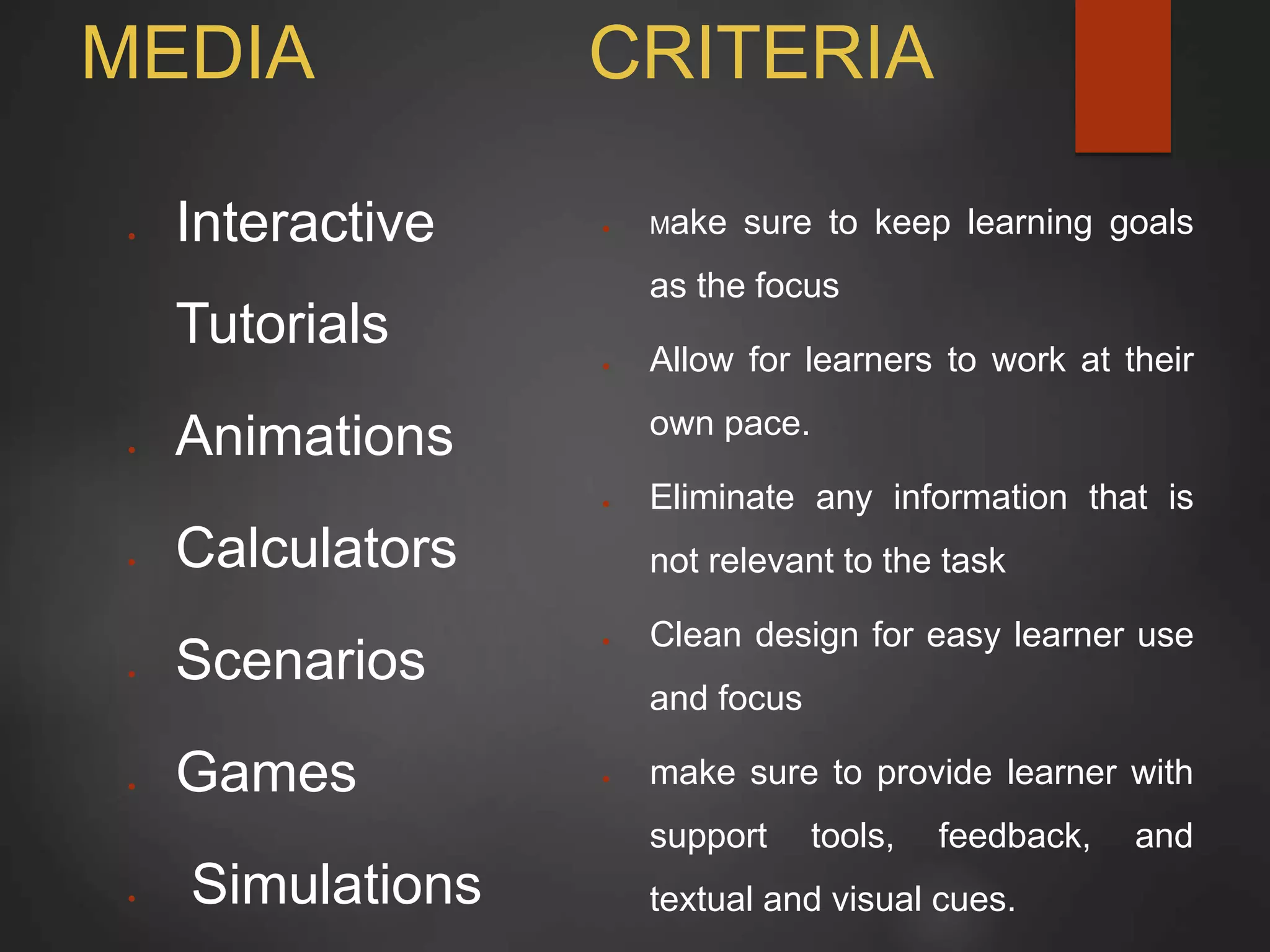
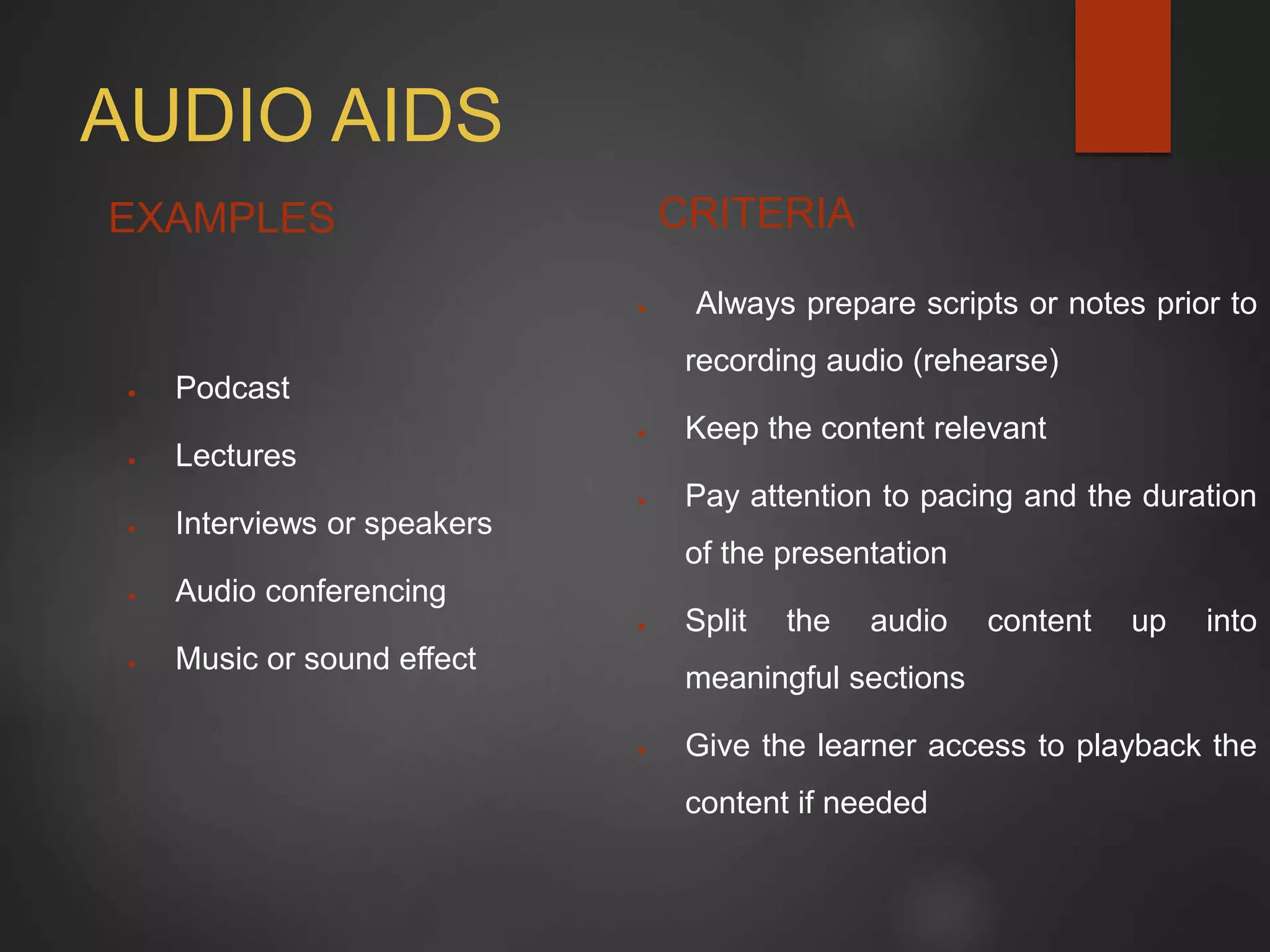
DIORAMAS
GUIDELINES FOR SELECTION AND USE
MEDIA CRITERIA FOR SELECTION AND USE
GRAPHICS
Photographs
Drawings
Graphs or
Charts
3D images
Icons or Logos
keep images close to related content
as not to confuse students.
Keep decorative graphics to a
minimum (keep it simple)
When choosing visuals, choose only
relevant and essential elements to
keep students focused
Make sure to reinforce key concepts
that were taught
MEDIA CRITERIA
 Interactive
Tutorials
 Animations
 Calculators
 Scenarios
 Games
 Simulations
 Make sure to keep learning goals
as the focus
 Allow for learners to work at their
own pace.
 Eliminate any information that is
not relevant to the task
 Clean design for easy learner use
and focus
 make sure to provide learner with
support tools, feedback, and
textual and visual cues.
AUDIO AIDS
EXAMPLES
 Podcast
 Lectures
 Interviews or speakers
 Audio conferencing
 Music or sound effect
CRITERIA
 Always prepare scripts or notes prior to
recording audio (rehearse)
 Keep the content relevant
 Pay attention to pacing and the duration
of the presentation
 Split the audio content up into
meaningful sections
 Give the learner access to playback the
content if needed
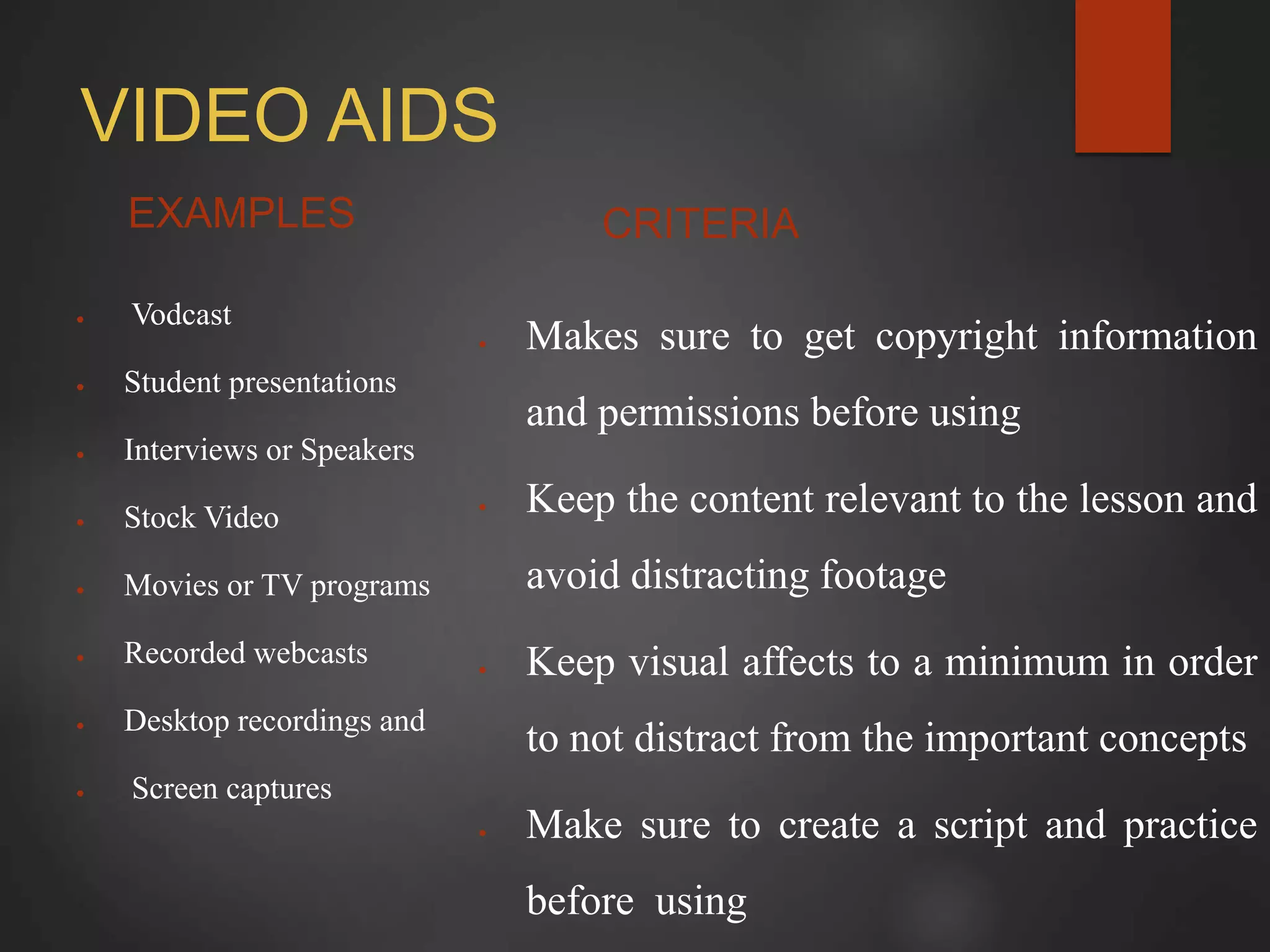
VIDEO AIDS
EXAMPLES
 Vodcast
 Student presentations
 Interviews or Speakers
 Stock Video
 Movies or TV programs
 Recorded webcasts
 Desktop recordings and
 Screen captures
CRITERIA
 Makes sure to get copyright information
and permissions before using
 Keep the content relevant to the lesson and
avoid distracting footage
 Keep visual affects to a minimum in order
to not distract from the important concepts
 Make sure to create a script and practice
before using
RESEARCH STUDIES REGARDING
SELECTION AND USE OF MEDIA
Factors Influencing Selection and Use
of Media for Christian Religious
Education Teaching and Learning
Henry H et al at University of Science
and Technology, Kenya
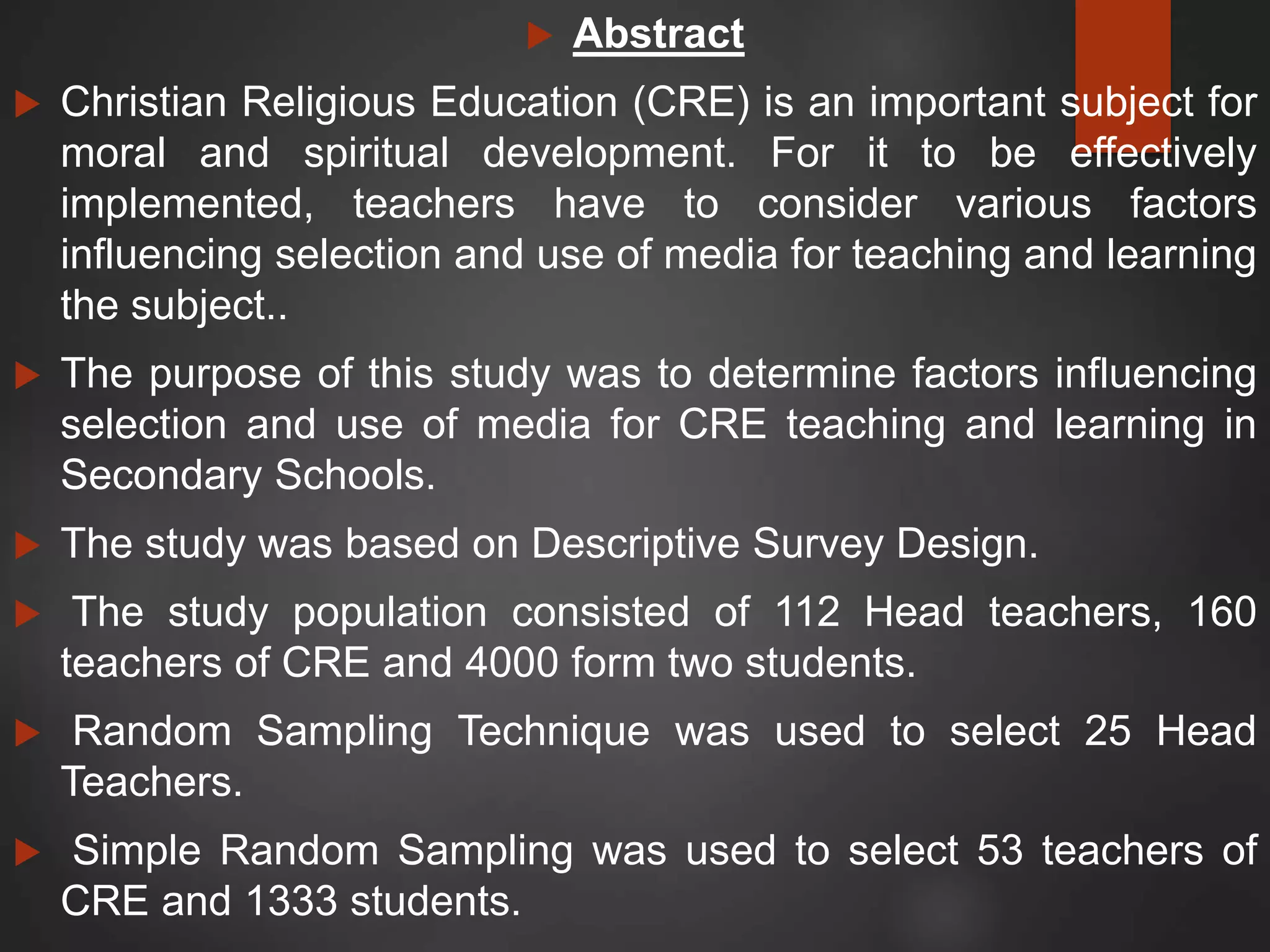
 Abstract
 Christian Religious Education (CRE) is an important subject for
moral and spiritual development. For it to be effectively
implemented, teachers have to consider various factors
influencing selection and use of media for teaching and learning
the subject..
 The purpose of this study was to determine factors influencing
selection and use of media for CRE teaching and learning in
Secondary Schools.
 The study was based on Descriptive Survey Design.
 The study population consisted of 112 Head teachers, 160
teachers of CRE and 4000 form two students.
 Random Sampling Technique was used to select 25 Head
Teachers.
 Simple Random Sampling was used to select 53 teachers of
CRE and 1333 students.
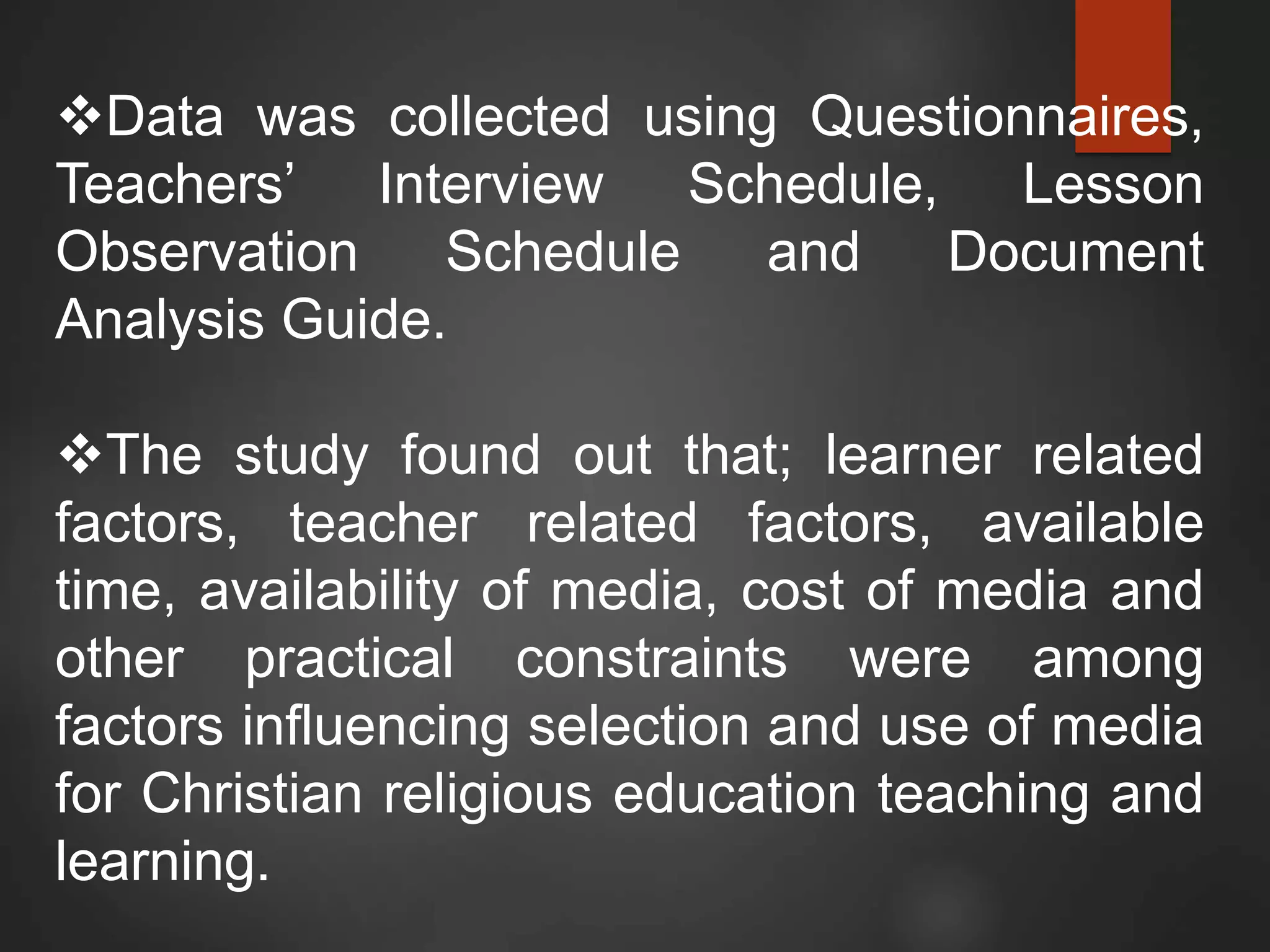
Data was collected using Questionnaires,
Teachers’ Interview Schedule, Lesson
Observation Schedule and Document
Analysis Guide.
The study found out that; learner related
factors, teacher related factors, available
time, availability of media, cost of media and
other practical constraints were among
factors influencing selection and use of media
for Christian religious education teaching and
learning.
Learners’ abilities were ranked highly as a factor
that influenced selection and use of media for CRE
teaching and learning as compared to learners’
preferences which were lowly ranked.
Teachers’ knowledge and skills on the other hand
were also highly ranked as compared to teacher
preferences.
The study recommended that; school
administrators should be inducted on the importance
of selection and use of instructional media resources
so as to be supportive of their teachers in the effort of
availing such resources to schools.
CONCLUSION
 Instructional media in education has been extremely
effective in teaching individuals a wide range
of subjects .
 It is changing the way we communicate with each
other.
 The variables influencing media selection include the
educational purpose, the type of contents, the features
of the target population and the constraints imposed
by the contexts of production and use.
 Face-to-face lessons can be greatly enhanced by the
effective use of images, text and audio/video
reproduction, especially if the adopted approach
doesn’t entail passive fruition by the students.
REFERENCES
 1.Ouinn ,M .F et al ,(2007).Quinns’s principles and practice of nursing education 5th
edition.U K:Lucy Mills publication.page no 205-207
 2.Bastable .S B.(2003)Nurse as educator principles and practice of teaching and learning
for nursing practice.second edition.Massachusetts:Jones and Barlett publishers.page no
389-426
 3Bates, A.W. (2015) Teaching in a Digital Age: Guidelines for Designing Teaching and
Learning Vancouver BC: Tony Bates Associates Ltd. ISBN: 978-0-9952692-0-0.
 4 Sodhi J k; (2017)Comprehensive textbook of nursing education.1st edition New Delhi:
Jaypee Brothers medical publishers pvt limited Publisher; pages 124-135
 5.Neeraja K P(2003) Textbook of nursing education. first edition. New Delhi: Jaypee
Brothers medical publishers private limited page no 206-211
 5.Persico, Donatella. (2006). Media Selection from the Teachers’ Point of View.
10.4018/978-1-59140-953-3.ch019.
 6.Rasul, Saima & Bukhsh, Qadir & Batool, Shazia. (2011). A study to analyze the
effectiveness of audio visual aids in teaching learning process at university level. Procedia
- Social and Behavioral Sciences. 28. 78–81. 10.1016/j.sbspro.2011.11.016.
 7.Steve Statzer, Selection and Use of Support Media for Classroom Instruction: Part 4.
Visual Aids, Laboratory Medicine, Volume 11, Issue 10, 1 October 1980, Pages 686–
689, https://doi.org/10.1093/labmed/11.10.686
Key Concepts in selection and use of media in nursing education

Key Concepts in selection and use of media in nursing education

  • 1.
    KEY CONCEPTS IN SELECTIONAND USE OF MEDIA IN EDUCATION PRESENTER MATHEW VARGHESE V MSN FHNP CCEPC CSTPN
  • 2.
    INSTRUCTIONAL MEDIA INTRODUCTION  Thereis a famous Chinese proverb which says “What I hear I forget, what I see I remember, what I do I understand “.  Different types of instructional media enhances clarity in communication.  It increases forcefulness of subject being learned or taught. Instructional technology involves integration of men, machines materials and ideas
  • 3.
    INSTRUCTIONAL MEDIA Definitions  Mediaare generally defined as the means by which information is conveyed from one place to another.  It refers to all the aids or vehicles by which information is communicated.  Instructional media are information carriers designed specifically to fulfill objectives in a teaching-learning situation.
  • 4.
    Definitions….  According toAzikiwe (2007), Instructional media cover whatever the teacher uses to involve all the five senses of sight, hearing, touch, smell and taste while presenting his/her lessons.  Adegun (1997) says instructional media are things which are intended to help the teacher to teach more effectively and enable the students to learn more readily.
  • 5.
    DEFINITION OF AV AIDS  According to Burton, Audiovisual aids are those sensory objects or images which initiate or stimulate and reinforce learning.
  • 6.
    PURPOSES  To providebasis for more effective perceptual and conceptual learning.  To increase the meaningfulness of abstract content.  To stimulate thinking and motivate action.  To initiate and sustain attention.  To provide concreteness, realism in teaching experience  To gain practical skill.  To bring remote event in the class
  • 7.
  • 8.
    Concepts for selectionand use  It should be systematically well planned so that ,suitable media for a particular group of students as per learning objectives can be selected and used  Teacher should think judiciously while planning their lesson about the use of media
  • 9.
    CONCEPTS FOR SELECTION OF INSTRUCTIONALMEDIA LEARNING OBJECTIVE SIZE AND NATURE OF THE GROUP AVAILABILITY OF RESOURCES TECHNICAL SUPPORT KNOW YOUR EXPERTISE IN PREPARATION OF MEDIA
  • 10.
    CONCEPTS FOR SELECTION OF INSTRUCTIONALMEDIA MEDIA CHARACTERISTICS AVAILABILITY OF ELECTRICITY LEGAL CONSIDERATIONS LEARNER`S RESPONSE OTHER CONCEPTS
  • 11.
    Learning objectives  Keyarea which determine suitability and applicability of a particular A V aid  Select A V aid from all the available options that can be helpful to deliver lesson to achieve desired objectives.  e.g. Use of power point to depict research finding will serve objective rather than chalk board
  • 12.
    SIZE AND NATUREOF THE GROUP  For small size class of 10-30,charts but for large group of 50- 100,power point with sound amplifier can be used  Age, sex, sociocultural background,  Motivation ,physical abilities and disabilities  Know the size of group in advance
  • 13.
    Availability of resources Teacher has to explore the available resources in the college  In resource limited settings you could not plan for costly media  .It is better to use economical media
  • 14.
    TECHNICAL SUPPORT  Ifteacher is using technically sophisticated media, then make sure that technical support is available whenever required .It is better to avoid technically sophisticated media like film strip projector if teacher is not well acquainted with technology of that particular media or where the technical support is not readily available
  • 15.
    KNOW YOUR EXPERTISE INPREPARATION OF MEDIA  Choose the media on which teacher & students can prepare content more skillfully& creatively. In some situations teacher may need to consider commercially available AV aids.
  • 16.
    MEDIA CHARECTERISTICS  Preferenceto be given to media that can be stored &retrieved providing that given media is not compromising the learning objectives and the students attention .  Another media characteristic of significance is the physical quality of the media ,which includes the attributes ,authenticity and significance of content.
  • 17.
    AVAILABILITY OF ELECTRICITY Availability of electricity becomes an important consideration before selecting a media that uses electricity (transparency ,LCD projector).  Teacher has to ensure there is uninterrupted supply of electricity in the class room or else have an alternate media ready to use in case of electricity failure
  • 18.
    LEARNERS RESPONSE Your textMedia utilization should focus on learner`s response through discussion, dramatization & so on.
  • 19.
    LEGAL CONSIDERATIONS  Legalaspects should be considered in the production and the utilization of educational communications media and this is particularly important where AV materials are prepared by the author It is advisable to get the permission in writing to avoid possible legal involvement
  • 20.
    OTHER CONCEPTS  Stimulusvariation, feedback ,reinforcement, learner participation are some other concepts that should be considered.
  • 21.
    ROMISZOWSKI ‘S CONCEPT FORSELECTION AND USE OF MEDIA TASK FACTO RS LEARNE R AND LECTUR ER FACTOR S COURSE OBJECTI VES AND CONTEN T FACTOR S MATERIA L FACTOR S
  • 22.
    Factors affecting theselection of instruction media (Sources: Adapted from Romiszowski, 1981, and Laver, 1990).
  • 23.
    SECTIONS MODEL –AFRAME WORK FOR SELECTION AND USE OF MEDIA IN EDUCATION  The SECTIONS model was described by AW Tony Bates in 2005 gives a frame work for selection and use of media
  • 25.
  • 26.
    PRINCIPLE OF SELECTION 1. Principleof learner centeredness 2. Principle of interest & motivation 3. Principle of educational value 4. Principle of realization of objectives 5. Principle of simplicity
  • 27.
    PRINCIPLE OF SELECTION 6. Principleof relevancy &suitability 7. Principle of accuracy 8. Principe of size 9. Principle of availability 10. Principle of means to an end
  • 28.
    PRINCIPLES OF UTILIZATION 1. Principleof preparation 2. Principle of physical control 3. Principle of proper presentation 4. Principle of response 5. Principle of evaluation
  • 29.
  • 30.
    Reasons for mediause General examples To form a clear idea of something Real object, model To stress the essential and leave the non-essential in the background Model, scheme To give visual access to something which may be inaccessible Model, picture, photo, poster, film To clarify abstract information which may be difficult to communicate verbally Diagrams, columns of figures To condense large quantities of information Diagrams, handouts To promote mental activities of students Handouts, textbooks, films, pictures To give feedback to the teacher about student progress/achievement Tests, study guides with assignments, handouts with questions To encourage emotional response Films, photos, poems To support the work of the teacher Sound recordings, any medium To give tests Any medium
  • 31.
  • 32.
    2nd approach toclassify • Audio • Tape recorder AUDIOAIDS • Models, video • maps VISUAL AIDS
  • 33.
  • 34.
    CLASSIFICATION OF PROJECTED MEDIA OPAQUE PROJECTOR OVERHEAD PROJECTOR SLIDE PROJECTOR FILM PROJECTOR
  • 35.
    NON PROJECTED MEDIAS Non projected media means the pictures that are not projected and which are for the use of a small group of people Principles of Non projected media  It should be self –explanatory  It should contain one idea at a time.  It should be simple to understand  It should be done with attractive colours  It should be easy to handle  It should be placed in an area ,which can be visualized by all
  • 37.
  • 38.
    GUIDELINES FOR SELECTIONAND USE MEDIA CRITERIA FOR SELECTION AND USE GRAPHICS Photographs Drawings Graphs or Charts 3D images Icons or Logos keep images close to related content as not to confuse students. Keep decorative graphics to a minimum (keep it simple) When choosing visuals, choose only relevant and essential elements to keep students focused Make sure to reinforce key concepts that were taught
  • 39.
    MEDIA CRITERIA  Interactive Tutorials Animations  Calculators  Scenarios  Games  Simulations  Make sure to keep learning goals as the focus  Allow for learners to work at their own pace.  Eliminate any information that is not relevant to the task  Clean design for easy learner use and focus  make sure to provide learner with support tools, feedback, and textual and visual cues.
  • 40.
    AUDIO AIDS EXAMPLES  Podcast Lectures  Interviews or speakers  Audio conferencing  Music or sound effect CRITERIA  Always prepare scripts or notes prior to recording audio (rehearse)  Keep the content relevant  Pay attention to pacing and the duration of the presentation  Split the audio content up into meaningful sections  Give the learner access to playback the content if needed
  • 41.
    VIDEO AIDS EXAMPLES  Vodcast Student presentations  Interviews or Speakers  Stock Video  Movies or TV programs  Recorded webcasts  Desktop recordings and  Screen captures CRITERIA  Makes sure to get copyright information and permissions before using  Keep the content relevant to the lesson and avoid distracting footage  Keep visual affects to a minimum in order to not distract from the important concepts  Make sure to create a script and practice before using
  • 42.
    RESEARCH STUDIES REGARDING SELECTIONAND USE OF MEDIA Factors Influencing Selection and Use of Media for Christian Religious Education Teaching and Learning Henry H et al at University of Science and Technology, Kenya
  • 43.
     Abstract  ChristianReligious Education (CRE) is an important subject for moral and spiritual development. For it to be effectively implemented, teachers have to consider various factors influencing selection and use of media for teaching and learning the subject..  The purpose of this study was to determine factors influencing selection and use of media for CRE teaching and learning in Secondary Schools.  The study was based on Descriptive Survey Design.  The study population consisted of 112 Head teachers, 160 teachers of CRE and 4000 form two students.  Random Sampling Technique was used to select 25 Head Teachers.  Simple Random Sampling was used to select 53 teachers of CRE and 1333 students.
  • 44.
    Data was collectedusing Questionnaires, Teachers’ Interview Schedule, Lesson Observation Schedule and Document Analysis Guide. The study found out that; learner related factors, teacher related factors, available time, availability of media, cost of media and other practical constraints were among factors influencing selection and use of media for Christian religious education teaching and learning.
  • 45.
    Learners’ abilities wereranked highly as a factor that influenced selection and use of media for CRE teaching and learning as compared to learners’ preferences which were lowly ranked. Teachers’ knowledge and skills on the other hand were also highly ranked as compared to teacher preferences. The study recommended that; school administrators should be inducted on the importance of selection and use of instructional media resources so as to be supportive of their teachers in the effort of availing such resources to schools.
  • 46.
    CONCLUSION  Instructional mediain education has been extremely effective in teaching individuals a wide range of subjects .  It is changing the way we communicate with each other.  The variables influencing media selection include the educational purpose, the type of contents, the features of the target population and the constraints imposed by the contexts of production and use.  Face-to-face lessons can be greatly enhanced by the effective use of images, text and audio/video reproduction, especially if the adopted approach doesn’t entail passive fruition by the students.
  • 47.
    REFERENCES  1.Ouinn ,M.F et al ,(2007).Quinns’s principles and practice of nursing education 5th edition.U K:Lucy Mills publication.page no 205-207  2.Bastable .S B.(2003)Nurse as educator principles and practice of teaching and learning for nursing practice.second edition.Massachusetts:Jones and Barlett publishers.page no 389-426  3Bates, A.W. (2015) Teaching in a Digital Age: Guidelines for Designing Teaching and Learning Vancouver BC: Tony Bates Associates Ltd. ISBN: 978-0-9952692-0-0.  4 Sodhi J k; (2017)Comprehensive textbook of nursing education.1st edition New Delhi: Jaypee Brothers medical publishers pvt limited Publisher; pages 124-135  5.Neeraja K P(2003) Textbook of nursing education. first edition. New Delhi: Jaypee Brothers medical publishers private limited page no 206-211  5.Persico, Donatella. (2006). Media Selection from the Teachers’ Point of View. 10.4018/978-1-59140-953-3.ch019.  6.Rasul, Saima & Bukhsh, Qadir & Batool, Shazia. (2011). A study to analyze the effectiveness of audio visual aids in teaching learning process at university level. Procedia - Social and Behavioral Sciences. 28. 78–81. 10.1016/j.sbspro.2011.11.016.  7.Steve Statzer, Selection and Use of Support Media for Classroom Instruction: Part 4. Visual Aids, Laboratory Medicine, Volume 11, Issue 10, 1 October 1980, Pages 686– 689, https://doi.org/10.1093/labmed/11.10.686