Cognitive Views of
Learning(Information
processing model)
BY:AZRA SOOMRO
2K17/M.ED/08
COGNITIVE:
relating to cognition; concerned with the
act or process of knowing, perceiving, etc
Learning:
the activity or process of gaining
knowledge or skill by studying, practicing,
being taught, or experiencing something :
the activity of someone who learns. :
knowledge or skill gained from learning
Knowledge is a familiarity, awareness,
or understanding of someone or
something, such as facts, information,
descriptions, or skills, which is acquired
through experience or education by
perceiving, discovering, or learning.
Cognitive view of learning:
Using Thinking to Learn. The Cognitive
Learning Theory explains why the brain is the
most incredible network of information
processing and interpretation in the body as we
learn things. This theory can be divided into two
specific theories: the Social Cognitive Theory
(SCT), and the Cognitive Behavioral Theory
(CBT).
cognitive learning:
1. learning that is concerned with
acquisition of problem-solving abilities
and with intelligence and conscious
thought.
2. A theory that defines learning as a
behavioral change based on the
acquisition of information about the
environment.
Kinds of knowledge
General
Domain specific
Declarative
Procedural
Conditional or structural
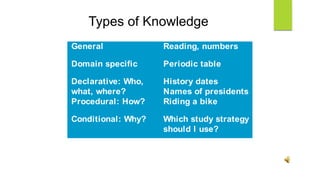
Types of Knowledge
General Reading, numbers
Domain specific Periodic table
Declarative: Who,
what, where?
History dates
Names of presidents
Procedural: How? Riding a bike
Conditional: Why? Which study strategy
should I use?
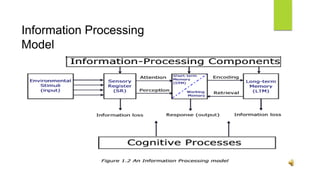
Information Processing
Model
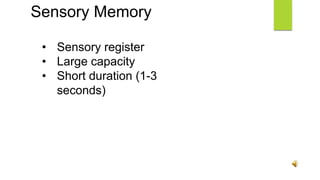
Sensory Memory
• Sensory register
• Large capacity
• Short duration (1-3
seconds)
Long Term Memory
• Storage takes more time & effort
• Unlimited capacity
• Unlimited duration
• Contains visual or verbal or a
combination of codes
Comparison of Working & Long
Term Memory
Working
Very fast input
Limited capacity
5–20 seconds duration
Contains words, images, ideas,
sentences
Immediate recovery
Long Term
Relatively slow input
Practically unlimited capacity
Practically unlimited duration
Contains networks, schemata
Retrieval depends on connections
Metacognition
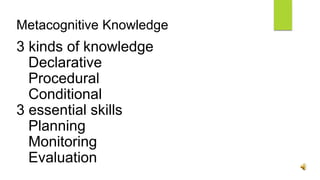
Metacognitive Knowledge
3 kinds of knowledge
Declarative
Procedural
Conditional
3 essential skills
Planning
Monitoring
Evaluation
Thanks

Cognitive View of Learning

  • 1.
    Cognitive Views of Learning(Information processingmodel) BY:AZRA SOOMRO 2K17/M.ED/08
  • 2.
    COGNITIVE: relating to cognition;concerned with the act or process of knowing, perceiving, etc Learning: the activity or process of gaining knowledge or skill by studying, practicing, being taught, or experiencing something : the activity of someone who learns. : knowledge or skill gained from learning
  • 3.
    Knowledge is afamiliarity, awareness, or understanding of someone or something, such as facts, information, descriptions, or skills, which is acquired through experience or education by perceiving, discovering, or learning.
  • 4.
    Cognitive view oflearning: Using Thinking to Learn. The Cognitive Learning Theory explains why the brain is the most incredible network of information processing and interpretation in the body as we learn things. This theory can be divided into two specific theories: the Social Cognitive Theory (SCT), and the Cognitive Behavioral Theory (CBT).
  • 5.
    cognitive learning: 1. learningthat is concerned with acquisition of problem-solving abilities and with intelligence and conscious thought. 2. A theory that defines learning as a behavioral change based on the acquisition of information about the environment.
  • 6.
    Kinds of knowledge General Domainspecific Declarative Procedural Conditional or structural
  • 7.
    Types of Knowledge GeneralReading, numbers Domain specific Periodic table Declarative: Who, what, where? History dates Names of presidents Procedural: How? Riding a bike Conditional: Why? Which study strategy should I use?
  • 8.
  • 9.
    Sensory Memory • Sensoryregister • Large capacity • Short duration (1-3 seconds)
  • 10.
    Long Term Memory •Storage takes more time & effort • Unlimited capacity • Unlimited duration • Contains visual or verbal or a combination of codes
  • 11.
    Comparison of Working& Long Term Memory Working Very fast input Limited capacity 5–20 seconds duration Contains words, images, ideas, sentences Immediate recovery Long Term Relatively slow input Practically unlimited capacity Practically unlimited duration Contains networks, schemata Retrieval depends on connections
  • 12.
  • 13.
    Metacognitive Knowledge 3 kindsof knowledge Declarative Procedural Conditional 3 essential skills Planning Monitoring Evaluation
  • 14.