Google Images
                Dr Barbara Spears
From drooling dogs & pecking pigeons to complex
human behaviour
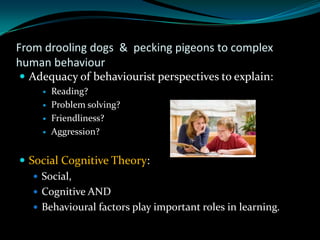
 Adequacy of behaviourist perspectives to explain:
        Reading?
        Problem solving?
        Friendliness?
        Aggression?


 Social Cognitive Theory:
    Social,
    Cognitive AND
    Behavioural factors play important roles in learning.
Looking Back......Behaviourism
Emphasis on experimental methods
 Focus on variables we can:
    Observe
    Measure
    Manipulate ( Drooling dogs, & pecking pigeons)

 CC: Respondent: Pavlov
    Autonomic; involuntary, reflexive
        Contiguous learning: stimulus : response

 OC: Operant: Watson/Thorndike/Skinner
   ABC
        Environmental experiences and behaviour

 Neglects:
    Influence of social and cognitive factors
Social and Cognitive factors in learning?
Social Factors?                   Cognitive Factors?
 Students observing their         Students’ expectations for
  parents’ achievement              success
  behaviour

 What social factors have been    What cognitive factors have
  important in your learning?       been important in your
                                    learning?
Moving Forwards
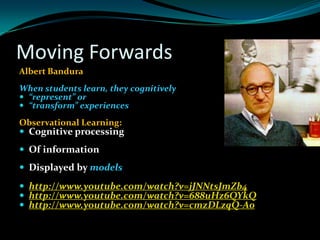
Albert Bandura
When students learn, they cognitively
 “represent” or
 “transform” experiences

Observational Learning:
 Cognitive processing
 Of information
 Displayed by models

 http://www.youtube.com/watch?v=jJNNtsJmZb4
 http://www.youtube.com/watch?v=688uHz6QYkQ
 http://www.youtube.com/watch?v=cmzDLzqQ-A0
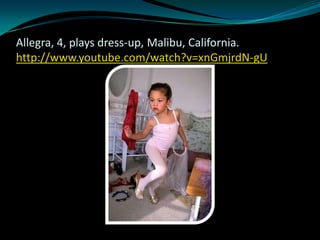
Allegra, 4, plays dress-up, Malibu, California.
http://www.youtube.com/watch?v=xnGmjrdN-gU
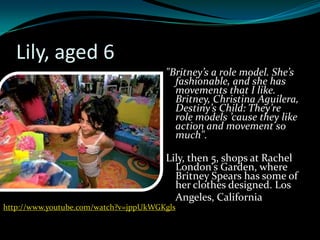
Lily, aged 6
                                       "Britney’s a role model. She’s
                                         fashionable, and she has
                                         movements that I like.
                                         Britney, Christina Aguilera,
                                         Destiny’s Child: They’re
                                         role models ’cause they like
                                         action and movement so
                                         much".

                                       Lily, then 5, shops at Rachel
                                         London's Garden, where
                                         Britney Spears has some of
                                         her clothes designed. Los
                                         Angeles, California
http://www.youtube.com/watch?v=jppUkWGKgls
Albert Bandura
Social Learning Theory
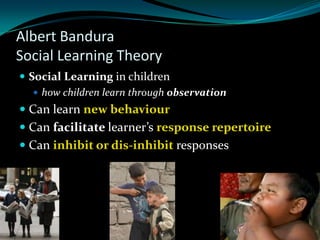
 Social Learning in children
    how children learn through observation
 Can learn new behaviour
 Can facilitate learner’s response repertoire
 Can inhibit or dis-inhibit responses
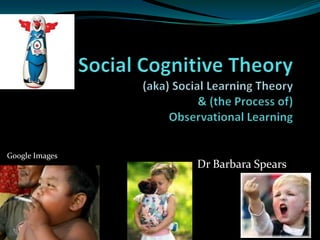
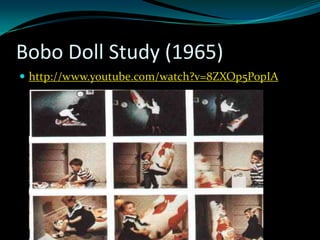
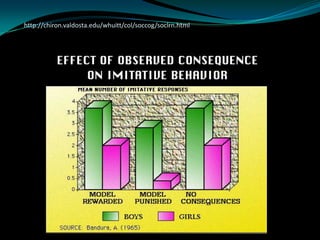
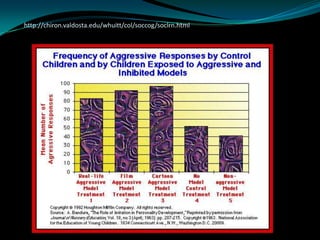
Bobo Doll Study (1965)
 http://www.youtube.com/watch?v=8ZXOp5PopIA
http://chiron.valdosta.edu/whuitt/col/soccog/soclrn.html
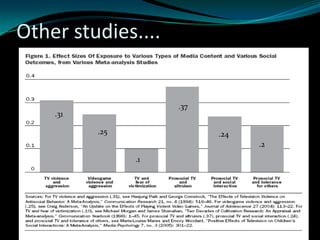
Other studies....


                     .37
    .31

          .25              .24
                                 .2
                .1
Video Games and Violence?
 http://www.youtube.com/watch?v=WB6vTkvi9to

 http://ithp.org/articles/violentvideogames.html

 http://www.apa.org/science/about/psa/2003/10/ander
 son.aspx

 http://www.telegraph.co.uk/education/educationnew
 s/9183385/Violent-video-games-are-fuelling-rise-in-
 aggressive-behaviour.html
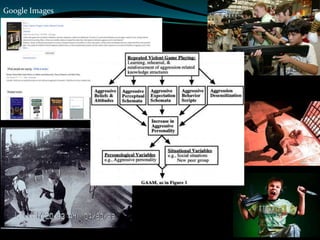
Google Images
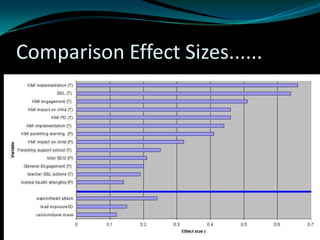
Comparison Effect Sizes......
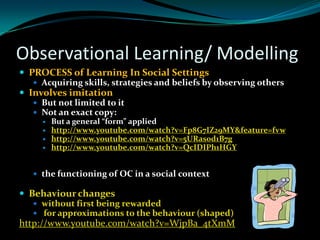
Observational Learning/ Modelling
 PROCESS of Learning In Social Settings
    Acquiring skills, strategies and beliefs by observing others
 Involves imitation
    But not limited to it
    Not an exact copy:
        But a general “form” applied
        http://www.youtube.com/watch?v=Fp8G7IZ29MY&feature=fvw
        http://www.youtube.com/watch?v=5URas0d1B7g
        http://www.youtube.com/watch?v=QcIDIPh1HGY


    the functioning of OC in a social context

 Behaviour changes
    without first being rewarded
    for approximations to the behaviour (shaped)
http://www.youtube.com/watch?v=WjpBa_4tXmM
Four Fundamentals of the
(Observational, Social Cognitive) Learning
Process:
To Learn:
 Attention
    = pay attention first : attend to the model


 Retention
    Remember what you have paid attention to: code in memory
      Imagery and language
            Store what we have seen as mental images/verbal descriptions


 (Re)Production
    Translate images into behaviour
    Have to have the ability to reproduce


 (Reinforcement and) Motivation
    Only perform when motivated
      Past reinforcement
      Promised reinforcement (incentives)
      Vicarious reinforcement (seeing others)
Comparison :
OC & OL
 OC: views
   reinforcement is a direct cause of learning (ABC)


 OL: views
   reinforcement as motivation, not learning
  learning occurs:
  form a representation of the behaviour in memory,
  &
  reproduce it
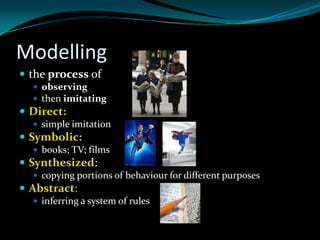
Modelling
 the process of
   observing
   then imitating
 Direct:
   simple imitation
 Symbolic:
   books; TV; films
 Synthesized:
   copying portions of behaviour for different purposes
 Abstract:
   inferring a system of rules
Determinants
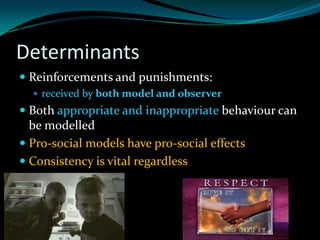
 Reinforcements and punishments:
   received by both model and observer
 Both appropriate and inappropriate behaviour can
  be modelled
 Pro-social models have pro-social effects
 Consistency is vital regardless
To Whom do we Pay Attention?
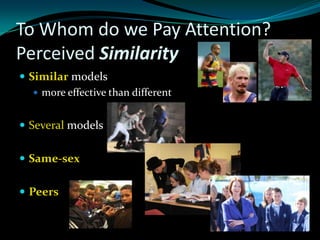
Perceived Similarity
 Similar models
    more effective than different


 Several models


 Same-sex


 Peers
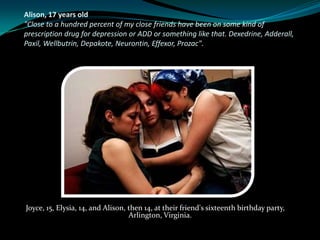
Alison, 17 years old
"Close to a hundred percent of my close friends have been on some kind of
prescription drug for depression or ADD or something like that. Dexedrine, Adderall,
Paxil, Wellbutrin, Depakote, Neurontin, Effexor, Prozac".


Joyce, 15, Elysia, 14, and Alison, then 14, at their friend's sixteenth birthday party,
                                   Arlington, Virginia.
To Whom Do we Pay Attention?
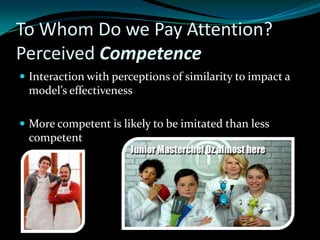
Perceived Competence
 Interaction with perceptions of similarity to impact a
 model’s effectiveness

 More competent is likely to be imitated than less
 competent
Competence?
 Olympians
 Football players
 Soap Stars
 Who in the Class????
(Re)production &Motivation :
Acquisition and Performance
We may all know more than we show

 While learning may have occurred,
   it may not be demonstrated (Re/Produced)
   until the situation is right (Motivated)


 May acquire new skill/behaviour:
   but may not perform it until motivated
Bandura Believes:
Traditional behavioural views are
   accurate, but incomplete
Social Learning Theory
   Extended behavioural explanations
   Recognised mental/psychological factors
Social COGNITIVE Theory
 Links:
   the functioning of OC;
   in a social setting;
   with the role of cognition in processing information
Social Cognitive Theory
 Emphasises internal processes:
   thoughts are always influencing actions and
   actions are always influencing thoughts (Bandura,
    1986)
 Children:
    Think about what they do;
    about what we want them to do

   those thoughts affect what they actually do.
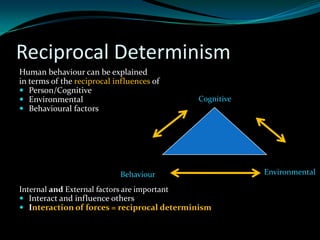
Reciprocal Determinism
Human behaviour can be explained
in terms of the reciprocal influences of
 Person/Cognitive
 Environmental                             Cognitive
 Behavioural factors


                            Behaviour                   Environmental

Internal and External factors are important
 Interact and influence others
 Interaction of forces = reciprocal determinism
3 key aspects
 That contribute to the interactive processes in his
 ideas about human behaviour and cognitive
 functioning:
1   Observation: Vicarious Conditioning
2   Language: Symbolic Processes
3   Self talk: Self regulation
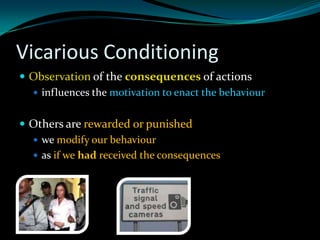
Vicarious Conditioning
 Observation of the consequences of actions
   influences the motivation to enact the behaviour


 Others are rewarded or punished
   we modify our behaviour
   as if we had received the consequences
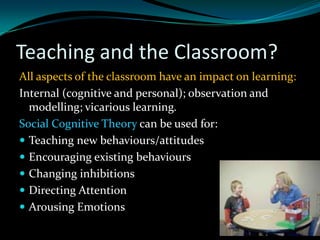
Teaching and the Classroom?
All aspects of the classroom have an impact on learning:
Internal (cognitive and personal); observation and
  modelling; vicarious learning.
Social Cognitive Theory can be used for:
 Teaching new behaviours/attitudes
 Encouraging existing behaviours
 Changing inhibitions
 Directing Attention
 Arousing Emotions
Cognitive Behaviour Approaches
Confucius:
“If you give a man a fish...you feed him for a day...If you
  teach a man to fish, you feed him for a lifetime...”
Cognitive Behaviour Approaches:
 Emphasise getting students to
    Monitor
    Manage
    Regulate their own behaviour
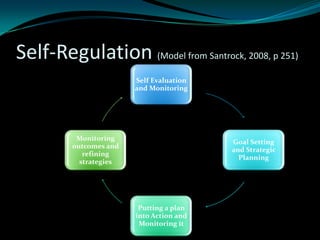
Self-Regulation (Model from Santrock, 2008, p 251)
                        Self Evaluation
                        and Monitoring


          Monitoring
                                          Goal Setting
         outcomes and
                                          and Strategic
            refining
                                            Planning
           strategies


                         Putting a plan
                        into Action and
                         Monitoring it
Self-Efficacy
“The belief in one’s capabilities to organise and
  execute the sources of action required to manage
  prospective situations”
 (Bandura, 1986)
Bandura & Schunk (1981) and Schunk (1984)
 self- efficacy judgments are thought to affect
  achievement by influencing an individual's
      choice of activities,
      task avoidance,
      effort expenditure, and
      goal persistence.
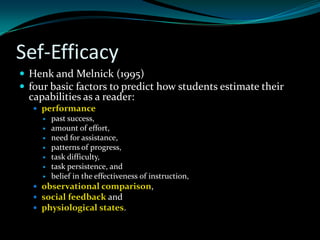
Sef-Efficacy
 Henk and Melnick (1995)
 four basic factors to predict how students estimate their
  capabilities as a reader:
    performance
        past success,
        amount of effort,
        need for assistance,
        patterns of progress,
        task difficulty,
        task persistence, and
        belief in the effectiveness of instruction,
    observational comparison,
    social feedback and
    physiological states.
Summary
Strengths
 Bandura extended behavioural theories:
   Internal (cognitive & personal)
   External (environmental or contextual) factors influence
    learning
   Learner makes an active contribution to behaviour change
   Focus on the role of observation and imitation heightened
    awareness of the impact of such media as TV, video, e-games
   Vicarious learning can have both positive and negative
    impacts on behaviour
Summary
Limitations
 The conditions under which vicarious learning occurs
  have been questioned:
   Why do children imitate the behaviours of some and not
    others?
   How can you be sure that desirable behaviours modelled
    have impact, whilst undesirable behaviours are ignored
    and forgotten?
Links
 http://teachnet.edb.utexas.edu/~lynda_abbott/Social.html

 http://psychclassics.yorku.ca/Bandura/bobo.htm

Social Cognitive Theory

  • 1.
    Google Images Dr Barbara Spears
  • 2.
    From drooling dogs& pecking pigeons to complex human behaviour  Adequacy of behaviourist perspectives to explain:  Reading?  Problem solving?  Friendliness?  Aggression?  Social Cognitive Theory:  Social,  Cognitive AND  Behavioural factors play important roles in learning.
  • 3.
    Looking Back......Behaviourism Emphasis onexperimental methods  Focus on variables we can:  Observe  Measure  Manipulate ( Drooling dogs, & pecking pigeons)  CC: Respondent: Pavlov  Autonomic; involuntary, reflexive  Contiguous learning: stimulus : response  OC: Operant: Watson/Thorndike/Skinner  ABC  Environmental experiences and behaviour  Neglects:  Influence of social and cognitive factors
  • 4.
    Social and Cognitivefactors in learning? Social Factors? Cognitive Factors?  Students observing their  Students’ expectations for parents’ achievement success behaviour  What social factors have been  What cognitive factors have important in your learning? been important in your learning?
  • 5.
    Moving Forwards Albert Bandura Whenstudents learn, they cognitively  “represent” or  “transform” experiences Observational Learning:  Cognitive processing  Of information  Displayed by models  http://www.youtube.com/watch?v=jJNNtsJmZb4  http://www.youtube.com/watch?v=688uHz6QYkQ  http://www.youtube.com/watch?v=cmzDLzqQ-A0
  • 6.
    Allegra, 4, playsdress-up, Malibu, California. http://www.youtube.com/watch?v=xnGmjrdN-gU
  • 7.
    Lily, aged 6 "Britney’s a role model. She’s fashionable, and she has movements that I like. Britney, Christina Aguilera, Destiny’s Child: They’re role models ’cause they like action and movement so much". Lily, then 5, shops at Rachel London's Garden, where Britney Spears has some of her clothes designed. Los Angeles, California http://www.youtube.com/watch?v=jppUkWGKgls
  • 8.
    Albert Bandura Social LearningTheory  Social Learning in children  how children learn through observation  Can learn new behaviour  Can facilitate learner’s response repertoire  Can inhibit or dis-inhibit responses
  • 9.
    Bobo Doll Study(1965)  http://www.youtube.com/watch?v=8ZXOp5PopIA
  • 10.
  • 11.
  • 12.
    Other studies.... .37 .31 .25 .24 .2 .1
  • 13.
    Video Games andViolence?  http://www.youtube.com/watch?v=WB6vTkvi9to  http://ithp.org/articles/violentvideogames.html  http://www.apa.org/science/about/psa/2003/10/ander son.aspx  http://www.telegraph.co.uk/education/educationnew s/9183385/Violent-video-games-are-fuelling-rise-in- aggressive-behaviour.html
  • 14.
  • 15.
  • 16.
    Observational Learning/ Modelling PROCESS of Learning In Social Settings  Acquiring skills, strategies and beliefs by observing others  Involves imitation  But not limited to it  Not an exact copy:  But a general “form” applied  http://www.youtube.com/watch?v=Fp8G7IZ29MY&feature=fvw  http://www.youtube.com/watch?v=5URas0d1B7g  http://www.youtube.com/watch?v=QcIDIPh1HGY  the functioning of OC in a social context  Behaviour changes  without first being rewarded  for approximations to the behaviour (shaped) http://www.youtube.com/watch?v=WjpBa_4tXmM
  • 17.
    Four Fundamentals ofthe (Observational, Social Cognitive) Learning Process: To Learn:  Attention  = pay attention first : attend to the model  Retention  Remember what you have paid attention to: code in memory  Imagery and language  Store what we have seen as mental images/verbal descriptions  (Re)Production  Translate images into behaviour  Have to have the ability to reproduce  (Reinforcement and) Motivation  Only perform when motivated  Past reinforcement  Promised reinforcement (incentives)  Vicarious reinforcement (seeing others)
  • 18.
    Comparison : OC &OL  OC: views  reinforcement is a direct cause of learning (ABC)  OL: views  reinforcement as motivation, not learning learning occurs: form a representation of the behaviour in memory, & reproduce it
  • 19.
    Modelling  the processof  observing  then imitating  Direct:  simple imitation  Symbolic:  books; TV; films  Synthesized:  copying portions of behaviour for different purposes  Abstract:  inferring a system of rules
  • 20.
    Determinants  Reinforcements andpunishments:  received by both model and observer  Both appropriate and inappropriate behaviour can be modelled  Pro-social models have pro-social effects  Consistency is vital regardless
  • 21.
    To Whom dowe Pay Attention? Perceived Similarity  Similar models  more effective than different  Several models  Same-sex  Peers
  • 22.
    Alison, 17 yearsold "Close to a hundred percent of my close friends have been on some kind of prescription drug for depression or ADD or something like that. Dexedrine, Adderall, Paxil, Wellbutrin, Depakote, Neurontin, Effexor, Prozac". Joyce, 15, Elysia, 14, and Alison, then 14, at their friend's sixteenth birthday party, Arlington, Virginia.
  • 23.
    To Whom Dowe Pay Attention? Perceived Competence  Interaction with perceptions of similarity to impact a model’s effectiveness  More competent is likely to be imitated than less competent
  • 24.
    Competence?  Olympians  Footballplayers  Soap Stars  Who in the Class????
  • 25.
    (Re)production &Motivation : Acquisitionand Performance We may all know more than we show  While learning may have occurred,  it may not be demonstrated (Re/Produced)  until the situation is right (Motivated)  May acquire new skill/behaviour:  but may not perform it until motivated
  • 26.
    Bandura Believes: Traditional behaviouralviews are  accurate, but incomplete Social Learning Theory  Extended behavioural explanations  Recognised mental/psychological factors Social COGNITIVE Theory  Links:  the functioning of OC;  in a social setting;  with the role of cognition in processing information
  • 27.
    Social Cognitive Theory Emphasises internal processes:  thoughts are always influencing actions and  actions are always influencing thoughts (Bandura, 1986)  Children:  Think about what they do;  about what we want them to do  those thoughts affect what they actually do.
  • 28.
    Reciprocal Determinism Human behaviourcan be explained in terms of the reciprocal influences of  Person/Cognitive  Environmental Cognitive  Behavioural factors Behaviour Environmental Internal and External factors are important  Interact and influence others  Interaction of forces = reciprocal determinism
  • 29.
    3 key aspects That contribute to the interactive processes in his ideas about human behaviour and cognitive functioning: 1 Observation: Vicarious Conditioning 2 Language: Symbolic Processes 3 Self talk: Self regulation
  • 30.
    Vicarious Conditioning  Observationof the consequences of actions  influences the motivation to enact the behaviour  Others are rewarded or punished  we modify our behaviour  as if we had received the consequences
  • 31.
    Teaching and theClassroom? All aspects of the classroom have an impact on learning: Internal (cognitive and personal); observation and modelling; vicarious learning. Social Cognitive Theory can be used for:  Teaching new behaviours/attitudes  Encouraging existing behaviours  Changing inhibitions  Directing Attention  Arousing Emotions
  • 32.
    Cognitive Behaviour Approaches Confucius: “Ifyou give a man a fish...you feed him for a day...If you teach a man to fish, you feed him for a lifetime...” Cognitive Behaviour Approaches:  Emphasise getting students to  Monitor  Manage  Regulate their own behaviour
  • 33.
    Self-Regulation (Model fromSantrock, 2008, p 251) Self Evaluation and Monitoring Monitoring Goal Setting outcomes and and Strategic refining Planning strategies Putting a plan into Action and Monitoring it
  • 34.
    Self-Efficacy “The belief inone’s capabilities to organise and execute the sources of action required to manage prospective situations” (Bandura, 1986) Bandura & Schunk (1981) and Schunk (1984)  self- efficacy judgments are thought to affect achievement by influencing an individual's  choice of activities,  task avoidance,  effort expenditure, and  goal persistence.
  • 35.
    Sef-Efficacy  Henk andMelnick (1995)  four basic factors to predict how students estimate their capabilities as a reader:  performance  past success,  amount of effort,  need for assistance,  patterns of progress,  task difficulty,  task persistence, and  belief in the effectiveness of instruction,  observational comparison,  social feedback and  physiological states.
  • 36.
    Summary Strengths  Bandura extendedbehavioural theories:  Internal (cognitive & personal)  External (environmental or contextual) factors influence learning  Learner makes an active contribution to behaviour change  Focus on the role of observation and imitation heightened awareness of the impact of such media as TV, video, e-games  Vicarious learning can have both positive and negative impacts on behaviour
  • 37.
    Summary Limitations  The conditionsunder which vicarious learning occurs have been questioned:  Why do children imitate the behaviours of some and not others?  How can you be sure that desirable behaviours modelled have impact, whilst undesirable behaviours are ignored and forgotten?
  • 38.

Editor's Notes

  • #6 Bandura: 1965 Bobo dollThe anti smoking ad is 1967.....
  • #11 http://www.edpsycinteractive.org/topics/soccog/soclrn.html
  • #12 http://www.edpsycinteractive.org/topics/soccog/soclrn.htmlhttp://www.surgeongeneral.gov/library/youthviolence/chapter4/appendix4bsec2.htmlFrom the report Surgeon General: Put on the homepage...
  • #13 Compare effect sizes....In statistics, an effect size is a measure of the strength of the relationship between two variables in a statistical population, or a sample-based estimate of that quantity. An effect size calculated from data is a descriptive statistic that conveys the estimated magnitude of a relationship without making any statement about whether the apparent relationship in the data reflects a true relationship in the population. In that way, effect sizes complement inferential statistics such as p-values. Among other uses, effect size measures play an important role in meta-analysis studies that summarize findings from a specific area of research, and in statistical power analysesReporting effect sizes is considered good practice when presenting empirical research findings in many fields.[1][2] Effect sizes are particularly prominent in social and medical research. Relative and absolute measures of effect size convey different information, and can be used complementarilyEffect Size: This is a statistical term that refers to the size of a relationship between two variable. Sometimes effect size is known as treatment effect because it is often used when dealing with therapeutic intervantions (ie., this treatment is shown to be more effective than another at treating a specific disorder)." Effect sizes are critical to result interpretation and synthesis across studies. Although statistical significance testing has historically dominated the determination of result importance, modern views emphasize the role of effect sizes and confidence intervals
  • #17 Observational learning is a powerful means of social learning. It principally occurs through the cognitive processing of information displayed by models. The information can be conveyed verbally, textually, and auditorially, and through actions either by live or symbolic models such as television, movies, and the Internet. Regardless of the medium used to present the modeled activities, the same psychological processes underlie observational learning. These include attention and memory processes directed to establish a conceptual representation of the modeled activity. This representation guides the enactment of observationally learned patterns of conduct. Whether the learned patterns will be performed or not depends on incentive structures and observers' actual and perceived competence to enact the modeled performances. Unlike learning by doing, observational learning does not require enactment of the modeling activities during learning. The complexity of the learning, however, is restricted by the cognitive competence and enactment skills of the learner.Read more: Observational Learning - Cognitive, Enactment, Modeled, Social, Representation, and Activitieshttp://social.jrank.org/pages/451/Observational-Learning.html#ixzz0wMPyjytE
  • #27 Social learning TheoryExtended behavioural explanationsRecognised the contribution of Mental /psychological factorsExplanation of human behaviour in terms of:CognitiveEnvironmentalBehavioural influences
  • #29 Cognitive: How I think about something influences my behaviour: which influences the environment in which I operate
  • #34 Self ObservationKeep tabs on ourselvesJudgmentCompare what we see with a standardSelf-ResponseDid well: RewardDid poorly: PunishingCompensation: delusions of grandeurInactivity: apathy, boredom, depressionEscape: drugs, alcohol, fantasies, suicideOutcome: Self ConceptMeet the standards;lots of rewardsGood self concept
  • #35 A persons' judgmentof his/her abilities to perform an activity, and the effect this perception has on the on-going and future conduct of the activity.
  • #39 http://www.youtube.com/watch?v=X_s9pG5CWXM&feature=relatedhttp://www.youtube.com/watch?v=X_s9pG5CWXM&feature=related