A market leader in the field of technical training is glad to
organize a seminar on VLSI Design (VHDL) to shape the career
of bright students and to turn them into a great engineer. We
hope to have a good time with you..!!!

                                Your concern and co-operation is highly valuable to us.
                                                                         ___________
                                                                        Team CETPA
To compress the digital world.
To explore the hidden perfection and create the
  brain of a machine.


*The above two are considered as a very difficult
tasks in the field of electronics engineering, where
in fact it’s a very simple technology.
 VHDL is for coding models of a digital system.
 Reasons for modeling:
  ◦ Requirements specification
  ◦ Documentation
  ◦ Testing using simulation
  ◦ Formal verification
  ◦ Synthesis
 Goal:
  ◦ Most ‘reliable’ design process, with minimum cost
    and time
  ◦ Avoid design errors!
 VHDL is a programming language that allows one to
  model and develop complex digital systems in a
  dynamic environment.

 Object Oriented methodology for you C people can
  be observed -- modules can be used and reused.

 Allows you to designate in/out ports (bits) and
  specify behavior or response of the system.
 C is procedural language whereas VHDL is semi
  concurrent & semi sequential language.

 C is Case Sensitive whereas VHDL is case
  insensitive.

 There are some similarities, as with any
  programming language, but syntax and logic are
  quite different.
•   Interfaces (PORTS)
•   Behavior
•   Structure
•   Test Benches
•   Simulation
•   Synthesis
Dataflow
Behavioral
Structural


Kind of BORING sounding huh??
Well, it gets more exciting with the details !!
              :)
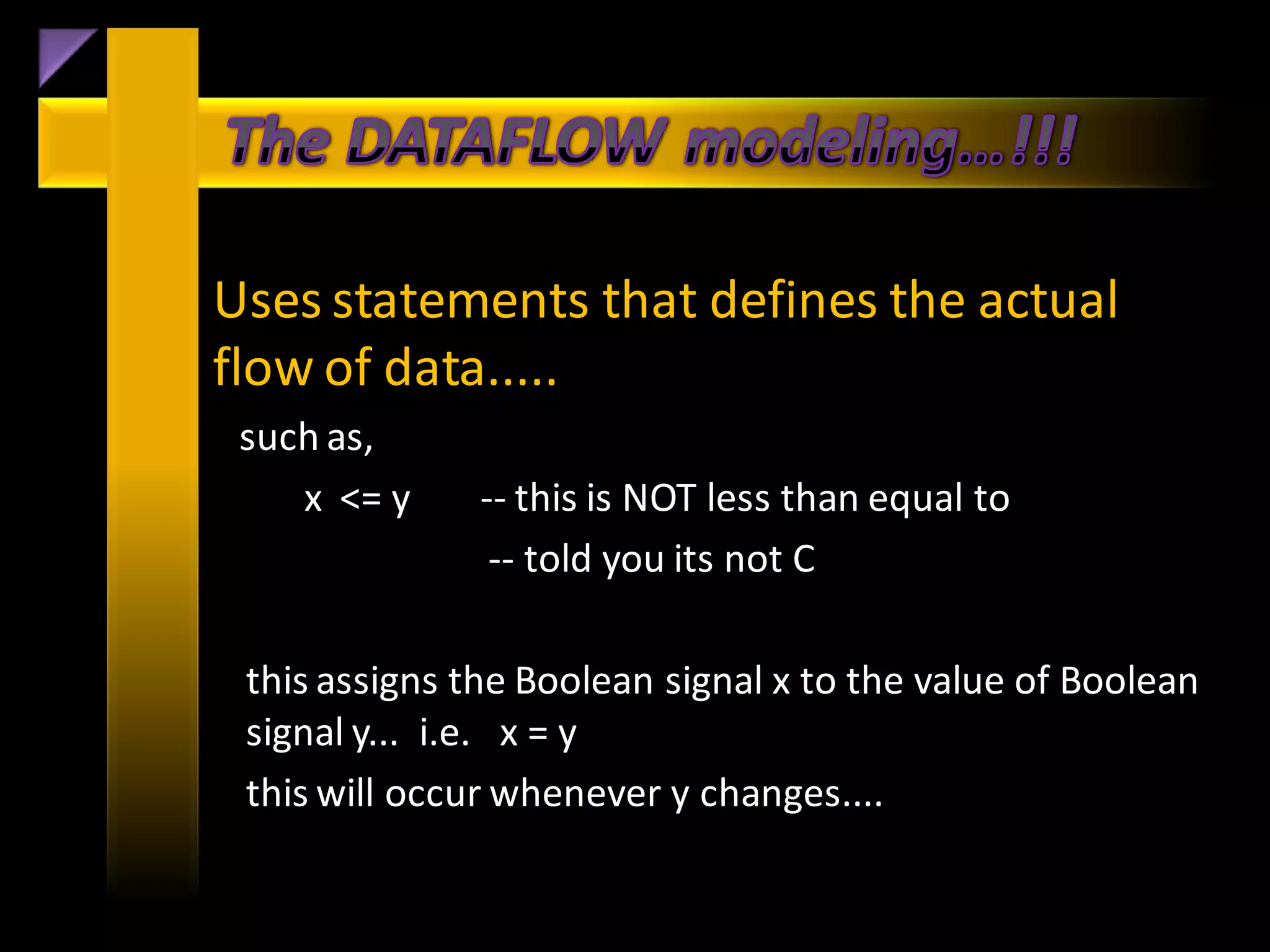
Uses statements that defines the actual
flow of data.....
 such as,
    x <= y     -- this is NOT less than equal to
                -- told you its not C

 this assigns the Boolean signal x to the value of Boolean
 signal y... i.e. x = y
 this will occur whenever y changes....
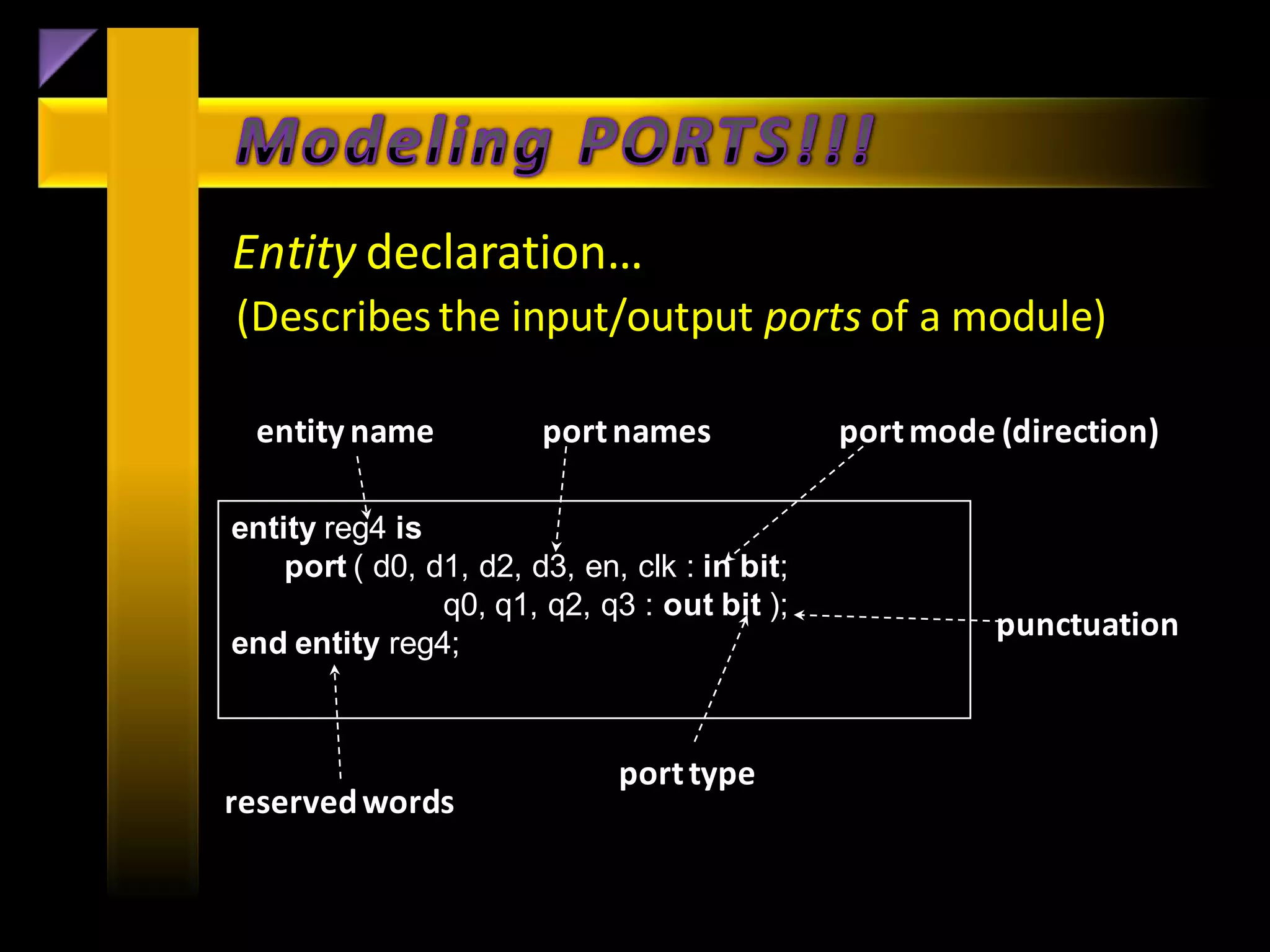
Entity declaration…
(Describes the input/output ports of a module)

 entity name            port names             port mode (direction)

entity reg4 is
    port ( d0, d1, d2, d3, en, clk : in bit;
                q0, q1, q2, q3 : out bit );
                                                         punctuation
end entity reg4;


                              port type
reserved words
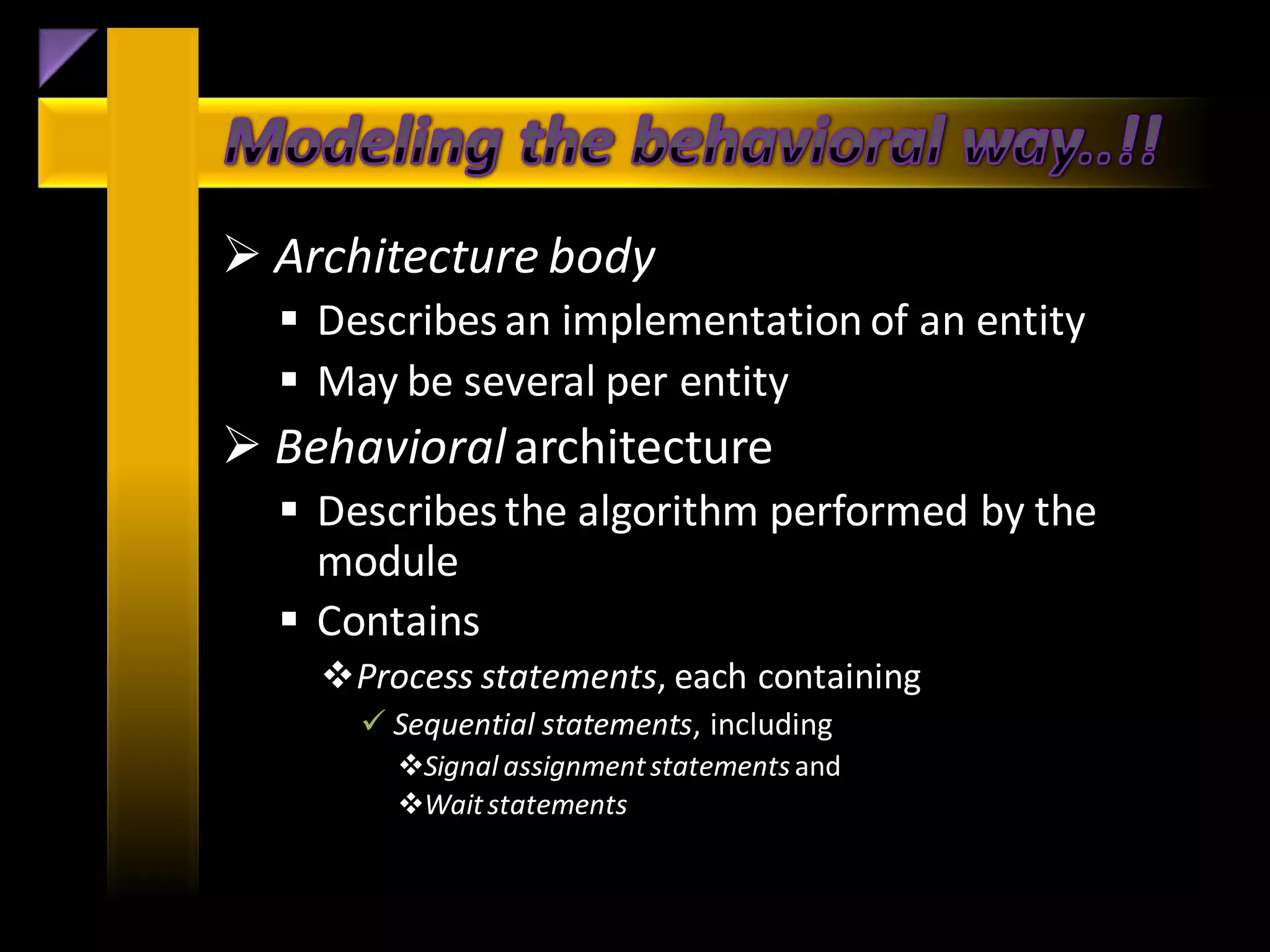
 Architecture body
   Describes an implementation of an entity
   May be several per entity
 Behavioral architecture
   Describes the algorithm performed by the
    module
   Contains
    Process statements, each containing
       Sequential statements, including
        Signal assignment statements and
        Wait statements
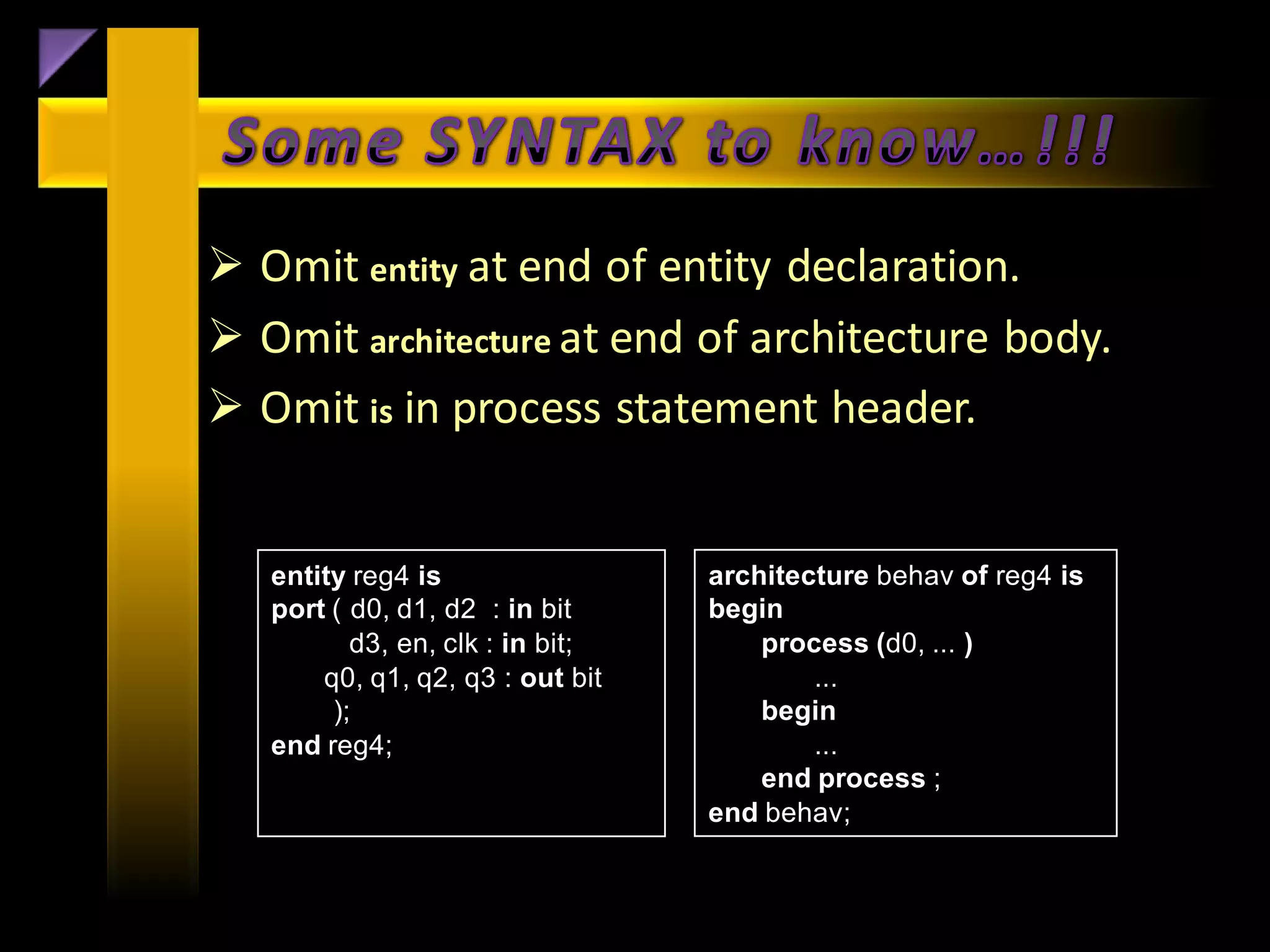
 Omit entity at end of entity declaration.
 Omit architecture at end of architecture body.
 Omit is in process statement header.


   entity reg4 is                 architecture behav of reg4 is
   port ( d0, d1, d2 : in bit     begin
          d3, en, clk : in bit;       process (d0, ... )
       q0, q1, q2, q3 : out bit           ...
        );                            begin
   end reg4;                              ...
                                      end process ;
                                  end behav;
Structural architecture
   implements the module as a composition of
    subsystems
   contains
    ○ signal declarations, for internal interconnections
       the entity ports are also treated as signals
    ○ component instances
       instances of previously declared entity/architecture pairs
    ○ port maps in component instances
       connect signals to component ports
 An architecture can contain both behavioral
  and structural parts
   Process statements and component instances
    ○ Collectively called concurrent statements
   Processes can read and assign to signals
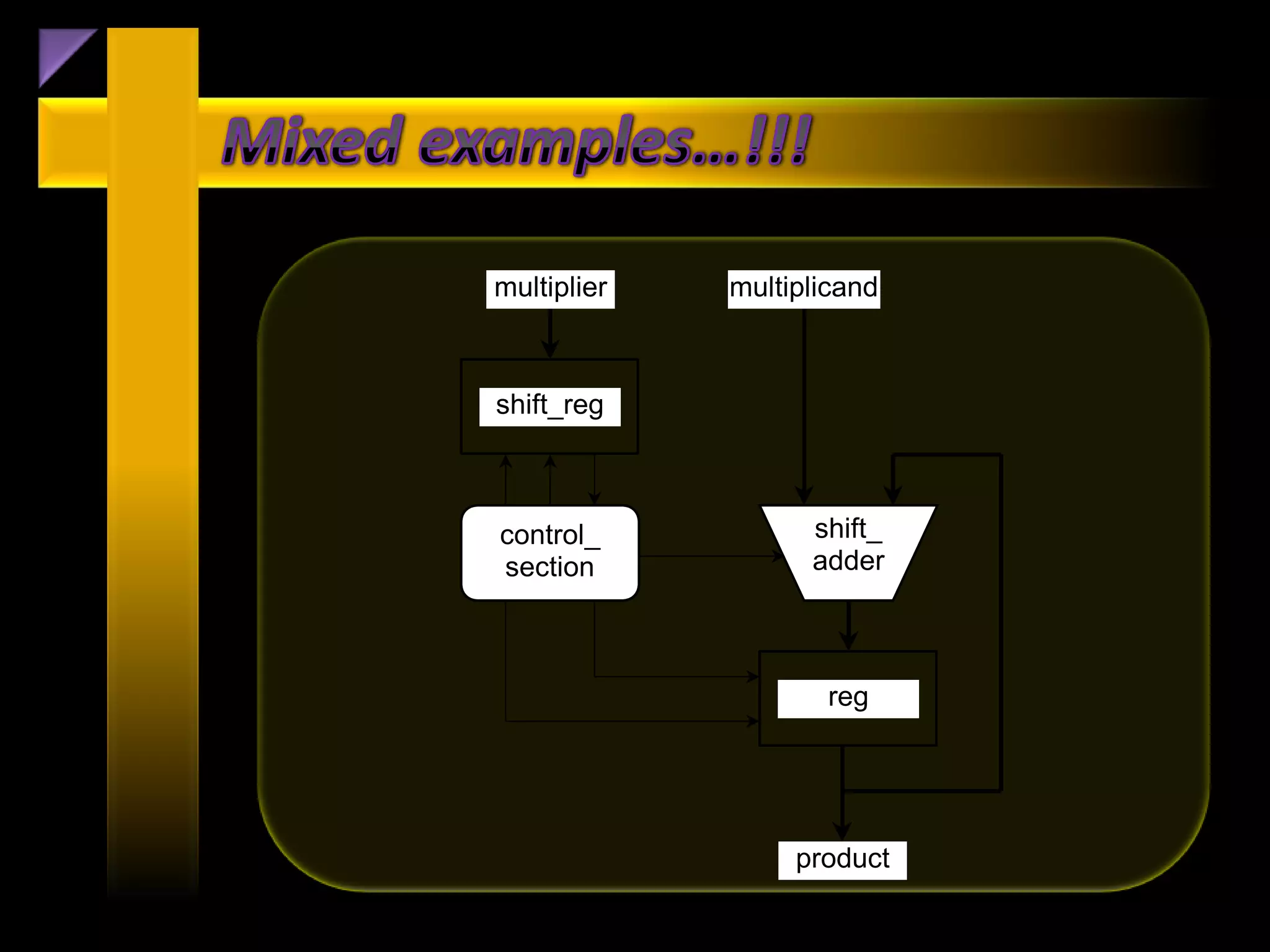
 Example: register-transfer-level (RTL) model
   Data path described structurally
   Control section described behaviorally
multiplier   multiplicand


shift_reg


control_           shift_
section            adder


                    reg


                  product
• Testing a design by simulation
• Use a test bench model
  – A model that uses your model
  – Apply test sequences to your inputs
  – Monitors values on output signals
     • Either using simulator.
     • Or with a process that verifies correct operation
     • Or logic analyzer.
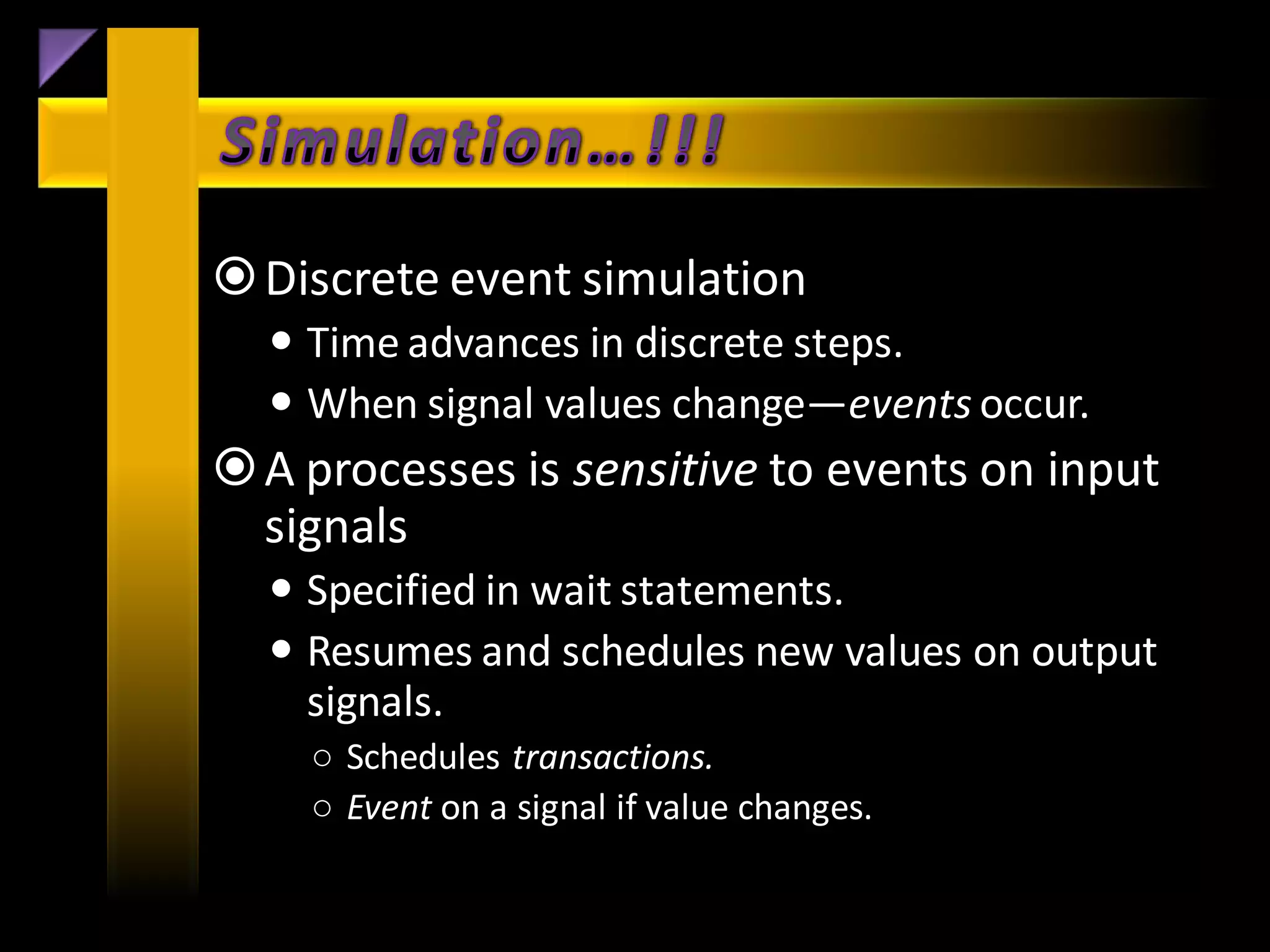
 Discrete event simulation
   Time advances in discrete steps.
   When signal values change—events occur.
 A processes is sensitive to events on input
  signals
   Specified in wait statements.
   Resumes and schedules new values on output
    signals.
    ○ Schedules transactions.
    ○ Event on a signal if value changes.
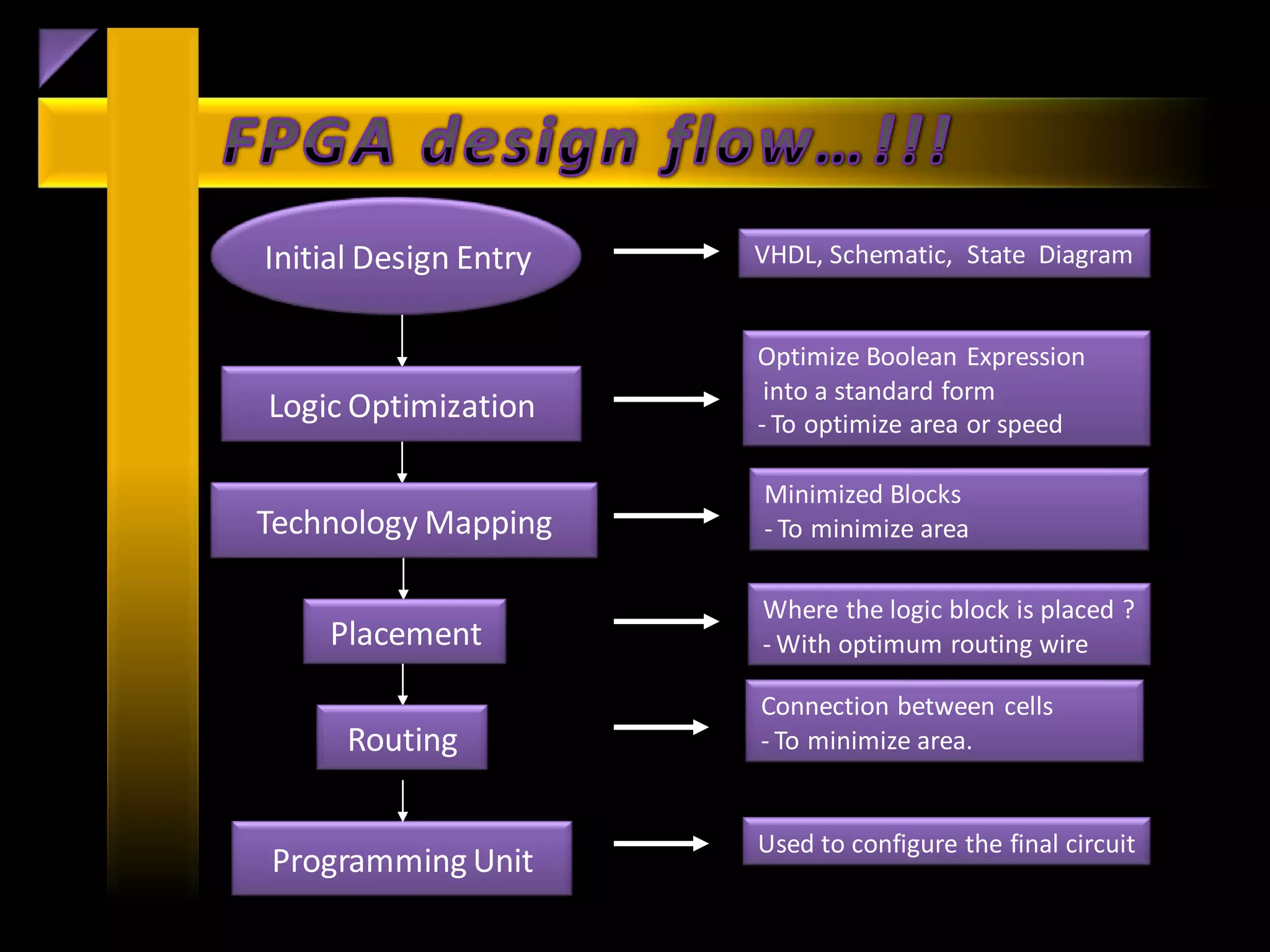
Initial Design Entry   VHDL, Schematic, State Diagram


                       Optimize Boolean Expression
                        into a standard form
Logic Optimization     - To optimize area or speed

                       Minimized Blocks
Technology Mapping     - To minimize area

                       Where the logic block is placed ?
    Placement          - With optimum routing wire

                       Connection between cells
      Routing          - To minimize area.


                       Used to configure the final circuit
Programming Unit
• Implement the VHDL portion of coding for synthesis.
• Identify the differences between behavioral and
  structural coding styles.
• Distinguish coding for synthesis versus coding for
  simulation.
• Use scalar and composite data types to represent
  information.
• Use concurrent and sequential control structure to
  regulate information flow.
• Implement common VHDL constructs (Finite State
  Machines [FSMs], RAM/ROM data structures).
• Executable specification.
• Functionality separated from implementation.
• Simulate early and fast (Manage complexity)
• Explore design alternatives.
• Get feedback (Produce better designs)
• Automatic synthesis and test generation (ATPG for
  ASICs)
• Increase productivity (Shorten time-to-market)
• Technology and tool independence.
• Portable design data (Protect investment)
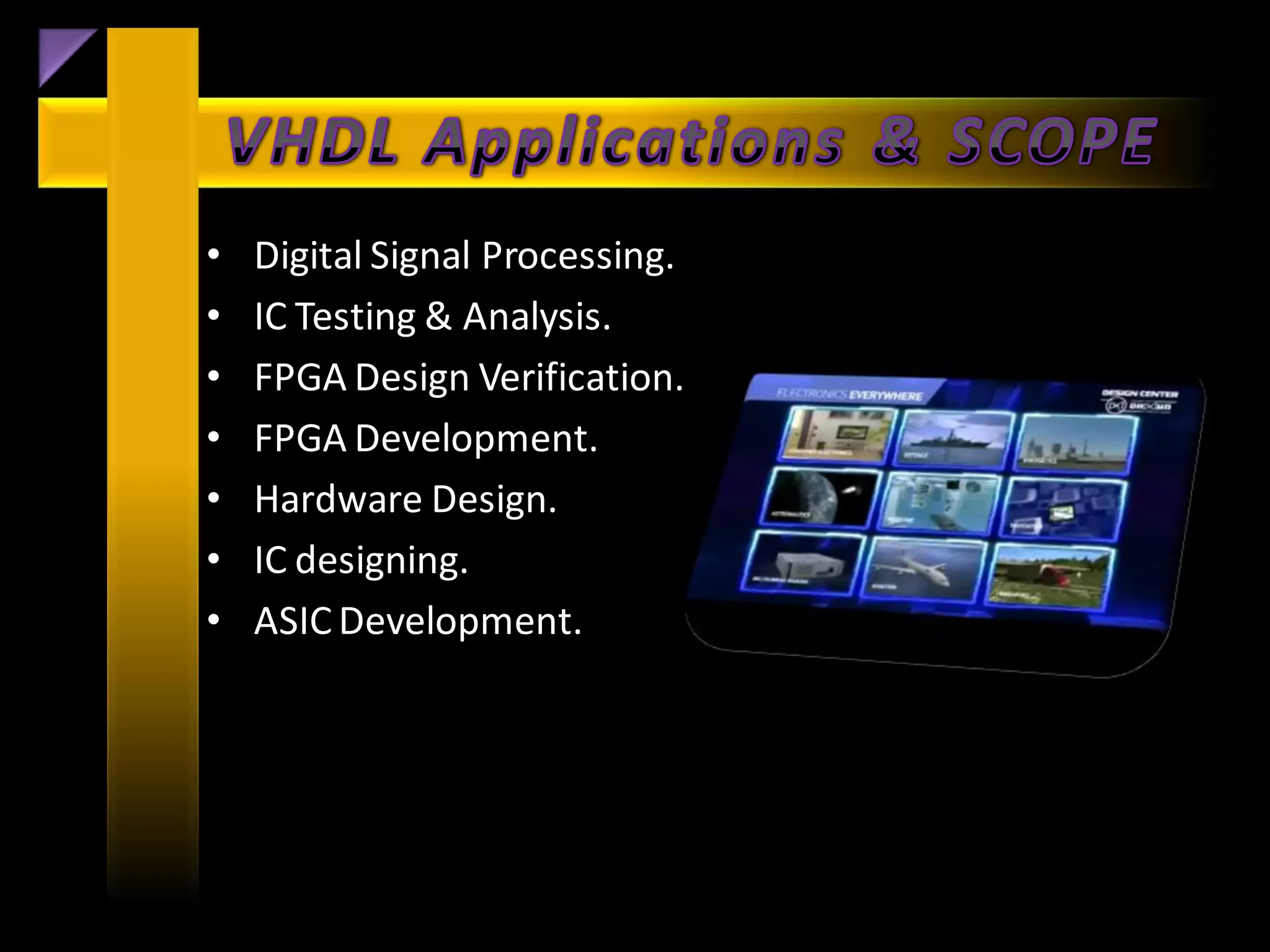
•   Digital Signal Processing.
•   IC Testing & Analysis.
•   FPGA Design Verification.
•   FPGA Development.
•   Hardware Design.
•   IC designing.
•   ASIC Development.
• THANK YOU
          E-Mail
    Gaurav_rai@live.com


•

Summer training vhdl

  • 1.
    A market leaderin the field of technical training is glad to organize a seminar on VLSI Design (VHDL) to shape the career of bright students and to turn them into a great engineer. We hope to have a good time with you..!!! Your concern and co-operation is highly valuable to us. ___________ Team CETPA
  • 3.
    To compress thedigital world. To explore the hidden perfection and create the brain of a machine. *The above two are considered as a very difficult tasks in the field of electronics engineering, where in fact it’s a very simple technology.
  • 4.
     VHDL isfor coding models of a digital system.  Reasons for modeling: ◦ Requirements specification ◦ Documentation ◦ Testing using simulation ◦ Formal verification ◦ Synthesis  Goal: ◦ Most ‘reliable’ design process, with minimum cost and time ◦ Avoid design errors!
  • 5.
     VHDL isa programming language that allows one to model and develop complex digital systems in a dynamic environment.  Object Oriented methodology for you C people can be observed -- modules can be used and reused.  Allows you to designate in/out ports (bits) and specify behavior or response of the system.
  • 6.
     C isprocedural language whereas VHDL is semi concurrent & semi sequential language.  C is Case Sensitive whereas VHDL is case insensitive.  There are some similarities, as with any programming language, but syntax and logic are quite different.
  • 7.
    Interfaces (PORTS) • Behavior • Structure • Test Benches • Simulation • Synthesis
  • 8.
    Dataflow Behavioral Structural Kind of BORINGsounding huh?? Well, it gets more exciting with the details !! :)
  • 9.
    Uses statements thatdefines the actual flow of data..... such as, x <= y -- this is NOT less than equal to -- told you its not C this assigns the Boolean signal x to the value of Boolean signal y... i.e. x = y this will occur whenever y changes....
  • 10.
    Entity declaration… (Describes theinput/output ports of a module) entity name port names port mode (direction) entity reg4 is port ( d0, d1, d2, d3, en, clk : in bit; q0, q1, q2, q3 : out bit ); punctuation end entity reg4; port type reserved words
  • 11.
     Architecture body  Describes an implementation of an entity  May be several per entity  Behavioral architecture  Describes the algorithm performed by the module  Contains Process statements, each containing  Sequential statements, including Signal assignment statements and Wait statements
  • 12.
     Omit entityat end of entity declaration.  Omit architecture at end of architecture body.  Omit is in process statement header. entity reg4 is architecture behav of reg4 is port ( d0, d1, d2 : in bit begin d3, en, clk : in bit; process (d0, ... ) q0, q1, q2, q3 : out bit ... ); begin end reg4; ... end process ; end behav;
  • 13.
    Structural architecture  implements the module as a composition of subsystems  contains ○ signal declarations, for internal interconnections  the entity ports are also treated as signals ○ component instances  instances of previously declared entity/architecture pairs ○ port maps in component instances  connect signals to component ports
  • 14.
     An architecturecan contain both behavioral and structural parts  Process statements and component instances ○ Collectively called concurrent statements  Processes can read and assign to signals  Example: register-transfer-level (RTL) model  Data path described structurally  Control section described behaviorally
  • 15.
    multiplier multiplicand shift_reg control_ shift_ section adder reg product
  • 16.
    • Testing adesign by simulation • Use a test bench model – A model that uses your model – Apply test sequences to your inputs – Monitors values on output signals • Either using simulator. • Or with a process that verifies correct operation • Or logic analyzer.
  • 17.
     Discrete eventsimulation  Time advances in discrete steps.  When signal values change—events occur.  A processes is sensitive to events on input signals  Specified in wait statements.  Resumes and schedules new values on output signals. ○ Schedules transactions. ○ Event on a signal if value changes.
  • 18.
    Initial Design Entry VHDL, Schematic, State Diagram Optimize Boolean Expression into a standard form Logic Optimization - To optimize area or speed Minimized Blocks Technology Mapping - To minimize area Where the logic block is placed ? Placement - With optimum routing wire Connection between cells Routing - To minimize area. Used to configure the final circuit Programming Unit
  • 21.
    • Implement theVHDL portion of coding for synthesis. • Identify the differences between behavioral and structural coding styles. • Distinguish coding for synthesis versus coding for simulation. • Use scalar and composite data types to represent information. • Use concurrent and sequential control structure to regulate information flow. • Implement common VHDL constructs (Finite State Machines [FSMs], RAM/ROM data structures).
  • 22.
    • Executable specification. •Functionality separated from implementation. • Simulate early and fast (Manage complexity) • Explore design alternatives. • Get feedback (Produce better designs) • Automatic synthesis and test generation (ATPG for ASICs) • Increase productivity (Shorten time-to-market) • Technology and tool independence. • Portable design data (Protect investment)
  • 23.
    Digital Signal Processing. • IC Testing & Analysis. • FPGA Design Verification. • FPGA Development. • Hardware Design. • IC designing. • ASIC Development.
  • 24.
    • THANK YOU E-Mail Gaurav_rai@live.com •