Digital Design And Synthesis
2014
Behavioral Verilog
always & initial blocks
Coding flops
if else & case statements
Blocking vs Non-Blocking
Simulator Mechanics part duo
2
Administrative Matters
 Readings
• Text Chapter 7 (Behavioral Modeling)
• Cummings SNUG Paper (Verilog Styles that Kill) (posted on webpage)
 Cover HW solution for asynch reset and tran count
 Midterm:
• Wednesday 10/21/08
• 5:00PM-6:45PM
• EH ????
3
Behavioral Verilog
 initial and always form basis of all behavioral Verilog
• All other behavioral statements occur within these
• initial and always blocks cannot be nested
• All <LHS> assignments must be to type reg
 initial statements start at time 0 and execute once
• If there are multiple initial blocks they all start at time 0
and execute independently. They may finish independently.
 If multiple behavioral statements are needed within
the initial statement then the initial statement can be
made compound with use of begin/end
4
More on initial statements
 Initial statement very useful for testbenches
 Initial statements don’t synthesize
 Don’t use them in DUT Verilog (stuff you intend to synthesize)
5
initial Blocks
`timescale 1 ns / 100 fs
module full_adder_tb;
reg [3:0] stim;
wire s, c;
full_adder(sum, carry, stim[2], stim[1], stim[0]); // instantiate DUT
// monitor statement is special - only needs to be made once,
initial $monitor(“%t: s=%b c=%b stim=%b”, $time, s, c, stim[2:0]);
// tell our simulation when to stop
initial #50 $stop;
initial begin // stimulus generation
for (stim = 4’h0; stim < 4’h8; stim = stim + 1) begin
#5;
end
end
endmodule
all initial blocks
start at time 0
multi-statement
block enclosed by
begin and end
6
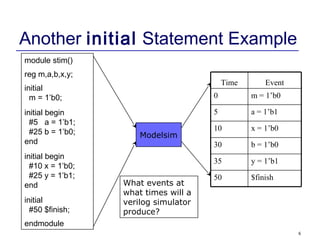
Another initial Statement Example
module stim()
reg m,a,b,x,y;
initial
m = 1’b0;
initial begin
#5 a = 1’b1;
#25 b = 1’b0;
end
initial begin
#10 x = 1’b0;
#25 y = 1’b1;
end
initial
#50 $finish;
endmodule
Modelsim
What events at
what times will a
verilog simulator
produce?
$finish50
y = 1’b135
b = 1’b030
x = 1’b010
a = 1’b15
m = 1’b00
EventTime
7
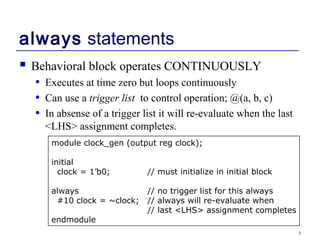
always statements
 Behavioral block operates CONTINUOUSLY
• Executes at time zero but loops continuously
• Can use a trigger list to control operation; @(a, b, c)
• In absense of a trigger list it will re-evaluate when the last
<LHS> assignment completes.
module clock_gen (output reg clock);
initial
clock = 1’b0; // must initialize in initial block
always // no trigger list for this always
#10 clock = ~clock; // always will re-evaluate when
// last <LHS> assignment completes
endmodule
8
always vs initial
reg [7:0] v1, v2, v3, v4;
initial begin
v1 = 1;
#2 v2 = v1 + 1;
v3 = v2 + 1;
#2 v4 = v3 + 1;
v1 = v4 + 1;
#2 v2 = v1 + 1;
v3 = v2 + 1;
end
reg [7:0] v1, v2, v3, v4;
always begin
v1 = 1;
#2 v2 = v1 + 1;
v3 = v2 + 1;
#2 v4 = v3 + 1;
v1 = v4 + 1;
#2 v2 = v1 + 1;
v3 = v2 + 1;
end
 What values does each block produce?
 Lets take our best guess
 Then lets try it in Silos simulator
9
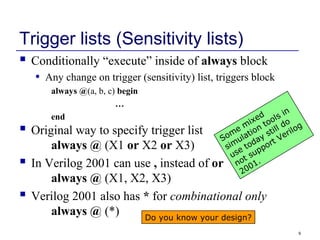
Trigger lists (Sensitivity lists)
 Conditionally “execute” inside of always block
• Any change on trigger (sensitivity) list, triggers block
always @(a, b, c) begin
…
end
 Original way to specify trigger list
always @ (X1 or X2 or X3)
 In Verilog 2001 can use , instead of or
always @ (X1, X2, X3)
 Verilog 2001 also has * for combinational only
always @ (*)
Some m
ixed
sim
ulation
tools in
use today still do
not support Verilog
2001.
Do you know your design?
10
Example: Comparator
module compare_4bit_behave(output reg A_lt_B, A_gt_B, A_eq_B,
input [3:0] A, B);
always@( ) begin
end
endmodule
Flush out this template with sensitivity list and implementation
Hint: a if…else if…else statement is best for implementation
11
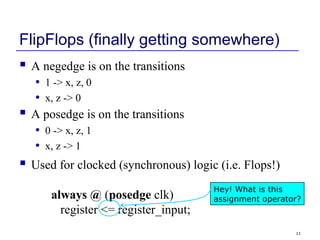
FlipFlops (finally getting somewhere)
 A negedge is on the transitions
• 1 -> x, z, 0
• x, z -> 0
 A posedge is on the transitions
• 0 -> x, z, 1
• x, z -> 1
 Used for clocked (synchronous) logic (i.e. Flops!)
always @ (posedge clk)
register <= register_input;
Hey! What is this
assignment operator?
12
Implying Flops (my way or the highway)
clk
d q
Standard D-FF
with no reset
reg q;
always @(posedge clk)
q <= d;
reg [11:0] DAC_val;
always @(posedge clk)
DAC_val <= result[11:0];
It can be
A vector
too
Be careful… Yes, a non–reset flop is smaller than a
reset Flop, but most of the time you need to reset your
flops.
Always error on the side of reseting the flop if you are at
all uncertain.
13
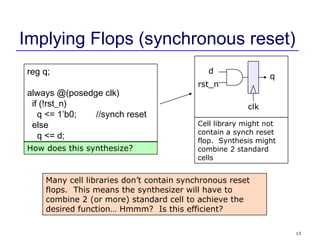
Implying Flops (synchronous reset)
reg q;
always @(posedge clk)
if (!rst_n)
q <= 1’b0; //synch reset
else
q <= d;
How does this synthesize?
clk
d
q
Cell library might not
contain a synch reset
flop. Synthesis might
combine 2 standard
cells
rst_n
Many cell libraries don’t contain synchronous reset
flops. This means the synthesizer will have to
combine 2 (or more) standard cell to achieve the
desired function… Hmmm? Is this efficient?
14
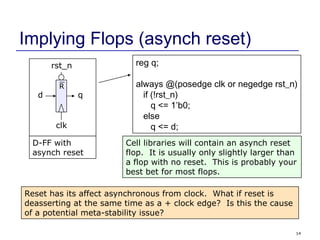
Implying Flops (asynch reset)
clk
d q
D-FF with
asynch reset
R
rst_n reg q;
always @(posedge clk or negedge rst_n)
if (!rst_n)
q <= 1’b0;
else
q <= d;
Cell libraries will contain an asynch reset
flop. It is usually only slightly larger than
a flop with no reset. This is probably your
best bet for most flops.
Reset has its affect asynchronous from clock. What if reset is
deasserting at the same time as a + clock edge? Is this the cause
of a potential meta-stability issue?
15
Know your cell library
 What type of flops are available
• + or – edge triggered (most are positive)
• Is the asynch reset active high or active low
• Is a synchronous reset available?
• Do I have scan flops available?
 Code to what is available
• You want synthesis to be able to pick the least number of
cells to implement what you code.
• If your library has active low asynch reset flops then don’t
code active high reset flops.
16
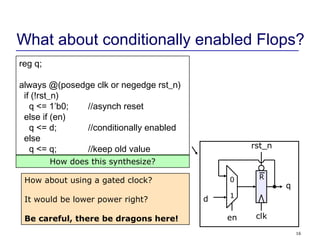
What about conditionally enabled Flops?
reg q;
always @(posedge clk or negedge rst_n)
if (!rst_n)
q <= 1’b0; //asynch reset
else if (en)
q <= d; //conditionally enabled
else
q <= q; //keep old value
How does this synthesize?
0
1
clk
d
q
R
en
rst_n
How about using a gated clock?
It would be lower power right?
Be careful, there be dragons here!
17
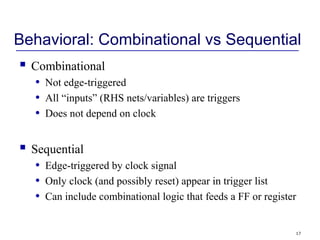
Behavioral: Combinational vs Sequential
 Combinational
• Not edge-triggered
• All “inputs” (RHS nets/variables) are triggers
• Does not depend on clock
 Sequential
• Edge-triggered by clock signal
• Only clock (and possibly reset) appear in trigger list
• Can include combinational logic that feeds a FF or register
18
 Blocking “Evaluated” sequentially
 Works a lot like software (danger!)
 Used for combinational logic
Blocking vs non-Blocking
module addtree(output reg [9:0] out,
input [7:0] in1, in2, in3, in4);
reg [8:0] part1, part2;
always @(in1, in2, in3, in4) begin
part1 = in1 + in2;
part2 = in3 + in4;
out = part1 + part2;
end
endmodule
+ +
+
out
in1in2 in3in4
part1 part2
19
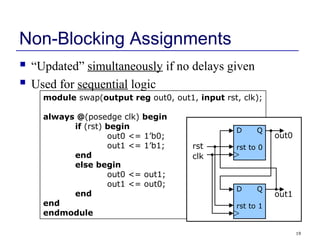
Non-Blocking Assignments
 “Updated” simultaneously if no delays given
 Used for sequential logic
module swap(output reg out0, out1, input rst, clk);
always @(posedge clk) begin
if (rst) begin
out0 <= 1’b0;
out1 <= 1’b1;
end
else begin
out0 <= out1;
out1 <= out0;
end
end
endmodule
D Q
rst to 1
D Q
rst to 0
clk
rst
out1
out0
20
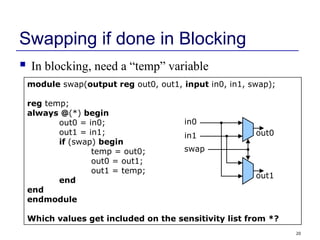
Swapping if done in Blocking
 In blocking, need a “temp” variable
module swap(output reg out0, out1, input in0, in1, swap);
reg temp;
always @(*) begin
out0 = in0;
out1 = in1;
if (swap) begin
temp = out0;
out0 = out1;
out1 = temp;
end
end
endmodule
Which values get included on the sensitivity list from *?
swap
in1
in0
out0
out1
21
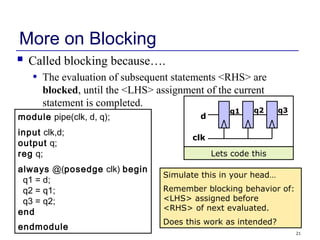
More on Blocking
 Called blocking because….
• The evaluation of subsequent statements <RHS> are
blocked, until the <LHS> assignment of the current
statement is completed.
d
clk
q1 q2 q3
Lets code this
module pipe(clk, d, q);
input clk,d;
output q;
reg q;
always @(posedge clk) begin
q1 = d;
q2 = q1;
q3 = q2;
end
endmodule
Simulate this in your head…
Remember blocking behavior of:
<LHS> assigned before
<RHS> of next evaluated.
Does this work as intended?
22
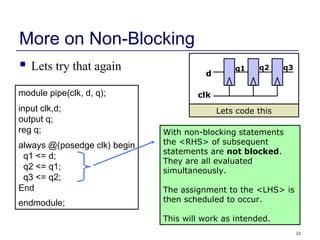
More on Non-Blocking
 Lets try that again
d
clk
q1 q2 q3
Lets code this
module pipe(clk, d, q);
input clk,d;
output q;
reg q;
always @(posedge clk) begin
q1 <= d;
q2 <= q1;
q3 <= q2;
End
endmodule;
With non-blocking statements
the <RHS> of subsequent
statements are not blocked.
They are all evaluated
simultaneously.
The assignment to the <LHS> is
then scheduled to occur.
This will work as intended.
23
So Blocking is no good and we should
always use Non-Blocking??
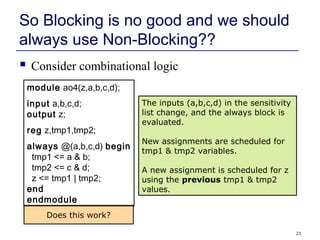
 Consider combinational logic
module ao4(z,a,b,c,d);
input a,b,c,d;
output z;
reg z,tmp1,tmp2;
always @(a,b,c,d) begin
tmp1 <= a & b;
tmp2 <= c & d;
z <= tmp1 | tmp2;
end
endmodule
Does this work?
The inputs (a,b,c,d) in the sensitivity
list change, and the always block is
evaluated.
New assignments are scheduled for
tmp1 & tmp2 variables.
A new assignment is scheduled for z
using the previous tmp1 & tmp2
values.
24
Why not non-Blocking for
Combinational
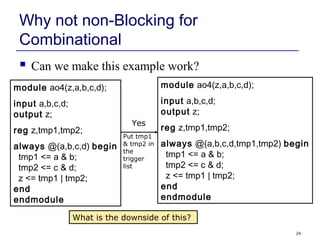
 Can we make this example work?
What is the downside of this?
module ao4(z,a,b,c,d);
input a,b,c,d;
output z;
reg z,tmp1,tmp2;
always @(a,b,c,d) begin
tmp1 <= a & b;
tmp2 <= c & d;
z <= tmp1 | tmp2;
end
endmodule
Yes
Put tmp1
& tmp2 in
the
trigger
list
module ao4(z,a,b,c,d);
input a,b,c,d;
output z;
reg z,tmp1,tmp2;
always @(a,b,c,d,tmp1,tmp2) begin
tmp1 <= a & b;
tmp2 <= c & d;
z <= tmp1 | tmp2;
end
endmodule
25
Cummings SNUG Paper
 Posted on ECE551 website
• Well written easy to understand paper
• Describes this stuff better than I can
• Read it!
 Outlines 8 guidelines for good Verilog coding
• Learn them
• Use them
26
Verilog Stratified Event Queue
 Need to be able to model both parallel and sequential
logic
 Need to make sure simulation matches hardware
 Verilog defines how ordering of statements is
interpreted by both simulator and synthesis tools
• Simulation matches hardware if code well-written
• Can have some differences with “bad” code
Simulator is sequential
Hardware is parallel
Race conditions can occur
27
Simulation Terminology [1]
 These only apply to SIMULATION
 Processes
• Objects that can be evaluated
• Includes primitives, modules, initial and always blocks,
continuous assignments, tasks, and procedural assignments
 Update event
• Change in the value of a net or register (LHS assignment)
 Evaluation event
• Computing the RHS of a statement
 Scheduling an event
• Putting an event on the event queue
28
Simulation Terminology [2]
 Simulation time
• Time value used by simulator to model actual time.
 Simulation cycle
• Complete processing of all currently active events
 Can be multiple simulation cycles per simulation time
 Explicit zero delay (#0)
• Forces process to be inactive event instead of active
• Incorrectly used to avoid race conditions
• #0 doesn’t synthesize!
• Don’t use it
29
Verilog Stratified Event Queue [1]
 Region 1: Active Events
• Most events except those explicitly in other regions
• Includes $display system tasks
 Region 2: Inactive Events
• Processed after all active events
• #0 delay events (bad!)
 Region 3: Non-blocking Assign Update Events
• Evaluation previously performed
• Update is after all active and inactive events complete
 Region 4: Monitor Events
• Caused by $monitor and $strobe system tasks
 Region 5: Future Events
• Occurs at some future simulation time
• Includes future events of other regions
• Other regions only contain events for CURRENT simulation time
30
Verilog Stratified Event Queue [2]
within a block,
blocking
assignments,
are in order
31
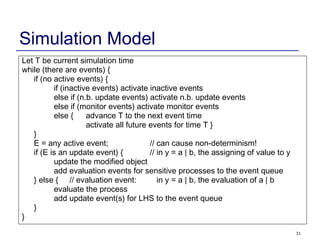
Simulation Model
Let T be current simulation time
while (there are events) {
if (no active events) {
if (inactive events) activate inactive events
else if (n.b. update events) activate n.b. update events
else if (monitor events) activate monitor events
else { advance T to the next event time
activate all future events for time T }
}
E = any active event; // can cause non-determinism!
if (E is an update event) { // in y = a | b, the assigning of value to y
update the modified object
add evaluation events for sensitive processes to the event queue
} else { // evaluation event: in y = a | b, the evaluation of a | b
evaluate the process
add update event(s) for LHS to the event queue
}
}
32
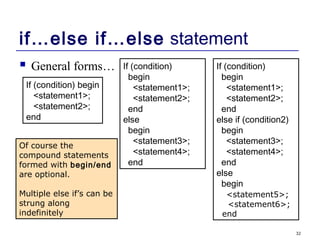
if…else if…else statement
 General forms…
If (condition) begin
<statement1>;
<statement2>;
end
If (condition)
begin
<statement1>;
<statement2>;
end
else
begin
<statement3>;
<statement4>;
end
If (condition)
begin
<statement1>;
<statement2>;
end
else if (condition2)
begin
<statement3>;
<statement4>;
end
else
begin
<statement5>;
<statement6>;
end
Of course the
compound statements
formed with begin/end
are optional.
Multiple else if’s can be
strung along
indefinitely
33
How does and if…else if…else
statement synthesize?
• Does not conditionally “execute” block of “code”
• Does not conditionally create hardware!
• It makes a multiplexer or selecting logic
• Generally:
Hardware for both paths is created
Both paths “compute” simultaneously
The result is selected depending on the condition
If (func_add)
alu = a + b;
else if (func_and)
alu = a & b;
Else
alu = 8’h00;
+
1
0
1
0
&
8’h00
8
a[7:0]
b[7:0]
func_addfunc_and
8
alu
34
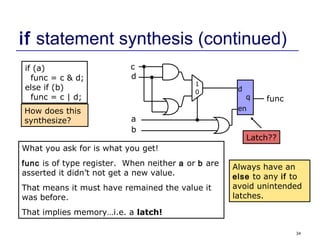
if statement synthesis (continued)
if (a)
func = c & d;
else if (b)
func = c | d;
How does this
synthesize?
en
1
0 d
q
c
d
a
b
func
Latch??
What you ask for is what you get!
func is of type register. When neither a or b are
asserted it didn’t not get a new value.
That means it must have remained the value it
was before.
That implies memory…i.e. a latch!
Always have an
else to any if to
avoid unintended
latches.
35
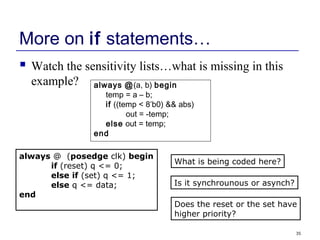
More on if statements…
 Watch the sensitivity lists…what is missing in this
example? always @(a, b) begin
temp = a – b;
if ((temp < 8’b0) && abs)
out = -temp;
else out = temp;
end
always @ (posedge clk) begin
if (reset) q <= 0;
else if (set) q <= 1;
else q <= data;
end
What is being coded here?
Is it synchrounous or asynch?
Does the reset or the set have
higher priority?
36
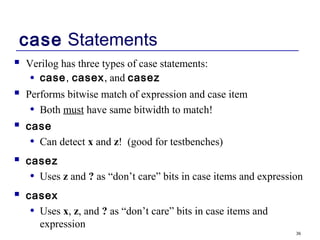
case Statements
 Verilog has three types of case statements:
• case, casex, and casez
 Performs bitwise match of expression and case item
• Both must have same bitwidth to match!
 case
• Can detect x and z! (good for testbenches)
 casez
• Uses z and ? as “don’t care” bits in case items and expression
 casex
• Uses x, z, and ? as “don’t care” bits in case items and
expression
37
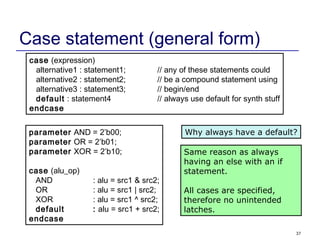
Case statement (general form)
case (expression)
alternative1 : statement1; // any of these statements could
alternative2 : statement2; // be a compound statement using
alternative3 : statement3; // begin/end
default : statement4 // always use default for synth stuff
endcase
parameter AND = 2’b00;
parameter OR = 2’b01;
parameter XOR = 2’b10;
case (alu_op)
AND : alu = src1 & src2;
OR : alu = src1 | src2;
XOR : alu = src1 ^ src2;
default : alu = src1 + src2;
endcase
Why always have a default?
Same reason as always
having an else with an if
statement.
All cases are specified,
therefore no unintended
latches.
38
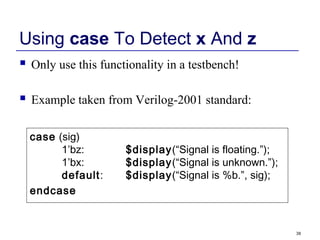
Using case To Detect x And z
 Only use this functionality in a testbench!
 Example taken from Verilog-2001 standard:
case (sig)
1’bz: $display(“Signal is floating.”);
1’bx: $display(“Signal is unknown.”);
default: $display(“Signal is %b.”, sig);
endcase
39
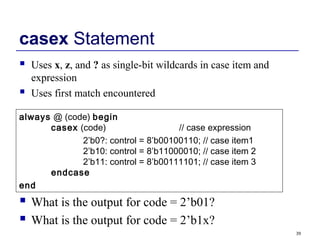
casex Statement
 Uses x, z, and ? as single-bit wildcards in case item and
expression
 Uses first match encountered
always @ (code) begin
casex (code) // case expression
2’b0?: control = 8’b00100110; // case item1
2’b10: control = 8’b11000010; // case item 2
2’b11: control = 8’b00111101; // case item 3
endcase
end
 What is the output for code = 2’b01?
 What is the output for code = 2’b1x?
40
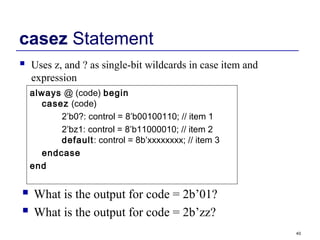
casez Statement
 Uses z, and ? as single-bit wildcards in case item and
expression
always @ (code) begin
casez (code)
2’b0?: control = 8’b00100110; // item 1
2’bz1: control = 8’b11000010; // item 2
default: control = 8b’xxxxxxxx; // item 3
endcase
end
 What is the output for code = 2b’01?
 What is the output for code = 2b’zz?
41
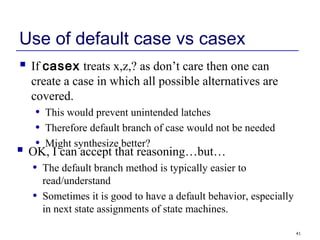
Use of default case vs casex
 If casex treats x,z,? as don’t care then one can
create a case in which all possible alternatives are
covered.
• This would prevent unintended latches
• Therefore default branch of case would not be needed
• Might synthesize better?
 OK, I can accept that reasoning…but…
• The default branch method is typically easier to
read/understand
• Sometimes it is good to have a default behavior, especially
in next state assignments of state machines.

Verilog Lecture4 2014

  • 1.
    Digital Design AndSynthesis 2014 Behavioral Verilog always & initial blocks Coding flops if else & case statements Blocking vs Non-Blocking Simulator Mechanics part duo
  • 2.
    2 Administrative Matters  Readings •Text Chapter 7 (Behavioral Modeling) • Cummings SNUG Paper (Verilog Styles that Kill) (posted on webpage)  Cover HW solution for asynch reset and tran count  Midterm: • Wednesday 10/21/08 • 5:00PM-6:45PM • EH ????
  • 3.
    3 Behavioral Verilog  initialand always form basis of all behavioral Verilog • All other behavioral statements occur within these • initial and always blocks cannot be nested • All <LHS> assignments must be to type reg  initial statements start at time 0 and execute once • If there are multiple initial blocks they all start at time 0 and execute independently. They may finish independently.  If multiple behavioral statements are needed within the initial statement then the initial statement can be made compound with use of begin/end
  • 4.
    4 More on initialstatements  Initial statement very useful for testbenches  Initial statements don’t synthesize  Don’t use them in DUT Verilog (stuff you intend to synthesize)
  • 5.
    5 initial Blocks `timescale 1ns / 100 fs module full_adder_tb; reg [3:0] stim; wire s, c; full_adder(sum, carry, stim[2], stim[1], stim[0]); // instantiate DUT // monitor statement is special - only needs to be made once, initial $monitor(“%t: s=%b c=%b stim=%b”, $time, s, c, stim[2:0]); // tell our simulation when to stop initial #50 $stop; initial begin // stimulus generation for (stim = 4’h0; stim < 4’h8; stim = stim + 1) begin #5; end end endmodule all initial blocks start at time 0 multi-statement block enclosed by begin and end
  • 6.
    6 Another initial StatementExample module stim() reg m,a,b,x,y; initial m = 1’b0; initial begin #5 a = 1’b1; #25 b = 1’b0; end initial begin #10 x = 1’b0; #25 y = 1’b1; end initial #50 $finish; endmodule Modelsim What events at what times will a verilog simulator produce? $finish50 y = 1’b135 b = 1’b030 x = 1’b010 a = 1’b15 m = 1’b00 EventTime
  • 7.
    7 always statements  Behavioralblock operates CONTINUOUSLY • Executes at time zero but loops continuously • Can use a trigger list to control operation; @(a, b, c) • In absense of a trigger list it will re-evaluate when the last <LHS> assignment completes. module clock_gen (output reg clock); initial clock = 1’b0; // must initialize in initial block always // no trigger list for this always #10 clock = ~clock; // always will re-evaluate when // last <LHS> assignment completes endmodule
  • 8.
    8 always vs initial reg[7:0] v1, v2, v3, v4; initial begin v1 = 1; #2 v2 = v1 + 1; v3 = v2 + 1; #2 v4 = v3 + 1; v1 = v4 + 1; #2 v2 = v1 + 1; v3 = v2 + 1; end reg [7:0] v1, v2, v3, v4; always begin v1 = 1; #2 v2 = v1 + 1; v3 = v2 + 1; #2 v4 = v3 + 1; v1 = v4 + 1; #2 v2 = v1 + 1; v3 = v2 + 1; end  What values does each block produce?  Lets take our best guess  Then lets try it in Silos simulator
  • 9.
    9 Trigger lists (Sensitivitylists)  Conditionally “execute” inside of always block • Any change on trigger (sensitivity) list, triggers block always @(a, b, c) begin … end  Original way to specify trigger list always @ (X1 or X2 or X3)  In Verilog 2001 can use , instead of or always @ (X1, X2, X3)  Verilog 2001 also has * for combinational only always @ (*) Some m ixed sim ulation tools in use today still do not support Verilog 2001. Do you know your design?
  • 10.
    10 Example: Comparator module compare_4bit_behave(outputreg A_lt_B, A_gt_B, A_eq_B, input [3:0] A, B); always@( ) begin end endmodule Flush out this template with sensitivity list and implementation Hint: a if…else if…else statement is best for implementation
  • 11.
    11 FlipFlops (finally gettingsomewhere)  A negedge is on the transitions • 1 -> x, z, 0 • x, z -> 0  A posedge is on the transitions • 0 -> x, z, 1 • x, z -> 1  Used for clocked (synchronous) logic (i.e. Flops!) always @ (posedge clk) register <= register_input; Hey! What is this assignment operator?
  • 12.
    12 Implying Flops (myway or the highway) clk d q Standard D-FF with no reset reg q; always @(posedge clk) q <= d; reg [11:0] DAC_val; always @(posedge clk) DAC_val <= result[11:0]; It can be A vector too Be careful… Yes, a non–reset flop is smaller than a reset Flop, but most of the time you need to reset your flops. Always error on the side of reseting the flop if you are at all uncertain.
  • 13.
    13 Implying Flops (synchronousreset) reg q; always @(posedge clk) if (!rst_n) q <= 1’b0; //synch reset else q <= d; How does this synthesize? clk d q Cell library might not contain a synch reset flop. Synthesis might combine 2 standard cells rst_n Many cell libraries don’t contain synchronous reset flops. This means the synthesizer will have to combine 2 (or more) standard cell to achieve the desired function… Hmmm? Is this efficient?
  • 14.
    14 Implying Flops (asynchreset) clk d q D-FF with asynch reset R rst_n reg q; always @(posedge clk or negedge rst_n) if (!rst_n) q <= 1’b0; else q <= d; Cell libraries will contain an asynch reset flop. It is usually only slightly larger than a flop with no reset. This is probably your best bet for most flops. Reset has its affect asynchronous from clock. What if reset is deasserting at the same time as a + clock edge? Is this the cause of a potential meta-stability issue?
  • 15.
    15 Know your celllibrary  What type of flops are available • + or – edge triggered (most are positive) • Is the asynch reset active high or active low • Is a synchronous reset available? • Do I have scan flops available?  Code to what is available • You want synthesis to be able to pick the least number of cells to implement what you code. • If your library has active low asynch reset flops then don’t code active high reset flops.
  • 16.
    16 What about conditionallyenabled Flops? reg q; always @(posedge clk or negedge rst_n) if (!rst_n) q <= 1’b0; //asynch reset else if (en) q <= d; //conditionally enabled else q <= q; //keep old value How does this synthesize? 0 1 clk d q R en rst_n How about using a gated clock? It would be lower power right? Be careful, there be dragons here!
  • 17.
    17 Behavioral: Combinational vsSequential  Combinational • Not edge-triggered • All “inputs” (RHS nets/variables) are triggers • Does not depend on clock  Sequential • Edge-triggered by clock signal • Only clock (and possibly reset) appear in trigger list • Can include combinational logic that feeds a FF or register
  • 18.
    18  Blocking “Evaluated”sequentially  Works a lot like software (danger!)  Used for combinational logic Blocking vs non-Blocking module addtree(output reg [9:0] out, input [7:0] in1, in2, in3, in4); reg [8:0] part1, part2; always @(in1, in2, in3, in4) begin part1 = in1 + in2; part2 = in3 + in4; out = part1 + part2; end endmodule + + + out in1in2 in3in4 part1 part2
  • 19.
    19 Non-Blocking Assignments  “Updated”simultaneously if no delays given  Used for sequential logic module swap(output reg out0, out1, input rst, clk); always @(posedge clk) begin if (rst) begin out0 <= 1’b0; out1 <= 1’b1; end else begin out0 <= out1; out1 <= out0; end end endmodule D Q rst to 1 D Q rst to 0 clk rst out1 out0
  • 20.
    20 Swapping if donein Blocking  In blocking, need a “temp” variable module swap(output reg out0, out1, input in0, in1, swap); reg temp; always @(*) begin out0 = in0; out1 = in1; if (swap) begin temp = out0; out0 = out1; out1 = temp; end end endmodule Which values get included on the sensitivity list from *? swap in1 in0 out0 out1
  • 21.
    21 More on Blocking Called blocking because…. • The evaluation of subsequent statements <RHS> are blocked, until the <LHS> assignment of the current statement is completed. d clk q1 q2 q3 Lets code this module pipe(clk, d, q); input clk,d; output q; reg q; always @(posedge clk) begin q1 = d; q2 = q1; q3 = q2; end endmodule Simulate this in your head… Remember blocking behavior of: <LHS> assigned before <RHS> of next evaluated. Does this work as intended?
  • 22.
    22 More on Non-Blocking Lets try that again d clk q1 q2 q3 Lets code this module pipe(clk, d, q); input clk,d; output q; reg q; always @(posedge clk) begin q1 <= d; q2 <= q1; q3 <= q2; End endmodule; With non-blocking statements the <RHS> of subsequent statements are not blocked. They are all evaluated simultaneously. The assignment to the <LHS> is then scheduled to occur. This will work as intended.
  • 23.
    23 So Blocking isno good and we should always use Non-Blocking??  Consider combinational logic module ao4(z,a,b,c,d); input a,b,c,d; output z; reg z,tmp1,tmp2; always @(a,b,c,d) begin tmp1 <= a & b; tmp2 <= c & d; z <= tmp1 | tmp2; end endmodule Does this work? The inputs (a,b,c,d) in the sensitivity list change, and the always block is evaluated. New assignments are scheduled for tmp1 & tmp2 variables. A new assignment is scheduled for z using the previous tmp1 & tmp2 values.
  • 24.
    24 Why not non-Blockingfor Combinational  Can we make this example work? What is the downside of this? module ao4(z,a,b,c,d); input a,b,c,d; output z; reg z,tmp1,tmp2; always @(a,b,c,d) begin tmp1 <= a & b; tmp2 <= c & d; z <= tmp1 | tmp2; end endmodule Yes Put tmp1 & tmp2 in the trigger list module ao4(z,a,b,c,d); input a,b,c,d; output z; reg z,tmp1,tmp2; always @(a,b,c,d,tmp1,tmp2) begin tmp1 <= a & b; tmp2 <= c & d; z <= tmp1 | tmp2; end endmodule
  • 25.
    25 Cummings SNUG Paper Posted on ECE551 website • Well written easy to understand paper • Describes this stuff better than I can • Read it!  Outlines 8 guidelines for good Verilog coding • Learn them • Use them
  • 26.
    26 Verilog Stratified EventQueue  Need to be able to model both parallel and sequential logic  Need to make sure simulation matches hardware  Verilog defines how ordering of statements is interpreted by both simulator and synthesis tools • Simulation matches hardware if code well-written • Can have some differences with “bad” code Simulator is sequential Hardware is parallel Race conditions can occur
  • 27.
    27 Simulation Terminology [1] These only apply to SIMULATION  Processes • Objects that can be evaluated • Includes primitives, modules, initial and always blocks, continuous assignments, tasks, and procedural assignments  Update event • Change in the value of a net or register (LHS assignment)  Evaluation event • Computing the RHS of a statement  Scheduling an event • Putting an event on the event queue
  • 28.
    28 Simulation Terminology [2] Simulation time • Time value used by simulator to model actual time.  Simulation cycle • Complete processing of all currently active events  Can be multiple simulation cycles per simulation time  Explicit zero delay (#0) • Forces process to be inactive event instead of active • Incorrectly used to avoid race conditions • #0 doesn’t synthesize! • Don’t use it
  • 29.
    29 Verilog Stratified EventQueue [1]  Region 1: Active Events • Most events except those explicitly in other regions • Includes $display system tasks  Region 2: Inactive Events • Processed after all active events • #0 delay events (bad!)  Region 3: Non-blocking Assign Update Events • Evaluation previously performed • Update is after all active and inactive events complete  Region 4: Monitor Events • Caused by $monitor and $strobe system tasks  Region 5: Future Events • Occurs at some future simulation time • Includes future events of other regions • Other regions only contain events for CURRENT simulation time
  • 30.
    30 Verilog Stratified EventQueue [2] within a block, blocking assignments, are in order
  • 31.
    31 Simulation Model Let Tbe current simulation time while (there are events) { if (no active events) { if (inactive events) activate inactive events else if (n.b. update events) activate n.b. update events else if (monitor events) activate monitor events else { advance T to the next event time activate all future events for time T } } E = any active event; // can cause non-determinism! if (E is an update event) { // in y = a | b, the assigning of value to y update the modified object add evaluation events for sensitive processes to the event queue } else { // evaluation event: in y = a | b, the evaluation of a | b evaluate the process add update event(s) for LHS to the event queue } }
  • 32.
    32 if…else if…else statement General forms… If (condition) begin <statement1>; <statement2>; end If (condition) begin <statement1>; <statement2>; end else begin <statement3>; <statement4>; end If (condition) begin <statement1>; <statement2>; end else if (condition2) begin <statement3>; <statement4>; end else begin <statement5>; <statement6>; end Of course the compound statements formed with begin/end are optional. Multiple else if’s can be strung along indefinitely
  • 33.
    33 How does andif…else if…else statement synthesize? • Does not conditionally “execute” block of “code” • Does not conditionally create hardware! • It makes a multiplexer or selecting logic • Generally: Hardware for both paths is created Both paths “compute” simultaneously The result is selected depending on the condition If (func_add) alu = a + b; else if (func_and) alu = a & b; Else alu = 8’h00; + 1 0 1 0 & 8’h00 8 a[7:0] b[7:0] func_addfunc_and 8 alu
  • 34.
    34 if statement synthesis(continued) if (a) func = c & d; else if (b) func = c | d; How does this synthesize? en 1 0 d q c d a b func Latch?? What you ask for is what you get! func is of type register. When neither a or b are asserted it didn’t not get a new value. That means it must have remained the value it was before. That implies memory…i.e. a latch! Always have an else to any if to avoid unintended latches.
  • 35.
    35 More on ifstatements…  Watch the sensitivity lists…what is missing in this example? always @(a, b) begin temp = a – b; if ((temp < 8’b0) && abs) out = -temp; else out = temp; end always @ (posedge clk) begin if (reset) q <= 0; else if (set) q <= 1; else q <= data; end What is being coded here? Is it synchrounous or asynch? Does the reset or the set have higher priority?
  • 36.
    36 case Statements  Veriloghas three types of case statements: • case, casex, and casez  Performs bitwise match of expression and case item • Both must have same bitwidth to match!  case • Can detect x and z! (good for testbenches)  casez • Uses z and ? as “don’t care” bits in case items and expression  casex • Uses x, z, and ? as “don’t care” bits in case items and expression
  • 37.
    37 Case statement (generalform) case (expression) alternative1 : statement1; // any of these statements could alternative2 : statement2; // be a compound statement using alternative3 : statement3; // begin/end default : statement4 // always use default for synth stuff endcase parameter AND = 2’b00; parameter OR = 2’b01; parameter XOR = 2’b10; case (alu_op) AND : alu = src1 & src2; OR : alu = src1 | src2; XOR : alu = src1 ^ src2; default : alu = src1 + src2; endcase Why always have a default? Same reason as always having an else with an if statement. All cases are specified, therefore no unintended latches.
  • 38.
    38 Using case ToDetect x And z  Only use this functionality in a testbench!  Example taken from Verilog-2001 standard: case (sig) 1’bz: $display(“Signal is floating.”); 1’bx: $display(“Signal is unknown.”); default: $display(“Signal is %b.”, sig); endcase
  • 39.
    39 casex Statement  Usesx, z, and ? as single-bit wildcards in case item and expression  Uses first match encountered always @ (code) begin casex (code) // case expression 2’b0?: control = 8’b00100110; // case item1 2’b10: control = 8’b11000010; // case item 2 2’b11: control = 8’b00111101; // case item 3 endcase end  What is the output for code = 2’b01?  What is the output for code = 2’b1x?
  • 40.
    40 casez Statement  Usesz, and ? as single-bit wildcards in case item and expression always @ (code) begin casez (code) 2’b0?: control = 8’b00100110; // item 1 2’bz1: control = 8’b11000010; // item 2 default: control = 8b’xxxxxxxx; // item 3 endcase end  What is the output for code = 2b’01?  What is the output for code = 2b’zz?
  • 41.
    41 Use of defaultcase vs casex  If casex treats x,z,? as don’t care then one can create a case in which all possible alternatives are covered. • This would prevent unintended latches • Therefore default branch of case would not be needed • Might synthesize better?  OK, I can accept that reasoning…but… • The default branch method is typically easier to read/understand • Sometimes it is good to have a default behavior, especially in next state assignments of state machines.