


The document provides guidance on coaching for optimal employee performance. It discusses the characteristics of a good coach, including being positive, supportive, goal-oriented, focused and observant. It also outlines the key elements of an effective coaching session, such as establishing clear purpose and ground rules. Communication skills for coaching like asking open questions and active listening are also covered. Finally, it describes the five steps of coaching: describing performance issues, discussing causes, identifying solutions, developing an action plan, and follow up.
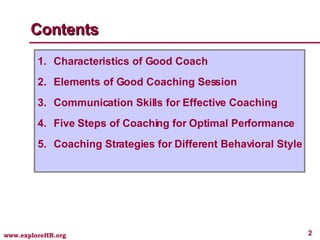
Contents Characteristics ofGood Coach Elements of Good Coaching Session Communication Skills for Effective Coaching Five Steps of Coaching for Optimal Performance Coaching Strategies for Different Behavioral Style
3.
www.exploreHR.org You candownload this presentation at: Please visit www.exploreHR.org for more presentations on leadership, personal development, and HR management.
4.
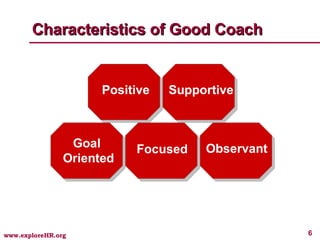
Characteristics of Good Coach If you find this presentation useful, please consider telling others about our site www.exploreHR.org )
5.
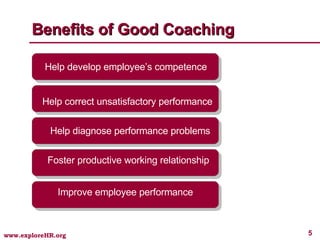
Benefits of GoodCoaching Improve employee performance Help develop employee’s competence Help diagnose performance problems Help correct unsatisfactory performance Foster productive working relationship
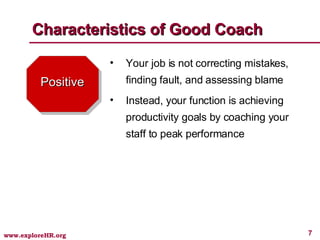
Positive Your jobis not correcting mistakes, finding fault, and assessing blame Instead, your function is achieving productivity goals by coaching your staff to peak performance Characteristics of Good Coach
8.
Supportive Your jobas coach is to get workers what they need to do their job well, including tools, time, instruction, answers to questions, and protection from outside interference Characteristics of Good Coach
9.
Goal Oriented Baseyour assignments on clear, definable goals Tie specific tasks to those goals Communicate those goals to the people who actually have to do the work Characteristics of Good Coach
10.
Focused Effective communicationis specific and focused You are far more likely to get action if that employee leaves your office focused on resolving the issue at hand Characteristics of Good Coach
11.
Observant Being observantmeans more than just keeping your eyes and ears open You need to be aware of what isn’t said as well as what is. If you are paying attention, you won’t have to wait for somebody to tell you about a problem Characteristics of Good Coach
12.
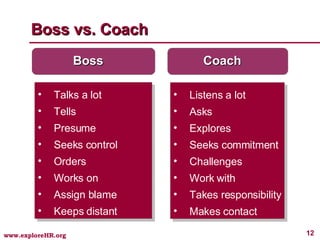
Boss vs. CoachBoss Talks a lot Tells Presume Seeks control Orders Works on Assign blame Keeps distant Listens a lot Asks Explores Seeks commitment Challenges Work with Takes responsibility Makes contact Coach
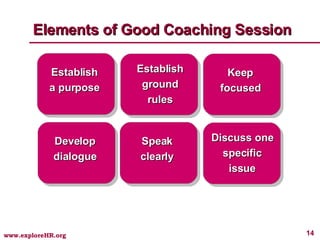
Elements of GoodCoaching Session Establish a purpose Establish ground rules Keep focused Develop dialogue Speak clearly Discuss one specific issue
15.
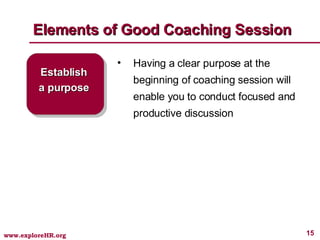
Elements of GoodCoaching Session Establish a purpose Having a clear purpose at the beginning of coaching session will enable you to conduct focused and productive discussion
16.
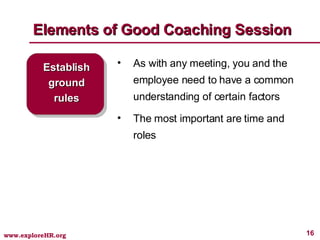
Elements of GoodCoaching Session Establish ground rules As with any meeting, you and the employee need to have a common understanding of certain factors The most important are time and roles
17.
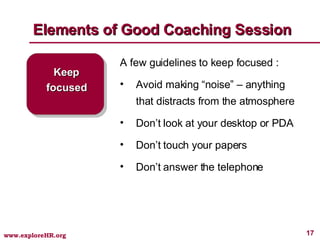
Elements of GoodCoaching Session Keep focused A few guidelines to keep focused : Avoid making “noise” – anything that distracts from the atmosphere Don’t look at your desktop or PDA Don’t touch your papers Don’t answer the telephone
18.
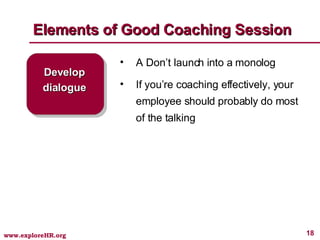
Elements of GoodCoaching Session Develop dialogue A Don’t launch into a monolog If you’re coaching effectively, your employee should probably do most of the talking
19.
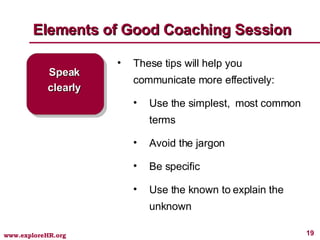
Elements of GoodCoaching Session Speak clearly These tips will help you communicate more effectively: Use the simplest, most common terms Avoid the jargon Be specific Use the known to explain the unknown
20.
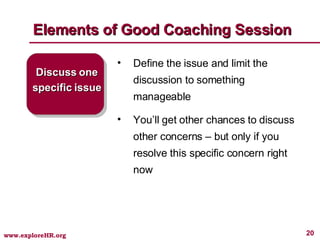
Elements of GoodCoaching Session Discuss one specific issue Define the issue and limit the discussion to something manageable You’ll get other chances to discuss other concerns – but only if you resolve this specific concern right now
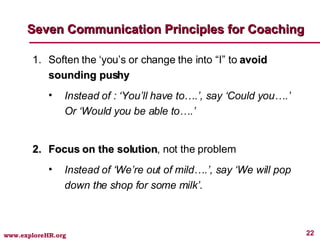
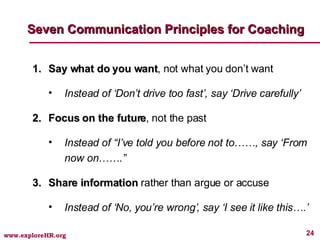
Seven Communication Principlesfor Coaching Soften the ‘you’s or change the into “I” to avoid sounding pushy Instead of : ‘You’ll have to….’, say ‘Could you….’ Or ‘Would you be able to….’ Focus on the solution , not the problem Instead of ‘We’re out of mild….’, say ‘We will pop down the shop for some milk’.
23.
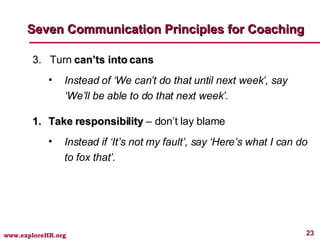
3. Turn can’ts into cans Instead of ‘We can’t do that until next week’, say ‘We’ll be able to do that next week’. Take responsibility – don’t lay blame Instead if ‘It’s not my fault’, say ‘Here’s what I can do to fox that’. Seven Communication Principles for Coaching
24.
Say what doyou want , not what you don’t want Instead of ‘Don’t drive too fast’, say ‘Drive carefully’ Focus on the future , not the past Instead of “I’ve told you before not to……, say ‘From now on…….” Share information rather than argue or accuse Instead of ‘No, you’re wrong’, say ‘I see it like this….’ Seven Communication Principles for Coaching
25.
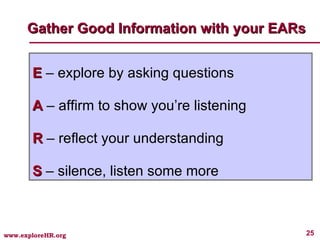
Gather Good Informationwith your EARs E – explore by asking questions A – affirm to show you’re listening R – reflect your understanding S – silence, listen some more
26.
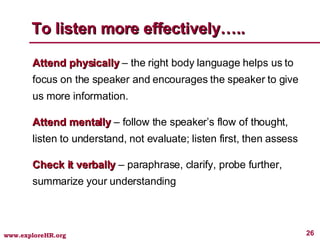
To listen moreeffectively….. Attend physically – the right body language helps us to focus on the speaker and encourages the speaker to give us more information. Attend mentally – follow the speaker’s flow of thought, listen to understand, not evaluate; listen first, then assess Check it verbally – paraphrase, clarify, probe further, summarize your understanding
27.
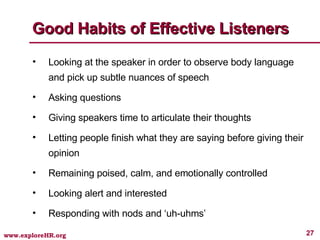
Good Habits ofEffective Listeners Looking at the speaker in order to observe body language and pick up subtle nuances of speech Asking questions Giving speakers time to articulate their thoughts Letting people finish what they are saying before giving their opinion Remaining poised, calm, and emotionally controlled Looking alert and interested Responding with nods and ‘uh-uhms’
28.
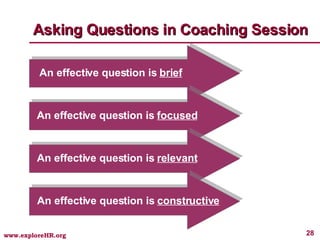
Asking Questions inCoaching Session An effective question is brief An effective question is focused An effective question is relevant An effective question is constructive
29.
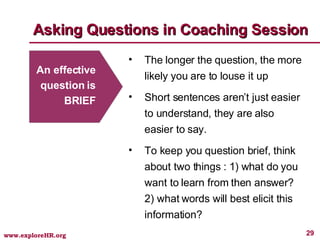
Asking Questions inCoaching Session An effective question is BRIEF The longer the question, the more likely you are to louse it up Short sentences aren’t just easier to understand, they are also easier to say. To keep you question brief, think about two things : 1) what do you want to learn from then answer? 2) what words will best elicit this information?
30.
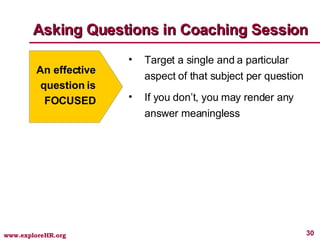
Asking Questions inCoaching Session An effective question is FOCUSED Target a single and a particular aspect of that subject per question If you don’t, you may render any answer meaningless
31.
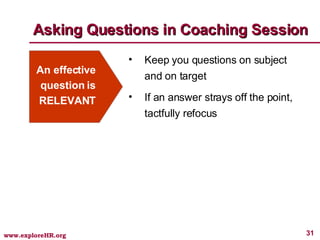
Asking Questions inCoaching Session An effective question is RELEVANT Keep you questions on subject and on target If an answer strays off the point, tactfully refocus
32.
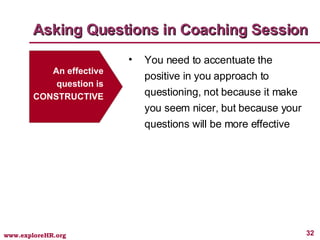
Asking Questions inCoaching Session An effective question is CONSTRUCTIVE You need to accentuate the positive in you approach to questioning, not because it make you seem nicer, but because your questions will be more effective
33.
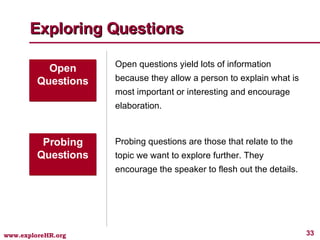
Exploring Questions OpenQuestions Open questions yield lots of information because they allow a person to explain what is most important or interesting and encourage elaboration. Probing Questions Probing questions are those that relate to the topic we want to explore further. They encourage the speaker to flesh out the details.
34.
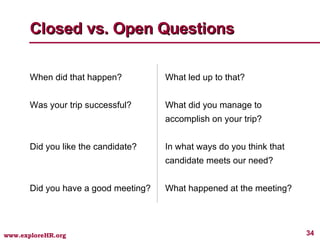
Closed vs. OpenQuestions When did that happen? What led up to that? Was your trip successful? What did you manage to accomplish on your trip? Did you like the candidate? In what ways do you think that candidate meets our need? Did you have a good meeting? What happened at the meeting?
35.
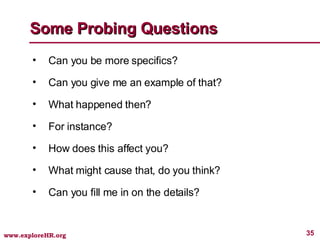
Some Probing QuestionsCan you be more specifics? Can you give me an example of that? What happened then? For instance? How does this affect you? What might cause that, do you think? Can you fill me in on the details?
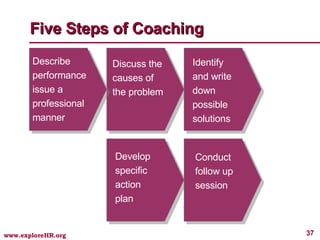
Five Steps ofCoaching Describe performance issue a professional manner Discuss the causes of the problem Identify and write down possible solutions Develop specific action plan Conduct follow up session
38.
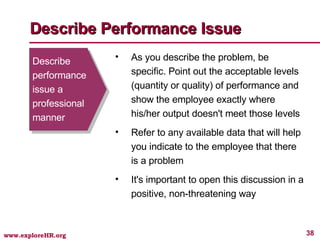
Describe Performance IssueDescribe performance issue a professional manner As you describe the problem, be specific. Point out the acceptable levels (quantity or quality) of performance and show the employee exactly where his/her output doesn't meet those levels Refer to any available data that will help you indicate to the employee that there is a problem It's important to open this discussion in a positive, non-threatening way
39.
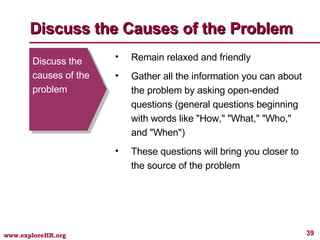
Discuss the causesof the problem Remain relaxed and friendly Gather all the information you can about the problem by asking open-ended questions (general questions beginning with words like "How," "What," "Who," and "When") These questions will bring you closer to the source of the problem Discuss the Causes of the Problem
40.
Discuss the causesof the problem You may find it appropriate to ask some specific questions designed to clarify and pinpoint causes This is a good time to listen and respond with empathy, since the employee may express concern or frustration over factors which he/she feels cannot be controlled Discuss the Causes of the Problem
41.
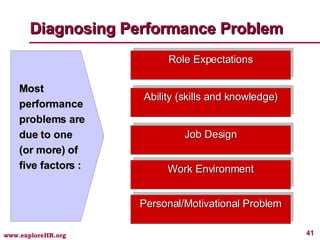
Diagnosing Performance ProblemRole Expectations Ability (skills and knowledge) Job Design Work Environment Personal/Motivational Problem Most performance problems are due to one (or more) of five factors :
42.
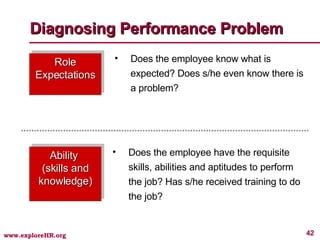
Diagnosing Performance ProblemRole Expectations Ability (skills and knowledge) Does the employee know what is expected? Does s/he even know there is a problem? Does the employee have the requisite skills, abilities and aptitudes to perform the job? Has s/he received training to do the job?
43.
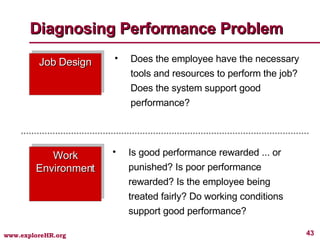
Diagnosing Performance ProblemJob Design Work Environment Does the employee have the necessary tools and resources to perform the job? Does the system support good performance? Is good performance rewarded ... or punished? Is poor performance rewarded? Is the employee being treated fairly? Do working conditions support good performance?
44.
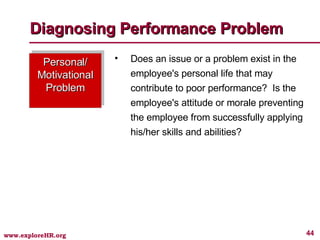
Diagnosing Performance ProblemPersonal/ Motivational Problem Does an issue or a problem exist in the employee's personal life that may contribute to poor performance? Is the employee's attitude or morale preventing the employee from successfully applying his/her skills and abilities?
45.
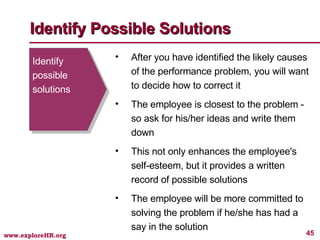
Identify possible solutionsAfter you have identified the likely causes of the performance problem, you will want to decide how to correct it The employee is closest to the problem - so ask for his/her ideas and write them down This not only enhances the employee's self-esteem, but it provides a written record of possible solutions The employee will be more committed to solving the problem if he/she has had a say in the solution Identify Possible Solutions
46.
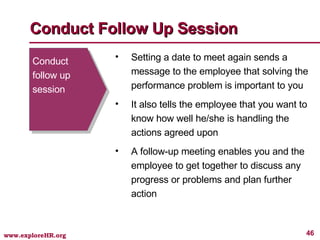
Conduct follow upsession Setting a date to meet again sends a message to the employee that solving the performance problem is important to you It also tells the employee that you want to know how well he/she is handling the actions agreed upon A follow-up meeting enables you and the employee to get together to discuss any progress or problems and plan further action Conduct Follow Up Session
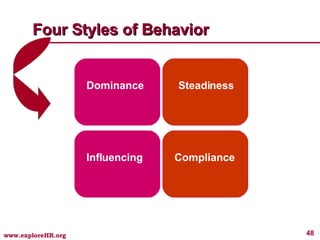
Four Styles ofBehavior Dominance Influencing Steadiness Compliance
49.
Dominance They liketo control their environment by overcoming opposition to accomplish their desired results They are direct, forceful, impatient, and can be extremely demanding They enjoy being in charge and getting things done When they are negatively motivated, they can be defiant They don’t like being told what to do They are reluctant with tasks that involve dealing with lots of detail They would quickly become bored with a routine task
50.
Influencing They liketo shape the environment by influencing or persuading others to see things their way They dislike for handling complex details or working as lone rangers They prefer to deal with people rather than things They enjoy making a favorable impression, a good motivational environment, and viewing people and environment optimistically They will chat with you about anything on their minds They motivate their people and love to generate enthusiasm When negatively motivated, they can be indiscriminately impulsive
51.
Steadiness They liketo cooperate with others to carry out a task They are team player and prefer dealing with things, one thing at a time They are patient, reliable, loyal and resistant to sudden changes in their environment They appreciate an orderly step-by-step approach They tend to perform in a consistent, predictable manner and prefer a stable, harmonious work environment When they get demotivated they can become stubborn or stern, moods usually expressed in the form of passive resistance
52.
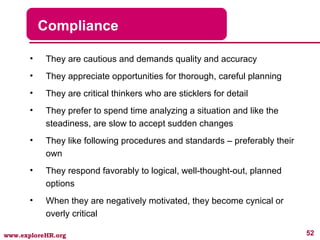
Compliance They arecautious and demands quality and accuracy They appreciate opportunities for thorough, careful planning They are critical thinkers who are sticklers for detail They prefer to spend time analyzing a situation and like the steadiness, are slow to accept sudden changes They like following procedures and standards – preferably their own They respond favorably to logical, well-thought-out, planned options When they are negatively motivated, they become cynical or overly critical
53.
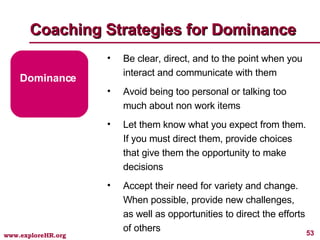
Coaching Strategies forDominance Dominance Be clear, direct, and to the point when you interact and communicate with them Avoid being too personal or talking too much about non work items Let them know what you expect from them. If you must direct them, provide choices that give them the opportunity to make decisions Accept their need for variety and change. When possible, provide new challenges, as well as opportunities to direct the efforts of others
54.
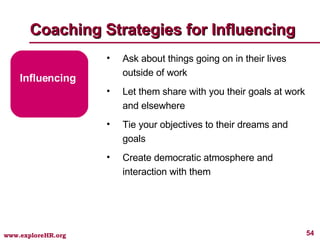
Coaching Strategies forInfluencing Influencing Ask about things going on in their lives outside of work Let them share with you their goals at work and elsewhere Tie your objectives to their dreams and goals Create democratic atmosphere and interaction with them
55.
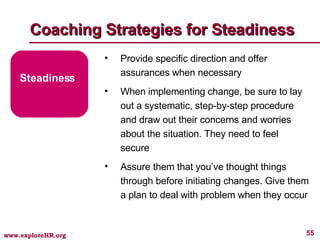
Coaching Strategies forSteadiness Steadiness Provide specific direction and offer assurances when necessary When implementing change, be sure to lay out a systematic, step-by-step procedure and draw out their concerns and worries about the situation. They need to feel secure Assure them that you’ve thought things through before initiating changes. Give them a plan to deal with problem when they occur
56.
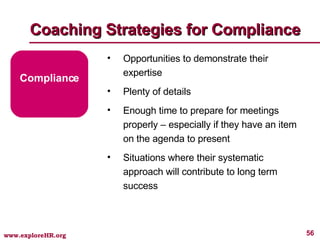
Coaching Strategies forCompliance Compliance Opportunities to demonstrate their expertise Plenty of details Enough time to prepare for meetings properly – especially if they have an item on the agenda to present Situations where their systematic approach will contribute to long term success
57.
Recommended Further ReadingsMarshal J. Cook, Effective Coaching , McGraw Hill Jack Cullen and Len D’Innocenzo, Coaching to Maximize Performance , Velocity Business Publishing