Coaching For Success


        Helen Dyrkacz
       November 6, 2008
Objectives
•   To understand the principles of coaching
•   To learn the coaching process
•   To conduct a coaching session
•   To use various tools to enhance coaching
•   To learn how to provide support and
    ongoing coaching assistance
What is Coaching?
Webster
• A teacher who helps someone prepare for
  a special test
• A person who teaches athletic teams
• To teach or train
1. What is a Working Definition of

           Coaching?
Coaching is…
• A means for learning and development
• Guiding someone toward their goals
• Sharing of experience and opinions to
  create agreed-upon outcomes
• About inspiring and supporting another
  person
Coaching is Not…
• An opportunity to correct someone’s
  behaviors or actions
• Directing someone to do something to
  meet goals
• Being the expert or supervisor with all the
  answers
• About trying to address personal issues
“You cannot teach a man
anything. You can only help
      them discover it within
                   himself.”
                  Galieo Dallei
2. To be effective, a coach must
          be able to…
3. The consequences of not
   coaching for improved
    performance are…
4. Some conditions that need to
exist for a coaching session to be
             effective…
When Do We Coach?
• A staff member needs direction
• New direct report is ready for new
  responsibilities
• Problem performer needs guidance
• Worker needs positive feedback and
  recognition
What is the Purpose of Coaching?
•   Maximize individual strengths
•   Overcome obstacles
•   Reach potential by continuous learning
•   Achieve new skills and competencies
•   Prepare themselves for new responsibilities
•   Better manage themselves
•   Clarify and work towards performance goals
What are Some Benefits of
              Coaching?
•   Increased job satisfaction
•   Increased employee motivation
•   Increased productivity
•   Better use of organizational resources
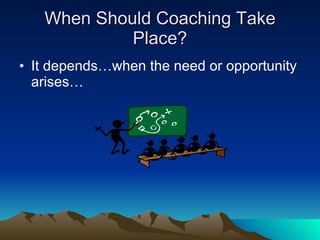
When Should Coaching Take
            Place?
• It depends…when the need or opportunity
  arises…
How Should You Coach?
• Focus on cooperation and facilitation of
  employee’s development
• Steps
  – Know their skill level and behavior patterns
  – Create a comfortable environment where
    action plans can be developed together
• To coach, you need to:
  – Observe without judging
  – Listen actively
  – Ask questions
Giving Feedback as a Coach
• Focus on behavior – not character,
  attitude or personality
• Describe their behavior and impact on
  project or coworker
• Be specific – avoid generalizations
• Be sincere
• Be realistic
• Provide feedback frequently
Receiving Feedback as a Coach

• Ask for specific information
• Ask them for clarification
• Be willing to receive positive and negative
  comments
• Avoid emotion-laden terms
• Avoid being defensive
• Thank them
Agreement Building Process
1.   Looking into different perspectives
2.   Presenting options
3.   Checking for understanding
4.   Checking for agreement
5.   When agreement is in question, go back
     to step 1 and begin the process again
Steps to Successful Coaching
1. Identify the opportunity
2. Prepare for the session
3. Conduct the session
4. Develop an action plan
5. Always follow up
Identify the Opportunity
• Is there an opportunity to improve
  performance?
Preparing for a Coaching Session

•   What needs to be accomplished?
•   What is at stake?
•   What is the purpose of the session?
•   What are some potential issues and how I
    handle these issues?
How to Conduct a Coaching
               Session
•   Keep it positive
•   Determine the desired results
•   Sincerity
•   Share perspectives on the situation
•   Share advice and suggestions
•   Listen to their ideas and response to yours
•   Discus pro’s and con’s on outcomes
•   Commitment to action plan and date
Developing an Action Plan – What
      is the Coach’s Role?
• Set SMART goals
• Priortize the tasks
• Review potential obstacles and brainstorm
  possible solutions
• What additional coaching is needed
• Include resources
Follow Up
• Ask what is working well? What is not
  working?
• Share your observations and reinforce
  positive progress
• Look for opportunities for development
  and feedback
• Suggest possible changes to action plan
• Ask what worked well in the coaching
  session and what could be done differently
Follow Up
• Take the time to celebrate their
  accomplishment
• Reward them for their courage to try
  something new
• If they did not achieve goal:
  – Discuss the results
  – Decide together what change is needed
  – What will the individual need to do differently,
   better or more of in order to reached the goal?
Coaching Styles
1. Direct
  – Developing skills
     •   Need to instruct
  – Providing answers
  – Instructing
Coaching Styles
2. Supportive
  – Facilitating problem
    solving
  – Building self
    confidence
  – Encouraging others to
    learn on their own
  – Serving as a resource
Supportive Coaching and
            “High Flyers”
• Acknowledge their good work
• Ask them to coach others
• Talk to them about career goals
• Identify knowledge, skills and commitment they
  need for other opportunities
• Ask them to identify their gaps and areas of
  interest
• Develop mutually acceptable plan
• Follow up on the plan
The Balancing Act Between Coach
         and Coachee
Employees open up to Coaches and who
 they TRUST

TRUST is the foundation of the relationship
Conducting a Coaching
      Session
When Things Go Wrong…
1.   Build rapport
2.   Relate to the situation
3.   Restore performance
4.   Reassure
5.   Remove
When Things Go Wrong…OOOPS!

1. Build Rapport
  •   Put them at ease – even if they have made
      a mistake
  •   Provide them with honest appreciation –
      supported by evidence
  •   Choose a behavior you have observed and
      comment specifically about it
2. Relate to the Situation
• Focus on the problem or behavior – NOT
  the person
• Ask them to explain what happened
• Gather facts and information
• Get to the root cause
3. Restore Performance
• Remedy the problem
• Reduce the chance of the mistake
  happening again
• If accept responsibility
  – Use questioning, listening and coaching
• If does not accept responsibility
  – Reaffirm performance expectations
4. Reassure
• Reassure employee of their value and
  importance to the organization
• Provide them with support and encouragement
• The “blamer” will leave with sense of
  accountability and understanding of what the
  expectations are.
• Employee should understand that manager is
  interested in their success and growth
5. Remove
• Not a good fit
• Explore strengths, interests and goals
Presentation  Coaching 2

Presentation Coaching 2

  • 1.
    Coaching For Success Helen Dyrkacz November 6, 2008
  • 2.
    Objectives • To understand the principles of coaching • To learn the coaching process • To conduct a coaching session • To use various tools to enhance coaching • To learn how to provide support and ongoing coaching assistance
  • 3.
    What is Coaching? Webster •A teacher who helps someone prepare for a special test • A person who teaches athletic teams • To teach or train
  • 4.
    1. What isa Working Definition of Coaching?
  • 5.
    Coaching is… • Ameans for learning and development • Guiding someone toward their goals • Sharing of experience and opinions to create agreed-upon outcomes • About inspiring and supporting another person
  • 6.
    Coaching is Not… •An opportunity to correct someone’s behaviors or actions • Directing someone to do something to meet goals • Being the expert or supervisor with all the answers • About trying to address personal issues
  • 7.
    “You cannot teacha man anything. You can only help them discover it within himself.” Galieo Dallei
  • 8.
    2. To beeffective, a coach must be able to…
  • 9.
    3. The consequencesof not coaching for improved performance are…
  • 10.
    4. Some conditionsthat need to exist for a coaching session to be effective…
  • 11.
    When Do WeCoach? • A staff member needs direction • New direct report is ready for new responsibilities • Problem performer needs guidance • Worker needs positive feedback and recognition
  • 12.
    What is thePurpose of Coaching? • Maximize individual strengths • Overcome obstacles • Reach potential by continuous learning • Achieve new skills and competencies • Prepare themselves for new responsibilities • Better manage themselves • Clarify and work towards performance goals
  • 13.
    What are SomeBenefits of Coaching? • Increased job satisfaction • Increased employee motivation • Increased productivity • Better use of organizational resources
  • 14.
    When Should CoachingTake Place? • It depends…when the need or opportunity arises…
  • 15.
    How Should YouCoach? • Focus on cooperation and facilitation of employee’s development • Steps – Know their skill level and behavior patterns – Create a comfortable environment where action plans can be developed together
  • 16.
    • To coach,you need to: – Observe without judging – Listen actively – Ask questions
  • 17.
    Giving Feedback asa Coach • Focus on behavior – not character, attitude or personality • Describe their behavior and impact on project or coworker • Be specific – avoid generalizations • Be sincere • Be realistic • Provide feedback frequently
  • 18.
    Receiving Feedback asa Coach • Ask for specific information • Ask them for clarification • Be willing to receive positive and negative comments • Avoid emotion-laden terms • Avoid being defensive • Thank them
  • 19.
    Agreement Building Process 1. Looking into different perspectives 2. Presenting options 3. Checking for understanding 4. Checking for agreement 5. When agreement is in question, go back to step 1 and begin the process again
  • 20.
    Steps to SuccessfulCoaching 1. Identify the opportunity 2. Prepare for the session 3. Conduct the session 4. Develop an action plan 5. Always follow up
  • 21.
    Identify the Opportunity •Is there an opportunity to improve performance?
  • 22.
    Preparing for aCoaching Session • What needs to be accomplished? • What is at stake? • What is the purpose of the session? • What are some potential issues and how I handle these issues?
  • 23.
    How to Conducta Coaching Session • Keep it positive • Determine the desired results • Sincerity • Share perspectives on the situation • Share advice and suggestions • Listen to their ideas and response to yours • Discus pro’s and con’s on outcomes • Commitment to action plan and date
  • 24.
    Developing an ActionPlan – What is the Coach’s Role? • Set SMART goals • Priortize the tasks • Review potential obstacles and brainstorm possible solutions • What additional coaching is needed • Include resources
  • 25.
    Follow Up • Askwhat is working well? What is not working? • Share your observations and reinforce positive progress • Look for opportunities for development and feedback • Suggest possible changes to action plan • Ask what worked well in the coaching session and what could be done differently
  • 26.
    Follow Up • Takethe time to celebrate their accomplishment • Reward them for their courage to try something new • If they did not achieve goal: – Discuss the results – Decide together what change is needed – What will the individual need to do differently, better or more of in order to reached the goal?
  • 27.
    Coaching Styles 1. Direct – Developing skills • Need to instruct – Providing answers – Instructing
  • 28.
    Coaching Styles 2. Supportive – Facilitating problem solving – Building self confidence – Encouraging others to learn on their own – Serving as a resource
  • 29.
    Supportive Coaching and “High Flyers” • Acknowledge their good work • Ask them to coach others • Talk to them about career goals • Identify knowledge, skills and commitment they need for other opportunities • Ask them to identify their gaps and areas of interest • Develop mutually acceptable plan • Follow up on the plan
  • 30.
    The Balancing ActBetween Coach and Coachee Employees open up to Coaches and who they TRUST TRUST is the foundation of the relationship
  • 31.
  • 32.
    When Things GoWrong… 1. Build rapport 2. Relate to the situation 3. Restore performance 4. Reassure 5. Remove
  • 33.
    When Things GoWrong…OOOPS! 1. Build Rapport • Put them at ease – even if they have made a mistake • Provide them with honest appreciation – supported by evidence • Choose a behavior you have observed and comment specifically about it
  • 34.
    2. Relate tothe Situation • Focus on the problem or behavior – NOT the person • Ask them to explain what happened • Gather facts and information • Get to the root cause
  • 35.
    3. Restore Performance •Remedy the problem • Reduce the chance of the mistake happening again • If accept responsibility – Use questioning, listening and coaching • If does not accept responsibility – Reaffirm performance expectations
  • 36.
    4. Reassure • Reassureemployee of their value and importance to the organization • Provide them with support and encouragement • The “blamer” will leave with sense of accountability and understanding of what the expectations are. • Employee should understand that manager is interested in their success and growth
  • 37.
    5. Remove • Nota good fit • Explore strengths, interests and goals