Performance Management
© www.asia-masters.com
What Is “Good
Performance”?
• More than just activities, effort, good intentions, or
results
• Working hard and staying busy are not necessarily
high performance
• Attending training sessions and studying hard does
not necessarily lead to good performance
• Strong commitment may not lead to good
performance
• Even accomplishing some goals may not be high
performance
© www.asia-masters.com
Broader Than
Performance
Appraisal
Begins with a look at goals & strategies of the
organization
© www.asia-masters.com
Organizational
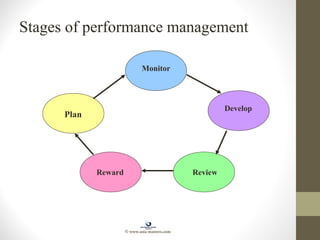
Alignment
All efforts must be aligned with overall goals and
strategies of the organization.
…a key to Performance
Management
© www.asia-masters.com
Performance Management
a Cascading Process
• Mission, goals, and strategies should be defined, and clearly
understood by everyone
• How do all tasks contribute to overall plans for the
organization?
© www.asia-masters.com
Annual Plans Should Create
Performance Standards for
Each Department
• These should translate into performance goals for each worker
• Quantity
• Quality
• Time
• Cost
© www.asia-masters.com
What Are the Three Steps in
Performance Management?
Defining Performance
Facilitating Performance
Encouraging Performance
© www.asia-masters.com
Performance
Appraisal continues to
be one of the most
criticized HR functions
in organizations
© www.asia-masters.com
Performance Appraisal
• We all measure our subordinates’ performance whether we
do it formally or informally
• Very important to document what we evaluate
• Also necessary to show a clear link between what we
evaluate and job requirements
© www.asia-masters.com
How Frequently
Should Performance
Appraisal Be Done?
Why?
© www.asia-masters.com
Performance Appraisal -
a Continuing Process
• Is not a once-a-year or once-a-quarter experience
• Effective appraisal occurs frequently
• There should be no surprises when an employee is
given his or her formal appraisal interview
• Essential for coaching & positive motivation
© www.asia-masters.com
The Main Point
Be sure that what is measured is documented & can be
shown to match job expectations
© www.asia-masters.com
A Key to All of This:
Supervisors must have the support &
encouragement of higher management
to make all this work
© www.asia-masters.com
MBO
• Steps in development and usage?
• Potential strengths and weaknesses?
© www.asia-masters.com
What Do You Think?
What Form of Performance Appraisal Would
You Recommend?
What Criteria Have You Used in Making
Your Recommendation?
What Limitations (As Well As Strengths)
Does Your Recommended Method Have?
© www.asia-masters.com
Performance management
Definition:
Employee performance management is the process
of involving employees in accomplishing your
agency’s mission and goals.
Employee performance management includes:
planning work and setting goals, monitoring
performance, developing capacity, reviewing
performance, and rewarding good work.
© www.asia-masters.com
Designing the performance
management system
• What will be the purpose?
• What will be the sequential stages?
• What performance will be measured?
• Who will assess employee performance?
• What will be on the form?
• Will a rating scheme be used?
• What support systems need to be in place?
© www.asia-masters.com
Managing performance for …
Accountability
Performance target
setting and
outcome/results
review
AND / OR
© www.asia-masters.com
Performance Management Cycle
Performance Planning
Staff and the Organisation
Performance and Development
Reviewing
Enabling staff
to deliver
Taking stock of achievements, diagnostics
Setting Objectives, defining what is needed
Action
Reset objectives
Make changes
© www.asia-masters.com
Alignment Model
Your
Organizational
Priorities
Your Major Areas of
Responsibility and
Individual Priorities
Mission
Values
Departmental
Priorities
Knowledge, Skills
and Behaviors
Performance Development Process
UNITOR
DEPARTMENT
HARVARDCOLLEGE
LIBRARY
PERSONAL
“What” “How”
© www.asia-masters.com
Managing performance for …
Employee
Development
Competence assessment
and development
© www.asia-masters.com
Stages of performance management
Plan
Monitor
Develop
ReviewReward
© www.asia-masters.com
Stage 1 – Individual Performance Planning
Stage 1 – Planning
•Work goals
•Competencies
•Learning
Performance planning at the start of the year and then
periodically is the core of the performance
management process. The performance plan should
be a written document.
Plan
© www.asia-masters.com
Performance planning
• How is what I do on a
daily basis tied to the
success of this
organization?
• What are my
performance goals for
the next time period?
• How are my goals
aligned with the
organizational goals?
© www.asia-masters.com
Performance Planning
• Performance results – the what
• Performance outcomes or standards – from job description
• Performance objectives for the next time period
• Performance behavior – the how
• Competencies, performance factors, or behavior expectations
• Development objectives
© www.asia-masters.com
• MBO is a system in which specific performance objectives
are jointly determined by subordinates and their superiors,
progress toward objectives is periodically reviewed, and
rewards are allocated on the basis of this progress.
© www.asia-masters.com
MBO Principles
Cascading of organizational goals and objectives
Specific objectives for each member
Participative decision making
Explicit time period
Performance evaluation and feedback
© www.asia-masters.com
Objectives should be specific, attainable, yet
challenging.
Is the objective appropriate for the business at this
time?
Does it take the organization in the direction it wants to
go?
Does it support the overall mission of the business?
Is it compatible and complementary with the other
objectives?
Is it acceptable and understandable to the majority
who will be charged with implementing it?
Is it affordable for the organization?
Is it measurable and achievable?
Is it ambitious enough to be challenging?
© www.asia-masters.com
Hierarchy of objectives
Vision
Mission
Goals
Objectives
Policies
Procedures
© www.asia-masters.com
MBO substitutes for good intentions a process that
requires rather precise written description of
objectives (for the period ahead) and time-lines
for their monitoring and achievement. The
process requires that the manager and the
employee agree to what the employee will
attempt to achieve in the period ahead, and (very
important) that the employee accept and buy into
the objectives (otherwise commitment will be
lacking).
© www.asia-masters.com
SMART
Management by Objectives introduced the
SMART method for checking the validity of
Objectives,
'SMART':
• Specific
• Measurable
• Achievable
• Realistic, and
• Time-related.
© www.asia-masters.com
Stage 2/3 – Monitor and Develop
Daily performance
management!
Monitoring includes
measuring performance
and giving feedback. Two
way communication
between the manager and
employee throughout the
performance period is
critical to the performance
management process.
Stage 2/3 – Monitor and
Develop
•Feedback
•Coach
•Adjust goals
Monitor
Develop
© www.asia-masters.com
Daily performance
management
• Feedback and coaching –
informal
• Monitoring and tracking
performance against standards
and progress toward goals.
• Quarterly performance
planning and performance
discussions
• Development through
coaching, training, challenging
or visible assignments,
improving work processes
© www.asia-masters.com
What performance will be
measured?
• Behaviors – how the work is done
• Performance factors / competencies
• Required behaviors
• Behaviors supporting desired organizational culture
• Results – what is achieved
• Performance outcomes
• Performance compared to job standards
• Performance goals and/or objectives
© www.asia-masters.com
Stage 4 – Performance Review
The formal process of
documenting results the
employee has achieved
and behaviors and /or
competencies displayed
should occur at least
once a year.Stage 4 – Review
•At least annually
•Discuss
•Document
Review
© www.asia-masters.com
Performance Review
• Summary of performance
over a period of time
• Evaluate performance
results and behaviors
• Conducted face-to-face
with a written record.
• While rating and ranking
has both pros and cons, a
summary rating of each
employee may be useful.
© www.asia-masters.com
If a rating scheme will be used
• Number of levels: three, four, five, or six
• Rating labels
• Numerical: e. g. 1, 2, 3, 4, 5
• Behavioral frequency: e. g. always, usually, frequently, sometimes,
rarely
• Evaluation: e. g. distinguished, superior, competent, fair, marginal
• Performance against a standard: e. g. exceeds, meets, does not meet
© www.asia-masters.com
Who will assess performance?
• Immediate supervisor
only
• In addition to the
immediate supervisor
• Employee (self)
• Peers and coworkers
• Internal and external
customers
• Subordinates
Choices include:
© www.asia-masters.com
39
Performance Appraisal v. Performance Management
A Matter of Perspectives
Appraisal Management
One time event Ongoing
Retrospective Prospective
Short Term Long Term
Correction oriented Progress steps
Completing form Planning/goal setting
© www.asia-masters.com
Approaches to designing an
appraisal form• Trait based
• Behavior based
• Competencies (or performance factors)
• Behaviors
• Results based
• Performance outcomes
• Objectives
© www.asia-masters.com
What will be on the form?
• Identifying information
• Instructions
• Performance outcomes and/or results achieved (or not achieved)
on objectives
• Performance factors / competencies / work behaviors
• Employee signature and approvals
© www.asia-masters.com
Other information
• Employee comments
• Summary of one to three major achievements
• Strengths / areas for development
• Overall rating
• Plan for development (if not elsewhere)
• Performance plan for next period (if not elsewhere)
© www.asia-masters.com
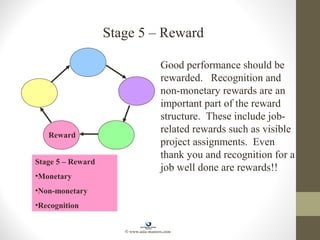
Stage 5 – Reward
Good performance should be
rewarded. Recognition and
non-monetary rewards are an
important part of the reward
structure. These include job-
related rewards such as visible
project assignments. Even
thank you and recognition for a
job well done are rewards!!
Stage 5 – Reward
•Monetary
•Non-monetary
•Recognition
Reward
© www.asia-masters.com
Rewards, recognition, and
compensation
• Recognizing employees for
performance
• Non-monetary rewards
• Informal and ongoing
acknowledgements of good work
• Compensation
• Merit increases?
• Pay to market?
• Increases added to base pay or lump
sum?
Separate conversation about pay from conversation about
performance!!!!!
© www.asia-masters.com
What support systems need to
be in place?
• Senior management support
• Management accountability
• Communication about the process
• Training
• Process for new employees
• Process for dealing with poor performance
• Monitoring and evaluating the process (HR)
• Appeals process (HR)
© www.asia-masters.com
Communication
• Timeframe for the
performance management
cycle
• Instructions for the
supervisor
• Instructions for the
employee
• Tie to other systems
• Support available
© www.asia-masters.com
Performance Appraisal
Purpose
• Control Behavior
• Set Standard
• Measure Performance
• Compare Performance Against Standard
• If Discrepancy Exist, Take Corrective Action
• Used to Provide Feedback
• Used as Basis of Reward & Punishment Systems
• Used for System Improvement
© Dr. Dianna Stone
© www.asia-masters.com
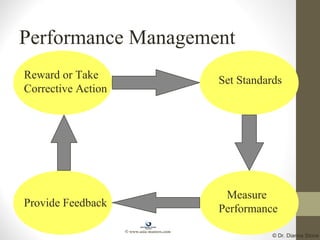
Performance Management
Reward or Take
Corrective Action
Reward or Take
Corrective Action
Set Standards
Provide Feedback
Measure
Performance
© Dr. Dianna Stone
© www.asia-masters.com
Conflicts in Performance Appraisal
Conflicting Goals of Appraisal Create Problems
Organization Seeks
Information To
Improve Systems
Individual Seeks
Valid Performance
Feedback
Individual Seeks
Extrinsic Rewards
Organization Seeks
Information On Which
To Base Rewards
© Dr. Dianna Stone
Requirements of Effective
Performance Management
• Relevant to job
performance
• Distinguishes Effective &
Ineffective Performance
• Fair & Acceptable
© Dr. Dianna Stone
© www.asia-masters.com
Performance Standards
• Managers assume standards
are clear
• Communicate - What is to
be done?
• How well should it be done?
© Dr. Dianna Stone
© www.asia-masters.com
Performance Measures
• Objective Measures - Hard Criteria
$ Sales Personnel Data Tardiness
Units ProducedAbsence Rate
Error Rate Turnover
• Weaknesses
• Performance Modified by Situation - Opportunity Bias
• System Responsible for 96% of Variance - Person 4%
(Deming)
• Objective measures do not apply to all jobs
© Dr. Dianna Stone
© www.asia-masters.com
Performance Measures
• Subjective Measures - Performance Measures
• Who Rates? Supervisors, Peers, Subordinates, Self
• Errors & Biases
• Halo Error
• Central Tendency
• Leniency (Positive & Negative)
Goal is to Accurately Appraise Performance
© Dr. Dianna Stone
© www.asia-masters.com
Methods
• Ranking - Rank order ratees from highest to lowest
• Behavioral Checklist - Series of Descriptive
Statements of Job-Related Behavior
Example: ____ Comes to class on time
____ Courteous with clients
____ Sleeps on the job
• Forced Distribution
10% 20% 40% 20% 10%
Poor Below Average Above Excellent
Average Average
© Dr. Dianna Stone
© www.asia-masters.com
Methods
• Advantages (Forced Distribution) : Decreases Central
Tendency & Leniency Errors
• Disadvantages (Forced Distribution): May not be
accurate reflection of performance
• Graphic Rating Scale - Most Widely Use
Quality
(1) (2) (3) (4) (5)
Poor Below Average Above Excellent
Average Average
• Behaviorally Anchored Rating Scale - Based on
critical incidents, Behaviors are anchors
© Dr. Dianna Stone
Methods
• Behaviorally Anchored Rating Scales
Police Officer: Job Knowledge
High (7, 8, 9) Follows correct procedures for
evidence preservation
Average (4, 5, 6) Seldom has to ask other about
points of law
Low (1, 2, 3) Misinforms the public about laws
© Dr. Dianna Stone
© www.asia-masters.com
End
© www.asia-masters.com

Performance Management Leadership Training

  • 1.
  • 2.
    What Is “Good Performance”? •More than just activities, effort, good intentions, or results • Working hard and staying busy are not necessarily high performance • Attending training sessions and studying hard does not necessarily lead to good performance • Strong commitment may not lead to good performance • Even accomplishing some goals may not be high performance © www.asia-masters.com
  • 3.
    Broader Than Performance Appraisal Begins witha look at goals & strategies of the organization © www.asia-masters.com
  • 4.
    Organizational Alignment All efforts mustbe aligned with overall goals and strategies of the organization. …a key to Performance Management © www.asia-masters.com
  • 5.
    Performance Management a CascadingProcess • Mission, goals, and strategies should be defined, and clearly understood by everyone • How do all tasks contribute to overall plans for the organization? © www.asia-masters.com
  • 6.
    Annual Plans ShouldCreate Performance Standards for Each Department • These should translate into performance goals for each worker • Quantity • Quality • Time • Cost © www.asia-masters.com
  • 7.
    What Are theThree Steps in Performance Management? Defining Performance Facilitating Performance Encouraging Performance © www.asia-masters.com
  • 8.
    Performance Appraisal continues to beone of the most criticized HR functions in organizations © www.asia-masters.com
  • 9.
    Performance Appraisal • Weall measure our subordinates’ performance whether we do it formally or informally • Very important to document what we evaluate • Also necessary to show a clear link between what we evaluate and job requirements © www.asia-masters.com
  • 10.
    How Frequently Should Performance AppraisalBe Done? Why? © www.asia-masters.com
  • 11.
    Performance Appraisal - aContinuing Process • Is not a once-a-year or once-a-quarter experience • Effective appraisal occurs frequently • There should be no surprises when an employee is given his or her formal appraisal interview • Essential for coaching & positive motivation © www.asia-masters.com
  • 12.
    The Main Point Besure that what is measured is documented & can be shown to match job expectations © www.asia-masters.com
  • 13.
    A Key toAll of This: Supervisors must have the support & encouragement of higher management to make all this work © www.asia-masters.com
  • 14.
    MBO • Steps indevelopment and usage? • Potential strengths and weaknesses? © www.asia-masters.com
  • 15.
    What Do YouThink? What Form of Performance Appraisal Would You Recommend? What Criteria Have You Used in Making Your Recommendation? What Limitations (As Well As Strengths) Does Your Recommended Method Have? © www.asia-masters.com
  • 16.
    Performance management Definition: Employee performancemanagement is the process of involving employees in accomplishing your agency’s mission and goals. Employee performance management includes: planning work and setting goals, monitoring performance, developing capacity, reviewing performance, and rewarding good work. © www.asia-masters.com
  • 17.
    Designing the performance managementsystem • What will be the purpose? • What will be the sequential stages? • What performance will be measured? • Who will assess employee performance? • What will be on the form? • Will a rating scheme be used? • What support systems need to be in place? © www.asia-masters.com
  • 18.
    Managing performance for… Accountability Performance target setting and outcome/results review AND / OR © www.asia-masters.com
  • 19.
    Performance Management Cycle PerformancePlanning Staff and the Organisation Performance and Development Reviewing Enabling staff to deliver Taking stock of achievements, diagnostics Setting Objectives, defining what is needed Action Reset objectives Make changes © www.asia-masters.com
  • 20.
    Alignment Model Your Organizational Priorities Your MajorAreas of Responsibility and Individual Priorities Mission Values Departmental Priorities Knowledge, Skills and Behaviors Performance Development Process UNITOR DEPARTMENT HARVARDCOLLEGE LIBRARY PERSONAL “What” “How” © www.asia-masters.com
  • 21.
    Managing performance for… Employee Development Competence assessment and development © www.asia-masters.com
  • 22.
    Stages of performancemanagement Plan Monitor Develop ReviewReward © www.asia-masters.com
  • 23.
    Stage 1 –Individual Performance Planning Stage 1 – Planning •Work goals •Competencies •Learning Performance planning at the start of the year and then periodically is the core of the performance management process. The performance plan should be a written document. Plan © www.asia-masters.com
  • 24.
    Performance planning • Howis what I do on a daily basis tied to the success of this organization? • What are my performance goals for the next time period? • How are my goals aligned with the organizational goals? © www.asia-masters.com
  • 25.
    Performance Planning • Performanceresults – the what • Performance outcomes or standards – from job description • Performance objectives for the next time period • Performance behavior – the how • Competencies, performance factors, or behavior expectations • Development objectives © www.asia-masters.com
  • 26.
    • MBO isa system in which specific performance objectives are jointly determined by subordinates and their superiors, progress toward objectives is periodically reviewed, and rewards are allocated on the basis of this progress. © www.asia-masters.com
  • 27.
    MBO Principles Cascading oforganizational goals and objectives Specific objectives for each member Participative decision making Explicit time period Performance evaluation and feedback © www.asia-masters.com
  • 28.
    Objectives should bespecific, attainable, yet challenging. Is the objective appropriate for the business at this time? Does it take the organization in the direction it wants to go? Does it support the overall mission of the business? Is it compatible and complementary with the other objectives? Is it acceptable and understandable to the majority who will be charged with implementing it? Is it affordable for the organization? Is it measurable and achievable? Is it ambitious enough to be challenging? © www.asia-masters.com
  • 29.
  • 30.
    MBO substitutes forgood intentions a process that requires rather precise written description of objectives (for the period ahead) and time-lines for their monitoring and achievement. The process requires that the manager and the employee agree to what the employee will attempt to achieve in the period ahead, and (very important) that the employee accept and buy into the objectives (otherwise commitment will be lacking). © www.asia-masters.com
  • 31.
    SMART Management by Objectivesintroduced the SMART method for checking the validity of Objectives, 'SMART': • Specific • Measurable • Achievable • Realistic, and • Time-related. © www.asia-masters.com
  • 32.
    Stage 2/3 –Monitor and Develop Daily performance management! Monitoring includes measuring performance and giving feedback. Two way communication between the manager and employee throughout the performance period is critical to the performance management process. Stage 2/3 – Monitor and Develop •Feedback •Coach •Adjust goals Monitor Develop © www.asia-masters.com
  • 33.
    Daily performance management • Feedbackand coaching – informal • Monitoring and tracking performance against standards and progress toward goals. • Quarterly performance planning and performance discussions • Development through coaching, training, challenging or visible assignments, improving work processes © www.asia-masters.com
  • 34.
    What performance willbe measured? • Behaviors – how the work is done • Performance factors / competencies • Required behaviors • Behaviors supporting desired organizational culture • Results – what is achieved • Performance outcomes • Performance compared to job standards • Performance goals and/or objectives © www.asia-masters.com
  • 35.
    Stage 4 –Performance Review The formal process of documenting results the employee has achieved and behaviors and /or competencies displayed should occur at least once a year.Stage 4 – Review •At least annually •Discuss •Document Review © www.asia-masters.com
  • 36.
    Performance Review • Summaryof performance over a period of time • Evaluate performance results and behaviors • Conducted face-to-face with a written record. • While rating and ranking has both pros and cons, a summary rating of each employee may be useful. © www.asia-masters.com
  • 37.
    If a ratingscheme will be used • Number of levels: three, four, five, or six • Rating labels • Numerical: e. g. 1, 2, 3, 4, 5 • Behavioral frequency: e. g. always, usually, frequently, sometimes, rarely • Evaluation: e. g. distinguished, superior, competent, fair, marginal • Performance against a standard: e. g. exceeds, meets, does not meet © www.asia-masters.com
  • 38.
    Who will assessperformance? • Immediate supervisor only • In addition to the immediate supervisor • Employee (self) • Peers and coworkers • Internal and external customers • Subordinates Choices include: © www.asia-masters.com
  • 39.
    39 Performance Appraisal v.Performance Management A Matter of Perspectives Appraisal Management One time event Ongoing Retrospective Prospective Short Term Long Term Correction oriented Progress steps Completing form Planning/goal setting © www.asia-masters.com
  • 40.
    Approaches to designingan appraisal form• Trait based • Behavior based • Competencies (or performance factors) • Behaviors • Results based • Performance outcomes • Objectives © www.asia-masters.com
  • 41.
    What will beon the form? • Identifying information • Instructions • Performance outcomes and/or results achieved (or not achieved) on objectives • Performance factors / competencies / work behaviors • Employee signature and approvals © www.asia-masters.com
  • 42.
    Other information • Employeecomments • Summary of one to three major achievements • Strengths / areas for development • Overall rating • Plan for development (if not elsewhere) • Performance plan for next period (if not elsewhere) © www.asia-masters.com
  • 43.
    Stage 5 –Reward Good performance should be rewarded. Recognition and non-monetary rewards are an important part of the reward structure. These include job- related rewards such as visible project assignments. Even thank you and recognition for a job well done are rewards!! Stage 5 – Reward •Monetary •Non-monetary •Recognition Reward © www.asia-masters.com
  • 44.
    Rewards, recognition, and compensation •Recognizing employees for performance • Non-monetary rewards • Informal and ongoing acknowledgements of good work • Compensation • Merit increases? • Pay to market? • Increases added to base pay or lump sum? Separate conversation about pay from conversation about performance!!!!! © www.asia-masters.com
  • 45.
    What support systemsneed to be in place? • Senior management support • Management accountability • Communication about the process • Training • Process for new employees • Process for dealing with poor performance • Monitoring and evaluating the process (HR) • Appeals process (HR) © www.asia-masters.com
  • 46.
    Communication • Timeframe forthe performance management cycle • Instructions for the supervisor • Instructions for the employee • Tie to other systems • Support available © www.asia-masters.com
  • 47.
    Performance Appraisal Purpose • ControlBehavior • Set Standard • Measure Performance • Compare Performance Against Standard • If Discrepancy Exist, Take Corrective Action • Used to Provide Feedback • Used as Basis of Reward & Punishment Systems • Used for System Improvement © Dr. Dianna Stone © www.asia-masters.com
  • 48.
    Performance Management Reward orTake Corrective Action Reward or Take Corrective Action Set Standards Provide Feedback Measure Performance © Dr. Dianna Stone © www.asia-masters.com
  • 49.
    Conflicts in PerformanceAppraisal Conflicting Goals of Appraisal Create Problems Organization Seeks Information To Improve Systems Individual Seeks Valid Performance Feedback Individual Seeks Extrinsic Rewards Organization Seeks Information On Which To Base Rewards © Dr. Dianna Stone
  • 50.
    Requirements of Effective PerformanceManagement • Relevant to job performance • Distinguishes Effective & Ineffective Performance • Fair & Acceptable © Dr. Dianna Stone © www.asia-masters.com
  • 51.
    Performance Standards • Managersassume standards are clear • Communicate - What is to be done? • How well should it be done? © Dr. Dianna Stone © www.asia-masters.com
  • 52.
    Performance Measures • ObjectiveMeasures - Hard Criteria $ Sales Personnel Data Tardiness Units ProducedAbsence Rate Error Rate Turnover • Weaknesses • Performance Modified by Situation - Opportunity Bias • System Responsible for 96% of Variance - Person 4% (Deming) • Objective measures do not apply to all jobs © Dr. Dianna Stone © www.asia-masters.com
  • 53.
    Performance Measures • SubjectiveMeasures - Performance Measures • Who Rates? Supervisors, Peers, Subordinates, Self • Errors & Biases • Halo Error • Central Tendency • Leniency (Positive & Negative) Goal is to Accurately Appraise Performance © Dr. Dianna Stone © www.asia-masters.com
  • 54.
    Methods • Ranking -Rank order ratees from highest to lowest • Behavioral Checklist - Series of Descriptive Statements of Job-Related Behavior Example: ____ Comes to class on time ____ Courteous with clients ____ Sleeps on the job • Forced Distribution 10% 20% 40% 20% 10% Poor Below Average Above Excellent Average Average © Dr. Dianna Stone © www.asia-masters.com
  • 55.
    Methods • Advantages (ForcedDistribution) : Decreases Central Tendency & Leniency Errors • Disadvantages (Forced Distribution): May not be accurate reflection of performance • Graphic Rating Scale - Most Widely Use Quality (1) (2) (3) (4) (5) Poor Below Average Above Excellent Average Average • Behaviorally Anchored Rating Scale - Based on critical incidents, Behaviors are anchors © Dr. Dianna Stone
  • 56.
    Methods • Behaviorally AnchoredRating Scales Police Officer: Job Knowledge High (7, 8, 9) Follows correct procedures for evidence preservation Average (4, 5, 6) Seldom has to ask other about points of law Low (1, 2, 3) Misinforms the public about laws © Dr. Dianna Stone © www.asia-masters.com
  • 57.

Editor's Notes

  • #17 Peter Scholtes used to say unpack your performance appraisal system. It does too much!!!!