People Management
By: Mariam Mustafa - Assistant Director Resource Development National University of Medical Sciences (NUMS)
1
Learning Points
What is People Management
01
What are the key components of
people management
02
Understanding the key components
through exercises
03
People Management Skills
04
Discussion on the skills
05
Conclution / endnote
06 2
Is People Management Different from
Human Resource Management?
3
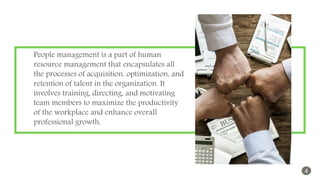
People management is a part of human
resource management that encapsulates all
the processes of acquisition, optimization, and
retention of talent in the organization. It
involves training, directing, and motivating
team members to maximize the productivity
of the workplace and enhance overall
professional growth.
4
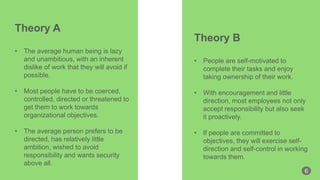
Theory B
• People are self-motivated to
complete their tasks and enjoy
taking ownership of their work.
• With encouragement and little
direction, most employees not only
accept responsibility but also seek
it proactively.
• If people are committed to
objectives, they will exercise self-
direction and self-control in working
towards them.
Theory A
• The average human being is lazy
and unambitious, with an inherent
dislike of work that they will avoid if
possible.
• Most people have to be coerced,
controlled, directed or threatened to
get them to work towards
organizational objectives.
• The average person prefers to be
directed, has relatively little
ambition, wished to avoid
responsibility and wants security
above all.
6
What does a People
Manager do?
• Resolving conflicts to promote
better collaboration and mutual
respect between team members.
• Meeting deadlines for tasks by
directing their team towards set
business goals.
• Providing adequate training to
existing and new team members so
that they can fulfil their roles and
responsibilities better.
• Creating a workplace culture that
supports continuous feedback,
which, in turn, can help the
company make actionable changes.
7
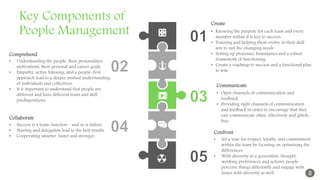
• Understanding the people, their personalities,
motivations, their personal and career goals.
• Empathy, active listening, and a people-first
approach lead to a deeper mutual understanding
of individuals and collectives.
• It is important to understand that people are
different and have different traits and skill
predispositions.
Comprehend
• Success is a team-function – and so is failure.
• Sharing and delegation lead to the best results.
• Cooperating smarter, faster and stronger.
Collaborate
• Knowing the purpose for each team and every
member within it is key to success.
• Training and helping them evolve in their skill
sets to suit the changing needs.
• Setting up processes, boundaries and a robust
framework of functioning.
• Create a roadmap to success and a functional plan
to win.
Create
• Open channels of communication and
feedback.
• Providing right channels of communication
and feedback in order to encourage that they
can communicate often, effectively and glitch-
free.
Communicate
• Set a tone for respect, loyalty, and commitment
within the team by focusing on optimizing the
differences.
• With diversity in a generation, thought,
working preferences and actions, people
perceive things differently and engage with
issues with diversity as well.
Confront
Key Components of
People Management
8
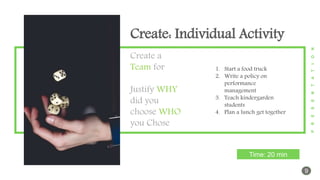
Create: Individual Activity
1. Start a food truck
2. Write a policy on
performance
management
3. Teach kindergarden
students
4. Plan a lunch get together
Time: 20 min
P
R
E
S
E
N
T
A
T
I
O
N
Create a
Team for
Justify WHY
did you
choose WHO
you Chose
9
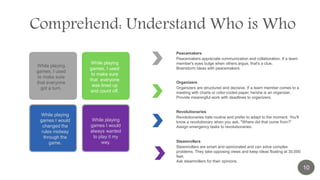
Comprehend: Understand Who is Who
Peacemakers appreciate communication and collaboration. If a team
member's eyes bulge when others argue, that's a clue.
Brainstorm ideas with peacemakers.
Peacemakers
Organizers are structured and decisive. If a team member comes to a
meeting with charts or color-coded paper, he/she is an organizer.
Provide meaningful work with deadlines to organizers.
Organizers
Revolutionaries hate routine and prefer to adapt to the moment. You'll
know a revolutionary when you ask, "Where did that come from?“
Assign emergency tasks to revolutionaries.
Revolutionaries
Steamrollers are smart and opinionated and can solve complex
problems. They take opposing views and keep ideas floating at 30,000
feet.
Ask steamrollers for their opinions.
Steamrollers
While playing
games, I used
to make sure
that everyone
was lined up
and count off.
While playing
games, I used
to make sure
that everyone
got a turn.
While playing
games I would
changed the
rules midway
through the
game.
While playing
games I would
always wanted
to play it my
way.
10
Communicate
Communication Exercises
11
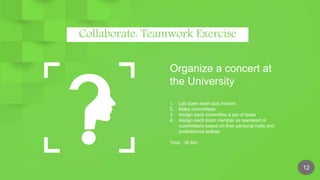
Collaborate: Teamwork Exercise
Organize a concert at
the University
1. List down each task involve
2. Make committees
3. Assign each committee a set of tasks
4. Assign each team member as teamlead of
committee/s based on their personal traits and
professional skillset.
Time: 35 Min
12
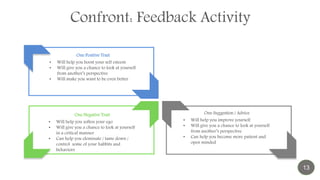
Confront: Feedback Activity
• Will help you improve yourself
• Will give you a chance to look at yourself
from another’s perspective
• Can help you become more patient and
open minded
One Suggestion / Advice
• Will help you boost your self esteem
• Will give you a chance to look at yourself
from another’s perspective
• Will make you want to be even better
One Positive Trait
• Will help you soften your ego
• Will give you a chance to look at yourself
in a critical manner
• Can help you eleminate / tame down /
control some of your habbits and
behaviors
One Negative Trait
13
People Management Skills
14
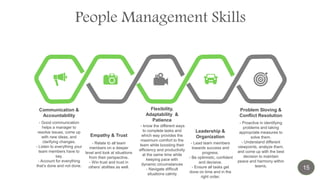
People Management Skills
Communication &
Accountability
- Good communication
helps a manager to
resolve issues, come up
with new ideas, and
clarifying changes.
- Listen to everything your
team members have to
say.
- Account for everything
that’s done and not done.
Leadership &
Organization
- Lead team members
towards success and
progress.
- Be optimistic, confident
and decisive.
- Ensure all tasks get
done on time and in the
right order.
Empathy & Trust
- Relate to all team
members on a deeper
level and look at situations
from their perspective.
- Win trust and trust in
others’ abilities as well.
Flexibility,
Adaptability &
Patience
- know the different ways
to complete tasks and
which way provides the
maximum comfort to the
team while boosting their
efficiency and productivity
at the same time while
keeping pace with
dynamic circumstances
- Navigate difficult
situations calmly
Problem Sloving &
Conflict Resolution
- Proactive in identifying
problems and taking
appropriate measures to
solve them.
- Understand different
viewpoints, analyze them,
and come up with the best
decision to maintain
peace and harmony within
teams.
15
Thank You
Hope you have learned something and are
aspire to become a good people manager.
16

People Management

  • 1.
    People Management By: MariamMustafa - Assistant Director Resource Development National University of Medical Sciences (NUMS) 1
  • 2.
    Learning Points What isPeople Management 01 What are the key components of people management 02 Understanding the key components through exercises 03 People Management Skills 04 Discussion on the skills 05 Conclution / endnote 06 2
  • 3.
    Is People ManagementDifferent from Human Resource Management? 3
  • 4.
    People management isa part of human resource management that encapsulates all the processes of acquisition, optimization, and retention of talent in the organization. It involves training, directing, and motivating team members to maximize the productivity of the workplace and enhance overall professional growth. 4
  • 5.
    Theory B • Peopleare self-motivated to complete their tasks and enjoy taking ownership of their work. • With encouragement and little direction, most employees not only accept responsibility but also seek it proactively. • If people are committed to objectives, they will exercise self- direction and self-control in working towards them. Theory A • The average human being is lazy and unambitious, with an inherent dislike of work that they will avoid if possible. • Most people have to be coerced, controlled, directed or threatened to get them to work towards organizational objectives. • The average person prefers to be directed, has relatively little ambition, wished to avoid responsibility and wants security above all. 6
  • 6.
    What does aPeople Manager do? • Resolving conflicts to promote better collaboration and mutual respect between team members. • Meeting deadlines for tasks by directing their team towards set business goals. • Providing adequate training to existing and new team members so that they can fulfil their roles and responsibilities better. • Creating a workplace culture that supports continuous feedback, which, in turn, can help the company make actionable changes. 7
  • 7.
    • Understanding thepeople, their personalities, motivations, their personal and career goals. • Empathy, active listening, and a people-first approach lead to a deeper mutual understanding of individuals and collectives. • It is important to understand that people are different and have different traits and skill predispositions. Comprehend • Success is a team-function – and so is failure. • Sharing and delegation lead to the best results. • Cooperating smarter, faster and stronger. Collaborate • Knowing the purpose for each team and every member within it is key to success. • Training and helping them evolve in their skill sets to suit the changing needs. • Setting up processes, boundaries and a robust framework of functioning. • Create a roadmap to success and a functional plan to win. Create • Open channels of communication and feedback. • Providing right channels of communication and feedback in order to encourage that they can communicate often, effectively and glitch- free. Communicate • Set a tone for respect, loyalty, and commitment within the team by focusing on optimizing the differences. • With diversity in a generation, thought, working preferences and actions, people perceive things differently and engage with issues with diversity as well. Confront Key Components of People Management 8
  • 8.
    Create: Individual Activity 1.Start a food truck 2. Write a policy on performance management 3. Teach kindergarden students 4. Plan a lunch get together Time: 20 min P R E S E N T A T I O N Create a Team for Justify WHY did you choose WHO you Chose 9
  • 9.
    Comprehend: Understand Whois Who Peacemakers appreciate communication and collaboration. If a team member's eyes bulge when others argue, that's a clue. Brainstorm ideas with peacemakers. Peacemakers Organizers are structured and decisive. If a team member comes to a meeting with charts or color-coded paper, he/she is an organizer. Provide meaningful work with deadlines to organizers. Organizers Revolutionaries hate routine and prefer to adapt to the moment. You'll know a revolutionary when you ask, "Where did that come from?“ Assign emergency tasks to revolutionaries. Revolutionaries Steamrollers are smart and opinionated and can solve complex problems. They take opposing views and keep ideas floating at 30,000 feet. Ask steamrollers for their opinions. Steamrollers While playing games, I used to make sure that everyone was lined up and count off. While playing games, I used to make sure that everyone got a turn. While playing games I would changed the rules midway through the game. While playing games I would always wanted to play it my way. 10
  • 10.
  • 11.
    Collaborate: Teamwork Exercise Organizea concert at the University 1. List down each task involve 2. Make committees 3. Assign each committee a set of tasks 4. Assign each team member as teamlead of committee/s based on their personal traits and professional skillset. Time: 35 Min 12
  • 12.
    Confront: Feedback Activity •Will help you improve yourself • Will give you a chance to look at yourself from another’s perspective • Can help you become more patient and open minded One Suggestion / Advice • Will help you boost your self esteem • Will give you a chance to look at yourself from another’s perspective • Will make you want to be even better One Positive Trait • Will help you soften your ego • Will give you a chance to look at yourself in a critical manner • Can help you eleminate / tame down / control some of your habbits and behaviors One Negative Trait 13
  • 13.
  • 14.
    People Management Skills Communication& Accountability - Good communication helps a manager to resolve issues, come up with new ideas, and clarifying changes. - Listen to everything your team members have to say. - Account for everything that’s done and not done. Leadership & Organization - Lead team members towards success and progress. - Be optimistic, confident and decisive. - Ensure all tasks get done on time and in the right order. Empathy & Trust - Relate to all team members on a deeper level and look at situations from their perspective. - Win trust and trust in others’ abilities as well. Flexibility, Adaptability & Patience - know the different ways to complete tasks and which way provides the maximum comfort to the team while boosting their efficiency and productivity at the same time while keeping pace with dynamic circumstances - Navigate difficult situations calmly Problem Sloving & Conflict Resolution - Proactive in identifying problems and taking appropriate measures to solve them. - Understand different viewpoints, analyze them, and come up with the best decision to maintain peace and harmony within teams. 15
  • 15.
    Thank You Hope youhave learned something and are aspire to become a good people manager. 16