Coaching forCoaching for
Optimal PerformanceOptimal Performance
ContentsContents
1. Benefits of Good Coaching
2. Characteristics of Good Coach
3. Elements of Good Coaching Session
4. Communication Skills for Effective Coaching
5. Five Steps of Coaching for Optimal Performance
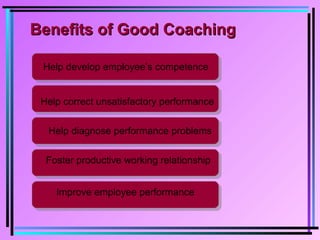
Benefits of Good CoachingBenefits of Good Coaching
Improve employee performance
Help develop employee’s competence
Help diagnose performance problems
Help correct unsatisfactory performance
Foster productive working relationship
Characteristics ofCharacteristics of
Good CoachGood Coach
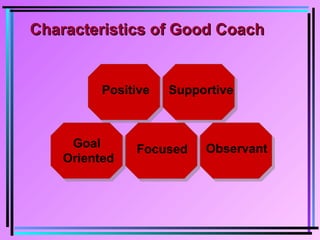
Characteristics of Good CoachCharacteristics of Good Coach
Positive
Goal
Oriented
Supportive
Focused Observant
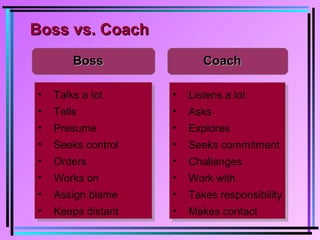
Boss vs. CoachBoss vs. Coach
BossBoss
• Talks a lot
• Tells
• Presume
• Seeks control
• Orders
• Works on
• Assign blame
• Keeps distant
• Talks a lot
• Tells
• Presume
• Seeks control
• Orders
• Works on
• Assign blame
• Keeps distant
• Listens a lot
• Asks
• Explores
• Seeks commitment
• Challenges
• Work with
• Takes responsibility
• Makes contact
• Listens a lot
• Asks
• Explores
• Seeks commitment
• Challenges
• Work with
• Takes responsibility
• Makes contact
CoachCoach
Elements ofElements of
Good Coaching SessionGood Coaching Session
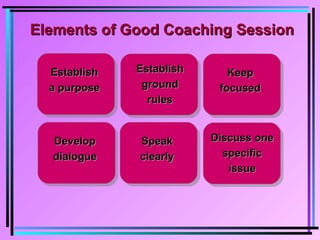
Elements of Good Coaching SessionElements of Good Coaching Session
EstablishEstablish
a purposea purpose
EstablishEstablish
groundground
rulesrules
KeepKeep
focusedfocused
DevelopDevelop
dialoguedialogue
SpeakSpeak
clearlyclearly
Discuss oneDiscuss one
specificspecific
issueissue
Communication Skills forCommunication Skills for
Effective CoachingEffective Coaching
Seven Communication Principles for CoachingSeven Communication Principles for Coaching
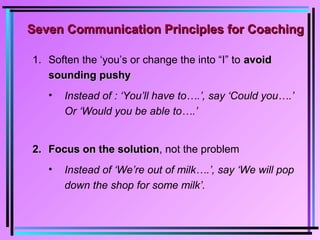
1. Soften the ‘you’s or change the into “I” to avoidavoid
sounding pushysounding pushy
• Instead of : ‘You’ll have to….’, say ‘Could you….’
Or ‘Would you be able to….’
2.2. Focus on the solutionFocus on the solution, not the problem
• Instead of ‘We’re out of milk….’, say ‘We will pop
down the shop for some milk’.
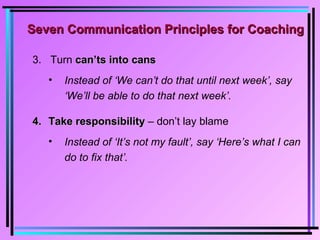
3. Turn can’ts into canscan’ts into cans
• Instead of ‘We can’t do that until next week’, say
‘We’ll be able to do that next week’.
4.4. Take responsibilityTake responsibility – don’t lay blame
• Instead of ‘It’s not my fault’, say ‘Here’s what I can
do to fix that’.
Seven Communication Principles for CoachingSeven Communication Principles for Coaching
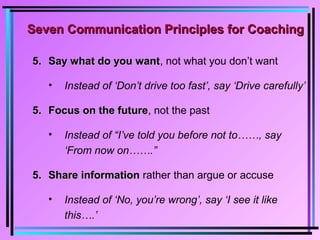
5.5. Say what do you wantSay what do you want, not what you don’t want
• Instead of ‘Don’t drive too fast’, say ‘Drive carefully’
5.5. Focus on the futureFocus on the future, not the past
• Instead of “I’ve told you before not to……, say
‘From now on…….”
5.5. Share informationShare information rather than argue or accuse
• Instead of ‘No, you’re wrong’, say ‘I see it like
this….’
Seven Communication Principles for CoachingSeven Communication Principles for Coaching
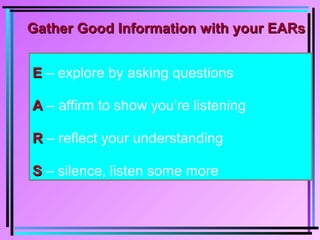
Gather Good Information with your EARsGather Good Information with your EARs
EE – explore by asking questions
AA – affirm to show you’re listening
RR – reflect your understanding
SS – silence, listen some more
To listen more effectively…..To listen more effectively…..
Attend physicallyAttend physically – the right body language helps us to
focus on the speaker and encourages the speaker to give
us more information.
Attend mentallyAttend mentally – follow the speaker’s flow of thought,
listen to understand, not evaluate; listen first, then assess
Check it verballyCheck it verbally – paraphrase, clarify, probe further,
summarize your understanding
Good Habits of Effective ListenersGood Habits of Effective Listeners
• Looking at the speaker in order to observe body language
and pick up subtle nuances of speech
• Asking questions
• Giving speakers time to articulate their thoughts
• Letting people finish what they are saying before giving
their opinion
• Remaining poised, calm, and emotionally controlled
• Looking alert and interested
• Responding with nods and ‘uh-uhms’
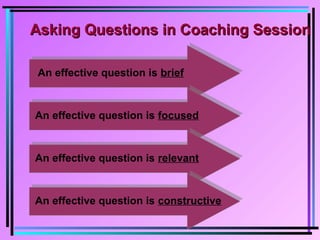
Asking Questions in Coaching SessionAsking Questions in Coaching Session
An effective question is brief
An effective question is focused
An effective question is relevant
An effective question is constructive
Asking Questions in Coaching SessionAsking Questions in Coaching Session
An effective
question is
BRIEF
• The longer the question, the
more likely you are to louse it up
• Short sentences aren’t just easier
to understand, they are also
easier to say.
• To keep you question brief, think
about two things : 1) what do you
want to learn from the answer?
2) what words will best elicit this
information?
Asking Questions in Coaching SessionAsking Questions in Coaching Session
An effective
question is
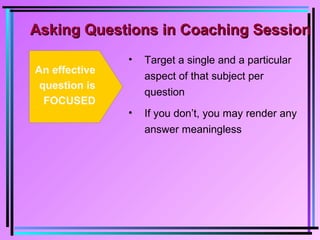
FOCUSED
• Target a single and a particular
aspect of that subject per
question
• If you don’t, you may render any
answer meaningless
Asking Questions in Coaching SessionAsking Questions in Coaching Session
An effective
question is
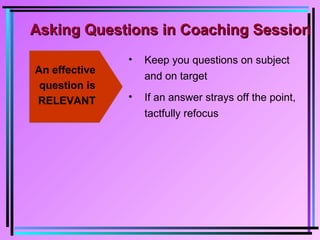
RELEVANT
• Keep you questions on subject
and on target
• If an answer strays off the point,
tactfully refocus
Asking Questions in Coaching SessionAsking Questions in Coaching Session
An effective
question is
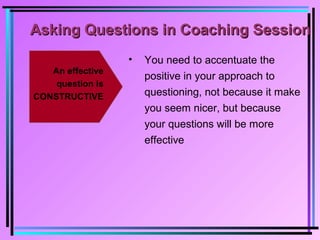
CONSTRUCTIVE
• You need to accentuate the
positive in your approach to
questioning, not because it make
you seem nicer, but because
your questions will be more
effective
Exploring QuestionsExploring Questions
Open
Questions
Open
Questions
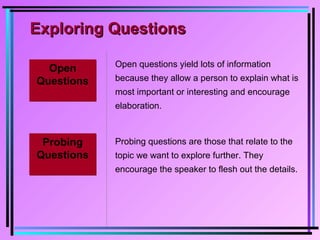
Open questions yield lots of information
because they allow a person to explain what is
most important or interesting and encourage
elaboration.
Probing
Questions
Probing
Questions
Probing questions are those that relate to the
topic we want to explore further. They
encourage the speaker to flesh out the details.
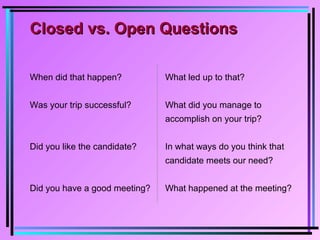
Closed vs. Open QuestionsClosed vs. Open Questions
When did that happen? What led up to that?
Was your trip successful? What did you manage to
accomplish on your trip?
Did you like the candidate? In what ways do you think that
candidate meets our need?
Did you have a good meeting? What happened at the meeting?
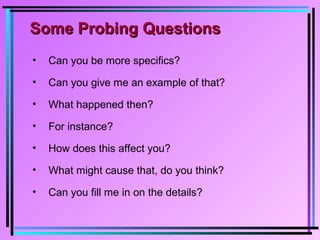
Some Probing QuestionsSome Probing Questions
• Can you be more specifics?
• Can you give me an example of that?
• What happened then?
• For instance?
• How does this affect you?
• What might cause that, do you think?
• Can you fill me in on the details?
Five Steps forFive Steps for
Effective CoachingEffective Coaching
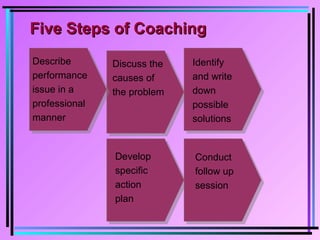
Five Steps of CoachingFive Steps of Coaching
Describe
performance
issue in a
professional
manner
Discuss the
causes of
the problem
Identify
and write
down
possible
solutions
Develop
specific
action
plan
Conduct
follow up
session
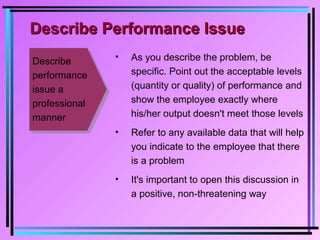
Describe Performance IssueDescribe Performance Issue
Describe
performance
issue a
professional
manner
• As you describe the problem, be
specific. Point out the acceptable levels
(quantity or quality) of performance and
show the employee exactly where
his/her output doesn't meet those levels
• Refer to any available data that will help
you indicate to the employee that there
is a problem
• It's important to open this discussion in
a positive, non-threatening way
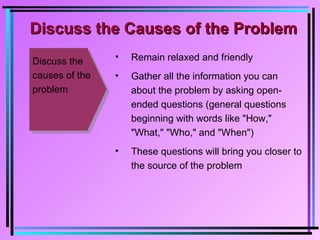
Discuss the
causes of the
problem
• Remain relaxed and friendly
• Gather all the information you can
about the problem by asking open-
ended questions (general questions
beginning with words like "How,"
"What," "Who," and "When")
• These questions will bring you closer to
the source of the problem
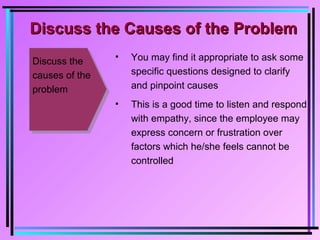
Discuss the Causes of the ProblemDiscuss the Causes of the Problem
Discuss the
causes of the
problem
• You may find it appropriate to ask some
specific questions designed to clarify
and pinpoint causes
• This is a good time to listen and respond
with empathy, since the employee may
express concern or frustration over
factors which he/she feels cannot be
controlled
Discuss the Causes of the ProblemDiscuss the Causes of the Problem
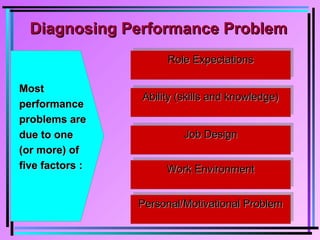
Diagnosing Performance ProblemDiagnosing Performance Problem
Role ExpectationsRole ExpectationsRole ExpectationsRole Expectations
Ability (skills and knowledge)Ability (skills and knowledge)Ability (skills and knowledge)Ability (skills and knowledge)
Job DesignJob DesignJob DesignJob Design
Work EnvironmentWork EnvironmentWork EnvironmentWork Environment
Personal/Motivational ProblemPersonal/Motivational ProblemPersonal/Motivational ProblemPersonal/Motivational Problem
MostMost
performanceperformance
problems areproblems are
due to onedue to one
(or more) of(or more) of
five factors :five factors :
Diagnosing Performance ProblemDiagnosing Performance Problem
RoleRole
ExpectationsExpectations
RoleRole
ExpectationsExpectations
AbilityAbility
(skills and(skills and
knowledge)knowledge)
AbilityAbility
(skills and(skills and
knowledge)knowledge)
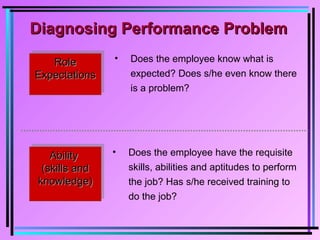
• Does the employee know what is
expected? Does s/he even know there
is a problem?
• Does the employee have the requisite
skills, abilities and aptitudes to perform
the job? Has s/he received training to
do the job?
Diagnosing Performance ProblemDiagnosing Performance Problem
Job DesignJob DesignJob DesignJob Design
WorkWork
EnvironmentEnvironment
WorkWork
EnvironmentEnvironment
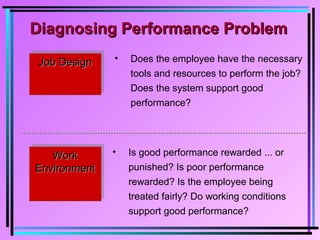
• Does the employee have the necessary
tools and resources to perform the job?
Does the system support good
performance?
• Is good performance rewarded ... or
punished? Is poor performance
rewarded? Is the employee being
treated fairly? Do working conditions
support good performance?
Diagnosing Performance ProblemDiagnosing Performance Problem
Personal/Personal/
MotivationalMotivational
ProblemProblem
Personal/Personal/
MotivationalMotivational
ProblemProblem
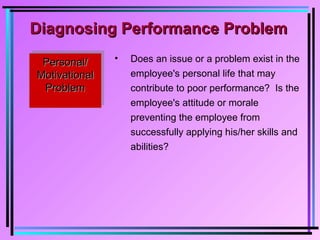
• Does an issue or a problem exist in the
employee's personal life that may
contribute to poor performance? Is the
employee's attitude or morale
preventing the employee from
successfully applying his/her skills and
abilities?
Identify
possible
solutions
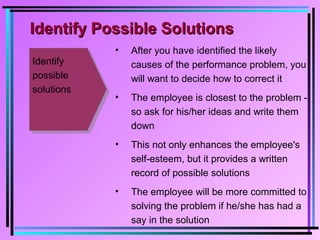
• After you have identified the likely
causes of the performance problem, you
will want to decide how to correct it
• The employee is closest to the problem -
so ask for his/her ideas and write them
down
• This not only enhances the employee's
self-esteem, but it provides a written
record of possible solutions
• The employee will be more committed to
solving the problem if he/she has had a
say in the solution
Identify Possible SolutionsIdentify Possible Solutions
Conduct
follow up
session
• Setting a date to meet again sends a
message to the employee that solving
the performance problem is important to
you
• It also tells the employee that you want
to know how well he/she is handling the
actions agreed upon
• A follow-up meeting enables you and the
employee to get together to discuss any
progress or problems and plan further
action
Conduct Follow Up SessionConduct Follow Up Session
THANK YOUTHANK YOU

Coaching For Optimal Performance

  • 1.
    Coaching forCoaching for OptimalPerformanceOptimal Performance
  • 2.
    ContentsContents 1. Benefits ofGood Coaching 2. Characteristics of Good Coach 3. Elements of Good Coaching Session 4. Communication Skills for Effective Coaching 5. Five Steps of Coaching for Optimal Performance
  • 3.
    Benefits of GoodCoachingBenefits of Good Coaching Improve employee performance Help develop employee’s competence Help diagnose performance problems Help correct unsatisfactory performance Foster productive working relationship
  • 4.
  • 5.
    Characteristics of GoodCoachCharacteristics of Good Coach Positive Goal Oriented Supportive Focused Observant
  • 6.
    Boss vs. CoachBossvs. Coach BossBoss • Talks a lot • Tells • Presume • Seeks control • Orders • Works on • Assign blame • Keeps distant • Talks a lot • Tells • Presume • Seeks control • Orders • Works on • Assign blame • Keeps distant • Listens a lot • Asks • Explores • Seeks commitment • Challenges • Work with • Takes responsibility • Makes contact • Listens a lot • Asks • Explores • Seeks commitment • Challenges • Work with • Takes responsibility • Makes contact CoachCoach
  • 7.
    Elements ofElements of GoodCoaching SessionGood Coaching Session
  • 8.
    Elements of GoodCoaching SessionElements of Good Coaching Session EstablishEstablish a purposea purpose EstablishEstablish groundground rulesrules KeepKeep focusedfocused DevelopDevelop dialoguedialogue SpeakSpeak clearlyclearly Discuss oneDiscuss one specificspecific issueissue
  • 9.
    Communication Skills forCommunicationSkills for Effective CoachingEffective Coaching
  • 10.
    Seven Communication Principlesfor CoachingSeven Communication Principles for Coaching 1. Soften the ‘you’s or change the into “I” to avoidavoid sounding pushysounding pushy • Instead of : ‘You’ll have to….’, say ‘Could you….’ Or ‘Would you be able to….’ 2.2. Focus on the solutionFocus on the solution, not the problem • Instead of ‘We’re out of milk….’, say ‘We will pop down the shop for some milk’.
  • 11.
    3. Turn can’tsinto canscan’ts into cans • Instead of ‘We can’t do that until next week’, say ‘We’ll be able to do that next week’. 4.4. Take responsibilityTake responsibility – don’t lay blame • Instead of ‘It’s not my fault’, say ‘Here’s what I can do to fix that’. Seven Communication Principles for CoachingSeven Communication Principles for Coaching
  • 12.
    5.5. Say whatdo you wantSay what do you want, not what you don’t want • Instead of ‘Don’t drive too fast’, say ‘Drive carefully’ 5.5. Focus on the futureFocus on the future, not the past • Instead of “I’ve told you before not to……, say ‘From now on…….” 5.5. Share informationShare information rather than argue or accuse • Instead of ‘No, you’re wrong’, say ‘I see it like this….’ Seven Communication Principles for CoachingSeven Communication Principles for Coaching
  • 13.
    Gather Good Informationwith your EARsGather Good Information with your EARs EE – explore by asking questions AA – affirm to show you’re listening RR – reflect your understanding SS – silence, listen some more
  • 14.
    To listen moreeffectively…..To listen more effectively….. Attend physicallyAttend physically – the right body language helps us to focus on the speaker and encourages the speaker to give us more information. Attend mentallyAttend mentally – follow the speaker’s flow of thought, listen to understand, not evaluate; listen first, then assess Check it verballyCheck it verbally – paraphrase, clarify, probe further, summarize your understanding
  • 15.
    Good Habits ofEffective ListenersGood Habits of Effective Listeners • Looking at the speaker in order to observe body language and pick up subtle nuances of speech • Asking questions • Giving speakers time to articulate their thoughts • Letting people finish what they are saying before giving their opinion • Remaining poised, calm, and emotionally controlled • Looking alert and interested • Responding with nods and ‘uh-uhms’
  • 16.
    Asking Questions inCoaching SessionAsking Questions in Coaching Session An effective question is brief An effective question is focused An effective question is relevant An effective question is constructive
  • 17.
    Asking Questions inCoaching SessionAsking Questions in Coaching Session An effective question is BRIEF • The longer the question, the more likely you are to louse it up • Short sentences aren’t just easier to understand, they are also easier to say. • To keep you question brief, think about two things : 1) what do you want to learn from the answer? 2) what words will best elicit this information?
  • 18.
    Asking Questions inCoaching SessionAsking Questions in Coaching Session An effective question is FOCUSED • Target a single and a particular aspect of that subject per question • If you don’t, you may render any answer meaningless
  • 19.
    Asking Questions inCoaching SessionAsking Questions in Coaching Session An effective question is RELEVANT • Keep you questions on subject and on target • If an answer strays off the point, tactfully refocus
  • 20.
    Asking Questions inCoaching SessionAsking Questions in Coaching Session An effective question is CONSTRUCTIVE • You need to accentuate the positive in your approach to questioning, not because it make you seem nicer, but because your questions will be more effective
  • 21.
    Exploring QuestionsExploring Questions Open Questions Open Questions Openquestions yield lots of information because they allow a person to explain what is most important or interesting and encourage elaboration. Probing Questions Probing Questions Probing questions are those that relate to the topic we want to explore further. They encourage the speaker to flesh out the details.
  • 22.
    Closed vs. OpenQuestionsClosed vs. Open Questions When did that happen? What led up to that? Was your trip successful? What did you manage to accomplish on your trip? Did you like the candidate? In what ways do you think that candidate meets our need? Did you have a good meeting? What happened at the meeting?
  • 23.
    Some Probing QuestionsSomeProbing Questions • Can you be more specifics? • Can you give me an example of that? • What happened then? • For instance? • How does this affect you? • What might cause that, do you think? • Can you fill me in on the details?
  • 24.
    Five Steps forFiveSteps for Effective CoachingEffective Coaching
  • 25.
    Five Steps ofCoachingFive Steps of Coaching Describe performance issue in a professional manner Discuss the causes of the problem Identify and write down possible solutions Develop specific action plan Conduct follow up session
  • 26.
    Describe Performance IssueDescribePerformance Issue Describe performance issue a professional manner • As you describe the problem, be specific. Point out the acceptable levels (quantity or quality) of performance and show the employee exactly where his/her output doesn't meet those levels • Refer to any available data that will help you indicate to the employee that there is a problem • It's important to open this discussion in a positive, non-threatening way
  • 27.
    Discuss the causes ofthe problem • Remain relaxed and friendly • Gather all the information you can about the problem by asking open- ended questions (general questions beginning with words like "How," "What," "Who," and "When") • These questions will bring you closer to the source of the problem Discuss the Causes of the ProblemDiscuss the Causes of the Problem
  • 28.
    Discuss the causes ofthe problem • You may find it appropriate to ask some specific questions designed to clarify and pinpoint causes • This is a good time to listen and respond with empathy, since the employee may express concern or frustration over factors which he/she feels cannot be controlled Discuss the Causes of the ProblemDiscuss the Causes of the Problem
  • 29.
    Diagnosing Performance ProblemDiagnosingPerformance Problem Role ExpectationsRole ExpectationsRole ExpectationsRole Expectations Ability (skills and knowledge)Ability (skills and knowledge)Ability (skills and knowledge)Ability (skills and knowledge) Job DesignJob DesignJob DesignJob Design Work EnvironmentWork EnvironmentWork EnvironmentWork Environment Personal/Motivational ProblemPersonal/Motivational ProblemPersonal/Motivational ProblemPersonal/Motivational Problem MostMost performanceperformance problems areproblems are due to onedue to one (or more) of(or more) of five factors :five factors :
  • 30.
    Diagnosing Performance ProblemDiagnosingPerformance Problem RoleRole ExpectationsExpectations RoleRole ExpectationsExpectations AbilityAbility (skills and(skills and knowledge)knowledge) AbilityAbility (skills and(skills and knowledge)knowledge) • Does the employee know what is expected? Does s/he even know there is a problem? • Does the employee have the requisite skills, abilities and aptitudes to perform the job? Has s/he received training to do the job?
  • 31.
    Diagnosing Performance ProblemDiagnosingPerformance Problem Job DesignJob DesignJob DesignJob Design WorkWork EnvironmentEnvironment WorkWork EnvironmentEnvironment • Does the employee have the necessary tools and resources to perform the job? Does the system support good performance? • Is good performance rewarded ... or punished? Is poor performance rewarded? Is the employee being treated fairly? Do working conditions support good performance?
  • 32.
    Diagnosing Performance ProblemDiagnosingPerformance Problem Personal/Personal/ MotivationalMotivational ProblemProblem Personal/Personal/ MotivationalMotivational ProblemProblem • Does an issue or a problem exist in the employee's personal life that may contribute to poor performance? Is the employee's attitude or morale preventing the employee from successfully applying his/her skills and abilities?
  • 33.
    Identify possible solutions • After youhave identified the likely causes of the performance problem, you will want to decide how to correct it • The employee is closest to the problem - so ask for his/her ideas and write them down • This not only enhances the employee's self-esteem, but it provides a written record of possible solutions • The employee will be more committed to solving the problem if he/she has had a say in the solution Identify Possible SolutionsIdentify Possible Solutions
  • 34.
    Conduct follow up session • Settinga date to meet again sends a message to the employee that solving the performance problem is important to you • It also tells the employee that you want to know how well he/she is handling the actions agreed upon • A follow-up meeting enables you and the employee to get together to discuss any progress or problems and plan further action Conduct Follow Up SessionConduct Follow Up Session
  • 35.