






HR Management for Non HR Managers Essentials of  HR Management
Training Agenda  HR Management : An Overview HR Planning and Recruitment Employee Selection Training and Development Performance Management Career Management
www.exploreHR.org You can download this presentation at: Please visit  www.exploreHR.org   for more presentations on leadership, personal development, and HR management.
Human Resource Management : An Overview
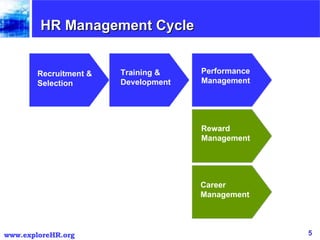
HR Management Cycle Recruitment & Selection Training &  Development Performance Management Reward Management Career Management
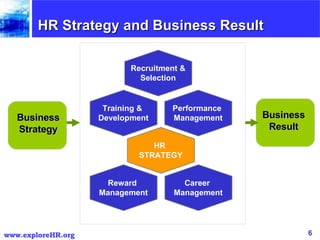
HR Strategy and Business Result Recruitment & Selection Training &  Development Performance  Management Reward  Management Career  Management HR  STRATEGY Business Strategy Business Result
Manpower Planning & Employee Recruitment
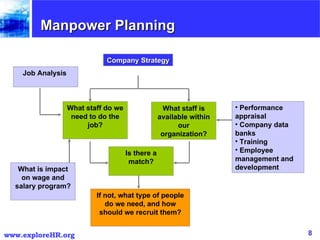
Manpower Planning Company Strategy  What staff do we need to do the job? What staff is available within our organization? Is there a match? If not, what type of people do we need, and how should we recruit them? Job Analysis  Performance appraisal Company data banks Training Employee management and development What is impact on wage and salary program?
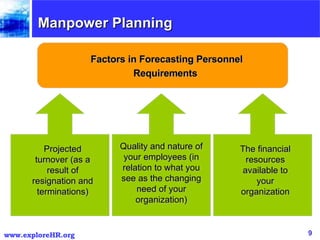
Manpower Planning The financial resources available to your organization Factors in Forecasting Personnel Requirements  Projected turnover (as a result of resignation and terminations) Quality and nature of your employees (in relation to what you see as the changing need of your organization)
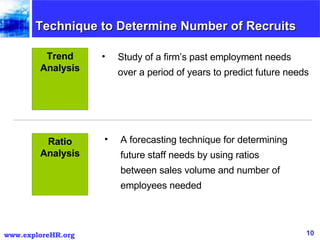
Technique to Determine Number of Recruits Study of a firm’s past employment needs over a period of years to predict future needs Trend Analysis Ratio Analysis A forecasting technique for determining future staff needs by using ratios between sales volume and number of employees needed
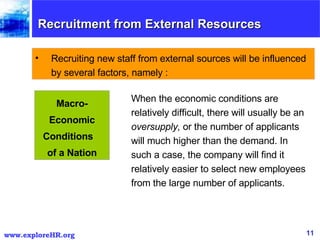
Recruitment from External Resources  Recruiting new staff from external sources will be influenced by several factors, namely : When the economic conditions are relatively difficult, there will usually be an  oversupply,  or the number of applicants will much higher than the demand. In such a case, the company will find it relatively easier to select new employees from the large number of applicants.  Macro- Economic Conditions  of a Nation
When the sector is one that is considered a ‘rare’ sector, the company will have more difficulty in recruiting staff for this sector. For example, computer technology, or cellular engineering.  Availability  of Manpower  in Desired Sectors  Recruitment from External Resources
It will tend to be easier for a company to find and recruit the best people if the company has a good reputation, therefore the best fresh graduates will flock to apply to the company. Example : Google, McKinsey or Microsoft.  Company Reputation  Recruitment from External Resources
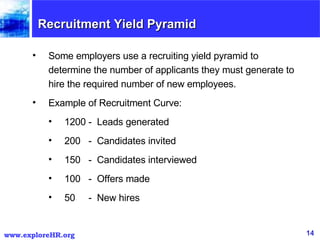
Some employers use a recruiting yield pyramid to determine the number of applicants they must generate to hire the required number of new employees. Example of Recruitment Curve: 1200 -  Leads generated 200  -  Candidates invited 150  -  Candidates interviewed 100  -  Offers made 50  -  New hires Recruitment Yield Pyramid
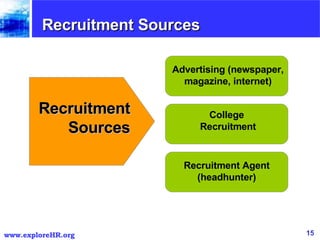
Recruitment Sources Advertising (newspaper, magazine, internet) College  Recruitment Recruitment Agent (headhunter) Recruitment Sources
Employee Selection
Basic Concept of Selection Tests The quality of an employee selection test is determined by three main factors, namely : Criterion Validity :  A type of validity based on showing that scores on the test (“predictors”) are related to job performance (“criterion”). Content Validity :  A test that is “content valid” is one in which the test contains a fair sample of the tasks and skills actually needed for the job in question. Reliability  : The consistency of scores obtained by the same person when retested with identical or equivalent test.
Some Types of Selection Test 1.  Cognitive Ability Test Personality Test  3.  Interview
Cognitive Ability Test Cognitive Abilities Tests: Paper and pencil or individualized assessment measures of an individual's general mental ability or intelligence.
Advantages of Cognitive Ability Test highly reliable  verbal reasoning and numerical tests have shown high validity for a wide range of jobs  the validity rises with increasing complexity of the job  may be administered in group settings where many applicants can be tested at the same time  scoring of the tests may be completed by computer scanning equipment  lower cost than personality tests
Disadvantages of Cognitive Ability Test non-minorities typically score one standard deviation above minorities which may result in adverse impact depending on how the scores are used in the selection process  differences between males and females in abilities (e.g., knowledge of mathematics) may negatively impact the scores of female applicants
Personality Test Personality Tests:  A selection procedure measure the personality characteristics of applicants that are related to future job performance.   Personality tests typically measure one or more of five personality dimensions:  extroversion, emotional stability, agreeableness, conscientiousness, and openness to experience.
Advantages of Personality Test can result in lower turnover due if applicants are selected for traits that are highly correlated with employees who have high longevity within the organization  can reveal more information about applicant's abilities and interests  can identify interpersonal traits that may be needed for certain jobs
Disadvantages of Personality Test difficult to measure personality traits that may not be well defined  responses by applicant may be altered by applicant's desire to respond in a way they feel would result in their selection  lack of diversity if all selected applicants have same personality traits  lack of evidence to support validity of use of personality tests
Interview Interviews: A selection procedure designed to predict future job performance on the basis of applicants' oral responses to oral inquiries.
Advantages of Interview useful for determining if the applicant has requisite communicative or social skills which may be necessary for the job  can assess the applicant's job knowledge  can be used for selection among equally qualified applicants  enables the supervisor and/or co-workers to determine if there is compatibility between the applicant and the employees  allows the applicant to ask questions that may reveal additional information useful for making a selection decision
Disadvantages of Interview subjective evaluations are made  decisions tend to be made within the first few minutes of the interview with the remainder of the interview used to validate or justify the original decision  interviewers form stereotypes concerning the characteristics required for success on the job  research has shown disproportionate rates of selection between minority and non-minority members using interviews  negative information seems to be given more weight  not as reliable as tests
Training & Development
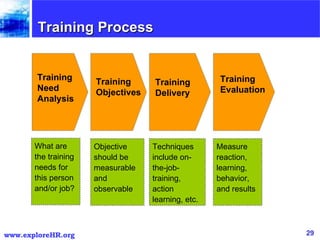
Training Need Analysis Training Objectives Training  Delivery Training Evaluation Training Process  What are the training needs for this person and/or job? Objective should be measurable and observable Techniques include on-the-job-training, action learning, etc. Measure reaction, learning, behavior, and results
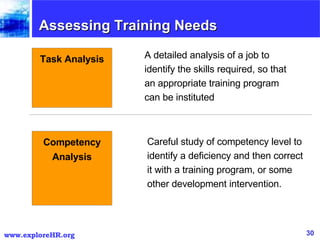
Assessing Training Needs Task Analysis A detailed analysis of a job to identify the skills required, so that an appropriate training program can be instituted Competency Analysis Careful study of competency level to identify a deficiency and then correct it with a training program, or some other development intervention.
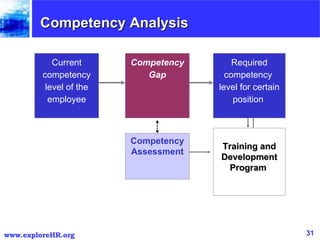
Competency Analysis Required competency  level for certain position  Competency Gap Competency Assessment Current competency level of the employee Training and Development Program
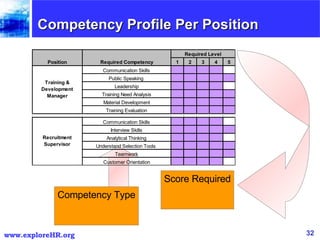
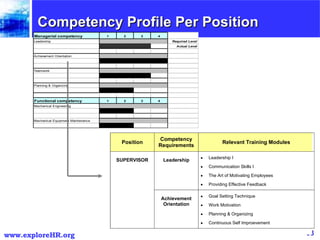
Competency Profile Per Position Score Required Competency Type
Competency Profile Per Position
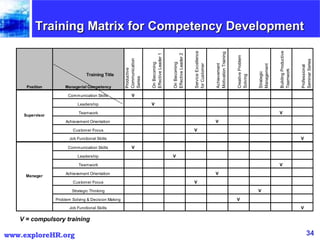
Training Matrix for Competency Development V = compulsory training  Training Title
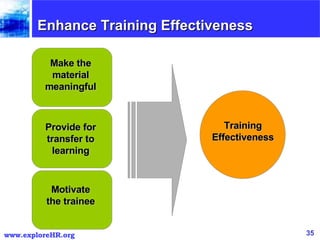
Enhance Training Effectiveness Make the material meaningful Provide for transfer to learning Motivate the trainee Training Effectiveness
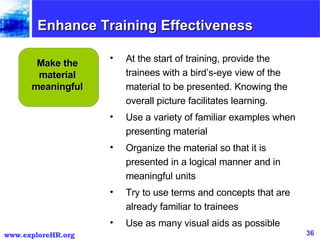
Enhance Training Effectiveness Make the material meaningful At the start of training, provide the trainees with a bird’s-eye view of the material to be presented. Knowing the overall picture facilitates learning. Use a variety of familiar examples when presenting material Organize the material so that it is presented in a logical manner and in meaningful units Try to use terms and concepts that are already familiar to trainees Use as many visual aids as possible
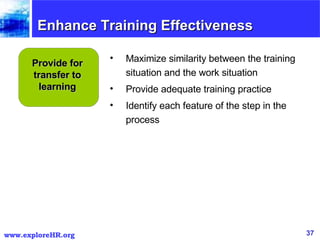
Enhance Training Effectiveness Provide for transfer to learning Maximize similarity between the training situation and the work situation Provide adequate training practice Identify each feature of the step in the process
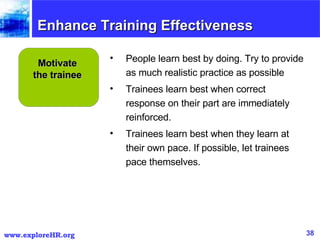
Enhance Training Effectiveness Motivate the trainee People learn best by doing. Try to provide as much realistic practice as possible Trainees learn best when correct response on their part are immediately reinforced. Trainees learn best when they learn at their own pace. If possible, let trainees pace themselves.
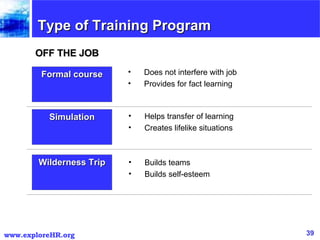
Type of Training Program Formal course OFF THE JOB Simulation Wilderness Trip Does not interfere with job Provides for fact learning Helps transfer of learning Creates lifelike situations Builds teams Builds self-esteem
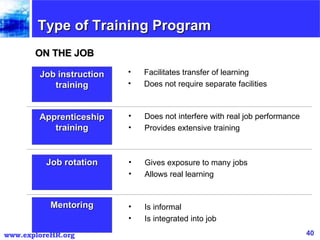
Type of Training Program Job instruction training ON THE JOB Apprenticeship training Job rotation Mentoring Facilitates transfer of learning Does not require separate facilities Does not interfere with real job performance Provides extensive training Gives exposure to many jobs Allows real learning Is informal Is integrated into job
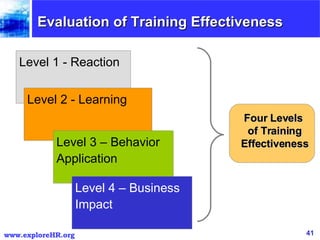
Evaluation of Training Effectiveness Level 1 - Reaction Level 2 - Learning Level 3 – Behavior Application Level 4 – Business Impact Four Levels  of Training Effectiveness
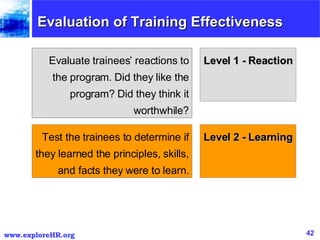
Evaluation of Training Effectiveness Test the trainees to determine if they learned the principles, skills, and facts they were to learn. Evaluate trainees’ reactions to the program. Did they like the program? Did they think it worthwhile? Level 1 - Reaction Level 2 - Learning
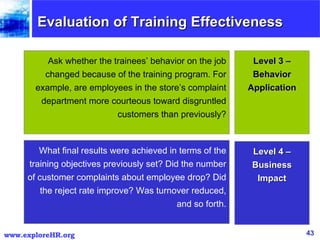
Evaluation of Training Effectiveness What final results were achieved in terms of the training objectives previously set? Did the number of customer complaints about employee drop? Did the reject rate improve? Was turnover reduced, and so forth. Ask whether the trainees’ behavior on the job changed because of the training program. For example, are employees in the store’s complaint department more courteous toward disgruntled customers than previously? Level 3 – Behavior Application Level 4 – Business Impact
Employee  Performance Management
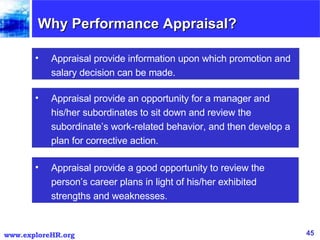
Why Performance Appraisal? Appraisal provide information upon which promotion and salary decision can be made. Appraisal provide an opportunity for a manager and his/her subordinates to sit down and review the subordinate’s work-related behavior, and then develop a plan for corrective action. Appraisal provide a good opportunity to review the person’s career plans in light of his/her exhibited strengths and weaknesses.
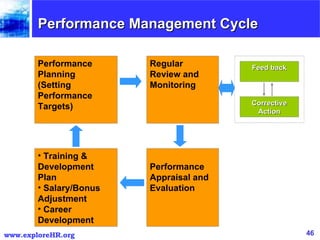
Performance Management Cycle Performance Planning (Setting Performance Targets) Regular Review and Monitoring Feed back Corrective Action Performance Appraisal and Evaluation Training & Development Plan Salary/Bonus Adjustment Career Development
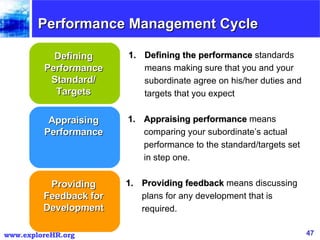
Performance Management Cycle Defining Performance Standard/ Targets Appraising Performance Providing Feedback for Development Defining the performance  standards means making sure that you and your subordinate agree on his/her duties and targets that you expect Appraising performance  means comparing your subordinate’s actual performance to the standard/targets set in step one. Providing feedback  means discussing plans for any development that is required.
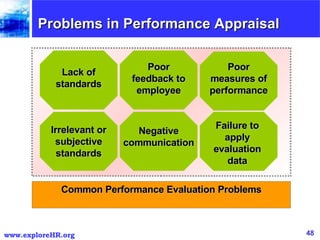
Problems in Performance Appraisal Lack of standards Irrelevant or subjective standards Poor measures of performance Poor feedback to employee Negative communication Failure to apply evaluation data Common Performance Evaluation Problems
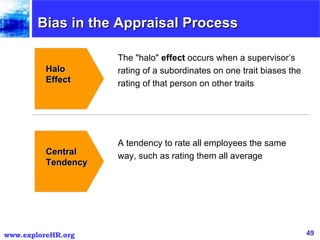
Bias in the Appraisal Process Halo Effect The "halo"  effect  occurs when a supervisor’s rating of a subordinates on one trait biases the rating of that person on other traits Central Tendency A tendency to rate all employees the same way, such as rating them all average
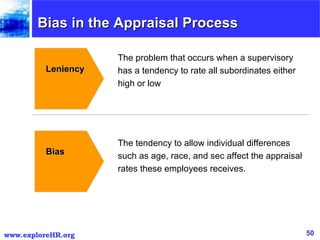
Leniency The problem that occurs when a supervisory has a tendency to rate all subordinates either high or low Bias The tendency to allow individual differences such as age, race, and sec affect the appraisal rates these employees receives. Bias in the Appraisal Process
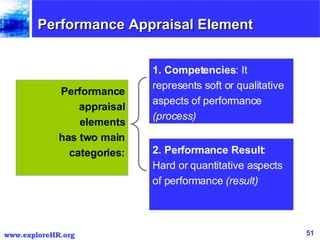
Performance appraisal elements has two main categories: 2. Performance Result : Hard or quantitative aspects of performance  (result) 1. Competencies : It represents soft or qualitative aspects of performance  (process)   Performance Appraisal Element
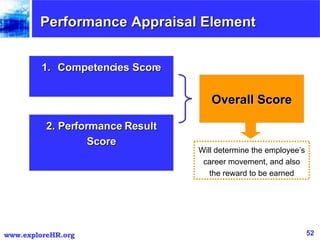
Competencies Score 2. Performance Result Score Overall Score Will determine the employee’s career movement, and also the reward to be earned Performance Appraisal Element
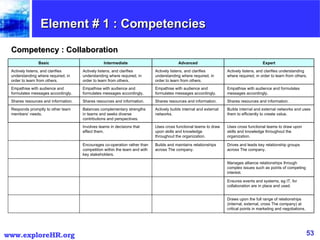
Element # 1 : Competencies  Competency : Collaboration Draws upon the full range of relationships (internal, external, cross The company) at critical points in marketing and negotiations. Ensures events and systems, eg IT, for collaboration are in place and used. Manages alliance relationships through complex issues such as points of competing interest. Drives and leads key relationship groups across The company. Builds and maintains relationships across The company. Encourages co-operation rather than competition within the team and with key stakeholders. Uses cross functional teams to draw upon skills and knowledge throughout the organization. Uses cross functional teams to draw upon skills and knowledge throughout the organization. Involves teams in decisions that effect them. Builds internal and external networks and uses them to efficiently to create value. Actively builds internal and external networks. Balances complementary strengths in teams and seeks diverse contributions and perspectives. Responds promptly to other team members’ needs. Shares resources and information. Shares resources and information. Shares resources and information. Shares resources and information. Empathise with audience and formulates messages accordingly. Empathise with audience and formulates messages accordingly. Empathise with audience and formulates messages accordingly. Empathise with audience and formulates messages accordingly. Actively listens, and clarifies understanding where required, in order to learn from others. Actively listens, and clarifies understanding where required, in order to learn from others. Actively listens, and clarifies understanding where required, in order to learn from others. Actively listens, and clarifies understanding where required, in order to learn from others. Expert Advanced Intermediate Basic
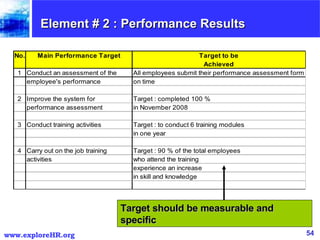
Element # 2 : Performance Results Target should be measurable and specific
Employee Career Management
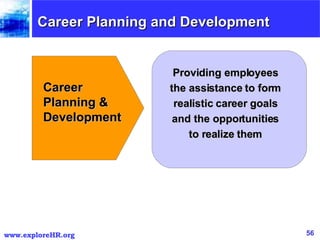
Career Planning and Development Providing employees the assistance to form realistic career goals and the opportunities to realize them Career Planning & Development
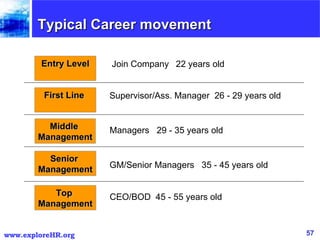
Entry Level First Line  Middle  Management Senior  Management Top  Management Join Company  22 years old Supervisor/Ass. Manager  26 - 29 years old Managers  29 - 35 years old GM/Senior Managers  35 - 45 years old CEO/BOD  45 - 55 years old Typical Career movement
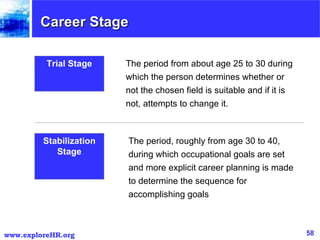
Career Stage Trial Stage The period from about age 25 to 30 during which the person determines whether or not the chosen field is suitable and if it is not, attempts to change it. Stabilization Stage The period, roughly from age 30 to 40, during which occupational goals are set and more explicit career planning is made to determine the sequence for accomplishing goals
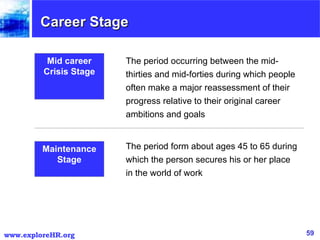
Mid career Crisis Stage The period occurring between the mid-thirties and mid-forties during which people often make a major reassessment of their progress relative to their original career ambitions and goals Maintenance Stage The period form about ages 45 to 65 during which the person secures his or her place in the world of work Career Stage
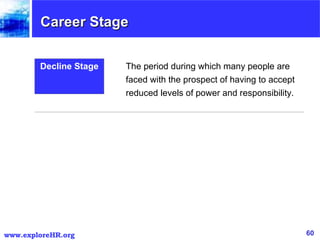
Decline Stage The period during which many people are faced with the prospect of having to accept reduced levels of power and responsibility. Career Stage
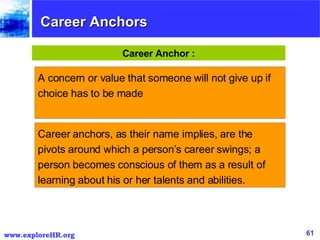
Career Anchors Career Anchor : A concern or value that someone will not give up if choice has to be made Career anchors, as their name implies, are the pivots around which a person’s career swings; a person becomes conscious of them as a result of learning about his or her talents and abilities.
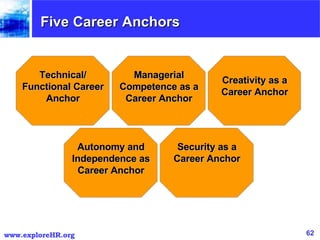
Five Career Anchors Technical/ Functional Career Anchor Managerial Competence as a Career Anchor Creativity as a Career Anchor Autonomy and Independence as Career Anchor Security as a Career Anchor
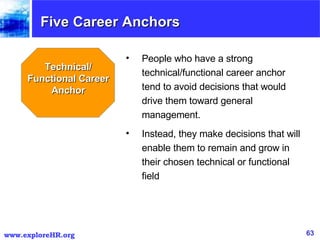
Five Career Anchors Technical/ Functional Career Anchor People who have a strong technical/functional career anchor tend to avoid decisions that would drive them toward general management.  Instead, they make decisions that will enable them to remain and grow in their chosen technical or functional field
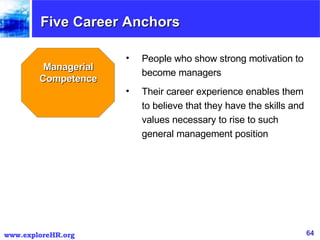
Five Career Anchors Managerial Competence People who show strong motivation to become managers Their career experience enables them to believe that they have the skills and values necessary to rise to such general management position
Five Career Anchors Creativity People who go on to become successful entrepreneurs These people seem to have a need to build or create something that is entirely their own product – a product or process that bears their name, a company of their own, or a personal fortune that reflects their accomplishments.
Five Career Anchors Autonomy and Independence People who are driven by the need to be on their own, free from the dependence that can arise when a person elects to work in a large organization. Some of these people decide to become consultants, working either alone or as part of relatively small firm. Others choose to become professors, free-lance writers, or proprietors of a small retail business.
Five Career Anchors Security People who are mostly concern with long-run career stability and job security. They seem willing to do what is required to maintain job security, a decent income, and a stable future in the form of a good retirement program and benefits.
Career Management and the First Assignment Factors to keep in mind about the important first assignment, include : Avoid reality shock (reality shock refers to the result of a period that may occur at the initial career entry when the new employee’s high job expectations confront the reality of boring, unchallenging jobs. Provide challenging initial jobs Provide realistic job preview in recruiting Be demanding
Career Management and the First Assignment Provide periodic job rotation  Provide career-oriented performance appraisals Encourage career-planning activities
Recommended Further Readings Gary Dessler,  Human resource Management,  Prentice Hall  Susan Jackson and Randall Schuler,  Managing Human Resource : A Partnership Perspective,  South-Western College Publishing
End of Material  If you find this presentation useful, please consider telling others about our site  (www.exploreHR.org)

HR Management

  • 1.
    HR Management forNon HR Managers Essentials of HR Management
  • 2.
    Training Agenda HR Management : An Overview HR Planning and Recruitment Employee Selection Training and Development Performance Management Career Management
  • 3.
    www.exploreHR.org You candownload this presentation at: Please visit www.exploreHR.org for more presentations on leadership, personal development, and HR management.
  • 4.
  • 5.
    HR Management CycleRecruitment & Selection Training & Development Performance Management Reward Management Career Management
  • 6.
    HR Strategy andBusiness Result Recruitment & Selection Training & Development Performance Management Reward Management Career Management HR STRATEGY Business Strategy Business Result
  • 7.
    Manpower Planning &Employee Recruitment
  • 8.
    Manpower Planning CompanyStrategy What staff do we need to do the job? What staff is available within our organization? Is there a match? If not, what type of people do we need, and how should we recruit them? Job Analysis Performance appraisal Company data banks Training Employee management and development What is impact on wage and salary program?
  • 9.
    Manpower Planning Thefinancial resources available to your organization Factors in Forecasting Personnel Requirements Projected turnover (as a result of resignation and terminations) Quality and nature of your employees (in relation to what you see as the changing need of your organization)
  • 10.
    Technique to DetermineNumber of Recruits Study of a firm’s past employment needs over a period of years to predict future needs Trend Analysis Ratio Analysis A forecasting technique for determining future staff needs by using ratios between sales volume and number of employees needed
  • 11.
    Recruitment from ExternalResources Recruiting new staff from external sources will be influenced by several factors, namely : When the economic conditions are relatively difficult, there will usually be an oversupply, or the number of applicants will much higher than the demand. In such a case, the company will find it relatively easier to select new employees from the large number of applicants. Macro- Economic Conditions of a Nation
  • 12.
    When the sectoris one that is considered a ‘rare’ sector, the company will have more difficulty in recruiting staff for this sector. For example, computer technology, or cellular engineering. Availability of Manpower in Desired Sectors Recruitment from External Resources
  • 13.
    It will tendto be easier for a company to find and recruit the best people if the company has a good reputation, therefore the best fresh graduates will flock to apply to the company. Example : Google, McKinsey or Microsoft. Company Reputation Recruitment from External Resources
  • 14.
    Some employers usea recruiting yield pyramid to determine the number of applicants they must generate to hire the required number of new employees. Example of Recruitment Curve: 1200 - Leads generated 200 - Candidates invited 150 - Candidates interviewed 100 - Offers made 50 - New hires Recruitment Yield Pyramid
  • 15.
    Recruitment Sources Advertising(newspaper, magazine, internet) College Recruitment Recruitment Agent (headhunter) Recruitment Sources
  • 16.
  • 17.
    Basic Concept ofSelection Tests The quality of an employee selection test is determined by three main factors, namely : Criterion Validity : A type of validity based on showing that scores on the test (“predictors”) are related to job performance (“criterion”). Content Validity : A test that is “content valid” is one in which the test contains a fair sample of the tasks and skills actually needed for the job in question. Reliability : The consistency of scores obtained by the same person when retested with identical or equivalent test.
  • 18.
    Some Types ofSelection Test 1. Cognitive Ability Test Personality Test 3. Interview
  • 19.
    Cognitive Ability TestCognitive Abilities Tests: Paper and pencil or individualized assessment measures of an individual's general mental ability or intelligence.
  • 20.
    Advantages of CognitiveAbility Test highly reliable verbal reasoning and numerical tests have shown high validity for a wide range of jobs the validity rises with increasing complexity of the job may be administered in group settings where many applicants can be tested at the same time scoring of the tests may be completed by computer scanning equipment lower cost than personality tests
  • 21.
    Disadvantages of CognitiveAbility Test non-minorities typically score one standard deviation above minorities which may result in adverse impact depending on how the scores are used in the selection process differences between males and females in abilities (e.g., knowledge of mathematics) may negatively impact the scores of female applicants
  • 22.
    Personality Test PersonalityTests: A selection procedure measure the personality characteristics of applicants that are related to future job performance. Personality tests typically measure one or more of five personality dimensions: extroversion, emotional stability, agreeableness, conscientiousness, and openness to experience.
  • 23.
    Advantages of PersonalityTest can result in lower turnover due if applicants are selected for traits that are highly correlated with employees who have high longevity within the organization can reveal more information about applicant's abilities and interests can identify interpersonal traits that may be needed for certain jobs
  • 24.
    Disadvantages of PersonalityTest difficult to measure personality traits that may not be well defined responses by applicant may be altered by applicant's desire to respond in a way they feel would result in their selection lack of diversity if all selected applicants have same personality traits lack of evidence to support validity of use of personality tests
  • 25.
    Interview Interviews: Aselection procedure designed to predict future job performance on the basis of applicants' oral responses to oral inquiries.
  • 26.
    Advantages of Interviewuseful for determining if the applicant has requisite communicative or social skills which may be necessary for the job can assess the applicant's job knowledge can be used for selection among equally qualified applicants enables the supervisor and/or co-workers to determine if there is compatibility between the applicant and the employees allows the applicant to ask questions that may reveal additional information useful for making a selection decision
  • 27.
    Disadvantages of Interviewsubjective evaluations are made decisions tend to be made within the first few minutes of the interview with the remainder of the interview used to validate or justify the original decision interviewers form stereotypes concerning the characteristics required for success on the job research has shown disproportionate rates of selection between minority and non-minority members using interviews negative information seems to be given more weight not as reliable as tests
  • 28.
  • 29.
    Training Need AnalysisTraining Objectives Training Delivery Training Evaluation Training Process What are the training needs for this person and/or job? Objective should be measurable and observable Techniques include on-the-job-training, action learning, etc. Measure reaction, learning, behavior, and results
  • 30.
    Assessing Training NeedsTask Analysis A detailed analysis of a job to identify the skills required, so that an appropriate training program can be instituted Competency Analysis Careful study of competency level to identify a deficiency and then correct it with a training program, or some other development intervention.
  • 31.
    Competency Analysis Requiredcompetency level for certain position Competency Gap Competency Assessment Current competency level of the employee Training and Development Program
  • 32.
    Competency Profile PerPosition Score Required Competency Type
  • 33.
  • 34.
    Training Matrix forCompetency Development V = compulsory training Training Title
  • 35.
    Enhance Training EffectivenessMake the material meaningful Provide for transfer to learning Motivate the trainee Training Effectiveness
  • 36.
    Enhance Training EffectivenessMake the material meaningful At the start of training, provide the trainees with a bird’s-eye view of the material to be presented. Knowing the overall picture facilitates learning. Use a variety of familiar examples when presenting material Organize the material so that it is presented in a logical manner and in meaningful units Try to use terms and concepts that are already familiar to trainees Use as many visual aids as possible
  • 37.
    Enhance Training EffectivenessProvide for transfer to learning Maximize similarity between the training situation and the work situation Provide adequate training practice Identify each feature of the step in the process
  • 38.
    Enhance Training EffectivenessMotivate the trainee People learn best by doing. Try to provide as much realistic practice as possible Trainees learn best when correct response on their part are immediately reinforced. Trainees learn best when they learn at their own pace. If possible, let trainees pace themselves.
  • 39.
    Type of TrainingProgram Formal course OFF THE JOB Simulation Wilderness Trip Does not interfere with job Provides for fact learning Helps transfer of learning Creates lifelike situations Builds teams Builds self-esteem
  • 40.
    Type of TrainingProgram Job instruction training ON THE JOB Apprenticeship training Job rotation Mentoring Facilitates transfer of learning Does not require separate facilities Does not interfere with real job performance Provides extensive training Gives exposure to many jobs Allows real learning Is informal Is integrated into job
  • 41.
    Evaluation of TrainingEffectiveness Level 1 - Reaction Level 2 - Learning Level 3 – Behavior Application Level 4 – Business Impact Four Levels of Training Effectiveness
  • 42.
    Evaluation of TrainingEffectiveness Test the trainees to determine if they learned the principles, skills, and facts they were to learn. Evaluate trainees’ reactions to the program. Did they like the program? Did they think it worthwhile? Level 1 - Reaction Level 2 - Learning
  • 43.
    Evaluation of TrainingEffectiveness What final results were achieved in terms of the training objectives previously set? Did the number of customer complaints about employee drop? Did the reject rate improve? Was turnover reduced, and so forth. Ask whether the trainees’ behavior on the job changed because of the training program. For example, are employees in the store’s complaint department more courteous toward disgruntled customers than previously? Level 3 – Behavior Application Level 4 – Business Impact
  • 44.
  • 45.
    Why Performance Appraisal?Appraisal provide information upon which promotion and salary decision can be made. Appraisal provide an opportunity for a manager and his/her subordinates to sit down and review the subordinate’s work-related behavior, and then develop a plan for corrective action. Appraisal provide a good opportunity to review the person’s career plans in light of his/her exhibited strengths and weaknesses.
  • 46.
    Performance Management CyclePerformance Planning (Setting Performance Targets) Regular Review and Monitoring Feed back Corrective Action Performance Appraisal and Evaluation Training & Development Plan Salary/Bonus Adjustment Career Development
  • 47.
    Performance Management CycleDefining Performance Standard/ Targets Appraising Performance Providing Feedback for Development Defining the performance standards means making sure that you and your subordinate agree on his/her duties and targets that you expect Appraising performance means comparing your subordinate’s actual performance to the standard/targets set in step one. Providing feedback means discussing plans for any development that is required.
  • 48.
    Problems in PerformanceAppraisal Lack of standards Irrelevant or subjective standards Poor measures of performance Poor feedback to employee Negative communication Failure to apply evaluation data Common Performance Evaluation Problems
  • 49.
    Bias in theAppraisal Process Halo Effect The "halo" effect occurs when a supervisor’s rating of a subordinates on one trait biases the rating of that person on other traits Central Tendency A tendency to rate all employees the same way, such as rating them all average
  • 50.
    Leniency The problemthat occurs when a supervisory has a tendency to rate all subordinates either high or low Bias The tendency to allow individual differences such as age, race, and sec affect the appraisal rates these employees receives. Bias in the Appraisal Process
  • 51.
    Performance appraisal elementshas two main categories: 2. Performance Result : Hard or quantitative aspects of performance (result) 1. Competencies : It represents soft or qualitative aspects of performance (process) Performance Appraisal Element
  • 52.
    Competencies Score 2.Performance Result Score Overall Score Will determine the employee’s career movement, and also the reward to be earned Performance Appraisal Element
  • 53.
    Element # 1: Competencies Competency : Collaboration Draws upon the full range of relationships (internal, external, cross The company) at critical points in marketing and negotiations. Ensures events and systems, eg IT, for collaboration are in place and used. Manages alliance relationships through complex issues such as points of competing interest. Drives and leads key relationship groups across The company. Builds and maintains relationships across The company. Encourages co-operation rather than competition within the team and with key stakeholders. Uses cross functional teams to draw upon skills and knowledge throughout the organization. Uses cross functional teams to draw upon skills and knowledge throughout the organization. Involves teams in decisions that effect them. Builds internal and external networks and uses them to efficiently to create value. Actively builds internal and external networks. Balances complementary strengths in teams and seeks diverse contributions and perspectives. Responds promptly to other team members’ needs. Shares resources and information. Shares resources and information. Shares resources and information. Shares resources and information. Empathise with audience and formulates messages accordingly. Empathise with audience and formulates messages accordingly. Empathise with audience and formulates messages accordingly. Empathise with audience and formulates messages accordingly. Actively listens, and clarifies understanding where required, in order to learn from others. Actively listens, and clarifies understanding where required, in order to learn from others. Actively listens, and clarifies understanding where required, in order to learn from others. Actively listens, and clarifies understanding where required, in order to learn from others. Expert Advanced Intermediate Basic
  • 54.
    Element # 2: Performance Results Target should be measurable and specific
  • 55.
  • 56.
    Career Planning andDevelopment Providing employees the assistance to form realistic career goals and the opportunities to realize them Career Planning & Development
  • 57.
    Entry Level FirstLine Middle Management Senior Management Top Management Join Company 22 years old Supervisor/Ass. Manager 26 - 29 years old Managers 29 - 35 years old GM/Senior Managers 35 - 45 years old CEO/BOD 45 - 55 years old Typical Career movement
  • 58.
    Career Stage TrialStage The period from about age 25 to 30 during which the person determines whether or not the chosen field is suitable and if it is not, attempts to change it. Stabilization Stage The period, roughly from age 30 to 40, during which occupational goals are set and more explicit career planning is made to determine the sequence for accomplishing goals
  • 59.
    Mid career CrisisStage The period occurring between the mid-thirties and mid-forties during which people often make a major reassessment of their progress relative to their original career ambitions and goals Maintenance Stage The period form about ages 45 to 65 during which the person secures his or her place in the world of work Career Stage
  • 60.
    Decline Stage Theperiod during which many people are faced with the prospect of having to accept reduced levels of power and responsibility. Career Stage
  • 61.
    Career Anchors CareerAnchor : A concern or value that someone will not give up if choice has to be made Career anchors, as their name implies, are the pivots around which a person’s career swings; a person becomes conscious of them as a result of learning about his or her talents and abilities.
  • 62.
    Five Career AnchorsTechnical/ Functional Career Anchor Managerial Competence as a Career Anchor Creativity as a Career Anchor Autonomy and Independence as Career Anchor Security as a Career Anchor
  • 63.
    Five Career AnchorsTechnical/ Functional Career Anchor People who have a strong technical/functional career anchor tend to avoid decisions that would drive them toward general management. Instead, they make decisions that will enable them to remain and grow in their chosen technical or functional field
  • 64.
    Five Career AnchorsManagerial Competence People who show strong motivation to become managers Their career experience enables them to believe that they have the skills and values necessary to rise to such general management position
  • 65.
    Five Career AnchorsCreativity People who go on to become successful entrepreneurs These people seem to have a need to build or create something that is entirely their own product – a product or process that bears their name, a company of their own, or a personal fortune that reflects their accomplishments.
  • 66.
    Five Career AnchorsAutonomy and Independence People who are driven by the need to be on their own, free from the dependence that can arise when a person elects to work in a large organization. Some of these people decide to become consultants, working either alone or as part of relatively small firm. Others choose to become professors, free-lance writers, or proprietors of a small retail business.
  • 67.
    Five Career AnchorsSecurity People who are mostly concern with long-run career stability and job security. They seem willing to do what is required to maintain job security, a decent income, and a stable future in the form of a good retirement program and benefits.
  • 68.
    Career Management andthe First Assignment Factors to keep in mind about the important first assignment, include : Avoid reality shock (reality shock refers to the result of a period that may occur at the initial career entry when the new employee’s high job expectations confront the reality of boring, unchallenging jobs. Provide challenging initial jobs Provide realistic job preview in recruiting Be demanding
  • 69.
    Career Management andthe First Assignment Provide periodic job rotation Provide career-oriented performance appraisals Encourage career-planning activities
  • 70.
    Recommended Further ReadingsGary Dessler, Human resource Management, Prentice Hall Susan Jackson and Randall Schuler, Managing Human Resource : A Partnership Perspective, South-Western College Publishing
  • 71.
    End of Material If you find this presentation useful, please consider telling others about our site (www.exploreHR.org)