


Creating Good-to-GREAT Company
Composed by : www.exploreHR.org Visit  www.exploreHR.org  for more presentations on Human Capital Strategy and Personal Development
Six Key Elements of  Good to Great Company
Element 1 : Level 5 Leadership
Element 2 : First Who…..then What
Element 3 : Confront the Brutal Facts (Yet Never Lose Faith)
Element 4 : The Hedgehog Concept
Element 5 : A Culture of Discipline
Element 6: Technology Accelerators
Element 1: Level 5 Leadership
Level 5: Good-to-Great Leader Level 4: Effective Leader Level 3: Competent Manager Level 2: Contributing Team Member Level 1: Highly Capable Individual  Level 5 Leadership
Level 5 leaders display  a compelling modesty, are self-effacing and understated.
In contrast, two thirds of the comparison companies had leaders with gargantuan personal egos that contributed to the demise or continued mediocrity of the company
Level 5 leaders are  fanatically driven, infected with an incurable need to produce sustained results.
Element 2: First Who…Then What
The good-to-great leaders began the transformation by first getting  the right people on the bus (and the wrong  people off the bus)  and then figured out where to drive it
The key point of this element is  not  just the idea  of getting the right people on the team.
The key point is that "who" questions come  before  "what" decisions—before vision, before strategy, before organization structure, before tactics.  First  who,  then  what  — as a rigorous discipline, consistently applied.
Element 3: Confront the Brutal Fact
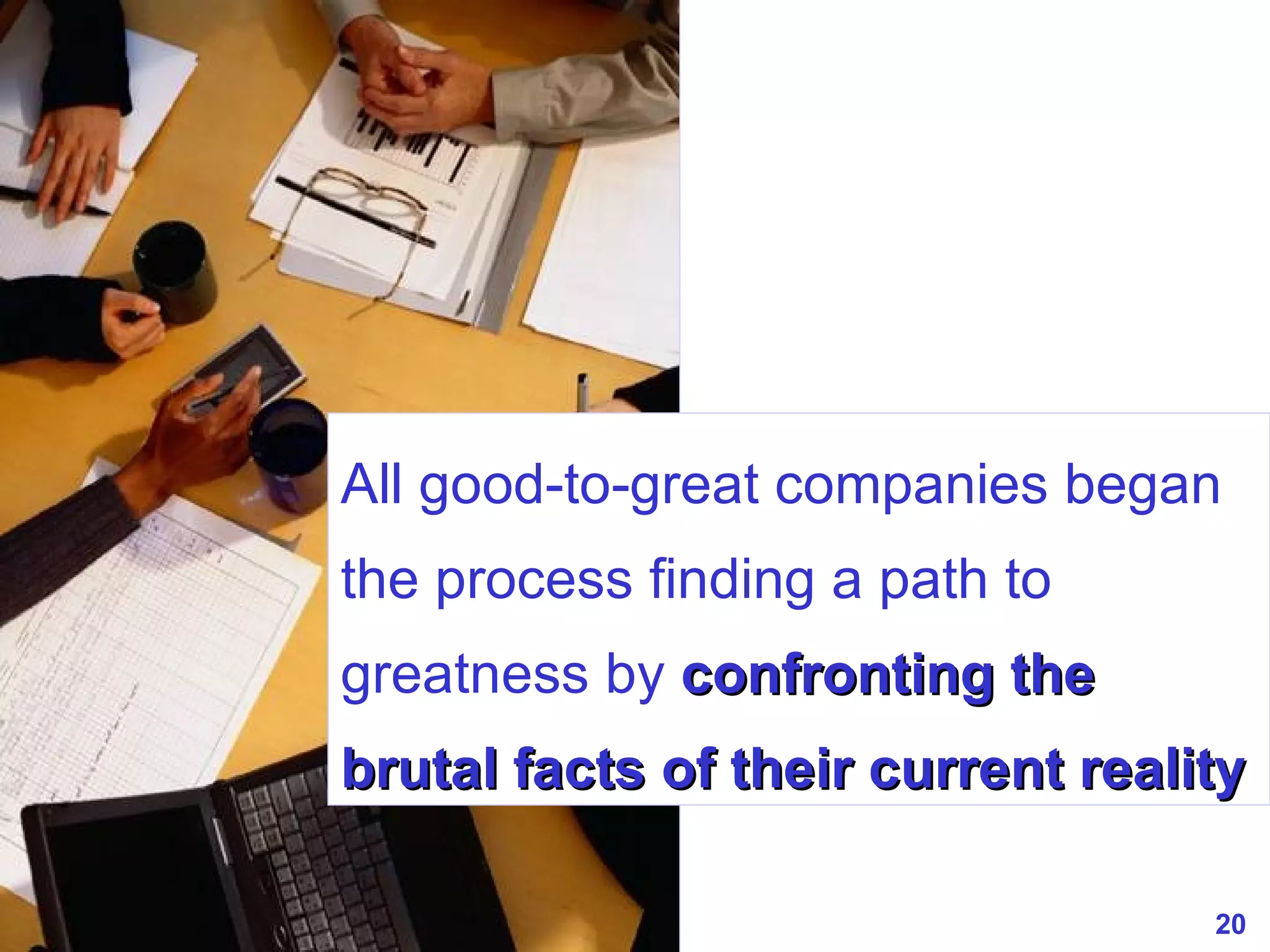
All good-to-great companies began the process finding a path to greatness by  confronting the brutal facts of their current reality
A key psychology for leading from good to great is  the Stockdale Paradox  : Retain absolute faith that you can and will prevail in the end, regardless of the difficulties, and  at the same time   confront the most brutal facts of your current reality,  whatever they might be.
A primary task in taking a company from good to great is to create a culture wherein people have a tremendous opportunity  to be heard and, ultimately,  for  the truth to  be heard
Element 4: Hedgehog Concept
The good-to-great companies are more like  hedgehogs  — simple, dowdy creatures that know  "one big thing"  and  stick to it.  The comparison companies are more like  foxes  — crafty, cunning creatures that know many things yet  lack consistency .
It took four years on average for the good-to-great companies to get a Hedgehog Concept.
You absolutely do not need to be in a great industry to produce sustained great results. No matter how bad the  industry, every good-to-great company figured out how to produce truly superior economic returns.
Element 5: A Culture of Discipline
The good-to-great companies appear boring and pedestrian looking in from the outside, but upon closer inspection,  they're full of people who display  extreme diligence and a stunning intensity
A culture of discipline is not just about action. It is about getting  disciplined people  who engage in  disciplined thought  and who then take  disciplined action .
A culture of discipline involves a duality. On the one hand, it requires people who  adhere to a consistent system ;  yet, on the other hand, it gives people  freedom and responsibility  within the framework of that system.
Element 6: Technology Accelerators
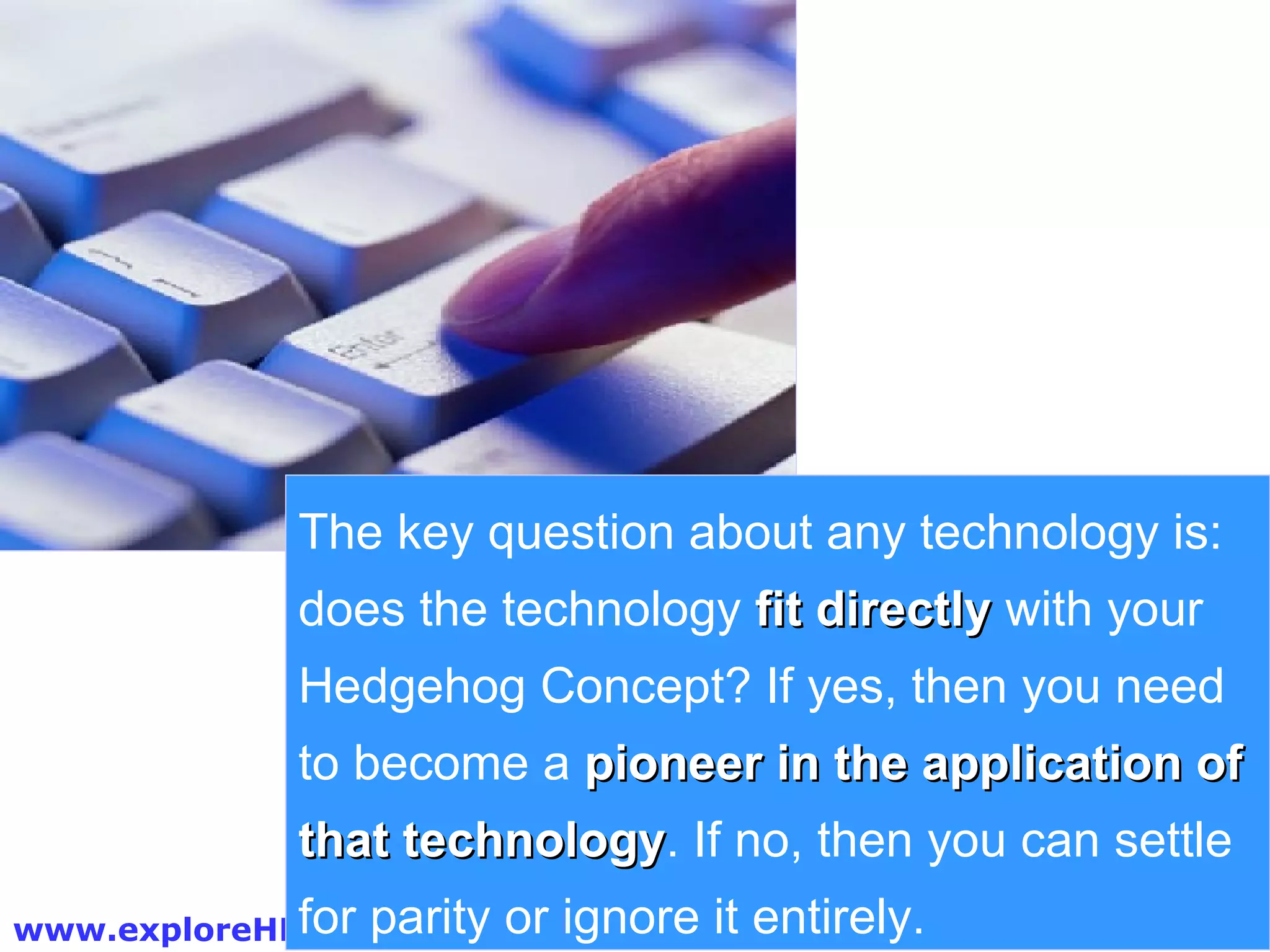
The key question about any technology is: does the technology  fit directly  with your Hedgehog Concept? If yes, then you need to become a  pioneer in the application of that technology . If no, then you can settle for parity or ignore it entirely.
The good-to-great companies used technology as  an accelerator of momentum , not a creator of it. None of the good-to-great companies began their transformations with pioneering technology, yet they all became pioneers in the application of technology once they grasped how it fit with their strategies.
Source of Reference: Jim Collins,  Good to Great : Why Some Companies Make the Leap…and Others Don’t , Harper Business

Good To Great

  • 1.
  • 2.
    Composed by :www.exploreHR.org Visit www.exploreHR.org for more presentations on Human Capital Strategy and Personal Development
  • 3.
    Six Key Elementsof Good to Great Company
  • 4.
    Element 1 :Level 5 Leadership
  • 5.
    Element 2 :First Who…..then What
  • 6.
    Element 3 :Confront the Brutal Facts (Yet Never Lose Faith)
  • 7.
    Element 4 :The Hedgehog Concept
  • 8.
    Element 5 :A Culture of Discipline
  • 9.
  • 10.
    Element 1: Level5 Leadership
  • 11.
    Level 5: Good-to-GreatLeader Level 4: Effective Leader Level 3: Competent Manager Level 2: Contributing Team Member Level 1: Highly Capable Individual Level 5 Leadership
  • 12.
    Level 5 leadersdisplay a compelling modesty, are self-effacing and understated.
  • 13.
    In contrast, twothirds of the comparison companies had leaders with gargantuan personal egos that contributed to the demise or continued mediocrity of the company
  • 14.
    Level 5 leadersare fanatically driven, infected with an incurable need to produce sustained results.
  • 15.
    Element 2: FirstWho…Then What
  • 16.
    The good-to-great leadersbegan the transformation by first getting the right people on the bus (and the wrong people off the bus) and then figured out where to drive it
  • 17.
    The key pointof this element is not just the idea of getting the right people on the team.
  • 18.
    The key pointis that "who" questions come before "what" decisions—before vision, before strategy, before organization structure, before tactics. First who, then what — as a rigorous discipline, consistently applied.
  • 19.
    Element 3: Confrontthe Brutal Fact
  • 20.
    All good-to-great companiesbegan the process finding a path to greatness by confronting the brutal facts of their current reality
  • 21.
    A key psychologyfor leading from good to great is the Stockdale Paradox : Retain absolute faith that you can and will prevail in the end, regardless of the difficulties, and at the same time confront the most brutal facts of your current reality, whatever they might be.
  • 22.
    A primary taskin taking a company from good to great is to create a culture wherein people have a tremendous opportunity to be heard and, ultimately, for the truth to be heard
  • 23.
  • 24.
    The good-to-great companiesare more like hedgehogs — simple, dowdy creatures that know "one big thing" and stick to it. The comparison companies are more like foxes — crafty, cunning creatures that know many things yet lack consistency .
  • 25.
    It took fouryears on average for the good-to-great companies to get a Hedgehog Concept.
  • 26.
    You absolutely donot need to be in a great industry to produce sustained great results. No matter how bad the industry, every good-to-great company figured out how to produce truly superior economic returns.
  • 27.
    Element 5: ACulture of Discipline
  • 28.
    The good-to-great companiesappear boring and pedestrian looking in from the outside, but upon closer inspection, they're full of people who display extreme diligence and a stunning intensity
  • 29.
    A culture ofdiscipline is not just about action. It is about getting disciplined people who engage in disciplined thought and who then take disciplined action .
  • 30.
    A culture ofdiscipline involves a duality. On the one hand, it requires people who adhere to a consistent system ; yet, on the other hand, it gives people freedom and responsibility within the framework of that system.
  • 31.
  • 32.
    The key questionabout any technology is: does the technology fit directly with your Hedgehog Concept? If yes, then you need to become a pioneer in the application of that technology . If no, then you can settle for parity or ignore it entirely.
  • 33.
    The good-to-great companiesused technology as an accelerator of momentum , not a creator of it. None of the good-to-great companies began their transformations with pioneering technology, yet they all became pioneers in the application of technology once they grasped how it fit with their strategies.
  • 34.
    Source of Reference:Jim Collins, Good to Great : Why Some Companies Make the Leap…and Others Don’t , Harper Business