Coaching for Superior
Employee Performance
Techniques for Supervisors
Session Objectives
Recognize the benefits of coaching
Identify the role of the coach
Understand the techniques involved
in successful coaching
Use coaching effectively to improve
employee performance
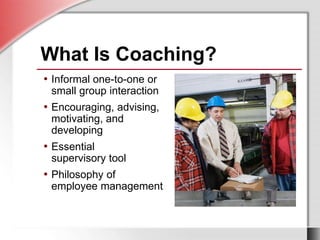
What Is Coaching?
• Informal one-to-one or
small group interaction
• Encouraging, advising,
motivating, and
developing
• Essential
supervisory tool
• Philosophy of
employee management
© Business & Legal Reports, Inc. 0901
• Inform
• Teach
• Guide
• Recognize
• Inform
• Teach
• Guide
• Recognize
Purposes of Coaching
• Motivate
• Assist
• Develop
• Empower
Purposes of Coaching (cont.)
• Motivate
• Assist
• Develop
• Empower
• Improves quality and
productivity
• Boosts enthusiasm
and morale
• Strengthens relationships
and communication
• Increases job satisfaction
• Improves teamwork
• Builds trust and
enhances loyalty
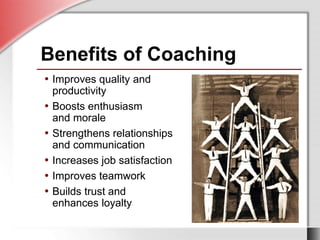
Benefits of Coaching
• Improves quality and
productivity
• Boosts enthusiasm
and morale
• Strengthens relationships
and communication
• Increases job satisfaction
• Improves teamwork
• Builds trust and
enhances loyalty
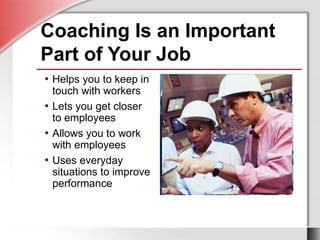
Coaching Is an Important
Part of Your Job
• Helps you to keep in
touch with workers
• Lets you get closer
to employees
• Allows you to work
with employees
• Uses everyday
situations to improve
performance
© Business & Legal Reports, Inc. 0901
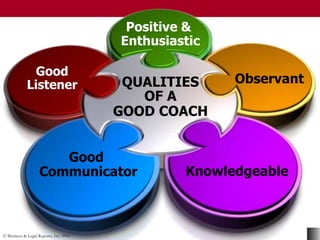
QUALITIES
OF A
GOOD COACH
Positive &
Enthusiastic
Knowledgeable
Observant
Good
Communicator
Good
Listener
© Business & Legal Reports, Inc. 0901
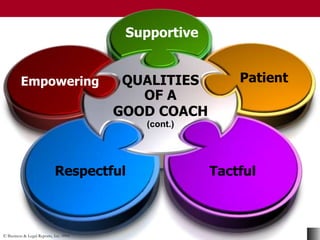
QUALITIES
OF A
GOOD COACH
(cont.)
Respectful
Supportive
Patient
Tactful
Empowering
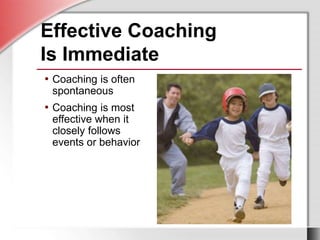
Effective Coaching
Is Immediate
• Coaching is often
spontaneous
• Coaching is most
effective when it
closely follows
events or behavior
© Business & Legal Reports, Inc. 0901
• What is done well and what
needs improvement
• Required skills and knowledge
• Standards of good performance
• Significance of the job
• Corrective action
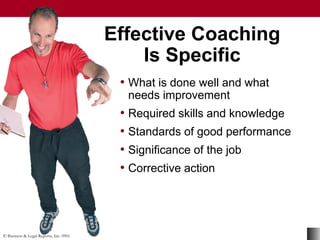
Effective Coaching
Is Specific
• What is done well and what
needs improvement
• Required skills and knowledge
• Standards of good performance
• Significance of the job
• Corrective action
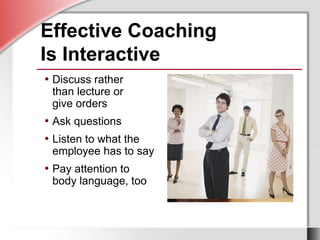
Effective Coaching
Is Interactive
• Discuss rather
than lecture or
give orders
• Ask questions
• Listen to what the
employee has to say
• Pay attention to
body language, too
© Business & Legal Reports, Inc. 0901
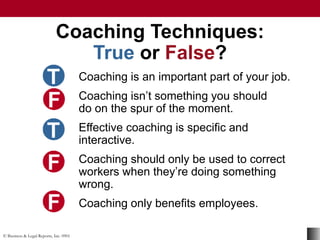
Coaching Techniques:
True or False?
Coaching is an important part of your job.
Coaching isn’t something you should
do on the spur of the moment.
Effective coaching is specific and
interactive.
Coaching should only be used to correct
workers when they’re doing something
wrong.
Coaching only benefits employees.
Do you understand:
• What coaching is?
• Purposes of
coaching?
• Benefits of coaching?
• Basic coaching
techniques?
Coaching Basics
Do you understand:
• What coaching is?
• Purposes of
coaching?
• Benefits of coaching?
• Basic coaching
techniques?
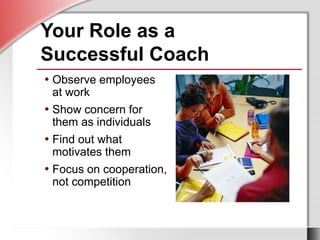
• Observe employees
at work
• Show concern for
them as individuals
• Find out what
motivates them
• Focus on cooperation,
not competition
• Observe employees
at work
• Show concern for
them as individuals
• Find out what
motivates them
• Focus on cooperation,
not competition
Your Role as a
Successful Coach
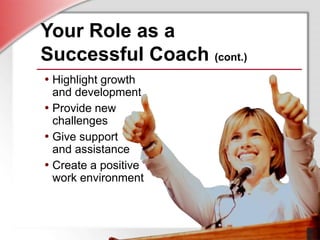
• Highlight growth
and development
• Provide new
challenges
• Give support
and assistance
• Create a positive
work environment
Your Role as a
Successful Coach (cont.)
• Highlight growth
and development
• Provide new
challenges
• Give support
and assistance
• Create a positive
work environment
• Determine the
agenda
• Focus on one or
two issues at a time
• Begin by checking
progress
• Show appreciation
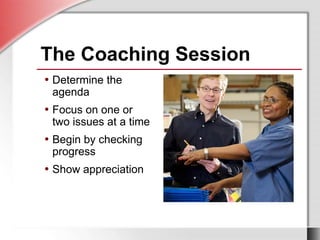
The Coaching Session
• Determine the
agenda
• Focus on one or
two issues at a time
• Begin by checking
progress
• Show appreciation
© Business & Legal Reports, Inc. 0901
The Coaching Session(cont.)
Ask for feedback
Discuss problems and
possible solutions
Allow time for questions
Agree on a plan of action
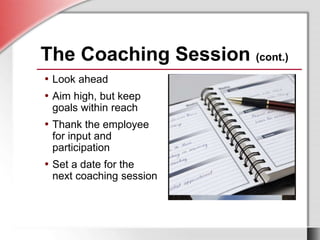
The Coaching Session (cont.)
• Look ahead
• Aim high, but keep
goals within reach
• Thank the employee
for input and
participation
• Set a date for the
next coaching session
© Business & Legal Reports, Inc. 0901
Follow Up
• Review performance
and goals
• Provide feedback
• Offer advice
and support
• Don᾽t give up
• Review performance
and goals
• Provide feedback
• Offer advice
and support
• Don᾽t give up
© Business & Legal Reports, Inc. 0901
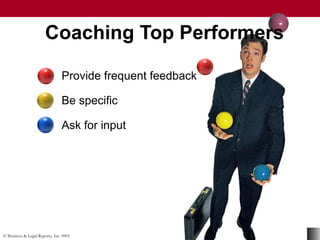
Provide frequent feedback
Be specific
Ask for input
Coaching Top Performers
• Keep them
challenged
• Give them adequate
recognition and
rewards
Coaching Top Performers
(cont.)
• Keep them
challenged
• Give them adequate
recognition and
rewards
© Business & Legal Reports, Inc. 0901
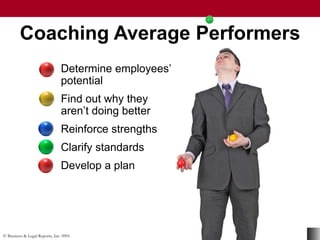
Coaching Average Performers
Determine employees’
potential
Find out why they
aren’t doing better
Reinforce strengths
Clarify standards
Develop a plan
© Business & Legal Reports, Inc. 0901
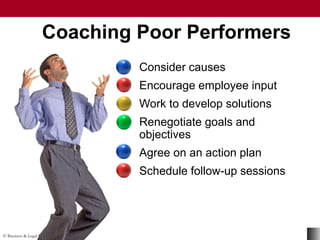
Coaching Poor Performers
Consider causes
Encourage employee input
Work to develop solutions
Renegotiate goals and
objectives
Agree on an action plan
Schedule follow-up sessions
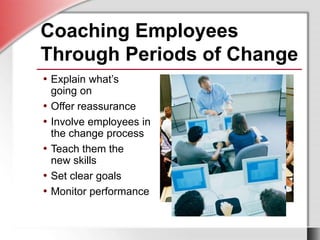
Coaching Employees
Through Periods of Change
• Explain what’s
going on
• Offer reassurance
• Involve employees in
the change process
• Teach them the
new skills
• Set clear goals
• Monitor performance
© Business & Legal Reports, Inc. 0901
Coaching Sessions:
Is it True?
Focus only on one or two issues
per session.
Because sessions are informal,
you don’t need an agenda.
Little employee participation is
required for a successful coaching
session.
Set goals a lot higher than you know
employees can reach to challenge
them.
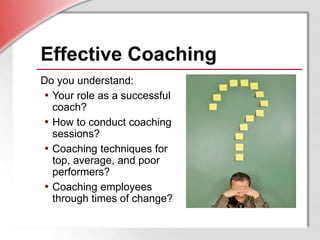
Do you understand:
• Your role as a successful
coach?
• How to conduct coaching
sessions?
• Coaching techniques for
top, average, and poor
performers?
• Coaching employees
through times of change?
Do you understand:
• Your role as a successful
coach?
• How to conduct coaching
sessions?
• Coaching techniques for
top, average, and poor
performers?
• Coaching employees
through times of change?
Effective Coaching
Key Points to Remember
Coaching employees is a very important
part of your job.
Coaching helps employees improve
performance and grow professionally.
Coaching helps you develop closer, more
effective working relationships with
employees.
You already possess the qualities that will
make you a good coach.

Coaching for better performance

  • 1.
    Coaching for Superior EmployeePerformance Techniques for Supervisors
  • 2.
    Session Objectives Recognize thebenefits of coaching Identify the role of the coach Understand the techniques involved in successful coaching Use coaching effectively to improve employee performance
  • 3.
    What Is Coaching? •Informal one-to-one or small group interaction • Encouraging, advising, motivating, and developing • Essential supervisory tool • Philosophy of employee management
  • 4.
    © Business &Legal Reports, Inc. 0901 • Inform • Teach • Guide • Recognize • Inform • Teach • Guide • Recognize Purposes of Coaching
  • 5.
    • Motivate • Assist •Develop • Empower Purposes of Coaching (cont.) • Motivate • Assist • Develop • Empower
  • 6.
    • Improves qualityand productivity • Boosts enthusiasm and morale • Strengthens relationships and communication • Increases job satisfaction • Improves teamwork • Builds trust and enhances loyalty Benefits of Coaching • Improves quality and productivity • Boosts enthusiasm and morale • Strengthens relationships and communication • Increases job satisfaction • Improves teamwork • Builds trust and enhances loyalty
  • 7.
    Coaching Is anImportant Part of Your Job • Helps you to keep in touch with workers • Lets you get closer to employees • Allows you to work with employees • Uses everyday situations to improve performance
  • 8.
    © Business &Legal Reports, Inc. 0901 QUALITIES OF A GOOD COACH Positive & Enthusiastic Knowledgeable Observant Good Communicator Good Listener
  • 9.
    © Business &Legal Reports, Inc. 0901 QUALITIES OF A GOOD COACH (cont.) Respectful Supportive Patient Tactful Empowering
  • 10.
    Effective Coaching Is Immediate •Coaching is often spontaneous • Coaching is most effective when it closely follows events or behavior
  • 11.
    © Business &Legal Reports, Inc. 0901 • What is done well and what needs improvement • Required skills and knowledge • Standards of good performance • Significance of the job • Corrective action Effective Coaching Is Specific • What is done well and what needs improvement • Required skills and knowledge • Standards of good performance • Significance of the job • Corrective action
  • 12.
    Effective Coaching Is Interactive •Discuss rather than lecture or give orders • Ask questions • Listen to what the employee has to say • Pay attention to body language, too
  • 13.
    © Business &Legal Reports, Inc. 0901 Coaching Techniques: True or False? Coaching is an important part of your job. Coaching isn’t something you should do on the spur of the moment. Effective coaching is specific and interactive. Coaching should only be used to correct workers when they’re doing something wrong. Coaching only benefits employees.
  • 14.
    Do you understand: •What coaching is? • Purposes of coaching? • Benefits of coaching? • Basic coaching techniques? Coaching Basics Do you understand: • What coaching is? • Purposes of coaching? • Benefits of coaching? • Basic coaching techniques?
  • 15.
    • Observe employees atwork • Show concern for them as individuals • Find out what motivates them • Focus on cooperation, not competition • Observe employees at work • Show concern for them as individuals • Find out what motivates them • Focus on cooperation, not competition Your Role as a Successful Coach
  • 16.
    • Highlight growth anddevelopment • Provide new challenges • Give support and assistance • Create a positive work environment Your Role as a Successful Coach (cont.) • Highlight growth and development • Provide new challenges • Give support and assistance • Create a positive work environment
  • 17.
    • Determine the agenda •Focus on one or two issues at a time • Begin by checking progress • Show appreciation The Coaching Session • Determine the agenda • Focus on one or two issues at a time • Begin by checking progress • Show appreciation
  • 18.
    © Business &Legal Reports, Inc. 0901 The Coaching Session(cont.) Ask for feedback Discuss problems and possible solutions Allow time for questions Agree on a plan of action
  • 19.
    The Coaching Session(cont.) • Look ahead • Aim high, but keep goals within reach • Thank the employee for input and participation • Set a date for the next coaching session
  • 20.
    © Business &Legal Reports, Inc. 0901 Follow Up • Review performance and goals • Provide feedback • Offer advice and support • Don᾽t give up • Review performance and goals • Provide feedback • Offer advice and support • Don᾽t give up
  • 21.
    © Business &Legal Reports, Inc. 0901 Provide frequent feedback Be specific Ask for input Coaching Top Performers
  • 22.
    • Keep them challenged •Give them adequate recognition and rewards Coaching Top Performers (cont.) • Keep them challenged • Give them adequate recognition and rewards
  • 23.
    © Business &Legal Reports, Inc. 0901 Coaching Average Performers Determine employees’ potential Find out why they aren’t doing better Reinforce strengths Clarify standards Develop a plan
  • 24.
    © Business &Legal Reports, Inc. 0901 Coaching Poor Performers Consider causes Encourage employee input Work to develop solutions Renegotiate goals and objectives Agree on an action plan Schedule follow-up sessions
  • 25.
    Coaching Employees Through Periodsof Change • Explain what’s going on • Offer reassurance • Involve employees in the change process • Teach them the new skills • Set clear goals • Monitor performance
  • 26.
    © Business &Legal Reports, Inc. 0901 Coaching Sessions: Is it True? Focus only on one or two issues per session. Because sessions are informal, you don’t need an agenda. Little employee participation is required for a successful coaching session. Set goals a lot higher than you know employees can reach to challenge them.
  • 27.
    Do you understand: •Your role as a successful coach? • How to conduct coaching sessions? • Coaching techniques for top, average, and poor performers? • Coaching employees through times of change? Do you understand: • Your role as a successful coach? • How to conduct coaching sessions? • Coaching techniques for top, average, and poor performers? • Coaching employees through times of change? Effective Coaching
  • 28.
    Key Points toRemember Coaching employees is a very important part of your job. Coaching helps employees improve performance and grow professionally. Coaching helps you develop closer, more effective working relationships with employees. You already possess the qualities that will make you a good coach.