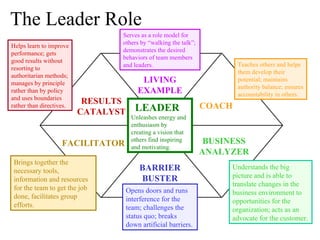
The Leader Role LEADER Unleashes energy and enthusiasm by creating a vision that others find inspiring and motivating. Serves as a role model for others by “walking the talk”; demonstrates the desired behaviors of team members and leaders. Teaches others and helps them develop their potential; maintains authority balance; ensures accountability in others. Understands the big picture and is able to translate changes in the business environment to opportunities for the organization; acts as an advocate for the customer. Opens doors and runs interference for the team; challenges the status quo; breaks down artificial barriers. Brings together the necessary tools, information and resources for the team to get the job done, facilitates group efforts. Helps learn to improve performance; gets good results without resorting to authoritarian methods; manages by principle rather than by policy and uses boundaries rather than directives. RESULTS CATALYST FACILITATOR LIVING EXAMPLE COACH BUSINESS ANALYZER BARRIER BUSTER
How Leaders and Managers Differ From George Barnha Barnha How leaders operate How managers operate Conceptualize outcomes by working from the future back to  the present Conceptualize plans by working from the present to the future Focus on the long-term Focus on the short-term Embrace the macro perspective Embrace a micro perspective Favor innovative thinking Favor routine thinking Balance idealism and realism Emphasize pragmaticism over idealism Revolutionary flair Protector of the status quo Emphasis on what and why Emphasis on how and when Clarifies the vision Implements the vision
How Leaders and Managers Differ From George Barnha Barnha How leaders operate How managers operate Inspiring and motivating Controlling and directing Excited by change Threatened by change Identifies opportunities Identifies obstacles Takes risks Avoids risks Pursues acquisition of resources Actions limited by available resources Person centered, idea centered Systems centered, plan centered

The Leader Role

  • 1.
    The Leader RoleLEADER Unleashes energy and enthusiasm by creating a vision that others find inspiring and motivating. Serves as a role model for others by “walking the talk”; demonstrates the desired behaviors of team members and leaders. Teaches others and helps them develop their potential; maintains authority balance; ensures accountability in others. Understands the big picture and is able to translate changes in the business environment to opportunities for the organization; acts as an advocate for the customer. Opens doors and runs interference for the team; challenges the status quo; breaks down artificial barriers. Brings together the necessary tools, information and resources for the team to get the job done, facilitates group efforts. Helps learn to improve performance; gets good results without resorting to authoritarian methods; manages by principle rather than by policy and uses boundaries rather than directives. RESULTS CATALYST FACILITATOR LIVING EXAMPLE COACH BUSINESS ANALYZER BARRIER BUSTER
  • 2.
    How Leaders andManagers Differ From George Barnha Barnha How leaders operate How managers operate Conceptualize outcomes by working from the future back to the present Conceptualize plans by working from the present to the future Focus on the long-term Focus on the short-term Embrace the macro perspective Embrace a micro perspective Favor innovative thinking Favor routine thinking Balance idealism and realism Emphasize pragmaticism over idealism Revolutionary flair Protector of the status quo Emphasis on what and why Emphasis on how and when Clarifies the vision Implements the vision
  • 3.
    How Leaders andManagers Differ From George Barnha Barnha How leaders operate How managers operate Inspiring and motivating Controlling and directing Excited by change Threatened by change Identifies opportunities Identifies obstacles Takes risks Avoids risks Pursues acquisition of resources Actions limited by available resources Person centered, idea centered Systems centered, plan centered