Coaching and Performance
Management
The Need for Coaching
• Too many managers use a negative approach
to managing behavior
• Alternative: conflict avoidance – and overload
the good workers
• Sometimes the only time the supervisor talks
to a worker is when there is a problem
Coaching – A Positive Approach
• An active and positive management approach
• Employees should know:
– What to do
– How to do it
– Problem solving
• Participative Management
– Workers have a voice in their work
Coaching and Performance
Management
• Performance appraisal
– The first step
• Performance management
– Employee goal setting
– Coaching
– Rewards
– Individual development
Definitions of Coaching
• No single accepted definition
• A mutual discussion leading to improved
performance and positive relationships
• A process to encourage employees to:
– Accept responsibility for their actions
– Achieve and sustain superior performance
– Work as partners in achieving organizational goals and
effectiveness
Supervisor’s Role in Coaching
A supervisor:
• Should be motivated to see the work group
succeed
• Can use all information on hand
• Has opportunity to coach and counsel
• Has authority to carry out coaching
• Is responsible for unit’s effectiveness
HRD Professional’s Coaching
Role
• Provides training for coaches
• Provides training to correct performance
problems
• Provides organizational development support
• Coaching is an HRD intervention
Coaching to Improve Poor
Performance
• Defining poor performance
• Responding to poor performance
• Conducting a coaching analysis
• Using the coaching discussion
Defining Poor Performance
• Definition: “Specific, agreed upon deviations
from expected behavior.”
• Performance must be evaluated against some
standard or expected level of performance
• Standards and expected levels of performance
must be known by the supervisor and the
worker
Types of Standards
• Absolute
– Same scale or standard is applied to all subordinates
• Relative
– Performance is evaluated relative to the performance
of others
Deviant Workplace Behavior
• Production deviance
– Working slowly, leaving early
• Property deviance
– Sabotage, lying about hours worked
• Political deviance
– Showing favoritism, gossiping
• Personal aggression
– Harassment, abuse, stealing, etc.
Responding to Poor Performance
• Causal Attribution Theory
– People assign causes to behavior
– Different actions are likely based on internal versus
external attributions
• Fundamental Attribution Error
– Assumes or attributes behavior comes from a cause
within a person
– Supervisor may overlook other causes
Coaching Analysis
• The process of analyzing the factors that
contribute to unsatisfactory performance
• Deciding on the appropriate response to
improve performance
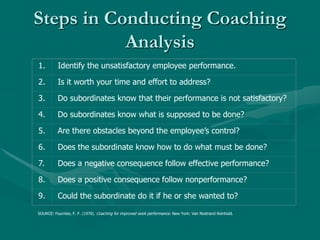
Steps in Conducting Coaching
Analysis
1. Identify the unsatisfactory employee performance.
2. Is it worth your time and effort to address?
3. Do subordinates know that their performance is not satisfactory?
4. Do subordinates know what is supposed to be done?
5. Are there obstacles beyond the employee’s control?
6. Does the subordinate know how to do what must be done?
7. Does a negative consequence follow effective performance?
8. Does a positive consequence follow nonperformance?
9. Could the subordinate do it if he or she wanted to?
SOURCE: Fournies, F. F. (1978). Coaching for improved work performance. New York: Van Nostrand Reinhold.
Steps to Follow in Conducting a
Coaching Analysis
• Identify the unsatisfactory performance
• Decide if it’s worth YOUR time and effort
• Find out if the worker knows that their work
is not satisfactory
• Does the worker know what is to be done?
Steps to Follow in Conducting a
Coaching Analysis – 2
• Are there obstacles beyond the worker’s
control?
• Does worker know HOW to do the job?
• Does a negative consequence follow effective
performance?
Steps to Follow in Conducting a
Coaching Analysis – 3
• Does a positive consequence follow
nonperformance?
• Can the worker do the job if he/she wants to?
• Can the job or task be modified?
• What if the problem persists?
The Coaching Discussion
• Kinlaw’s Approach:
– Confronting or presenting
– Using reactions to develop information
– Resolving or resolution
The Coaching Discussion – 2
• The Fournies Approach:
– Get agreement with worker that a problem exists
– Mutually discuss alternative solutions to the
problem
– Mutually agree on actions to be taken
– Follow-up to measure results
– Recognize achievement when it happens
Critical Points for Both
• You need specific objectives or goals
• Goals must be mutually understood and
agreed upon
What if Coaching Fails?
• Transfer the employee to work that the
employee can do
• Terminate for substandard performance
• Have adequate documentation of coaching
efforts to support termination!
Maintaining Effective Performance and
Encouraging Superior Performance
• Must reward good performance
• Use:
– Goal Setting
– Job redesign
– Worker participation
– Job ownership
Manager-Coach Responsibilities
• Provide evaluation
– Self-evaluation can be difficult
– People often focus on their weaknesses
• Manager-coach can:
– see the big picture
– make suggestions for improvement
– reinforce company values
Skills Needed for Effective
Coaching
• Communication skills
• Interpersonal skills
Communication Skills
• Writing
• Speaking
• Active listening
Writing Skills
• Acceptable grammar and spelling
• Clear and concise style
• Example: Facts, Discussion, Recommendation
(FDR)
Speaking Skills
• Specific and descriptive
• Focused on the issue at hand
• Polite and respectful
• Focused on the problem, not the person
• Objective, not based on feelings
Active Listening
• More than, “I hear you”
• Must listen for what the other person is trying
to say
• Specific techniques are needed
• It is NOT easy!
How to Listen Actively
• Mirror back what the individual says:
– “So you think that you are doing the right thing. Is
there more?”
• Paraphrase and summarize:
– “So you feel you are doing the job the way you
were taught to do it, and that any quality errors
are not your fault. Is that right? Is there more?”
How to Listen Actively – 2
• Use open-ended questions to get information:
– Can’t be answered with simple yes or no
• Use closed questions to get a yes or no answer
• See Tables 10-2 and 10-3
• Active listening takes a lot of work!
Interpersonal Skills
• Show respect for the individual
• Focus on the present and future
– Not on the past!
• Be objective
• Plan ahead
Interpersonal Skills – 2
• Affirm the efforts of others
• Be consistent
• Build trust
• Demonstrate commitment to and respect for
others
• Integrity, Integrity, Integrity!!!
Effectiveness of Coaching
• Hard to measure objectively
• Can be measured in many ways
• Some coaches ARE better than others
• Others need to keep working to improve
their coaching skills; good coaching skills can
be learned
Performance Appraisal Interview
• Major source of employee feedback
• Gives employee the chance for feedback and
participation in the process
• Allows the coach to affirm his/her support
• Provides opportunity for constructive criticism – both
ways
– Focus on the problem, not the “personality”
Performance Appraisal Interview
– 2
• Time to mutually set next period’s goals and
objectives
• Provides mutually understood basis for
improvement
Training the
Supervisor/Appraiser
Effective training:
• Helps the appraiser to be credible
• Promotes acceptance of appraisal
• Helps provide accurate feedback
• Assists the supervisor in demonstrating support
for the employee
Organizational Support
• Organization needs to support their coaching
and performance management efforts
• Takes time, training, and money
• Needs to be part of the corporate culture
• Needs to be linked to compensation, rewards,
and promotion systems
Coaching in a Nutshell
• Worker participates in discussions
• Worker helps set goals for improvement
• Feedback is specific and behavioral
• Coaches are supportive and helpful
• Supervisor needs to know the worker’s job
• Coaches need support and training
Summary
• Managers must ensure effective employee
performance
• Positive coaching provides a great opportunity
for individual improvement
• Allows worker to:
– accept responsibility
– achieve superior performance
– work towards organizational goals
Summary – 2
• Good coaches needs:
– Effective communication skills
– Effective interpersonal skills
– Integrity
– Effective performance appraisal skills
• Is it any wonder that good coaches can be
hard to find?

coaching-and-performance-management.ppt

  • 1.
  • 2.
    The Need forCoaching • Too many managers use a negative approach to managing behavior • Alternative: conflict avoidance – and overload the good workers • Sometimes the only time the supervisor talks to a worker is when there is a problem
  • 3.
    Coaching – APositive Approach • An active and positive management approach • Employees should know: – What to do – How to do it – Problem solving • Participative Management – Workers have a voice in their work
  • 4.
    Coaching and Performance Management •Performance appraisal – The first step • Performance management – Employee goal setting – Coaching – Rewards – Individual development
  • 5.
    Definitions of Coaching •No single accepted definition • A mutual discussion leading to improved performance and positive relationships • A process to encourage employees to: – Accept responsibility for their actions – Achieve and sustain superior performance – Work as partners in achieving organizational goals and effectiveness
  • 6.
    Supervisor’s Role inCoaching A supervisor: • Should be motivated to see the work group succeed • Can use all information on hand • Has opportunity to coach and counsel • Has authority to carry out coaching • Is responsible for unit’s effectiveness
  • 7.
    HRD Professional’s Coaching Role •Provides training for coaches • Provides training to correct performance problems • Provides organizational development support • Coaching is an HRD intervention
  • 8.
    Coaching to ImprovePoor Performance • Defining poor performance • Responding to poor performance • Conducting a coaching analysis • Using the coaching discussion
  • 9.
    Defining Poor Performance •Definition: “Specific, agreed upon deviations from expected behavior.” • Performance must be evaluated against some standard or expected level of performance • Standards and expected levels of performance must be known by the supervisor and the worker
  • 10.
    Types of Standards •Absolute – Same scale or standard is applied to all subordinates • Relative – Performance is evaluated relative to the performance of others
  • 11.
    Deviant Workplace Behavior •Production deviance – Working slowly, leaving early • Property deviance – Sabotage, lying about hours worked • Political deviance – Showing favoritism, gossiping • Personal aggression – Harassment, abuse, stealing, etc.
  • 12.
    Responding to PoorPerformance • Causal Attribution Theory – People assign causes to behavior – Different actions are likely based on internal versus external attributions • Fundamental Attribution Error – Assumes or attributes behavior comes from a cause within a person – Supervisor may overlook other causes
  • 13.
    Coaching Analysis • Theprocess of analyzing the factors that contribute to unsatisfactory performance • Deciding on the appropriate response to improve performance
  • 14.
    Steps in ConductingCoaching Analysis 1. Identify the unsatisfactory employee performance. 2. Is it worth your time and effort to address? 3. Do subordinates know that their performance is not satisfactory? 4. Do subordinates know what is supposed to be done? 5. Are there obstacles beyond the employee’s control? 6. Does the subordinate know how to do what must be done? 7. Does a negative consequence follow effective performance? 8. Does a positive consequence follow nonperformance? 9. Could the subordinate do it if he or she wanted to? SOURCE: Fournies, F. F. (1978). Coaching for improved work performance. New York: Van Nostrand Reinhold.
  • 15.
    Steps to Followin Conducting a Coaching Analysis • Identify the unsatisfactory performance • Decide if it’s worth YOUR time and effort • Find out if the worker knows that their work is not satisfactory • Does the worker know what is to be done?
  • 16.
    Steps to Followin Conducting a Coaching Analysis – 2 • Are there obstacles beyond the worker’s control? • Does worker know HOW to do the job? • Does a negative consequence follow effective performance?
  • 17.
    Steps to Followin Conducting a Coaching Analysis – 3 • Does a positive consequence follow nonperformance? • Can the worker do the job if he/she wants to? • Can the job or task be modified? • What if the problem persists?
  • 18.
    The Coaching Discussion •Kinlaw’s Approach: – Confronting or presenting – Using reactions to develop information – Resolving or resolution
  • 19.
    The Coaching Discussion– 2 • The Fournies Approach: – Get agreement with worker that a problem exists – Mutually discuss alternative solutions to the problem – Mutually agree on actions to be taken – Follow-up to measure results – Recognize achievement when it happens
  • 20.
    Critical Points forBoth • You need specific objectives or goals • Goals must be mutually understood and agreed upon
  • 21.
    What if CoachingFails? • Transfer the employee to work that the employee can do • Terminate for substandard performance • Have adequate documentation of coaching efforts to support termination!
  • 22.
    Maintaining Effective Performanceand Encouraging Superior Performance • Must reward good performance • Use: – Goal Setting – Job redesign – Worker participation – Job ownership
  • 23.
    Manager-Coach Responsibilities • Provideevaluation – Self-evaluation can be difficult – People often focus on their weaknesses • Manager-coach can: – see the big picture – make suggestions for improvement – reinforce company values
  • 24.
    Skills Needed forEffective Coaching • Communication skills • Interpersonal skills
  • 25.
    Communication Skills • Writing •Speaking • Active listening
  • 26.
    Writing Skills • Acceptablegrammar and spelling • Clear and concise style • Example: Facts, Discussion, Recommendation (FDR)
  • 27.
    Speaking Skills • Specificand descriptive • Focused on the issue at hand • Polite and respectful • Focused on the problem, not the person • Objective, not based on feelings
  • 28.
    Active Listening • Morethan, “I hear you” • Must listen for what the other person is trying to say • Specific techniques are needed • It is NOT easy!
  • 29.
    How to ListenActively • Mirror back what the individual says: – “So you think that you are doing the right thing. Is there more?” • Paraphrase and summarize: – “So you feel you are doing the job the way you were taught to do it, and that any quality errors are not your fault. Is that right? Is there more?”
  • 30.
    How to ListenActively – 2 • Use open-ended questions to get information: – Can’t be answered with simple yes or no • Use closed questions to get a yes or no answer • See Tables 10-2 and 10-3 • Active listening takes a lot of work!
  • 31.
    Interpersonal Skills • Showrespect for the individual • Focus on the present and future – Not on the past! • Be objective • Plan ahead
  • 32.
    Interpersonal Skills –2 • Affirm the efforts of others • Be consistent • Build trust • Demonstrate commitment to and respect for others • Integrity, Integrity, Integrity!!!
  • 33.
    Effectiveness of Coaching •Hard to measure objectively • Can be measured in many ways • Some coaches ARE better than others • Others need to keep working to improve their coaching skills; good coaching skills can be learned
  • 34.
    Performance Appraisal Interview •Major source of employee feedback • Gives employee the chance for feedback and participation in the process • Allows the coach to affirm his/her support • Provides opportunity for constructive criticism – both ways – Focus on the problem, not the “personality”
  • 35.
    Performance Appraisal Interview –2 • Time to mutually set next period’s goals and objectives • Provides mutually understood basis for improvement
  • 36.
    Training the Supervisor/Appraiser Effective training: •Helps the appraiser to be credible • Promotes acceptance of appraisal • Helps provide accurate feedback • Assists the supervisor in demonstrating support for the employee
  • 37.
    Organizational Support • Organizationneeds to support their coaching and performance management efforts • Takes time, training, and money • Needs to be part of the corporate culture • Needs to be linked to compensation, rewards, and promotion systems
  • 38.
    Coaching in aNutshell • Worker participates in discussions • Worker helps set goals for improvement • Feedback is specific and behavioral • Coaches are supportive and helpful • Supervisor needs to know the worker’s job • Coaches need support and training
  • 39.
    Summary • Managers mustensure effective employee performance • Positive coaching provides a great opportunity for individual improvement • Allows worker to: – accept responsibility – achieve superior performance – work towards organizational goals
  • 40.
    Summary – 2 •Good coaches needs: – Effective communication skills – Effective interpersonal skills – Integrity – Effective performance appraisal skills • Is it any wonder that good coaches can be hard to find?