















Business Model
Generation
2
These slides are just samples.
You can download full version of
these PPT files at :
www.sales-management-slides.com
4
5
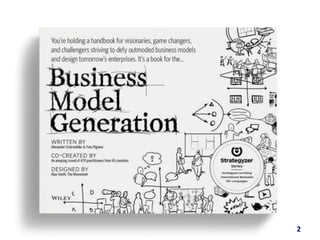
The book “Business Model
Generation” reviews how to
formulate a Business Model
Canvas which contains 9 main
pillars in designing a business
model.
Here are the 9 main pillars...
Pillar 1: Customer Segment
6
Who is the market segment that
we want to target?
• Segmentation by socioeconomic
class (upper, middle, lower)
• Segmentation by gender
• Segmentation by geographic
location
7
Who is the market segment that
we want to target?
• Segmentation based on
psychographic aspects (behavior
and lifestyle of the target
market)
8
Starbucks target market : upper middle
class segment with an urban lifestyle
Middle class segment and practical
behavior (instant coffee)
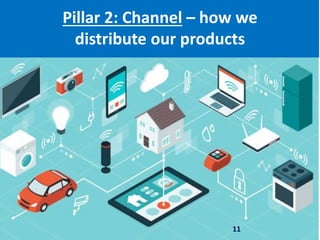
Pillar 2: Channel – how we
distribute our products
11
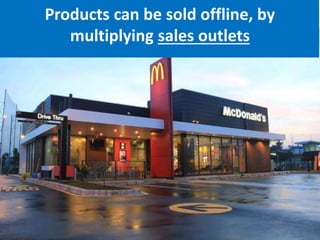
Products can be sold offline, by
multiplying sales outlets
Or products are sold online through the
e-commerce channel
Pillar 3: Relationship
with Customers
14
This third pillar demonstrates how
we build the most effective
relationship with our customers.
What is our strategy to build
relationship with customers and to
maintain their loyalty? What
communication channels will we
use to interact with customers?
Pillar 4: Value Proposition
16
17
Value proposition is the
main benefit and value ​​that
your product offers; and
what most attracts potential
customers to buy it.
18
The value proposition can be
in the form of product
quality, product features,
durability, or in the form of
an economical price
advantage
Honda's Value Proposition:
good design, reliable engine and great
after-sales service
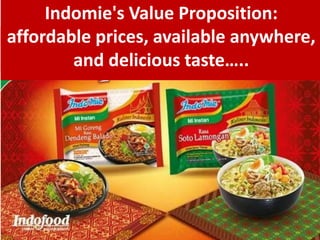
Indomie's Value Proposition:
affordable prices, available anywhere,
and delicious taste…..
Google Search Engine Value
Proposition: easy to use and very
effective search results
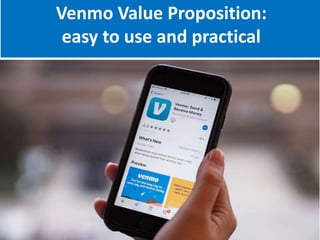
Venmo Value Proposition:
easy to use and practical
Pillar 5: Revenue Stream
23
24
The fifth pillar is the revenue
stream, or the main source of
income for the business. Will
you sell on a one-time event or
subscription basis? How is the
payment method – via cash or
installments?
25
Netflix earns revenue through the subscription
system from its million members
26
Mercedes Benz sells its cars with a cash
and credit system (car installments)
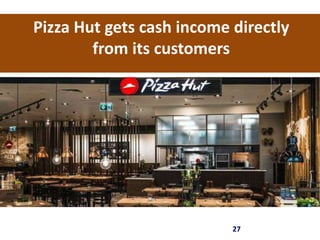
27
Pizza Hut gets cash income directly
from its customers
Pillar 6: Key Resources
28
29
The sixth pillar shows the
key resources we need to
make and sell the products
or services we provide to
customers
30
Resources can be physical raw
materials, finished goods,
working capital, expertise
resources, or can also be in
the form of digital assets
(internet network, social
media followers)
31
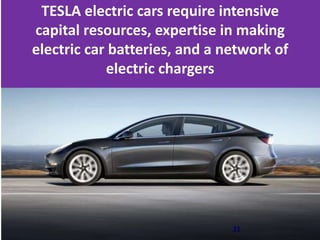
TESLA electric cars require intensive
capital resources, expertise in making
electric car batteries, and a network of
electric chargers
32
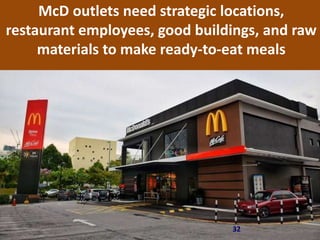
McD outlets need strategic locations,
restaurant employees, good buildings, and raw
materials to make ready-to-eat meals
33
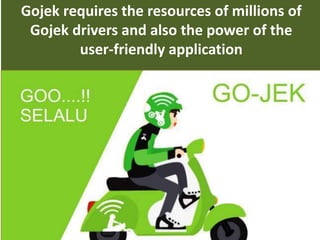
Gojek requires the resources of millions of
Gojek drivers and also the power of the
user-friendly application
.
Pillar 7 : Key Activities
34
The seventh
pillar shows the
main activity to
deliver a
product or
service that can
satisfy
customers.
36
The main
activity is also a
key business
process that
greatly
determines the
company's
competitive
advantage.
37
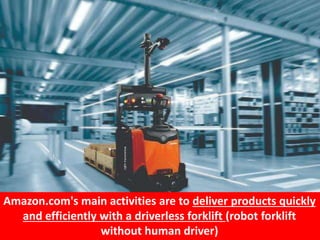
Amazon.com's main activities are to deliver products quickly
and efficiently with a driverless forklift (robot forklift
without human driver)
38
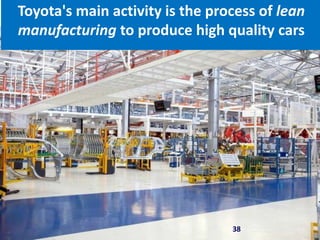
Toyota's main activity is the process of lean
manufacturing to produce high quality cars
39
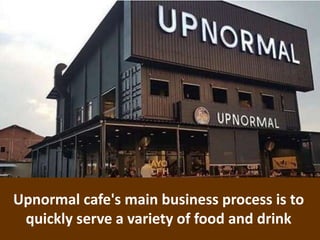
Upnormal cafe's main business process is to
quickly serve a variety of food and drink
Pillar 8 : Key Partnership
40
Key partnerships give
information about key
collaborations to run a business,
for example: who is the supplier,
who is the investor, or who will
be invited to cooperate to
become a reseller/agent.
42
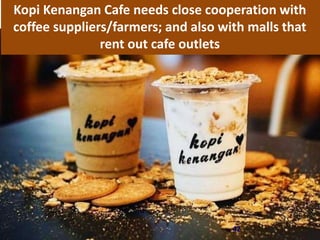
Kopi Kenangan Cafe needs close cooperation with
coffee suppliers/farmers; and also with malls that
rent out cafe outlets
43
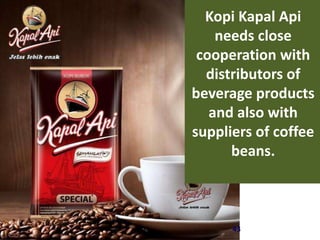
Kopi Kapal Api
needs close
cooperation with
distributors of
beverage products
and also with
suppliers of coffee
beans.
Pillar 9 : COST
44
This last pillar represents the cost or capital
component required to run a business
successfully.
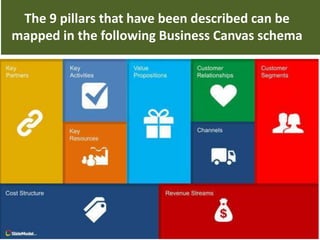
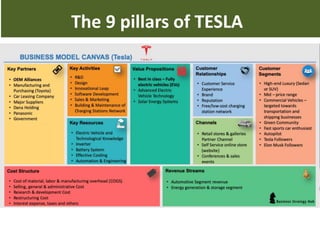
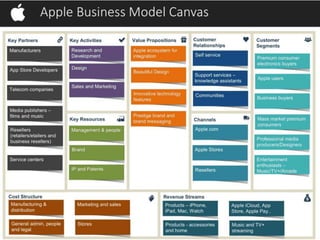
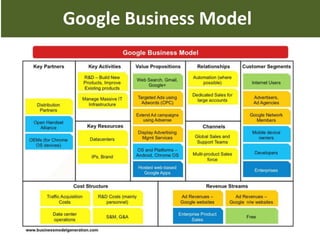
The 9 pillars that have been described can be
mapped in the following Business Canvas schema
The 9 pillars of TESLA
Google Business Model
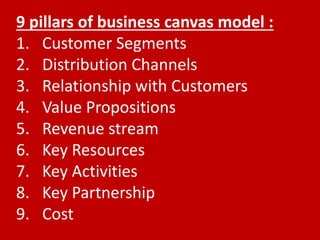
9 pillars of business canvas model :
1. Customer Segments
2. Distribution Channels
3. Relationship with Customers
4. Value Propositions
5. Revenue stream
6. Key Resources
7. Key Activities
8. Key Partnership
9. Cost
51
FINISH

Business model generation ppt