

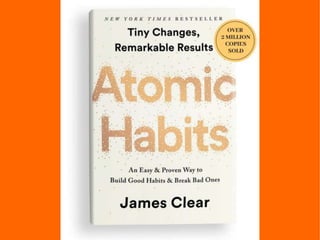






Atomic Habits
These slides are just samples.
You can download full version of
these PPT files at :
www.HR-management-slides.com
4
This international
bestseller (which has sold
over 3 million copies
worldwide) was written
by James Clear, a well-
known blogger who is
also an expert in the
science of habits.
5
Atomic Habits, in
detail, explains
various practical
techniques and tips
to build good habits,
and at the same
time to eliminate
bad habits.
6
Why Are They Called Atomic Habits?
This book is entitled Atomic Habits for
two reasons. The first, the smallest
component of our lives is actually the
daily habits that we do. This habit will
then determine the pattern of our daily
behavior.
7
Furthermore, this pattern of behavior
will determine our destiny in the
future. From this schematic, it is
obvious that habits are the core
component of our lives, but slowly
they can have a tremendous impact
on our future.
The second reason of why it is called
atomic habits, because this book explains
that the best way to start a new positive
habit is to start it through "tiny habits” or
small habits that are easy to do. Atomic
habits invites us to start a new habit by
starting from small components, or from
small easy-to-do activities.
8
9
Focus on Habits or System, not on
Goal
James Clear writes: instead of focusing
on goals or dreams obsessively, it's
much better to focus on what habits
you need to create, so that your
dreams will slowly come true by
themselves.
10
These habits must be daily
executed. This set of habits is
like your “work system”. If this
habit or work system is done
repeatedly, then rest assured,
your dreams will slowly come
true.
11
Example: A person has a dream to write a book.
However, the dream is then just always planned;
but never leads to real action. In the end, his or her
dream will never come true.
It would be better for that person to compose new
habits which are then used as a kind of work
system. His new habit is simple: every morning at
8am just write 1 page (or 250 words). Then he could
do this habit repeatedly every day. Over the time,
this habit will make him successful in writing a
complete book.
12
3 Key Tips of Building
GOOD HABITS
Tip #1:
Make It Obvious
(make the new habit as
something clear,
measurable and concrete)
14
The mistake of many people when they
want to start a new habit is to only plan in
abstract and non-specific sentences.
For example, when someone wants to start
a sports habit, he just says: Starting
tomorrow, I want to do exercise. Or when
someone wants to start a new habit of
reading books, he just says: Starting next
week I will start reading books diligently.
15
Such intention is useless, because it is
very abstract and non-specific.
James Clear wrote: determining to start
the new habit must be manifested in a
plan that is specific and concrete. This
habit plan is also known as habit
implementation plan.
16
Here are some
examples of
habit
implementation
plan
17
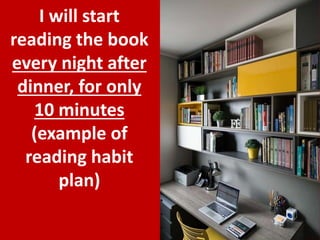
I will start
reading the book
every night after
dinner, for only
10 minutes
(example of
reading habit
plan)
18
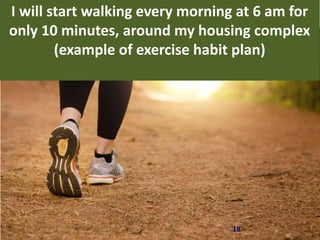
I will start walking every morning at 6 am for
only 10 minutes, around my housing complex
(example of exercise habit plan)
19
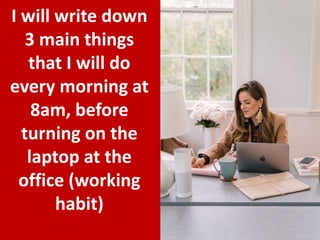
I will write down
3 main things
that I will do
every morning at
8am, before
turning on the
laptop at the
office (working
habit)
20
I will learn and
practice about
online business
every night
from 8pm to
9pm (personal
growth habit)
21
From various examples of habit plan
above, we can see how we
formulate this habit plan specifically
and when it will be done every day.
This kind of method has proven to
help our minds to really focus on the
real actions that we must do.
22
In formulating the habit plan, it is
recommended that we formulate the
implementation of the habit at
relatively the same hours each day.
Why? Because by determining the
same hour or time for each habit
implementation, our bodies will also
be easier to adapt to these new
habits.
Tip # 2 :
Start SMALL
(take baby steps and
simple action)
Tip #2 : Start Small. Other practical tips
described in the Atomic Habits are:
when we want to start a new habit, we
should start with small steps that are
easy to do.
Starting a new
habit with a small
scale and short
duration can
actually encourage
us to genuinely
want to do it.
Because it's small
and easy.
Why should the first action be so
simple and easy to do? Because
basically we are all lazy and resistant
to change.
To fight the inertia (the tendency to be
lazy to move) that resides in your body,
then the first action should be so
simple.
An example of such a simple action:
Instead of running 1 KM per week,
starting tomorrow, just walk around
the office for 3 minutes, every
afternoon break.
Just 3 minutes.
Another simple action:
Instead of reading 3 or 4 books per
week, just start reading 1 page
from tomorrow, every night after
dinner. Just one page.
29
Starting a small scale and easy-to-do
habit, will encourage us to do it.
Furthermore, this small step at the
beginning will slowly enlarge by itself
due to the effect of momentum. That
is, after we are able to do the new
habit on a regular basis, then slowly
we are motivated to do it on an
increasingly large scale.
Tip # 3 :
Do New Habit at the
Same Hour
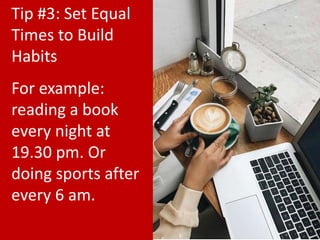
Tip #3: Set Equal
Times to Build
Habits
For example:
reading a book
every night at
19.30 pm. Or
doing sports after
every 6 am.
Habit that is
done at the same
hour will be
easier to stick in
your daily
behavior.
Tip # 4 :
Attach New Habit to
Past Habit
Tip #3: Embed New Habits in
Old Habits
After dinner (old habit), you can
attach a new habit, for example:
going to read one page of your
favorite book.
Another example :
after waking up in
the morning (old
habit) you can build
new habit, such as
doing meditation or
walking for 5
minutes.
36
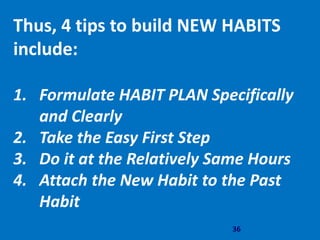
Thus, 4 tips to build NEW HABITS
include:
1. Formulate HABIT PLAN Specifically
and Clearly
2. Take the Easy First Step
3. Do it at the Relatively Same Hours
4. Attach the New Habit to the Past
Habit
Change Your Habits,
Change Your Life
37

Atomic habits ppt

  • 1.
  • 3.
    These slides arejust samples. You can download full version of these PPT files at : www.HR-management-slides.com
  • 4.
    4 This international bestseller (whichhas sold over 3 million copies worldwide) was written by James Clear, a well- known blogger who is also an expert in the science of habits.
  • 5.
    5 Atomic Habits, in detail,explains various practical techniques and tips to build good habits, and at the same time to eliminate bad habits.
  • 6.
    6 Why Are TheyCalled Atomic Habits? This book is entitled Atomic Habits for two reasons. The first, the smallest component of our lives is actually the daily habits that we do. This habit will then determine the pattern of our daily behavior.
  • 7.
    7 Furthermore, this patternof behavior will determine our destiny in the future. From this schematic, it is obvious that habits are the core component of our lives, but slowly they can have a tremendous impact on our future.
  • 8.
    The second reasonof why it is called atomic habits, because this book explains that the best way to start a new positive habit is to start it through "tiny habits” or small habits that are easy to do. Atomic habits invites us to start a new habit by starting from small components, or from small easy-to-do activities. 8
  • 9.
    9 Focus on Habitsor System, not on Goal James Clear writes: instead of focusing on goals or dreams obsessively, it's much better to focus on what habits you need to create, so that your dreams will slowly come true by themselves.
  • 10.
    10 These habits mustbe daily executed. This set of habits is like your “work system”. If this habit or work system is done repeatedly, then rest assured, your dreams will slowly come true.
  • 11.
    11 Example: A personhas a dream to write a book. However, the dream is then just always planned; but never leads to real action. In the end, his or her dream will never come true. It would be better for that person to compose new habits which are then used as a kind of work system. His new habit is simple: every morning at 8am just write 1 page (or 250 words). Then he could do this habit repeatedly every day. Over the time, this habit will make him successful in writing a complete book.
  • 12.
    12 3 Key Tipsof Building GOOD HABITS
  • 13.
    Tip #1: Make ItObvious (make the new habit as something clear, measurable and concrete)
  • 14.
    14 The mistake ofmany people when they want to start a new habit is to only plan in abstract and non-specific sentences. For example, when someone wants to start a sports habit, he just says: Starting tomorrow, I want to do exercise. Or when someone wants to start a new habit of reading books, he just says: Starting next week I will start reading books diligently.
  • 15.
    15 Such intention isuseless, because it is very abstract and non-specific. James Clear wrote: determining to start the new habit must be manifested in a plan that is specific and concrete. This habit plan is also known as habit implementation plan.
  • 16.
    16 Here are some examplesof habit implementation plan
  • 17.
    17 I will start readingthe book every night after dinner, for only 10 minutes (example of reading habit plan)
  • 18.
    18 I will startwalking every morning at 6 am for only 10 minutes, around my housing complex (example of exercise habit plan)
  • 19.
    19 I will writedown 3 main things that I will do every morning at 8am, before turning on the laptop at the office (working habit)
  • 20.
    20 I will learnand practice about online business every night from 8pm to 9pm (personal growth habit)
  • 21.
    21 From various examplesof habit plan above, we can see how we formulate this habit plan specifically and when it will be done every day. This kind of method has proven to help our minds to really focus on the real actions that we must do.
  • 22.
    22 In formulating thehabit plan, it is recommended that we formulate the implementation of the habit at relatively the same hours each day. Why? Because by determining the same hour or time for each habit implementation, our bodies will also be easier to adapt to these new habits.
  • 23.
    Tip # 2: Start SMALL (take baby steps and simple action)
  • 24.
    Tip #2 :Start Small. Other practical tips described in the Atomic Habits are: when we want to start a new habit, we should start with small steps that are easy to do.
  • 25.
    Starting a new habitwith a small scale and short duration can actually encourage us to genuinely want to do it. Because it's small and easy.
  • 26.
    Why should thefirst action be so simple and easy to do? Because basically we are all lazy and resistant to change. To fight the inertia (the tendency to be lazy to move) that resides in your body, then the first action should be so simple.
  • 27.
    An example ofsuch a simple action: Instead of running 1 KM per week, starting tomorrow, just walk around the office for 3 minutes, every afternoon break. Just 3 minutes.
  • 28.
    Another simple action: Insteadof reading 3 or 4 books per week, just start reading 1 page from tomorrow, every night after dinner. Just one page.
  • 29.
    29 Starting a smallscale and easy-to-do habit, will encourage us to do it. Furthermore, this small step at the beginning will slowly enlarge by itself due to the effect of momentum. That is, after we are able to do the new habit on a regular basis, then slowly we are motivated to do it on an increasingly large scale.
  • 30.
    Tip # 3: Do New Habit at the Same Hour
  • 31.
    Tip #3: SetEqual Times to Build Habits For example: reading a book every night at 19.30 pm. Or doing sports after every 6 am.
  • 32.
    Habit that is doneat the same hour will be easier to stick in your daily behavior.
  • 33.
    Tip # 4: Attach New Habit to Past Habit
  • 34.
    Tip #3: EmbedNew Habits in Old Habits After dinner (old habit), you can attach a new habit, for example: going to read one page of your favorite book.
  • 35.
    Another example : afterwaking up in the morning (old habit) you can build new habit, such as doing meditation or walking for 5 minutes.
  • 36.
    36 Thus, 4 tipsto build NEW HABITS include: 1. Formulate HABIT PLAN Specifically and Clearly 2. Take the Easy First Step 3. Do it at the Relatively Same Hours 4. Attach the New Habit to the Past Habit
  • 37.