CMOS FABRICATION
USING P-WELL
VLSI DESIGN
NITHIN KALLEPALLY
CMOS FABRICATION
• For less power dissipation requirement CMOS technology is used
for implementing transistors. If we require a faster circuit then
transistors are implemented over IC using BJT . Fabrication
of CMOS transistors as IC’s can be done in three different
methods.
• The N-well / P-well technology, where n-type diffusion is done
over a p-type substrate or p-type diffusion is done over n-type
substrate respectively.
P-WELL PROCESS
• The fabrication steps of p well process are same as that of an n-well process except
that instead of n-well a p-well is implanted .The process steps involved in p-well
process are shown in Figure below.The process starts with the n type substrate
• Step 1 : A thin layer of SiO2 is deposited which will serve as the pad oxide.
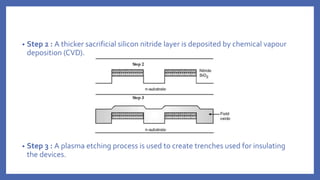
• Step 2 : A thicker sacrificial silicon nitride layer is deposited by chemical vapour
deposition (CVD).
• Step 3 : A plasma etching process is used to create trenches used for insulating
the devices.
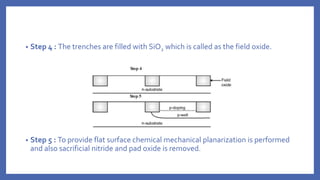
• Step 4 : The trenches are filled with SiO2 which is called as the field oxide.
• Step 5 : To provide flat surface chemical mechanical planarization is performed
and also sacrificial nitride and pad oxide is removed.
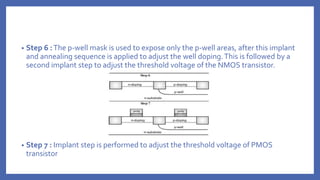
• Step 6 :The p-well mask is used to expose only the p-well areas, after this implant
and annealing sequence is applied to adjust the well doping.This is followed by a
second implant step to adjust the threshold voltage of the NMOS transistor.
• Step 7 : Implant step is performed to adjust the threshold voltage of PMOS
transistor
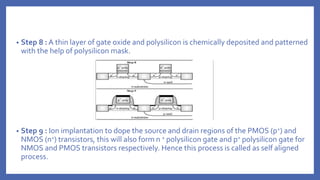
• Step 8 : A thin layer of gate oxide and polysilicon is chemically deposited and patterned
with the help of polysilicon mask.
• Step 9 : Ion implantation to dope the source and drain regions of the PMOS (p+) and
NMOS (n+) transistors, this will also form n + polysilicon gate and p+ polysilicon gate for
NMOS and PMOS transistors respectively. Hence this process is called as self aligned
process.
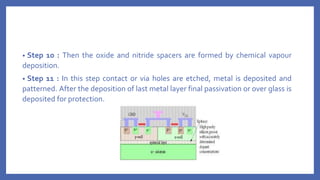
• Step 10 : Then the oxide and nitride spacers are formed by chemical vapour
deposition.
• Step 11 : In this step contact or via holes are etched, metal is deposited and
patterned. After the deposition of last metal layer final passivation or over glass is
deposited for protection.
THANK YOU…

CMOS Fabrication using P-well -VLSI

  • 1.
    CMOS FABRICATION USING P-WELL VLSIDESIGN NITHIN KALLEPALLY
  • 2.
    CMOS FABRICATION • Forless power dissipation requirement CMOS technology is used for implementing transistors. If we require a faster circuit then transistors are implemented over IC using BJT . Fabrication of CMOS transistors as IC’s can be done in three different methods. • The N-well / P-well technology, where n-type diffusion is done over a p-type substrate or p-type diffusion is done over n-type substrate respectively.
  • 3.
    P-WELL PROCESS • Thefabrication steps of p well process are same as that of an n-well process except that instead of n-well a p-well is implanted .The process steps involved in p-well process are shown in Figure below.The process starts with the n type substrate • Step 1 : A thin layer of SiO2 is deposited which will serve as the pad oxide.
  • 4.
    • Step 2: A thicker sacrificial silicon nitride layer is deposited by chemical vapour deposition (CVD). • Step 3 : A plasma etching process is used to create trenches used for insulating the devices.
  • 5.
    • Step 4: The trenches are filled with SiO2 which is called as the field oxide. • Step 5 : To provide flat surface chemical mechanical planarization is performed and also sacrificial nitride and pad oxide is removed.
  • 6.
    • Step 6:The p-well mask is used to expose only the p-well areas, after this implant and annealing sequence is applied to adjust the well doping.This is followed by a second implant step to adjust the threshold voltage of the NMOS transistor. • Step 7 : Implant step is performed to adjust the threshold voltage of PMOS transistor
  • 7.
    • Step 8: A thin layer of gate oxide and polysilicon is chemically deposited and patterned with the help of polysilicon mask. • Step 9 : Ion implantation to dope the source and drain regions of the PMOS (p+) and NMOS (n+) transistors, this will also form n + polysilicon gate and p+ polysilicon gate for NMOS and PMOS transistors respectively. Hence this process is called as self aligned process.
  • 8.
    • Step 10: Then the oxide and nitride spacers are formed by chemical vapour deposition. • Step 11 : In this step contact or via holes are etched, metal is deposited and patterned. After the deposition of last metal layer final passivation or over glass is deposited for protection.
  • 9.