VLAN
-VIRTUAL LAN
NITHIN KALLEPALLY
COMPUTER
NETWORKS
LAN
 A Local Area Network (LAN) was originally defined
as a network of computers located within the same
area
 Local Area Networks are defined as a single
broadcast domain. This means that if a user
broadcasts information on his/her LAN, the
broadcast will be received by every other user on the
LAN.
 Broadcasts are prevented from leaving a LAN by
using a router. The disadvantage of this method is
routers usually take more time to process incoming
data compared to a bridge or a switch
VLAN
A VLAN is a logical group of network devices
that appears to be on the same LAN
Configured as if they are attached to the
same physical connection even if they are
located on a number of different LAN
segments.
Logically segment LAN into different
broadcast domains.
VLAN
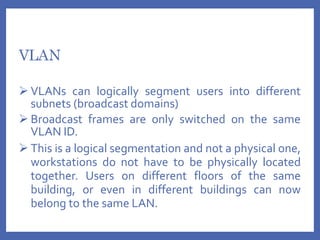
 VLANs can logically segment users into different
subnets (broadcast domains)
 Broadcast frames are only switched on the same
VLAN ID.
 This is a logical segmentation and not a physical one,
workstations do not have to be physically located
together. Users on different floors of the same
building, or even in different buildings can now
belong to the same LAN.
LAN VS VLAN
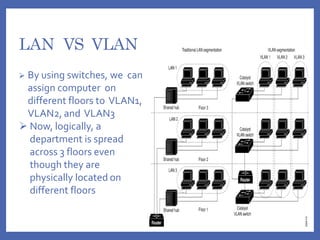
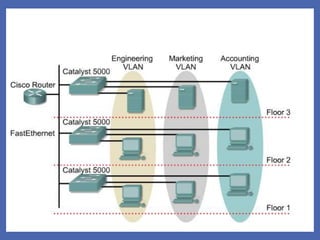
 By using switches, we can
assign computer on
different floors to VLAN1,
VLAN2, and VLAN3
 Now, logically, a
department is spread
across 3 floors even
though they are
physically located on
different floors
VLAN Configurations
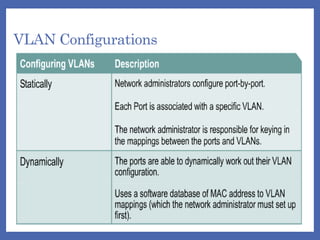
STATIC VLANS
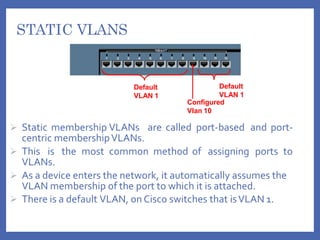
 Static membership VLANs are called port-based and port-
centric membershipVLANs.
 This is the most common method of assigning ports to
VLANs.
 As a device enters the network, it automatically assumes the
VLAN membership of the port to which it is attached.
 There is a default VLAN, on Cisco switches that isVLAN 1.
Default
VLAN 1
Default
VLAN 1
Configured
Vlan 10
DYNAMIC VLANS
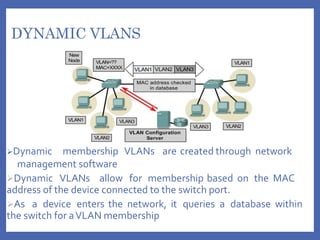
Dynamic membership VLANs are created through network
management software
Dynamic VLANs allow for membership based on the MAC
address of the device connected to the switch port.
As a device enters the network, it queries a database within
the switch for aVLAN membership
CONFIGURING PORTS
 Access ports are used when:
 Only a single device is connected to the port
 Multiple devices (hub) are connected to the port, all
belonging to the sameVLAN
 Another switch is connected to this interface, but this
link is only carrying a singleVLAN (non- trunk link).
 Trunk ports are used when:
 Another switch is connected to this interface, and this
link is carrying multipleVLANs(trunk link).
• Switch(config-if)switchport mode
[access|trunk]
• An access port means that the port (interface)
can only belong to a single VLAN.
ADVANTAGES
• Performance
• Formation ofVirtualWorkgroups
• SimplifiedAdministration
• Reduced Cost
• Security
THANK
YOU…

VLAN -VIRTUAL LAN -COMPUTER NETWORKS

  • 1.
  • 2.
    LAN  A LocalArea Network (LAN) was originally defined as a network of computers located within the same area  Local Area Networks are defined as a single broadcast domain. This means that if a user broadcasts information on his/her LAN, the broadcast will be received by every other user on the LAN.  Broadcasts are prevented from leaving a LAN by using a router. The disadvantage of this method is routers usually take more time to process incoming data compared to a bridge or a switch
  • 3.
    VLAN A VLAN isa logical group of network devices that appears to be on the same LAN Configured as if they are attached to the same physical connection even if they are located on a number of different LAN segments. Logically segment LAN into different broadcast domains.
  • 4.
    VLAN  VLANs canlogically segment users into different subnets (broadcast domains)  Broadcast frames are only switched on the same VLAN ID.  This is a logical segmentation and not a physical one, workstations do not have to be physically located together. Users on different floors of the same building, or even in different buildings can now belong to the same LAN.
  • 5.
    LAN VS VLAN By using switches, we can assign computer on different floors to VLAN1, VLAN2, and VLAN3  Now, logically, a department is spread across 3 floors even though they are physically located on different floors
  • 7.
  • 8.
    STATIC VLANS  Staticmembership VLANs are called port-based and port- centric membershipVLANs.  This is the most common method of assigning ports to VLANs.  As a device enters the network, it automatically assumes the VLAN membership of the port to which it is attached.  There is a default VLAN, on Cisco switches that isVLAN 1. Default VLAN 1 Default VLAN 1 Configured Vlan 10
  • 9.
    DYNAMIC VLANS Dynamic membershipVLANs are created through network management software Dynamic VLANs allow for membership based on the MAC address of the device connected to the switch port. As a device enters the network, it queries a database within the switch for aVLAN membership
  • 10.
    CONFIGURING PORTS  Accessports are used when:  Only a single device is connected to the port  Multiple devices (hub) are connected to the port, all belonging to the sameVLAN  Another switch is connected to this interface, but this link is only carrying a singleVLAN (non- trunk link).  Trunk ports are used when:  Another switch is connected to this interface, and this link is carrying multipleVLANs(trunk link).
  • 11.
    • Switch(config-if)switchport mode [access|trunk] •An access port means that the port (interface) can only belong to a single VLAN.
  • 12.
    ADVANTAGES • Performance • FormationofVirtualWorkgroups • SimplifiedAdministration • Reduced Cost • Security
  • 13.