GRAY IMAGE
WATERMARKING
USING SLANT
TRANSFORM
NITHIN KALLEPALLY
DIGITAL IMAGE PROCESSING
• With the swift sprouting of internet and information technology, the information
exchange process is being carried out in the form of digital text, image, audio
and video. Information in digital format can be modified without loss in quality and
content and can be efficiently distributed with a great ease. The ease with which
digital content can be exchanged over the Internet has created copyright
infringement issues and has caused major concerns to digital content owner who
produces those digital content.
• This leads to a serious requirement of a robust technique that can address the
security of those information such that the authenticity, availability, confidentiality
,identity and integrity of the information is maintained. Digital image watermarking
is one of the techniques for solving copyright and ownership issues. In this a
pattern of bits are inserted into a digital image, audio, video or text file that
identifies the file's copyright information
• SLANT TRANSFORM
• This section details the proposed semi-blind watermarking scheme for copyright protection of digital images.
The following subsections present the steps involved in the watermark embedding and extraction processes
along with a brief description about the Slant transform, DWT and SVD
Slant transform is derived from saw tooth waveforms.Aslant transform matrix has a constant basis vector
corresponding to zero sequency and slant basis vector basis vectors monotonically decreases with sequency
inconstant step from maximum to minimum. The matrix has sequency property and high energy compaction
property[12]. The lowest order of slant matrix is 2 and 2 X 2 matrix is identical to Hadamard matrix
Let é/] be the original image of size N x N , its 2O-Slant transform is given by [5]
(1)
where S is the N x N unitary Slant matrix. The inverse transformation to recover [U
Tom the transform components V is given by
The Slant transform is a member of the orthogonal transforms. It has a constant function for
the first row, and has a second row which is a linear (slant) function of the column index.
The Slant transform matrix of order two is given by
1
1. Watermarking in Slant Transform domain
2. A generic block diagram of the blind watermarking system Figure 1. The original image is not necessary at
the watermark recovery stage. This refers to ‘Tlind” watermarking process. A visually recognizable pattern
is embedded by modifying the Slant transform coefficients of relevant sub-blocks of the host image. The
detailed Image-embedded watermark insertion and extraction algorithm are discussed in this section.
3. Copyright information in the form of a trademark or logo can be created as a pattern for watermarking. In our
experiment, a grayscale image of size 64 x 64 is used as the watermark. The watermark insertion process is
shown in Figure 2. We adapt a image-embedded watermark insertion algorithm as in [I], while using the
Slant transform domain instead of the Hadamard transform
The watermark image, W x,y) , is first transformed into a
set of Slant transform coefficients by equation (1). A Slant transform matrix of order 64 is applied
to this image, Let the original image be fax y) . Similar to the algorithm used in [1,2], it is
decomposed into a set of non-overlapped 8 x 8 sub-blocks. An m-sequence random number
generator is used to select a certain number of sub-blocks for watermark embedding, whose
initial seed is also kept in the secret key file. In every selected sub-block, sixteen middle and high
frequency coefficients are used for later modulation. The way of the coefficients selection affects
the performance of the watermarking scheme significantly
• The high frequency components are relatively vulnerable to compression operations, while the low frequency
components must be retained for visual quality of the watermarked image. Therefore, most existing
watermarking schemes choose to embed the watermark into the middle frequency band. In our scheme,
embedding locations as shown in Figure 3 are adopted, which are observed, through our experiments, to
provide a best tradeoff between robustness and data integrity.
Let the watermark Slant transform coefficients denoted by m,. The AC co efficients of Slant transformed original
image sub-blocks, before and after inserting watermark are
denoted by r, and x' , respectively, and i z (0, n) , where n
is the number of the watermarked coefficients to be inserted into every sub-block, which is set to 16 in our
experiment.
The embedding formula is given as follows
•In watermark detection, the positions of the sub-blocks with watermark embedded are computed
using the seed of the m-sequence and initial state number that is stored in the key file. All the
selected sub-blocks are Slant transformed. Let
•these coefficients denoted by z'’ atid the retrieved
•watermark Slant transform coefficients by m, , i e (0, n],
•where n is the number of the watert marked coefficients to be inserted in every sub-block. The
watermark extraction formula is given by
•
The exacted AC coefficients and the DC component stored in the key file are rearranged
into a 64 x 64 Slant transform coefficients matrix. The extracted watermark image, IP’ (z, y)
, is then obtained by an inverse Slant
transform using equation (2).
• Simulation Results
• We use two 512 x 512 gray-scale satellite images with distinct texture to test our algorithm. The
original and watermarked images are shown in FiG. Results show that there are no perceptually
visible degradations on the watermarked images with a PSNR of 37.43 dB for Singapore and 40.65
dB for Dolomites.
CONCLUSION
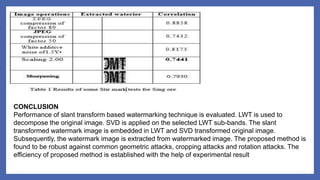
Performance of slant transform based watermarking technique is evaluated. LWT is used to
decompose the original image. SVD is applied on the selected LWT sub-bands. The slant
transformed watermark image is embedded in LWT and SVD transformed original image.
Subsequently, the watermark image is extracted from watermarked image. The proposed method is
found to be robust against common geometric attacks, cropping attacks and rotation attacks. The
efficiency of proposed method is established with the help of experimental result
THANK YOU …

Gray Image Watermarking using slant transform - digital image processing

  • 1.
    GRAY IMAGE WATERMARKING USING SLANT TRANSFORM NITHINKALLEPALLY DIGITAL IMAGE PROCESSING
  • 2.
    • With theswift sprouting of internet and information technology, the information exchange process is being carried out in the form of digital text, image, audio and video. Information in digital format can be modified without loss in quality and content and can be efficiently distributed with a great ease. The ease with which digital content can be exchanged over the Internet has created copyright infringement issues and has caused major concerns to digital content owner who produces those digital content. • This leads to a serious requirement of a robust technique that can address the security of those information such that the authenticity, availability, confidentiality ,identity and integrity of the information is maintained. Digital image watermarking is one of the techniques for solving copyright and ownership issues. In this a pattern of bits are inserted into a digital image, audio, video or text file that identifies the file's copyright information
  • 3.
    • SLANT TRANSFORM •This section details the proposed semi-blind watermarking scheme for copyright protection of digital images. The following subsections present the steps involved in the watermark embedding and extraction processes along with a brief description about the Slant transform, DWT and SVD Slant transform is derived from saw tooth waveforms.Aslant transform matrix has a constant basis vector corresponding to zero sequency and slant basis vector basis vectors monotonically decreases with sequency inconstant step from maximum to minimum. The matrix has sequency property and high energy compaction property[12]. The lowest order of slant matrix is 2 and 2 X 2 matrix is identical to Hadamard matrix Let é/] be the original image of size N x N , its 2O-Slant transform is given by [5] (1)
  • 4.
    where S isthe N x N unitary Slant matrix. The inverse transformation to recover [U Tom the transform components V is given by The Slant transform is a member of the orthogonal transforms. It has a constant function for the first row, and has a second row which is a linear (slant) function of the column index. The Slant transform matrix of order two is given by 1
  • 6.
    1. Watermarking inSlant Transform domain 2. A generic block diagram of the blind watermarking system Figure 1. The original image is not necessary at the watermark recovery stage. This refers to ‘Tlind” watermarking process. A visually recognizable pattern is embedded by modifying the Slant transform coefficients of relevant sub-blocks of the host image. The detailed Image-embedded watermark insertion and extraction algorithm are discussed in this section. 3. Copyright information in the form of a trademark or logo can be created as a pattern for watermarking. In our experiment, a grayscale image of size 64 x 64 is used as the watermark. The watermark insertion process is shown in Figure 2. We adapt a image-embedded watermark insertion algorithm as in [I], while using the Slant transform domain instead of the Hadamard transform
  • 7.
    The watermark image,W x,y) , is first transformed into a set of Slant transform coefficients by equation (1). A Slant transform matrix of order 64 is applied to this image, Let the original image be fax y) . Similar to the algorithm used in [1,2], it is decomposed into a set of non-overlapped 8 x 8 sub-blocks. An m-sequence random number generator is used to select a certain number of sub-blocks for watermark embedding, whose initial seed is also kept in the secret key file. In every selected sub-block, sixteen middle and high frequency coefficients are used for later modulation. The way of the coefficients selection affects the performance of the watermarking scheme significantly
  • 8.
    • The highfrequency components are relatively vulnerable to compression operations, while the low frequency components must be retained for visual quality of the watermarked image. Therefore, most existing watermarking schemes choose to embed the watermark into the middle frequency band. In our scheme, embedding locations as shown in Figure 3 are adopted, which are observed, through our experiments, to provide a best tradeoff between robustness and data integrity. Let the watermark Slant transform coefficients denoted by m,. The AC co efficients of Slant transformed original image sub-blocks, before and after inserting watermark are denoted by r, and x' , respectively, and i z (0, n) , where n is the number of the watermarked coefficients to be inserted into every sub-block, which is set to 16 in our experiment. The embedding formula is given as follows
  • 9.
    •In watermark detection,the positions of the sub-blocks with watermark embedded are computed using the seed of the m-sequence and initial state number that is stored in the key file. All the selected sub-blocks are Slant transformed. Let •these coefficients denoted by z'’ atid the retrieved •watermark Slant transform coefficients by m, , i e (0, n], •where n is the number of the watert marked coefficients to be inserted in every sub-block. The watermark extraction formula is given by • The exacted AC coefficients and the DC component stored in the key file are rearranged into a 64 x 64 Slant transform coefficients matrix. The extracted watermark image, IP’ (z, y) , is then obtained by an inverse Slant transform using equation (2).
  • 10.
    • Simulation Results •We use two 512 x 512 gray-scale satellite images with distinct texture to test our algorithm. The original and watermarked images are shown in FiG. Results show that there are no perceptually visible degradations on the watermarked images with a PSNR of 37.43 dB for Singapore and 40.65 dB for Dolomites.
  • 11.
    CONCLUSION Performance of slanttransform based watermarking technique is evaluated. LWT is used to decompose the original image. SVD is applied on the selected LWT sub-bands. The slant transformed watermark image is embedded in LWT and SVD transformed original image. Subsequently, the watermark image is extracted from watermarked image. The proposed method is found to be robust against common geometric attacks, cropping attacks and rotation attacks. The efficiency of proposed method is established with the help of experimental result
  • 12.