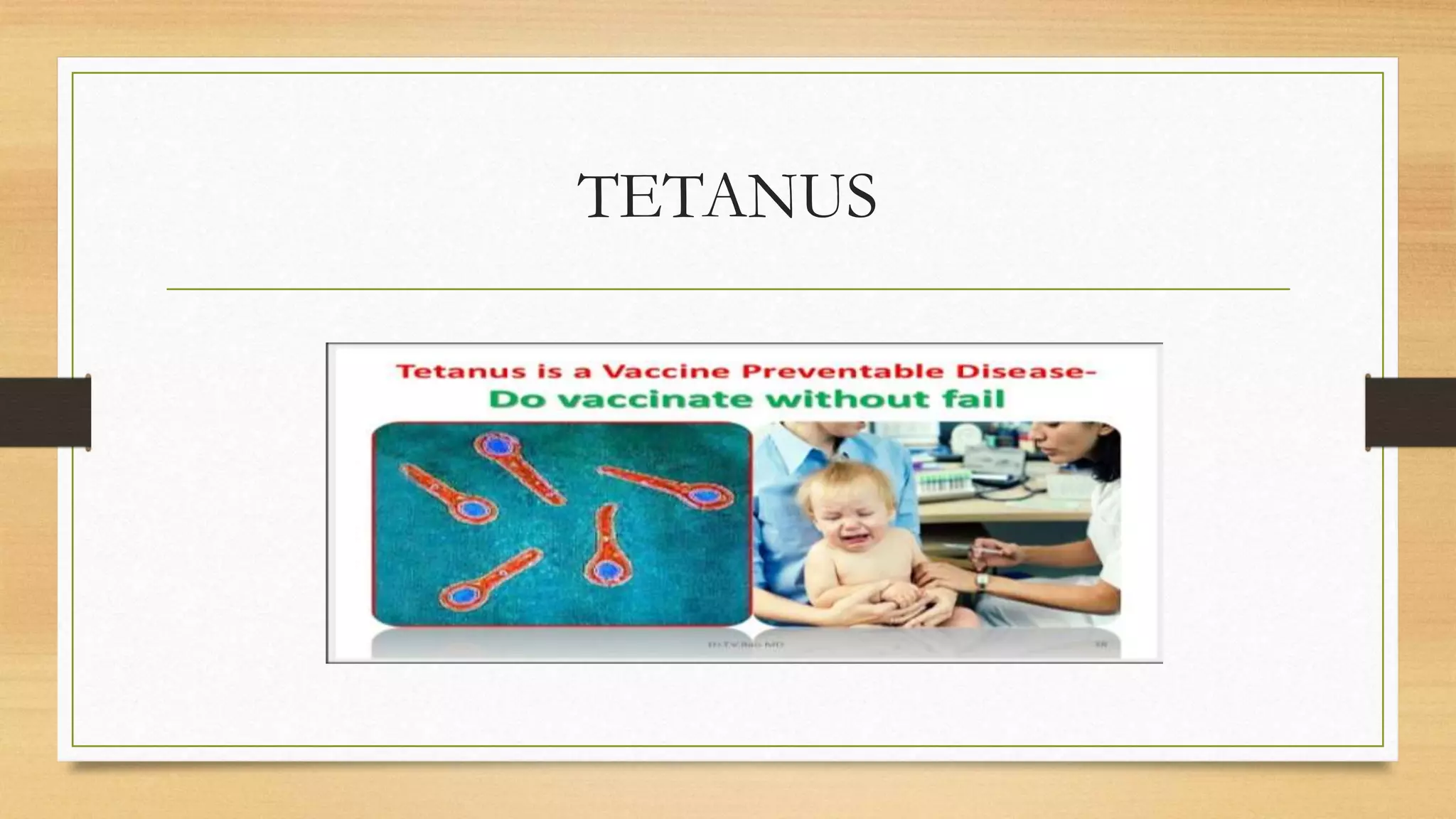
TETANUS
CONTENTS
• Introduction
• Causative agent
• Epidemiology
• Transmission, Host factors, Route of entry
• Mechanism of action of toxin
• Symptoms
• Prevention
• Cure
• Conclusion
• References
INTRODUCTION
• Tetanus-a Greek word – to stretch
• First described by Hippocrates & Susruta
• Tetanus an neurological disease characterized by an acute onset of hypertonia,
painful muscular contractions ( usually of the muscles of the jaw and neck), and
generalized muscle spasms without others apparent medical causes.
• Only vaccine preventable disease that is infectious but not contagious.
CAUSATIVE AGENT
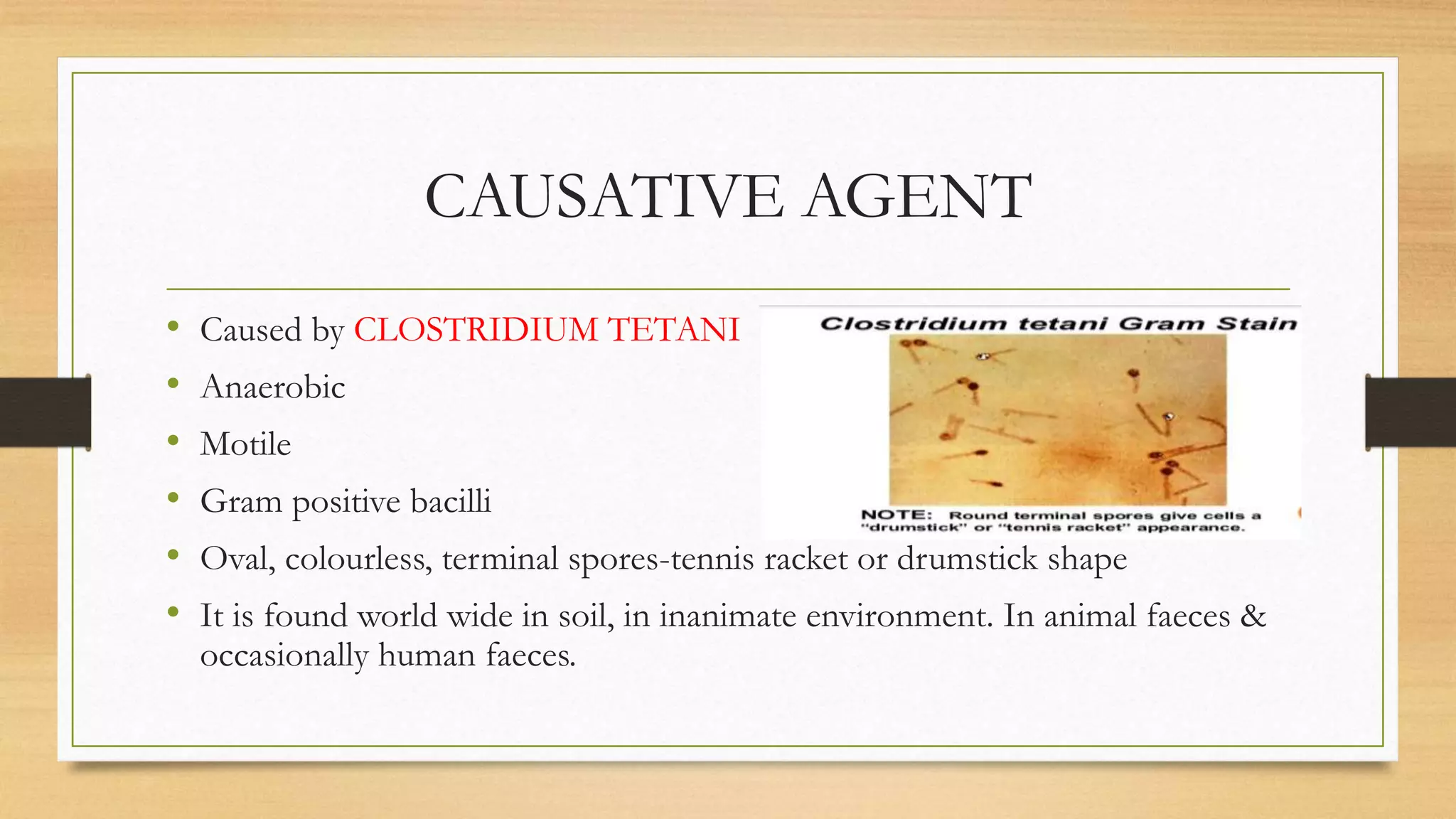
• Caused by CLOSTRIDIUM TETANI
• Anaerobic
• Motile
• Gram positive bacilli
• Oval, colourless, terminal spores-tennis racket or drumstick shape
• It is found world wide in soil, in inanimate environment. In animal faeces &
occasionally human faeces.
EPIDEMIOLOGY
• Tetanus is an international health problem, as spores are ubiquitous. The disease
occurs almost exclusively in persons who are unvaccinated or inadequately
immunized.
• Entirely preventable disease by immunization
• Tetanus occurs worldwide but is common in hot, damp climates with soil rich in
organic matter.
• More prevalent in industrial establishment, where agricultural workers are
employed.
TRANSMISSION
• Tetanus is not transmitted from person to person. Infection occurs when C.tetani spores are
introduced into acute wounds from trauma, surgeries and infections, or chronic skin lesions
and infections.
• Cases have resulted from wounds that were considered too trivial to warrant medical
attention.
• The incubation periods of tetanus is usually between 3 and 21 days (median 7 days). Shorter
incubation periods (<7 days) along with delays in seeking treatment are associated with fatal
outcomes.
• Outbreaks of tetanus related to injuries associated with natural disasters such as earthquakes
and tsunami's have been documented.
HOST FACTORS
• Age: It is the disease of active age 5-40 years.
• Sex: Higher incidence in males than females.
• Occupation: Agricultural workers are at higher risk.
• Rural & urban difference: Incidence of tetanus in urban areas is much lower
than in rural areas.
• Immunity: Hard immunity does not protect the individual.
• Environmental and social factors: Unhygienic custom habits, unhygienic
delivery practices.
ROUTE OF ENTRY
• Apparently trivial injuries
• Animal bites & human bites
• Open fractures
• Burns
• Gangrene
• Parenteral drug abuse
TETANUS PRONE WOUND
• A wound sustained more than 6 hr before surgical treatment.
• A wound sustained at any interval after injury which is puncture type or shows
much devitalized tissue or is septic or is contaminated with soil or manure.
• Spores that gain entry can persist in normal tissue for months to years under
anaerobic conditions.
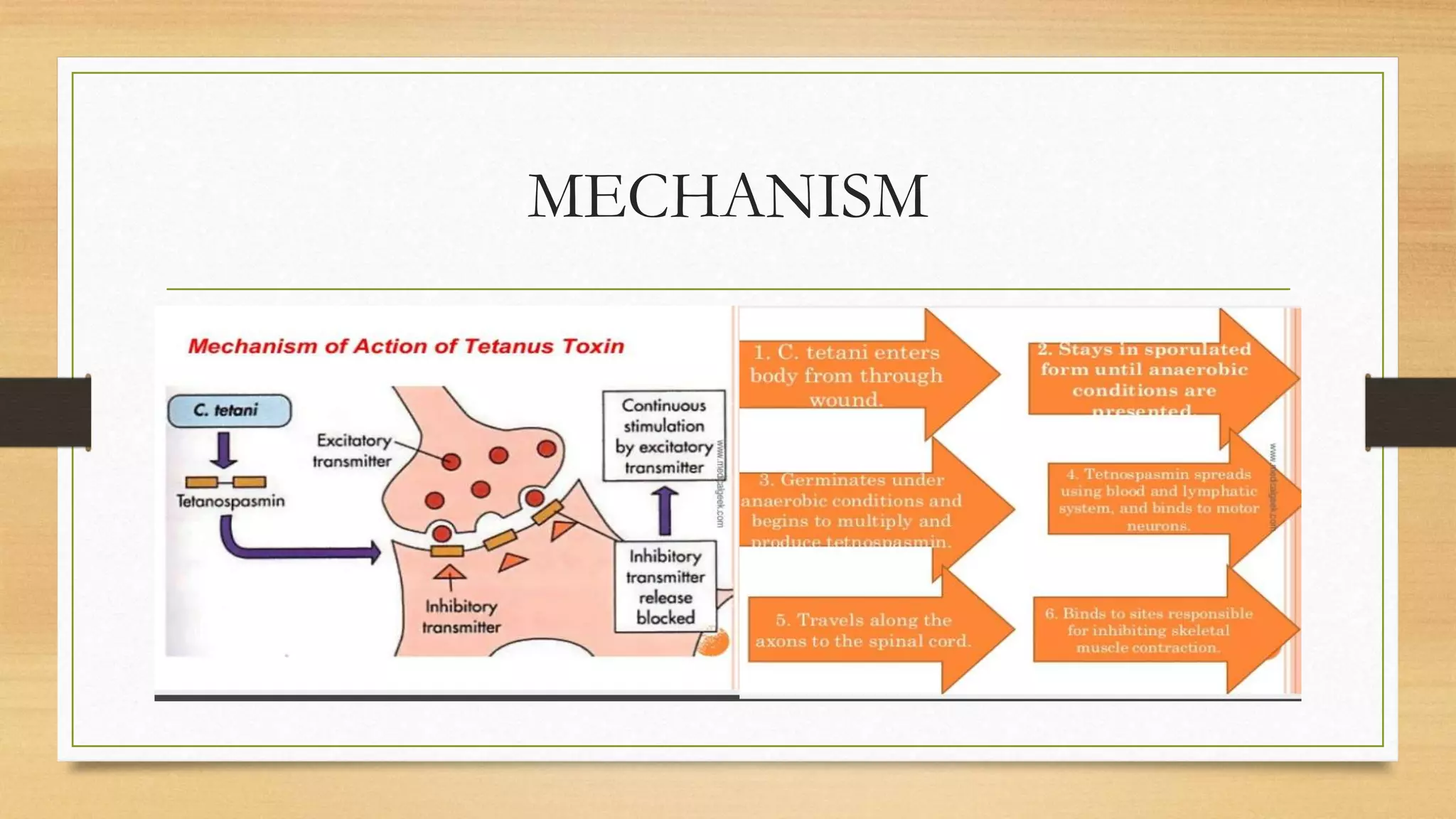
• When the oxygen levels in the surrounding tissue is sufficiently low, the implanted
C.tetani spore then germinates into a new, active vegetative cell that grows and
multiplies and most importantly produces tetanus toxin- tetanospasmin and
tetanolysin.
TETANOLYSIN
Tetanolysin is not believed to be of any significance in the clinical course of
tetanus.
A hemolytic toxin produced by the tetanus bacillus(Clostridium tetani)
TETANOSPASMIN
It is a neurotoxin and causes the clinical manifestations of tetanus.
MECHANISM
SYMPTOMS
• If the muscle spasms affect the larynx or chest wall, they may cause
asphyxiation.
• Stiffness of jaw (also called lock jaw)
• Stiffness of abdominal and back muscle
• Contraction of facial muscles
• Fast pulse
• Fever
• sweating
METHOD OF PREVENTION
• IMMUNIZATION
• A person recovering from tetanus should begin active immunization with
tetanus toxoid during convalescence.
• The tetanus toxoid is a formalin inactivated toxin, with an efficiency of
approx.100%.
• Because the antitoxin levels decrease over time booster immunization shots
are needed every 10 years.
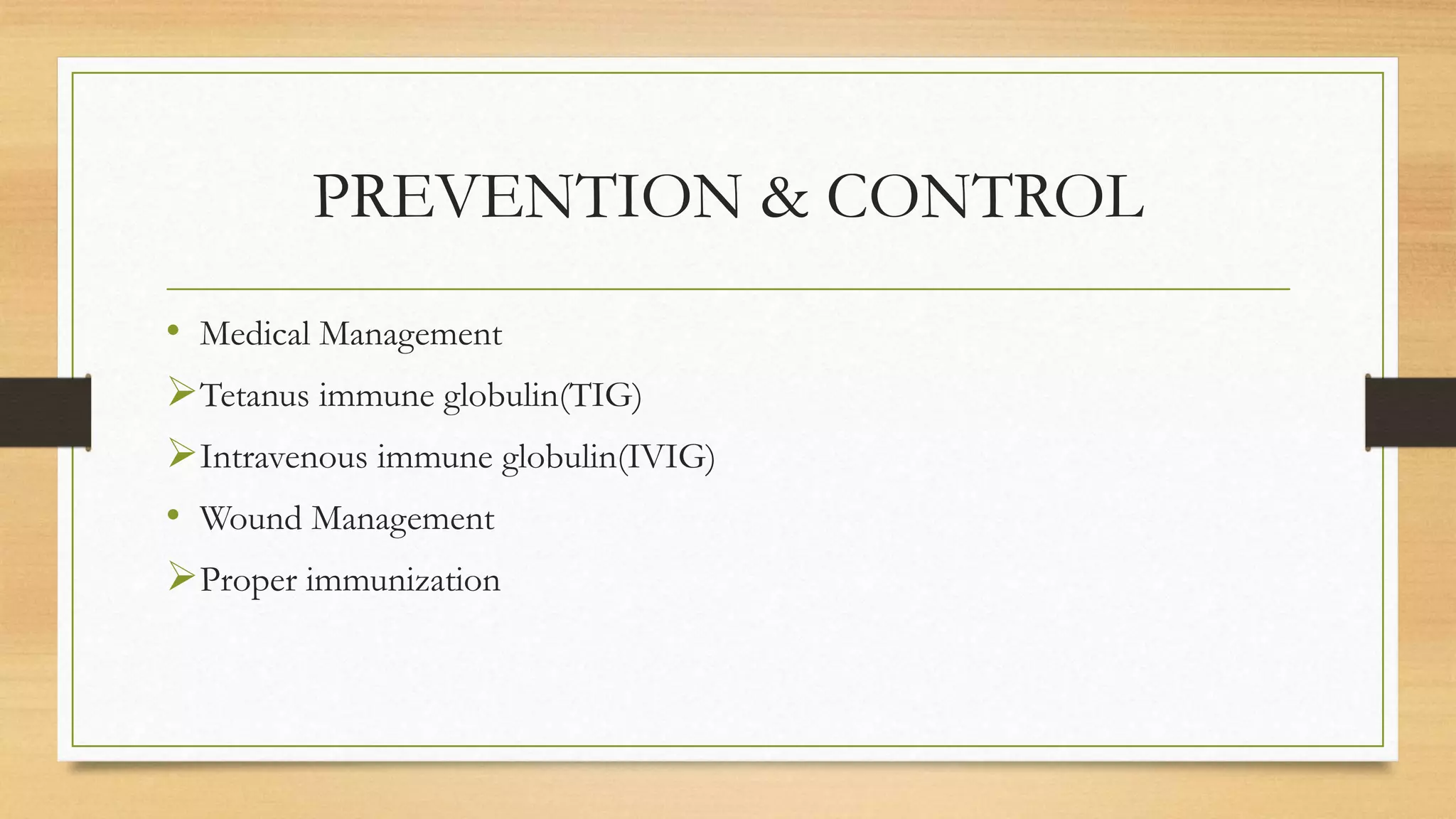
PREVENTION & CONTROL
• Medical Management
Tetanus immune globulin(TIG)
Intravenous immune globulin(IVIG)
• Wound Management
Proper immunization
OTHER SUPPORTING MEASURES
• Remove and destroy the source of the toxin through surgical exploration and
cleaning of the wound.
• Bed rest with a non stimulating environment may be recommended.
• Sedation may be necessary to keep the affected person calm.
• Respiratory support with oxygen and mechanical ventilation may be
necessary.
SPECIFIC TREATMENT
• Wound should be debrided widely.
• Maintain an adequate airway.
• Employ sedation or muscle.
• Active immunization.
• Special air flow equipment and filtered ventilation.
• Reduce airborne particles.
• Surgical instruments and dressing sterilization.
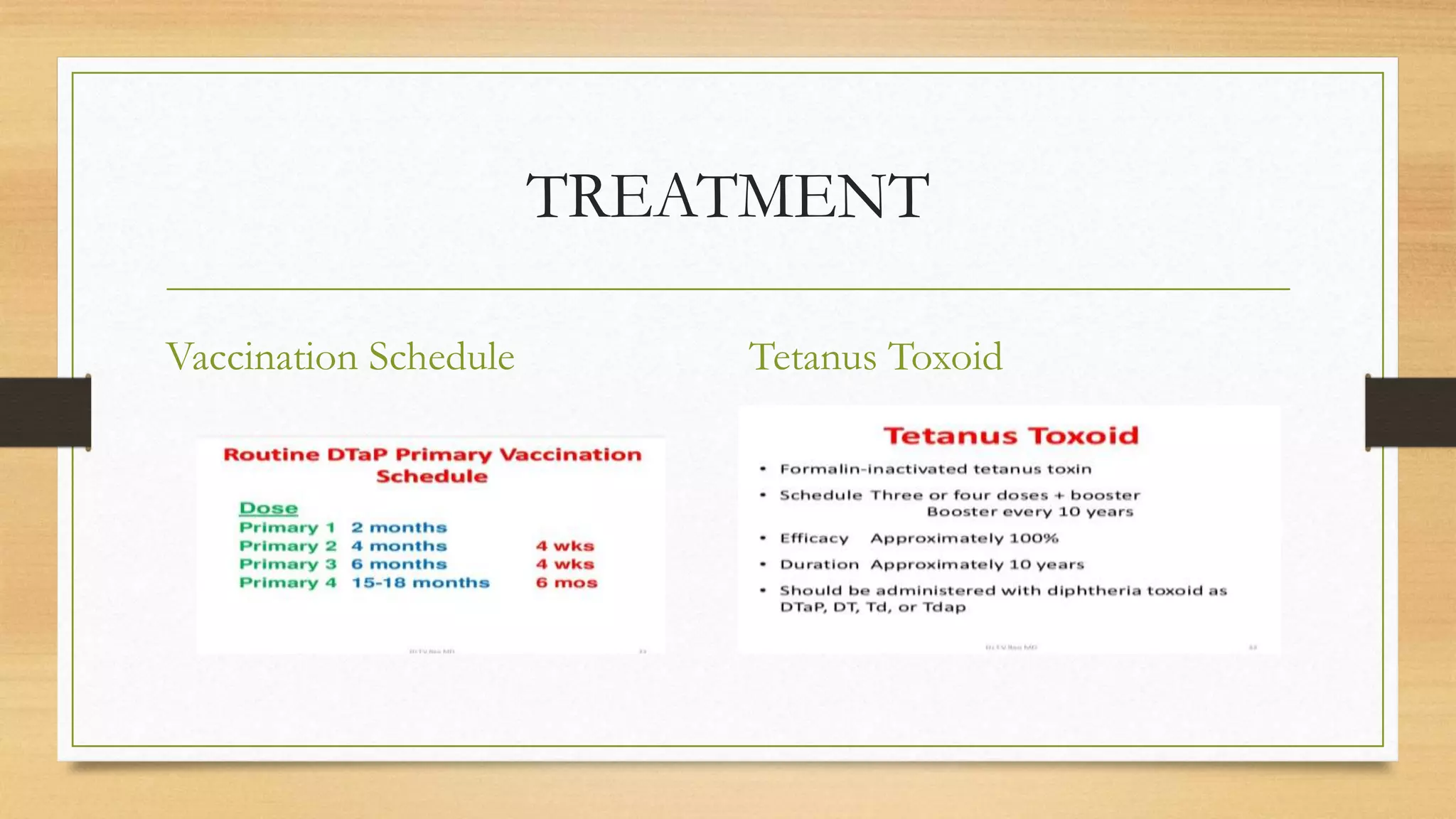
TREATMENT
Vaccination Schedule Tetanus Toxoid
CURE
• ANTIBIOTICS
• The antibiotics may prevent multiplication of C.tetani , thus halting
production of toxin .
• Penicillin G was the drug of choice initially but now Metronidazole is
preferred drug.
• Doxycycline, Clindamycin and Erythromycin are alternative for penicillin
allergic patients who can not tolerate metronidazole.
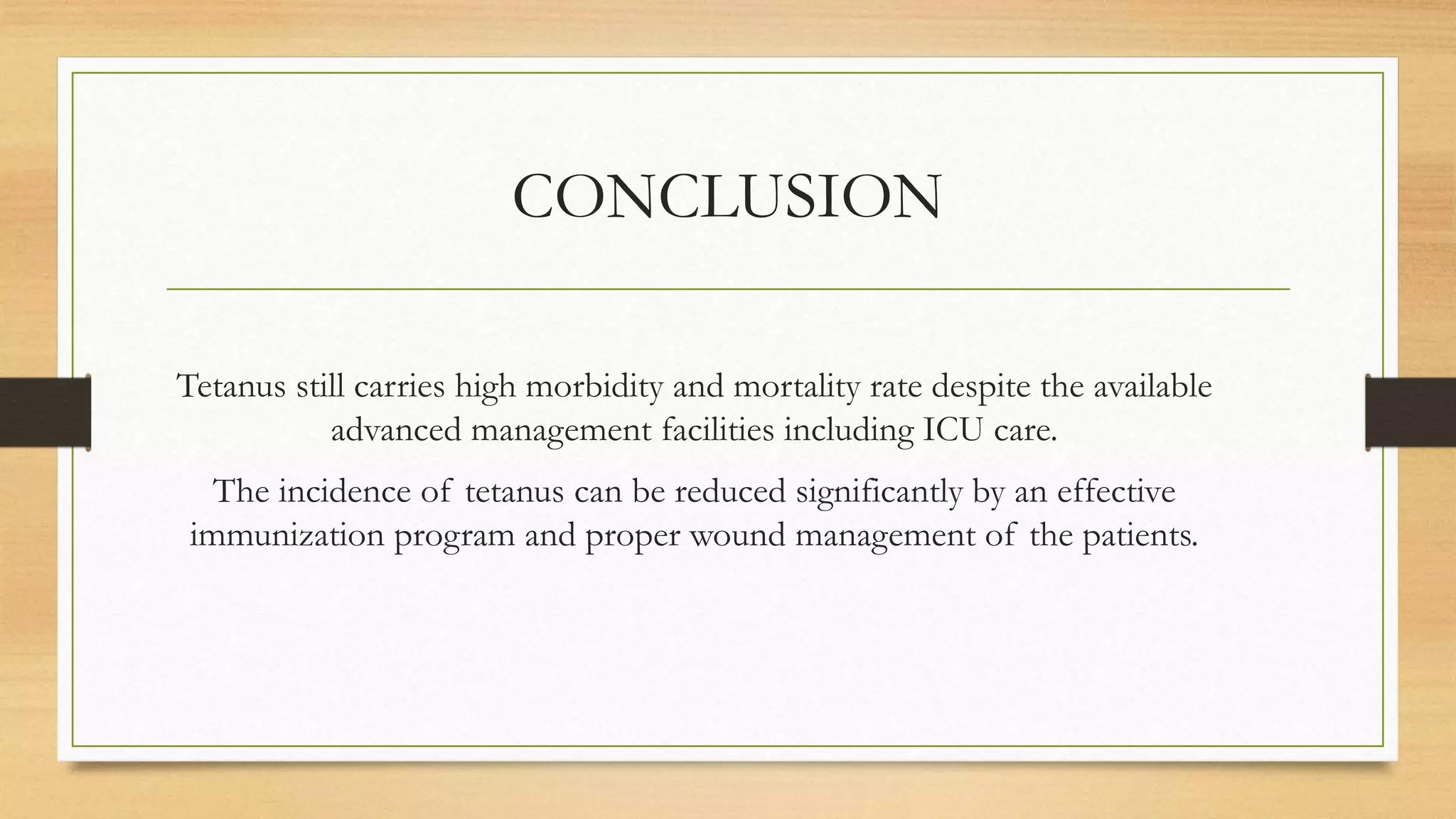
CONCLUSION
Tetanus still carries high morbidity and mortality rate despite the available
advanced management facilities including ICU care.
The incidence of tetanus can be reduced significantly by an effective
immunization program and proper wound management of the patients.
REFRENCES
• Textbook of preventive & social medicine - Park – 19th
Edition
• CDC Article – Tetanus
• Harrisons principles of internal medicine : Eighteenth Edition
Clostridium tetani (tetanus) - causes, symptoms, diagnosis, treatment, pathology

Clostridium tetani (tetanus) - causes, symptoms, diagnosis, treatment, pathology

  • 1.
  • 2.
    CONTENTS • Introduction • Causativeagent • Epidemiology • Transmission, Host factors, Route of entry • Mechanism of action of toxin • Symptoms • Prevention • Cure • Conclusion • References
  • 3.
    INTRODUCTION • Tetanus-a Greekword – to stretch • First described by Hippocrates & Susruta • Tetanus an neurological disease characterized by an acute onset of hypertonia, painful muscular contractions ( usually of the muscles of the jaw and neck), and generalized muscle spasms without others apparent medical causes. • Only vaccine preventable disease that is infectious but not contagious.
  • 4.
    CAUSATIVE AGENT • Causedby CLOSTRIDIUM TETANI • Anaerobic • Motile • Gram positive bacilli • Oval, colourless, terminal spores-tennis racket or drumstick shape • It is found world wide in soil, in inanimate environment. In animal faeces & occasionally human faeces.
  • 5.
    EPIDEMIOLOGY • Tetanus isan international health problem, as spores are ubiquitous. The disease occurs almost exclusively in persons who are unvaccinated or inadequately immunized. • Entirely preventable disease by immunization • Tetanus occurs worldwide but is common in hot, damp climates with soil rich in organic matter. • More prevalent in industrial establishment, where agricultural workers are employed.
  • 6.
    TRANSMISSION • Tetanus isnot transmitted from person to person. Infection occurs when C.tetani spores are introduced into acute wounds from trauma, surgeries and infections, or chronic skin lesions and infections. • Cases have resulted from wounds that were considered too trivial to warrant medical attention. • The incubation periods of tetanus is usually between 3 and 21 days (median 7 days). Shorter incubation periods (<7 days) along with delays in seeking treatment are associated with fatal outcomes. • Outbreaks of tetanus related to injuries associated with natural disasters such as earthquakes and tsunami's have been documented.
  • 7.
    HOST FACTORS • Age:It is the disease of active age 5-40 years. • Sex: Higher incidence in males than females. • Occupation: Agricultural workers are at higher risk. • Rural & urban difference: Incidence of tetanus in urban areas is much lower than in rural areas. • Immunity: Hard immunity does not protect the individual. • Environmental and social factors: Unhygienic custom habits, unhygienic delivery practices.
  • 8.
    ROUTE OF ENTRY •Apparently trivial injuries • Animal bites & human bites • Open fractures • Burns • Gangrene • Parenteral drug abuse
  • 9.
    TETANUS PRONE WOUND •A wound sustained more than 6 hr before surgical treatment. • A wound sustained at any interval after injury which is puncture type or shows much devitalized tissue or is septic or is contaminated with soil or manure. • Spores that gain entry can persist in normal tissue for months to years under anaerobic conditions. • When the oxygen levels in the surrounding tissue is sufficiently low, the implanted C.tetani spore then germinates into a new, active vegetative cell that grows and multiplies and most importantly produces tetanus toxin- tetanospasmin and tetanolysin.
  • 10.
    TETANOLYSIN Tetanolysin is notbelieved to be of any significance in the clinical course of tetanus. A hemolytic toxin produced by the tetanus bacillus(Clostridium tetani) TETANOSPASMIN It is a neurotoxin and causes the clinical manifestations of tetanus.
  • 11.
  • 12.
    SYMPTOMS • If themuscle spasms affect the larynx or chest wall, they may cause asphyxiation. • Stiffness of jaw (also called lock jaw) • Stiffness of abdominal and back muscle • Contraction of facial muscles • Fast pulse • Fever • sweating
  • 13.
    METHOD OF PREVENTION •IMMUNIZATION • A person recovering from tetanus should begin active immunization with tetanus toxoid during convalescence. • The tetanus toxoid is a formalin inactivated toxin, with an efficiency of approx.100%. • Because the antitoxin levels decrease over time booster immunization shots are needed every 10 years.
  • 14.
    PREVENTION & CONTROL •Medical Management Tetanus immune globulin(TIG) Intravenous immune globulin(IVIG) • Wound Management Proper immunization
  • 15.
    OTHER SUPPORTING MEASURES •Remove and destroy the source of the toxin through surgical exploration and cleaning of the wound. • Bed rest with a non stimulating environment may be recommended. • Sedation may be necessary to keep the affected person calm. • Respiratory support with oxygen and mechanical ventilation may be necessary.
  • 16.
    SPECIFIC TREATMENT • Woundshould be debrided widely. • Maintain an adequate airway. • Employ sedation or muscle. • Active immunization. • Special air flow equipment and filtered ventilation. • Reduce airborne particles. • Surgical instruments and dressing sterilization.
  • 17.
  • 18.
    CURE • ANTIBIOTICS • Theantibiotics may prevent multiplication of C.tetani , thus halting production of toxin . • Penicillin G was the drug of choice initially but now Metronidazole is preferred drug. • Doxycycline, Clindamycin and Erythromycin are alternative for penicillin allergic patients who can not tolerate metronidazole.
  • 19.
    CONCLUSION Tetanus still carrieshigh morbidity and mortality rate despite the available advanced management facilities including ICU care. The incidence of tetanus can be reduced significantly by an effective immunization program and proper wound management of the patients.
  • 20.
    REFRENCES • Textbook ofpreventive & social medicine - Park – 19th Edition • CDC Article – Tetanus • Harrisons principles of internal medicine : Eighteenth Edition