Tetanus
Lockjaw
Dr. Ramesh C.K.M.Sc.,(Biotech), M.Sc., (Seri) Ph.D.
Associate Professor &Chairman,
ckramck@gmail.com
Tetanus is infection of the nervous
system with the potentially deadly
bacteria Clostridium tetani (C. tetani).
How serious is tetanus?
Tetanus is very dangerous. It can cause breathing
problems and paralysis (unable to move parts of
the body). Muscle spasms can be strong enough
to break a child’s spine or other bones.
It can take months to recover fully from tetanus.
A child might need weeks of hospital care. As
many as 1 out of 5 people who get tetanus dies.
Tetanus
• Tetanos – a greek word – to strech
• Caused by CLOSTRIDIUM TETANI
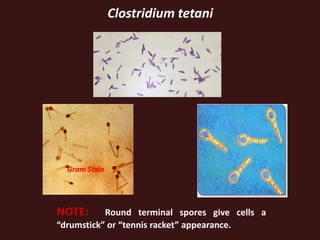
• An anaerobic, motile, gram positive rod that forms
oval, colourless, terminal spores – tennis racket or
drumstick shape.
• It is found worldwide in soil, in inanimate
environment, in animal faeces & occasionally
human faeces.
Clostridium tetani
NOTE: Round terminal spores give cells a
“drumstick” or “tennis racket” appearance.
Gram Stain
Epidemiology
• Occurs sporadically
• Affects unimmunized, partially immunized &
fully immunized who fail to maintain adequate
immunity with booster doses of vaccine.
• Although it is an entirely preventable disease
by immunization , the burden of disease
worldwide is great.
Virulence & Pathogenicity
• Not pathogenic to humans
and animals by invasive
infection but by the
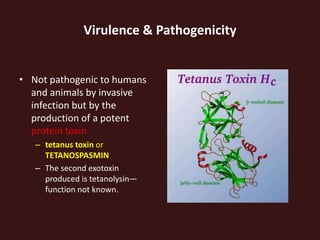
production of a potent
protein toxin
– tetanus toxin or
TETANOSPASMIN
– The second exotoxin
produced is tetanolysin—
function not known.
Tetanus toxin
• Produced when spores germinate and vegetative cells grow after gaining
access to wounds. The organism multiplies locally and symptoms
appear remote from the infection site.
• One of the three most poisonous substances known on a weight basis, the
other two being the toxins of botulism and diphtheria.
• Because the toxin has a specific affinity for nervous tissue, it is referred to
as a neurotoxin. The toxin has no known useful function to C. tetani.
• Entry of C. tetani into the body usually involves implantation of
spores into a wound.
• After gaining entry, C. tetani spores can persist in the body for
months, waiting for the proper low oxygen growth conditions
to develop.
• When the oxygen levels of the surrounding tissue is sufficiently low,
the implanted C. tetani spore then germinates into a new, active
vegetative cell that grows and multiplies and most importantly
produces tetanus toxin.
Pathogenesis
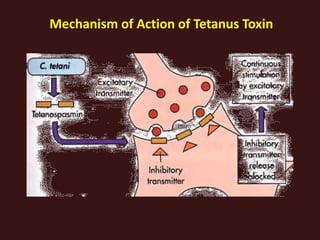
As growing cells of C. tetani produce
tetanospasmin at the wound site, the toxin
starts to migrate along the nerves and acts
mainly on 4 areas of nervous system
Motor end plate
Spinal cord
Brain
Sympathetic system
where it blocks the release of inhibitory
neurotransmitters.
As a consequence of too much “activator
transmitters”, muscles are over stimulated to
repeatedly contract—called spastic paralysis.
Mechanism of Action of Tetanus Toxin
Symptoms of tetanus
Signs and symptoms of tetanus appear anytime from a few days to several weeks after tetanus
bacteria enter our body through a wound. The average incubation period is seven to 10 days.
• Tetanus in children starts with headache, jaw cramping, and muscle
spasms (sudden, involuntary muscle tightening).
It also causes the following:
• Painful muscle stiffness all over the body
• Trouble swallowing
• Seizures (jerking or staring)
• Fever and sweating
• High blood pressure and fast heart rate
• Tetanus is often called “lockjaw” because the jaw muscles tighten,
and the person cannot open his mouth.
Death may occur from tetanus
•often from cardiac (heart) and
• respiratory (lung) effects or
•secondary complications from the infection
Complications of Tetanus
• Severe muscle spasms as a result of tetanus can also
cause serious health complications, such as:
• breathing problems due to spasms of the vocal cords
(laryngospasm) and spasms of the muscles that control
breathing
• pneumonia (an infection of the lungs)
• brain damage due to lack of oxygen
• abnormal heart rhythm
• bone fractures and fractures of the spine due to muscle
spasms and convulsions
• secondary infections due to prolonged hospital stays
Most common types
Generalized tetanus
This is the most common type of tetanus, representing about 80% of cases
- descending pattern: lockjaw  stiffness of neck  difficulty swallowing 
rigidity of abdominal and back muscles.
- Spasms continue for 3-4 weeks, and recovery can last for months
- Death occurs when spasms interfere with respiration.
Neonatal tetanus
- Form of generalized tetanus that occurs in newborn infants born without
protective passive immunity because the mother is not immune.
- Usually occurs through infection of the unhealed umbilical stump,
particularly when the stump is cut with an unsterile instrument. Neonatal
tetanus is common in many developing countries and is responsible for
about 14% (215,000) of all neonatal deaths, but is very rare in developed
countries.
Types of tetanus
( Trismus, lock jaw )
The back muscles are more
powerful, thus creating the arc
backward
“Oposthotonus” by Sir
Charles Bell, 1809.
Baby has neonatal tetanus with
complete rigidity
Poor feeding ,rigidity and spasms
Risus Sardonicus in Tetanus Patient
A person suffering from tetanus undergoes convulsive muscle contractions of
the jaw--called LOCKJAW
Opisthotonos in Tetanus Patient
The contractions by the muscles of the back and extremities may become
so violent and strong that bone fractures may occur
Uncommon types
• Local tetanus
• This is an uncommon form of the disease, in which patients have
persistent contraction of muscles in the same anatomic area as the injury.
The contractions may persist for many weeks before gradually subsiding.
Local tetanus is generally milder; only about 1% of cases are fatal, but it
may precede the onset of generalized tetanus
• Cephalic tetanus
• This is a rare form of the disease, occasionally occurring with ear
infections in which C. tetani is present in the flora of the middle ear, or
following injuries to the head. There is involvement of the cranial nerves,
especially in the facial area.
Cephalic Tetanus
Methods of diagnosis
• Based on the patient’s account and physical findings that are
characteristic symptoms of tetanus, such as muscle stiffness
and painful spasms.
• Unlike many other diseases, tetanus is not generally
diagnosed through laboratory tests.
• Tests that may be performed include the following:
– Culture of the wound site
– Tetanus antibody test
– Other tests may be used to rule out meningitis, rabies,, or other
diseases with similar symptoms.
Clinical treatment
• If treatment is not sought early, the disease is often fatal Without
treatment, one out of five infected people die. The death rate for
newborns with untreated tetanus is even higher.
• With proper treatment, less than 10% of infected patients die.
Treatment may include
• Antibiotics, including penicillin, clindamycin, erythromycin, or
metronidazole (metronidazole has been most successful)
• Bedrest with a nonstimulating environment (dim light, reduced noise,
and stable temperature)
• Medicine to reverse the poison (tetanus immune globulin, TIG. )
• Muscle relaxers such as diazepam
• Sedatives
• Surgery to clean the wound and remove the source of the poison
(debridement)
• Breathing support with oxygen, a breathing tube, and a breathing
machine may be necessary
Method of prevention - immunization
• A person recovering from tetanus should begin active immunization with
tetanus toxoid (Td) during convalescence.
• The tetanus toxoid is a formalin-inactivated toxin, with an efficiency of
approx. 100%.
• The DTaP vaccine includes tetanus, diphteria and pertussis toxoids; it is
routinely given during childhood.
• Because the antitoxin levels decrease over time, booster immunization
shots are needed every 10 years.
• Tetanus is completely preventable by active tetanus immunization.
Immunization is thought to provide protection for 10 years.
A toxoid is a bacterial toxin (usually an exotoxin) whose toxicity has been inactivated or
suppressed either by chemical (formalin) or heat treatment, while other properties,
typically immunogenicity, are maintained.
Td or Tdap
For Preteens, Teens, and Adults
Td is a tetanus and diphtheria vaccine given to preteens,
teens, and adults as a booster shot every 10 years, or after an
exposure to tetanus under some circumstances.
To prevent maternal and neonatal tetanus,
tetanus toxoid needs to be given to the mother
before or during pregnancy, and clean delivery
and cord care needs to be ensured.
Many people believe injuries caused by rusty nails
are the most dangerous.
This is true only if the nail is dirty as well as rusty,
as is usually the case.
It is the dirt on the nail, not the rust, that carries
the risk for tetanus.

Tetanus -Basics

  • 1.
    Tetanus Lockjaw Dr. Ramesh C.K.M.Sc.,(Biotech),M.Sc., (Seri) Ph.D. Associate Professor &Chairman, ckramck@gmail.com
  • 2.
    Tetanus is infectionof the nervous system with the potentially deadly bacteria Clostridium tetani (C. tetani).
  • 3.
    How serious istetanus? Tetanus is very dangerous. It can cause breathing problems and paralysis (unable to move parts of the body). Muscle spasms can be strong enough to break a child’s spine or other bones. It can take months to recover fully from tetanus. A child might need weeks of hospital care. As many as 1 out of 5 people who get tetanus dies.
  • 4.
    Tetanus • Tetanos –a greek word – to strech • Caused by CLOSTRIDIUM TETANI • An anaerobic, motile, gram positive rod that forms oval, colourless, terminal spores – tennis racket or drumstick shape. • It is found worldwide in soil, in inanimate environment, in animal faeces & occasionally human faeces.
  • 5.
    Clostridium tetani NOTE: Roundterminal spores give cells a “drumstick” or “tennis racket” appearance. Gram Stain
  • 6.
    Epidemiology • Occurs sporadically •Affects unimmunized, partially immunized & fully immunized who fail to maintain adequate immunity with booster doses of vaccine. • Although it is an entirely preventable disease by immunization , the burden of disease worldwide is great.
  • 7.
    Virulence & Pathogenicity •Not pathogenic to humans and animals by invasive infection but by the production of a potent protein toxin – tetanus toxin or TETANOSPASMIN – The second exotoxin produced is tetanolysin— function not known.
  • 8.
    Tetanus toxin • Producedwhen spores germinate and vegetative cells grow after gaining access to wounds. The organism multiplies locally and symptoms appear remote from the infection site. • One of the three most poisonous substances known on a weight basis, the other two being the toxins of botulism and diphtheria. • Because the toxin has a specific affinity for nervous tissue, it is referred to as a neurotoxin. The toxin has no known useful function to C. tetani.
  • 9.
    • Entry ofC. tetani into the body usually involves implantation of spores into a wound. • After gaining entry, C. tetani spores can persist in the body for months, waiting for the proper low oxygen growth conditions to develop. • When the oxygen levels of the surrounding tissue is sufficiently low, the implanted C. tetani spore then germinates into a new, active vegetative cell that grows and multiplies and most importantly produces tetanus toxin. Pathogenesis
  • 10.
    As growing cellsof C. tetani produce tetanospasmin at the wound site, the toxin starts to migrate along the nerves and acts mainly on 4 areas of nervous system Motor end plate Spinal cord Brain Sympathetic system where it blocks the release of inhibitory neurotransmitters. As a consequence of too much “activator transmitters”, muscles are over stimulated to repeatedly contract—called spastic paralysis.
  • 12.
    Mechanism of Actionof Tetanus Toxin
  • 13.
    Symptoms of tetanus Signsand symptoms of tetanus appear anytime from a few days to several weeks after tetanus bacteria enter our body through a wound. The average incubation period is seven to 10 days. • Tetanus in children starts with headache, jaw cramping, and muscle spasms (sudden, involuntary muscle tightening). It also causes the following: • Painful muscle stiffness all over the body • Trouble swallowing • Seizures (jerking or staring) • Fever and sweating • High blood pressure and fast heart rate • Tetanus is often called “lockjaw” because the jaw muscles tighten, and the person cannot open his mouth.
  • 14.
    Death may occurfrom tetanus •often from cardiac (heart) and • respiratory (lung) effects or •secondary complications from the infection
  • 15.
    Complications of Tetanus •Severe muscle spasms as a result of tetanus can also cause serious health complications, such as: • breathing problems due to spasms of the vocal cords (laryngospasm) and spasms of the muscles that control breathing • pneumonia (an infection of the lungs) • brain damage due to lack of oxygen • abnormal heart rhythm • bone fractures and fractures of the spine due to muscle spasms and convulsions • secondary infections due to prolonged hospital stays
  • 16.
    Most common types Generalizedtetanus This is the most common type of tetanus, representing about 80% of cases - descending pattern: lockjaw  stiffness of neck  difficulty swallowing  rigidity of abdominal and back muscles. - Spasms continue for 3-4 weeks, and recovery can last for months - Death occurs when spasms interfere with respiration. Neonatal tetanus - Form of generalized tetanus that occurs in newborn infants born without protective passive immunity because the mother is not immune. - Usually occurs through infection of the unhealed umbilical stump, particularly when the stump is cut with an unsterile instrument. Neonatal tetanus is common in many developing countries and is responsible for about 14% (215,000) of all neonatal deaths, but is very rare in developed countries. Types of tetanus
  • 17.
  • 18.
    The back musclesare more powerful, thus creating the arc backward “Oposthotonus” by Sir Charles Bell, 1809. Baby has neonatal tetanus with complete rigidity Poor feeding ,rigidity and spasms
  • 19.
    Risus Sardonicus inTetanus Patient A person suffering from tetanus undergoes convulsive muscle contractions of the jaw--called LOCKJAW
  • 20.
    Opisthotonos in TetanusPatient The contractions by the muscles of the back and extremities may become so violent and strong that bone fractures may occur
  • 21.
    Uncommon types • Localtetanus • This is an uncommon form of the disease, in which patients have persistent contraction of muscles in the same anatomic area as the injury. The contractions may persist for many weeks before gradually subsiding. Local tetanus is generally milder; only about 1% of cases are fatal, but it may precede the onset of generalized tetanus • Cephalic tetanus • This is a rare form of the disease, occasionally occurring with ear infections in which C. tetani is present in the flora of the middle ear, or following injuries to the head. There is involvement of the cranial nerves, especially in the facial area.
  • 22.
  • 23.
    Methods of diagnosis •Based on the patient’s account and physical findings that are characteristic symptoms of tetanus, such as muscle stiffness and painful spasms. • Unlike many other diseases, tetanus is not generally diagnosed through laboratory tests. • Tests that may be performed include the following: – Culture of the wound site – Tetanus antibody test – Other tests may be used to rule out meningitis, rabies,, or other diseases with similar symptoms.
  • 24.
    Clinical treatment • Iftreatment is not sought early, the disease is often fatal Without treatment, one out of five infected people die. The death rate for newborns with untreated tetanus is even higher. • With proper treatment, less than 10% of infected patients die. Treatment may include • Antibiotics, including penicillin, clindamycin, erythromycin, or metronidazole (metronidazole has been most successful) • Bedrest with a nonstimulating environment (dim light, reduced noise, and stable temperature) • Medicine to reverse the poison (tetanus immune globulin, TIG. ) • Muscle relaxers such as diazepam • Sedatives • Surgery to clean the wound and remove the source of the poison (debridement) • Breathing support with oxygen, a breathing tube, and a breathing machine may be necessary
  • 25.
    Method of prevention- immunization • A person recovering from tetanus should begin active immunization with tetanus toxoid (Td) during convalescence. • The tetanus toxoid is a formalin-inactivated toxin, with an efficiency of approx. 100%. • The DTaP vaccine includes tetanus, diphteria and pertussis toxoids; it is routinely given during childhood. • Because the antitoxin levels decrease over time, booster immunization shots are needed every 10 years. • Tetanus is completely preventable by active tetanus immunization. Immunization is thought to provide protection for 10 years. A toxoid is a bacterial toxin (usually an exotoxin) whose toxicity has been inactivated or suppressed either by chemical (formalin) or heat treatment, while other properties, typically immunogenicity, are maintained.
  • 26.
    Td or Tdap ForPreteens, Teens, and Adults Td is a tetanus and diphtheria vaccine given to preteens, teens, and adults as a booster shot every 10 years, or after an exposure to tetanus under some circumstances.
  • 27.
    To prevent maternaland neonatal tetanus, tetanus toxoid needs to be given to the mother before or during pregnancy, and clean delivery and cord care needs to be ensured.
  • 29.
    Many people believeinjuries caused by rusty nails are the most dangerous. This is true only if the nail is dirty as well as rusty, as is usually the case. It is the dirt on the nail, not the rust, that carries the risk for tetanus.