Prabin Kumar Bam
MBBS, CMCth
Nepal
5/26/2020 1
Other names:
Malignant pustule
Malignant edema
Woolsorter’s disease
Ragpicker’s disease
5/26/2020 2
Brief history of anthrax
5/26/2020 3
INTRODUCTION
• Anthrax is a serious infectious, zoonotic
disease primarily affecting herbivores such as
cows, sheep, horses, goats, etc.
• It is rare for humans to be infected with
anthrax.
• Most infections are localized to small cuts in
skin whose edges turn black hence the name
‘anthrax’ (In Greek; anthrakos means coal).
5/26/2020 4
Infectious agent
• Anthrax is caused by non-motile, spore
producing, gram-positive, rod-shaped bacteria
known as Bacillus Anthracis.
• B. anthracis was the first bacterial pathogen
described by Robert Koch in 1875 & was the
model pathogen for ‘Koch’s postulates’.
• Soil is the natural reservoir of this bacillus.
• Infection occur mainly due to contact with
spores.
5/26/2020 5
• Spores are highly resistant to heat, cold,
chemicals, dry climate & disinfectants.
• Virulence factor: Anthrax toxin.
• Anthrax toxin is made of:
1. Protective antigen
2. Edema factor
3. Lethal toxin
• Toxin causes tissue damage, edema and shock.
5/26/2020 6
5/26/2020 7
1. Definitive host
 Cow
 Sheep
 Goat
 Horse etc.
2. Accidental host
 Humans
5/26/2020 8
HOST
MODE OF TRANSMISSION
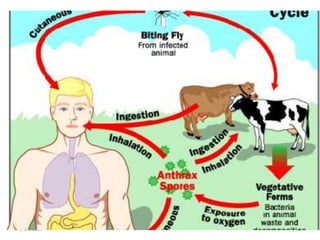
Direct transmission: through contact with
infected animals or contaminated animals
products.
Indirect transmission: through ingestion of
contaminated meat
Airborne transmission : through inhalation of
spores
The disease never transmits from person to
person.
5/26/2020 9
PATHOGENESIS
Production of dormant/ spores by bacteria
↓
Entry of spores in animal or human through
ingestion, inhalation or direct contact
↓
Spores are activated into active growing cells
↓
Multiplication of bacteria & production of toxins
↓
Causes severe illness & death if untreated.
5/26/2020 10
5/26/2020 11
CLINICAL FEATURES
These depend on the route of entry of spores
5/26/2020 12
Cutaneous anthrax
• 95-99% cases are of cutaneous anthrax.
• Occurs mainly in professionals like
veterinerian, butcher, zoo keeper.
• Characterized by skin lesions, ulcers, eschar
and edema at the site of entry of spores.
• It heals spontaneously & is rarely fatal.
5/26/2020 13
5/26/2020 14
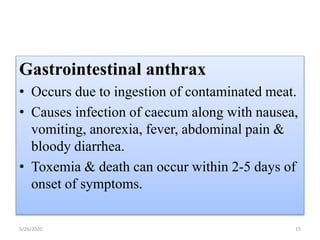
Gastrointestinal anthrax
• Occurs due to ingestion of contaminated meat.
• Causes infection of caecum along with nausea,
vomiting, anorexia, fever, abdominal pain &
bloody diarrhea.
• Toxemia & death can occur within 2-5 days of
onset of symptoms.
5/26/2020 15
5/26/2020 16
Inhalational anthrax
• Occurs due to inhalation of spores. It is
associated with bioterrorism.
• Characterized by fever, chest pain, shortness of
breath and hemorrhagic mediastinitis.
• May progress to septicemia and meningitis if
untreated.
• Mortality rate is > 95%.
5/26/2020 17
5/26/2020 18
DIAGNOSIS
 Clinically diagnosed on the basis of signs &
symptoms.
 Incubation period is from 1 to 7 days.
Although incubation period up to 60 days are
possible.
 Laboratory conformation requires at least
one of the following:
5/26/2020 19
1. Isolation of B. anthracis from a clinical
specimen.
2. Demonstration of B. anthracis in a clinical
specimen by immunofluorescence.
3. Significant antibody titre developing in an
appropriate clinical case.
5/26/2020 20
Following laboratory tests are performed:
Gram staining
Test of infected skin/ sores.
Blood tests
CT scan & Chest X-Ray
Lumbar puncture (spinal tap)
Endoscopy
5/26/2020 21
TREATMENT
• The case should be under the care of infectious
disease physician.
• Penicillin is the drug of choice and is given for
5-7 days.
• Tetracyclin, erythromycin & chloramphenicol
are also effective.
• Case and their caregivers must be advised
about the mode of transmission.
5/26/2020 22
• Immunization of domestic animals & high-risk
persons like veterinerians, butcher,
zookeepers etc. with anthrax vaccine.
5/26/2020 23
PREVENTION
Vaccination of animal against anthrax
5/26/2020 24
• Proper disposal of infected animal carcasses
by burning or burying deep.
5/26/2020 25
PREVENTION
• Do not eat meat that has not been properly
slaughtered and cooked.
• Anyone working with anthrax in a suspected
or confirmed victim should wear masks.
• Impermeable equipments like rubber gloves,
rubber aprons and rubber boots should be
used while handling the dead body.
5/26/2020 26
PREVENTION
• Disinfection of wool, hairs and other animal
products.
• Mass awareness.
5/26/2020 27
Anthrax vaccine
• Anthrax vaccine is approved by the Food and Drug
Administration (FDA) and recommended for adults 18
through 65 years of age who are at risk of exposure to
anthrax bacteria, including:
• Certain laboratory workers who work with Bacillus
anthracis
• People who handle potentially infected animals or their
carcasses
• Some military personnel (determined by the
Department of Defense)
• Some emergency and other responders whose
response activities might lead to exposure
5/26/2020 28
• These people should get 3 doses of anthrax vaccine,
followed by booster doses for ongoing protection.
• Anthrax vaccine is also recommended for unvaccinated
people of all ages who have been exposed to anthrax.
These people should get 3 doses of anthrax vaccine
together with recommended antibiotic drugs.
• Anthrax vaccine has not been studied or used in children
less than 18 years of age. Because its use in exposed
children is not approved by FDA, it must be used under an
expanded access Investigational New Drug (IND) program
and requires informed consent from a parent or legal
guardian.
-Centres for disease control and prevention
5/26/2020 29
GLOBAL SCENARIO OF ANTHRAX
5/26/2020 30
5/26/2020 31
 An estimated 2,000 to 20,000 human cases
of anthrax occur globally each year.
 Among them 95% cases are of cutaneous
anthrax.
 Human cases of anthrax are most prevalent
in agricultural regions of:
1. Central and South America
2. Sub- Saharan Africa
3. Central and Southwestern Asia
4. Southern and Eastern Europe
5/26/2020 32
 Among naturally occurring cases, most
involved exposure to contaminated wool,
goat hair, or animal hides.
5/26/2020 33
Anthrax is in animals is endemic in following
areas of the world:
1. Most areas of Middle East
2. Most areas of equatorial Africa
3. Mexico and Central America
4. Chile, Peru, Argentina, Bolivia
5. Southeast Asia ( Myanmar, Vietnam, Thailand)
6. And some Mediterranean countries
5/26/2020 34
Outbreaks of naturally occurring
anthrax
Outbreaks have been reported in in industrial
settings where animal products are processed
and in agricultural settings.
Notable examples of outbreaks are as follows:
1. A major outbreak involving 10,000 cases & 182
deaths occurred in Zimbabwe during late 1970s
and early 1980s.
2. An outbreak involving 9 cases occurred in 1957
in the United States.
5/26/2020 35
3. An outbreak of oro-pharyngeal anthrax
involving 24 cases occurred in Thailand in
1982 following consumption of
contaminated meat.
5/26/2020 36
ANTHRAX AS BIO-WEAPON
Aerosol release of weaponized spores is the
most likely mechanism for use of anthrax as a
biological weapon.
A 1970 WHO report estimated that an aerosol
release of 50 kg of dried powder containing
6×10^ 15 anthrax spores would produce 25,
000 illnesses and up to 100,000 deaths.
It was used as bio-weapon during World War
II by some countries.
5/26/2020 37
WHO ACTIVITIWS ON ANTHRAX
• A meeting on Improving public health
preparedness for and response to the threat
of epidemics: anthrax network was held in
Nice, France, from 29 to 30 March 2003 in
which Nepal also participated.
5/26/2020 38
OBJECTIVES
The main objectives of the meeting were to
review WHO’s activities on anthrax and plan
future strategies, and revise specific sections
of the 4th edition of the previously entitled
Guidelines for the surveillance and control of
anthrax in humans and animals.
5/26/2020 39
AIMS
To establish a network of anthrax experts and
involve them in diagnosis, surveillance, and
responding to outbreaks, and to provide
guidance on WHO’s activities on anthrax. The
experts should be able to provide advice on
training materials produced by WHO and may
participate in training and quality assessment
programs, particularly at the regional level.
5/26/2020 40
To establish a network of diagnostic
laboratories with defined anthrax capabilities.
To establish standard procedures relating to
anthrax and to disseminate information
To set up and implement training and quality
assurance programs for laboratories that are
part of the network.
5/26/2020 41
RECOMMENDATIONS
 WHO should expand its pool of experts able to be
involved in anthrax diagnosis, surveillance, and
response to outbreaks, as well as in training and quality
assurance programmes. While the network should be
geographically and technically representative, its
structure should be based on the needs of countries
and should be flexible.
 WHO should characterize the capabilities of existing
laboratories, using the questionnaire and follow-up,
and will identify the international and regional
reference laboratories. As for the network of experts,
the structure of the network of laboratories should be
based on the needs of countries and should be flexible.
5/26/2020 42
 WHO should maintain and improve its
collaboration with other organizations and
existing networks.
 WHO should encourage the sharing of
information between veterinary and public
health laboratories.
 A restricted-access web site should be
developed by WHO. The restrictions on access
should be kept to a minimum.
WHO should seek funding to support the long-
term maintenance of this network.
5/26/2020 43
 WHO should update and expand its information resources
for health care professionals and the public. The material
should be readily available on the WHO web site and in
print.
 WHO should develop a training module on anthrax
diagnosis and epidemiology, based on the 4th edition of
the anthrax guidelines, to be entitled Anthrax in humans
and animals.
 An anthrax workshop for laboratories (one laboratory from
each of several WHO regions) should be held following the
field test in Lyon. Laboratories which participate in the
workshop would ideally serve as regional focal points for
expansion of the training and expansion of the network.
5/26/2020 44
 A reagent bank of selected anthrax diagnostic materials should be
established. This bank would consist of “orphan” or difficult to
acquire anthrax diagnostic materials, such as anthrax-specific
antisera. Suitable reference laboratories would need to be
established to prepare and send out samples and reagents.
Laboratories would be able to order essential reagents through the
restricted-access web site, and would use the site to report their
quality assurance results.
 Efforts should be made by WHO to complement other training and
quality assurance programs, e.g. those organized by WHO Global
Salm-Surv; the WHO Regional Office for Africa/WHO Office in Lyon.
 WHO should seek funds to support the training and external
quality assessment programs for the long-term future.
5/26/2020 45
SCENARIO OF ANRHRAX IN NEPAL
5/26/2020 46
Anthrax is quiet uncommon in Nepal.
Dates relevant to history of anthrax in Nepal:
1. 1992- Animal anthrax was confirmed for the
first time in Nepal, in 4 cattle near
Kathmandu. During subsequent months , the
disease was confirmed in 20 cattle, 4 horses
and 2 pigs.
2. 2001- One case of swine anthrax was
reported.
5/26/2020 47
3. 2002 to 2013 – No cases of anthrax was
reported.
4. 2017 – An anthrax infected rhinoceros was
reported in Nawalparasi.
5/26/2020 48
References
• WHO.int
• Cdc.gov
5/26/2020 49
5/26/2020 50

Anthrax

  • 1.
    Prabin Kumar Bam MBBS,CMCth Nepal 5/26/2020 1
  • 2.
    Other names: Malignant pustule Malignantedema Woolsorter’s disease Ragpicker’s disease 5/26/2020 2
  • 3.
    Brief history ofanthrax 5/26/2020 3
  • 4.
    INTRODUCTION • Anthrax isa serious infectious, zoonotic disease primarily affecting herbivores such as cows, sheep, horses, goats, etc. • It is rare for humans to be infected with anthrax. • Most infections are localized to small cuts in skin whose edges turn black hence the name ‘anthrax’ (In Greek; anthrakos means coal). 5/26/2020 4
  • 5.
    Infectious agent • Anthraxis caused by non-motile, spore producing, gram-positive, rod-shaped bacteria known as Bacillus Anthracis. • B. anthracis was the first bacterial pathogen described by Robert Koch in 1875 & was the model pathogen for ‘Koch’s postulates’. • Soil is the natural reservoir of this bacillus. • Infection occur mainly due to contact with spores. 5/26/2020 5
  • 6.
    • Spores arehighly resistant to heat, cold, chemicals, dry climate & disinfectants. • Virulence factor: Anthrax toxin. • Anthrax toxin is made of: 1. Protective antigen 2. Edema factor 3. Lethal toxin • Toxin causes tissue damage, edema and shock. 5/26/2020 6
  • 7.
  • 8.
    1. Definitive host Cow  Sheep  Goat  Horse etc. 2. Accidental host  Humans 5/26/2020 8 HOST
  • 9.
    MODE OF TRANSMISSION Directtransmission: through contact with infected animals or contaminated animals products. Indirect transmission: through ingestion of contaminated meat Airborne transmission : through inhalation of spores The disease never transmits from person to person. 5/26/2020 9
  • 10.
    PATHOGENESIS Production of dormant/spores by bacteria ↓ Entry of spores in animal or human through ingestion, inhalation or direct contact ↓ Spores are activated into active growing cells ↓ Multiplication of bacteria & production of toxins ↓ Causes severe illness & death if untreated. 5/26/2020 10
  • 11.
  • 12.
    CLINICAL FEATURES These dependon the route of entry of spores 5/26/2020 12
  • 13.
    Cutaneous anthrax • 95-99%cases are of cutaneous anthrax. • Occurs mainly in professionals like veterinerian, butcher, zoo keeper. • Characterized by skin lesions, ulcers, eschar and edema at the site of entry of spores. • It heals spontaneously & is rarely fatal. 5/26/2020 13
  • 14.
  • 15.
    Gastrointestinal anthrax • Occursdue to ingestion of contaminated meat. • Causes infection of caecum along with nausea, vomiting, anorexia, fever, abdominal pain & bloody diarrhea. • Toxemia & death can occur within 2-5 days of onset of symptoms. 5/26/2020 15
  • 16.
  • 17.
    Inhalational anthrax • Occursdue to inhalation of spores. It is associated with bioterrorism. • Characterized by fever, chest pain, shortness of breath and hemorrhagic mediastinitis. • May progress to septicemia and meningitis if untreated. • Mortality rate is > 95%. 5/26/2020 17
  • 18.
  • 19.
    DIAGNOSIS  Clinically diagnosedon the basis of signs & symptoms.  Incubation period is from 1 to 7 days. Although incubation period up to 60 days are possible.  Laboratory conformation requires at least one of the following: 5/26/2020 19
  • 20.
    1. Isolation ofB. anthracis from a clinical specimen. 2. Demonstration of B. anthracis in a clinical specimen by immunofluorescence. 3. Significant antibody titre developing in an appropriate clinical case. 5/26/2020 20
  • 21.
    Following laboratory testsare performed: Gram staining Test of infected skin/ sores. Blood tests CT scan & Chest X-Ray Lumbar puncture (spinal tap) Endoscopy 5/26/2020 21
  • 22.
    TREATMENT • The caseshould be under the care of infectious disease physician. • Penicillin is the drug of choice and is given for 5-7 days. • Tetracyclin, erythromycin & chloramphenicol are also effective. • Case and their caregivers must be advised about the mode of transmission. 5/26/2020 22
  • 23.
    • Immunization ofdomestic animals & high-risk persons like veterinerians, butcher, zookeepers etc. with anthrax vaccine. 5/26/2020 23 PREVENTION
  • 24.
    Vaccination of animalagainst anthrax 5/26/2020 24
  • 25.
    • Proper disposalof infected animal carcasses by burning or burying deep. 5/26/2020 25 PREVENTION
  • 26.
    • Do noteat meat that has not been properly slaughtered and cooked. • Anyone working with anthrax in a suspected or confirmed victim should wear masks. • Impermeable equipments like rubber gloves, rubber aprons and rubber boots should be used while handling the dead body. 5/26/2020 26 PREVENTION
  • 27.
    • Disinfection ofwool, hairs and other animal products. • Mass awareness. 5/26/2020 27
  • 28.
    Anthrax vaccine • Anthraxvaccine is approved by the Food and Drug Administration (FDA) and recommended for adults 18 through 65 years of age who are at risk of exposure to anthrax bacteria, including: • Certain laboratory workers who work with Bacillus anthracis • People who handle potentially infected animals or their carcasses • Some military personnel (determined by the Department of Defense) • Some emergency and other responders whose response activities might lead to exposure 5/26/2020 28
  • 29.
    • These peopleshould get 3 doses of anthrax vaccine, followed by booster doses for ongoing protection. • Anthrax vaccine is also recommended for unvaccinated people of all ages who have been exposed to anthrax. These people should get 3 doses of anthrax vaccine together with recommended antibiotic drugs. • Anthrax vaccine has not been studied or used in children less than 18 years of age. Because its use in exposed children is not approved by FDA, it must be used under an expanded access Investigational New Drug (IND) program and requires informed consent from a parent or legal guardian. -Centres for disease control and prevention 5/26/2020 29
  • 30.
    GLOBAL SCENARIO OFANTHRAX 5/26/2020 30
  • 31.
  • 32.
     An estimated2,000 to 20,000 human cases of anthrax occur globally each year.  Among them 95% cases are of cutaneous anthrax.  Human cases of anthrax are most prevalent in agricultural regions of: 1. Central and South America 2. Sub- Saharan Africa 3. Central and Southwestern Asia 4. Southern and Eastern Europe 5/26/2020 32
  • 33.
     Among naturallyoccurring cases, most involved exposure to contaminated wool, goat hair, or animal hides. 5/26/2020 33
  • 34.
    Anthrax is inanimals is endemic in following areas of the world: 1. Most areas of Middle East 2. Most areas of equatorial Africa 3. Mexico and Central America 4. Chile, Peru, Argentina, Bolivia 5. Southeast Asia ( Myanmar, Vietnam, Thailand) 6. And some Mediterranean countries 5/26/2020 34
  • 35.
    Outbreaks of naturallyoccurring anthrax Outbreaks have been reported in in industrial settings where animal products are processed and in agricultural settings. Notable examples of outbreaks are as follows: 1. A major outbreak involving 10,000 cases & 182 deaths occurred in Zimbabwe during late 1970s and early 1980s. 2. An outbreak involving 9 cases occurred in 1957 in the United States. 5/26/2020 35
  • 36.
    3. An outbreakof oro-pharyngeal anthrax involving 24 cases occurred in Thailand in 1982 following consumption of contaminated meat. 5/26/2020 36
  • 37.
    ANTHRAX AS BIO-WEAPON Aerosolrelease of weaponized spores is the most likely mechanism for use of anthrax as a biological weapon. A 1970 WHO report estimated that an aerosol release of 50 kg of dried powder containing 6×10^ 15 anthrax spores would produce 25, 000 illnesses and up to 100,000 deaths. It was used as bio-weapon during World War II by some countries. 5/26/2020 37
  • 38.
    WHO ACTIVITIWS ONANTHRAX • A meeting on Improving public health preparedness for and response to the threat of epidemics: anthrax network was held in Nice, France, from 29 to 30 March 2003 in which Nepal also participated. 5/26/2020 38
  • 39.
    OBJECTIVES The main objectivesof the meeting were to review WHO’s activities on anthrax and plan future strategies, and revise specific sections of the 4th edition of the previously entitled Guidelines for the surveillance and control of anthrax in humans and animals. 5/26/2020 39
  • 40.
    AIMS To establish anetwork of anthrax experts and involve them in diagnosis, surveillance, and responding to outbreaks, and to provide guidance on WHO’s activities on anthrax. The experts should be able to provide advice on training materials produced by WHO and may participate in training and quality assessment programs, particularly at the regional level. 5/26/2020 40
  • 41.
    To establish anetwork of diagnostic laboratories with defined anthrax capabilities. To establish standard procedures relating to anthrax and to disseminate information To set up and implement training and quality assurance programs for laboratories that are part of the network. 5/26/2020 41
  • 42.
    RECOMMENDATIONS  WHO shouldexpand its pool of experts able to be involved in anthrax diagnosis, surveillance, and response to outbreaks, as well as in training and quality assurance programmes. While the network should be geographically and technically representative, its structure should be based on the needs of countries and should be flexible.  WHO should characterize the capabilities of existing laboratories, using the questionnaire and follow-up, and will identify the international and regional reference laboratories. As for the network of experts, the structure of the network of laboratories should be based on the needs of countries and should be flexible. 5/26/2020 42
  • 43.
     WHO shouldmaintain and improve its collaboration with other organizations and existing networks.  WHO should encourage the sharing of information between veterinary and public health laboratories.  A restricted-access web site should be developed by WHO. The restrictions on access should be kept to a minimum. WHO should seek funding to support the long- term maintenance of this network. 5/26/2020 43
  • 44.
     WHO shouldupdate and expand its information resources for health care professionals and the public. The material should be readily available on the WHO web site and in print.  WHO should develop a training module on anthrax diagnosis and epidemiology, based on the 4th edition of the anthrax guidelines, to be entitled Anthrax in humans and animals.  An anthrax workshop for laboratories (one laboratory from each of several WHO regions) should be held following the field test in Lyon. Laboratories which participate in the workshop would ideally serve as regional focal points for expansion of the training and expansion of the network. 5/26/2020 44
  • 45.
     A reagentbank of selected anthrax diagnostic materials should be established. This bank would consist of “orphan” or difficult to acquire anthrax diagnostic materials, such as anthrax-specific antisera. Suitable reference laboratories would need to be established to prepare and send out samples and reagents. Laboratories would be able to order essential reagents through the restricted-access web site, and would use the site to report their quality assurance results.  Efforts should be made by WHO to complement other training and quality assurance programs, e.g. those organized by WHO Global Salm-Surv; the WHO Regional Office for Africa/WHO Office in Lyon.  WHO should seek funds to support the training and external quality assessment programs for the long-term future. 5/26/2020 45
  • 46.
    SCENARIO OF ANRHRAXIN NEPAL 5/26/2020 46
  • 47.
    Anthrax is quietuncommon in Nepal. Dates relevant to history of anthrax in Nepal: 1. 1992- Animal anthrax was confirmed for the first time in Nepal, in 4 cattle near Kathmandu. During subsequent months , the disease was confirmed in 20 cattle, 4 horses and 2 pigs. 2. 2001- One case of swine anthrax was reported. 5/26/2020 47
  • 48.
    3. 2002 to2013 – No cases of anthrax was reported. 4. 2017 – An anthrax infected rhinoceros was reported in Nawalparasi. 5/26/2020 48
  • 49.
  • 50.