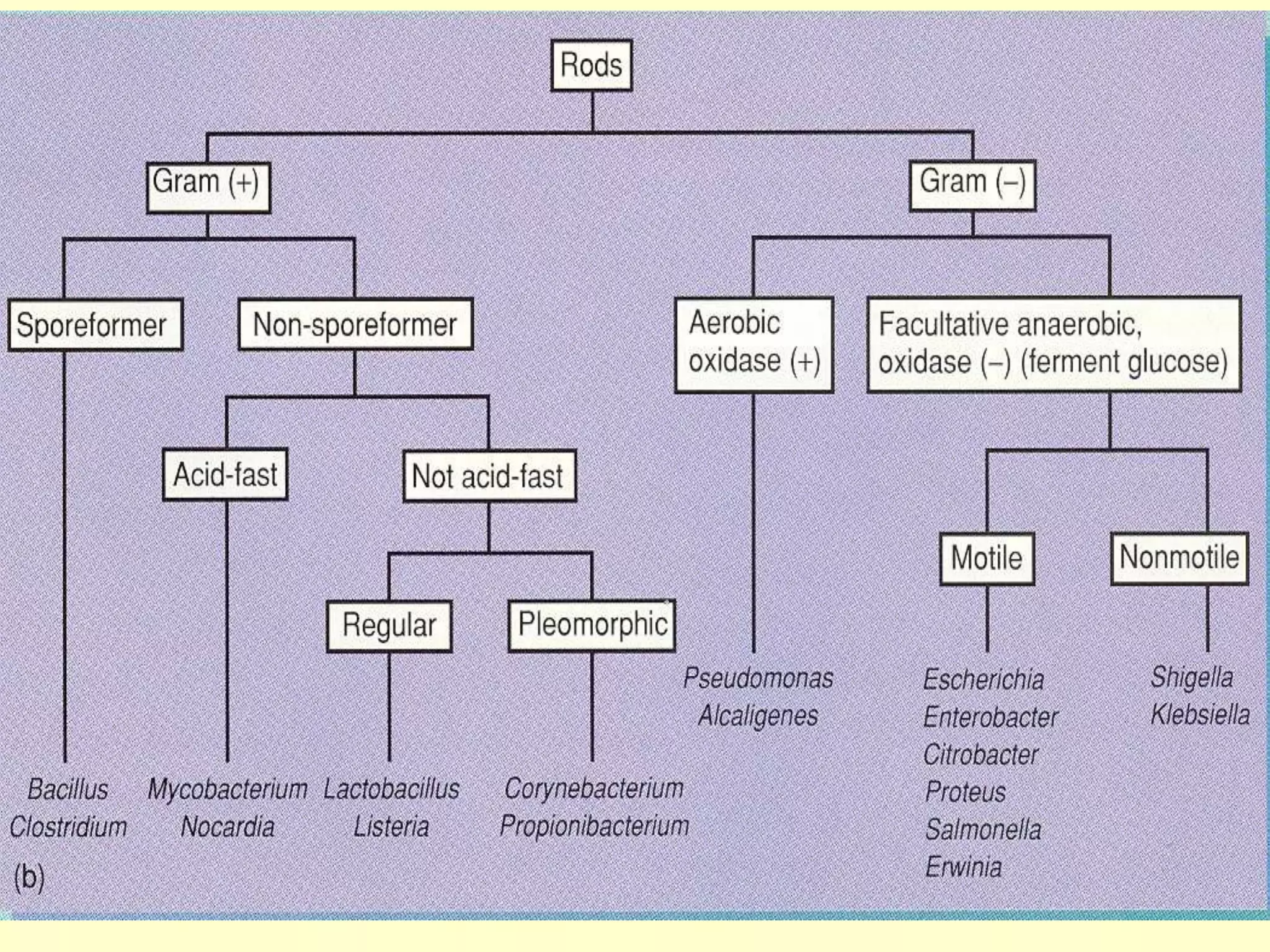
GRAM POSITIVE BACILLI
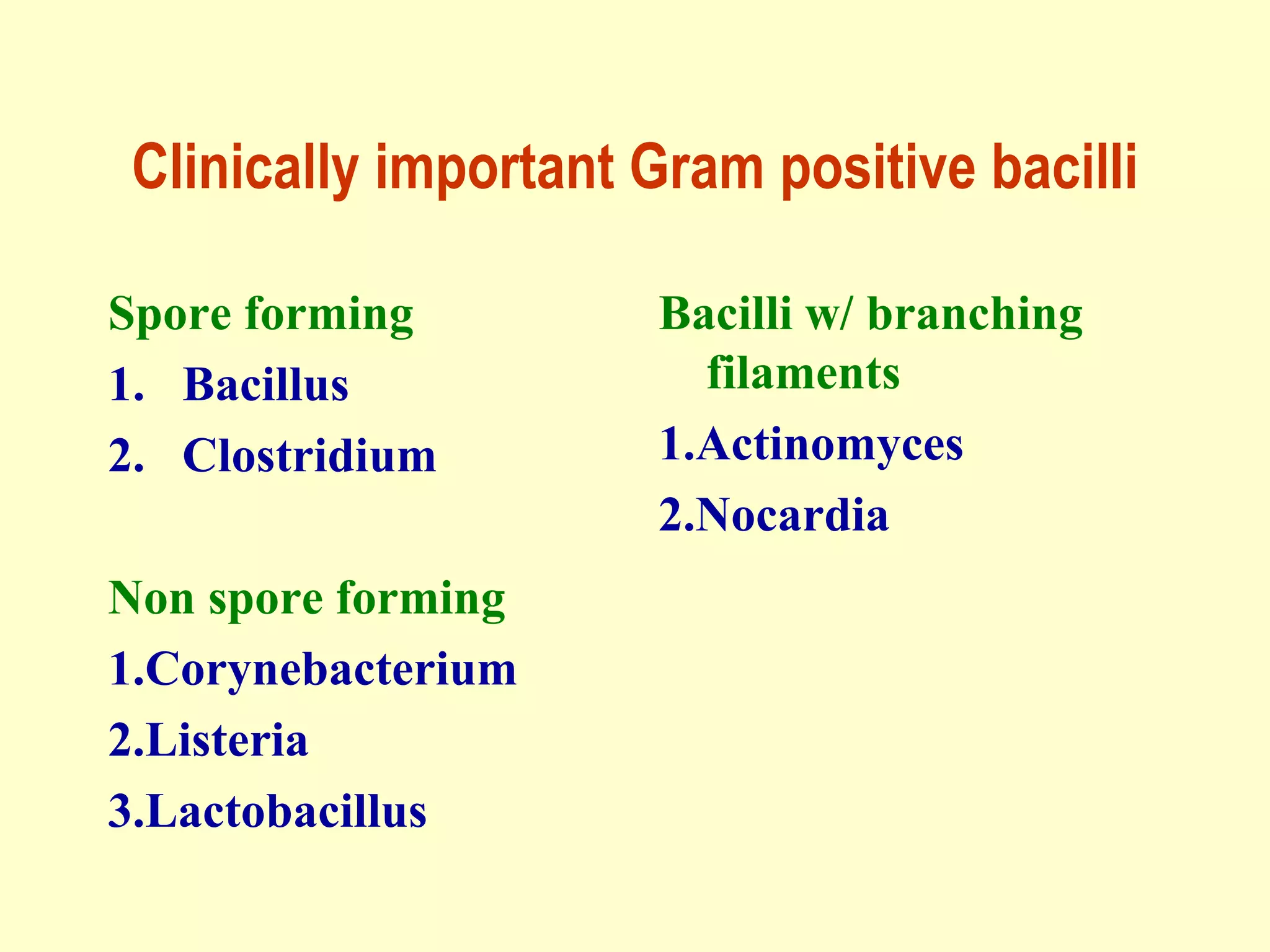
Clinically important Gram positive bacilli
Spore forming
1. Bacillus
2. Clostridium
Non spore forming
1.Corynebacterium
2.Listeria
3.Lactobacillus

Bacilli w/ branching
filaments
1.Actinomyces
2.Nocardia
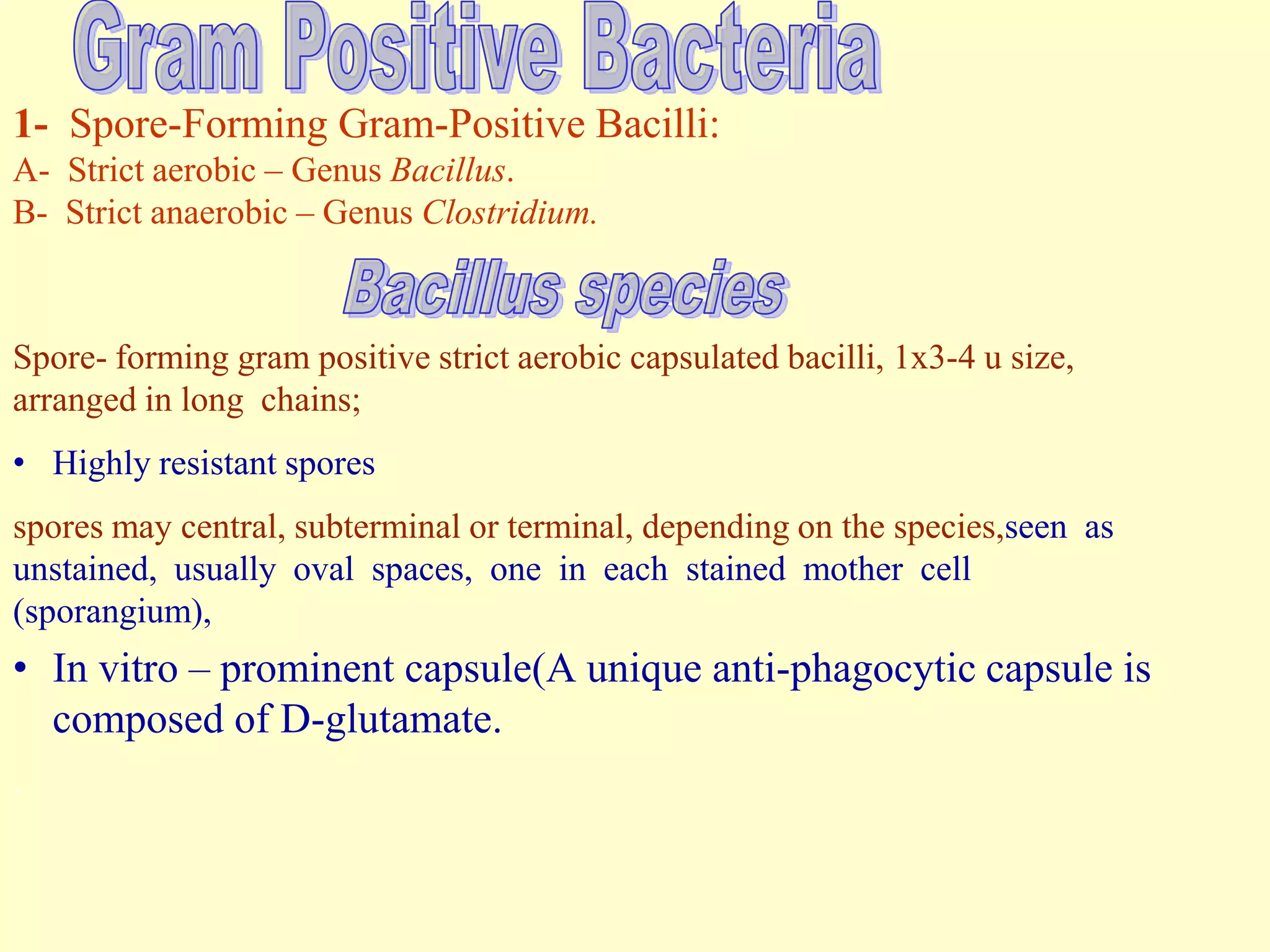
1- Spore-Forming Gram-Positive Bacilli:
A- Strict aerobic – Genus Bacillus.
B- Strict anaerobic – Genus Clostridium.

Spore- forming gram positive strict aerobic capsulated bacilli, 1x3-4 u size,
arranged in long chains;
• Highly resistant spores
spores may central, subterminal or terminal, depending on the species,seen as
unstained, usually oval spaces, one in each stained mother cell
(sporangium),

• In vitro – prominent capsule(A unique anti-phagocytic capsule is
composed of D-glutamate.
.
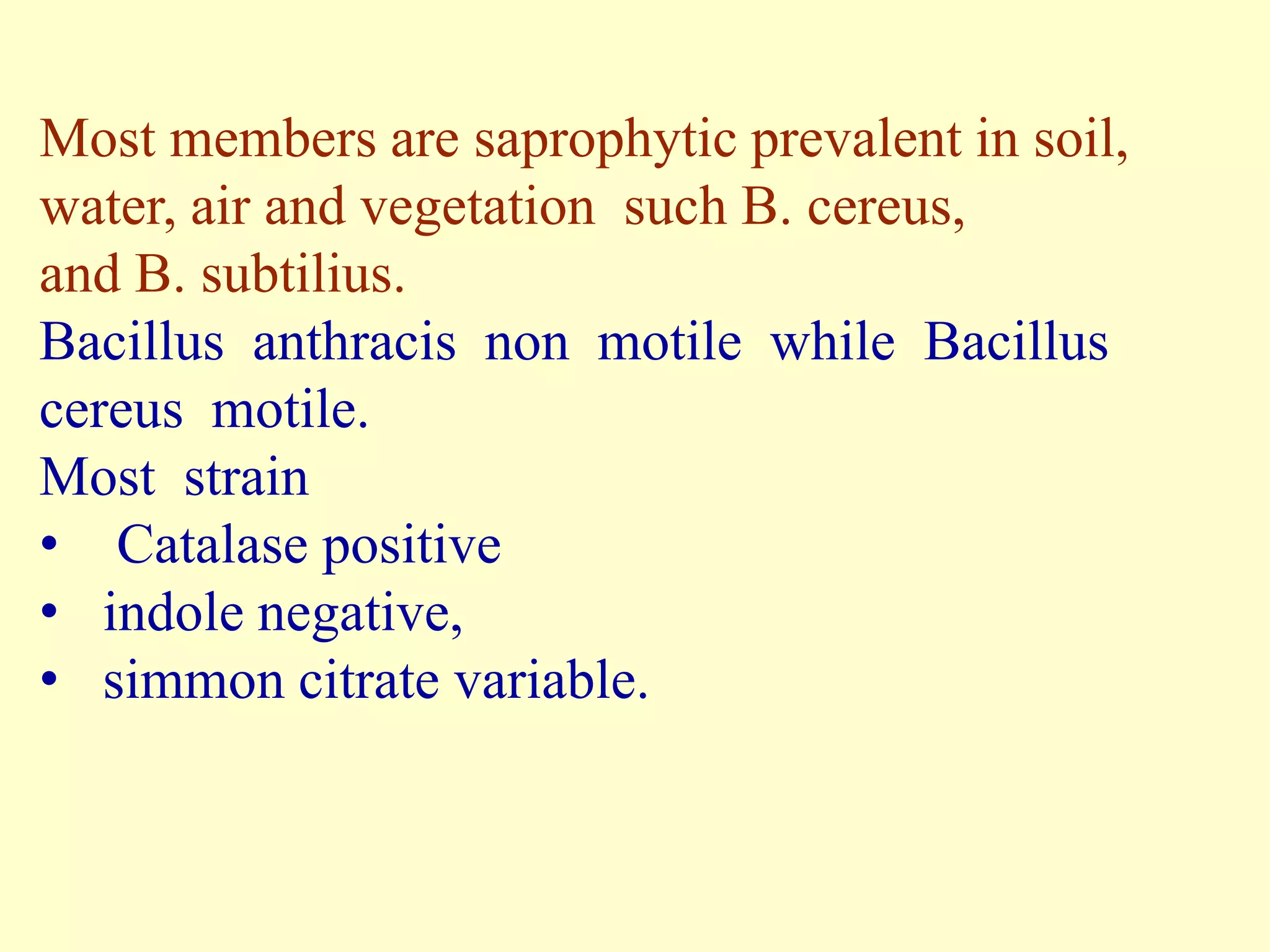
Most members are saprophytic prevalent in soil,
water, air and vegetation such B. cereus,
and B. subtilius.
Bacillus anthracis non motile while Bacillus
cereus motile.
Most strain
• Catalase positive
• indole negative,
• simmon citrate variable.
• Bacillus anthracis
– Human pathogen
– Isolation also considered to be clinically significant
– Zoonosis

• Bacillus cereus
– Environmental organism
– Contaminates food
– Common cause of food poisoning

• Bacillus stearothermophilus
– Tolerates very high temperatures
– Used for quality control of autoclaves

 Bacillus subtilis common lab contaminant
Cause the disease Anthrax in animals in which the organism is
transmitted through eating vegetations containing the spores. Human
is infected through contact with animals or their products.

Disease in Human
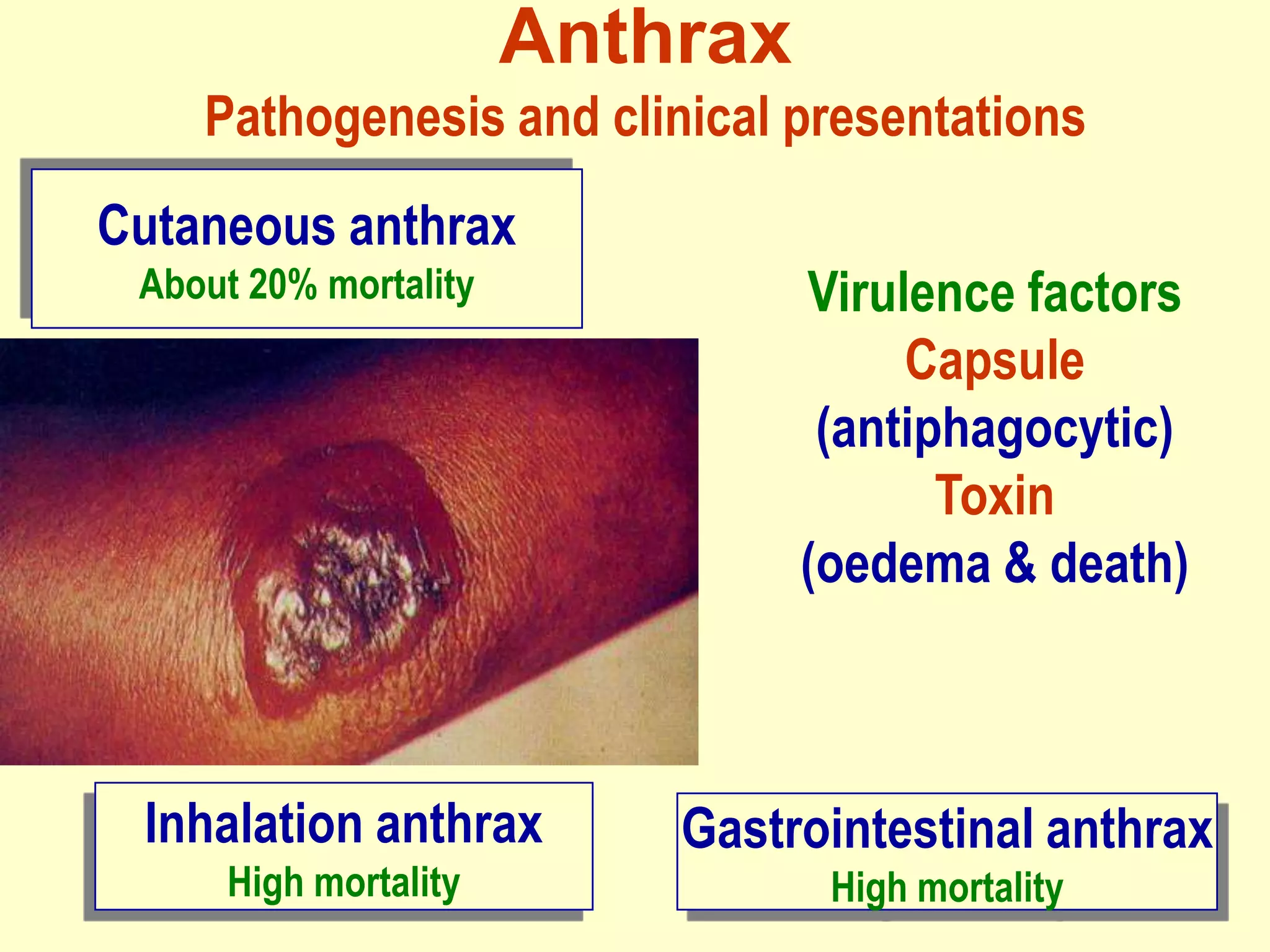
A- Cutaneous Anthrax(malignant pustule): Generally occurs on exposed surfaces
of the arms, face and neck through wound contamination by the spores of the
organism. About 95% of the cases with a mortality rate 20% .
B- Inhalation Anthrax(wool A sorter disease): About 5% of the cases with 85-90%
mortality.

C- Gastrointestinal Anthrax: Is very rare.
Anthrax
Pathogenesis and clinical presentations
Cutaneous anthrax
About 20% mortality

Inhalation anthrax
High mortality

Virulence factors
Capsule
(antiphagocytic)
Toxin
(oedema & death)

Gastrointestinal anthrax
High mortality
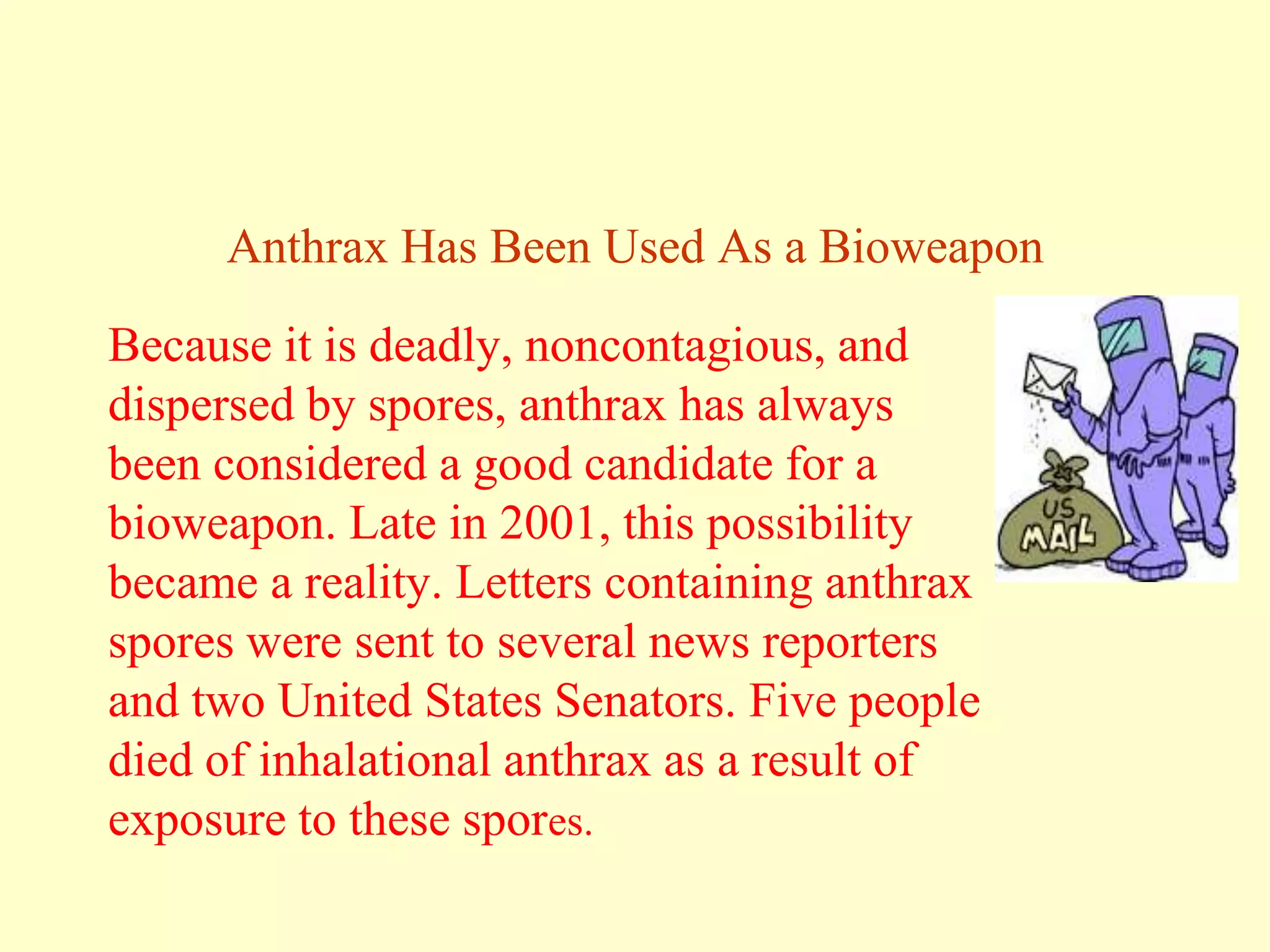
Anthrax Has Been Used As a Bioweapon

Because it is deadly, noncontagious, and
dispersed by spores, anthrax has always
been considered a good candidate for a
bioweapon. Late in 2001, this possibility
became a reality. Letters containing anthrax
spores were sent to several news reporters
and two United States Senators. Five people
died of inhalational anthrax as a result of
exposure to these spores.
Anthrax - Diagnosis
• Specimen
– Aspirate or swab from cutaneous lesion
– Blood culture
– Sputum , Fluid , pus,

• Laboratory investigation
– Gram stain
– Culture
– Identification of isolate
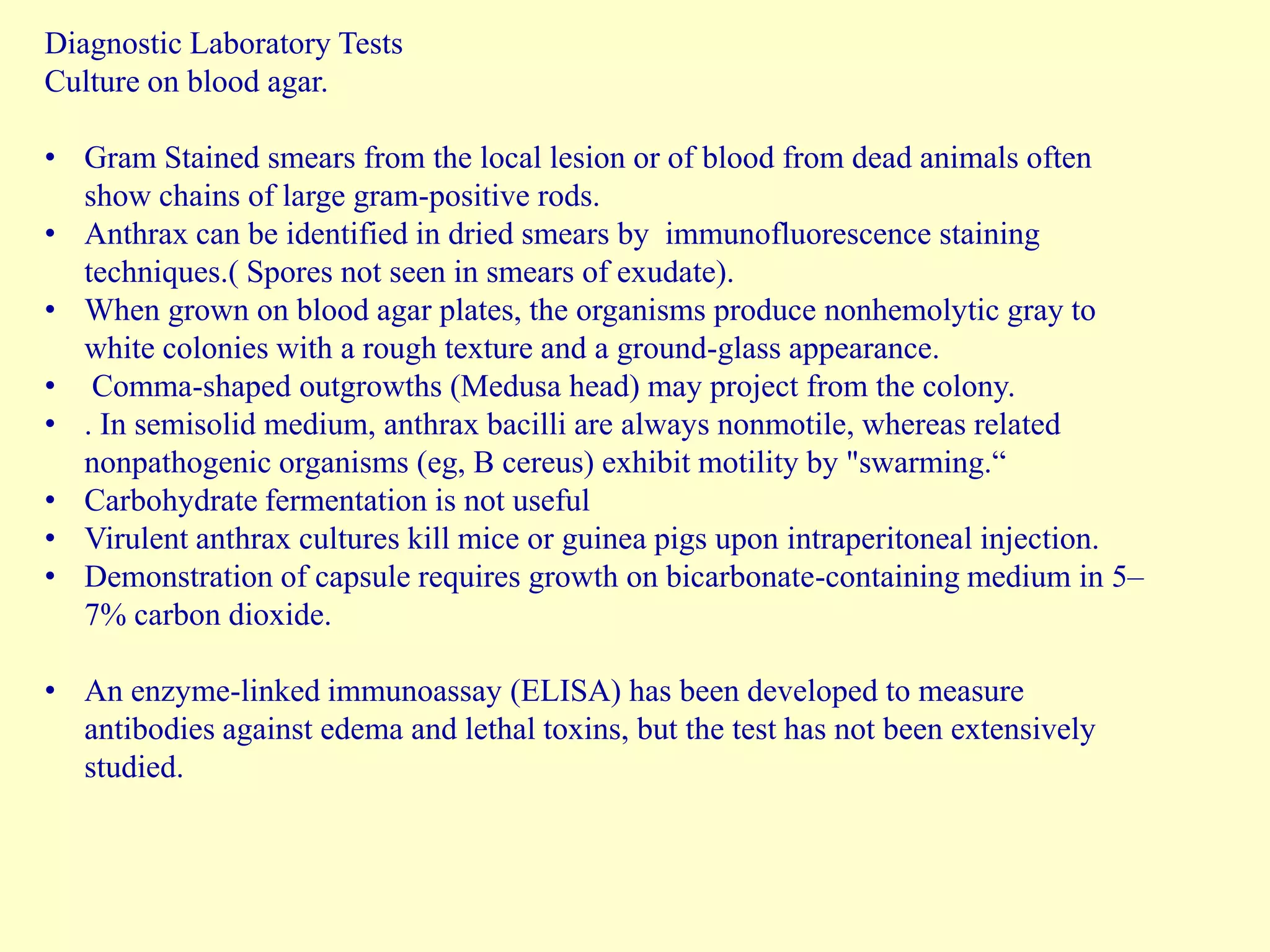
Diagnostic Laboratory Tests
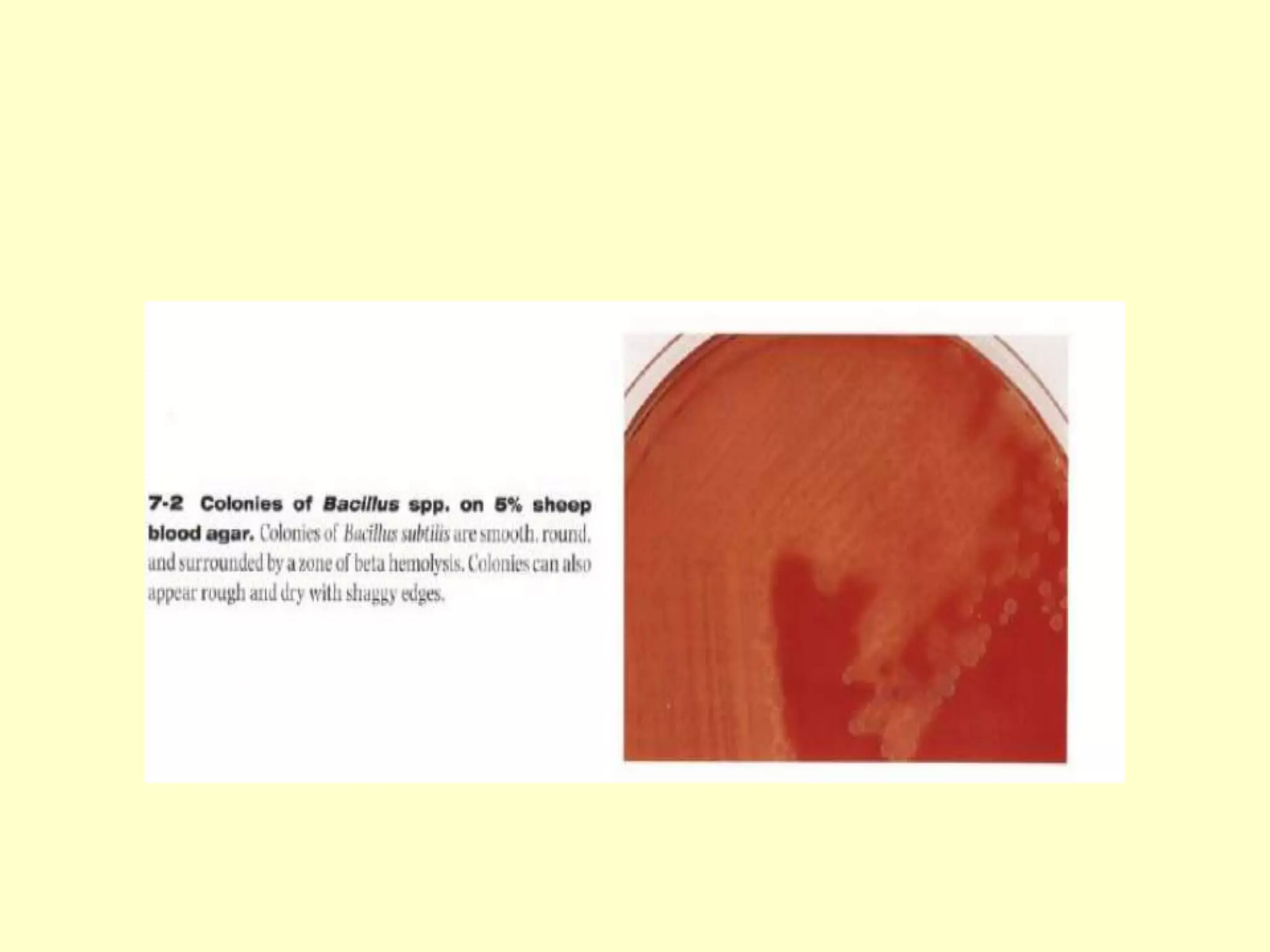
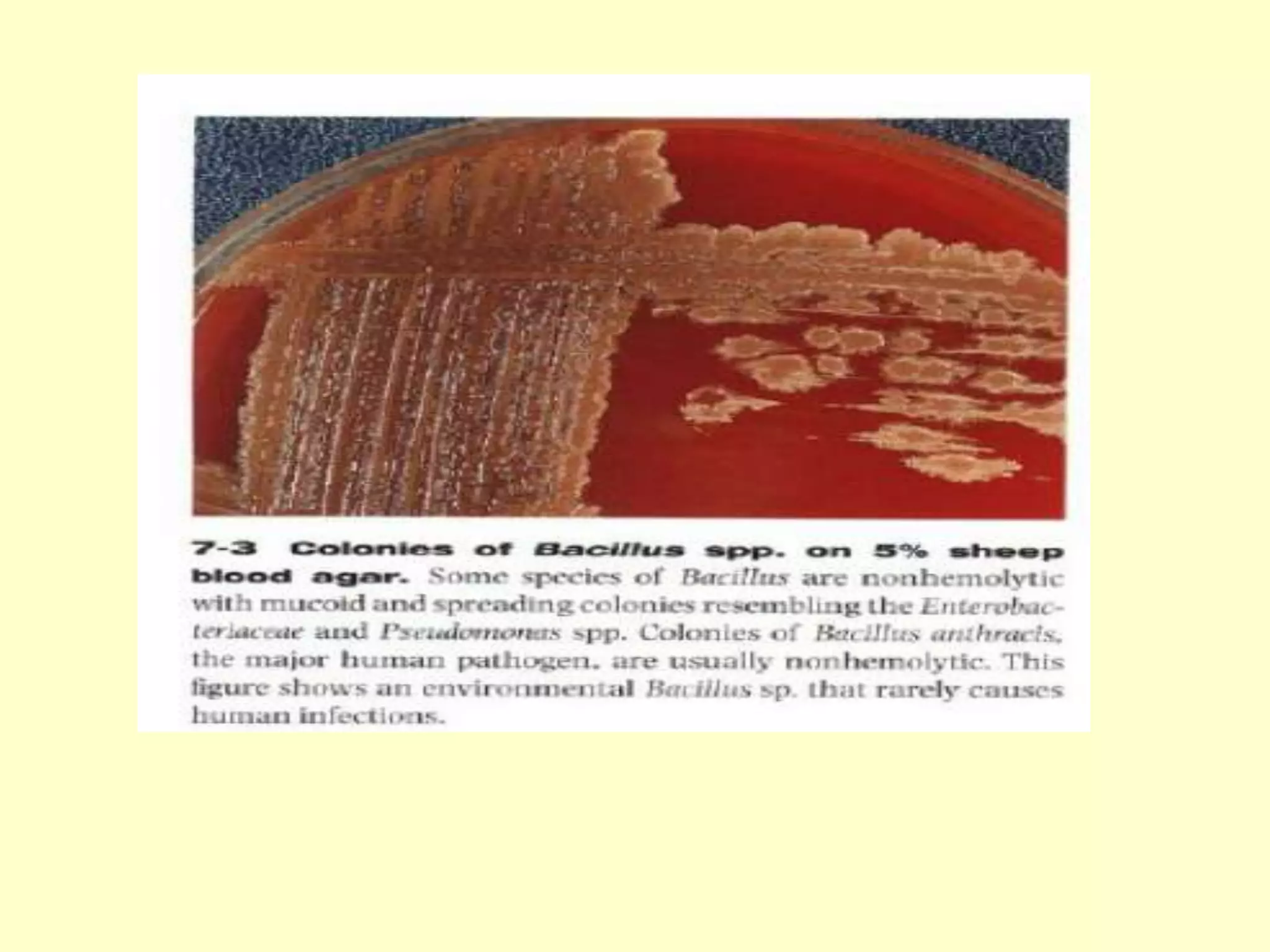
Culture on blood agar.
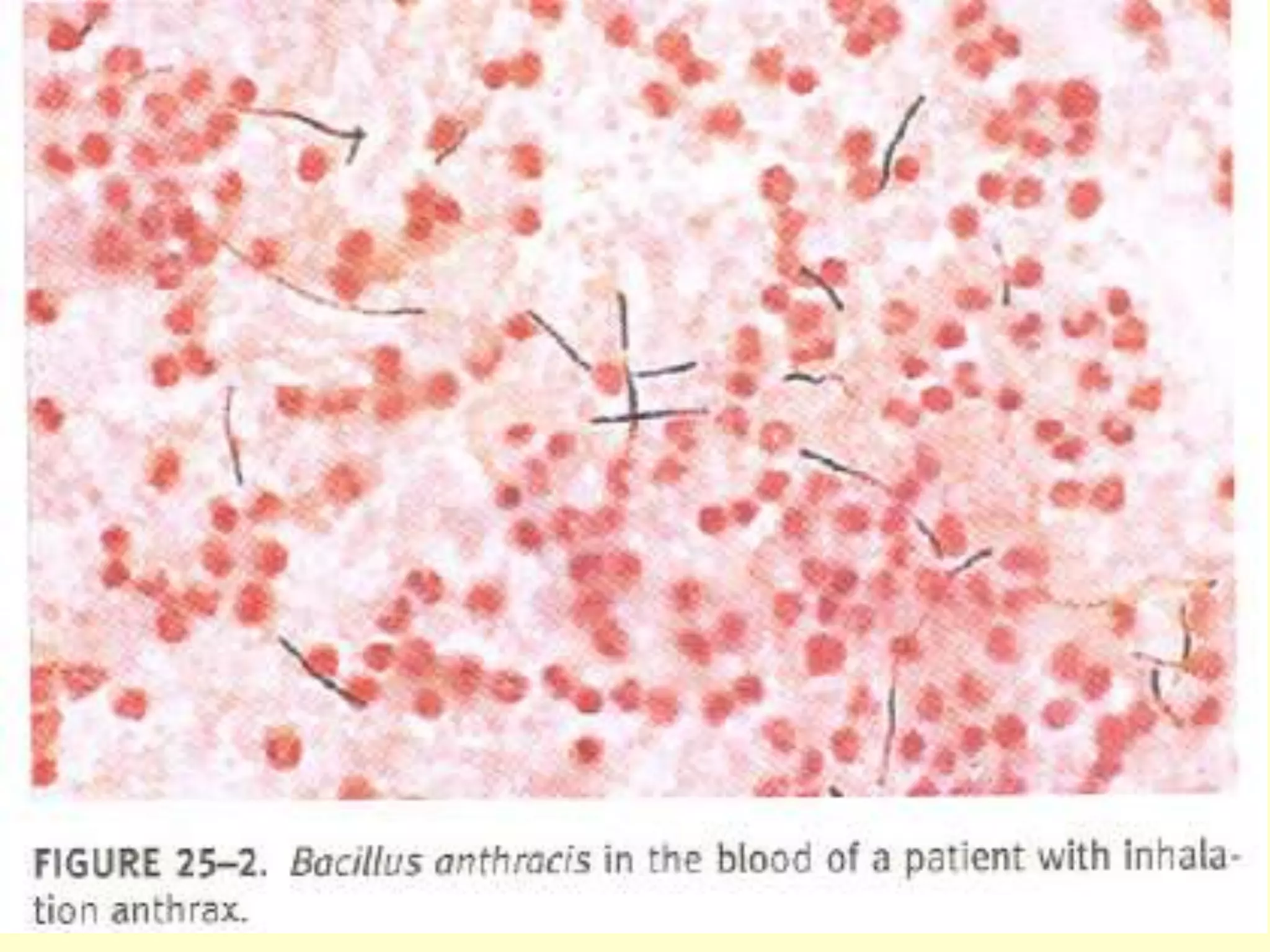
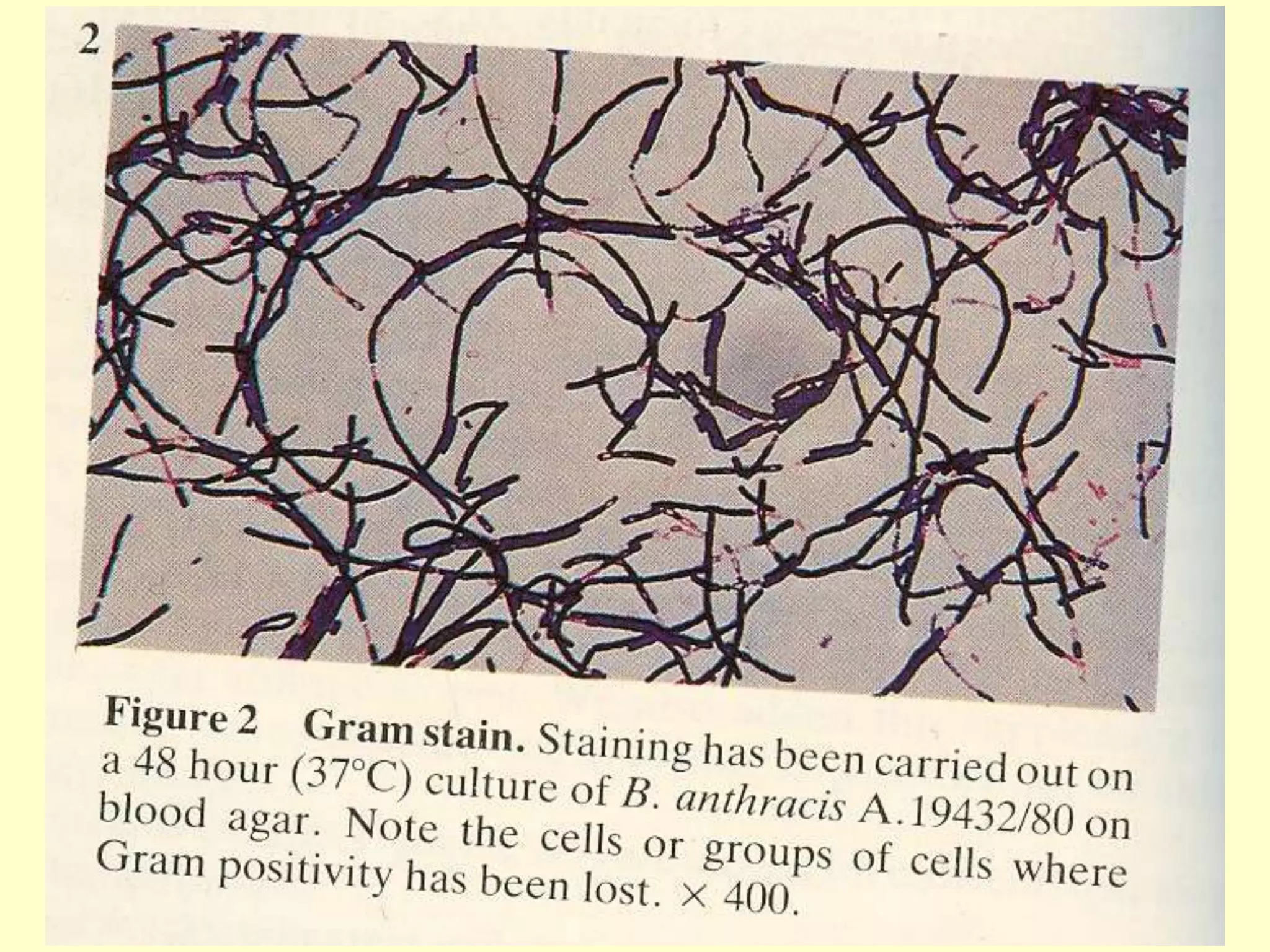
• Gram Stained smears from the local lesion or of blood from dead animals often
show chains of large gram-positive rods.
• Anthrax can be identified in dried smears by immunofluorescence staining
techniques.( Spores not seen in smears of exudate).
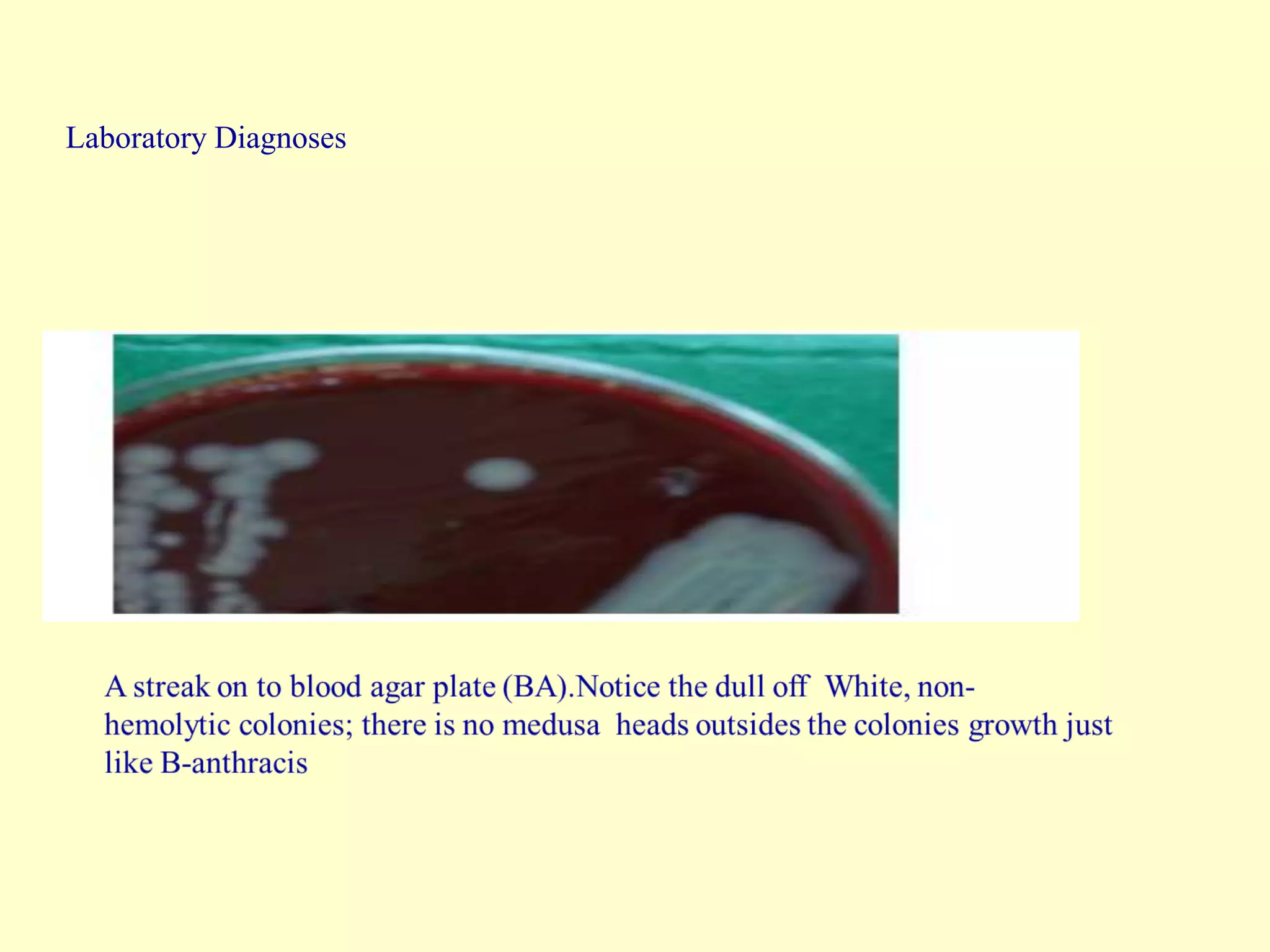
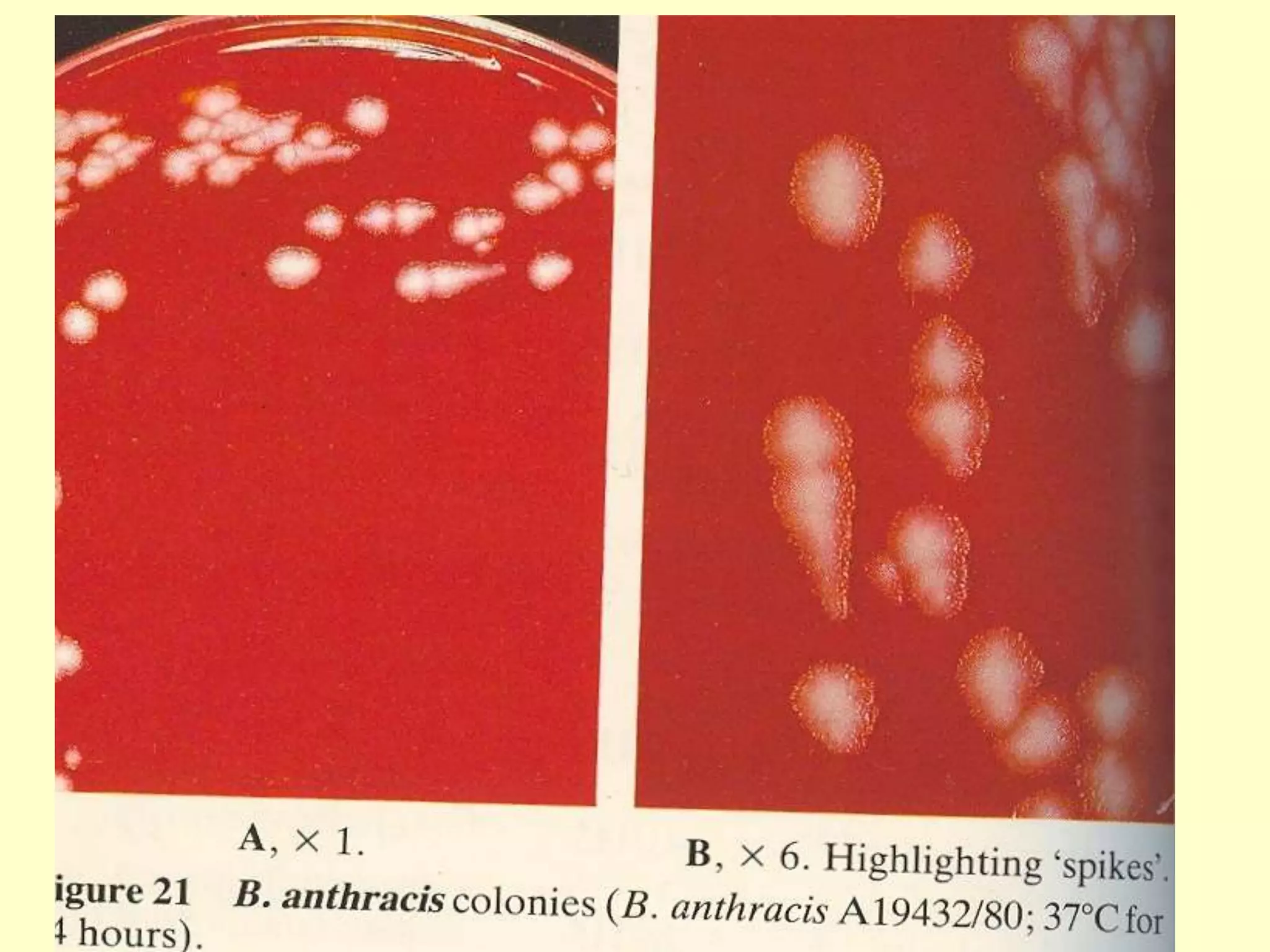
• When grown on blood agar plates, the organisms produce nonhemolytic gray to
white colonies with a rough texture and a ground-glass appearance.
• Comma-shaped outgrowths (Medusa head) may project from the colony.
• . In semisolid medium, anthrax bacilli are always nonmotile, whereas related
nonpathogenic organisms (eg, B cereus) exhibit motility by "swarming.“
• Carbohydrate fermentation is not useful
• Virulent anthrax cultures kill mice or guinea pigs upon intraperitoneal injection.
• Demonstration of capsule requires growth on bicarbonate-containing medium in 5–
7% carbon dioxide.
• An enzyme-linked immunoassay (ELISA) has been developed to measure
antibodies against edema and lethal toxins, but the test has not been extensively
studied.
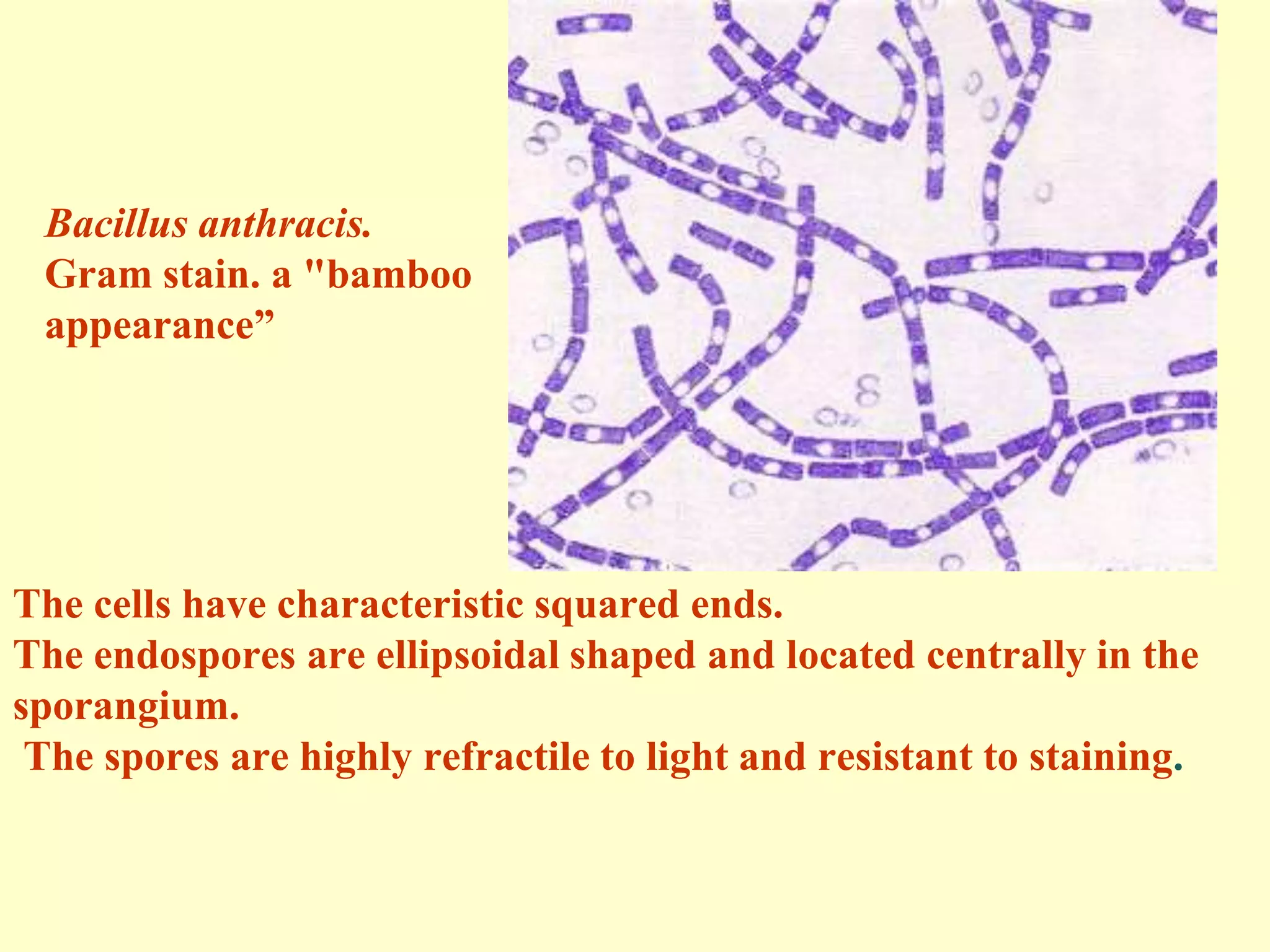
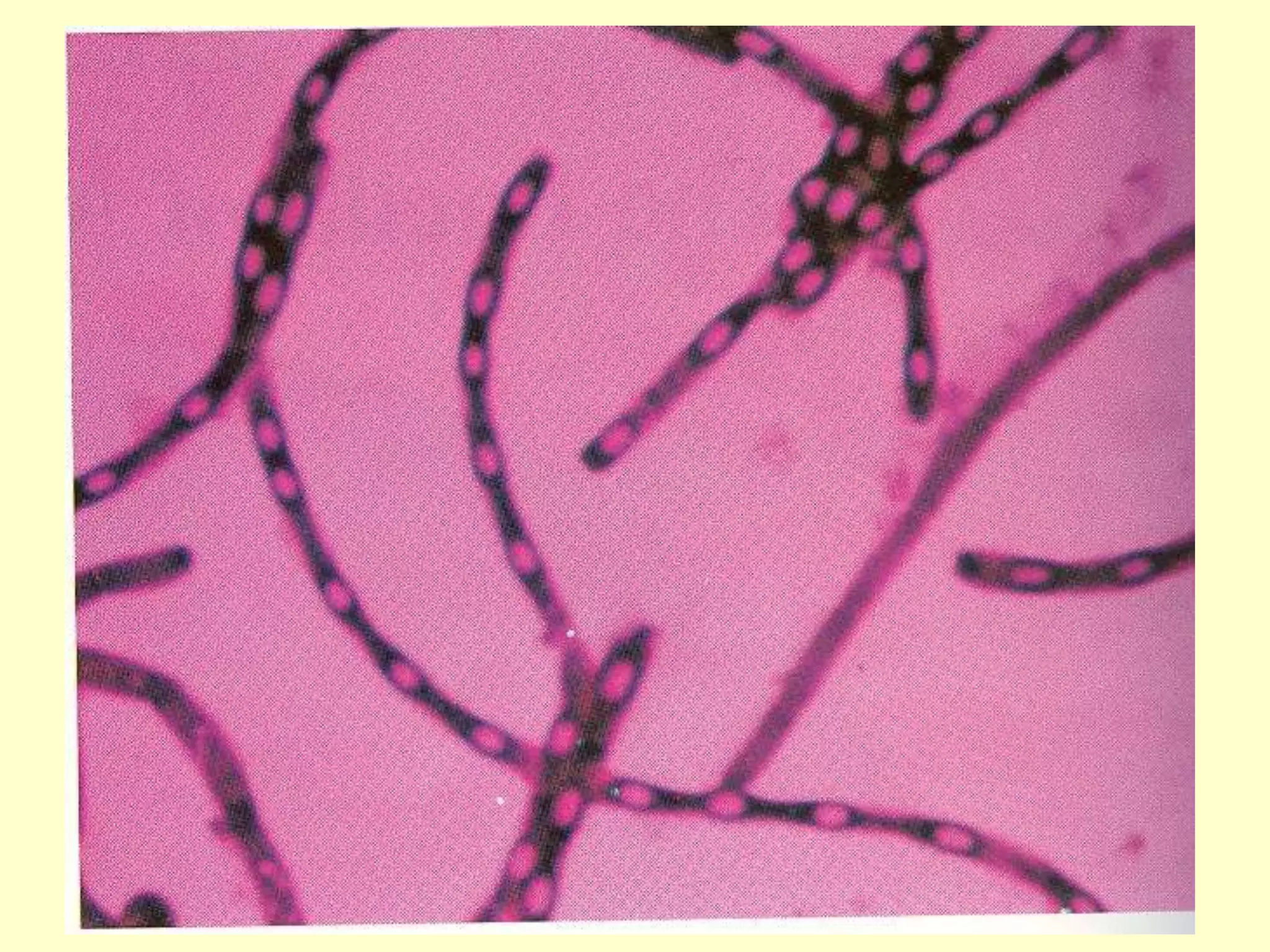
Bacillus anthracis.
Gram stain. a "bamboo
appearance”

The cells have characteristic squared ends.
The endospores are ellipsoidal shaped and located centrally in the
sporangium.
The spores are highly refractile to light and resistant to staining.
Laboratory Diagnoses
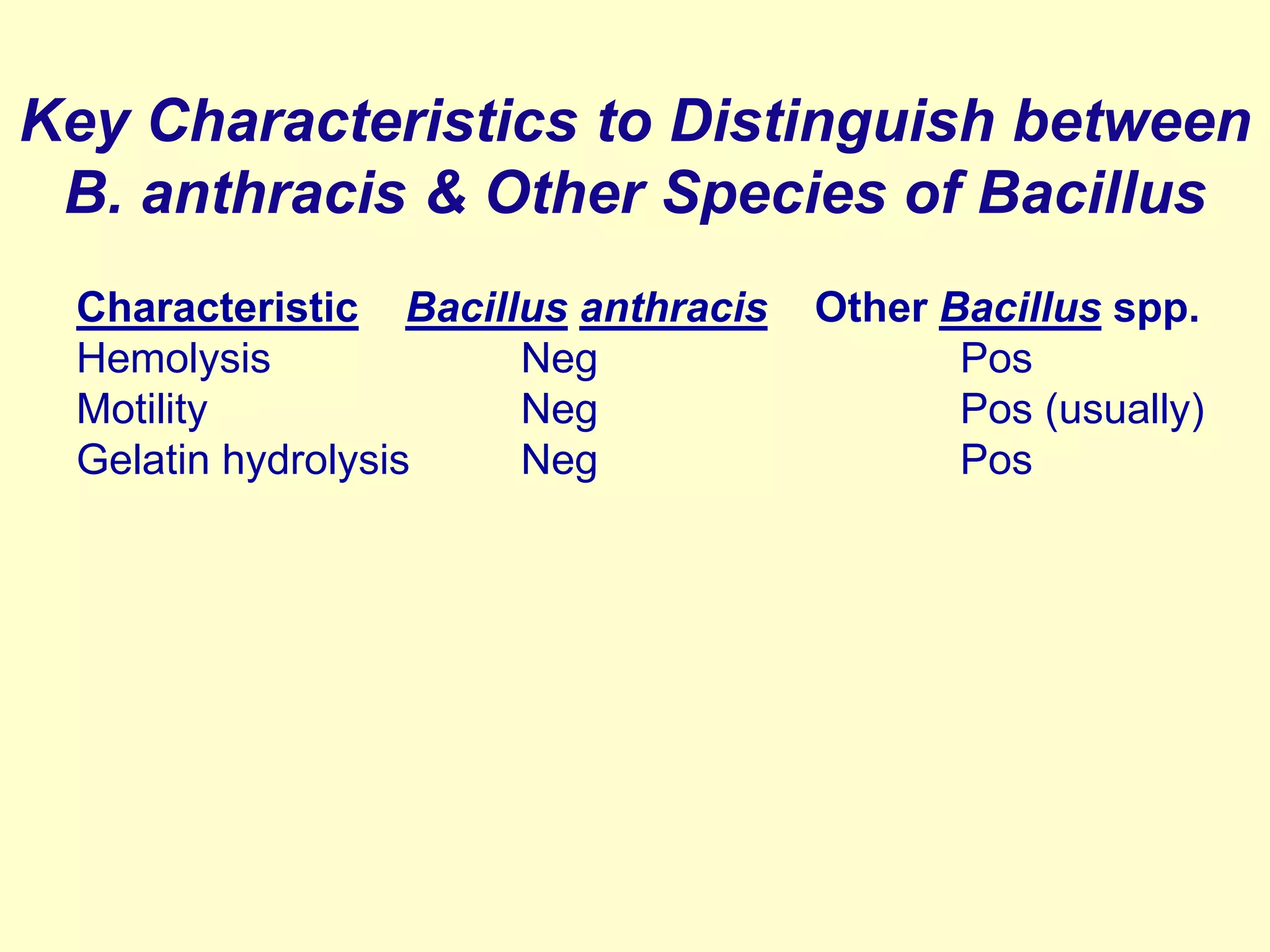
Key Characteristics to Distinguish between
B. anthracis & Other Species of Bacillus
Characteristic Bacillus anthracis
Hemolysis
Neg
Motility
Neg
Gelatin hydrolysis
Neg

Other Bacillus spp.
Pos
Pos (usually)
Pos
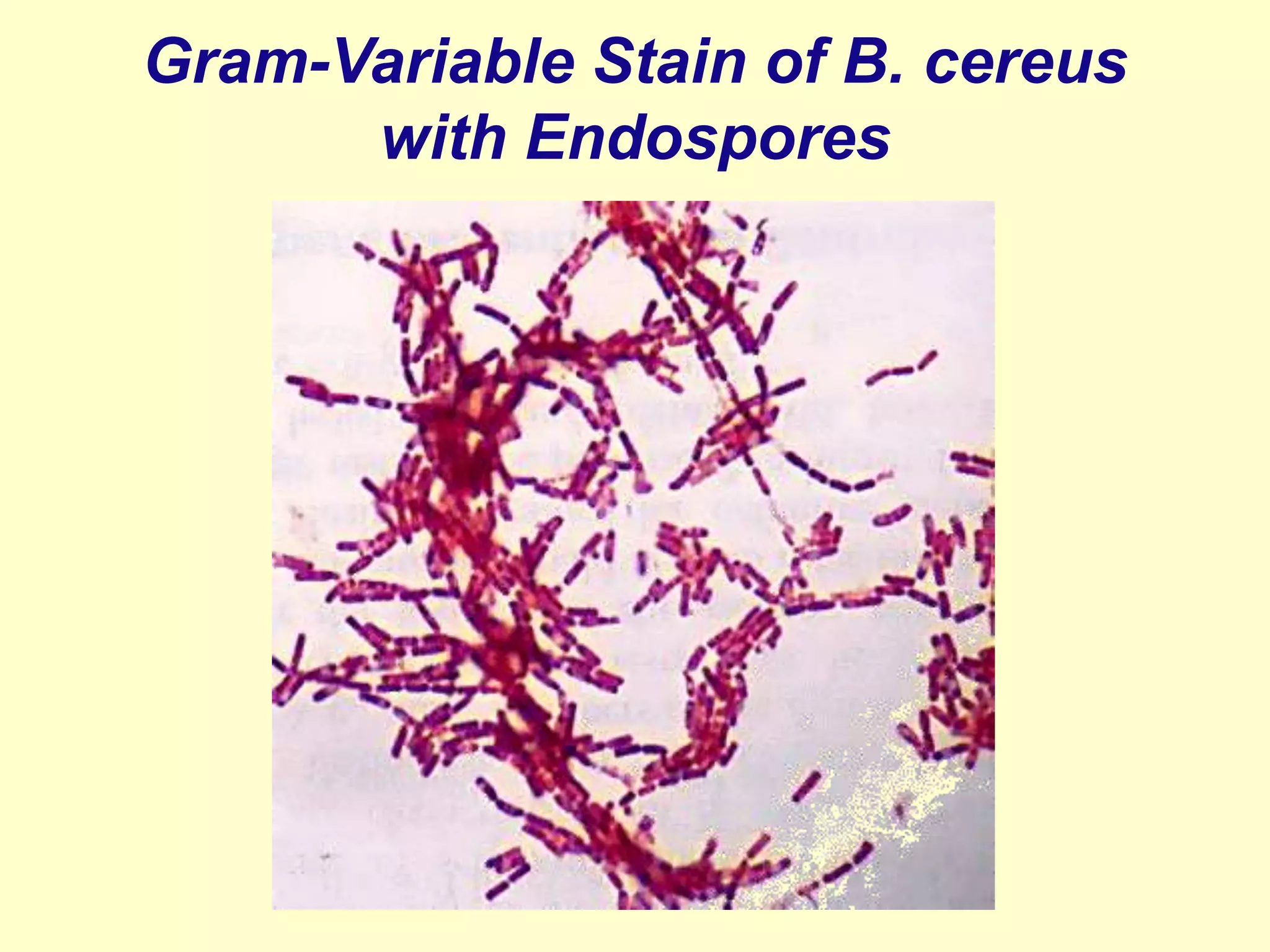
Gram-Variable Stain of B. cereus
with Endospores
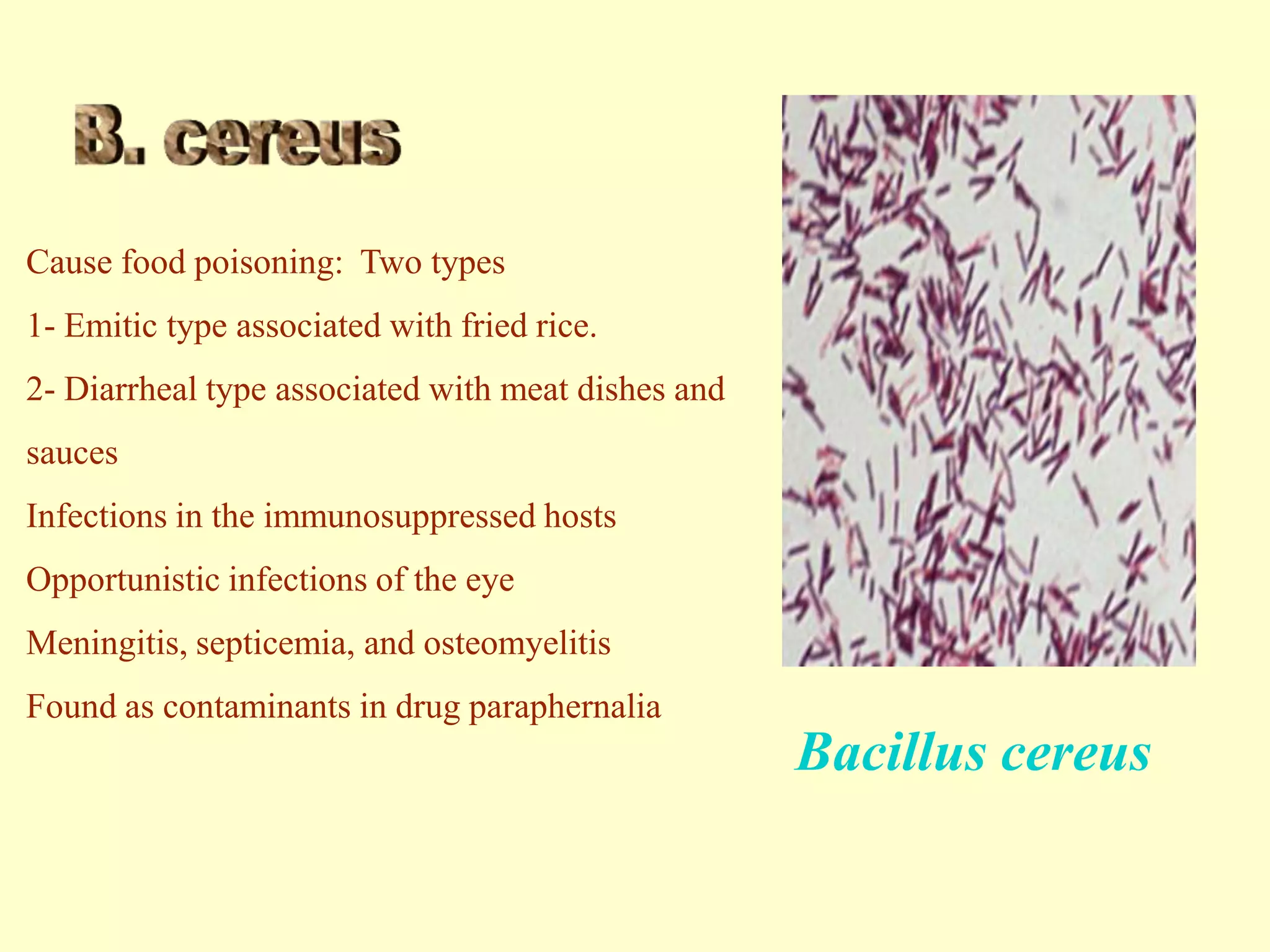
Cause food poisoning: Two types
1- Emitic type associated with fried rice.
2- Diarrheal type associated with meat dishes and
sauces
Infections in the immunosuppressed hosts
Opportunistic infections of the eye
Meningitis, septicemia, and osteomyelitis
Found as contaminants in drug paraphernalia

Bacillus cereus
Bacillus cereus
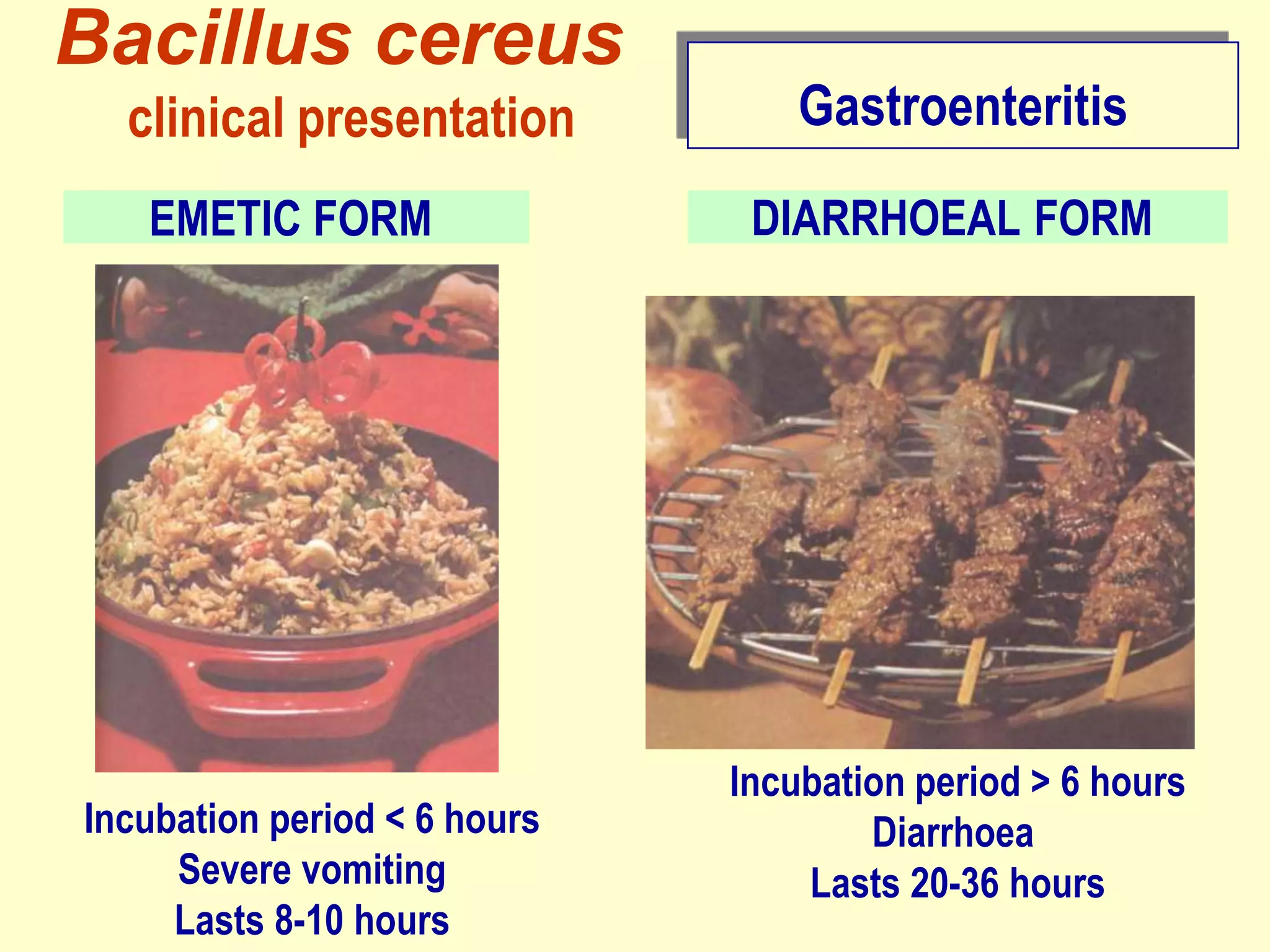
clinical presentation
EMETIC FORM

Incubation period < 6 hours
Severe vomiting
Lasts 8-10 hours

Gastroenteritis
DIARRHOEAL FORM

Incubation period > 6 hours
Diarrhoea
Lasts 20-36 hours
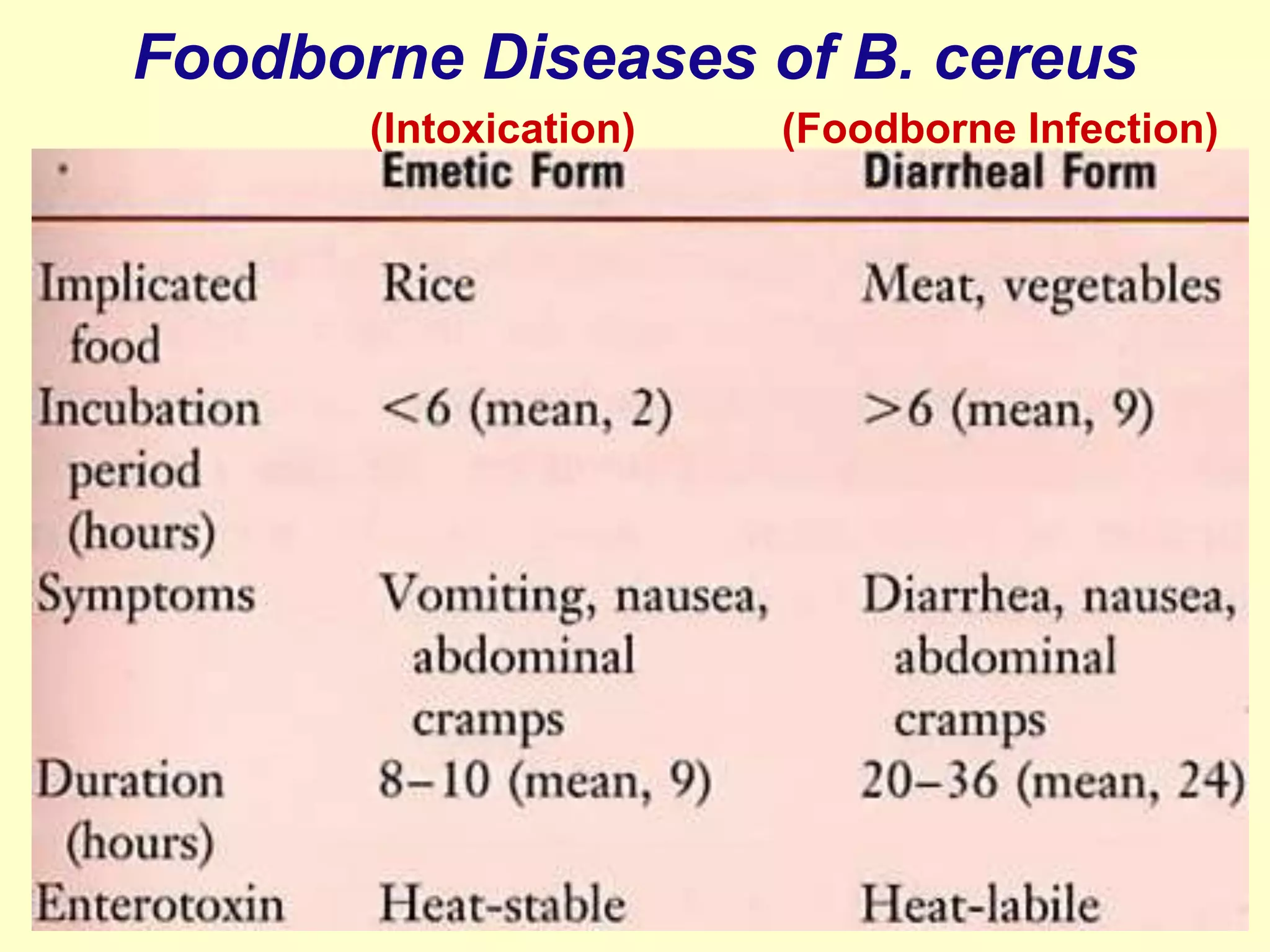
Foodborne Diseases of B. cereus
(Intoxication)

(Foodborne Infection)
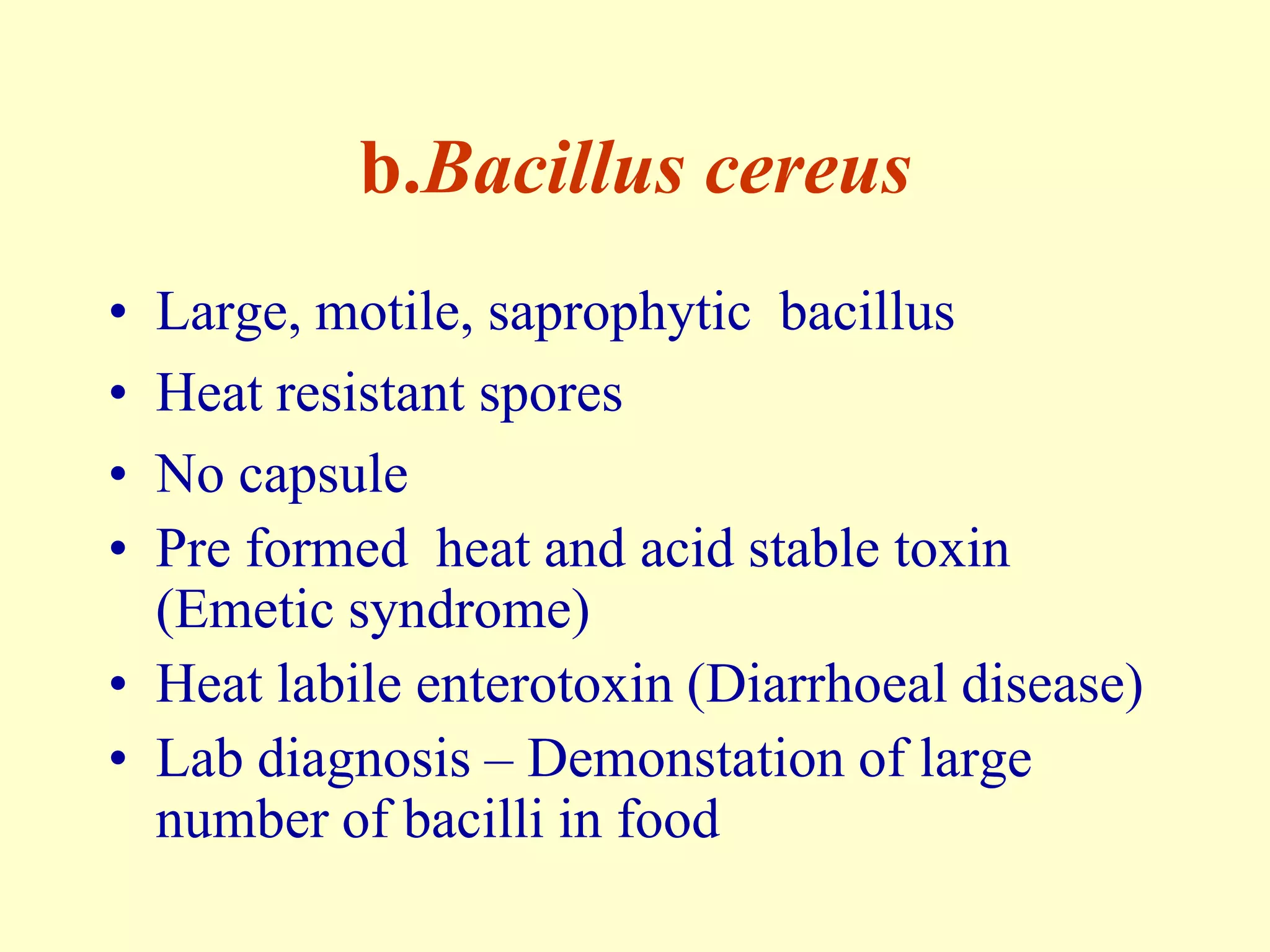
b.Bacillus cereus
•
•
•
•

Large, motile, saprophytic bacillus
Heat resistant spores
No capsule
Pre formed heat and acid stable toxin
(Emetic syndrome)
• Heat labile enterotoxin (Diarrhoeal disease)
• Lab diagnosis – Demonstation of large
number of bacilli in food
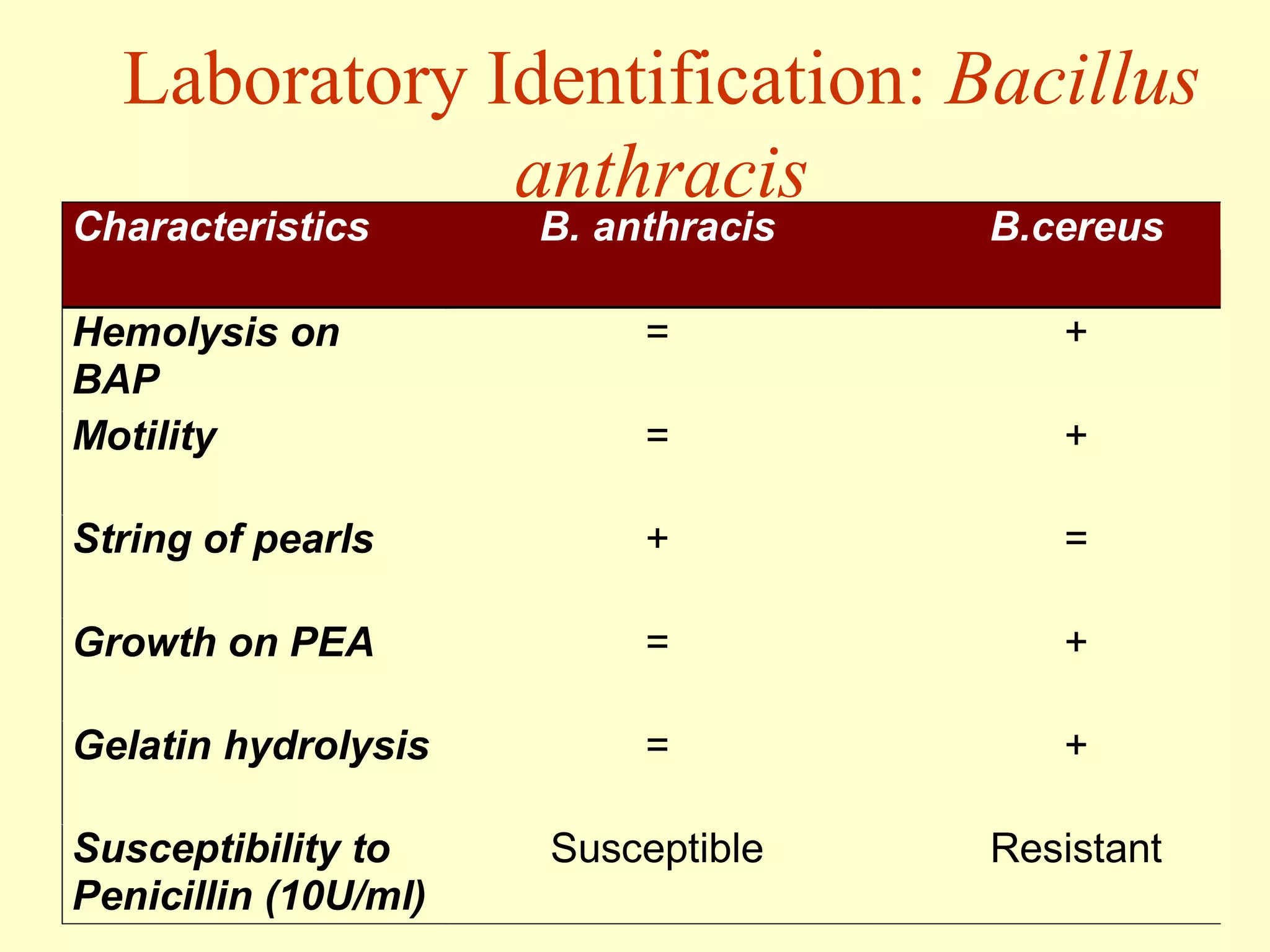
Laboratory Identification: Bacillus
anthracis

Characteristics

B. anthracis

B.cereus

Hemolysis on
BAP
Motility

=

+

=

+

String of pearls

+

=

Growth on PEA

=

+

Gelatin hydrolysis

=

+

Susceptibility to
Penicillin (10U/ml)

Susceptible

Resistant
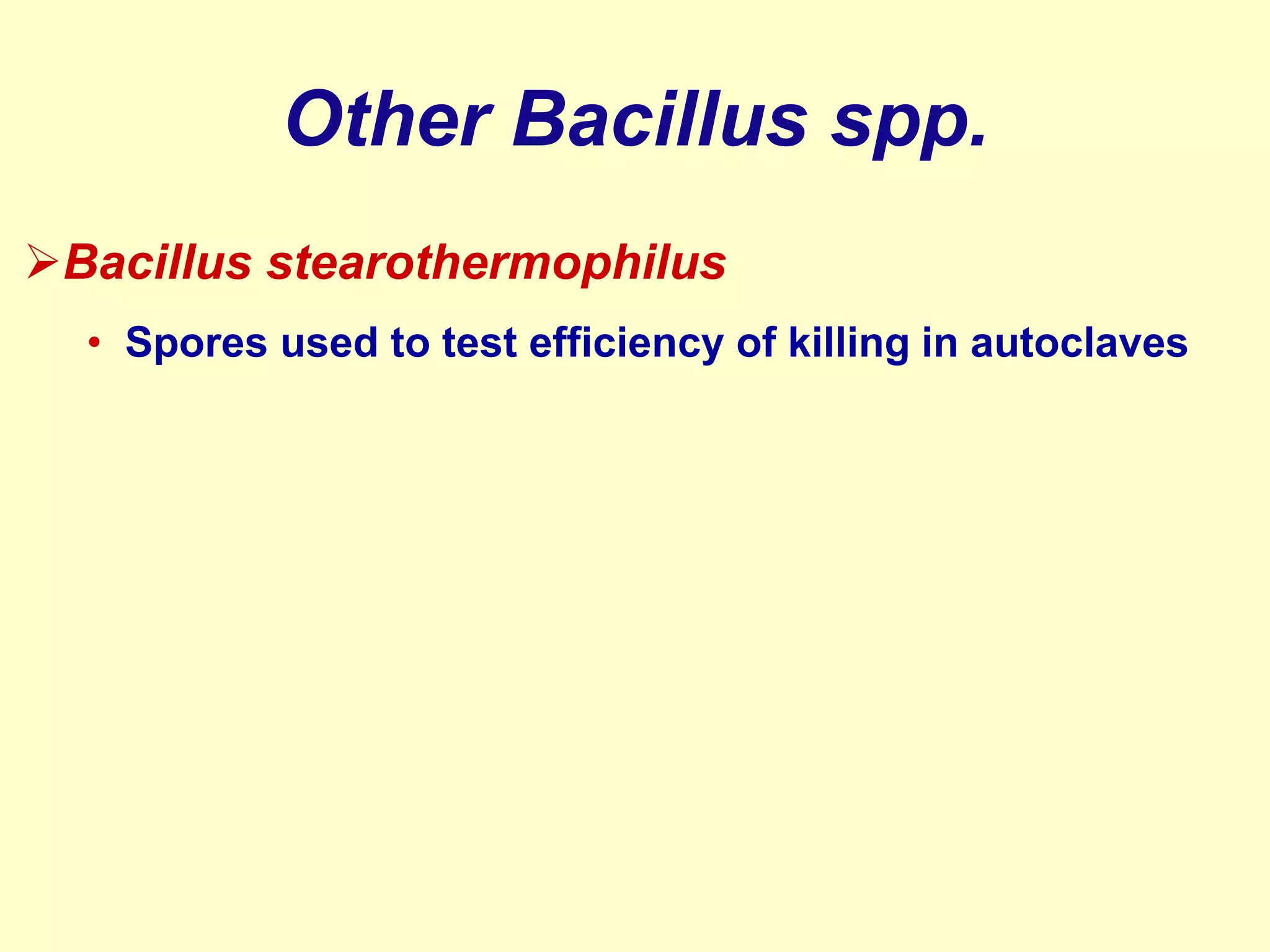
Other Bacillus spp.
Bacillus stearothermophilus
• Spores used to test efficiency of killing in autoclaves
Other Bacillus species
• Bacillus subtilis
– Common laboratory contaminant
Points to Remember
• Differentiating characteristics between B. anthracis and
saprophytic species
• Characteristic, microscopic appearance of Bacillus species
• Clinical forms of infection attributed to B. anthracis
• Clinical significance of Bacillus cereus in healthy as well as
in at-risk populations

1 spore-forming gram-positive bacilli 2014

  • 1.
  • 3.
    Clinically important Grampositive bacilli Spore forming 1. Bacillus 2. Clostridium Non spore forming 1.Corynebacterium 2.Listeria 3.Lactobacillus Bacilli w/ branching filaments 1.Actinomyces 2.Nocardia
  • 4.
    1- Spore-Forming Gram-PositiveBacilli: A- Strict aerobic – Genus Bacillus. B- Strict anaerobic – Genus Clostridium. Spore- forming gram positive strict aerobic capsulated bacilli, 1x3-4 u size, arranged in long chains; • Highly resistant spores spores may central, subterminal or terminal, depending on the species,seen as unstained, usually oval spaces, one in each stained mother cell (sporangium), • In vitro – prominent capsule(A unique anti-phagocytic capsule is composed of D-glutamate. .
  • 5.
    Most members aresaprophytic prevalent in soil, water, air and vegetation such B. cereus, and B. subtilius. Bacillus anthracis non motile while Bacillus cereus motile. Most strain • Catalase positive • indole negative, • simmon citrate variable.
  • 6.
    • Bacillus anthracis –Human pathogen – Isolation also considered to be clinically significant – Zoonosis • Bacillus cereus – Environmental organism – Contaminates food – Common cause of food poisoning • Bacillus stearothermophilus – Tolerates very high temperatures – Used for quality control of autoclaves  Bacillus subtilis common lab contaminant
  • 7.
    Cause the diseaseAnthrax in animals in which the organism is transmitted through eating vegetations containing the spores. Human is infected through contact with animals or their products. Disease in Human A- Cutaneous Anthrax(malignant pustule): Generally occurs on exposed surfaces of the arms, face and neck through wound contamination by the spores of the organism. About 95% of the cases with a mortality rate 20% . B- Inhalation Anthrax(wool A sorter disease): About 5% of the cases with 85-90% mortality. C- Gastrointestinal Anthrax: Is very rare.
  • 8.
    Anthrax Pathogenesis and clinicalpresentations Cutaneous anthrax About 20% mortality Inhalation anthrax High mortality Virulence factors Capsule (antiphagocytic) Toxin (oedema & death) Gastrointestinal anthrax High mortality
  • 9.
    Anthrax Has BeenUsed As a Bioweapon Because it is deadly, noncontagious, and dispersed by spores, anthrax has always been considered a good candidate for a bioweapon. Late in 2001, this possibility became a reality. Letters containing anthrax spores were sent to several news reporters and two United States Senators. Five people died of inhalational anthrax as a result of exposure to these spores.
  • 11.
    Anthrax - Diagnosis •Specimen – Aspirate or swab from cutaneous lesion – Blood culture – Sputum , Fluid , pus, • Laboratory investigation – Gram stain – Culture – Identification of isolate
  • 12.
    Diagnostic Laboratory Tests Cultureon blood agar. • Gram Stained smears from the local lesion or of blood from dead animals often show chains of large gram-positive rods. • Anthrax can be identified in dried smears by immunofluorescence staining techniques.( Spores not seen in smears of exudate). • When grown on blood agar plates, the organisms produce nonhemolytic gray to white colonies with a rough texture and a ground-glass appearance. • Comma-shaped outgrowths (Medusa head) may project from the colony. • . In semisolid medium, anthrax bacilli are always nonmotile, whereas related nonpathogenic organisms (eg, B cereus) exhibit motility by "swarming.“ • Carbohydrate fermentation is not useful • Virulent anthrax cultures kill mice or guinea pigs upon intraperitoneal injection. • Demonstration of capsule requires growth on bicarbonate-containing medium in 5– 7% carbon dioxide. • An enzyme-linked immunoassay (ELISA) has been developed to measure antibodies against edema and lethal toxins, but the test has not been extensively studied.
  • 13.
    Bacillus anthracis. Gram stain.a "bamboo appearance” The cells have characteristic squared ends. The endospores are ellipsoidal shaped and located centrally in the sporangium. The spores are highly refractile to light and resistant to staining.
  • 17.
  • 22.
    Key Characteristics toDistinguish between B. anthracis & Other Species of Bacillus Characteristic Bacillus anthracis Hemolysis Neg Motility Neg Gelatin hydrolysis Neg Other Bacillus spp. Pos Pos (usually) Pos
  • 23.
    Gram-Variable Stain ofB. cereus with Endospores
  • 24.
    Cause food poisoning:Two types 1- Emitic type associated with fried rice. 2- Diarrheal type associated with meat dishes and sauces Infections in the immunosuppressed hosts Opportunistic infections of the eye Meningitis, septicemia, and osteomyelitis Found as contaminants in drug paraphernalia Bacillus cereus
  • 25.
    Bacillus cereus clinical presentation EMETICFORM Incubation period < 6 hours Severe vomiting Lasts 8-10 hours Gastroenteritis DIARRHOEAL FORM Incubation period > 6 hours Diarrhoea Lasts 20-36 hours
  • 26.
    Foodborne Diseases ofB. cereus (Intoxication) (Foodborne Infection)
  • 27.
    b.Bacillus cereus • • • • Large, motile,saprophytic bacillus Heat resistant spores No capsule Pre formed heat and acid stable toxin (Emetic syndrome) • Heat labile enterotoxin (Diarrhoeal disease) • Lab diagnosis – Demonstation of large number of bacilli in food
  • 28.
    Laboratory Identification: Bacillus anthracis Characteristics B.anthracis B.cereus Hemolysis on BAP Motility = + = + String of pearls + = Growth on PEA = + Gelatin hydrolysis = + Susceptibility to Penicillin (10U/ml) Susceptible Resistant
  • 29.
    Other Bacillus spp. Bacillusstearothermophilus • Spores used to test efficiency of killing in autoclaves
  • 30.
    Other Bacillus species •Bacillus subtilis – Common laboratory contaminant
  • 33.
    Points to Remember •Differentiating characteristics between B. anthracis and saprophytic species • Characteristic, microscopic appearance of Bacillus species • Clinical forms of infection attributed to B. anthracis • Clinical significance of Bacillus cereus in healthy as well as in at-risk populations