CLONAL PROPAGATION SYSTEMS GROUP A 01/07/10 Slide Presentation Designed By Brian Birir SOMATIC EMBRYOGENESIS MERISTEM CULTURES
Asexual propagation of many new plants from an individual all with the same genotype. In vitro clonal propagation is a type of micro propagation. Gives rise to genetically identical plants. Identical also to the parent 01/07/10 Slide Presentation Designed By Brian Birir WHAT  IS  CLONAL PROPAGATION?
Clonal propagation benefits Variability arising from sexual reproduction and seed formation is omitted Plants with long seed dormancy can be raised faster than in vivo seed propagation Undesirable juvenile phase seen in seed raised plants does not appear in vegetatively propagated plants from adult material 01/07/10 Slide Presentation Designed By Brian Birir
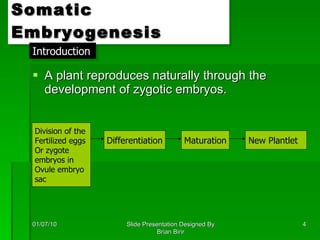
Somatic Embryogenesis A plant reproduces naturally through the development of zygotic embryos. 01/07/10 Slide Presentation Designed By Brian Birir Introduction Division of the  Fertilized eggs Or zygote  embryos in  Ovule embryo  sac Differentiation Maturation New Plantlet
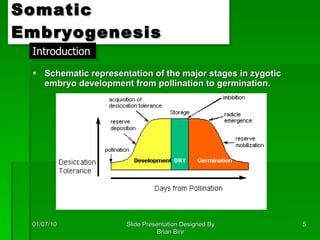
Somatic Embryogenesis Schematic representation of the major stages in zygotic embryo development from pollination to germination.   01/07/10 Slide Presentation Designed By Brian Birir Introduction
Somatic Embryogenesis But in somatic embryogenesis, the plant is derived from a single somatic cell or group of cells It therefore differs from the natural pathway of plant reproduction   01/07/10 Slide Presentation Designed By Brian Birir Introduction
Somatic Embryogenesis 01/07/10 Slide Presentation Designed By Brian Birir Therefore somatic embryogenesis can be defined as the clonal propagation technique that produces an unlimited number of genetically identical plants from a single somatic seed. The term “somatic” indicates that the plants are developed vegetatively. The somatic embryo’s development is however  analogous  to its zygotic counterpart All of the plantlets produced have the same genetic makeup.
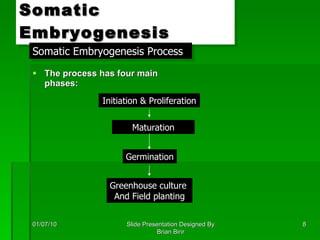
Somatic Embryogenesis The process has four main phases:   01/07/10 Slide Presentation Designed By Brian Birir Somatic Embryogenesis Process Initiation & Proliferation Maturation Germination Greenhouse culture  And Field planting
Somatic Embryogenesis Explant is placed on a Petri dish containing  Initiation medium  (to initiate cell division) After   6 weeks some of the growing tissue converts into embryogenic tissue (white, fluffy & translucent appearance) Embryogenic tissue continues to proliferate as long as its in the initiation medium Embryogenic tissue can also be frozen & stored in liquid nitrogen for future somatic embryogenesis . 01/07/10 Slide Presentation Designed By Brian Birir Initiation & Proliferation of embryogenic tissue
Somatic Embryogenesis Auxins: 2,4-D (2,4-dichlorophenoxy acetic acid) 2,4,5-T (2,4,5-trichlorophenoxyacetic acid) Inorganic components: potassium Organic components: proline The inorganic and organic components modulate embryogenesis or callus response 01/07/10 Slide Presentation Designed By Brian Birir Initiation Medium
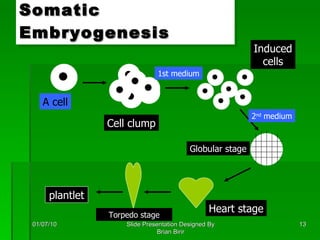
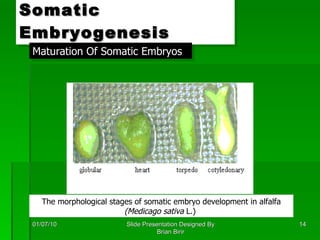
Somatic Embryogenesis Stop proliferation and allow tissue to form mature somatic embyros Clumps of embryogenic tissus transferred to  maturation medium  containing plant growth regulator Regulator promotes maturation After 6 weeks mature embryos begin to appear on the clumps They resemble embryos found in seeds  01/07/10 Slide Presentation Designed By Brian Birir Maturation Of Somatic Embryos
Somatic Embryogenesis Pre-maturation: From globular to torpedo Solid BOi2y medium lacking 2,4-D Maturation Phase 1: Enriched BOi2Y medium; contains a high level of sucrose, nitrogen and sulphur Deposition of storage reserves Embryos accumulate fresh and dry weight. Maturation Phase 2: Modified BOi2Y containing ABA (abscisic acid); induces desiccation tolerance. 01/07/10 Slide Presentation Designed By Brian Birir Maturation Of Somatic Embryos
Somatic Embryogenesis 01/07/10 Slide Presentation Designed By Brian Birir plantlet A cell Cell clump Globular stage Heart stage Induced cells Torpedo stage 2 nd  medium 1st medium
Somatic Embryogenesis 01/07/10 Slide Presentation Designed By Brian Birir Maturation Of Somatic Embryos The morphological stages of somatic embryo development in alfalfa  (Medicago sativa  L.)
Somatic Embryogenesis Individual mature embyos are picked from clumps. Then placed onto germination medium  Medium contains a mixture of nutrients for early plant development.(1/2 MS salts + 1%sucrose) Mature embryos germinate to form roots and shoots  The plants obtained are referred to as “emblings” / “somatic seedlings” / “somatic derived plantlets”. 01/07/10 Slide Presentation Designed By Brian Birir Germination Of Somatic Embryos
Somatic Embryogenesis When germinated emblings are large enough they are transplanted Into soil for further growth and acclimatization (Greenhouse) After normal greenhouse culture period they are planted in the field 01/07/10 Slide Presentation Designed By Brian Birir Greenhouse Culture & Field Planting
Somatic Embryogenesis Provision of cell lines for: Genetic engineering Long term gene storage Use in research Tree improvement programs Pest resistant Fast growing More productive (high value plantation forests; reduce need to harvest existing natural forest; conservation) 01/07/10 Slide Presentation Designed By Brian Birir Applications Of Somatic Embryogenesis
Meristem Cultures 01/07/10 Slide Presentation Designed By Brian Birir Introduction What is Meristem culture? The cultivation of axillary or apical shoot meristems, particularly of shoot apical meristem. Involves the development of an already existing shoot meristem and subsequently, the regeneration of adventitious roots from the developed shoots It does not involve the regeneration of a new shoot meristem
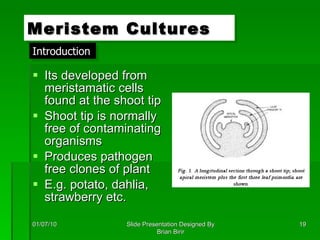
Its developed from meristamatic cells found at the shoot tip Shoot tip is normally free of contaminating organisms Produces pathogen free clones of plant E.g. potato, dahlia, strawberry etc. Meristem Cultures 01/07/10 Slide Presentation Designed By Brian Birir Introduction
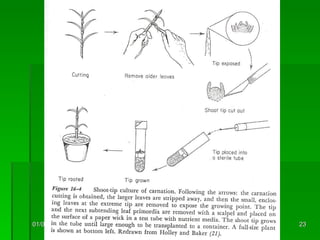
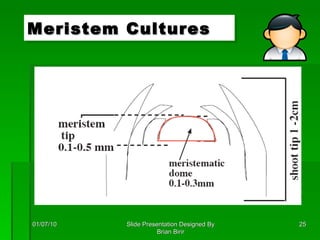
Explants used: The apical meristem and the first 1 or 2 leaf primordia below it are excised from the shoot tip (the meristem itself is not able to grow independently unless some leaf primordia are retained) Meristem Cultures 01/07/10 Slide Presentation Designed By Brian Birir
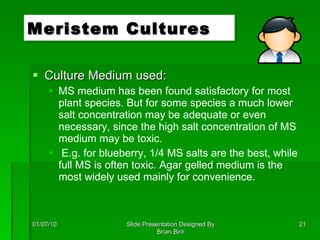
Culture Medium used: MS medium has been found satisfactory for most plant species. But for some species a much lower salt concentration may be adequate or even necessary, since the high salt concentration of MS medium may be toxic. E.g. for blueberry, 1/4 MS salts are the best, while full MS is often toxic. Agar gelled medium is the most widely used mainly for convenience. Meristem Cultures 01/07/10 Slide Presentation Designed By Brian Birir
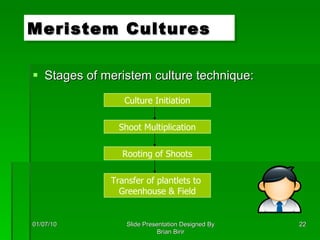
Stages of meristem culture technique: Meristem Cultures 01/07/10 Slide Presentation Designed By Brian Birir Culture Initiation Shoot Multiplication Rooting of Shoots Transfer of plantlets to  Greenhouse & Field
01/07/10 Slide Presentation Designed By Brian Birir
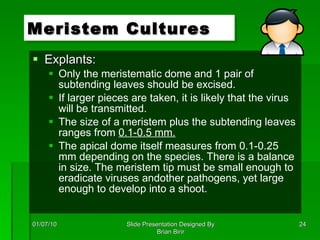
Explants: Only the meristematic dome and 1 pair of subtending leaves should be excised. If larger pieces are taken, it is likely that the virus will be transmitted.  The size of a meristem plus the subtending leaves ranges from  0.1-0.5 mm.   The apical dome itself measures from 0.1-0.25 mm depending on the species. There is a balance in size. The meristem tip must be small enough to eradicate viruses andother pathogens, yet large enough to develop into a shoot.  Meristem Cultures 01/07/10 Slide Presentation Designed By Brian Birir
Meristem Cultures 01/07/10 Slide Presentation Designed By Brian Birir
Culture Initiation: surface sterilization of explants and establishing them in vitro. detection and elimination of contamination Generally, a Growth Regulator-free basal medium is used.  In cases of heavy contamination or endophytic contamination (bacteria/fungi present inside explant) a suitable antibiotic, e.g.,  trimithoprim , and/or fungicide, e.g.  Bavistin , may be added to the culture medium. Meristem Cultures 01/07/10 Slide Presentation Designed By Brian Birir
Shoot Multiplication : After 2-3 weeks, the cultures are transferred to a shoot multiplication medium designed to promote axillary branching.  The medium generally contains:  a cytokinin (usually 1-2 mg/l, but up to 30 mg/l has been used) either alone or in combination (BAP is the most commonly used cytokinin, but with some species, e.g., blueberry, garlic, rhododendrons etc.,  2- ip  is much more effective. ) with an auxin (commonly 0.1-1 mg/l), chiefly depending on the plant species.  NAA, IBA and IAA are generally employed.  2,4-D is not used as it promotes  callusing .  Meristem Cultures 01/07/10 Slide Presentation Designed By Brian Birir
Shoot Multiplication : Higher concentrations (>2 mg/l BAP) of cytokinin induce adventitious buds and retard shoot growth. The latter may necessitate a culture of shoots on basal/low cytokinin/ GA3 medium for shoot elongation before they can be rooted. Therefore, a GR combination should be determined to obtain optimum shoot multiplication rates with the minimum risk of adventitious shoot buds and, if possible, without the need of shoot elongation step (to save time, labour and cost). Meristem Cultures 01/07/10 Slide Presentation Designed By Brian Birir
Rooting of Shoots : the rooting medium has:  low salt, e.g., 1/2 or even 1/4 salts of the MS medium,  reduced sugar levels (usually1g/l) reduced salts being essential for rooting in some species like Narcissus.  In some species, e.g., Narcissus, strawberry etc rooting occurs on Growth Regulator-free medium.  But in most species, 0.1-1 mg/l NAA or IBA is required for rooting.  In plants like Citrus, however, a pulse treatment with an auxin (10 min with 100 mg/l NAA or IBA) gives optimum rooting. Meristem Cultures 01/07/10 Slide Presentation Designed By Brian Birir
Rooting of Shoots : Shoots are usually rooted in an agar medium mix  The cut ends of shoots are treated with a suitable auxin solution or powder mix, transplanted in pots and kept under high relative humidity and low light intensity. Rooting takes about  10-15 days , depending mainly on species.  Plantlets with  0.5 to 1 cm  roots are usually transplanted into pots since longer roots tend to get damaged. Meristem Cultures 01/07/10 Slide Presentation Designed By Brian Birir
Transfer to Soil : Rooted shoots are removed from the medium Agar sticking to their roots is washed with tap water Then transplanted into plastic cups containing a suitable potting mix.  Plants are kept in a high (90%) humidity and, initially low light intensities. High humidity can be attained by: fog (water drops 10um or less) mist, or a clear plastic to cover individual (plastic bags) or groups(plastic sheets) of plants. Meristem Cultures 01/07/10 Slide Presentation Designed By Brian Birir
Transfer to Soil : The potting mix should not be too wet and water  not form on the plantlets. Therefore fog is preferred over mist.  The humidity is gradually decreased to the ambient level after about  7- 15 days , and the light intensity is increased. The plants are finally exposed to greenhouse conditions.  On a laboratory scale, individual plants may be covered with clear plastic bags and irrigated daily with  2-3 drops  of water or  ¼ MS  salts. After 7-10 days, the bags may be removed gradually. Meristem Cultures 01/07/10 Slide Presentation Designed By Brian Birir
Meristem tip culture is used successfully to remove viruses, bacteria, and fungi from plants. Why virus eradication works: Virus distribution is uneven in a plant and is much less in a meristem. Viruses cannot travel quickly enough through plasmodesmata to keep up with actively growing tip. Meristem Cultures 01/07/10 Slide Presentation Designed By Brian Birir Conclusion:
http://hugroup.cems.umn.edu/Archive/Research/plant/plant.html http://www.plant.uoguelph.ca/research/embryo/synseeds.htm http://www.ias.ac.in/currsci/jul25/articles18.htm http://trc.ucdavis.edu/egsutter/plb171/lecturespdf4/14-Virus%20elimination.pdf http://www.rocw.raifoundation.org/biotechnology/MScBioinformatics/planttissueculture/lecture-notes/lecture-08.pdf 01/07/10 Slide Presentation Designed By Brian Birir REFERENCE:

Clonal propagation tissueculture

  • 1.
    CLONAL PROPAGATION SYSTEMSGROUP A 01/07/10 Slide Presentation Designed By Brian Birir SOMATIC EMBRYOGENESIS MERISTEM CULTURES
  • 2.
    Asexual propagation ofmany new plants from an individual all with the same genotype. In vitro clonal propagation is a type of micro propagation. Gives rise to genetically identical plants. Identical also to the parent 01/07/10 Slide Presentation Designed By Brian Birir WHAT IS CLONAL PROPAGATION?
  • 3.
    Clonal propagation benefitsVariability arising from sexual reproduction and seed formation is omitted Plants with long seed dormancy can be raised faster than in vivo seed propagation Undesirable juvenile phase seen in seed raised plants does not appear in vegetatively propagated plants from adult material 01/07/10 Slide Presentation Designed By Brian Birir
  • 4.
    Somatic Embryogenesis Aplant reproduces naturally through the development of zygotic embryos. 01/07/10 Slide Presentation Designed By Brian Birir Introduction Division of the Fertilized eggs Or zygote embryos in Ovule embryo sac Differentiation Maturation New Plantlet
  • 5.
    Somatic Embryogenesis Schematicrepresentation of the major stages in zygotic embryo development from pollination to germination. 01/07/10 Slide Presentation Designed By Brian Birir Introduction
  • 6.
    Somatic Embryogenesis Butin somatic embryogenesis, the plant is derived from a single somatic cell or group of cells It therefore differs from the natural pathway of plant reproduction 01/07/10 Slide Presentation Designed By Brian Birir Introduction
  • 7.
    Somatic Embryogenesis 01/07/10Slide Presentation Designed By Brian Birir Therefore somatic embryogenesis can be defined as the clonal propagation technique that produces an unlimited number of genetically identical plants from a single somatic seed. The term “somatic” indicates that the plants are developed vegetatively. The somatic embryo’s development is however analogous to its zygotic counterpart All of the plantlets produced have the same genetic makeup.
  • 8.
    Somatic Embryogenesis Theprocess has four main phases: 01/07/10 Slide Presentation Designed By Brian Birir Somatic Embryogenesis Process Initiation & Proliferation Maturation Germination Greenhouse culture And Field planting
  • 9.
    Somatic Embryogenesis Explantis placed on a Petri dish containing Initiation medium (to initiate cell division) After 6 weeks some of the growing tissue converts into embryogenic tissue (white, fluffy & translucent appearance) Embryogenic tissue continues to proliferate as long as its in the initiation medium Embryogenic tissue can also be frozen & stored in liquid nitrogen for future somatic embryogenesis . 01/07/10 Slide Presentation Designed By Brian Birir Initiation & Proliferation of embryogenic tissue
  • 10.
    Somatic Embryogenesis Auxins:2,4-D (2,4-dichlorophenoxy acetic acid) 2,4,5-T (2,4,5-trichlorophenoxyacetic acid) Inorganic components: potassium Organic components: proline The inorganic and organic components modulate embryogenesis or callus response 01/07/10 Slide Presentation Designed By Brian Birir Initiation Medium
  • 11.
    Somatic Embryogenesis Stopproliferation and allow tissue to form mature somatic embyros Clumps of embryogenic tissus transferred to maturation medium containing plant growth regulator Regulator promotes maturation After 6 weeks mature embryos begin to appear on the clumps They resemble embryos found in seeds 01/07/10 Slide Presentation Designed By Brian Birir Maturation Of Somatic Embryos
  • 12.
    Somatic Embryogenesis Pre-maturation:From globular to torpedo Solid BOi2y medium lacking 2,4-D Maturation Phase 1: Enriched BOi2Y medium; contains a high level of sucrose, nitrogen and sulphur Deposition of storage reserves Embryos accumulate fresh and dry weight. Maturation Phase 2: Modified BOi2Y containing ABA (abscisic acid); induces desiccation tolerance. 01/07/10 Slide Presentation Designed By Brian Birir Maturation Of Somatic Embryos
  • 13.
    Somatic Embryogenesis 01/07/10Slide Presentation Designed By Brian Birir plantlet A cell Cell clump Globular stage Heart stage Induced cells Torpedo stage 2 nd medium 1st medium
  • 14.
    Somatic Embryogenesis 01/07/10Slide Presentation Designed By Brian Birir Maturation Of Somatic Embryos The morphological stages of somatic embryo development in alfalfa (Medicago sativa L.)
  • 15.
    Somatic Embryogenesis Individualmature embyos are picked from clumps. Then placed onto germination medium Medium contains a mixture of nutrients for early plant development.(1/2 MS salts + 1%sucrose) Mature embryos germinate to form roots and shoots The plants obtained are referred to as “emblings” / “somatic seedlings” / “somatic derived plantlets”. 01/07/10 Slide Presentation Designed By Brian Birir Germination Of Somatic Embryos
  • 16.
    Somatic Embryogenesis Whengerminated emblings are large enough they are transplanted Into soil for further growth and acclimatization (Greenhouse) After normal greenhouse culture period they are planted in the field 01/07/10 Slide Presentation Designed By Brian Birir Greenhouse Culture & Field Planting
  • 17.
    Somatic Embryogenesis Provisionof cell lines for: Genetic engineering Long term gene storage Use in research Tree improvement programs Pest resistant Fast growing More productive (high value plantation forests; reduce need to harvest existing natural forest; conservation) 01/07/10 Slide Presentation Designed By Brian Birir Applications Of Somatic Embryogenesis
  • 18.
    Meristem Cultures 01/07/10Slide Presentation Designed By Brian Birir Introduction What is Meristem culture? The cultivation of axillary or apical shoot meristems, particularly of shoot apical meristem. Involves the development of an already existing shoot meristem and subsequently, the regeneration of adventitious roots from the developed shoots It does not involve the regeneration of a new shoot meristem
  • 19.
    Its developed frommeristamatic cells found at the shoot tip Shoot tip is normally free of contaminating organisms Produces pathogen free clones of plant E.g. potato, dahlia, strawberry etc. Meristem Cultures 01/07/10 Slide Presentation Designed By Brian Birir Introduction
  • 20.
    Explants used: Theapical meristem and the first 1 or 2 leaf primordia below it are excised from the shoot tip (the meristem itself is not able to grow independently unless some leaf primordia are retained) Meristem Cultures 01/07/10 Slide Presentation Designed By Brian Birir
  • 21.
    Culture Medium used:MS medium has been found satisfactory for most plant species. But for some species a much lower salt concentration may be adequate or even necessary, since the high salt concentration of MS medium may be toxic. E.g. for blueberry, 1/4 MS salts are the best, while full MS is often toxic. Agar gelled medium is the most widely used mainly for convenience. Meristem Cultures 01/07/10 Slide Presentation Designed By Brian Birir
  • 22.
    Stages of meristemculture technique: Meristem Cultures 01/07/10 Slide Presentation Designed By Brian Birir Culture Initiation Shoot Multiplication Rooting of Shoots Transfer of plantlets to Greenhouse & Field
  • 23.
    01/07/10 Slide PresentationDesigned By Brian Birir
  • 24.
    Explants: Only themeristematic dome and 1 pair of subtending leaves should be excised. If larger pieces are taken, it is likely that the virus will be transmitted. The size of a meristem plus the subtending leaves ranges from 0.1-0.5 mm. The apical dome itself measures from 0.1-0.25 mm depending on the species. There is a balance in size. The meristem tip must be small enough to eradicate viruses andother pathogens, yet large enough to develop into a shoot. Meristem Cultures 01/07/10 Slide Presentation Designed By Brian Birir
  • 25.
    Meristem Cultures 01/07/10Slide Presentation Designed By Brian Birir
  • 26.
    Culture Initiation: surfacesterilization of explants and establishing them in vitro. detection and elimination of contamination Generally, a Growth Regulator-free basal medium is used. In cases of heavy contamination or endophytic contamination (bacteria/fungi present inside explant) a suitable antibiotic, e.g., trimithoprim , and/or fungicide, e.g. Bavistin , may be added to the culture medium. Meristem Cultures 01/07/10 Slide Presentation Designed By Brian Birir
  • 27.
    Shoot Multiplication :After 2-3 weeks, the cultures are transferred to a shoot multiplication medium designed to promote axillary branching. The medium generally contains: a cytokinin (usually 1-2 mg/l, but up to 30 mg/l has been used) either alone or in combination (BAP is the most commonly used cytokinin, but with some species, e.g., blueberry, garlic, rhododendrons etc., 2- ip is much more effective. ) with an auxin (commonly 0.1-1 mg/l), chiefly depending on the plant species. NAA, IBA and IAA are generally employed. 2,4-D is not used as it promotes callusing . Meristem Cultures 01/07/10 Slide Presentation Designed By Brian Birir
  • 28.
    Shoot Multiplication :Higher concentrations (>2 mg/l BAP) of cytokinin induce adventitious buds and retard shoot growth. The latter may necessitate a culture of shoots on basal/low cytokinin/ GA3 medium for shoot elongation before they can be rooted. Therefore, a GR combination should be determined to obtain optimum shoot multiplication rates with the minimum risk of adventitious shoot buds and, if possible, without the need of shoot elongation step (to save time, labour and cost). Meristem Cultures 01/07/10 Slide Presentation Designed By Brian Birir
  • 29.
    Rooting of Shoots: the rooting medium has: low salt, e.g., 1/2 or even 1/4 salts of the MS medium, reduced sugar levels (usually1g/l) reduced salts being essential for rooting in some species like Narcissus. In some species, e.g., Narcissus, strawberry etc rooting occurs on Growth Regulator-free medium. But in most species, 0.1-1 mg/l NAA or IBA is required for rooting. In plants like Citrus, however, a pulse treatment with an auxin (10 min with 100 mg/l NAA or IBA) gives optimum rooting. Meristem Cultures 01/07/10 Slide Presentation Designed By Brian Birir
  • 30.
    Rooting of Shoots: Shoots are usually rooted in an agar medium mix The cut ends of shoots are treated with a suitable auxin solution or powder mix, transplanted in pots and kept under high relative humidity and low light intensity. Rooting takes about 10-15 days , depending mainly on species. Plantlets with 0.5 to 1 cm roots are usually transplanted into pots since longer roots tend to get damaged. Meristem Cultures 01/07/10 Slide Presentation Designed By Brian Birir
  • 31.
    Transfer to Soil: Rooted shoots are removed from the medium Agar sticking to their roots is washed with tap water Then transplanted into plastic cups containing a suitable potting mix. Plants are kept in a high (90%) humidity and, initially low light intensities. High humidity can be attained by: fog (water drops 10um or less) mist, or a clear plastic to cover individual (plastic bags) or groups(plastic sheets) of plants. Meristem Cultures 01/07/10 Slide Presentation Designed By Brian Birir
  • 32.
    Transfer to Soil: The potting mix should not be too wet and water not form on the plantlets. Therefore fog is preferred over mist. The humidity is gradually decreased to the ambient level after about 7- 15 days , and the light intensity is increased. The plants are finally exposed to greenhouse conditions. On a laboratory scale, individual plants may be covered with clear plastic bags and irrigated daily with 2-3 drops of water or ¼ MS salts. After 7-10 days, the bags may be removed gradually. Meristem Cultures 01/07/10 Slide Presentation Designed By Brian Birir
  • 33.
    Meristem tip cultureis used successfully to remove viruses, bacteria, and fungi from plants. Why virus eradication works: Virus distribution is uneven in a plant and is much less in a meristem. Viruses cannot travel quickly enough through plasmodesmata to keep up with actively growing tip. Meristem Cultures 01/07/10 Slide Presentation Designed By Brian Birir Conclusion:
  • 34.
    http://hugroup.cems.umn.edu/Archive/Research/plant/plant.html http://www.plant.uoguelph.ca/research/embryo/synseeds.htm http://www.ias.ac.in/currsci/jul25/articles18.htmhttp://trc.ucdavis.edu/egsutter/plb171/lecturespdf4/14-Virus%20elimination.pdf http://www.rocw.raifoundation.org/biotechnology/MScBioinformatics/planttissueculture/lecture-notes/lecture-08.pdf 01/07/10 Slide Presentation Designed By Brian Birir REFERENCE: