Somatic hybridization and its
applications
PRESENTED BY: Pawan Nagar
Reg. no.: 04-2690-2015
M.Sc.(Fruit Science)
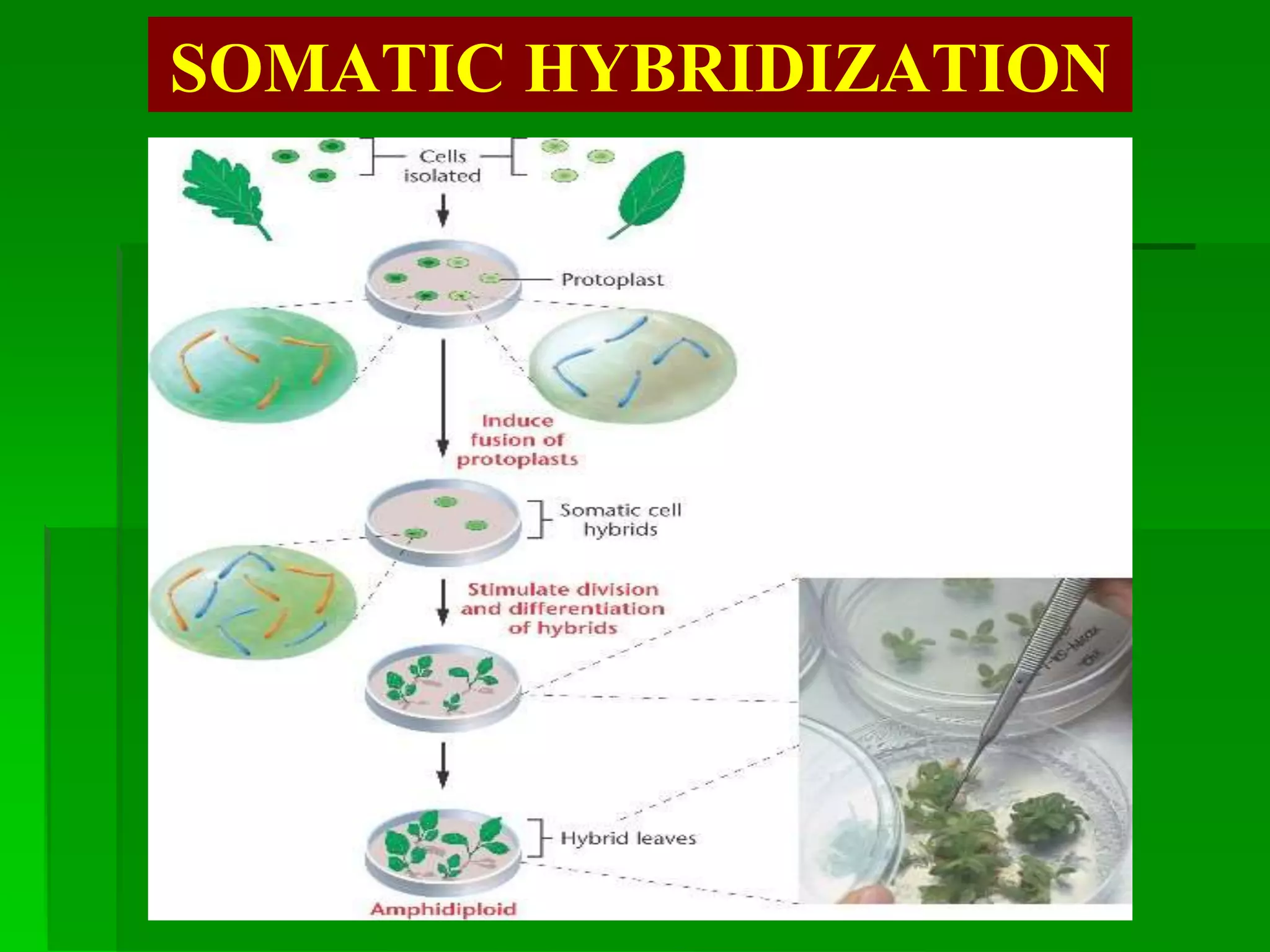
SOMATIC HYBRIDIZATION
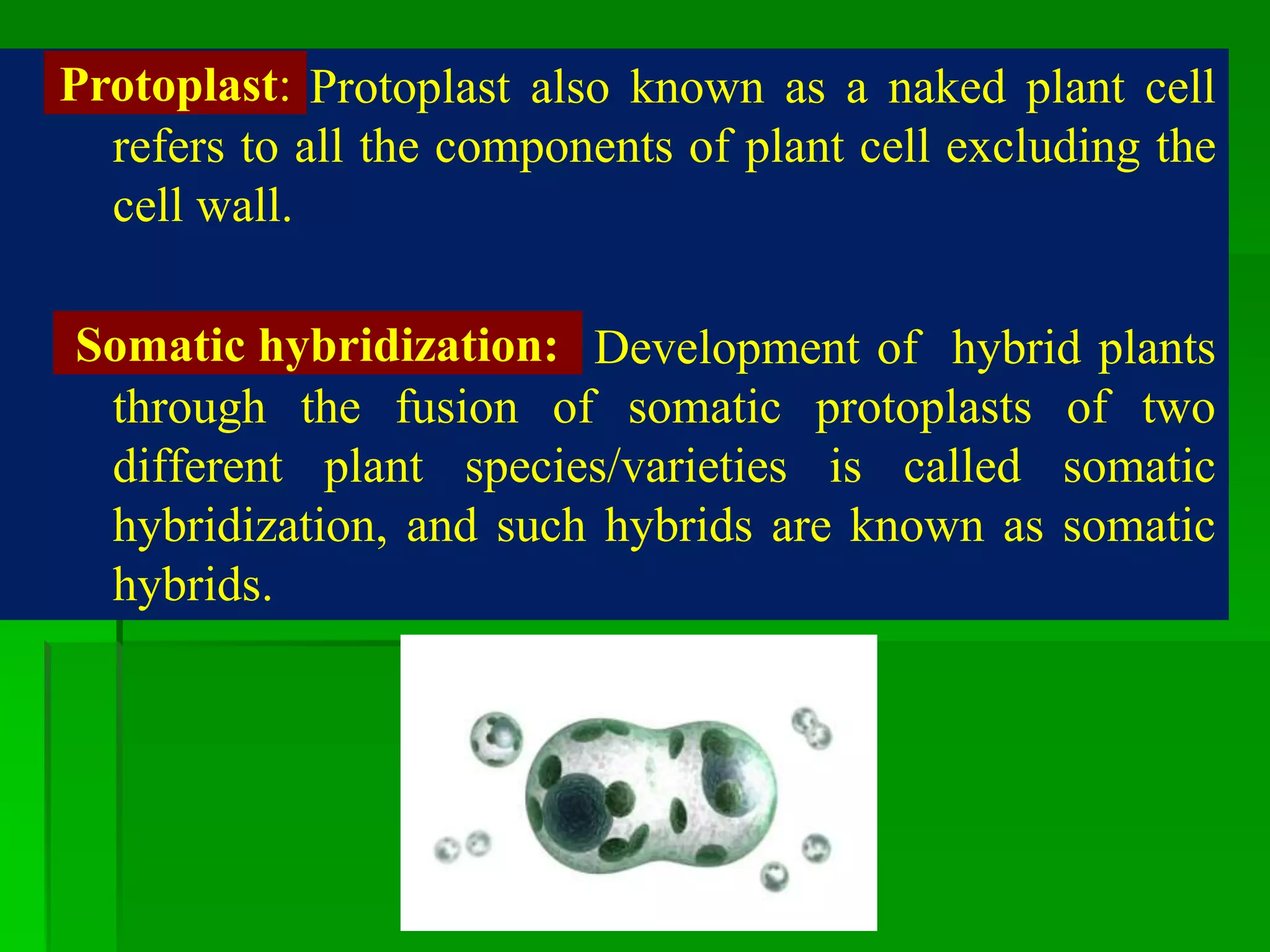
Protoplast also known as a naked plant cell
refers to all the components of plant cell excluding the
cell wall.
Development of hybrid plants
through the fusion of somatic protoplasts of two
different plant species/varieties is called somatic
hybridization, and such hybrids are known as somatic
hybrids.
Somatic hybridization:
Protoplast:
History
 Hanstein introduced the term ‘Protoplast’.
 The isolation of protoplasts from was first achieved
through by Klercker (1892) on plasmolysed cells.
 Cooking (1960) for the first time isolated the
protoplasts of plant tissues by using cell wall degrading
enzymes viz., cellulase, hemicellulase, pectinase, and
protease extracted from fungus Trichoderma viride and
Myrothecium verrucaria.
 First achievement in protoplast fusion by Power (1970)
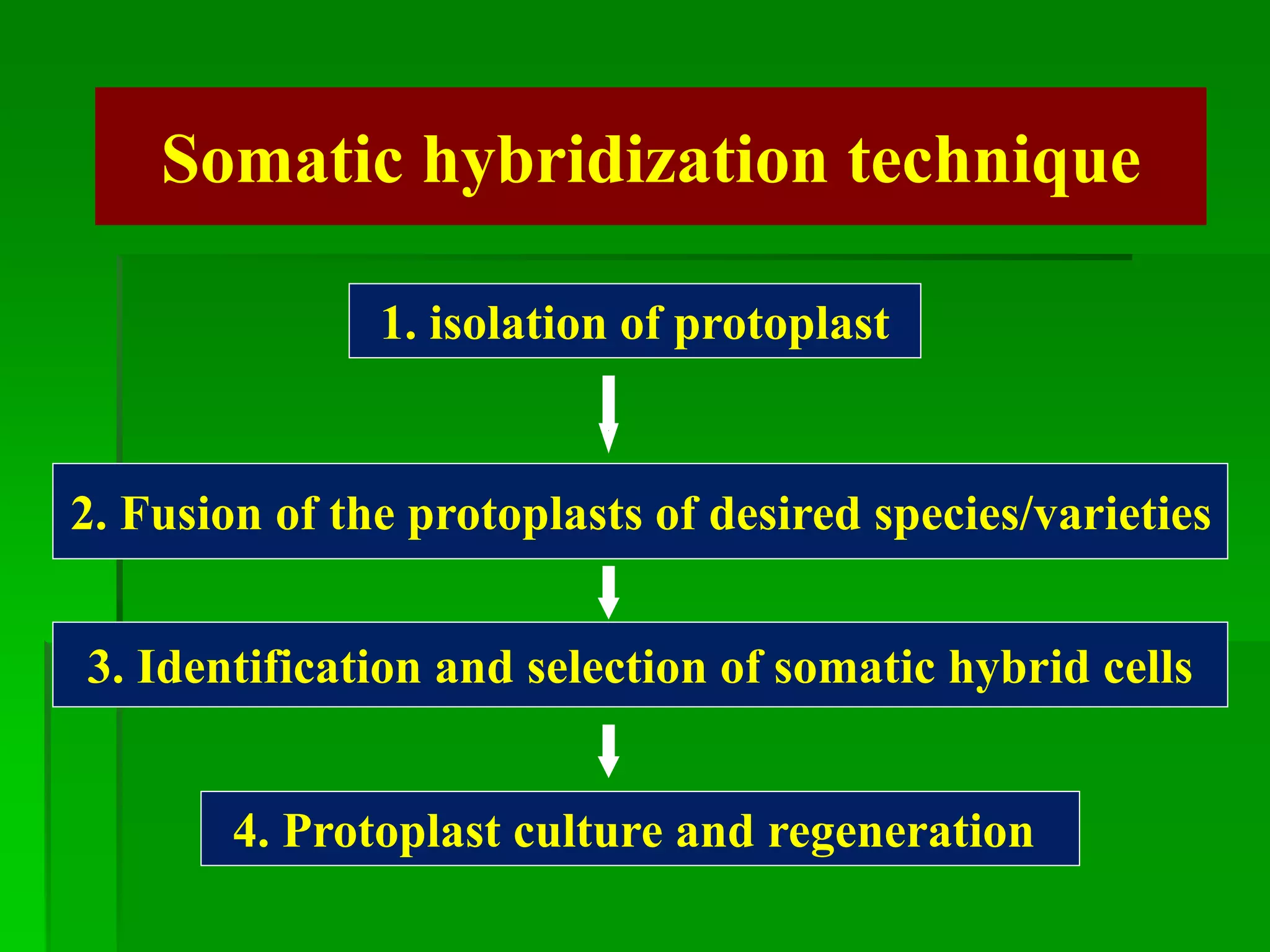
Somatic hybridization technique
1. isolation of protoplast
2. Fusion of the protoplasts of desired species/varieties
3. Identification and selection of somatic hybrid cells
4. Protoplast culture and regeneration
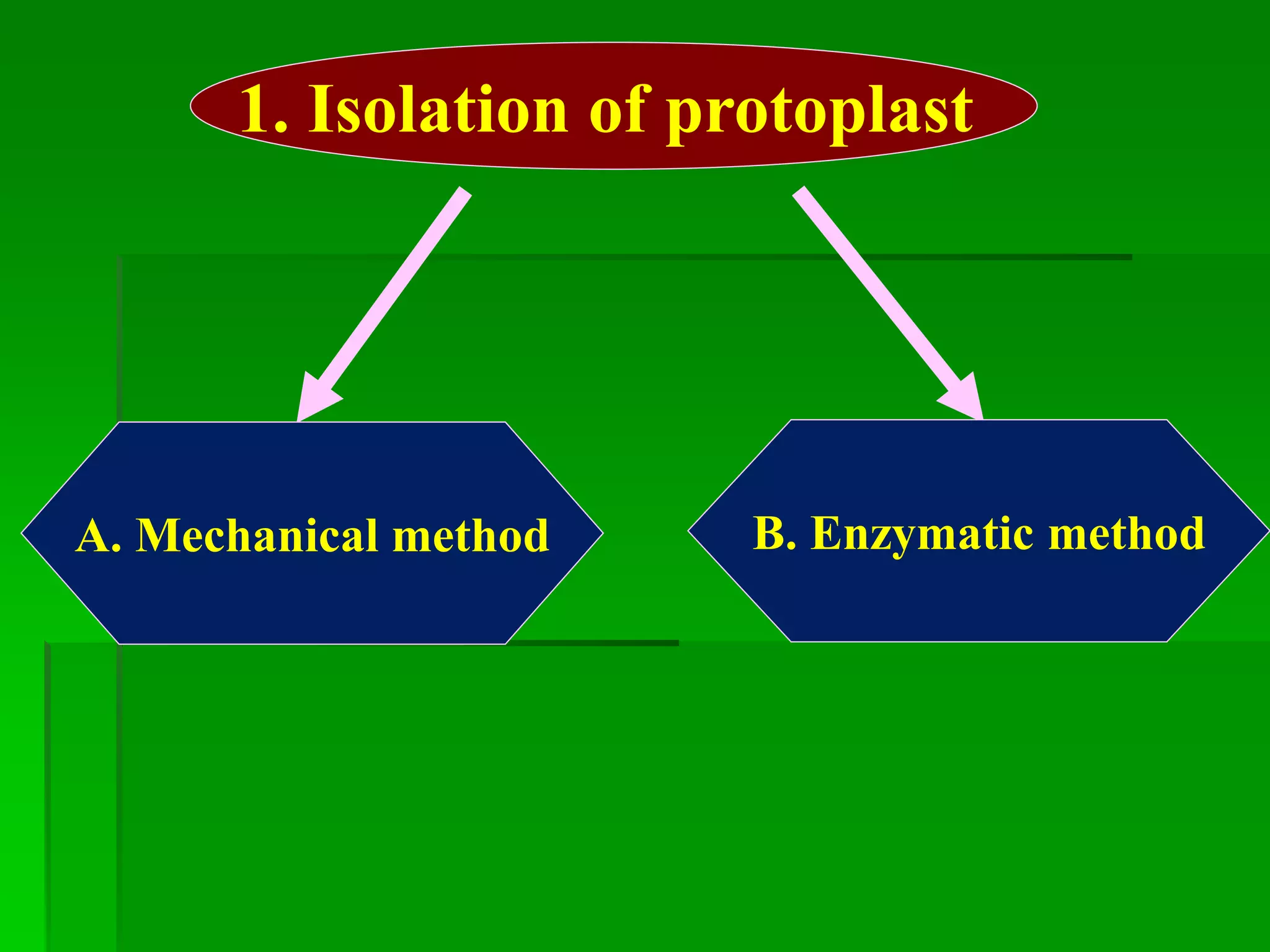
1. Isolation of protoplast
A. Mechanical method B. Enzymatic method
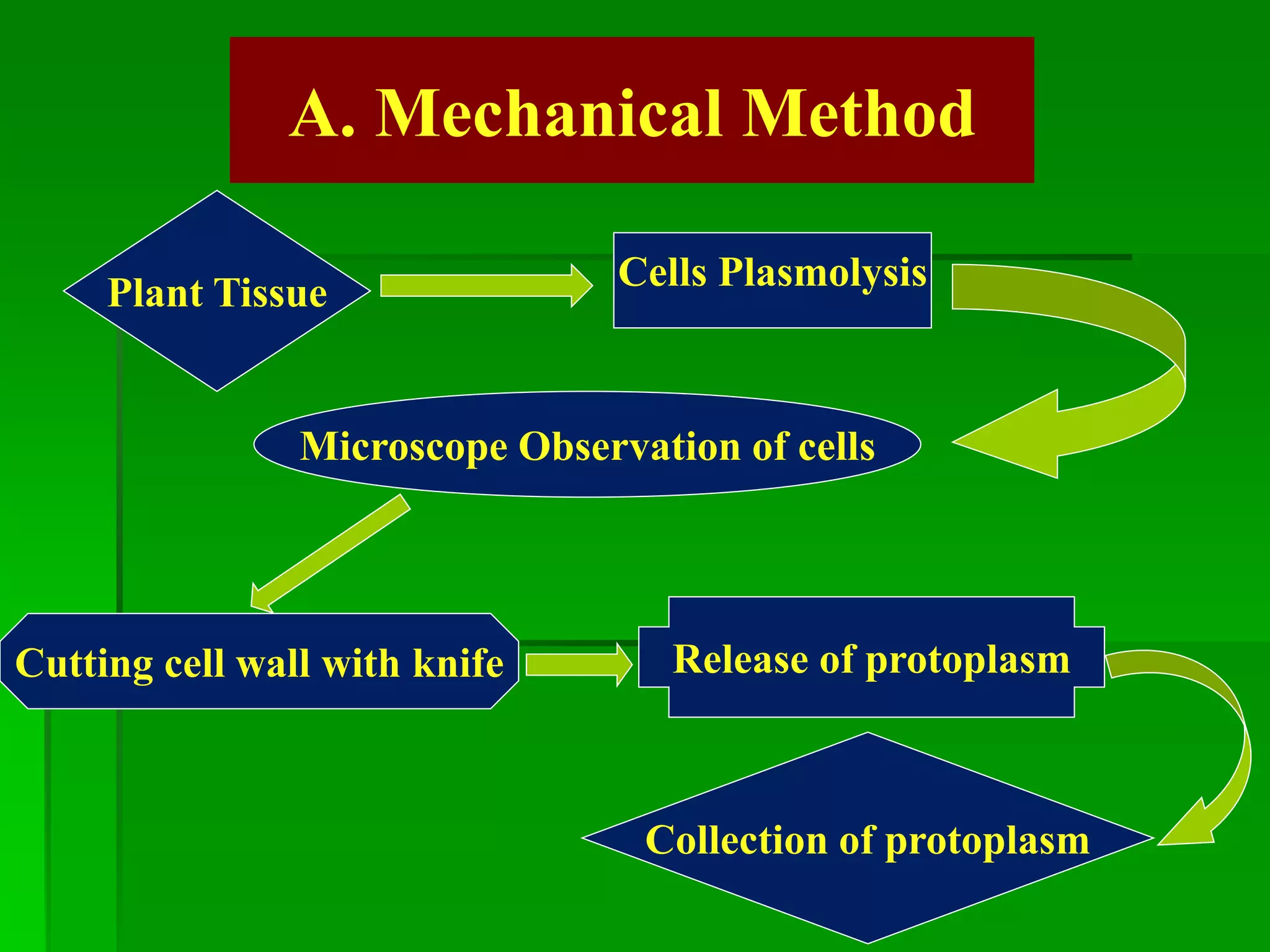
A. Mechanical Method
Plant Tissue
Collection of protoplasm
Cells Plasmolysis
Microscope Observation of cells
Cutting cell wall with knife Release of protoplasm
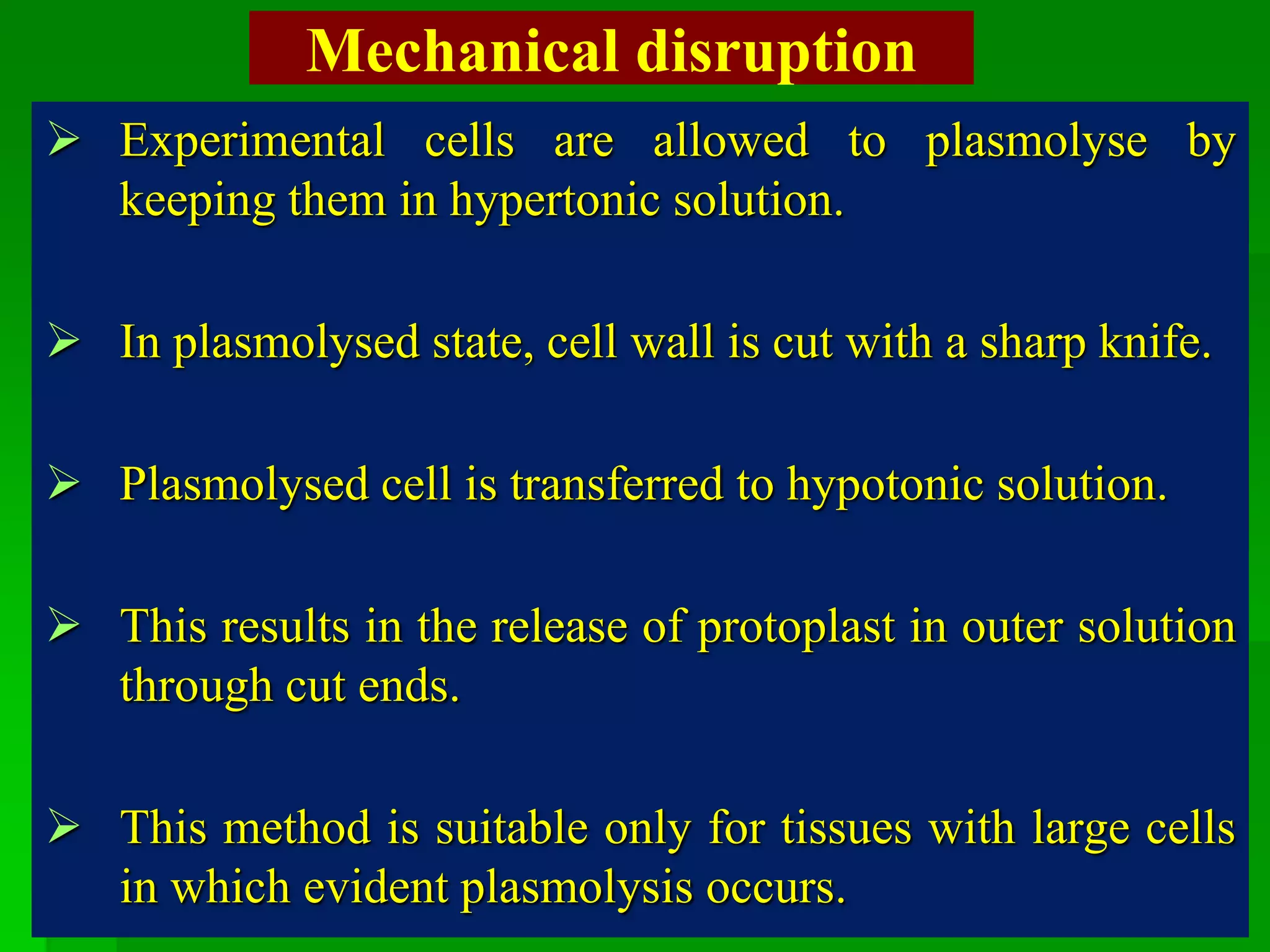
Mechanical disruption
 Experimental cells are allowed to plasmolyse by
keeping them in hypertonic solution.
 In plasmolysed state, cell wall is cut with a sharp knife.
 Plasmolysed cell is transferred to hypotonic solution.
 This results in the release of protoplast in outer solution
through cut ends.
 This method is suitable only for tissues with large cells
in which evident plasmolysis occurs.
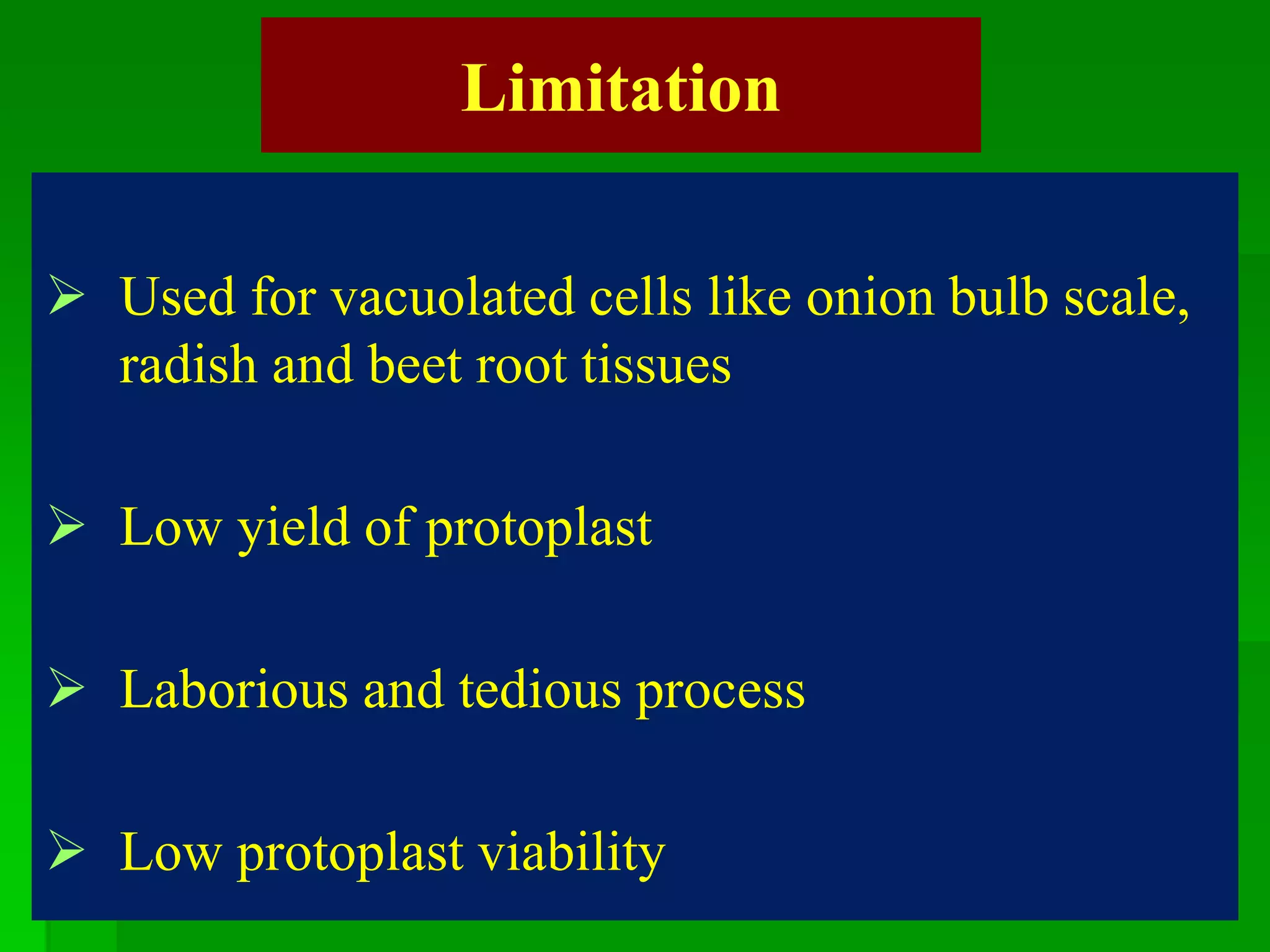
Limitation
 Used for vacuolated cells like onion bulb scale,
radish and beet root tissues
 Low yield of protoplast
 Laborious and tedious process
 Low protoplast viability
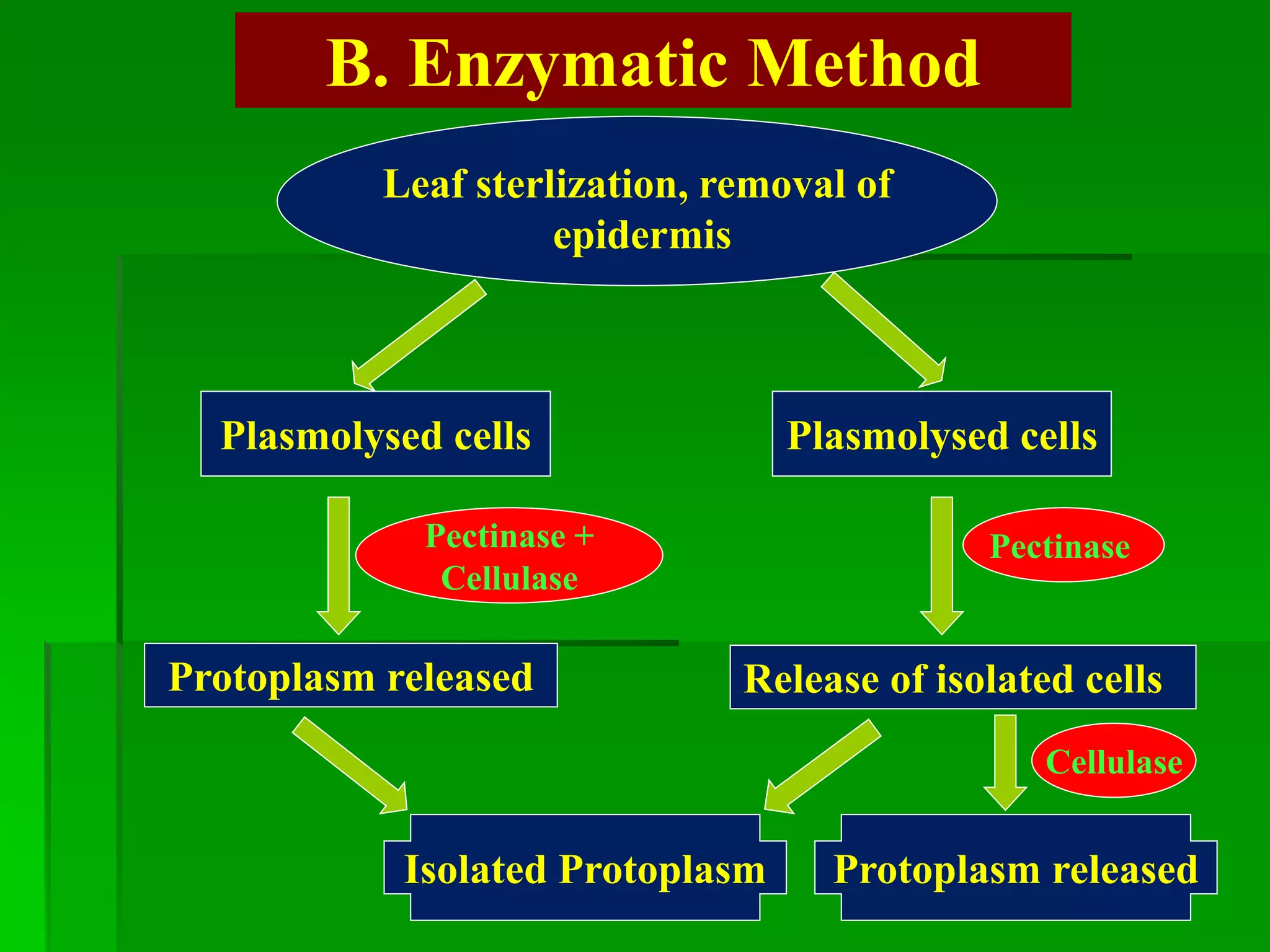
B. Enzymatic Method
Leaf sterlization, removal of
epidermis
Plasmolysed cellsPlasmolysed cells
Pectinase +
Cellulase
Pectinase
Protoplasm released Release of isolated cells
Cellulase
Isolated Protoplasm Protoplasm released
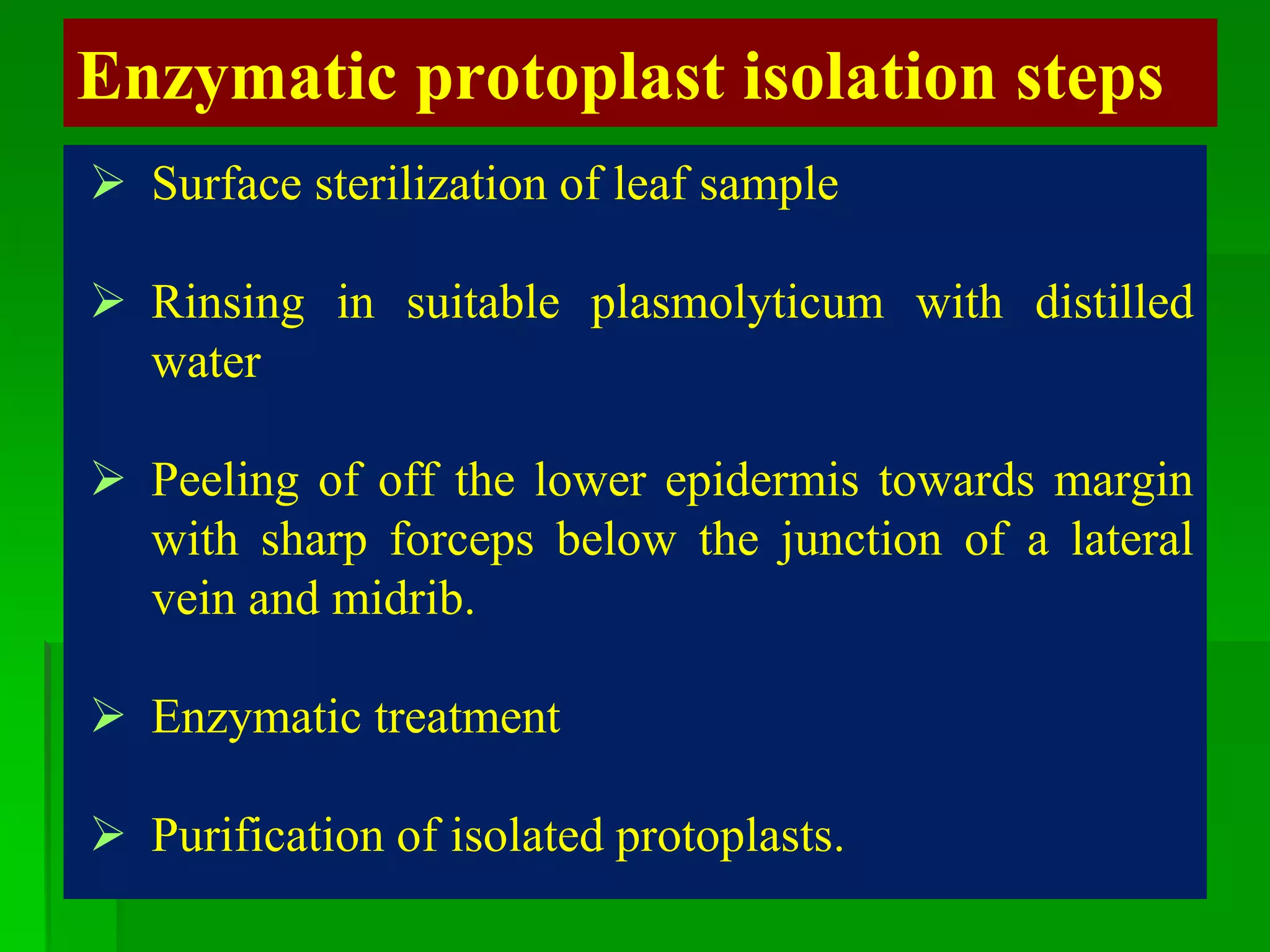
 Surface sterilization of leaf sample
 Rinsing in suitable plasmolyticum with distilled
water
 Peeling of off the lower epidermis towards margin
with sharp forceps below the junction of a lateral
vein and midrib.
 Enzymatic treatment
 Purification of isolated protoplasts.
Enzymatic protoplast isolation steps
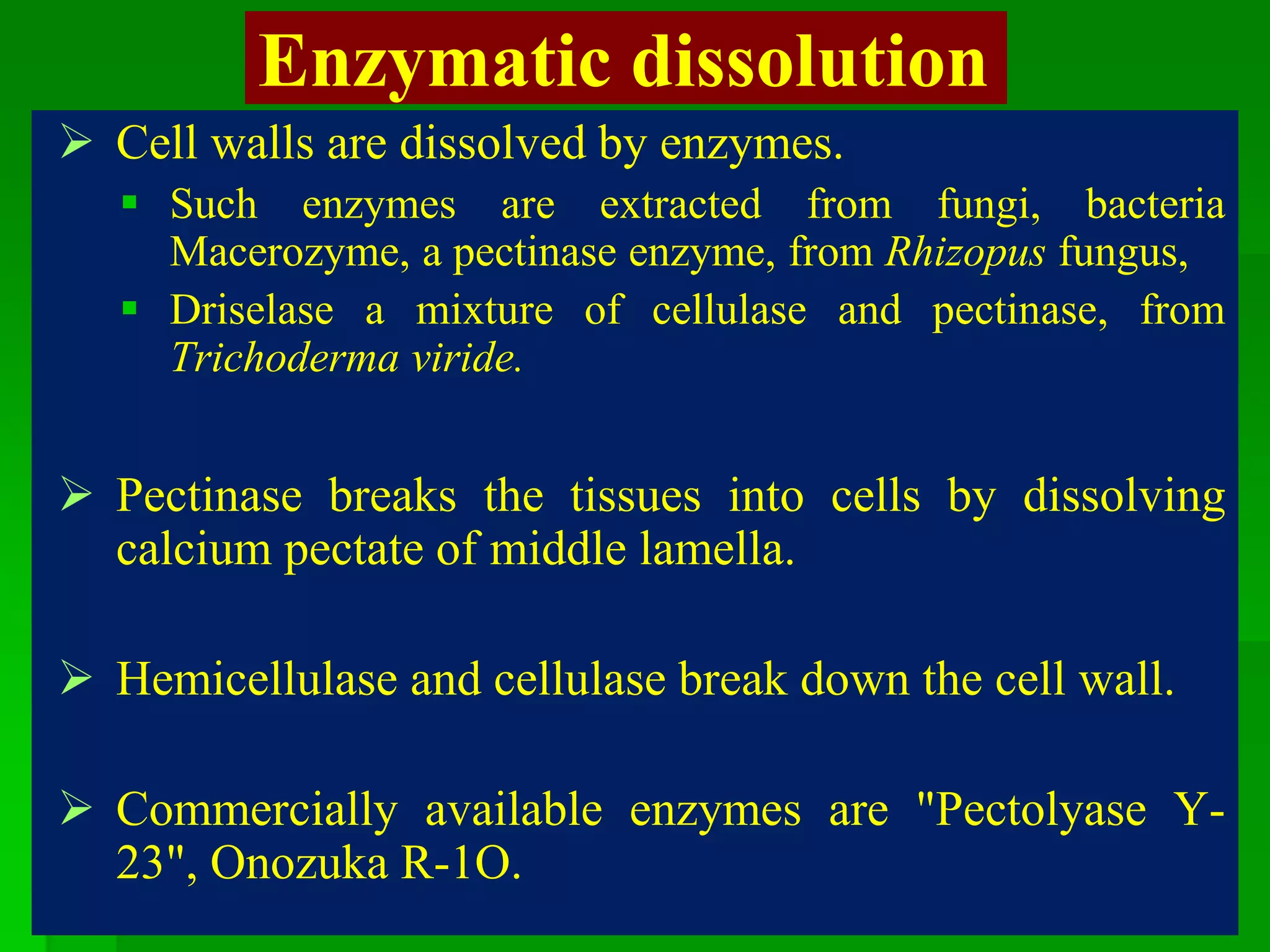
Enzymatic dissolution
 Cell walls are dissolved by enzymes.
 Such enzymes are extracted from fungi, bacteria
Macerozyme, a pectinase enzyme, from Rhizopus fungus,
 Driselase a mixture of cellulase and pectinase, from
Trichoderma viride.
 Pectinase breaks the tissues into cells by dissolving
calcium pectate of middle lamella.
 Hemicellulase and cellulase break down the cell wall.
 Commercially available enzymes are "Pectolyase Y-
23", Onozuka R-1O.
 Protoplast using enzymes may be isolated by sequential
method or mixed enzyme method.
 In the first process two enzymes-pectinase and cellulase
are used sequentially, while in the second process two
enzymes are used simultaneously.
 The enzyme mixture macerates the cells and
simultaneously destroys their walls.
 Sequential method is useful in isolating protoplasts
from palisade layer. While mixture enzyme method is
useful in isolating protoplasts from spongy parenchyma
and upper epidermis.
Advantages
 Used for variety of tissues and organs including
leaves, petioles, fruits, roots, coleoptiles, hypocotyls,
stem, shoot apices, embryo microspores
 Mesophyll tissue - most suitable source
 High yield of protoplast
 Easy to perform
 More protoplast viability
Protoplast purification
 Enzyme solutions are filtered with nylon mesh to remove
insoluble impurities.
 Filtrate is centrifuged for 5 minutes at 700 rpm.
 The protoplast forms pellet and goes at the bottom of
contrifuge tube.
 Supernatant is removed with Pasteur pipett.
 The pellet at the base is suspended in 10 ml of MS medium
plus mannitol and the process is repeated thrice.
 The resultant protoplast is pure.
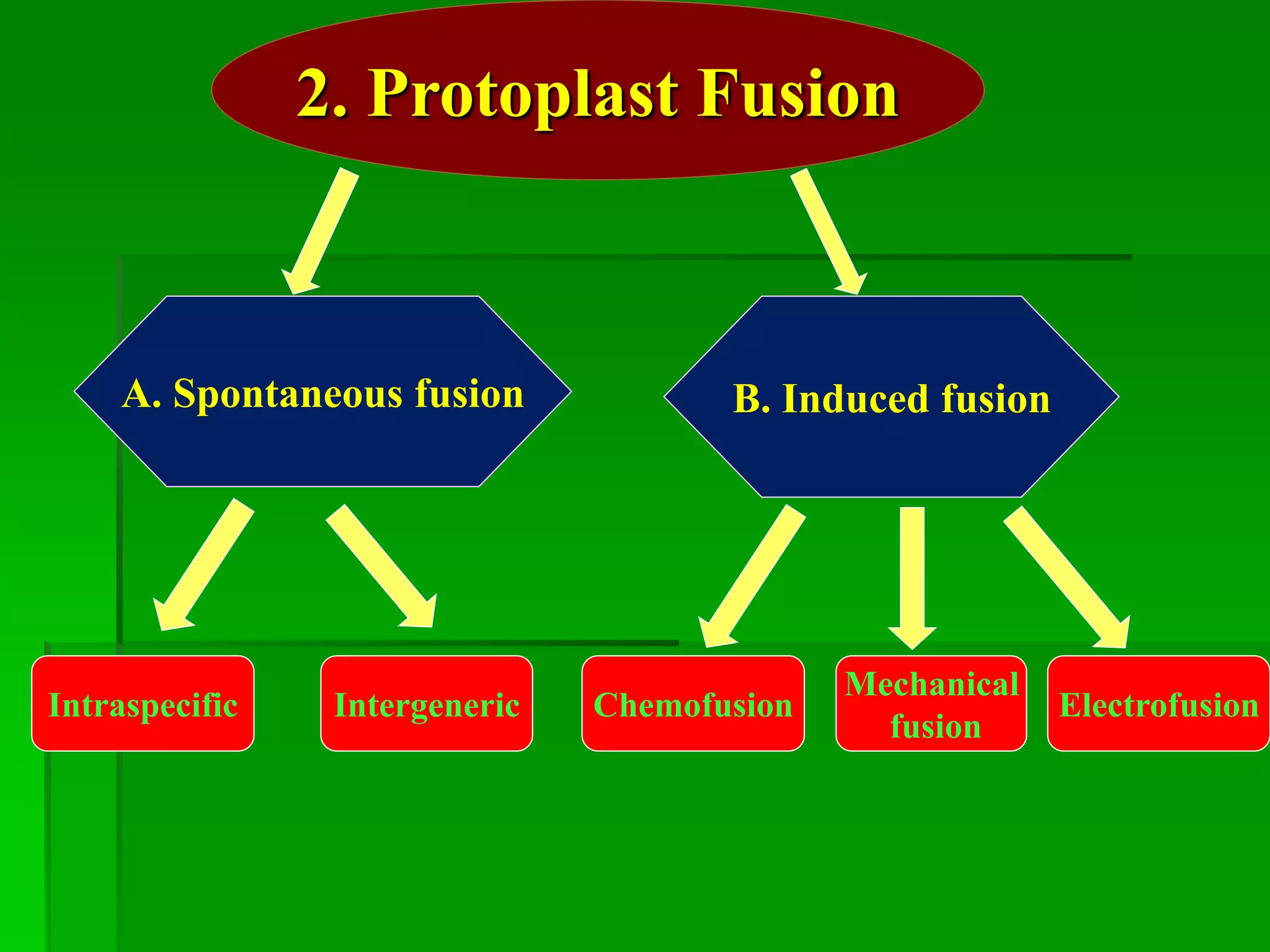
2. Protoplast Fusion
A. Spontaneous fusion B. Induced fusion
Intraspecific Intergeneric Electrofusion
Mechanical
fusion
Chemofusion
A. Spontaneous fusion
 Protoplast fuse spontaneously during isolation
process mainly due to physical contact
 Intraspecific
 Intergeneric
Intraspecific protoplast fusion
 Intraspecific protoplast fusion is the cross between the
same species
 This technique offers the only way of carrying out
crosses and genetic analysis.
Interspecific protoplast fusion
 Interspecific protoplast fusion is the crosses between
two different species.
 Interspecific protoplast fusions are of much importance
in the area where new products are to be produced.
 Due to new genetic set up many noval secondary
metabolites such as, antibiotics may be produced.
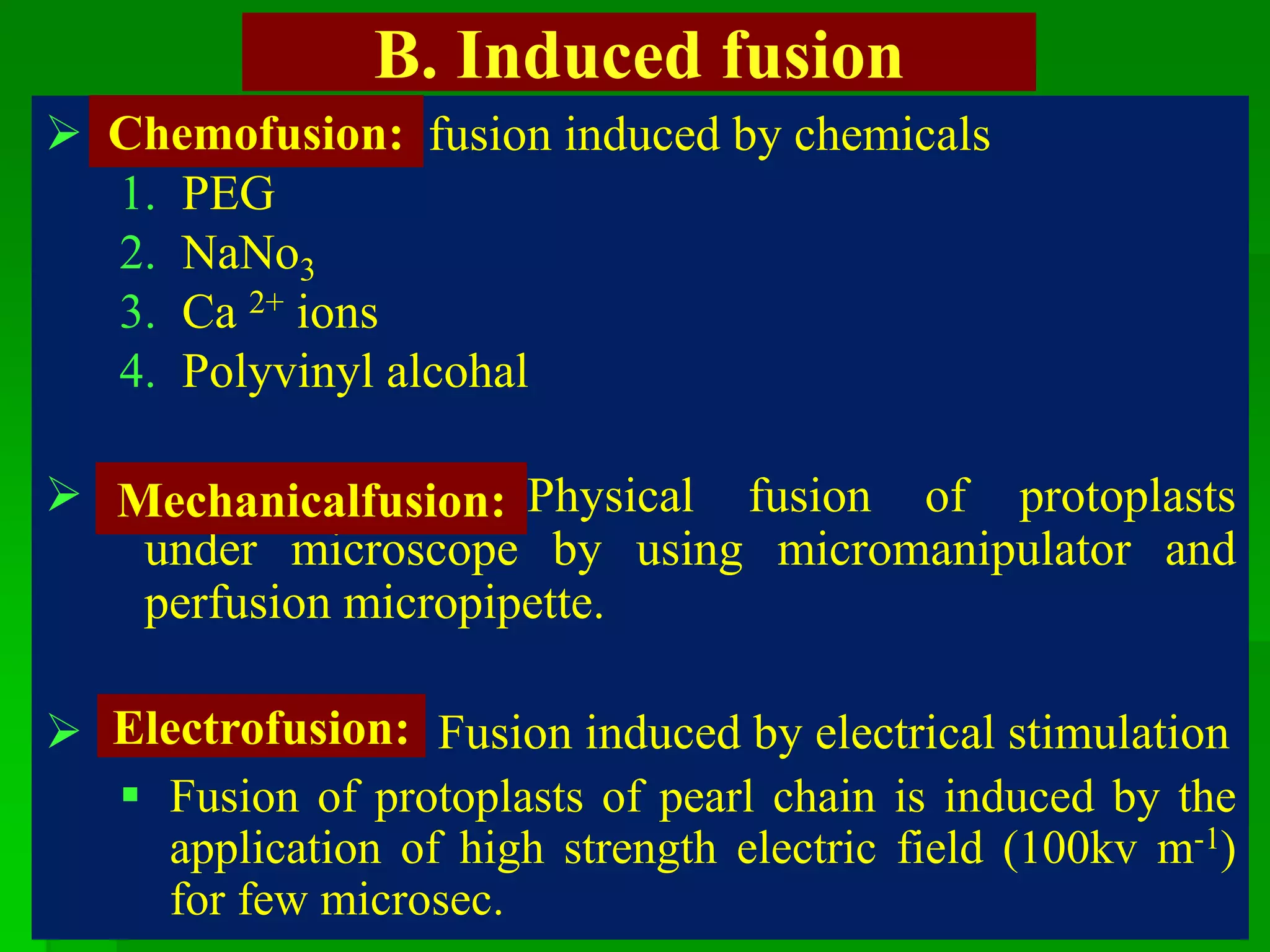
B. Induced fusion
 fusion induced by chemicals
1. PEG
2. NaNo3
3. Ca 2+ ions
4. Polyvinyl alcohal
 Physical fusion of protoplasts
under microscope by using micromanipulator and
perfusion micropipette.
 Fusion induced by electrical stimulation
 Fusion of protoplasts of pearl chain is induced by the
application of high strength electric field (100kv m-1)
for few microsec.
Chemofusion:
Mechanicalfusion:
Electrofusion:
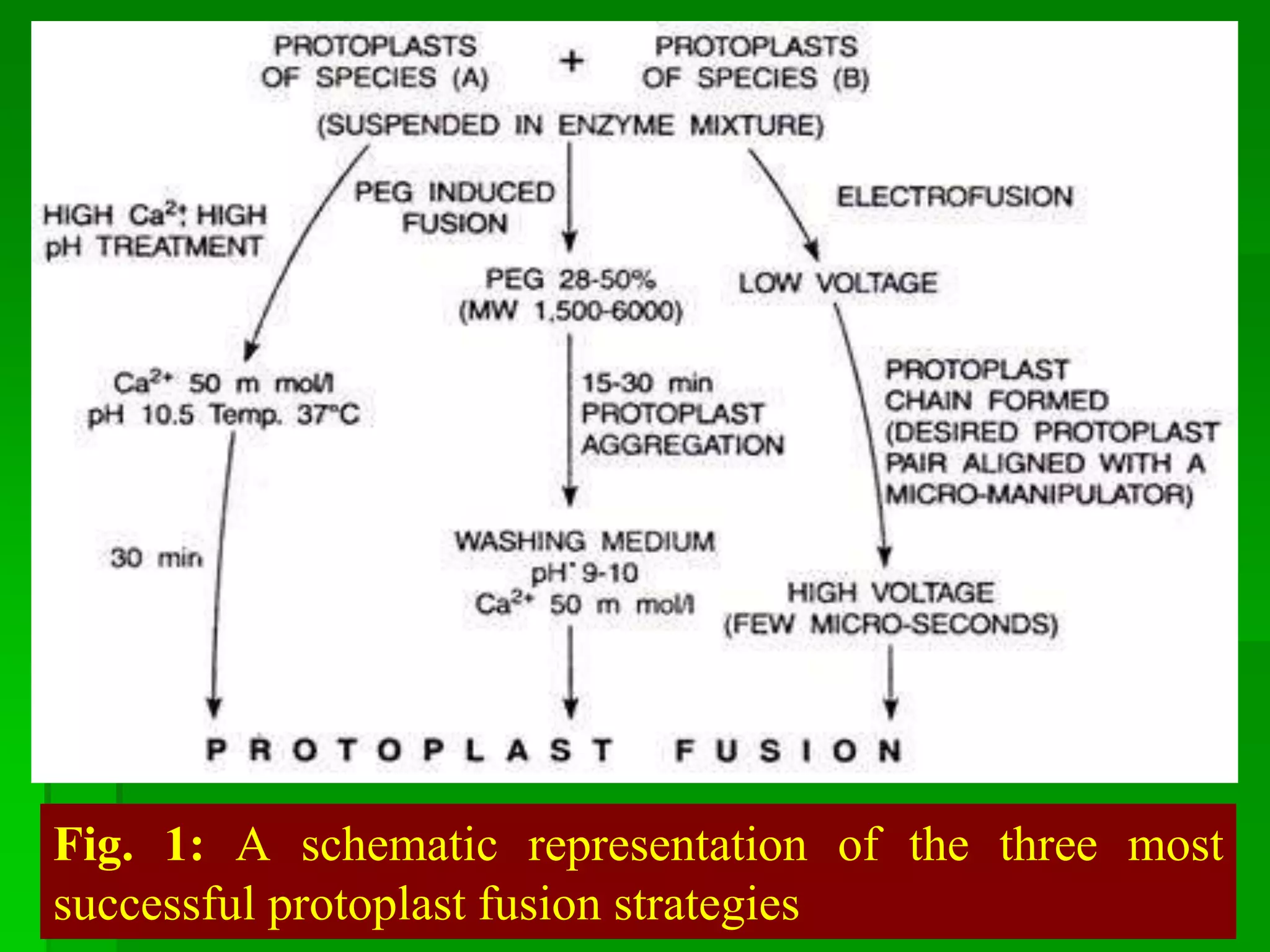
Fig. 1: A schematic representation of the three most
successful protoplast fusion strategies
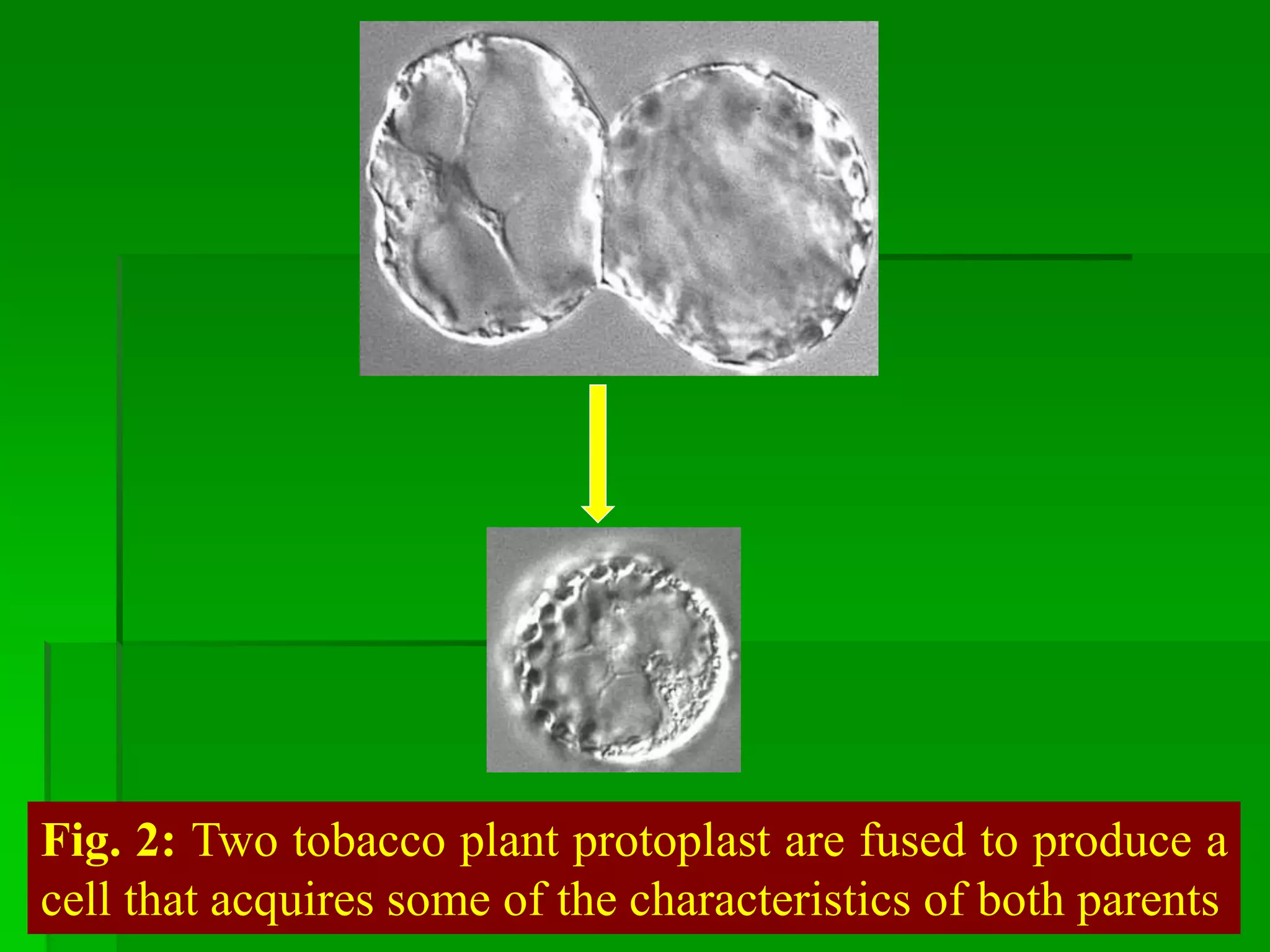
Fig. 2: Two tobacco plant protoplast are fused to produce a
cell that acquires some of the characteristics of both parents
3. Identification and Selection
 Hybrid identification- Based on difference between the
parental cells and hybrid cell with respect to
i. Pigmentation
ii. Cytoplasmic markers
 Fluorochromes like FITC (fluoroscein
isothiocyanate) and RITC (Rhodamine
isothiocyanate) are used for labelling of hybrid
cells
iii. Presence of chloroplast
iv. Nuclear staining
 Heterokaryon is stained by carbol-fuschin,
aceto-carmine or aceto-orcein stain
v. Several markers are used
 Genetic complementation
 Phytotoxins
 Specific amino acid
 Auxin autotrophy
 Antibiotics
 Auxotrophic and metabolic mutants
 Chromosomal analysis
 Herbicides
4. Protoplast culture and regeneration
 Plants are induced to regenerate from hybrid calli.
 Hybrid cells are cultured on sterile and cooled down
nutrient medium in petri dishes.
 The plates are incubated at 25°C in a dim white light.
 The protoplasts regenerate a cell wall, undergo cell division
and form callus. The callus can also be subcultured.
 Embryogenesis begins from callus when it is placed on
nutrient medium lacking mannitol and auxin. The embryo
develops into seedlings and finally mature plants.
 These hybrid plants must be at least partially fertile, in
addition to having some useful property, to be of any use in
breeding schemes.
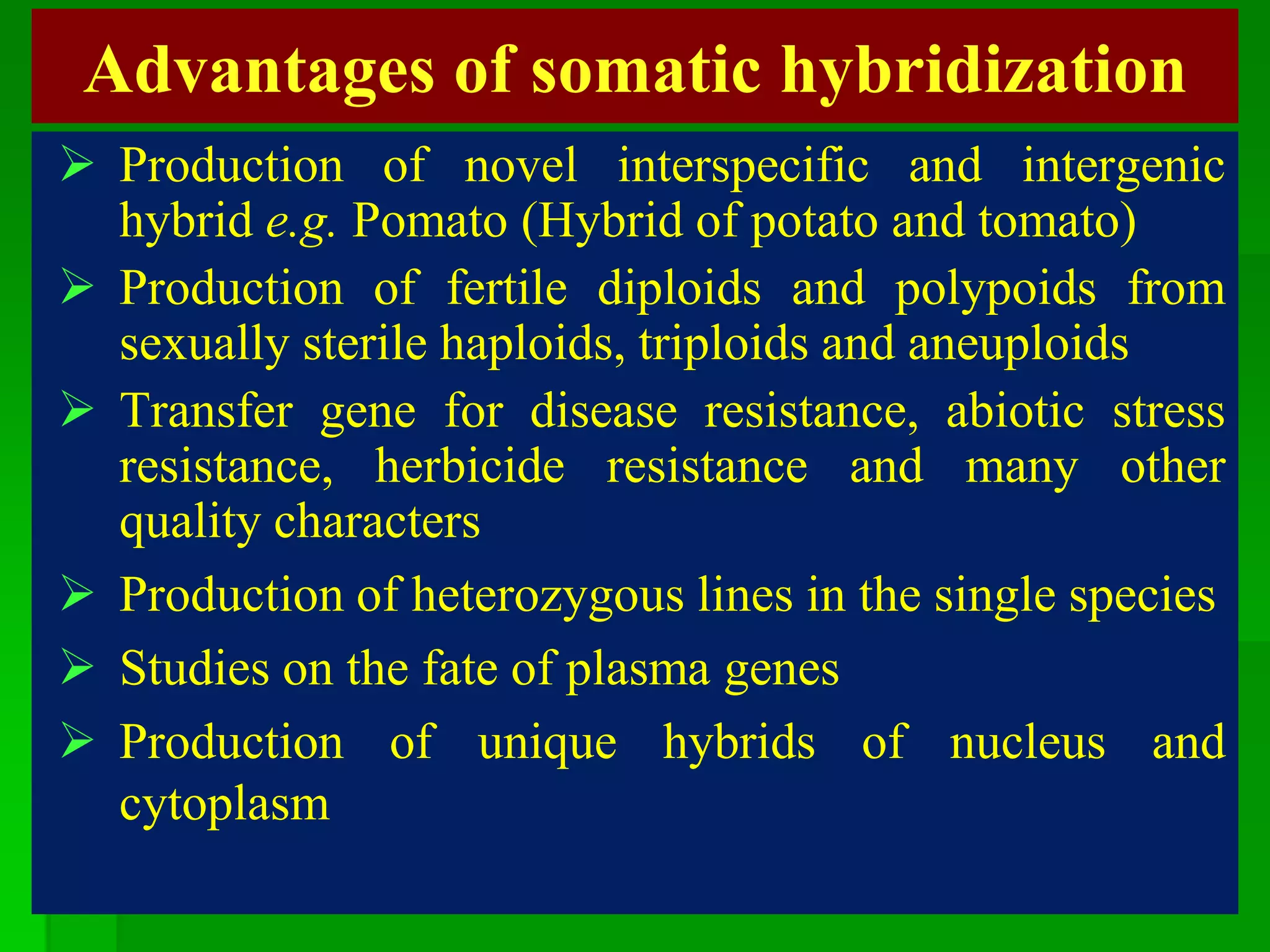
Advantages of somatic hybridization
 Production of novel interspecific and intergenic
hybrid e.g. Pomato (Hybrid of potato and tomato)
 Production of fertile diploids and polypoids from
sexually sterile haploids, triploids and aneuploids
 Transfer gene for disease resistance, abiotic stress
resistance, herbicide resistance and many other
quality characters
 Production of heterozygous lines in the single species
 Studies on the fate of plasma genes
 Production of unique hybrids of nucleus and
cytoplasm
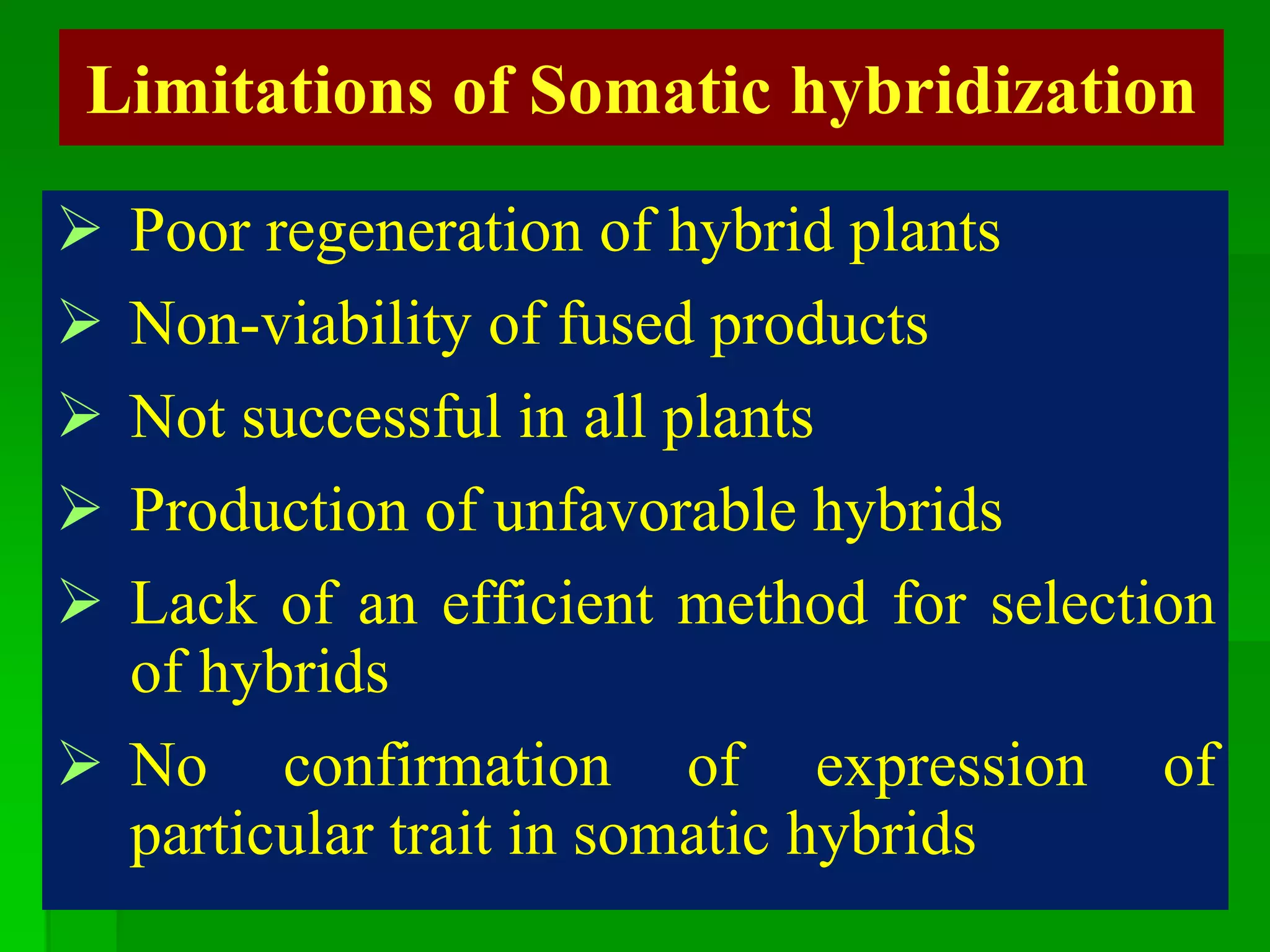
Limitations of Somatic hybridization
 Poor regeneration of hybrid plants
 Non-viability of fused products
 Not successful in all plants
 Production of unfavorable hybrids
 Lack of an efficient method for selection
of hybrids
 No confirmation of expression of
particular trait in somatic hybrids
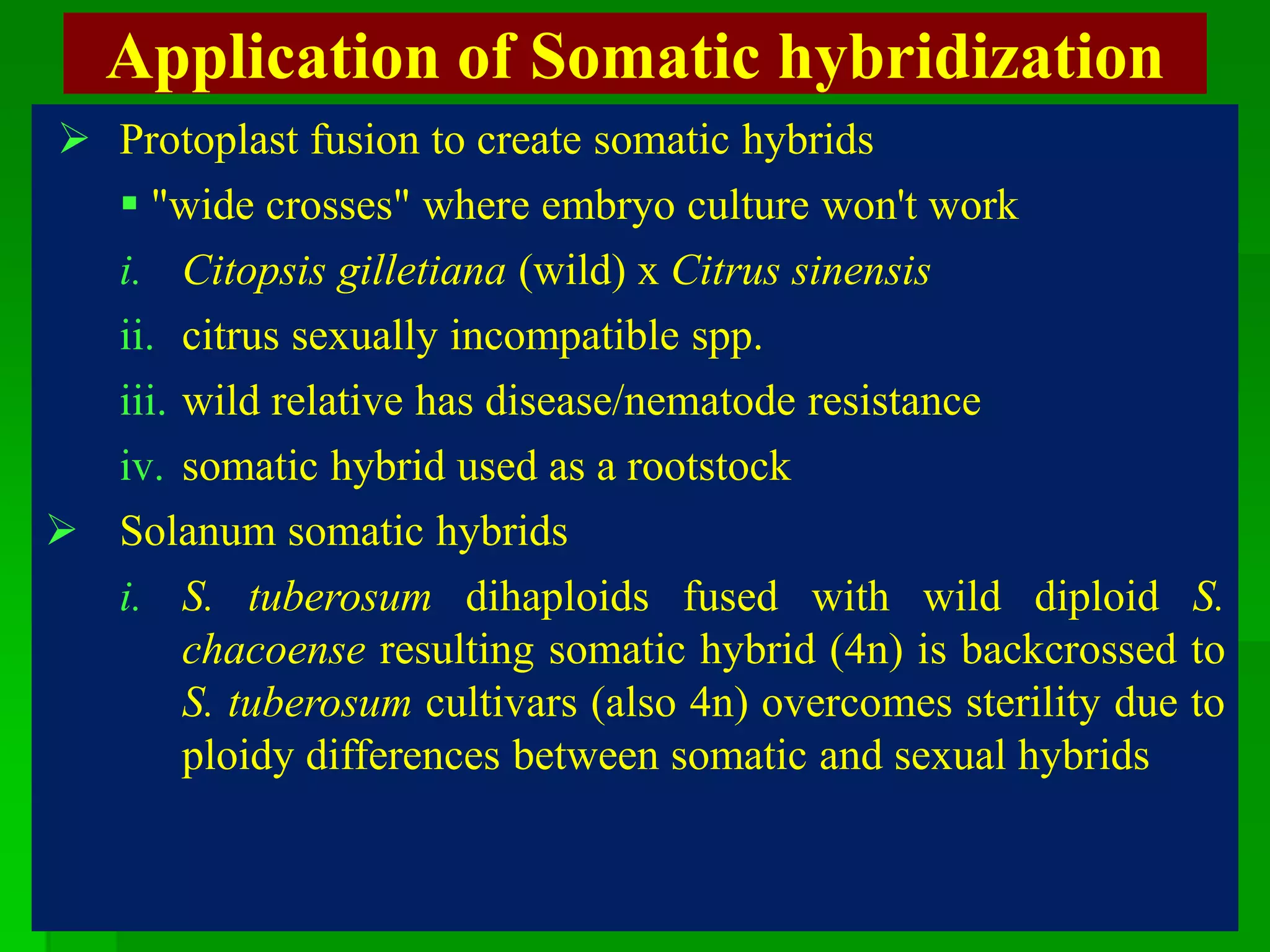
Application of Somatic hybridization
 Protoplast fusion to create somatic hybrids
 "wide crosses" where embryo culture won't work
i. Citopsis gilletiana (wild) x Citrus sinensis
ii. citrus sexually incompatible spp.
iii. wild relative has disease/nematode resistance
iv. somatic hybrid used as a rootstock
 Solanum somatic hybrids
i. S. tuberosum dihaploids fused with wild diploid S.
chacoense resulting somatic hybrid (4n) is backcrossed to
S. tuberosum cultivars (also 4n) overcomes sterility due to
ploidy differences between somatic and sexual hybrids
THANK
YOU

Somatic ybridization and its application

  • 1.
    Somatic hybridization andits applications PRESENTED BY: Pawan Nagar Reg. no.: 04-2690-2015 M.Sc.(Fruit Science)
  • 2.
  • 3.
    Protoplast also knownas a naked plant cell refers to all the components of plant cell excluding the cell wall. Development of hybrid plants through the fusion of somatic protoplasts of two different plant species/varieties is called somatic hybridization, and such hybrids are known as somatic hybrids. Somatic hybridization: Protoplast:
  • 4.
    History  Hanstein introducedthe term ‘Protoplast’.  The isolation of protoplasts from was first achieved through by Klercker (1892) on plasmolysed cells.  Cooking (1960) for the first time isolated the protoplasts of plant tissues by using cell wall degrading enzymes viz., cellulase, hemicellulase, pectinase, and protease extracted from fungus Trichoderma viride and Myrothecium verrucaria.  First achievement in protoplast fusion by Power (1970)
  • 5.
    Somatic hybridization technique 1.isolation of protoplast 2. Fusion of the protoplasts of desired species/varieties 3. Identification and selection of somatic hybrid cells 4. Protoplast culture and regeneration
  • 6.
    1. Isolation ofprotoplast A. Mechanical method B. Enzymatic method
  • 7.
    A. Mechanical Method PlantTissue Collection of protoplasm Cells Plasmolysis Microscope Observation of cells Cutting cell wall with knife Release of protoplasm
  • 8.
    Mechanical disruption  Experimentalcells are allowed to plasmolyse by keeping them in hypertonic solution.  In plasmolysed state, cell wall is cut with a sharp knife.  Plasmolysed cell is transferred to hypotonic solution.  This results in the release of protoplast in outer solution through cut ends.  This method is suitable only for tissues with large cells in which evident plasmolysis occurs.
  • 9.
    Limitation  Used forvacuolated cells like onion bulb scale, radish and beet root tissues  Low yield of protoplast  Laborious and tedious process  Low protoplast viability
  • 10.
    B. Enzymatic Method Leafsterlization, removal of epidermis Plasmolysed cellsPlasmolysed cells Pectinase + Cellulase Pectinase Protoplasm released Release of isolated cells Cellulase Isolated Protoplasm Protoplasm released
  • 11.
     Surface sterilizationof leaf sample  Rinsing in suitable plasmolyticum with distilled water  Peeling of off the lower epidermis towards margin with sharp forceps below the junction of a lateral vein and midrib.  Enzymatic treatment  Purification of isolated protoplasts. Enzymatic protoplast isolation steps
  • 12.
    Enzymatic dissolution  Cellwalls are dissolved by enzymes.  Such enzymes are extracted from fungi, bacteria Macerozyme, a pectinase enzyme, from Rhizopus fungus,  Driselase a mixture of cellulase and pectinase, from Trichoderma viride.  Pectinase breaks the tissues into cells by dissolving calcium pectate of middle lamella.  Hemicellulase and cellulase break down the cell wall.  Commercially available enzymes are "Pectolyase Y- 23", Onozuka R-1O.
  • 13.
     Protoplast usingenzymes may be isolated by sequential method or mixed enzyme method.  In the first process two enzymes-pectinase and cellulase are used sequentially, while in the second process two enzymes are used simultaneously.  The enzyme mixture macerates the cells and simultaneously destroys their walls.  Sequential method is useful in isolating protoplasts from palisade layer. While mixture enzyme method is useful in isolating protoplasts from spongy parenchyma and upper epidermis.
  • 14.
    Advantages  Used forvariety of tissues and organs including leaves, petioles, fruits, roots, coleoptiles, hypocotyls, stem, shoot apices, embryo microspores  Mesophyll tissue - most suitable source  High yield of protoplast  Easy to perform  More protoplast viability
  • 15.
    Protoplast purification  Enzymesolutions are filtered with nylon mesh to remove insoluble impurities.  Filtrate is centrifuged for 5 minutes at 700 rpm.  The protoplast forms pellet and goes at the bottom of contrifuge tube.  Supernatant is removed with Pasteur pipett.  The pellet at the base is suspended in 10 ml of MS medium plus mannitol and the process is repeated thrice.  The resultant protoplast is pure.
  • 16.
    2. Protoplast Fusion A.Spontaneous fusion B. Induced fusion Intraspecific Intergeneric Electrofusion Mechanical fusion Chemofusion
  • 17.
    A. Spontaneous fusion Protoplast fuse spontaneously during isolation process mainly due to physical contact  Intraspecific  Intergeneric
  • 18.
    Intraspecific protoplast fusion Intraspecific protoplast fusion is the cross between the same species  This technique offers the only way of carrying out crosses and genetic analysis. Interspecific protoplast fusion  Interspecific protoplast fusion is the crosses between two different species.  Interspecific protoplast fusions are of much importance in the area where new products are to be produced.  Due to new genetic set up many noval secondary metabolites such as, antibiotics may be produced.
  • 19.
    B. Induced fusion fusion induced by chemicals 1. PEG 2. NaNo3 3. Ca 2+ ions 4. Polyvinyl alcohal  Physical fusion of protoplasts under microscope by using micromanipulator and perfusion micropipette.  Fusion induced by electrical stimulation  Fusion of protoplasts of pearl chain is induced by the application of high strength electric field (100kv m-1) for few microsec. Chemofusion: Mechanicalfusion: Electrofusion:
  • 20.
    Fig. 1: Aschematic representation of the three most successful protoplast fusion strategies
  • 21.
    Fig. 2: Twotobacco plant protoplast are fused to produce a cell that acquires some of the characteristics of both parents
  • 22.
    3. Identification andSelection  Hybrid identification- Based on difference between the parental cells and hybrid cell with respect to i. Pigmentation ii. Cytoplasmic markers  Fluorochromes like FITC (fluoroscein isothiocyanate) and RITC (Rhodamine isothiocyanate) are used for labelling of hybrid cells iii. Presence of chloroplast
  • 23.
    iv. Nuclear staining Heterokaryon is stained by carbol-fuschin, aceto-carmine or aceto-orcein stain v. Several markers are used  Genetic complementation  Phytotoxins  Specific amino acid  Auxin autotrophy  Antibiotics  Auxotrophic and metabolic mutants  Chromosomal analysis  Herbicides
  • 24.
    4. Protoplast cultureand regeneration  Plants are induced to regenerate from hybrid calli.  Hybrid cells are cultured on sterile and cooled down nutrient medium in petri dishes.  The plates are incubated at 25°C in a dim white light.  The protoplasts regenerate a cell wall, undergo cell division and form callus. The callus can also be subcultured.  Embryogenesis begins from callus when it is placed on nutrient medium lacking mannitol and auxin. The embryo develops into seedlings and finally mature plants.  These hybrid plants must be at least partially fertile, in addition to having some useful property, to be of any use in breeding schemes.
  • 25.
    Advantages of somatichybridization  Production of novel interspecific and intergenic hybrid e.g. Pomato (Hybrid of potato and tomato)  Production of fertile diploids and polypoids from sexually sterile haploids, triploids and aneuploids  Transfer gene for disease resistance, abiotic stress resistance, herbicide resistance and many other quality characters  Production of heterozygous lines in the single species  Studies on the fate of plasma genes  Production of unique hybrids of nucleus and cytoplasm
  • 26.
    Limitations of Somatichybridization  Poor regeneration of hybrid plants  Non-viability of fused products  Not successful in all plants  Production of unfavorable hybrids  Lack of an efficient method for selection of hybrids  No confirmation of expression of particular trait in somatic hybrids
  • 27.
    Application of Somatichybridization  Protoplast fusion to create somatic hybrids  "wide crosses" where embryo culture won't work i. Citopsis gilletiana (wild) x Citrus sinensis ii. citrus sexually incompatible spp. iii. wild relative has disease/nematode resistance iv. somatic hybrid used as a rootstock  Solanum somatic hybrids i. S. tuberosum dihaploids fused with wild diploid S. chacoense resulting somatic hybrid (4n) is backcrossed to S. tuberosum cultivars (also 4n) overcomes sterility due to ploidy differences between somatic and sexual hybrids
  • 28.