Allie N U,
MSc Biotechnology,
Introduction
 Micropropagation is a practice of rapidly
multiplying stock plant material to produce a large
number of progeny plants using modern PTC
methods.
 Used to multiply novel plants, that are genetically
modified or bred through conventional plant
breeding methods.
 Also used to provide no. of plantlets from a stock
plant that does not produce seeds, or does not
respond well to vegetative propagation.
Clonal propagation
 Process of asexual reproduction by multiplication
of genetically identical copies of individual plants.
 Clone refers to plant population derived from a
single plant by asexual reproduction.
 Asexual reproduction through multiplication of
vegetative parts is the method for invivo
propagation of certain plants (as no viable seed is
produced).
 Successfully applied for propagation of apple,
potato, tuberous and several ornamental plants.
Invitro clonal propagation
 Invivo clonal propagation of plants is expensive
and frequently unsuccessfull
 Invitro clonal propagation through tissue culture –
micropropagation.
 Use of tissue culture technique for
micropropagation- Morel(1960) for orchids.
 Used for rapid multiplication of plants.
Technique
 It’s a complicated process.
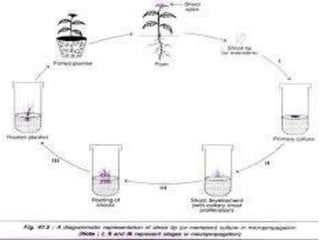
 Involves 3 stages (I,II and III). Sometimes two more
stages are added (0 and IV).
Stage 0:-
 Initial step in micropropagation.
 Involves the selection and growth of stock plants for
about 3 months under controlled conditions.
Stage I:-
 Initiation and establishment of culture in suitable
medium.
 Commonly used explants are organs, shoot tips and
axillary buds.
 Also explant is surface sterilized and washed before
use.
Stage II:-
 Activity of micropropagation occurs in defined culture
medium.
 Involves multiplication of shoots or rapid embryo
formation from the explant.
Stage III:-
 Involves the transfer of shoots to a medium for rapid
development.
 Sometimes, shoots are directly planted in soil to
develop roots.
 Invitro shooting is preferred while handling large
number of species.
Stage IV:-
 Involves establishment of plantlets in soil.
 Done by transferring plantlets of stage III from lab
to environment of green house.
 In some plants stage III is skipped and stage II
shoots are planted in pots or in suitable compost
mixture.
 These stages are useful for comparison between
two or more plant systems, besides better
understanding.
Approaches
 Two approaches:
1. Multiplication by axillary bud/apical shoots.
2. Multiplication by adventitious shoots.
 Besides these two approaches, plant
regeneration processes namely ‘organogenesis’
and ‘somatic embryogenesis’ may also be used.
Multiplication by axillary bud and
apical shoots
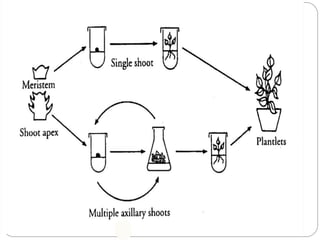
 Actively dividing meristems are present at axillary
and apical shoots.
 Axillary buds located in axile of leaves are
capable of developing into shoots.
 In the invitro state only limited no.of axillary
meristem can form shoots.
 Possible to develop plants from
1. meristem and shoot tip cultures ,
2. bud cultures
Meristem and shoot tip
cultures
 Apical meristem- dome of tissue located at extreme
tip of a shoot.
 Apical meristem along with young leaf primordia
constitute the shoot apex.
 For disease free plants, meristem tips are cultured.
Procedure :-
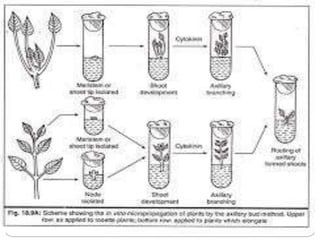
 Meristem or shoot tip is isolated from a stem by a V
shaped cut.
 Size (0.2 to 0.5mm) of tip is critical for culture.
 For good results, explants should be taken from
actively growing shoot tips, ideal timing is at end of
plant dormancy period.
 Widely used media are MS media and White’s
Stages of growth
Stage I:-
 Culture of meristem is established.
 Addition of growth regulators, cytokinins(kinetin, BAP) and
auxins(NAA, IBA) support growth and development.
Stage II:-
 Shoot development along with axillary shoot proliferation
occurs.
 High level of cytokinins are reqiured.
Stage III:-
 Associated with rooting of shoots and further growth.
 Facilitated by low cytokinin and high auxin concentration.
Thus both medium will be different in composition.
 Optimum temperature- 20- 28ºC and lower light intensity.
Bud cultures
 Plant bud possess active meristems depending
on physiological state of plant.
 Two types of bud cultures-
1. Single node culture:- natural method for
vegetative propagation of plants.
 Bud found in axil of leaf is comparable to stem
tips, for ablility in micropropagation.
 A bud along with piece of stem is isolated and
cultured to develop into plantlet.
 Closed buds used to reduce infection.
 No cytokinin is added here.
2. Axillary bud culture:- shoot tip along with
axillary bud is isolated.
 Cultures carried out with high cytokinin
concentration. Thus apical dominance stops
and axillary bud develop
 Good axillary bud culture – cytokinin/ auxin ratio
is 10:1.
Multiplication by adventitious
shoots
 Adventitious shoots include stems, bulbs, tubers
and rhizomes.
 Useful for invivo and invitro clonal propagation.
Applications
1) High rate of plant propagation:-
 Large no.of plants can be grown from single piece of
plant tissue within short period.
 Can be carried out throughout the year irrespective of
seasonal variations.
 Small sized propagules obtained in micropropagation
can be easily stored for many years.
2) Production of disease free plants:-
 Meristem tip cultures are generally employed to
develop pathogen free plants
 Successfully used for production of virus free plants of
sweet potato, cassava and yam
3) Production of seeds in some crops:-
 Through axillary bud proliferation seed production
can be done in some plants.
 Required in certain plants where limitation for
seed production is high degree of genetic
conservation.
4) Cost effective process:-
 Requires minimum growing space.
 Production cost is relatively low.
Automated micropropagation
 It is now possible to automate micropropagation
at various stages.
 Bioreactors have been set up for large scale
multiplication of shoots and bulbs.
 Some workers employ robots thus to reduce
production cost.
 Commmercial exploitation of tissue culture
technology is limited because of high cost of
production.
 This can be reduced by devising systems.
Bioreactors can be used for somatic
embryogenesis.
Robotics
 Robotics can be used , for example, in media
preparation, cutting microshoots and placing
them back on fresh medium.
 First commercial automated tissue culture robot
was introduced by Australian company for bio
robotics in 1997. target species- eucalypts,
acacia teak and pine.
 Miiwa 1991 – fully automated robotic
multiplication system.
Types
1) Total automation:-
With use of image analysis system and a robot or
other device
Little or no human interventions, except to control
the computer and repair parts
Eg: Toshiba ptc robot
2) Semi automation:-
Involvement of human operators contributing to any
stage of process.
Most commonly researched type of automation
Advantages
1) Management – management of machine will be
much easier.
2) Contamination – reduction of contamination can
be expected by using automation.
3) Operation time – two or three shifts become
possible.this increase the utilization of capacity
and reduce the depreciation costs per unit
4) Uniformity – machines act uniformly.
Disadvantages
 Flexibility – plant growth and shape are affected
by uncontrollable environmental factors. Once
production is started on non-uniform stock, it
would be difficult to coorect it in machines.
 Correction ability- application of automation
naturally decrease opportunity to detect
contamination.

Micropropagation technique

  • 1.
    Allie N U, MScBiotechnology,
  • 2.
    Introduction  Micropropagation isa practice of rapidly multiplying stock plant material to produce a large number of progeny plants using modern PTC methods.  Used to multiply novel plants, that are genetically modified or bred through conventional plant breeding methods.  Also used to provide no. of plantlets from a stock plant that does not produce seeds, or does not respond well to vegetative propagation.
  • 3.
    Clonal propagation  Processof asexual reproduction by multiplication of genetically identical copies of individual plants.  Clone refers to plant population derived from a single plant by asexual reproduction.  Asexual reproduction through multiplication of vegetative parts is the method for invivo propagation of certain plants (as no viable seed is produced).  Successfully applied for propagation of apple, potato, tuberous and several ornamental plants.
  • 4.
    Invitro clonal propagation Invivo clonal propagation of plants is expensive and frequently unsuccessfull  Invitro clonal propagation through tissue culture – micropropagation.  Use of tissue culture technique for micropropagation- Morel(1960) for orchids.  Used for rapid multiplication of plants.
  • 5.
    Technique  It’s acomplicated process.  Involves 3 stages (I,II and III). Sometimes two more stages are added (0 and IV). Stage 0:-  Initial step in micropropagation.  Involves the selection and growth of stock plants for about 3 months under controlled conditions. Stage I:-  Initiation and establishment of culture in suitable medium.  Commonly used explants are organs, shoot tips and axillary buds.  Also explant is surface sterilized and washed before use.
  • 6.
    Stage II:-  Activityof micropropagation occurs in defined culture medium.  Involves multiplication of shoots or rapid embryo formation from the explant. Stage III:-  Involves the transfer of shoots to a medium for rapid development.  Sometimes, shoots are directly planted in soil to develop roots.  Invitro shooting is preferred while handling large number of species.
  • 7.
    Stage IV:-  Involvesestablishment of plantlets in soil.  Done by transferring plantlets of stage III from lab to environment of green house.  In some plants stage III is skipped and stage II shoots are planted in pots or in suitable compost mixture.  These stages are useful for comparison between two or more plant systems, besides better understanding.
  • 10.
    Approaches  Two approaches: 1.Multiplication by axillary bud/apical shoots. 2. Multiplication by adventitious shoots.  Besides these two approaches, plant regeneration processes namely ‘organogenesis’ and ‘somatic embryogenesis’ may also be used.
  • 11.
    Multiplication by axillarybud and apical shoots  Actively dividing meristems are present at axillary and apical shoots.  Axillary buds located in axile of leaves are capable of developing into shoots.  In the invitro state only limited no.of axillary meristem can form shoots.  Possible to develop plants from 1. meristem and shoot tip cultures , 2. bud cultures
  • 12.
    Meristem and shoottip cultures  Apical meristem- dome of tissue located at extreme tip of a shoot.  Apical meristem along with young leaf primordia constitute the shoot apex.  For disease free plants, meristem tips are cultured. Procedure :-  Meristem or shoot tip is isolated from a stem by a V shaped cut.  Size (0.2 to 0.5mm) of tip is critical for culture.  For good results, explants should be taken from actively growing shoot tips, ideal timing is at end of plant dormancy period.  Widely used media are MS media and White’s
  • 13.
    Stages of growth StageI:-  Culture of meristem is established.  Addition of growth regulators, cytokinins(kinetin, BAP) and auxins(NAA, IBA) support growth and development. Stage II:-  Shoot development along with axillary shoot proliferation occurs.  High level of cytokinins are reqiured. Stage III:-  Associated with rooting of shoots and further growth.  Facilitated by low cytokinin and high auxin concentration. Thus both medium will be different in composition.  Optimum temperature- 20- 28ºC and lower light intensity.
  • 14.
    Bud cultures  Plantbud possess active meristems depending on physiological state of plant.  Two types of bud cultures- 1. Single node culture:- natural method for vegetative propagation of plants.  Bud found in axil of leaf is comparable to stem tips, for ablility in micropropagation.  A bud along with piece of stem is isolated and cultured to develop into plantlet.  Closed buds used to reduce infection.  No cytokinin is added here.
  • 15.
    2. Axillary budculture:- shoot tip along with axillary bud is isolated.  Cultures carried out with high cytokinin concentration. Thus apical dominance stops and axillary bud develop  Good axillary bud culture – cytokinin/ auxin ratio is 10:1.
  • 16.
    Multiplication by adventitious shoots Adventitious shoots include stems, bulbs, tubers and rhizomes.  Useful for invivo and invitro clonal propagation.
  • 19.
    Applications 1) High rateof plant propagation:-  Large no.of plants can be grown from single piece of plant tissue within short period.  Can be carried out throughout the year irrespective of seasonal variations.  Small sized propagules obtained in micropropagation can be easily stored for many years. 2) Production of disease free plants:-  Meristem tip cultures are generally employed to develop pathogen free plants  Successfully used for production of virus free plants of sweet potato, cassava and yam
  • 20.
    3) Production ofseeds in some crops:-  Through axillary bud proliferation seed production can be done in some plants.  Required in certain plants where limitation for seed production is high degree of genetic conservation. 4) Cost effective process:-  Requires minimum growing space.  Production cost is relatively low.
  • 21.
    Automated micropropagation  Itis now possible to automate micropropagation at various stages.  Bioreactors have been set up for large scale multiplication of shoots and bulbs.  Some workers employ robots thus to reduce production cost.  Commmercial exploitation of tissue culture technology is limited because of high cost of production.  This can be reduced by devising systems. Bioreactors can be used for somatic embryogenesis.
  • 22.
    Robotics  Robotics canbe used , for example, in media preparation, cutting microshoots and placing them back on fresh medium.  First commercial automated tissue culture robot was introduced by Australian company for bio robotics in 1997. target species- eucalypts, acacia teak and pine.  Miiwa 1991 – fully automated robotic multiplication system.
  • 23.
    Types 1) Total automation:- Withuse of image analysis system and a robot or other device Little or no human interventions, except to control the computer and repair parts Eg: Toshiba ptc robot 2) Semi automation:- Involvement of human operators contributing to any stage of process. Most commonly researched type of automation
  • 24.
    Advantages 1) Management –management of machine will be much easier. 2) Contamination – reduction of contamination can be expected by using automation. 3) Operation time – two or three shifts become possible.this increase the utilization of capacity and reduce the depreciation costs per unit 4) Uniformity – machines act uniformly.
  • 25.
    Disadvantages  Flexibility –plant growth and shape are affected by uncontrollable environmental factors. Once production is started on non-uniform stock, it would be difficult to coorect it in machines.  Correction ability- application of automation naturally decrease opportunity to detect contamination.