MERISTEM CULTURE
Bhoomika B G
JSS institute of
education
Sakleshpura
INTRODUCTION
• Meristem culture- process of culturing meristems which is free
of virus, used to obtain virus free plants by rapid
multiplication.
• Also called Shoot tip/ apical meristem culture.
• Morel and Martin-1952- developed technique of meristem
culture- in vivo virus eradication of Dahlia.
• Limmaset and Cornuet- observed declined growth of virus
towards the apical meristem.
• Most used media- Murashige and Skoog(MS)- low salt
concentration- fungicides,/antibiotics-removes contamination.
• Meristem culture- uses apical meristem with 1-3 leaf primordia-
clones of a plant develop- vegetative propagation.
• Meristem culture- v-shape cut on stem.
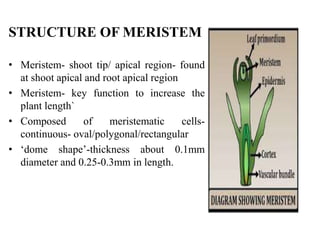
STRUCTURE OF MERISTEM
• Meristem- shoot tip/ apical region- found
at shoot apical and root apical region
• Meristem- key function to increase the
plant length`
• Composed of meristematic cells-
continuous- oval/polygonal/rectangular
• ‘dome shape’-thickness about 0.1mm
diameter and 0.25-0.3mm in length.
STAGES OF MERISTEM CULTURE
• Murashige- reported 3 stages of culture
• Stage1- culture establishment stage- explant may develop into
single or multiple shoot- explants supplied with Cytokinin-
BA, kinetin, 2iP.
• Stage 2- objective- multiply propagule- axillary shoot
proliferation-maintains higher genetic stability. Axillary shoot
proliferation- high level Cytokinin utilized to overcome apical
dominance.
• Stage 3- regeneration of adventitious roots- shoot in stage 2-
NAA followed by IBA,IAA, 2,4-D , other auxins- used for
induction of root generation
COMPONENTS OF MEDIA
• Inorganic nutrients- P, Ca, Mg, S
• Carbon source- sugar
• Organic supplements- vitamins, amino acids, complex organics
PLANT GROWTH HARMONS
• Auxins(root)
• Cytokinins(shoot)
• Gibberlins(meristem growth)
• Abscissic acid( culturing woody sps.)
• Solidifying agent (agarose)
• pH ( lower than 4.5/ higher 7.5 inhibit growth)
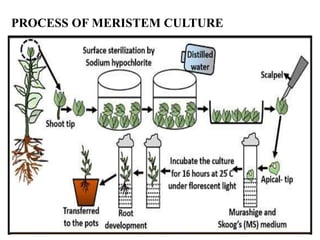
PROCESS OF MERISTEM CULTURE
• Remove young twigs- cut tip portion of that twig- 1cm.
• Surface sterilize shoot tip- sodium hypochlorite solution- 10mins
• Explant rinsed with distlled water for 4 times
• Transfer explant to sterilized petriplate.
• Dissect outer leaves of shoot tip- apex region gets exposed-
separated with the scalpel.
• Apex region transferred- MS Media
• Incubate- 16hrs at 25ºC.
• Single/ multiple shoot developed- transfer to hormone free
medium- root development.
• Transfer plants to pot with compost- green condition for
hardening.
Application
1. Virus elimination-
• Plants- more than one type of virus.
2. Micropropagation
• Asexual/ vegetative parts of the plant is used in tissue culture –
micropropagation.
3. Storage of Genetic resources
• Many plants produce seeds that are highly heterozygous in nature and
that is accepted for storing genetic resources- invitro.
4. Plant breeding
• Hybrid plant produce abortive/ non-viable seed which are unable to
develop into the mature plants in short time- meristem culture- speed
up the process of breeding programme
ADVANTAGES
• Lack of vascular tissue.
• High auxin concentration.
• Production of virus free plant- eg: TMV, SMV
• Facilitation of exchange between location.
• Cryopreservation or in vitro condition of germplasm.
DISADVANATGES
• Isolation is difficult.
• Low survival rate and regeneration rate.
APPLICATION
1. Virus elimination- meristem plant produces heterozygous
seeds- stored in invitro condition
2. Micropropagation- vegetative/ asexual propagation of whole
plant.
3. Storage of genetic resources
4. Use of plant breeding- hybrid plants can grow
CONCLUSION
There are numerous methods used for tissue culture given that
there are different types of tissue that requires specific conditions
for culture process. Meristem culture is an effective method to
produce virus free plant by rapid multiplication. It is used for
cloning purpose, genetic modification of given plant or simply to
accelerate/increase yield of plant of interest.
It has great significance in biological studies, due to wide range
of application. The process may be complex, requires lot of
care, to avoid effects of contamination.
meristem culture-ppt.pptx

meristem culture-ppt.pptx

  • 1.
    MERISTEM CULTURE Bhoomika BG JSS institute of education Sakleshpura
  • 2.
    INTRODUCTION • Meristem culture-process of culturing meristems which is free of virus, used to obtain virus free plants by rapid multiplication. • Also called Shoot tip/ apical meristem culture. • Morel and Martin-1952- developed technique of meristem culture- in vivo virus eradication of Dahlia. • Limmaset and Cornuet- observed declined growth of virus towards the apical meristem. • Most used media- Murashige and Skoog(MS)- low salt concentration- fungicides,/antibiotics-removes contamination. • Meristem culture- uses apical meristem with 1-3 leaf primordia- clones of a plant develop- vegetative propagation. • Meristem culture- v-shape cut on stem.
  • 3.
    STRUCTURE OF MERISTEM •Meristem- shoot tip/ apical region- found at shoot apical and root apical region • Meristem- key function to increase the plant length` • Composed of meristematic cells- continuous- oval/polygonal/rectangular • ‘dome shape’-thickness about 0.1mm diameter and 0.25-0.3mm in length.
  • 4.
    STAGES OF MERISTEMCULTURE • Murashige- reported 3 stages of culture • Stage1- culture establishment stage- explant may develop into single or multiple shoot- explants supplied with Cytokinin- BA, kinetin, 2iP. • Stage 2- objective- multiply propagule- axillary shoot proliferation-maintains higher genetic stability. Axillary shoot proliferation- high level Cytokinin utilized to overcome apical dominance. • Stage 3- regeneration of adventitious roots- shoot in stage 2- NAA followed by IBA,IAA, 2,4-D , other auxins- used for induction of root generation
  • 5.
    COMPONENTS OF MEDIA •Inorganic nutrients- P, Ca, Mg, S • Carbon source- sugar • Organic supplements- vitamins, amino acids, complex organics PLANT GROWTH HARMONS • Auxins(root) • Cytokinins(shoot) • Gibberlins(meristem growth) • Abscissic acid( culturing woody sps.) • Solidifying agent (agarose) • pH ( lower than 4.5/ higher 7.5 inhibit growth)
  • 6.
  • 7.
    • Remove youngtwigs- cut tip portion of that twig- 1cm. • Surface sterilize shoot tip- sodium hypochlorite solution- 10mins • Explant rinsed with distlled water for 4 times • Transfer explant to sterilized petriplate. • Dissect outer leaves of shoot tip- apex region gets exposed- separated with the scalpel. • Apex region transferred- MS Media • Incubate- 16hrs at 25ºC. • Single/ multiple shoot developed- transfer to hormone free medium- root development. • Transfer plants to pot with compost- green condition for hardening.
  • 8.
    Application 1. Virus elimination- •Plants- more than one type of virus. 2. Micropropagation • Asexual/ vegetative parts of the plant is used in tissue culture – micropropagation. 3. Storage of Genetic resources • Many plants produce seeds that are highly heterozygous in nature and that is accepted for storing genetic resources- invitro. 4. Plant breeding • Hybrid plant produce abortive/ non-viable seed which are unable to develop into the mature plants in short time- meristem culture- speed up the process of breeding programme
  • 9.
    ADVANTAGES • Lack ofvascular tissue. • High auxin concentration. • Production of virus free plant- eg: TMV, SMV • Facilitation of exchange between location. • Cryopreservation or in vitro condition of germplasm. DISADVANATGES • Isolation is difficult. • Low survival rate and regeneration rate.
  • 10.
    APPLICATION 1. Virus elimination-meristem plant produces heterozygous seeds- stored in invitro condition 2. Micropropagation- vegetative/ asexual propagation of whole plant. 3. Storage of genetic resources 4. Use of plant breeding- hybrid plants can grow
  • 11.
    CONCLUSION There are numerousmethods used for tissue culture given that there are different types of tissue that requires specific conditions for culture process. Meristem culture is an effective method to produce virus free plant by rapid multiplication. It is used for cloning purpose, genetic modification of given plant or simply to accelerate/increase yield of plant of interest. It has great significance in biological studies, due to wide range of application. The process may be complex, requires lot of care, to avoid effects of contamination.