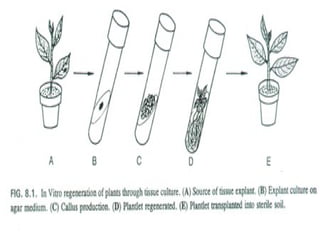
In Vitro Plant Breeding
In vitro Culture
The culture and maintenance of plant cells and organs
under artificial conditions in tubes, glasses plastics
The culture of plant seeds, organs, tissues, cells, or
protoplasts under a controlled and artificial environment ,
usually applying plastic or glass vessels, aseptic techniques and
defined growth media
The growth and development of plant seeds, organs,
tissues, cells or protoplasts under a controlled and artificial
environment , usually applying plastic or glass vessels, aseptic
techniques (axenic) conditions) and defined growth media
1. Environmental condition optimized (nutrition, light,
temperature).
2. Ability to give rise to callus, embryos, adventitious
roots and shoots.
3. Ability to grow as single cells (protoplasts,
microspores, suspension cultures).
4. Plant cells are totipotent, able to regenerate a whole
plant.
Characteristic of plant
In vitro Culture
Three fundamental abilities of plants
Totipotency
The potential or inherent capacity of a plant cell to develop into
an entire plant if suitably stimulated.
It implies that all the information necessary for growth and
reproduction of the organism is contained in the cell
Dedifferentiation
Capacity of mature cells to return to meristematic condition and
development of a new growing point, follow by redifferentiation
which is the ability to reorganize into new organ
Competency
The endogenous potential of a given cells or tissue to develop in a
particular way
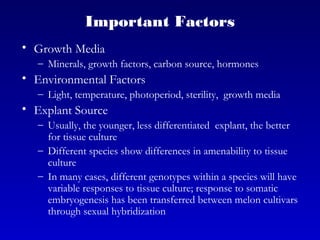
Important Factors
• Growth Media
– Minerals, growth factors, carbon source, hormones
• Environmental Factors
– Light, temperature, photoperiod, sterility, growth media
• Explant Source
– Usually, the younger, less differentiated explant, the better
for tissue culture
– Different species show differences in amenability to tissue
culture
– In many cases, different genotypes within a species will have
variable responses to tissue culture; response to somatic
embryogenesis has been transferred between melon cultivars
through sexual hybridization
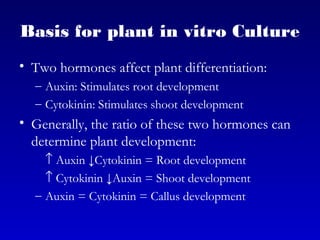
Basis for plant in vitro Culture
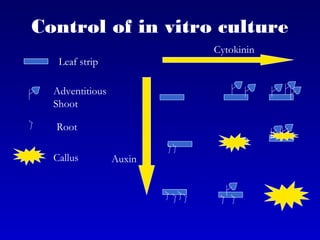
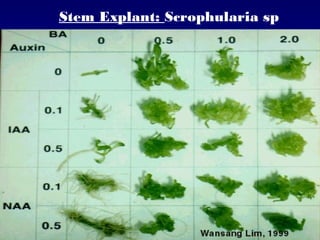
• Two hormones affect plant differentiation:
– Auxin: Stimulates root development
– Cytokinin: Stimulates shoot development
• Generally, the ratio of these two hormones can
determine plant development:
↑ Auxin ↓Cytokinin = Root development
↑ Cytokinin ↓Auxin = Shoot development
– Auxin = Cytokinin = Callus development
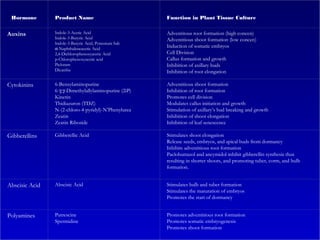
Hormone Product Name Function in Plant Tissue Culture
Auxins Indole-3-Acetic Acid
Indole-3-Butyric Acid
Indole-3-Butyric Acid, Potassium Salt
α-Naphthaleneacetic Acid
2,4-Dichlorophenoxyacetic Acid
p-Chlorophenoxyacetic acid
Picloram
Dicamba
Adventitous root formation (high concen)
Adventitious shoot formation (low concen)
Induction of somatic embryos
Cell Division
Callus formation and growth
Inhibition of axillary buds
Inhibition of root elongation
Cytokinins 6-Benzylaminopurine
6-γ,γ-Dimethylallylaminopurine (2iP)
Kinetin
Thidiazuron (TDZ)
N-(2-chloro-4-pyridyl)-N’Phenylurea
Zeatin
Zeatin Riboside
Adventitious shoot formation
Inhibition of root formation
Promotes cell division
Modulates callus initiation and growth
Stimulation of axillary’s bud breaking and growth
Inhibition of shoot elongation
Inhibition of leaf senescence
Gibberellins Gibberellic Acid Stimulates shoot elongation
Release seeds, embryos, and apical buds from dormancy
Inhibits adventitious root formation
Paclobutrazol and ancymidol inhibit gibberellin synthesis thus
resulting in shorter shoots, and promoting tuber, corm, and bulb
formation.
Abscisic Acid Abscisic Acid Stimulates bulb and tuber formation
Stimulates the maturation of embryos
Promotes the start of dormancy
Polyamines Putrescine
Spermidine
Promotes adventitious root formation
Promotes somatic embryogenesis
Promotes shoot formation
Control of in vitro culture
Cytokinin
Auxin
Leaf strip
Adventitious
Shoot
Root
Callus
Stem Explant: Scrophularia sp
Types of In vitro culture
(explant based)
 Culture of intact plants (seed and seedling culture)
 Embryo culture (immature embryo culture)
 Organ culture
 Callus culture
 Cell suspension culture
 Protoplast culture
Seed culture
Growing seed aseptically in vitro on artificial media
Increasing efficiency of germination of seeds that are
difficult to germinate in vivo
Precocious germination by application of plant growth
regulators
Production of clean seedlings for explants or meristem
culture
Embryo culture
 Growing embryo aseptically in vitro on artificial nutrient media
 It is developed from the need to rescue embryos (embryo rescue)
from wide crosses where fertilization occurred, but embryo
development did not occur
 It has been further developed for the production of plants from
embryos developed by non-sexual methods (haploid production
discussed later)
 Overcoming embryo abortion due to incompatibility barriers
 Overcoming seed dormancy and self-sterility of seeds
 Shortening of breeding cycle
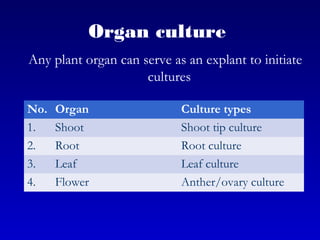
Organ culture
Any plant organ can serve as an explant to initiate
cultures
No. Organ Culture types
1. Shoot Shoot tip culture
2. Root Root culture
3. Leaf Leaf culture
4. Flower Anther/ovary culture
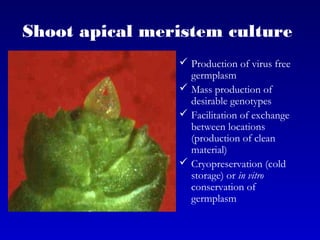
Shoot apical meristem culture
 Production of virus free
germplasm
 Mass production of
desirable genotypes
 Facilitation of exchange
between locations
(production of clean
material)
 Cryopreservation (cold
storage) or in vitro
conservation of
germplasm
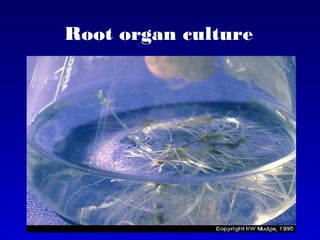
Root organ culture
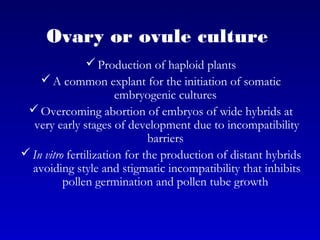
Ovary or ovule culture
Production of haploid plants
A common explant for the initiation of somatic
embryogenic cultures
Overcoming abortion of embryos of wide hybrids at
very early stages of development due to incompatibility
barriers
In vitro fertilization for the production of distant hybrids
avoiding style and stigmatic incompatibility that inhibits
pollen germination and pollen tube growth
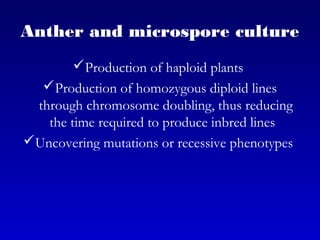
Anther and microspore culture
Production of haploid plants
Production of homozygous diploid lines
through chromosome doubling, thus reducing
the time required to produce inbred lines
Uncovering mutations or recessive phenotypes
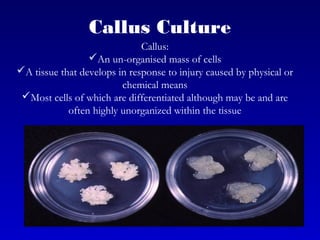
Callus Culture
Callus:
An un-organised mass of cells
A tissue that develops in response to injury caused by physical or
chemical means
Most cells of which are differentiated although may be and are
often highly unorganized within the tissue
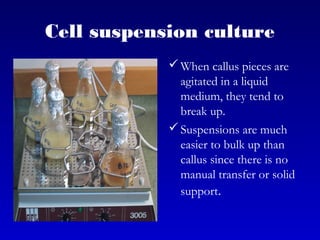
Cell suspension culture
When callus pieces are
agitated in a liquid
medium, they tend to
break up.
Suspensions are much
easier to bulk up than
callus since there is no
manual transfer or solid
support.
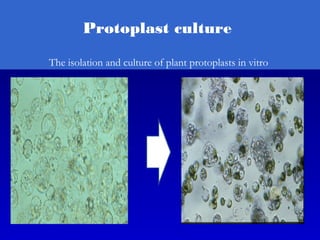
Protoplast culture
The isolation and culture of plant protoplasts in vitro
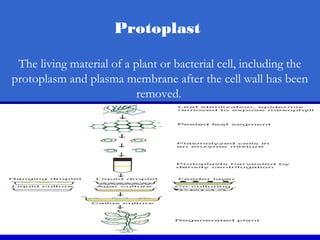
Protoplast
The living material of a plant or bacterial cell, including the
protoplasm and plasma membrane after the cell wall has been
removed.
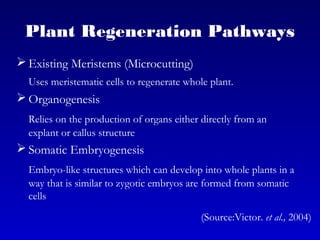
Plant Regeneration Pathways
 Existing Meristems (Microcutting)
Uses meristematic cells to regenerate whole plant.
 Organogenesis
Relies on the production of organs either directly from an
explant or callus structure
 Somatic Embryogenesis
Embryo-like structures which can develop into whole plants in a
way that is similar to zygotic embryos are formed from somatic
cells
(Source:Victor. et al., 2004)
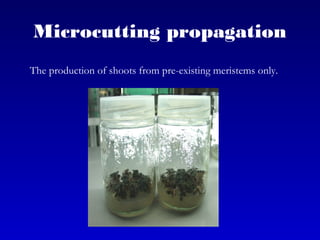
Microcutting propagation
The production of shoots from pre-existing meristems only.
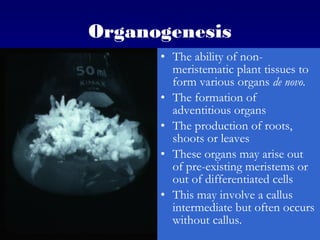
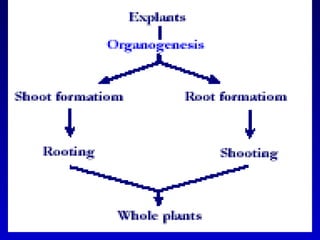
Organogenesis
• The ability of non-
meristematic plant tissues to
form various organs de novo.
• The formation of
adventitious organs
• The production of roots,
shoots or leaves
• These organs may arise out
of pre-existing meristems or
out of differentiated cells
• This may involve a callus
intermediate but often occurs
without callus.
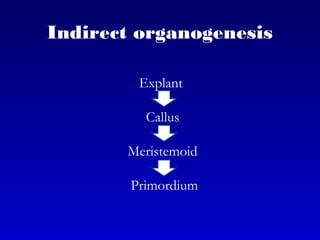
Indirect organogenesis
Explant
Callus
Meristemoid
Primordium
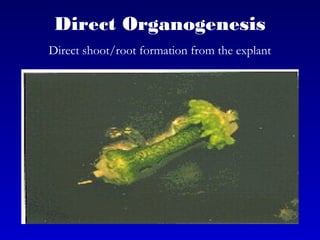
Direct Organogenesis
Direct shoot/root formation from the explant
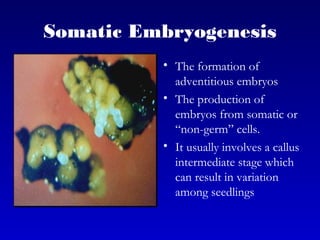
Somatic Embryogenesis
• The formation of
adventitious embryos
• The production of
embryos from somatic or
“non-germ” cells.
• It usually involves a callus
intermediate stage which
can result in variation
among seedlings
Types of embryogenic cells
• Pre-embryogenic determined cells, PEDCs
– The cells are committed to embryonic development and need
only to be released. Such cells are found in embryonic tissue.
• Induced embryogenic determined cells, IEDCs
– In majority of cases embryogenesis is through indirect method.
– Specific growth regulator concentrations and/or cultural
conditions are required for initiation of callus and then
redetermination of these cells into the embryogenic pattern of
development.
Various terms for non-
zygotic embryos
 Adventious embryos
Somatic embryos arising directly from other organs or
embryos.
 Parthenogenetic embryos (apomixis)
Somatic embryos are formed by the unfertilized egg.
 Androgenetic embryos
Somatic embryos are formed by the male gametophyte.
Somatic Embryogenesis and
Organogenesis
• Both of these technologies can be used as
methods of micropropagation.
• It is not always desirable because they may not
always result in populations of identical plants.
• The most beneficial use of somatic
embryogenesis and organogenesis is in the
production of whole plants from a single cell (or
a few cells).
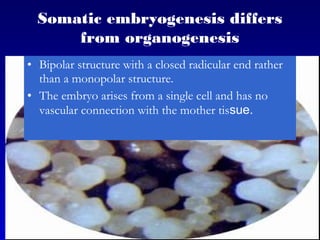
Somatic embryogenesis differs
from organogenesis
• Bipolar structure with a closed radicular end rather
than a monopolar structure.
• The embryo arises from a single cell and has no
vascular connection with the mother tissue.
Two routes to somatic
embryogenesis
(Sharp et al., 1980)
• Direct embryogenesis
– Embryos initiate directly from explant in the absence
of callus formation.
• Indirect embryogenesis
– Callus from explant takes place from which embryos
are developed.
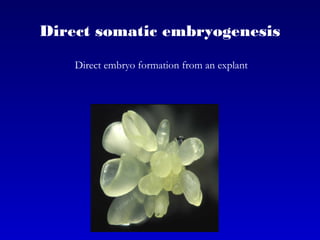
Direct somatic embryogenesis
Direct embryo formation from an explant
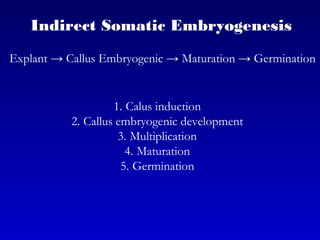
Indirect Somatic Embryogenesis
Explant → Callus Embryogenic → Maturation → Germination
1. Calus induction
2. Callus embryogenic development
3. Multiplication
4. Maturation
5. Germination
Somatic embryogenesis as a
means of propagation is
seldom used
High probability of mutations
The method is usually rather difficult.
Losing regenerative capacity become greater with
repeated subculture
Induction of embryogenesis is very difficult with many
plant species.
A deep dormancy often occurs with somatic
embryogenesis
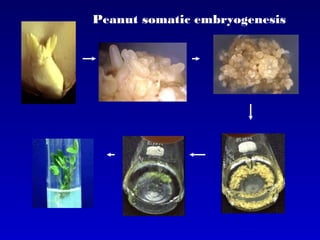
Peanut somatic embryogenesis
Induction
• Auxins required for induction
–Proembryogenic masses form
–2,4-D most used
–NAA, dicamba also used
Development
Auxin must be removed for embryo development
Continued use of auxin inhibits embryogenesis
Stages are similar to those of zygotic embryogenesis
– Globular
– Heart
– Torpedo
– Cotyledonary
– Germination (conversion)
Maturation
• Require complete maturation with apical
meristem, radicle, and cotyledons
• Often obtain repetitive embryony
• Storage protein production necessary
• Often require ABA for complete maturation
• ABA often required for normal embryo
morphology
– Fasciation
– Precocious germination
Germination
• May only obtain 3-5% germination
• Sucrose (10%), mannitol (4%) may be required
• Drying (desiccation)
– ABA levels decrease
– Woody plants
– Final moisture content 10-40%
• Chilling
– Decreases ABA levels
– Woody plants
Steps of Micropropagation
• Stage 0 – Selection & preparation of the mother plant
– sterilization of the plant tissue takes place
• Stage I  - Initiation of culture
– explant placed into growth media
• Stage II - Multiplication
– explant transferred to shoot media; shoots can be constantly
divided
• Stage III - Rooting
– explant transferred to root media
• Stage IV - Transfer to soil
– explant returned to soil; hardened off

2011plntbiotech

  • 1.
  • 2.
    In vitro Culture Theculture and maintenance of plant cells and organs under artificial conditions in tubes, glasses plastics The culture of plant seeds, organs, tissues, cells, or protoplasts under a controlled and artificial environment , usually applying plastic or glass vessels, aseptic techniques and defined growth media The growth and development of plant seeds, organs, tissues, cells or protoplasts under a controlled and artificial environment , usually applying plastic or glass vessels, aseptic techniques (axenic) conditions) and defined growth media
  • 3.
    1. Environmental conditionoptimized (nutrition, light, temperature). 2. Ability to give rise to callus, embryos, adventitious roots and shoots. 3. Ability to grow as single cells (protoplasts, microspores, suspension cultures). 4. Plant cells are totipotent, able to regenerate a whole plant. Characteristic of plant In vitro Culture
  • 4.
    Three fundamental abilitiesof plants Totipotency The potential or inherent capacity of a plant cell to develop into an entire plant if suitably stimulated. It implies that all the information necessary for growth and reproduction of the organism is contained in the cell Dedifferentiation Capacity of mature cells to return to meristematic condition and development of a new growing point, follow by redifferentiation which is the ability to reorganize into new organ Competency The endogenous potential of a given cells or tissue to develop in a particular way
  • 6.
    Important Factors • GrowthMedia – Minerals, growth factors, carbon source, hormones • Environmental Factors – Light, temperature, photoperiod, sterility, growth media • Explant Source – Usually, the younger, less differentiated explant, the better for tissue culture – Different species show differences in amenability to tissue culture – In many cases, different genotypes within a species will have variable responses to tissue culture; response to somatic embryogenesis has been transferred between melon cultivars through sexual hybridization
  • 7.
    Basis for plantin vitro Culture • Two hormones affect plant differentiation: – Auxin: Stimulates root development – Cytokinin: Stimulates shoot development • Generally, the ratio of these two hormones can determine plant development: ↑ Auxin ↓Cytokinin = Root development ↑ Cytokinin ↓Auxin = Shoot development – Auxin = Cytokinin = Callus development
  • 8.
    Hormone Product NameFunction in Plant Tissue Culture Auxins Indole-3-Acetic Acid Indole-3-Butyric Acid Indole-3-Butyric Acid, Potassium Salt α-Naphthaleneacetic Acid 2,4-Dichlorophenoxyacetic Acid p-Chlorophenoxyacetic acid Picloram Dicamba Adventitous root formation (high concen) Adventitious shoot formation (low concen) Induction of somatic embryos Cell Division Callus formation and growth Inhibition of axillary buds Inhibition of root elongation Cytokinins 6-Benzylaminopurine 6-γ,γ-Dimethylallylaminopurine (2iP) Kinetin Thidiazuron (TDZ) N-(2-chloro-4-pyridyl)-N’Phenylurea Zeatin Zeatin Riboside Adventitious shoot formation Inhibition of root formation Promotes cell division Modulates callus initiation and growth Stimulation of axillary’s bud breaking and growth Inhibition of shoot elongation Inhibition of leaf senescence Gibberellins Gibberellic Acid Stimulates shoot elongation Release seeds, embryos, and apical buds from dormancy Inhibits adventitious root formation Paclobutrazol and ancymidol inhibit gibberellin synthesis thus resulting in shorter shoots, and promoting tuber, corm, and bulb formation. Abscisic Acid Abscisic Acid Stimulates bulb and tuber formation Stimulates the maturation of embryos Promotes the start of dormancy Polyamines Putrescine Spermidine Promotes adventitious root formation Promotes somatic embryogenesis Promotes shoot formation
  • 9.
    Control of invitro culture Cytokinin Auxin Leaf strip Adventitious Shoot Root Callus
  • 10.
  • 11.
    Types of Invitro culture (explant based)  Culture of intact plants (seed and seedling culture)  Embryo culture (immature embryo culture)  Organ culture  Callus culture  Cell suspension culture  Protoplast culture
  • 12.
    Seed culture Growing seedaseptically in vitro on artificial media Increasing efficiency of germination of seeds that are difficult to germinate in vivo Precocious germination by application of plant growth regulators Production of clean seedlings for explants or meristem culture
  • 13.
    Embryo culture  Growingembryo aseptically in vitro on artificial nutrient media  It is developed from the need to rescue embryos (embryo rescue) from wide crosses where fertilization occurred, but embryo development did not occur  It has been further developed for the production of plants from embryos developed by non-sexual methods (haploid production discussed later)  Overcoming embryo abortion due to incompatibility barriers  Overcoming seed dormancy and self-sterility of seeds  Shortening of breeding cycle
  • 14.
    Organ culture Any plantorgan can serve as an explant to initiate cultures No. Organ Culture types 1. Shoot Shoot tip culture 2. Root Root culture 3. Leaf Leaf culture 4. Flower Anther/ovary culture
  • 15.
    Shoot apical meristemculture  Production of virus free germplasm  Mass production of desirable genotypes  Facilitation of exchange between locations (production of clean material)  Cryopreservation (cold storage) or in vitro conservation of germplasm
  • 16.
  • 17.
    Ovary or ovuleculture Production of haploid plants A common explant for the initiation of somatic embryogenic cultures Overcoming abortion of embryos of wide hybrids at very early stages of development due to incompatibility barriers In vitro fertilization for the production of distant hybrids avoiding style and stigmatic incompatibility that inhibits pollen germination and pollen tube growth
  • 18.
    Anther and microsporeculture Production of haploid plants Production of homozygous diploid lines through chromosome doubling, thus reducing the time required to produce inbred lines Uncovering mutations or recessive phenotypes
  • 19.
    Callus Culture Callus: An un-organisedmass of cells A tissue that develops in response to injury caused by physical or chemical means Most cells of which are differentiated although may be and are often highly unorganized within the tissue
  • 20.
    Cell suspension culture Whencallus pieces are agitated in a liquid medium, they tend to break up. Suspensions are much easier to bulk up than callus since there is no manual transfer or solid support.
  • 21.
    Protoplast culture The isolationand culture of plant protoplasts in vitro
  • 22.
    Protoplast The living materialof a plant or bacterial cell, including the protoplasm and plasma membrane after the cell wall has been removed.
  • 23.
    Plant Regeneration Pathways Existing Meristems (Microcutting) Uses meristematic cells to regenerate whole plant.  Organogenesis Relies on the production of organs either directly from an explant or callus structure  Somatic Embryogenesis Embryo-like structures which can develop into whole plants in a way that is similar to zygotic embryos are formed from somatic cells (Source:Victor. et al., 2004)
  • 24.
    Microcutting propagation The productionof shoots from pre-existing meristems only.
  • 25.
    Organogenesis • The abilityof non- meristematic plant tissues to form various organs de novo. • The formation of adventitious organs • The production of roots, shoots or leaves • These organs may arise out of pre-existing meristems or out of differentiated cells • This may involve a callus intermediate but often occurs without callus.
  • 27.
  • 28.
    Direct Organogenesis Direct shoot/rootformation from the explant
  • 29.
    Somatic Embryogenesis • Theformation of adventitious embryos • The production of embryos from somatic or “non-germ” cells. • It usually involves a callus intermediate stage which can result in variation among seedlings
  • 30.
    Types of embryogeniccells • Pre-embryogenic determined cells, PEDCs – The cells are committed to embryonic development and need only to be released. Such cells are found in embryonic tissue. • Induced embryogenic determined cells, IEDCs – In majority of cases embryogenesis is through indirect method. – Specific growth regulator concentrations and/or cultural conditions are required for initiation of callus and then redetermination of these cells into the embryogenic pattern of development.
  • 31.
    Various terms fornon- zygotic embryos  Adventious embryos Somatic embryos arising directly from other organs or embryos.  Parthenogenetic embryos (apomixis) Somatic embryos are formed by the unfertilized egg.  Androgenetic embryos Somatic embryos are formed by the male gametophyte.
  • 32.
    Somatic Embryogenesis and Organogenesis •Both of these technologies can be used as methods of micropropagation. • It is not always desirable because they may not always result in populations of identical plants. • The most beneficial use of somatic embryogenesis and organogenesis is in the production of whole plants from a single cell (or a few cells).
  • 33.
    Somatic embryogenesis differs fromorganogenesis • Bipolar structure with a closed radicular end rather than a monopolar structure. • The embryo arises from a single cell and has no vascular connection with the mother tissue.
  • 34.
    Two routes tosomatic embryogenesis (Sharp et al., 1980) • Direct embryogenesis – Embryos initiate directly from explant in the absence of callus formation. • Indirect embryogenesis – Callus from explant takes place from which embryos are developed.
  • 35.
    Direct somatic embryogenesis Directembryo formation from an explant
  • 36.
    Indirect Somatic Embryogenesis Explant→ Callus Embryogenic → Maturation → Germination 1. Calus induction 2. Callus embryogenic development 3. Multiplication 4. Maturation 5. Germination
  • 37.
    Somatic embryogenesis asa means of propagation is seldom used High probability of mutations The method is usually rather difficult. Losing regenerative capacity become greater with repeated subculture Induction of embryogenesis is very difficult with many plant species. A deep dormancy often occurs with somatic embryogenesis
  • 38.
  • 39.
    Induction • Auxins requiredfor induction –Proembryogenic masses form –2,4-D most used –NAA, dicamba also used
  • 40.
    Development Auxin must beremoved for embryo development Continued use of auxin inhibits embryogenesis Stages are similar to those of zygotic embryogenesis – Globular – Heart – Torpedo – Cotyledonary – Germination (conversion)
  • 41.
    Maturation • Require completematuration with apical meristem, radicle, and cotyledons • Often obtain repetitive embryony • Storage protein production necessary • Often require ABA for complete maturation • ABA often required for normal embryo morphology – Fasciation – Precocious germination
  • 42.
    Germination • May onlyobtain 3-5% germination • Sucrose (10%), mannitol (4%) may be required • Drying (desiccation) – ABA levels decrease – Woody plants – Final moisture content 10-40% • Chilling – Decreases ABA levels – Woody plants
  • 43.
    Steps of Micropropagation •Stage 0 – Selection & preparation of the mother plant – sterilization of the plant tissue takes place • Stage I  - Initiation of culture – explant placed into growth media • Stage II - Multiplication – explant transferred to shoot media; shoots can be constantly divided • Stage III - Rooting – explant transferred to root media • Stage IV - Transfer to soil – explant returned to soil; hardened off

Editor's Notes

  • #3 Additional Points: Growth of plant cells outside of an intact plant A technique essential to many areas of plant science Culture of individual or groups of cells and whole organs contribute to the understanding of both fundamental and applied science Cultures can be sustained and maintained as a mass of undifferentiated cells for an extended period of time or regenerated into whole plants
  • #7 Emphasize the implications for genetic involvement: Could there be undesirable genes linked to genes influencing tissue culture response?