A Term Paper Presentation On….“Clonal Propagation In Ornamental Plants”Course teacherDr. R.GnanamProfessorPersented byBhor Sachin AshokI.D.No.-09-607-001
What is clone & clonal propagation? A population derived from a single individual by asexual reproduction constitutes a clone.
Multiplication of genetically identical copies of a   cultivar by asexual reproduction is called a  clonal    propagation.
Applied in crops like potato ,apple, pear, Horticultural crops, ornamental bulbs and  in  tuberous plants also.
 This method can be done well under in vitro conditions.Contd...Clonal  propagation through tissue culture popularly called      micro propagation.
Use of tissue culture for micro propagation was  initiated by G. Morel(1960) who found this approach in orchid propagation.
Axillary or apical shoot meristems in in vitro are most widely used methods in clonal propagation.Methods of Propagation
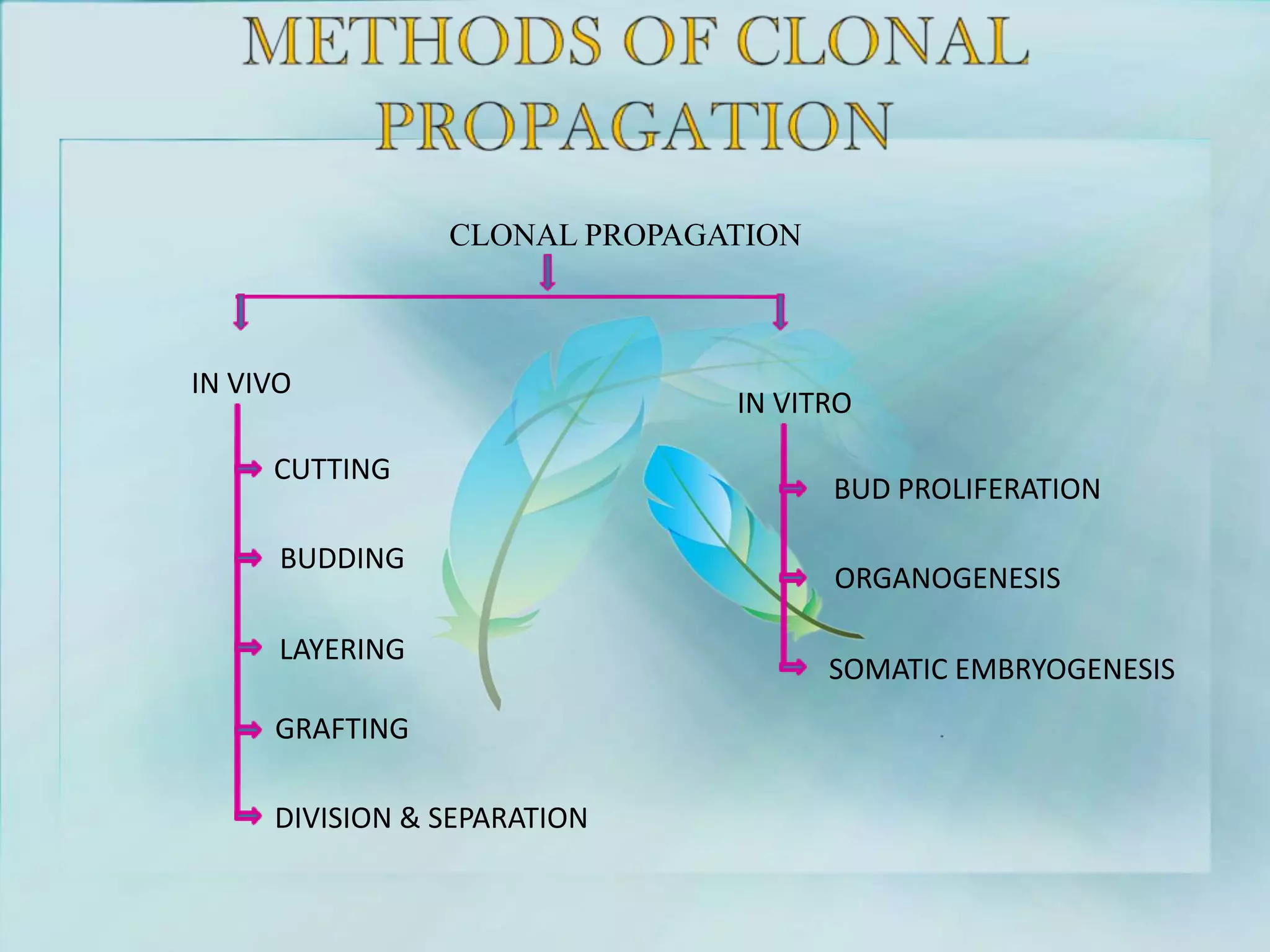
METHODS OF CLONAL PROPAGATIONCLONAL PROPAGATIONIN VIVOIN VITROCUTTINGBUD PROLIFERATIONBUDDINGORGANOGENESISLAYERINGSOMATIC EMBRYOGENESISGRAFTINGDIVISION & SEPARATION
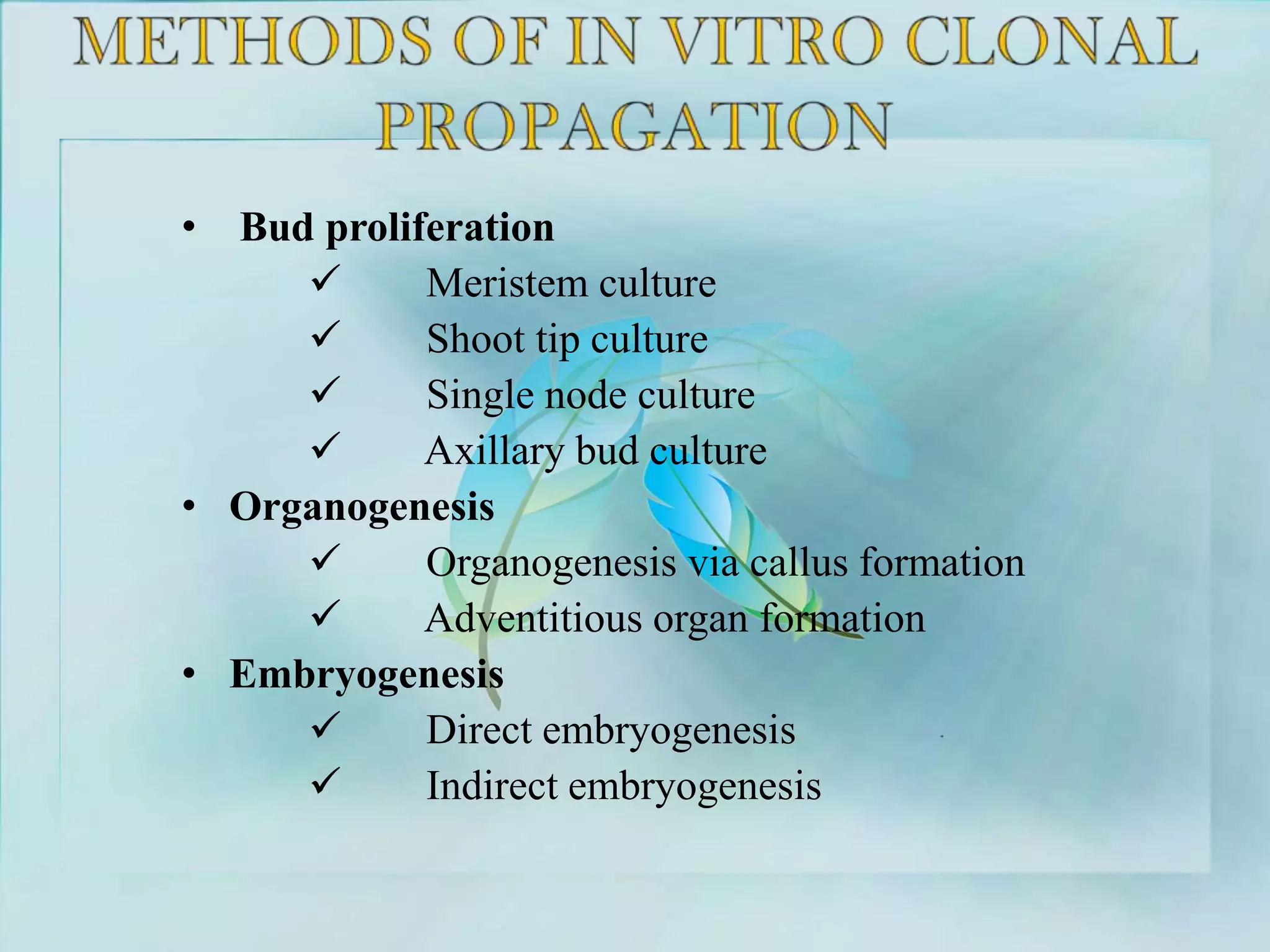
METHODS OF IN VITRO CLONAL PROPAGATIONBud proliferationMeristem culture
Shoot tip culture
 Single node culture
 Axillary bud cultureOrganogenesis        Organogenesis via callus formation
        Adventitious organ formationEmbryogenesis        Direct embryogenesis
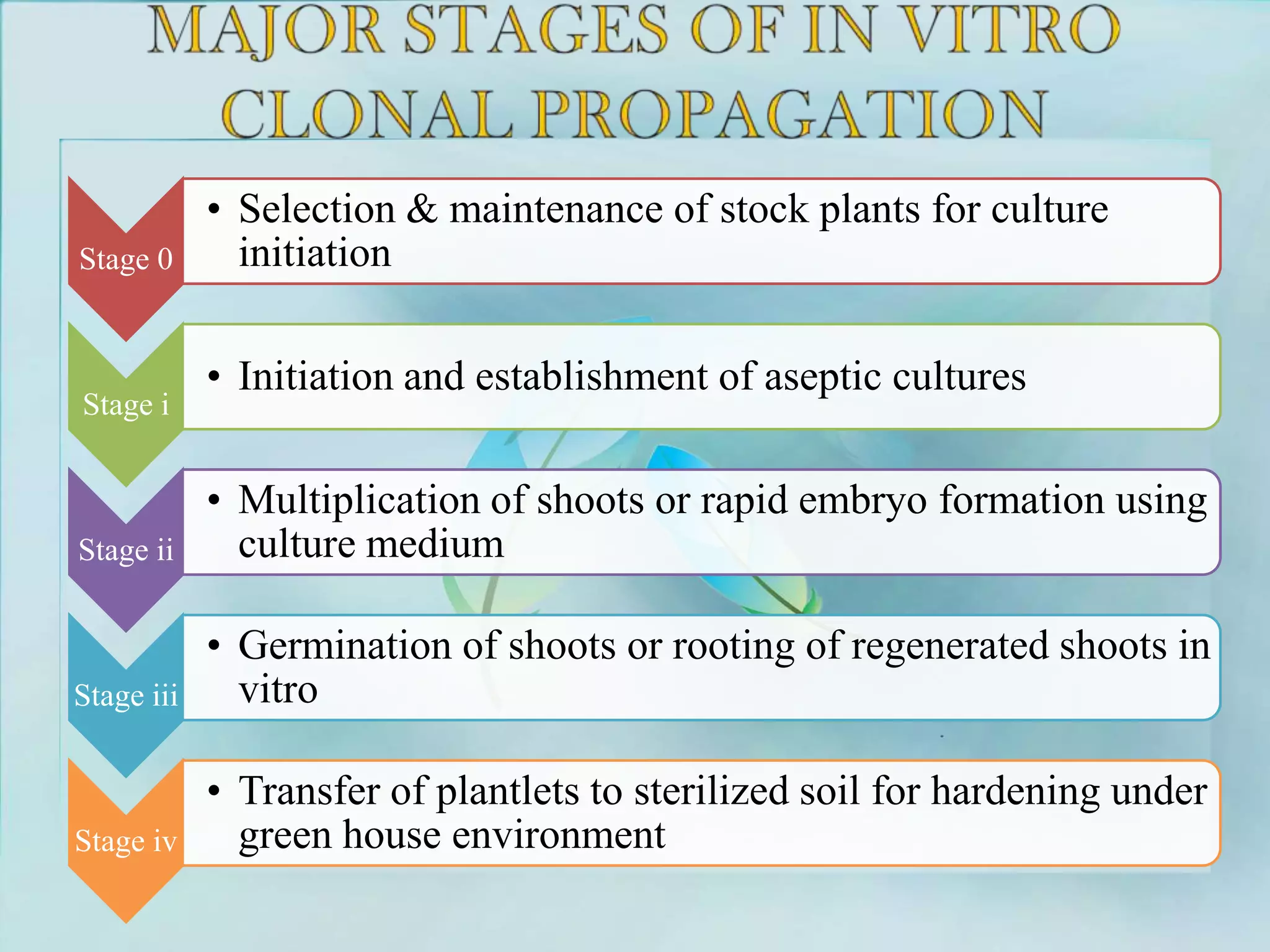
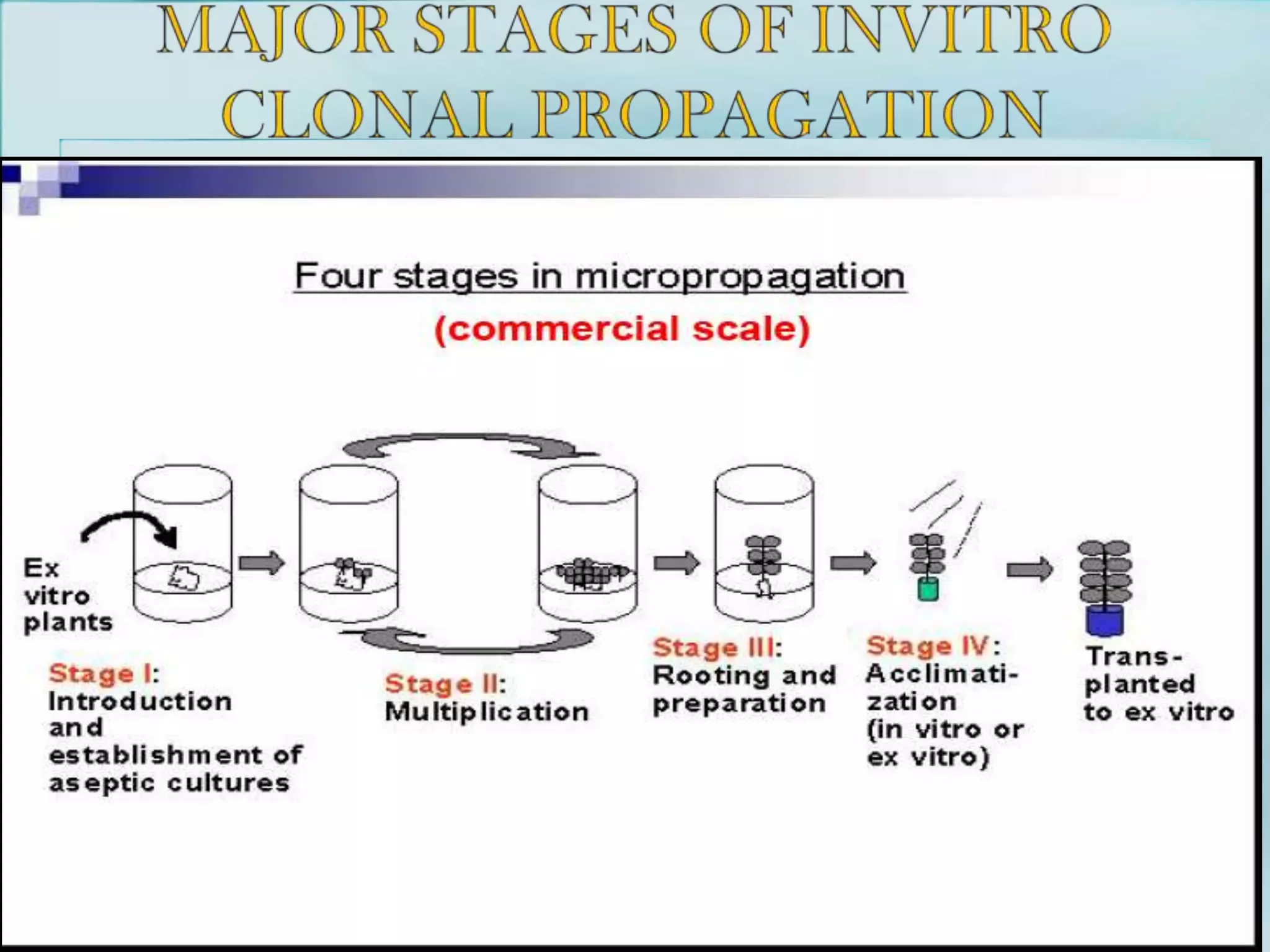
        Indirect embryogenesisMAJOR STAGES OF IN VITRO CLONAL PROPAGATION
MAJOR STAGES OF INVITRO CLONAL PROPAGATION
INVITRO MULTIPLICATION TAKES PLACE THROUGH….Multiplication  via Meristem culture
  Multiplication  via somatic embryogenesis.
  Multiplication  via thin cell layer
  Multiplication by adventitious shoots
  Multiplication  through callus cultureMULTIPLICATION VIA MERISTEM CULTUREIn vitro propagation through Meristem culture is the best possible means of virus elimination and produces a large numbers of plants in a short span of time.
The Meristem-tip culture is an aseptic culture on artificial medium of the apical dome without leaf primordia. It measures 0.2 to 0.3 mm.
Pelargonium, Chrysanthemum etc. are produced from  mother plants who were cleaned up by culture of meristems
The pathway of regeneration undergoes several steps.
Starting with an isolated explants, with de-differentiation followed by re-differentiation and organization into meristematic centre.MULTIPLICATION VIA SOMATIC EMBRYOGENESISSomatic embryos ,which are bipolar structures, arise from individual cells and have no vascular connection with the maternal tissue of the explant.
 Embryos develop through direct embryogenesis or through indirect embryogenesis.
Succeeded in ornamental pot plants like chrysanthemum (Dendrathemagrandiflorum)
Commercial application of somatic embryogenesis will be accomplished only when the germination rate of somatic embryos is high up to 80–85%.
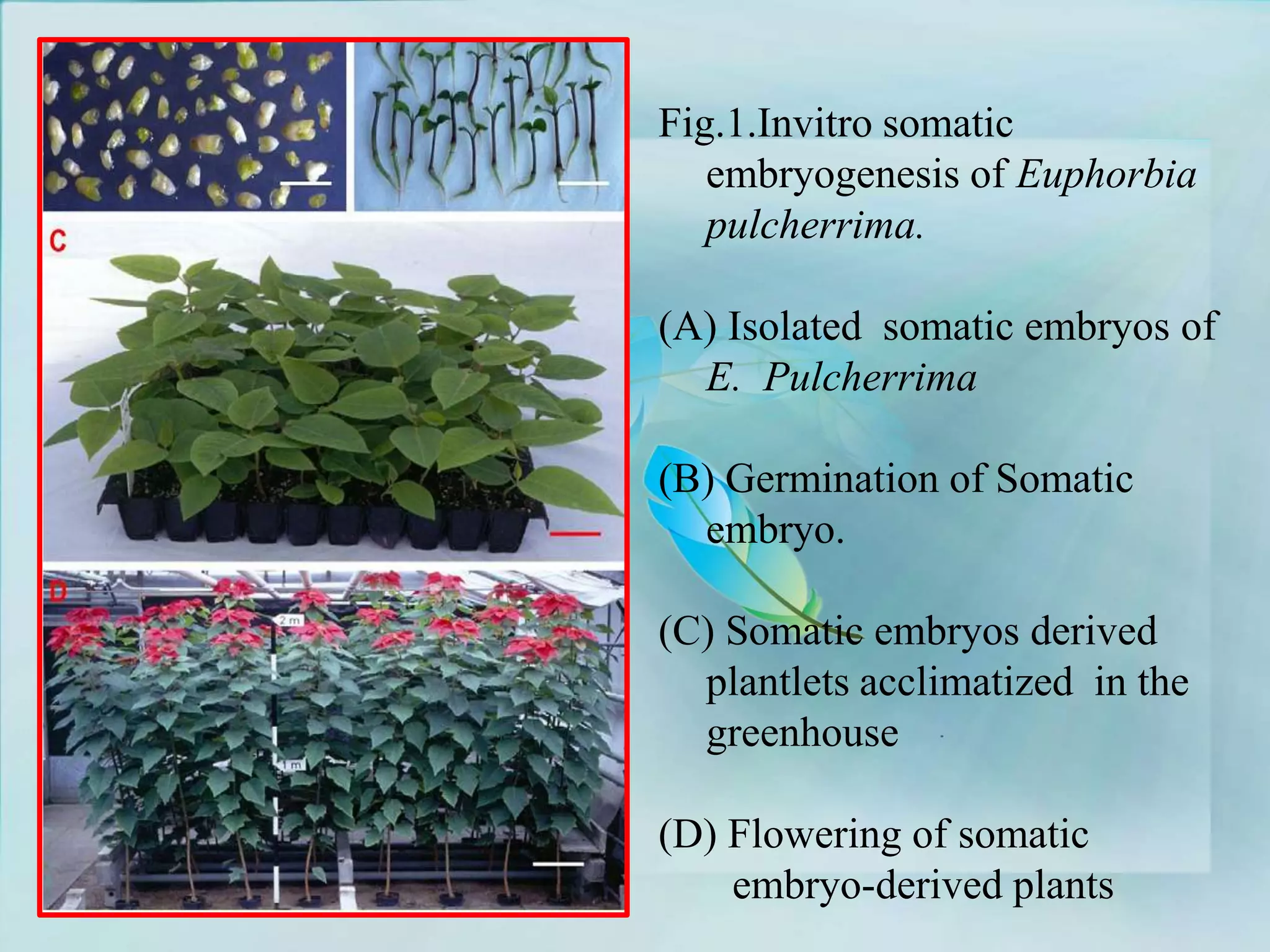
Fig.1.Invitro somatic embryogenesis of Euphorbia  pulcherrima. (A) Isolated  somatic embryos of E.  Pulcherrima(B) Germination of Somatic embryo.(C) Somatic embryos derived        plantlets acclimatized  in the greenhouse(D) Flowering of somatic       embryo-derived plants
MULTIPLICATION VIA THIN CELL LAYERTCLs can be excised from stem, leaf, vein, floral stalk, petiole, pedicel,   bulb-scale, etc
 Reduced cell number in TCL is important developmental process or the   morphogenetic programme.
 Applications in higher plant tissue and organ culture and genetic transformation MULTIPLICATION  VIA CALLUS  CULTUREDifferentiation of  plants from cultured cells via  shoot -root  formation or somatic embryogenesis  is the fastest method of cloning of plant species.
But yet the cultures produced from  calli are not stable genetically, which will decline plant regeneration capacity.
In some crops genetically stable calli also have been derived from explants  of  Lilium, Chrysanthemum and tomato.Basic parameters for in vitro Clonal propagation The Explant
The Nutrient medium
The culture EnvironmentEXAMPLES. . .
Advantages of Clonal propagation True to type plants
Off season production of plants
Reduction in life cycle of plant
Germplasm conservation
Genetic transformation

Clonal propagation in ornamental plants