1
Presentation
on
Commercial Exploitation of
Micro-propagation in fruit crops & its Techniques
Presentation
on
Commercial Exploitation of
Micro-propagation in fruit crops & its Techniques
• Course No.:- FsC 505
• Course TiTle:- ProPagaTioN & Nursery
MaNageMeNT For FruiT CroPs
subMiTTed To subMiTTed by
dr. M.M. Masu PawaN KuMar Nagar
assisTaNT researCh sCieNTisT M.sC. (horTi) PoMology
uNiversiTy bhavaN, reg. 04-2690-2015
aau, aNaNd baCa, aau, aNaNd 2
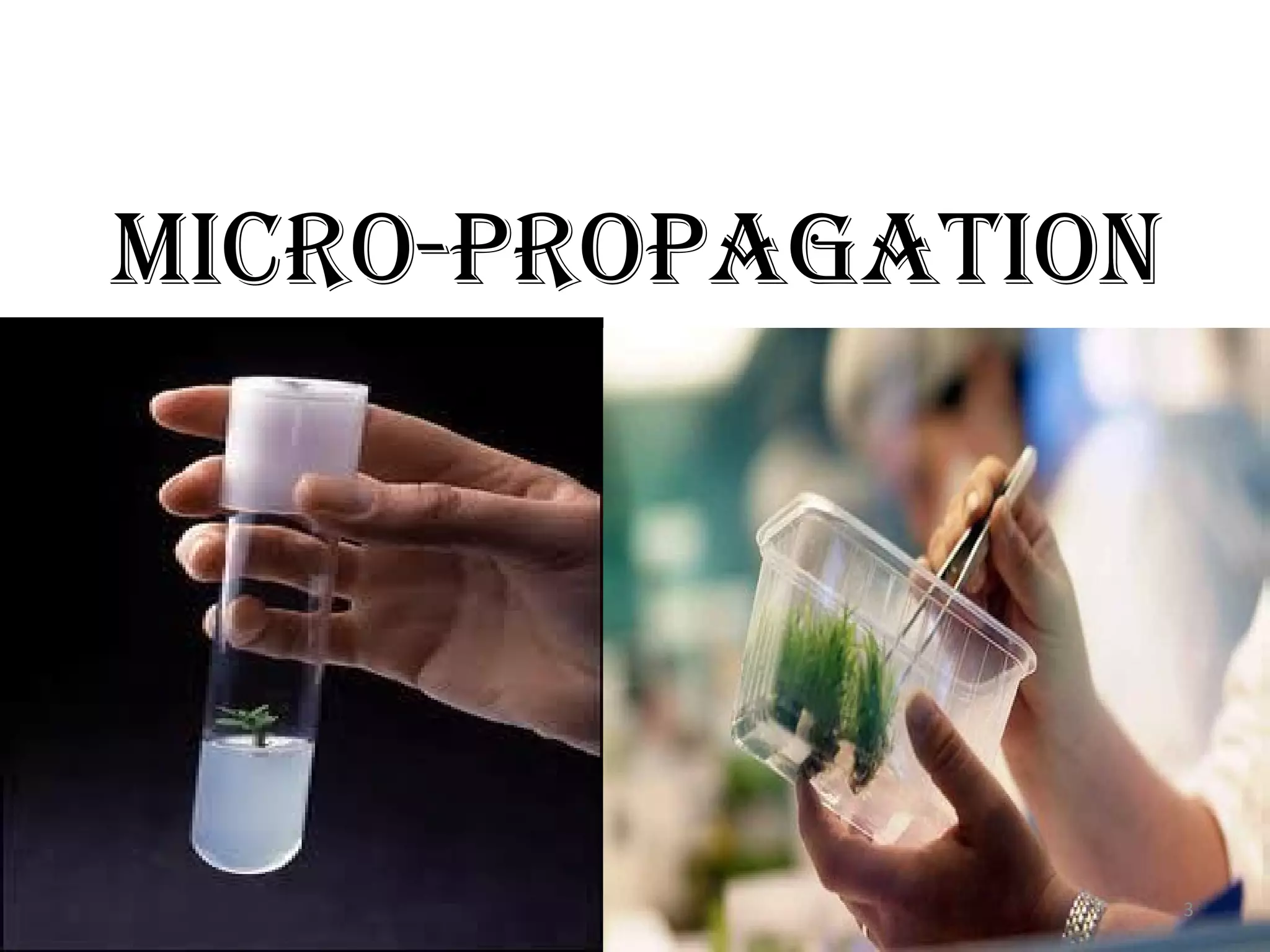
MiCro-ProPagaTioN
3
whaT iswhaT is
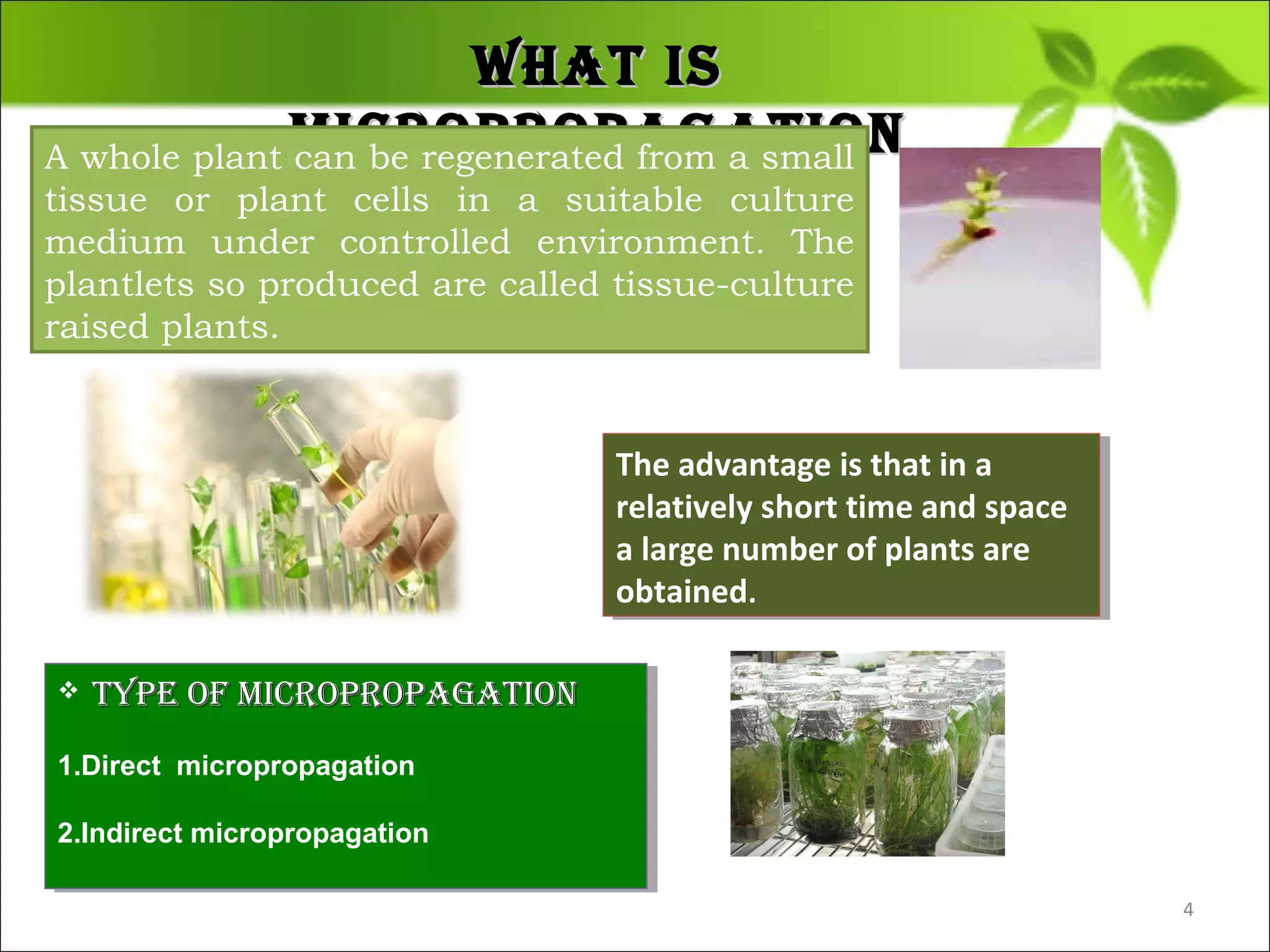
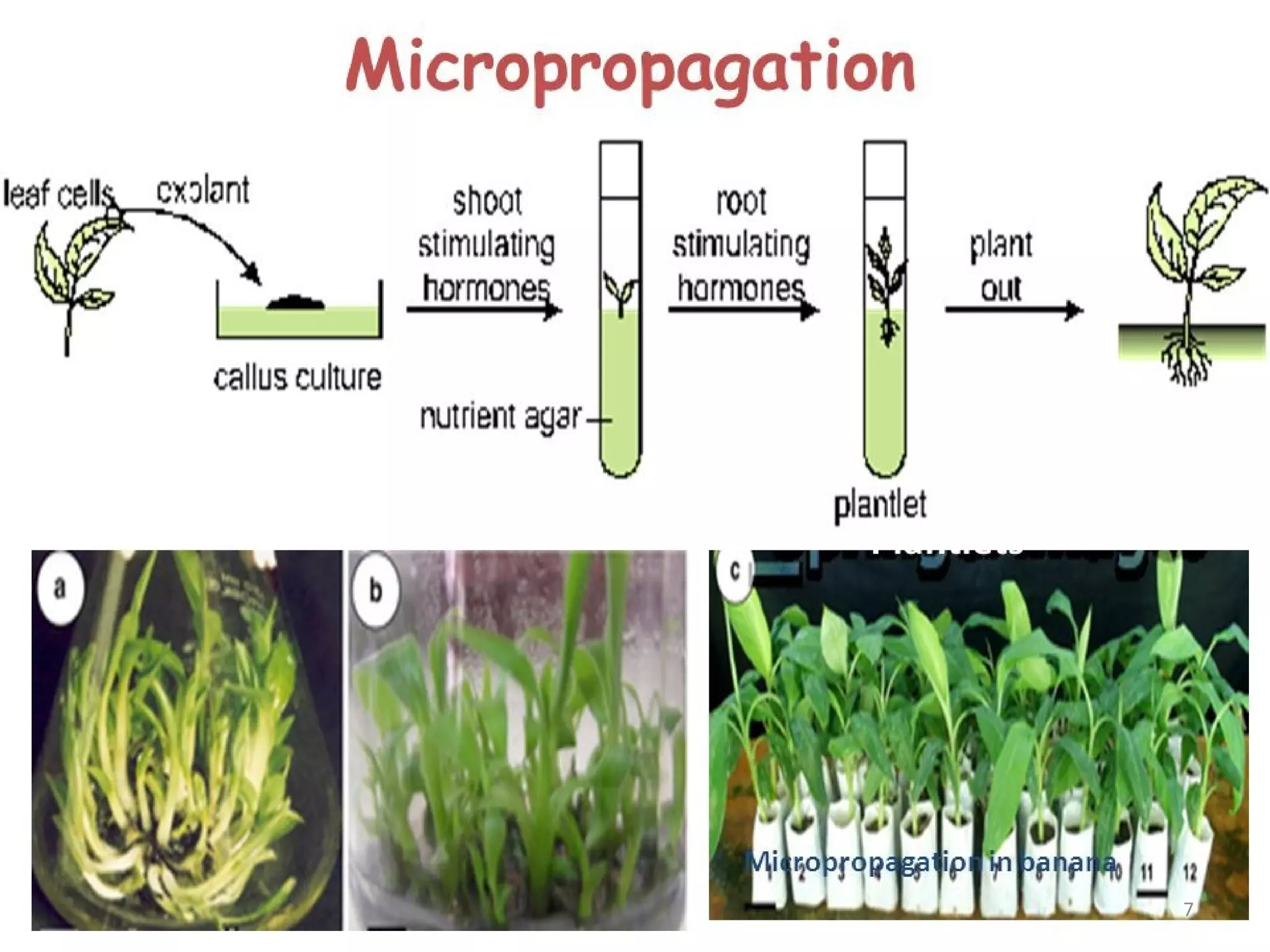
MiCroProPagaTioNMiCroProPagaTioNA whole plant can be regenerated from a small
tissue or plant cells in a suitable culture
medium under controlled environment. The
plantlets so produced are called tissue-culture
raised plants.
The advantage is that in a
relatively short time and space
a large number of plants are
obtained.
The advantage is that in a
relatively short time and space
a large number of plants are
obtained.
 TyPe oF MiCroProPagaTioNTyPe oF MiCroProPagaTioN
1.Direct micropropagation
2.Indirect micropropagation
 TyPe oF MiCroProPagaTioNTyPe oF MiCroProPagaTioN
1.Direct micropropagation
2.Indirect micropropagation
4
why dowhy do
MiCroProPagaTioNMiCroProPagaTioN
why dowhy do
MiCroProPagaTioNMiCroProPagaTioN
 A single explant can be multiplied into several thousand plants in less
than a year - this allows fast commercial propagation of new cultivars.
 Once established, a plant tissue culture line can give a continuous supply
of young plants throughout the year.
 In plants prone to virus diseases, virus free explants (new meristem
tissue is usually virus free) can be cultivated to provide virus free plants.
 Plant ‘tissue banks’ can be frozen, then regenerated through tissue
culture.
 Plant cultures in approved media are easier to export than are soil-grown
plants, as they are pathogen free and take up little space (most current
plant export is now done in this manner).
 A single explant can be multiplied into several thousand plants in less
than a year - this allows fast commercial propagation of new cultivars.
 Once established, a plant tissue culture line can give a continuous supply
of young plants throughout the year.
 In plants prone to virus diseases, virus free explants (new meristem
tissue is usually virus free) can be cultivated to provide virus free plants.
 Plant ‘tissue banks’ can be frozen, then regenerated through tissue
culture.
 Plant cultures in approved media are easier to export than are soil-grown
plants, as they are pathogen free and take up little space (most current
plant export is now done in this manner).
5
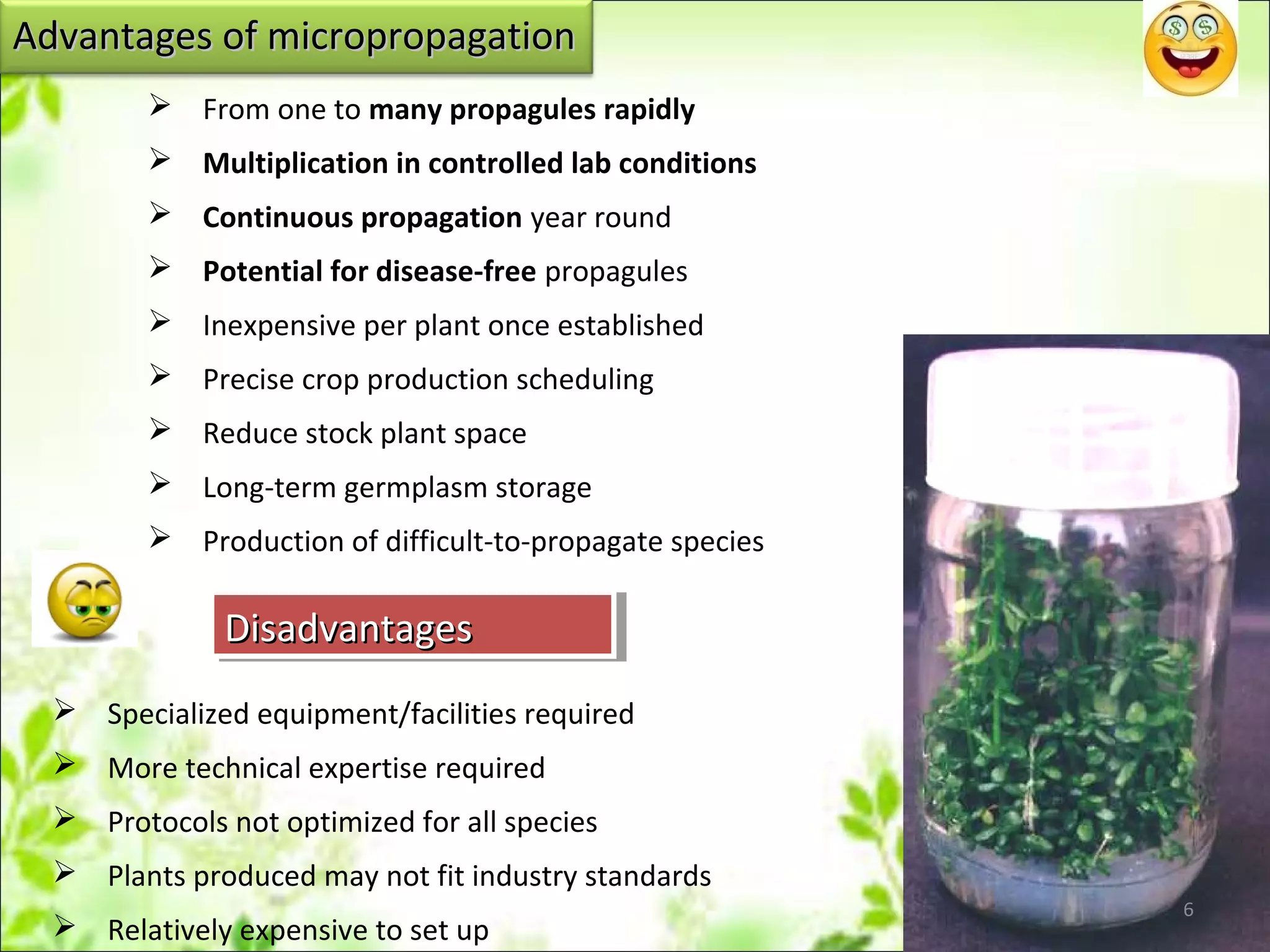
Advantages of micropropagationAdvantages of micropropagation
 From one to many propagules rapidly
 Multiplication in controlled lab conditions
 Continuous propagation year round
 Potential for disease-free propagules
 Inexpensive per plant once established
 Precise crop production scheduling
 Reduce stock plant space
 Long-term germplasm storage
 Production of difficult-to-propagate species
DisadvantagesDisadvantagesDisadvantagesDisadvantages
 Specialized equipment/facilities required
 More technical expertise required
 Protocols not optimized for all species
 Plants produced may not fit industry standards
 Relatively expensive to set up
6
7
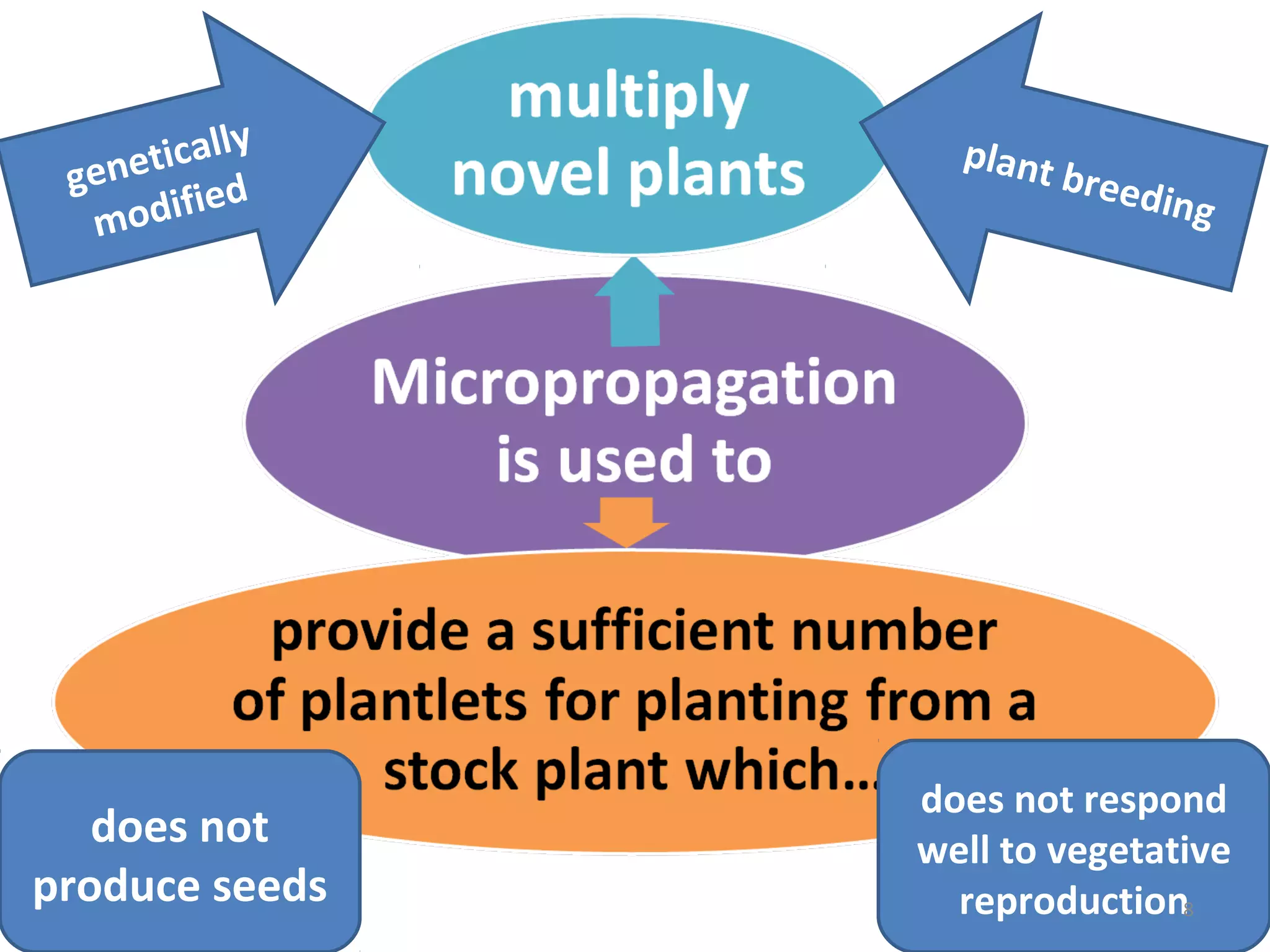
genetically
modified
plant breeding
does not
produce seeds
does not respond
well to vegetative
reproduction8
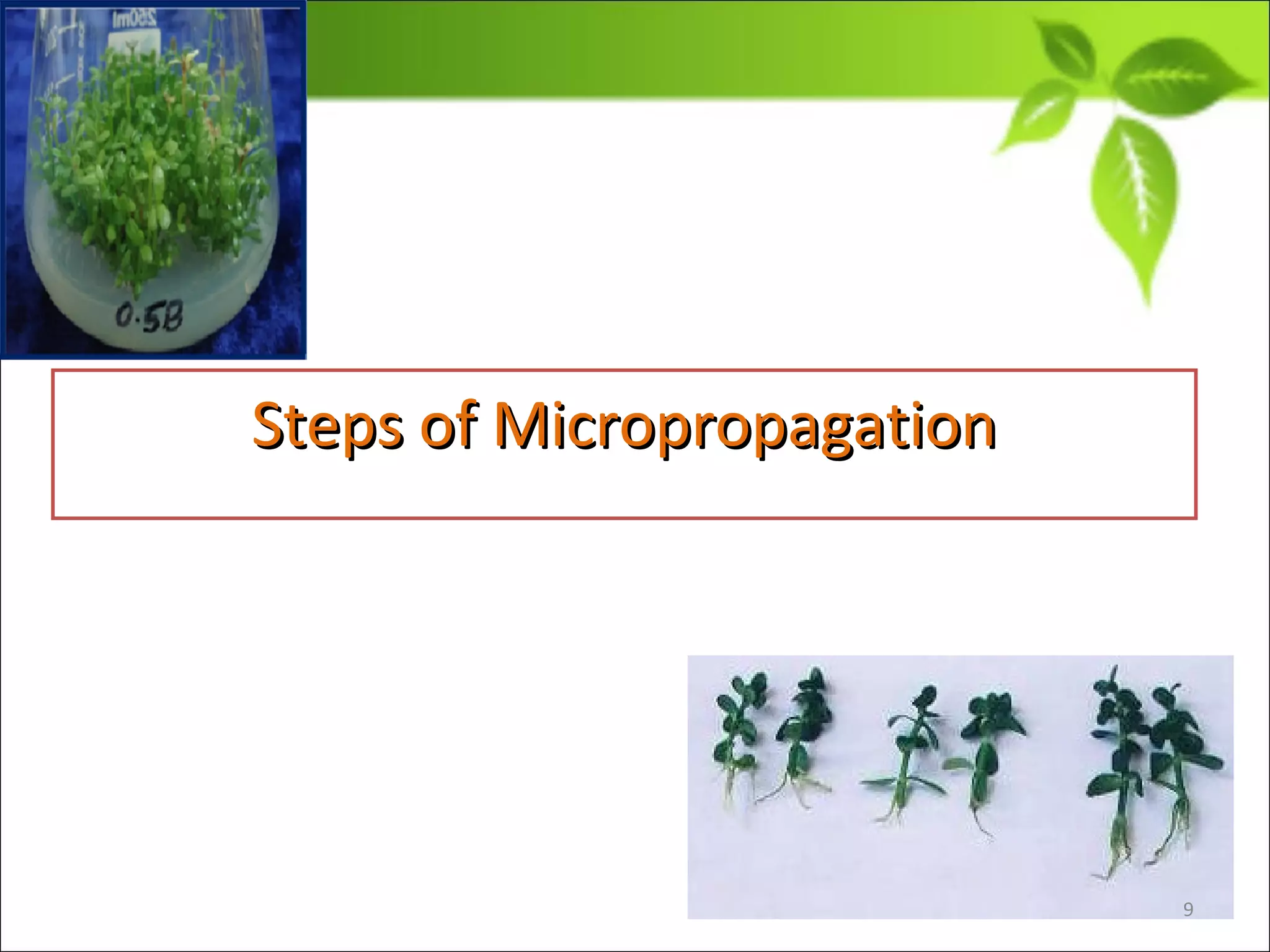
Steps of MicropropagationSteps of Micropropagation
9
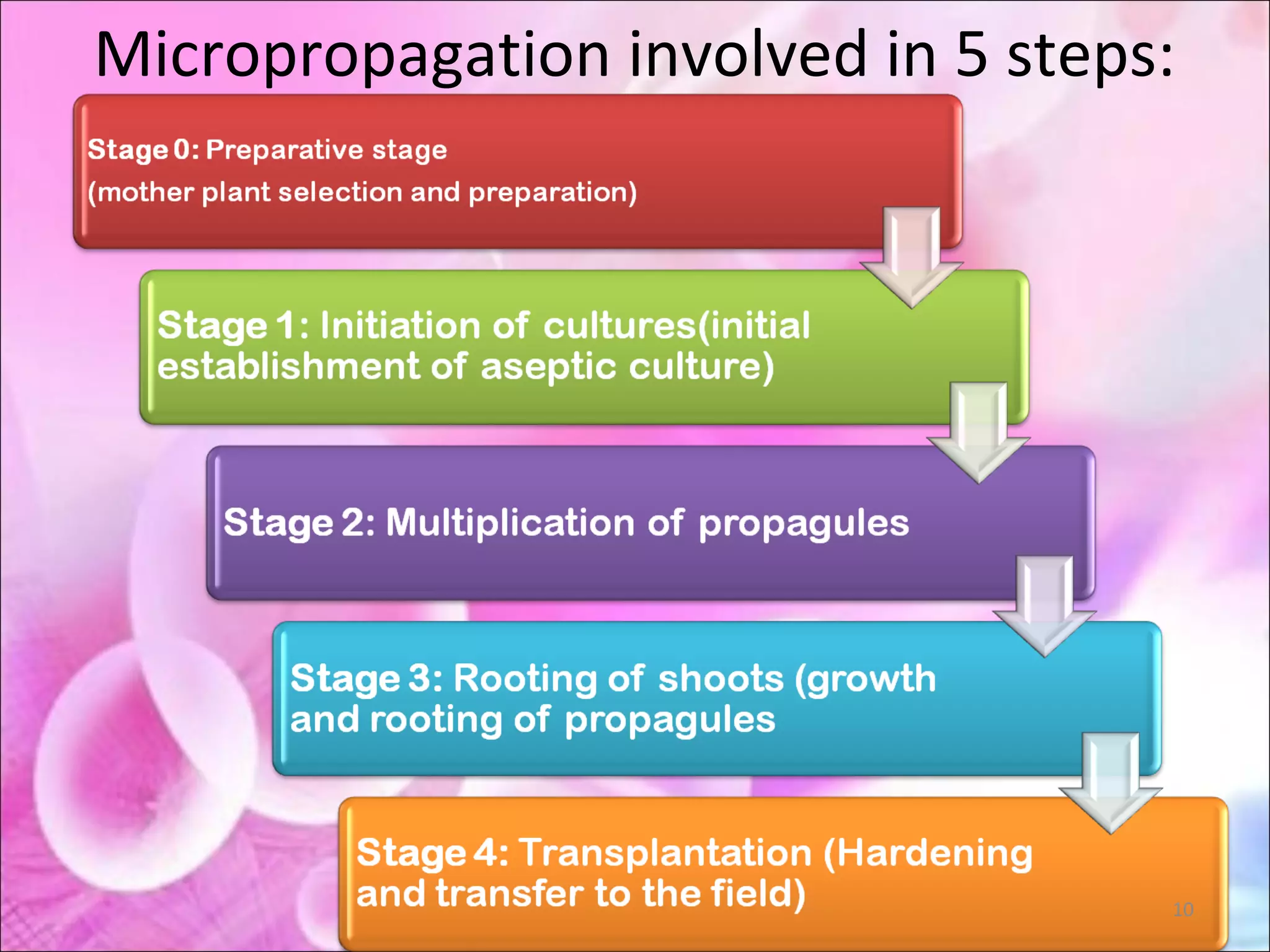
Micropropagation involved in 5 steps:
10
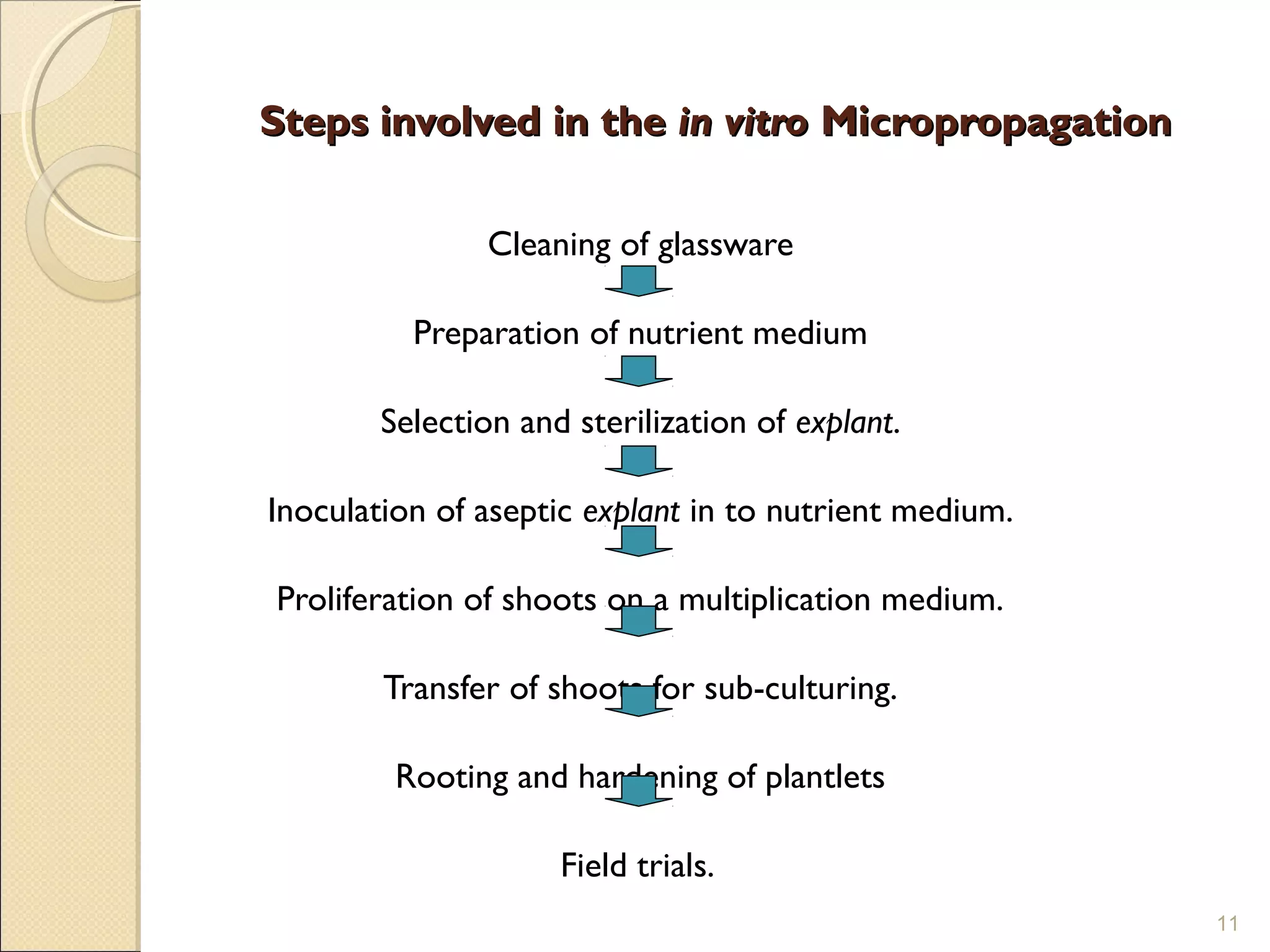
Steps involved in theSteps involved in the in vitroin vitro MicropropagationMicropropagation
Cleaning of glassware
Preparation of nutrient medium
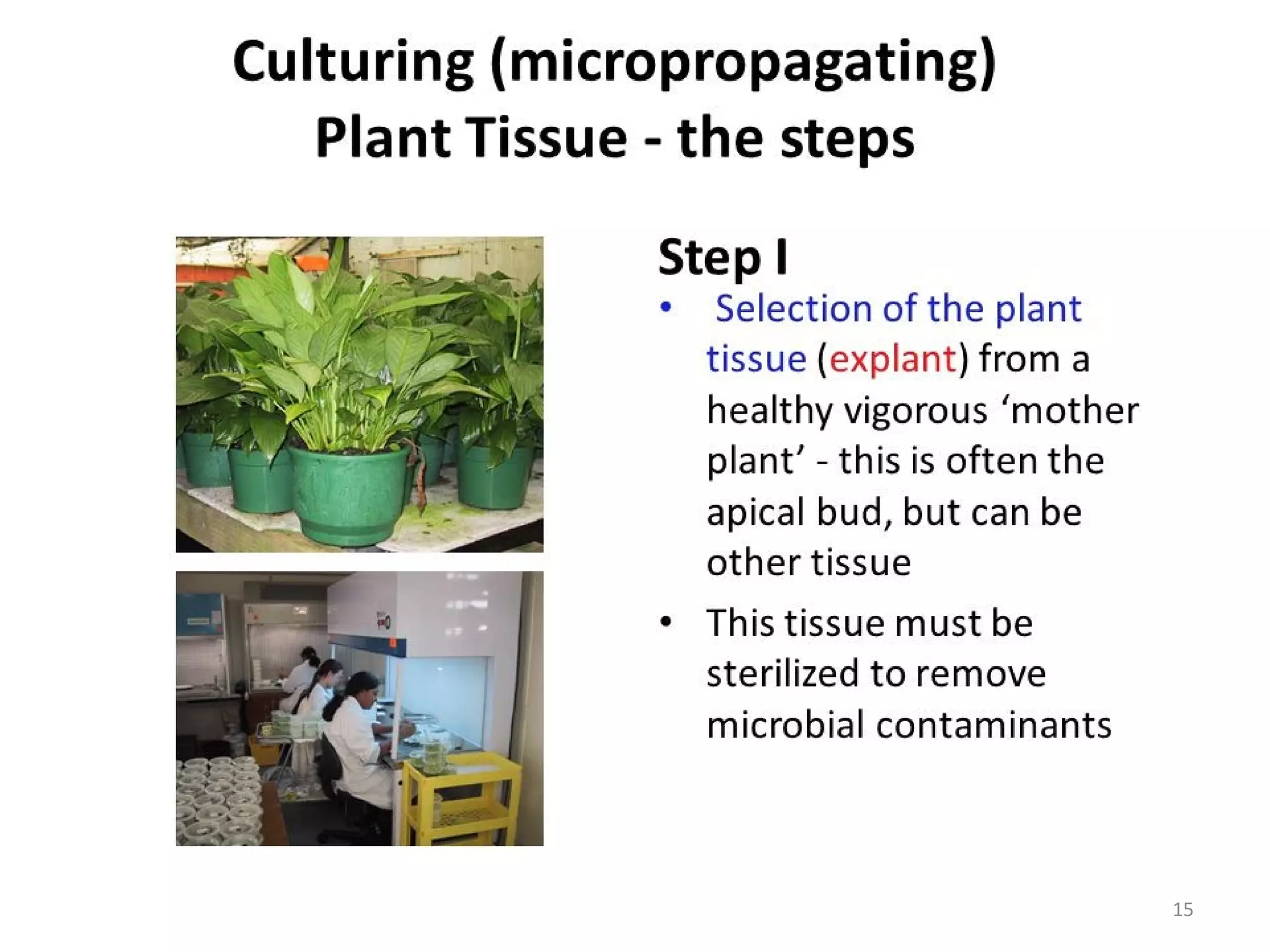
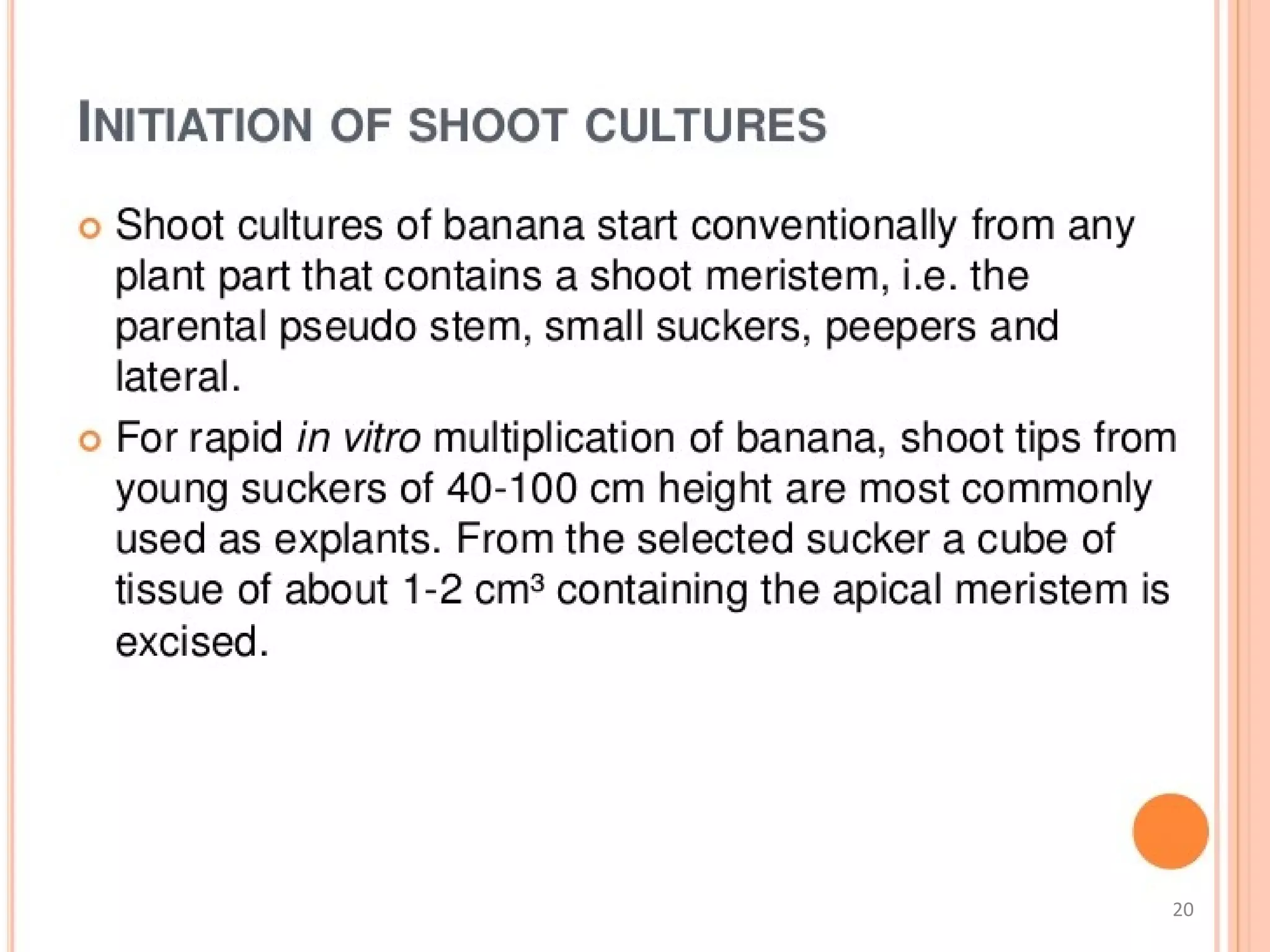
Selection and sterilization of explant.
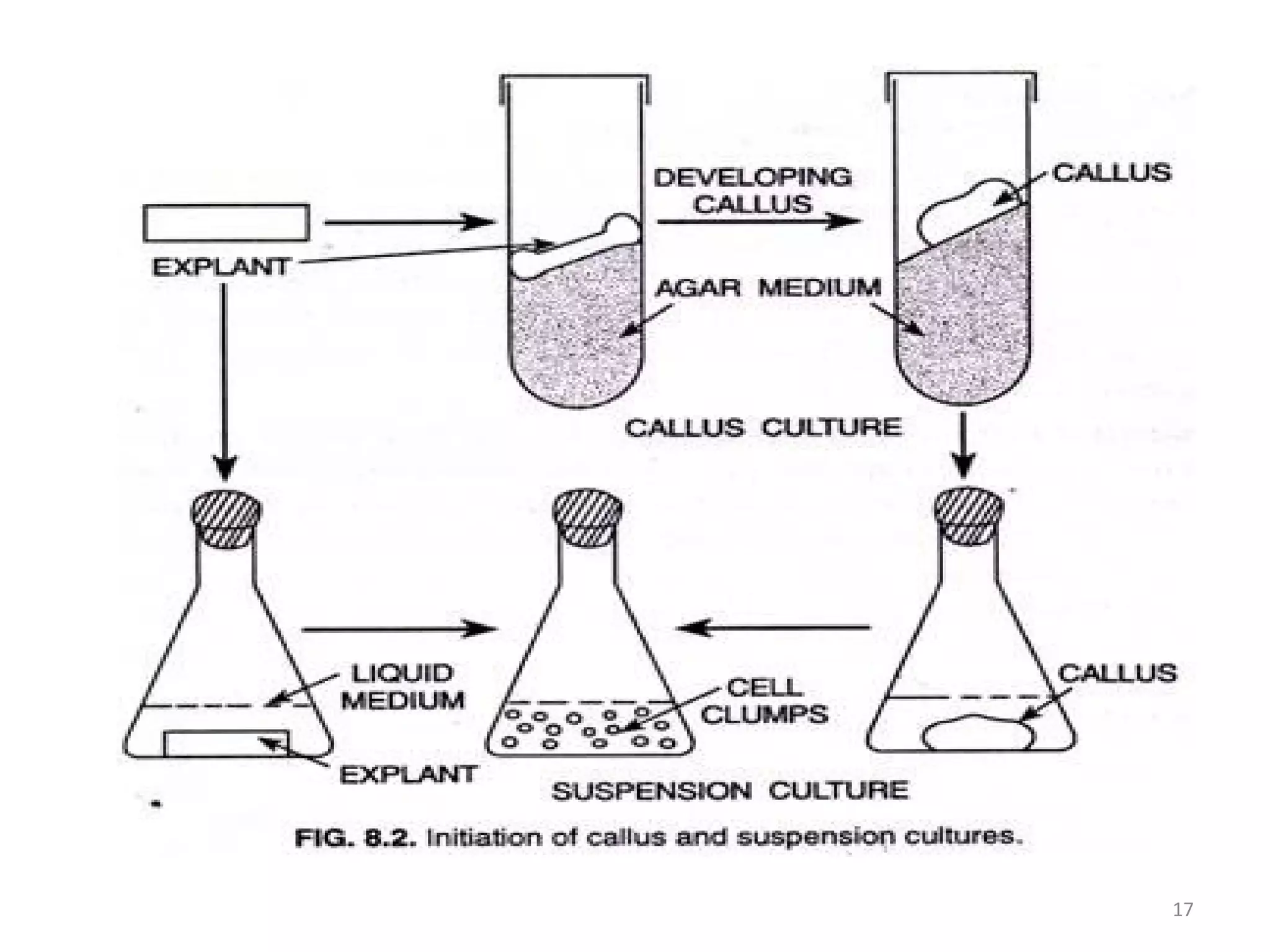
Inoculation of aseptic explant in to nutrient medium.
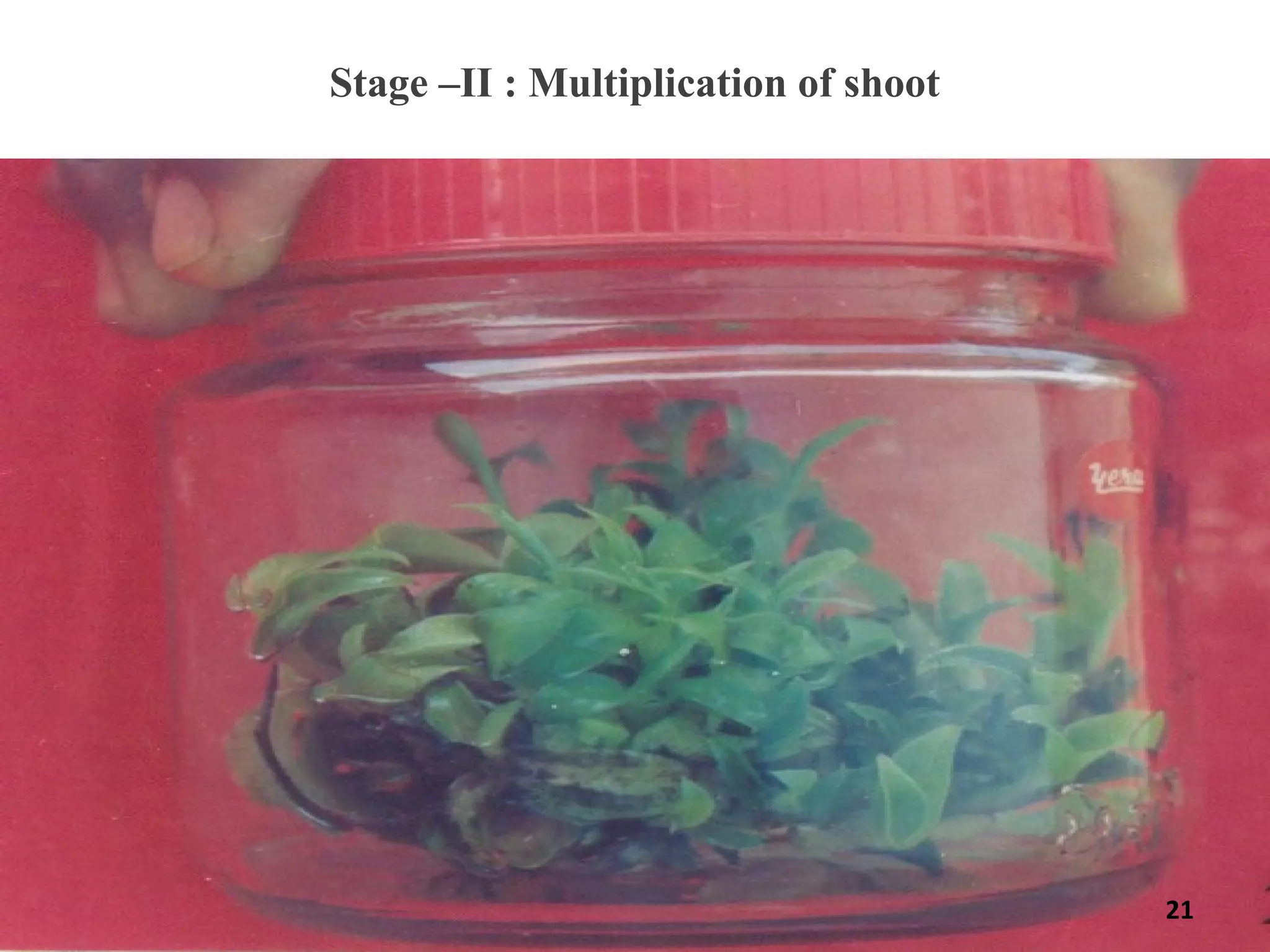
Proliferation of shoots on a multiplication medium.
Transfer of shoots for sub-culturing.
Rooting and hardening of plantlets
Field trials.
11
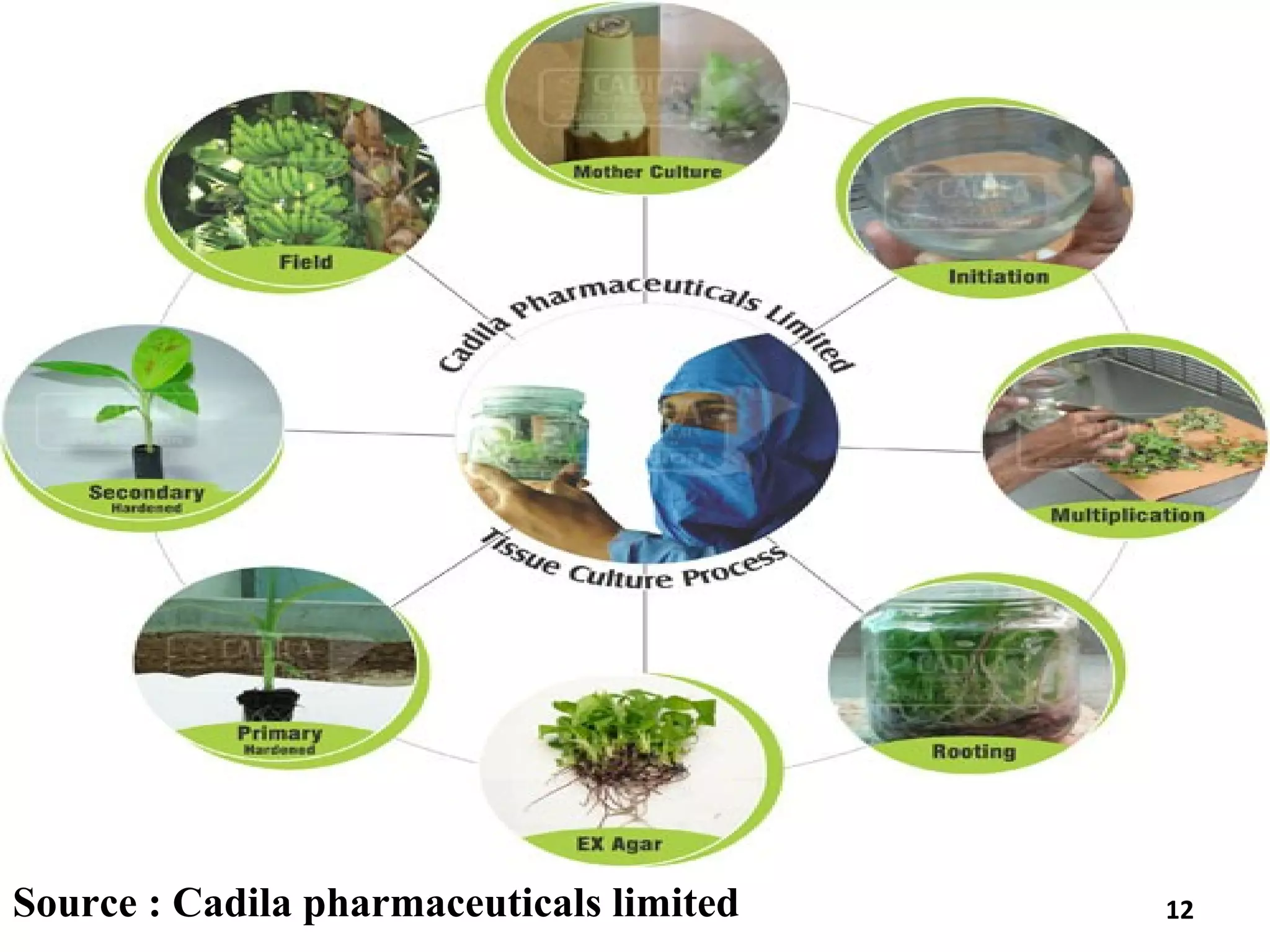
12Source : Cadila pharmaceuticals limited
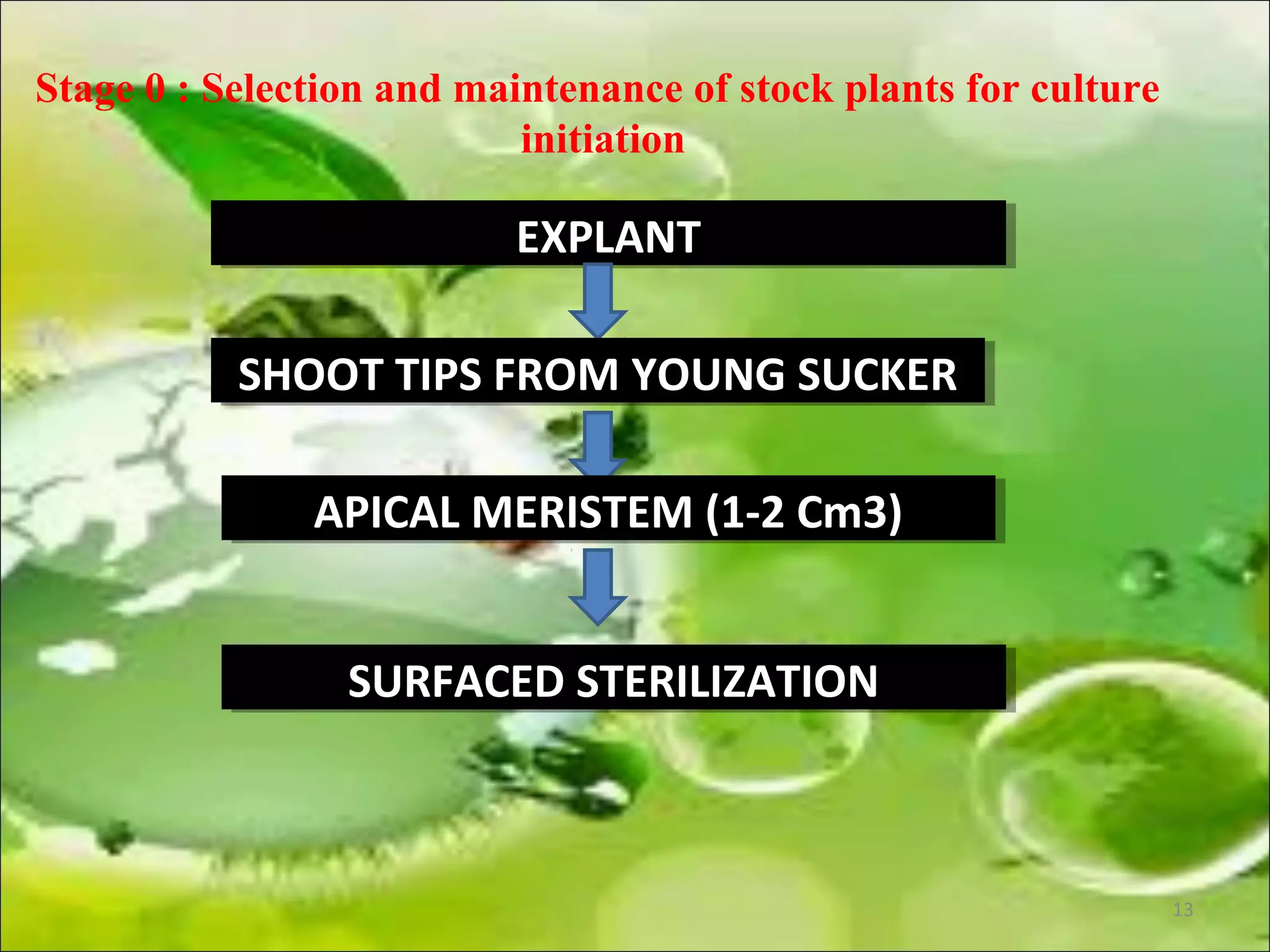
Stage 0 : Selection and maintenance of stock plants for culture
initiation
EXPLANTEXPLANT
SHOOT TIPS FROM YOUNG SUCKERSHOOT TIPS FROM YOUNG SUCKER
APICAL MERISTEM (1-2 Cm3)APICAL MERISTEM (1-2 Cm3)
SURFACED STERILIZATIONSURFACED STERILIZATION
13
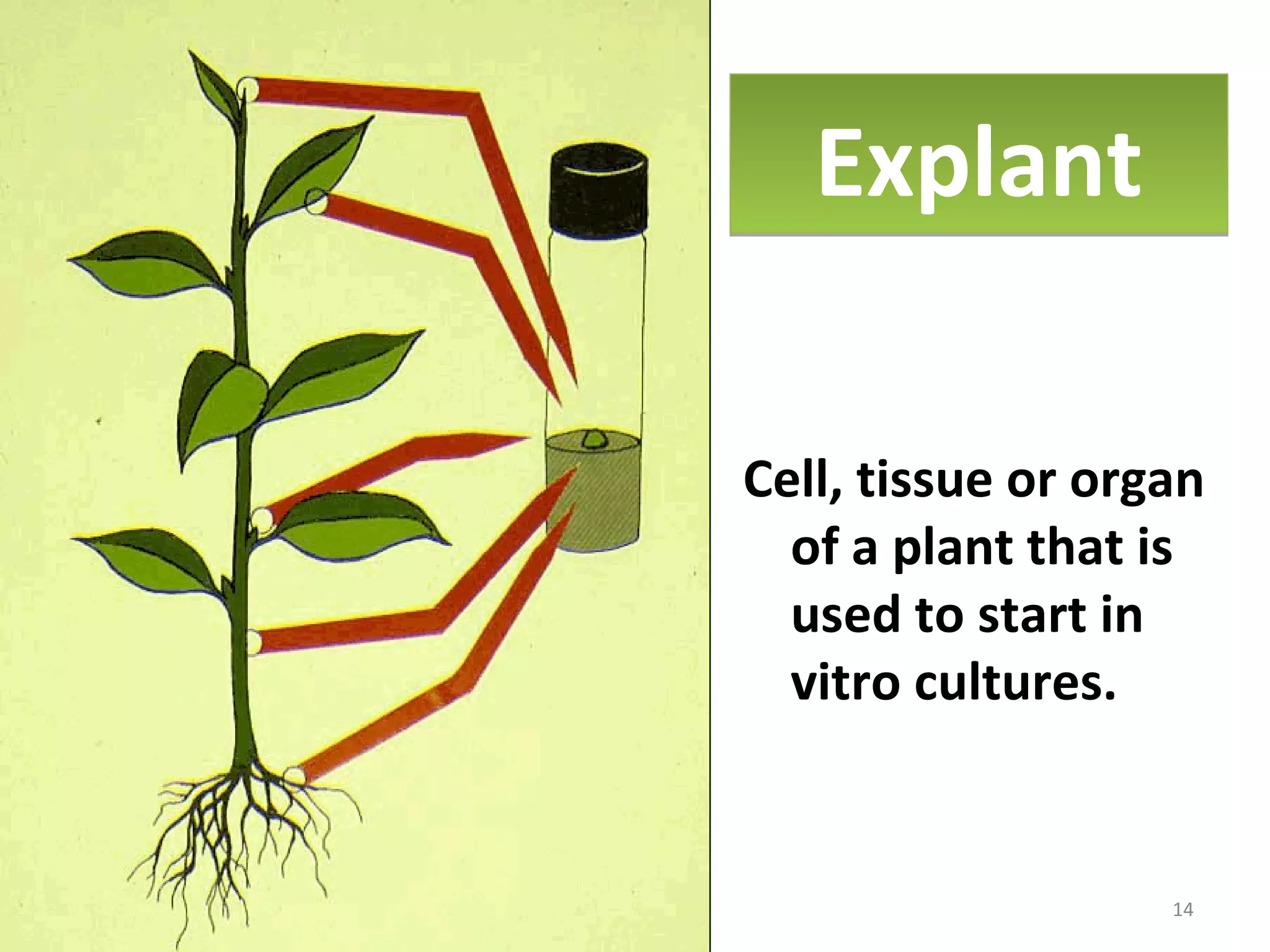
ExplantExplant
Cell, tissue or organ
of a plant that is
used to start in
vitro cultures.
14
15
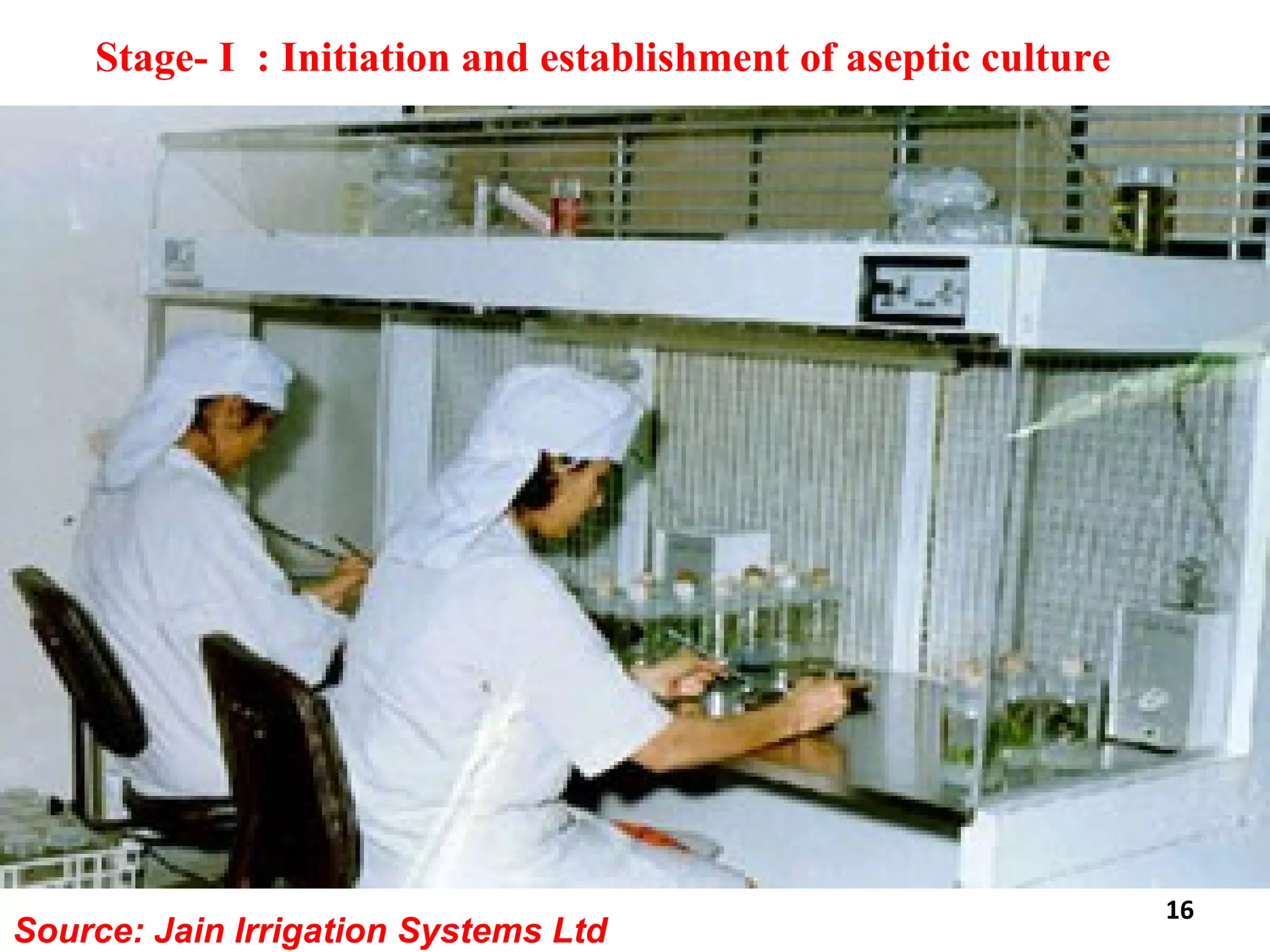
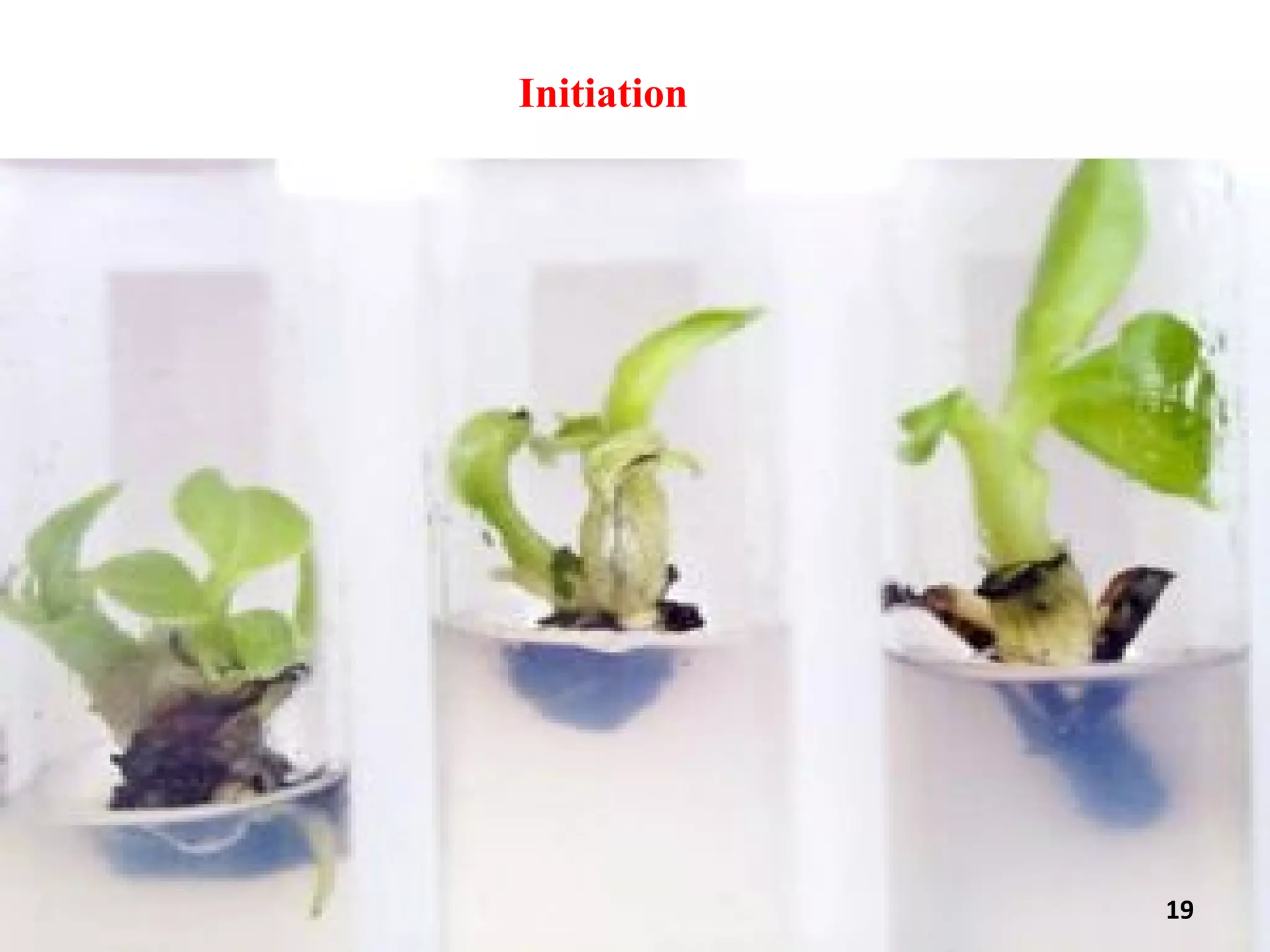
Stage- I : Initiation and establishment of aseptic culture
16
Source: Jain Irrigation Systems Ltd
17
18
Initiation
19
20
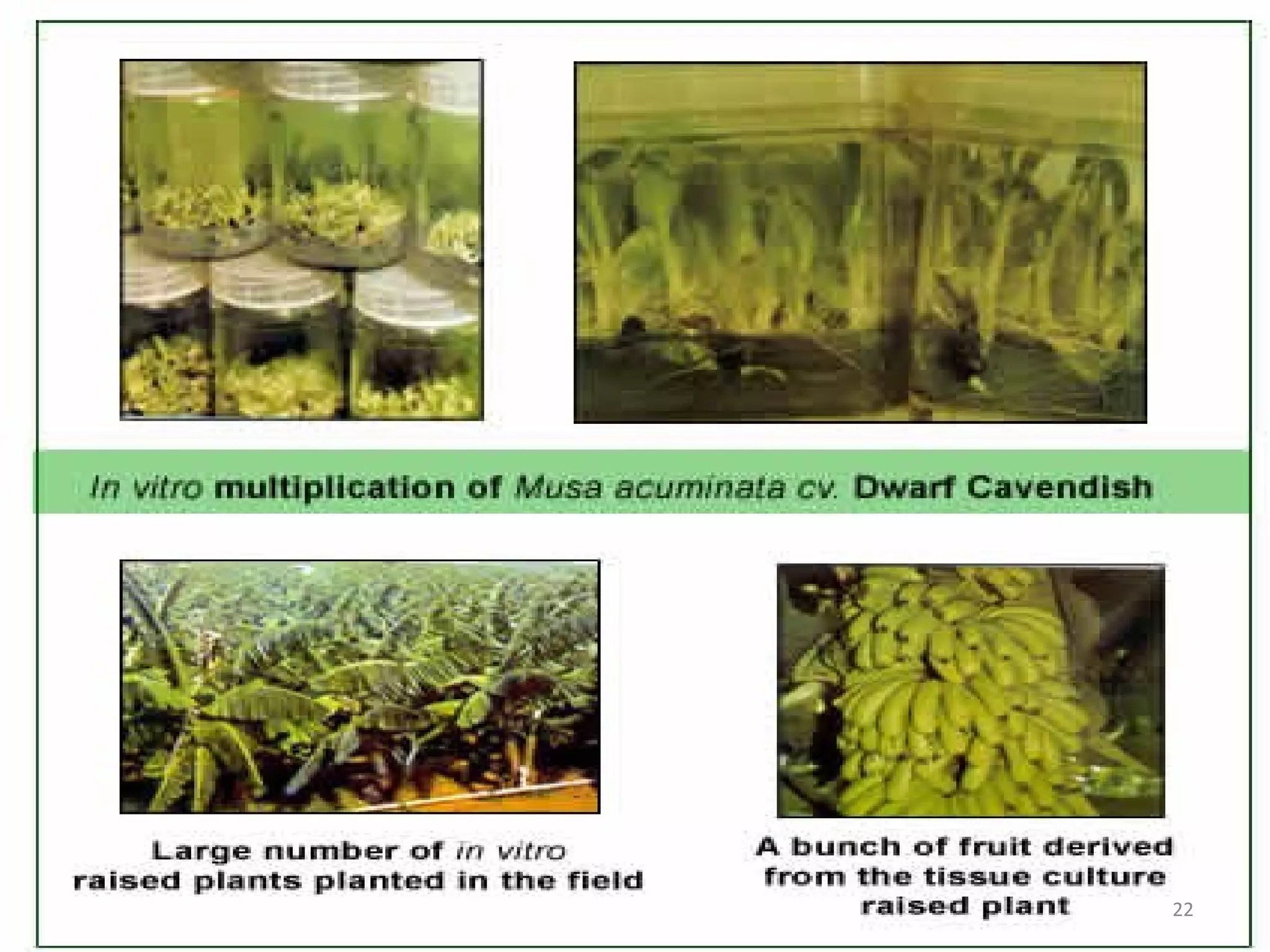
Stage –II : Multiplication of shoot
21
22
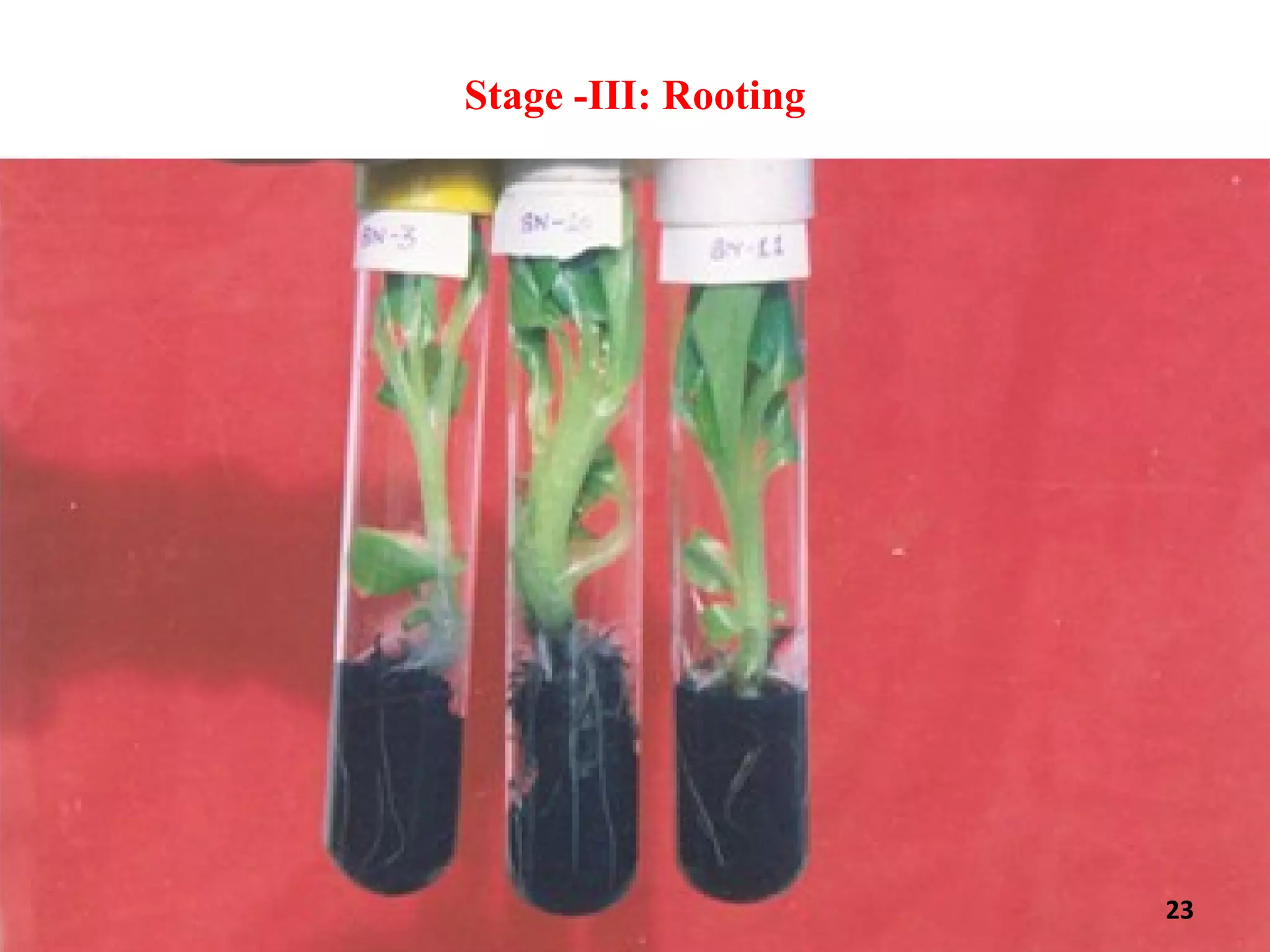
Stage -III: Rooting
23
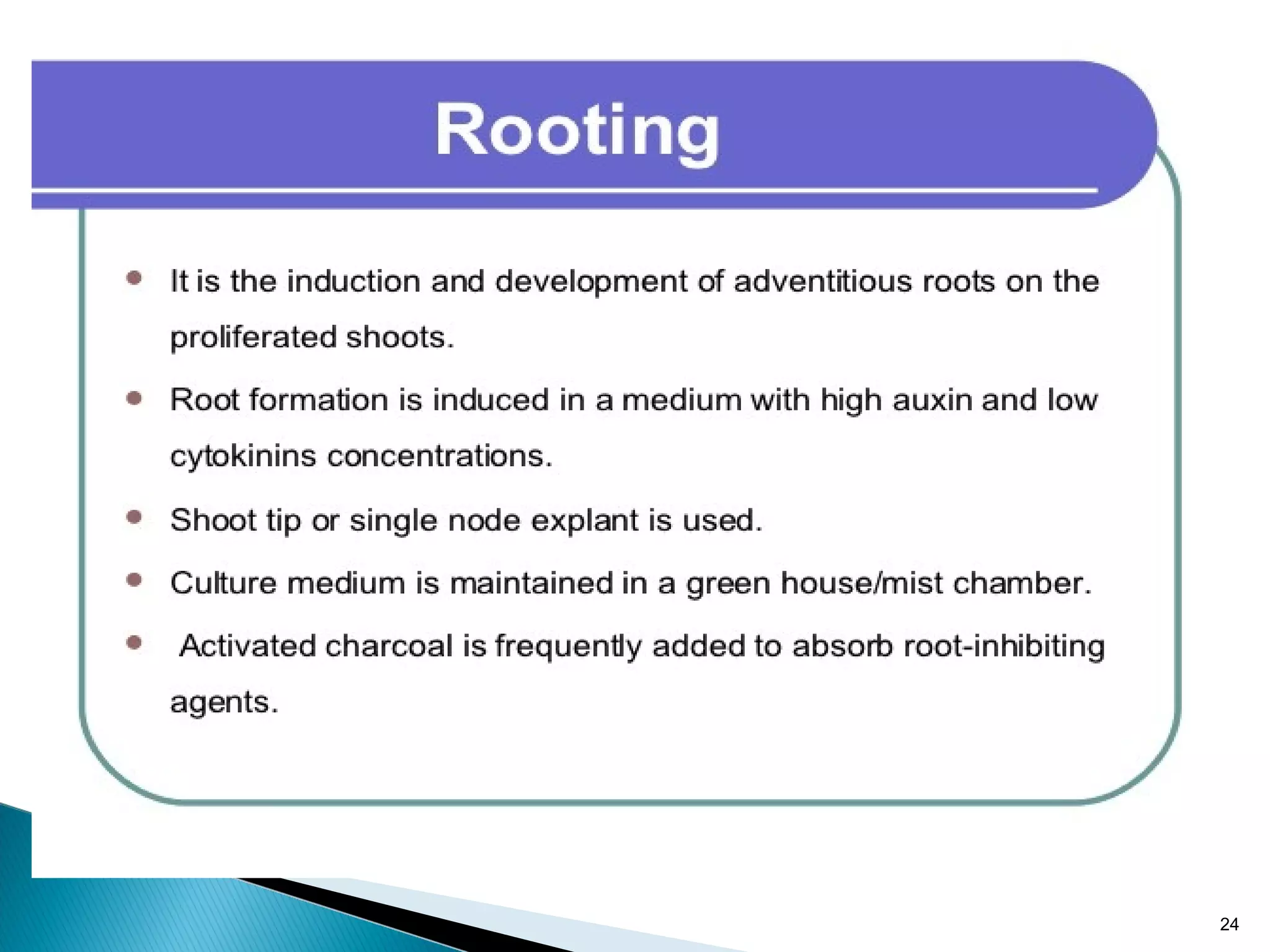
24
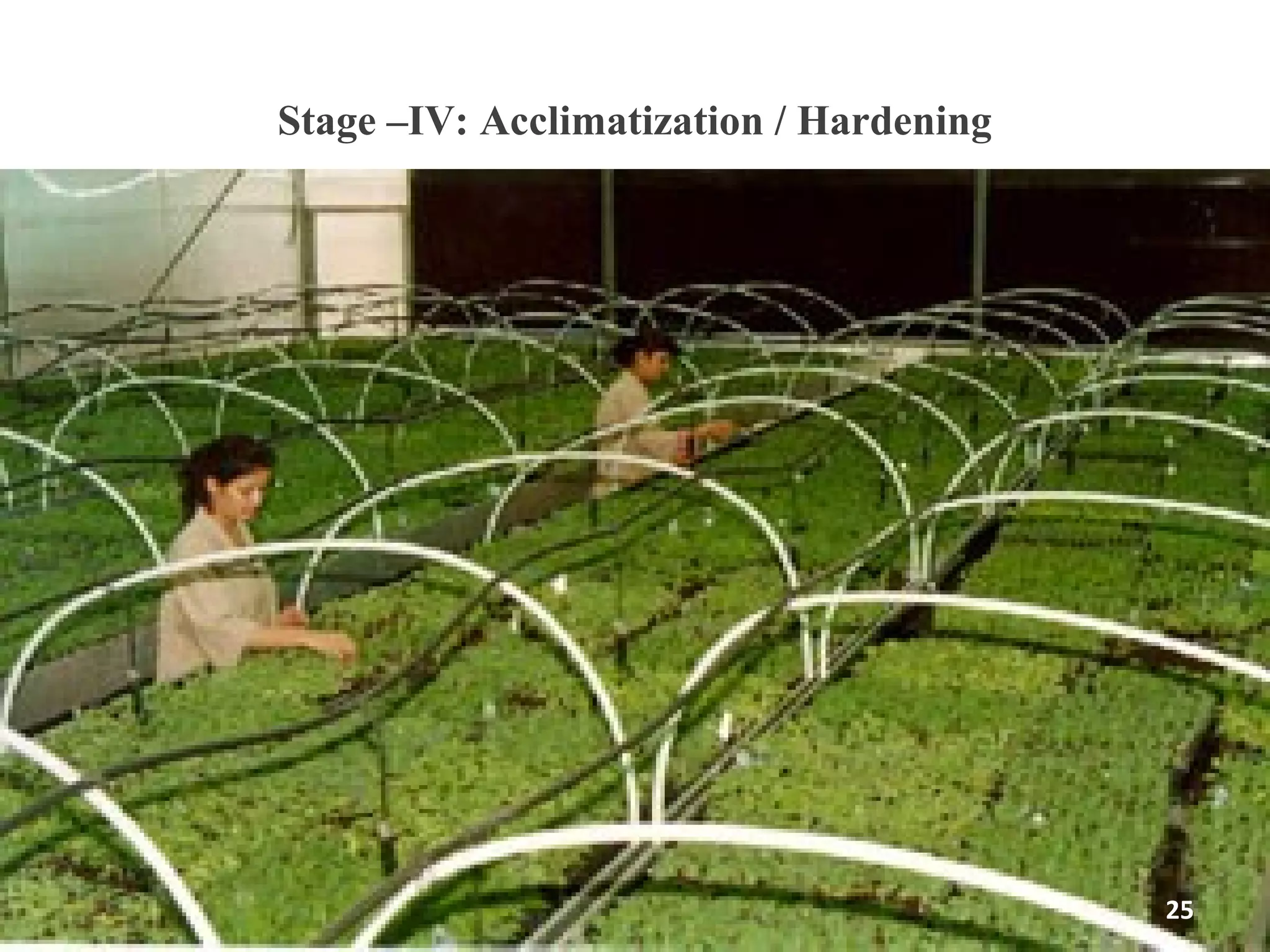
Stage –IV: Acclimatization / Hardening
25
 Healthy/elite plantlets are exposed to the natural conditions in a step wise manner.
 It is a gradual acclimatization of in vitro grown plants to in vivo condition.
 The plantlets are transferred to the pots/polyghene bag and immediately irrigated with
inorganic/nutrient solution.
 Plants are kept in the hardening room where controlled conditions of light, humidity
and temperature are maintained.
 Plants are maintained under high humidity for 10-20 days and subsequently
transferred in the field so as to grow under natural conditions. The success rate of
micropropagation depends on the survival of the plantlets when transferred from
culture to the soil (field).
26
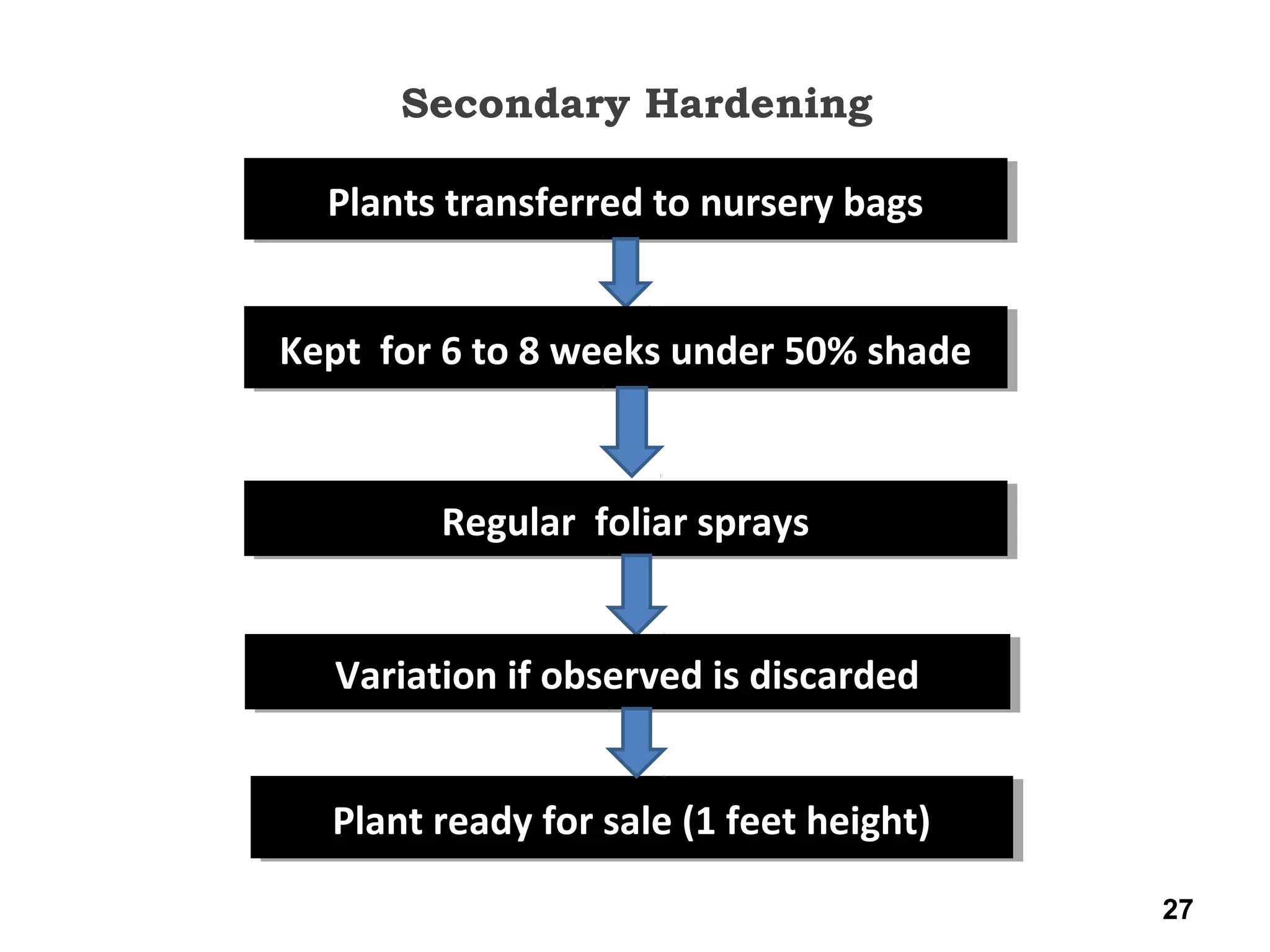
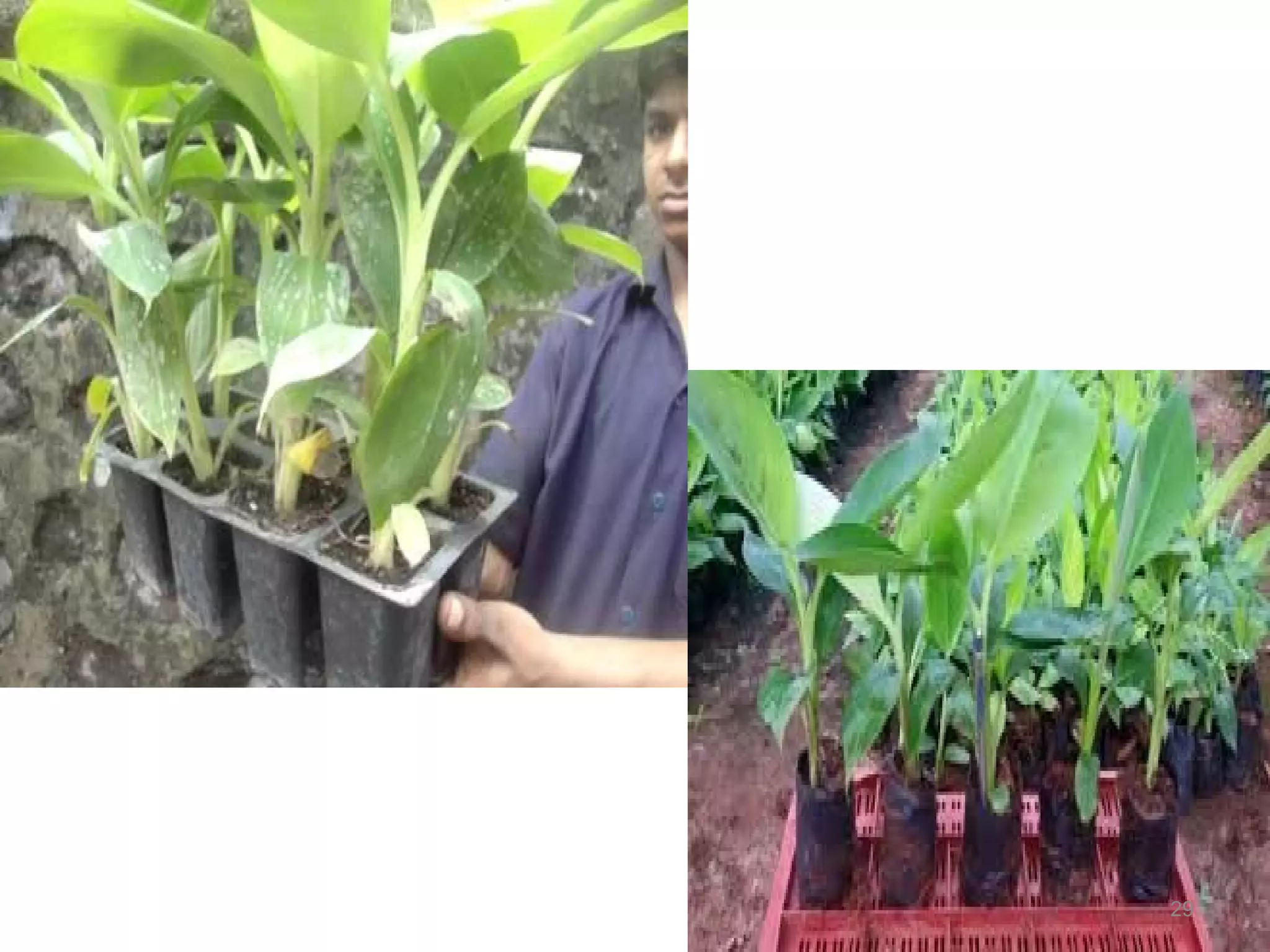
Secondary Hardening
27
Plants transferred to nursery bagsPlants transferred to nursery bags
Kept for 6 to 8 weeks under 50% shadeKept for 6 to 8 weeks under 50% shade
Regular foliar spraysRegular foliar sprays
Variation if observed is discardedVariation if observed is discarded
Plant ready for sale (1 feet height)Plant ready for sale (1 feet height)
28
29
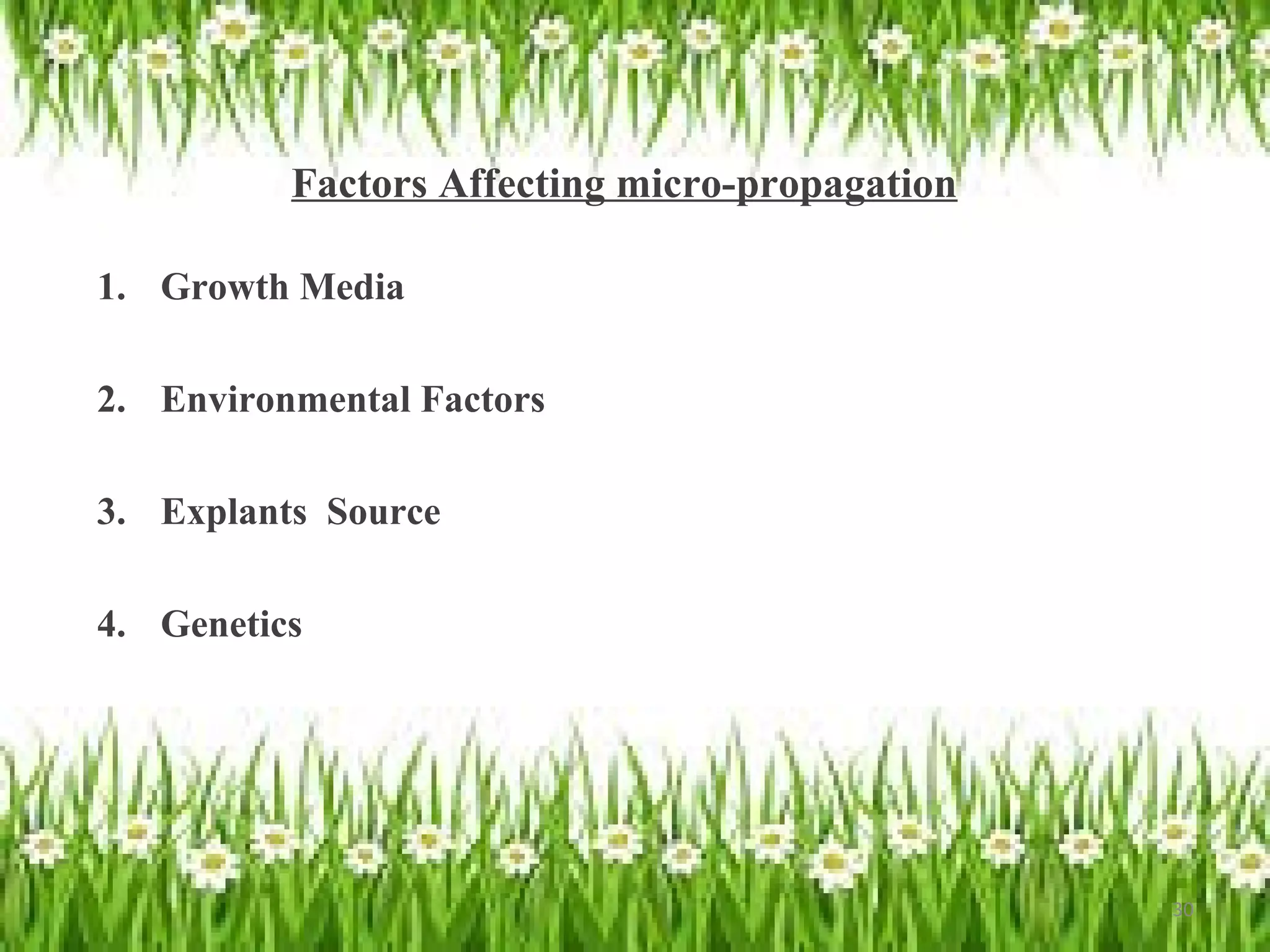
Factors Affecting micro-propagation
1. Growth Media
2. Environmental Factors
3. Explants Source
4. Genetics
30
Method of Micro-propagationMethod of Micro-propagation
31
Method of Micro-propagation
A. Meristem tip cultureA. Meristem tip culture
B. Callus cultureB. Callus culture
C. Suspension cultureC. Suspension culture
E. Protoplast cultureE. Protoplast culture
D. Embryo cultureD. Embryo culture
F. Ovule cultureF. Ovule culture
G. Anther cultureG. Anther culture
H. Cell cultureH. Cell culture
32
In addition to major use of tissue culture techniques
for rapid clonal multiplication of plants, this
technique is highly important for several purpose as
under:
1. Production and maintenance of pathogen free stock
plants;
2. Long term in vitro conservation of germplasm.
3. Selection and regeneration of transgenic plants.
4. Conservation of germplasm.
Other Implications of Micro-propagationOther Implications of Micro-propagation
33
Micro-propagation Techniques & ProcedureMicro-propagation Techniques & Procedure
34
A. Micro-propagation by NodesA. Micro-propagation by Nodes
B. Tip Axillary Bud cultureB. Tip Axillary Bud culture
C. Micro-cross Section technologyC. Micro-cross Section technology
G. Micro-propagation by Node cuttings in a liquid
medium
G. Micro-propagation by Node cuttings in a liquid
medium
D. Shoot tip cultureD. Shoot tip culture
E. Seed cultureE. Seed culture
F. Pseudo-bulb segment cultureF. Pseudo-bulb segment culture
35
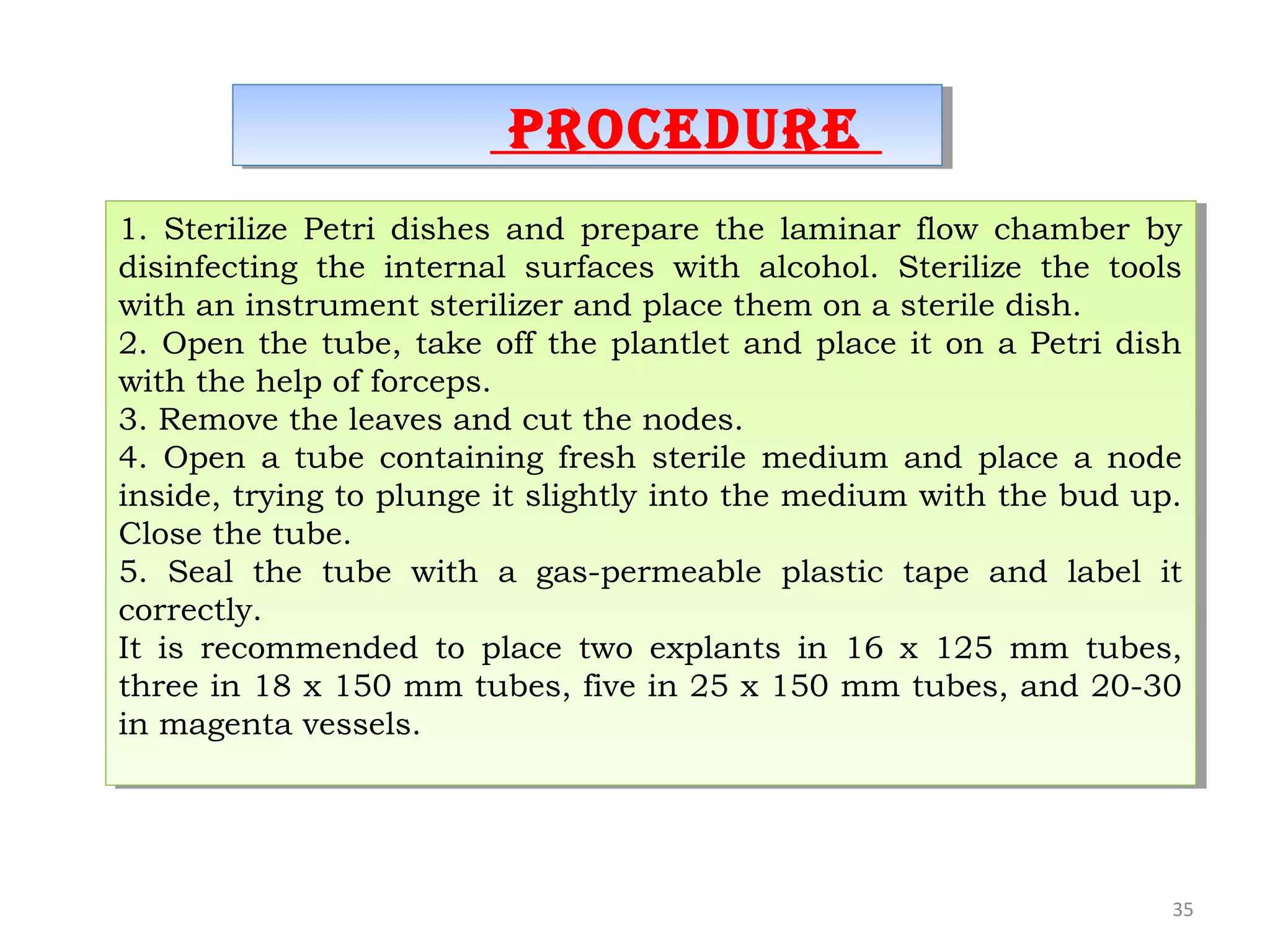
1. Sterilize Petri dishes and prepare the laminar flow chamber by
disinfecting the internal surfaces with alcohol. Sterilize the tools
with an instrument sterilizer and place them on a sterile dish.
2. Open the tube, take off the plantlet and place it on a Petri dish
with the help of forceps.
3. Remove the leaves and cut the nodes.
4. Open a tube containing fresh sterile medium and place a node
inside, trying to plunge it slightly into the medium with the bud up.
Close the tube.
5. Seal the tube with a gas-permeable plastic tape and label it
correctly.
It is recommended to place two explants in 16 x 125 mm tubes,
three in 18 x 150 mm tubes, five in 25 x 150 mm tubes, and 20-30
in magenta vessels.
1. Sterilize Petri dishes and prepare the laminar flow chamber by
disinfecting the internal surfaces with alcohol. Sterilize the tools
with an instrument sterilizer and place them on a sterile dish.
2. Open the tube, take off the plantlet and place it on a Petri dish
with the help of forceps.
3. Remove the leaves and cut the nodes.
4. Open a tube containing fresh sterile medium and place a node
inside, trying to plunge it slightly into the medium with the bud up.
Close the tube.
5. Seal the tube with a gas-permeable plastic tape and label it
correctly.
It is recommended to place two explants in 16 x 125 mm tubes,
three in 18 x 150 mm tubes, five in 25 x 150 mm tubes, and 20-30
in magenta vessels.
procedureprocedure
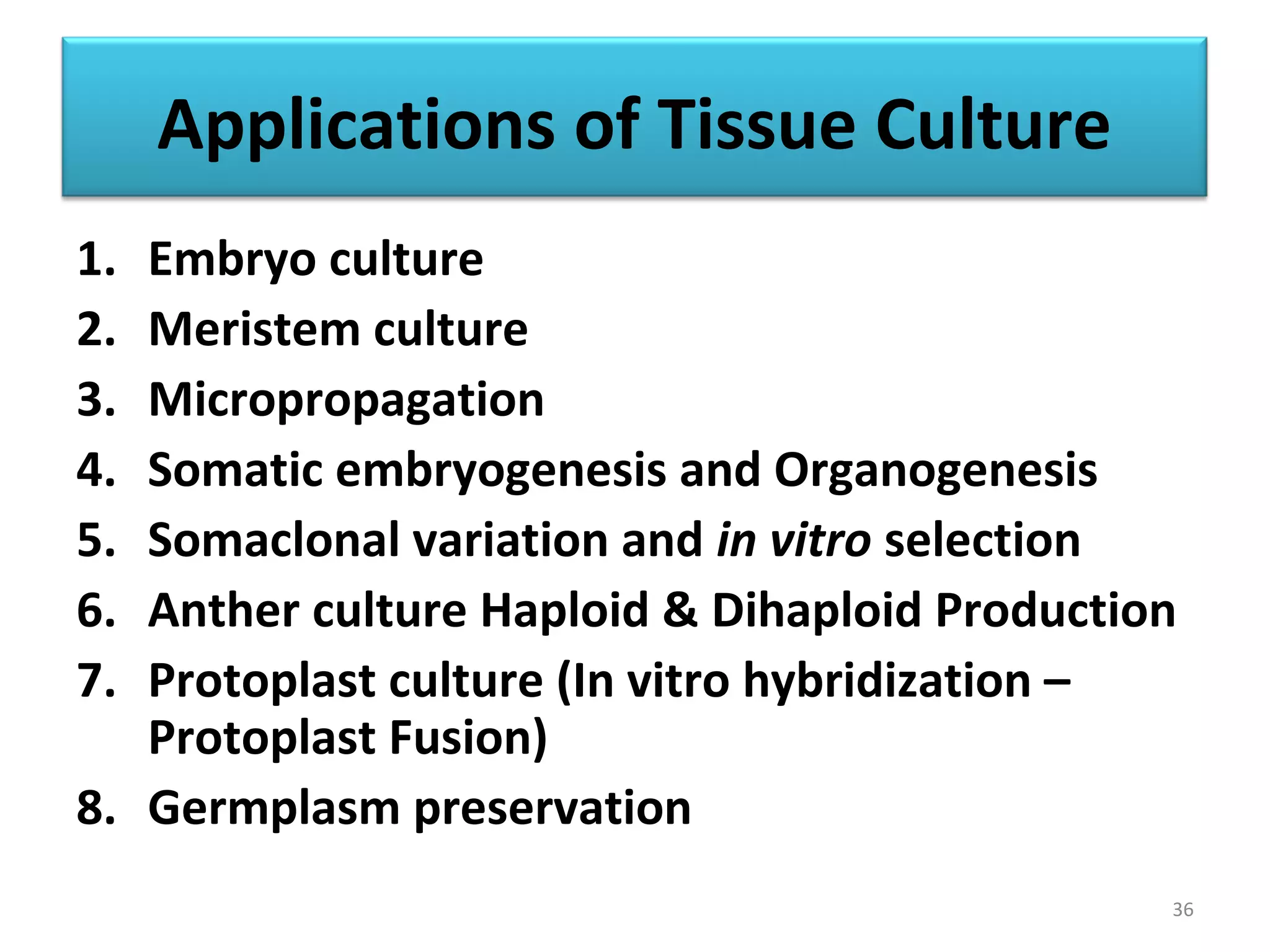
Applications of Tissue Culture
1. Embryo culture
2. Meristem culture
3. Micropropagation
4. Somatic embryogenesis and Organogenesis
5. Somaclonal variation and in vitro selection
6. Anther culture Haploid & Dihaploid Production
7. Protoplast culture (In vitro hybridization –
Protoplast Fusion)
8. Germplasm preservation
36
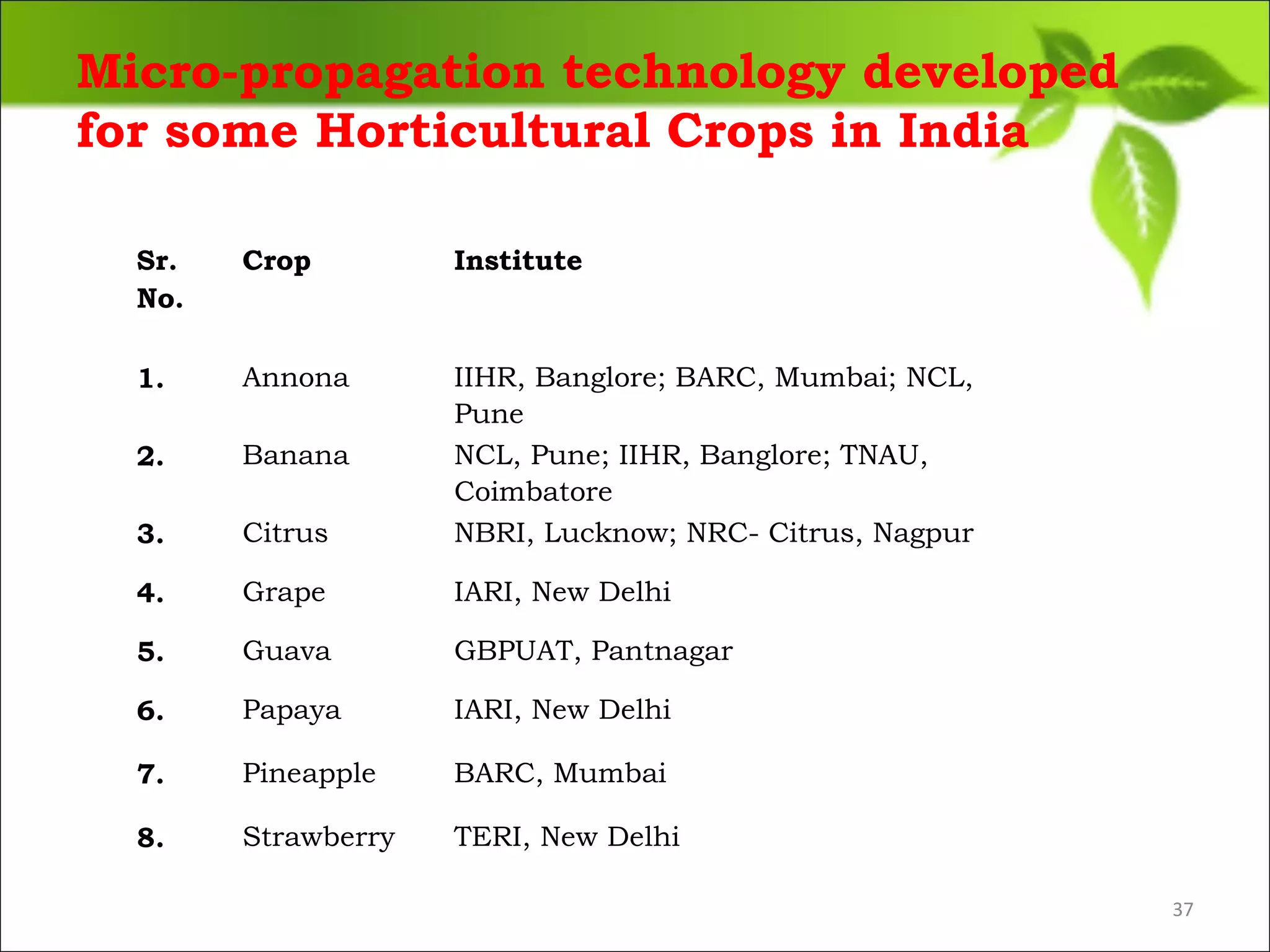
Micro-propagation technology developed
for some Horticultural Crops in India
Sr.
No.
Crop Institute
1. Annona IIHR, Banglore; BARC, Mumbai; NCL,
Pune
2. Banana NCL, Pune; IIHR, Banglore; TNAU,
Coimbatore
3. Citrus NBRI, Lucknow; NRC- Citrus, Nagpur
4. Grape IARI, New Delhi
5. Guava GBPUAT, Pantnagar
6. Papaya IARI, New Delhi
7. Pineapple BARC, Mumbai
8. Strawberry TERI, New Delhi
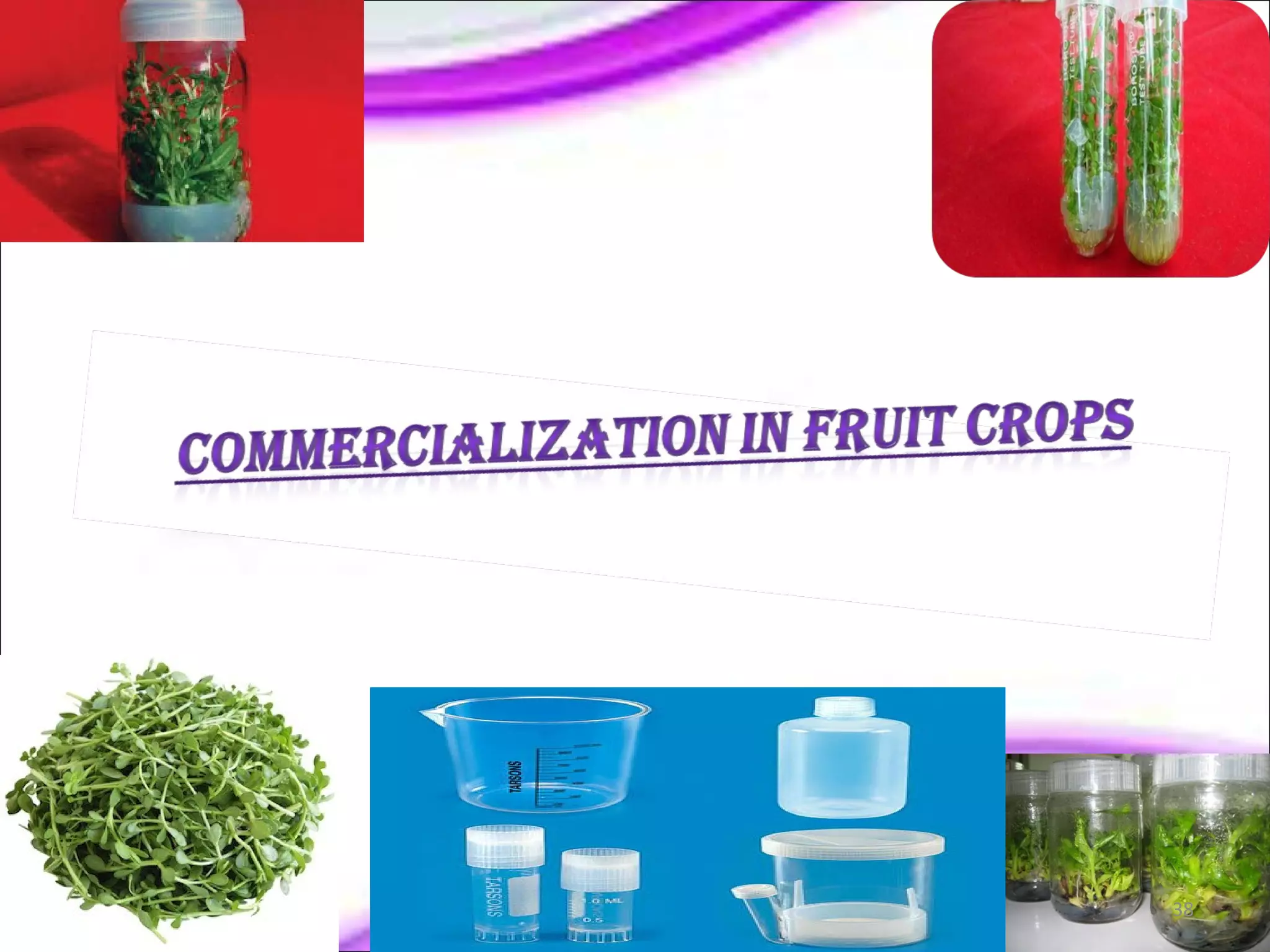
37
38
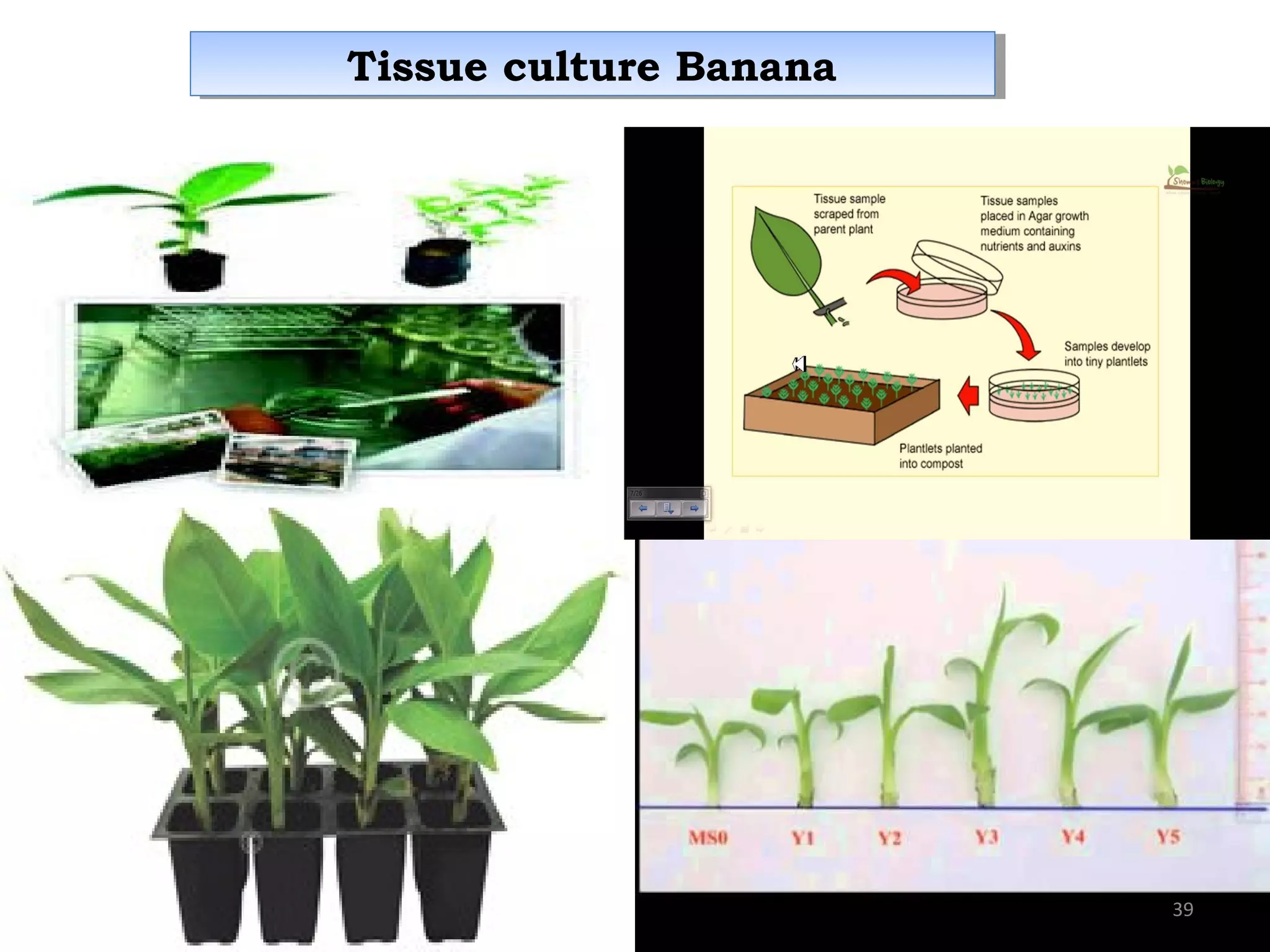
Tissue culture BananaTissue culture Banana
39
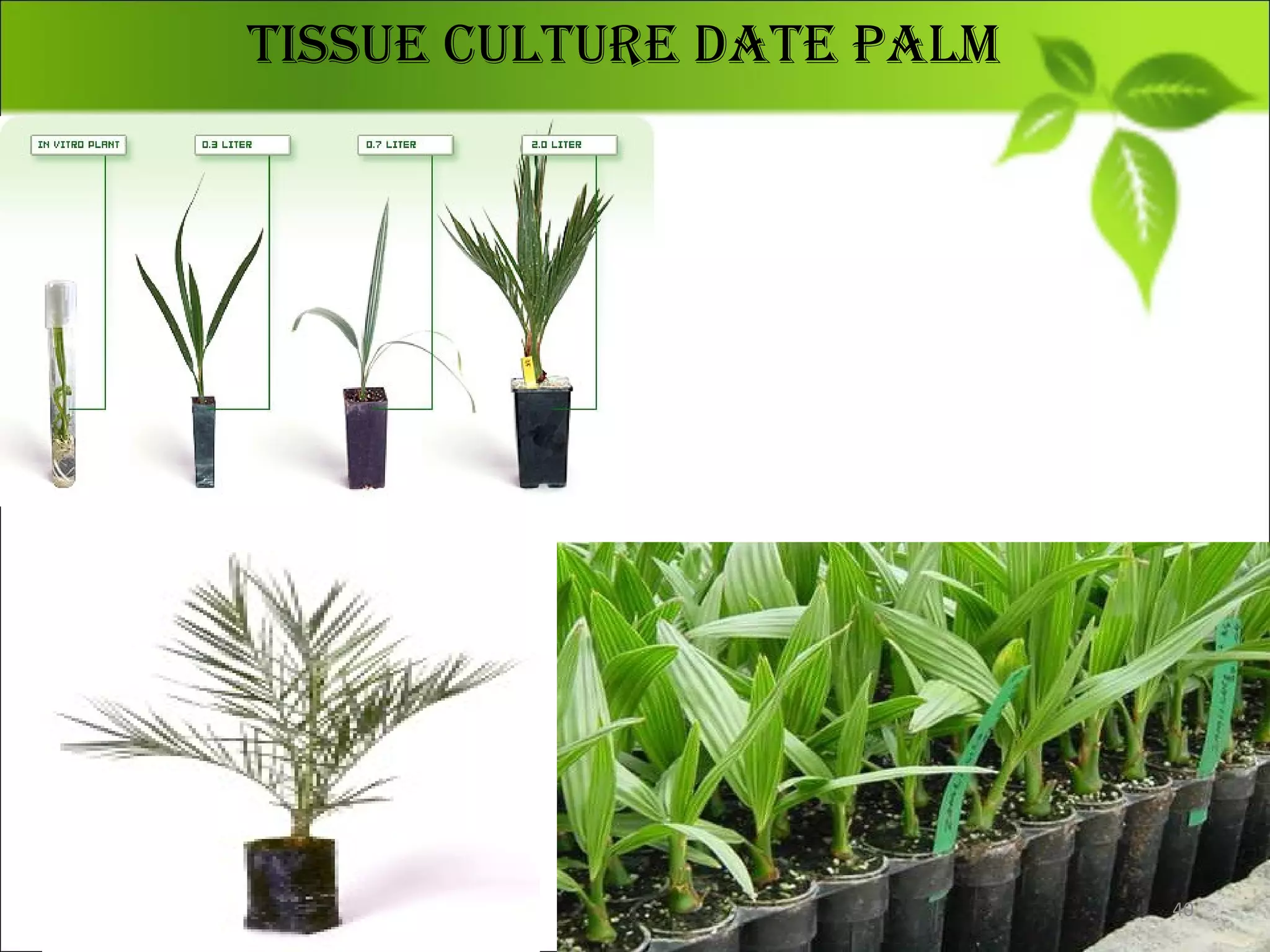
Tissue culTure DaTe palm
40
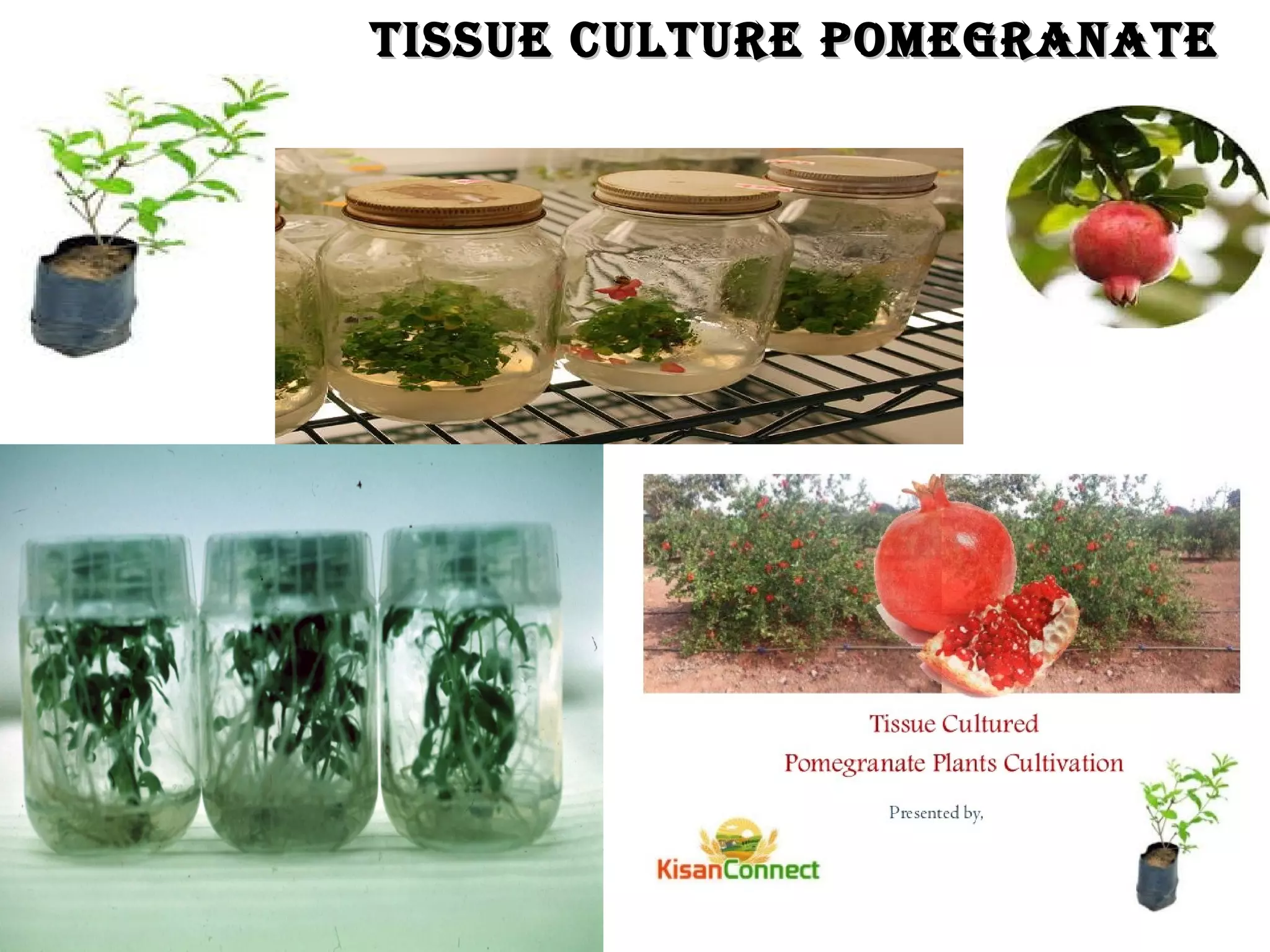
Tissue culTure pomegranaTeTissue culTure pomegranaTe
41
TissueTissue culTureculTure papayapapaya
42
Tissue culTure sTrawberry
43
44
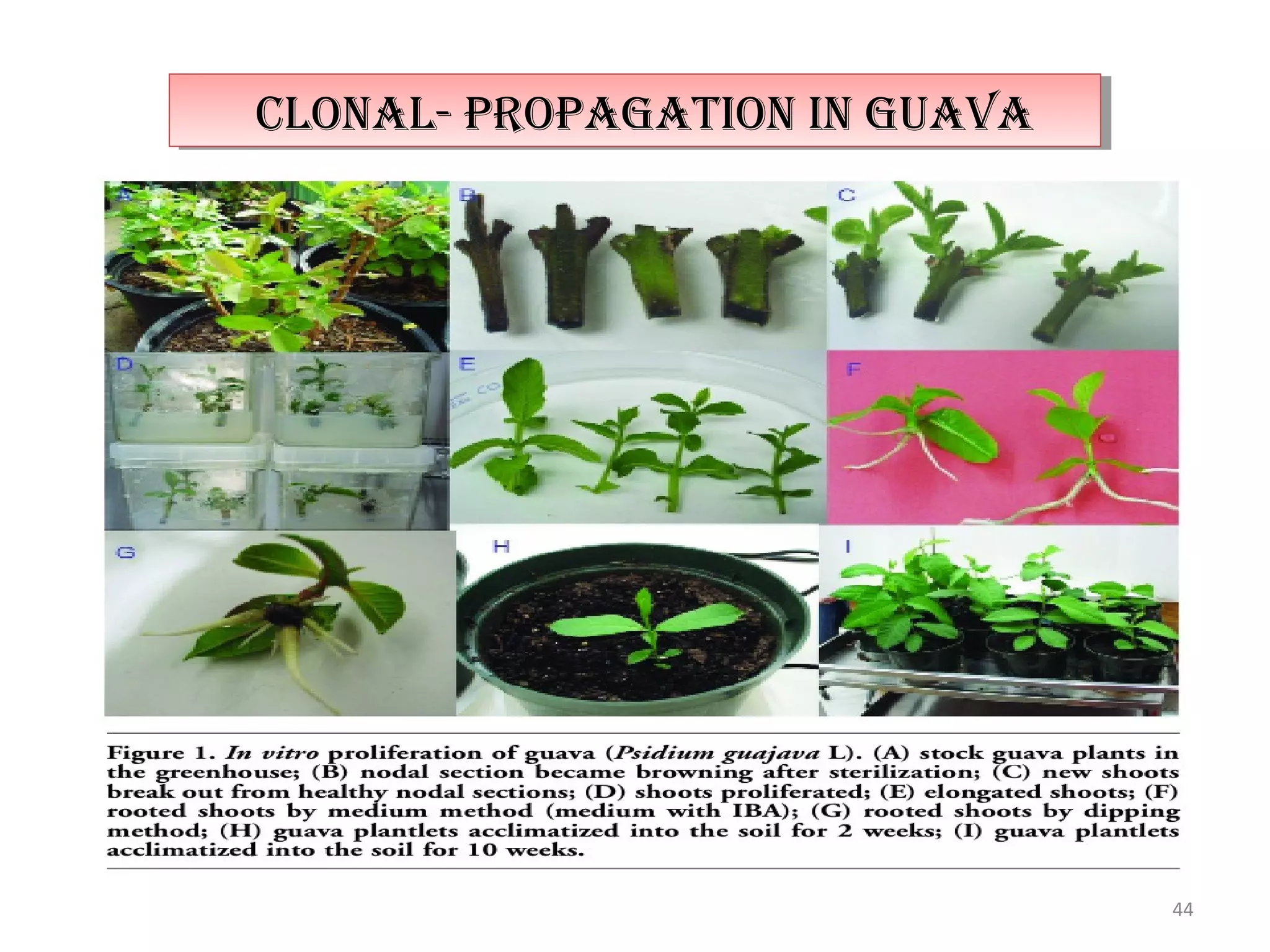
clonal- propagaTion in guavaclonal- propagaTion in guava
45
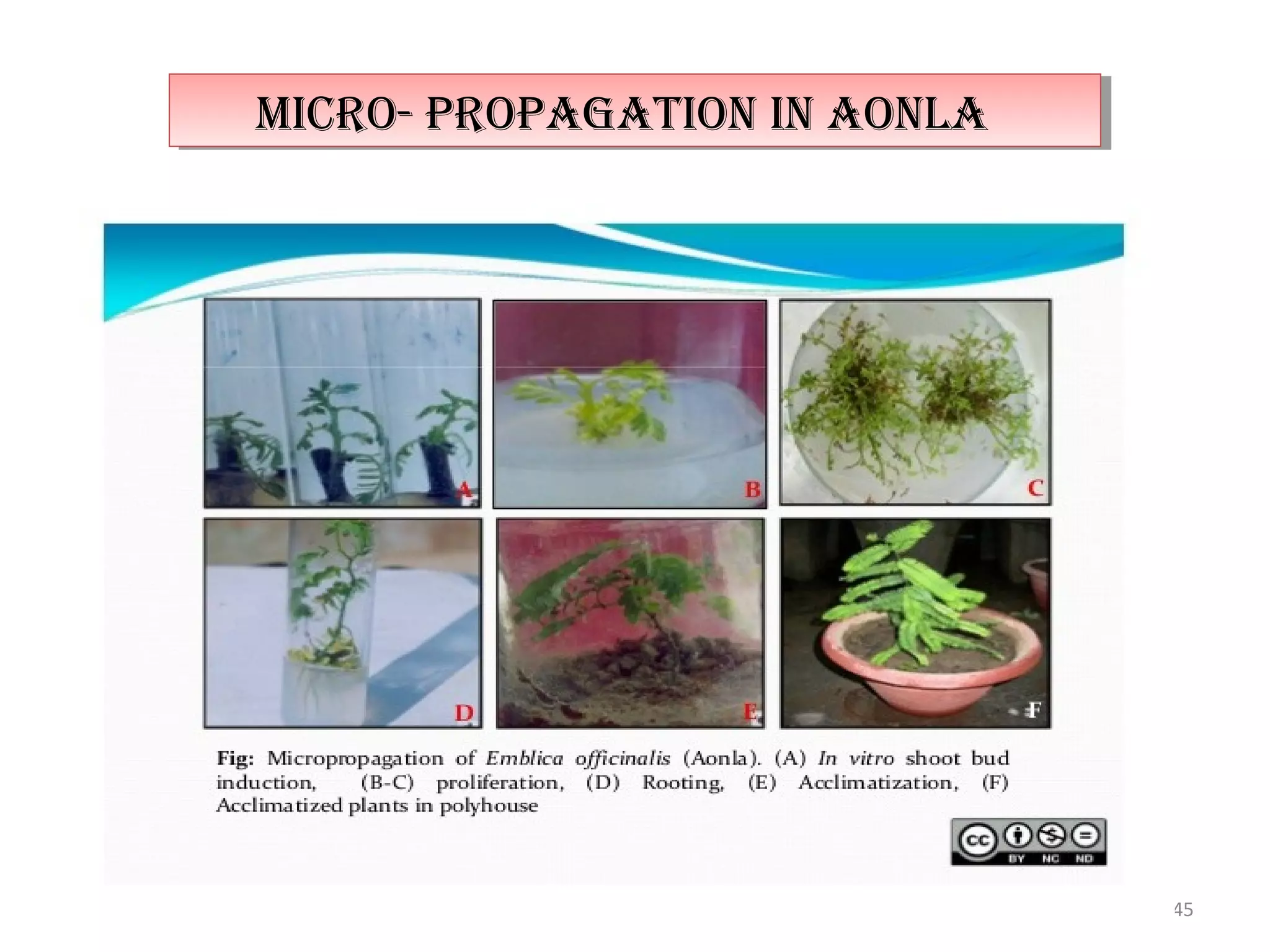
micro- propagaTion in aonlamicro- propagaTion in aonla
46
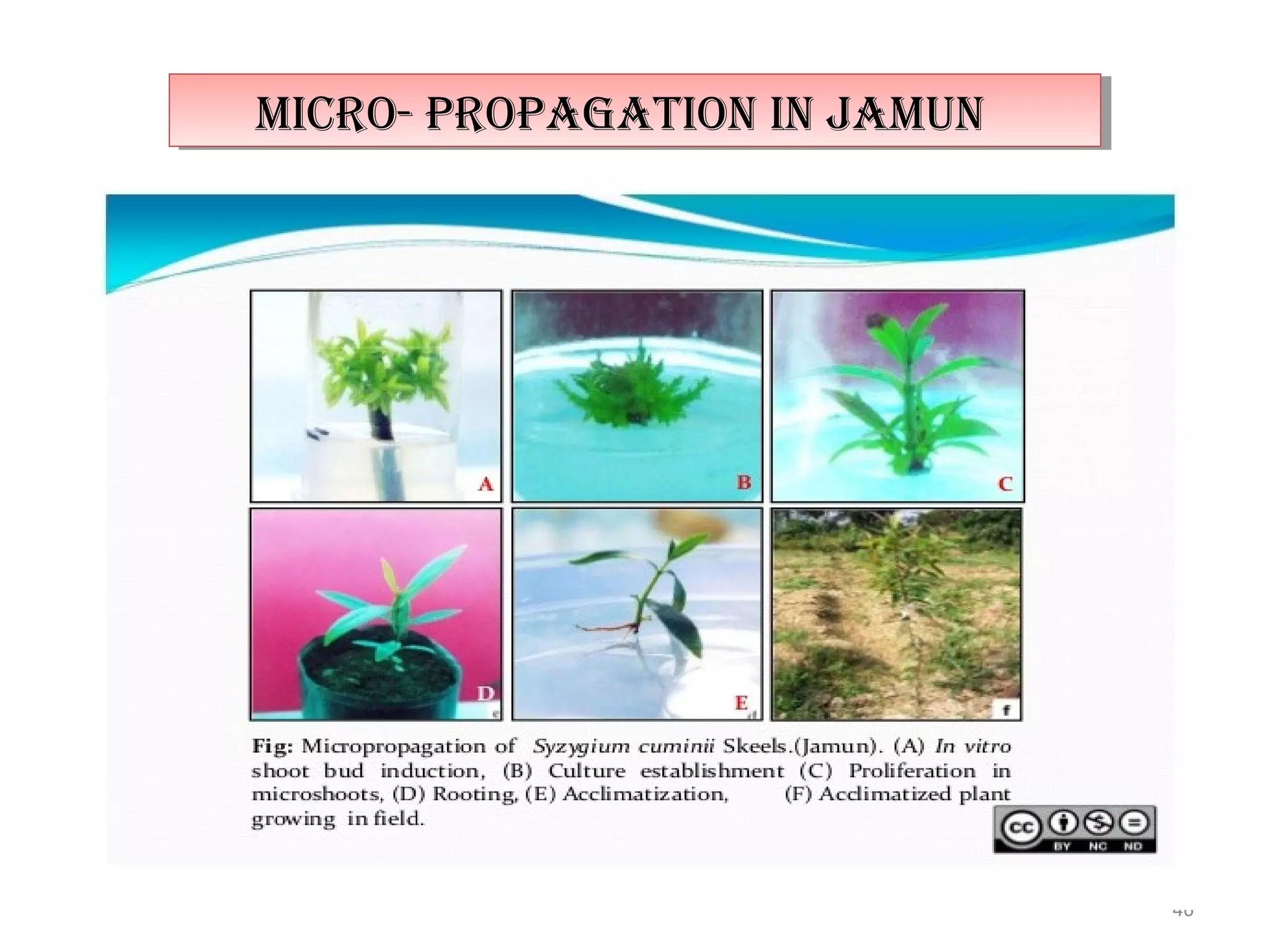
micro- propagaTion in Jamunmicro- propagaTion in Jamun
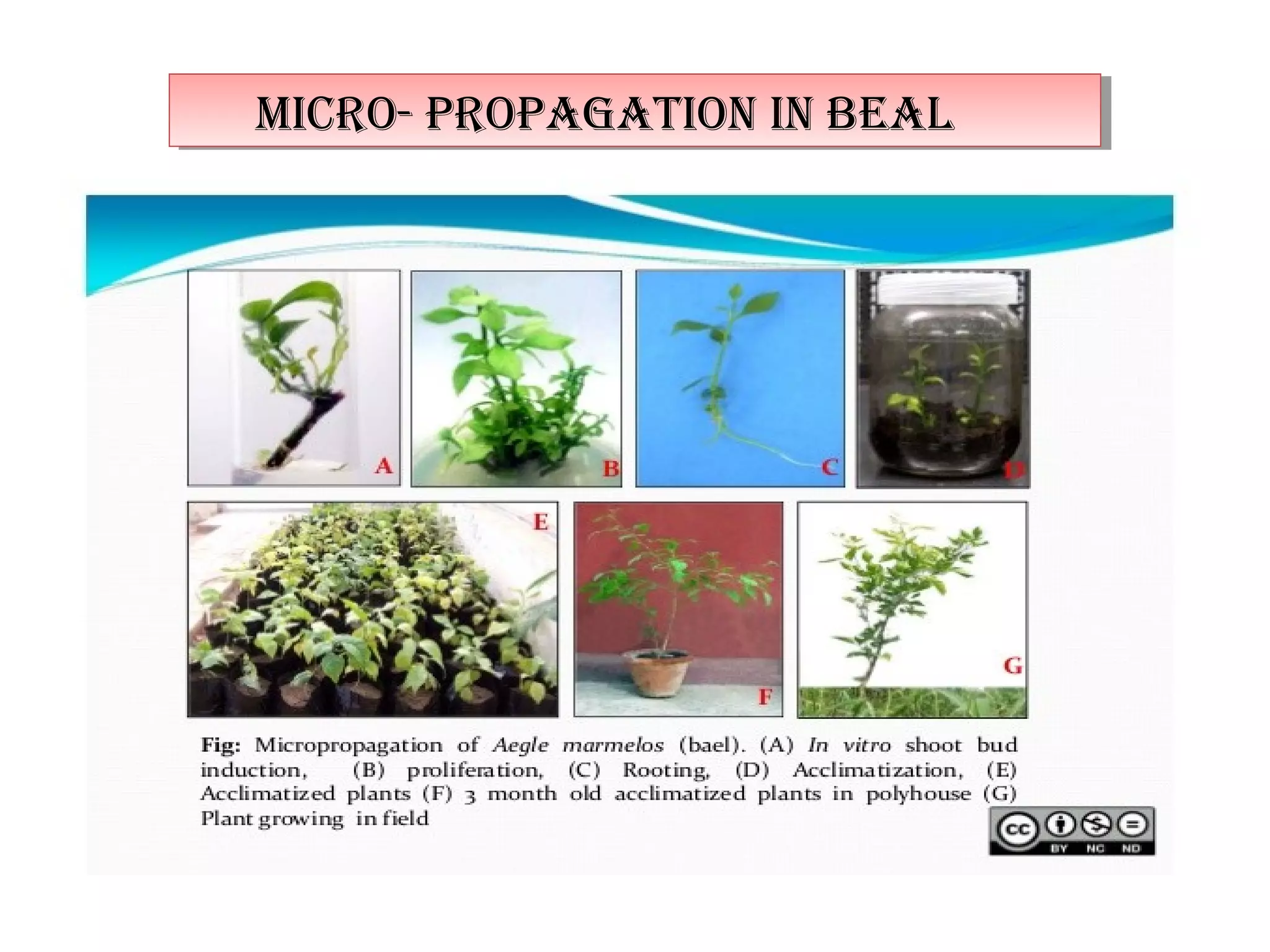
47
micro- propagaTion in bealmicro- propagaTion in beal
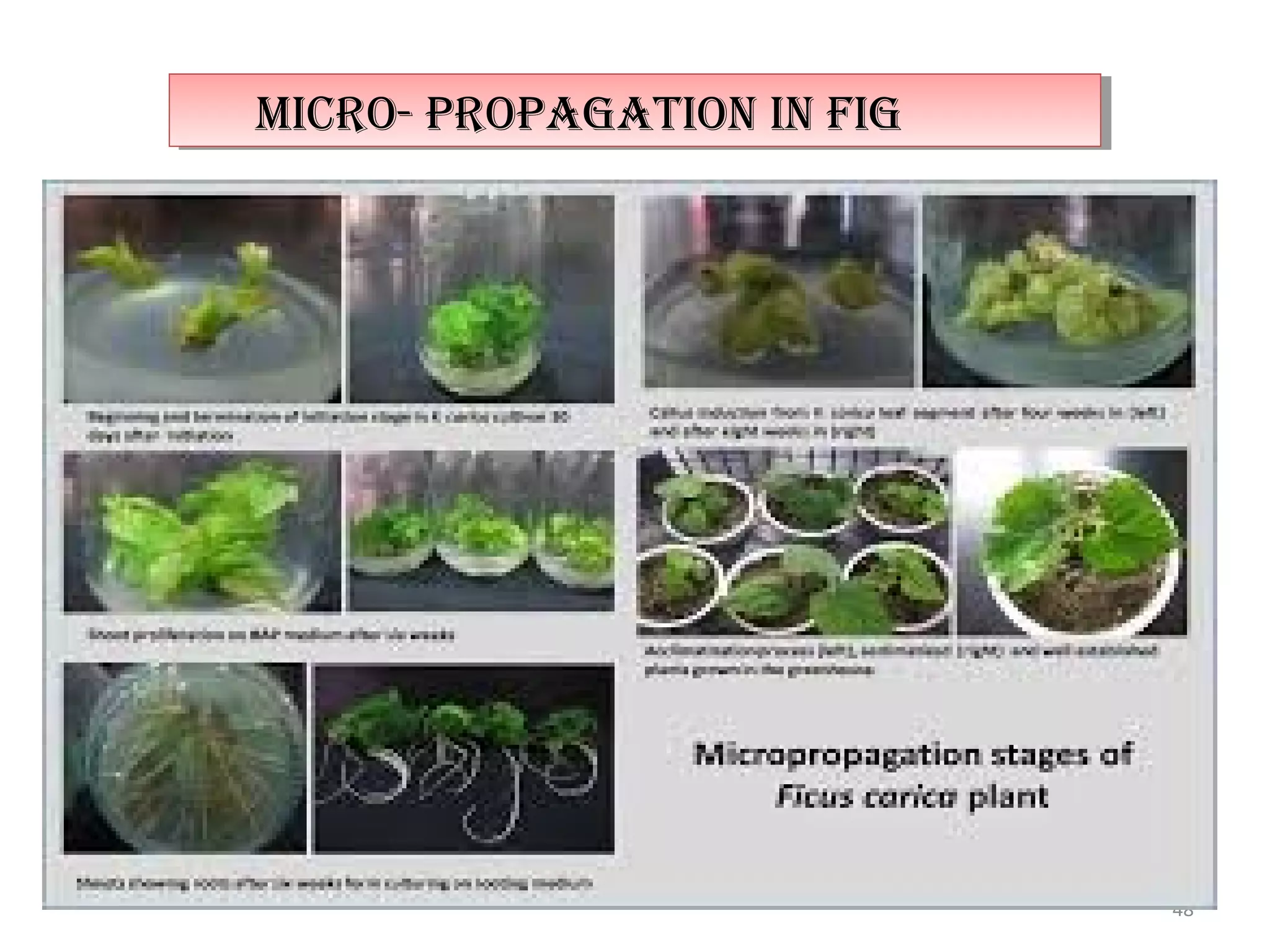
48
micro- propagaTion in Figmicro- propagaTion in Fig
49

Commercial Exploitation of Micro-propagation in fruit crops & its Techniques

  • 1.
  • 2.
    Presentation on Commercial Exploitation of Micro-propagationin fruit crops & its Techniques Presentation on Commercial Exploitation of Micro-propagation in fruit crops & its Techniques • Course No.:- FsC 505 • Course TiTle:- ProPagaTioN & Nursery MaNageMeNT For FruiT CroPs subMiTTed To subMiTTed by dr. M.M. Masu PawaN KuMar Nagar assisTaNT researCh sCieNTisT M.sC. (horTi) PoMology uNiversiTy bhavaN, reg. 04-2690-2015 aau, aNaNd baCa, aau, aNaNd 2
  • 3.
  • 4.
    whaT iswhaT is MiCroProPagaTioNMiCroProPagaTioNAwhole plant can be regenerated from a small tissue or plant cells in a suitable culture medium under controlled environment. The plantlets so produced are called tissue-culture raised plants. The advantage is that in a relatively short time and space a large number of plants are obtained. The advantage is that in a relatively short time and space a large number of plants are obtained.  TyPe oF MiCroProPagaTioNTyPe oF MiCroProPagaTioN 1.Direct micropropagation 2.Indirect micropropagation  TyPe oF MiCroProPagaTioNTyPe oF MiCroProPagaTioN 1.Direct micropropagation 2.Indirect micropropagation 4
  • 5.
    why dowhy do MiCroProPagaTioNMiCroProPagaTioN whydowhy do MiCroProPagaTioNMiCroProPagaTioN  A single explant can be multiplied into several thousand plants in less than a year - this allows fast commercial propagation of new cultivars.  Once established, a plant tissue culture line can give a continuous supply of young plants throughout the year.  In plants prone to virus diseases, virus free explants (new meristem tissue is usually virus free) can be cultivated to provide virus free plants.  Plant ‘tissue banks’ can be frozen, then regenerated through tissue culture.  Plant cultures in approved media are easier to export than are soil-grown plants, as they are pathogen free and take up little space (most current plant export is now done in this manner).  A single explant can be multiplied into several thousand plants in less than a year - this allows fast commercial propagation of new cultivars.  Once established, a plant tissue culture line can give a continuous supply of young plants throughout the year.  In plants prone to virus diseases, virus free explants (new meristem tissue is usually virus free) can be cultivated to provide virus free plants.  Plant ‘tissue banks’ can be frozen, then regenerated through tissue culture.  Plant cultures in approved media are easier to export than are soil-grown plants, as they are pathogen free and take up little space (most current plant export is now done in this manner). 5
  • 6.
    Advantages of micropropagationAdvantagesof micropropagation  From one to many propagules rapidly  Multiplication in controlled lab conditions  Continuous propagation year round  Potential for disease-free propagules  Inexpensive per plant once established  Precise crop production scheduling  Reduce stock plant space  Long-term germplasm storage  Production of difficult-to-propagate species DisadvantagesDisadvantagesDisadvantagesDisadvantages  Specialized equipment/facilities required  More technical expertise required  Protocols not optimized for all species  Plants produced may not fit industry standards  Relatively expensive to set up 6
  • 7.
  • 8.
    genetically modified plant breeding does not produceseeds does not respond well to vegetative reproduction8
  • 9.
    Steps of MicropropagationStepsof Micropropagation 9
  • 10.
  • 11.
    Steps involved intheSteps involved in the in vitroin vitro MicropropagationMicropropagation Cleaning of glassware Preparation of nutrient medium Selection and sterilization of explant. Inoculation of aseptic explant in to nutrient medium. Proliferation of shoots on a multiplication medium. Transfer of shoots for sub-culturing. Rooting and hardening of plantlets Field trials. 11
  • 12.
    12Source : Cadilapharmaceuticals limited
  • 13.
    Stage 0 :Selection and maintenance of stock plants for culture initiation EXPLANTEXPLANT SHOOT TIPS FROM YOUNG SUCKERSHOOT TIPS FROM YOUNG SUCKER APICAL MERISTEM (1-2 Cm3)APICAL MERISTEM (1-2 Cm3) SURFACED STERILIZATIONSURFACED STERILIZATION 13
  • 14.
    ExplantExplant Cell, tissue ororgan of a plant that is used to start in vitro cultures. 14
  • 15.
  • 16.
    Stage- I :Initiation and establishment of aseptic culture 16 Source: Jain Irrigation Systems Ltd
  • 17.
  • 18.
  • 19.
  • 20.
  • 21.
    Stage –II :Multiplication of shoot 21
  • 22.
  • 23.
  • 24.
  • 25.
  • 26.
     Healthy/elite plantletsare exposed to the natural conditions in a step wise manner.  It is a gradual acclimatization of in vitro grown plants to in vivo condition.  The plantlets are transferred to the pots/polyghene bag and immediately irrigated with inorganic/nutrient solution.  Plants are kept in the hardening room where controlled conditions of light, humidity and temperature are maintained.  Plants are maintained under high humidity for 10-20 days and subsequently transferred in the field so as to grow under natural conditions. The success rate of micropropagation depends on the survival of the plantlets when transferred from culture to the soil (field). 26
  • 27.
    Secondary Hardening 27 Plants transferredto nursery bagsPlants transferred to nursery bags Kept for 6 to 8 weeks under 50% shadeKept for 6 to 8 weeks under 50% shade Regular foliar spraysRegular foliar sprays Variation if observed is discardedVariation if observed is discarded Plant ready for sale (1 feet height)Plant ready for sale (1 feet height)
  • 28.
  • 29.
  • 30.
    Factors Affecting micro-propagation 1.Growth Media 2. Environmental Factors 3. Explants Source 4. Genetics 30
  • 31.
    Method of Micro-propagationMethodof Micro-propagation 31
  • 32.
    Method of Micro-propagation A.Meristem tip cultureA. Meristem tip culture B. Callus cultureB. Callus culture C. Suspension cultureC. Suspension culture E. Protoplast cultureE. Protoplast culture D. Embryo cultureD. Embryo culture F. Ovule cultureF. Ovule culture G. Anther cultureG. Anther culture H. Cell cultureH. Cell culture 32
  • 33.
    In addition tomajor use of tissue culture techniques for rapid clonal multiplication of plants, this technique is highly important for several purpose as under: 1. Production and maintenance of pathogen free stock plants; 2. Long term in vitro conservation of germplasm. 3. Selection and regeneration of transgenic plants. 4. Conservation of germplasm. Other Implications of Micro-propagationOther Implications of Micro-propagation 33
  • 34.
    Micro-propagation Techniques &ProcedureMicro-propagation Techniques & Procedure 34 A. Micro-propagation by NodesA. Micro-propagation by Nodes B. Tip Axillary Bud cultureB. Tip Axillary Bud culture C. Micro-cross Section technologyC. Micro-cross Section technology G. Micro-propagation by Node cuttings in a liquid medium G. Micro-propagation by Node cuttings in a liquid medium D. Shoot tip cultureD. Shoot tip culture E. Seed cultureE. Seed culture F. Pseudo-bulb segment cultureF. Pseudo-bulb segment culture
  • 35.
    35 1. Sterilize Petridishes and prepare the laminar flow chamber by disinfecting the internal surfaces with alcohol. Sterilize the tools with an instrument sterilizer and place them on a sterile dish. 2. Open the tube, take off the plantlet and place it on a Petri dish with the help of forceps. 3. Remove the leaves and cut the nodes. 4. Open a tube containing fresh sterile medium and place a node inside, trying to plunge it slightly into the medium with the bud up. Close the tube. 5. Seal the tube with a gas-permeable plastic tape and label it correctly. It is recommended to place two explants in 16 x 125 mm tubes, three in 18 x 150 mm tubes, five in 25 x 150 mm tubes, and 20-30 in magenta vessels. 1. Sterilize Petri dishes and prepare the laminar flow chamber by disinfecting the internal surfaces with alcohol. Sterilize the tools with an instrument sterilizer and place them on a sterile dish. 2. Open the tube, take off the plantlet and place it on a Petri dish with the help of forceps. 3. Remove the leaves and cut the nodes. 4. Open a tube containing fresh sterile medium and place a node inside, trying to plunge it slightly into the medium with the bud up. Close the tube. 5. Seal the tube with a gas-permeable plastic tape and label it correctly. It is recommended to place two explants in 16 x 125 mm tubes, three in 18 x 150 mm tubes, five in 25 x 150 mm tubes, and 20-30 in magenta vessels. procedureprocedure
  • 36.
    Applications of TissueCulture 1. Embryo culture 2. Meristem culture 3. Micropropagation 4. Somatic embryogenesis and Organogenesis 5. Somaclonal variation and in vitro selection 6. Anther culture Haploid & Dihaploid Production 7. Protoplast culture (In vitro hybridization – Protoplast Fusion) 8. Germplasm preservation 36
  • 37.
    Micro-propagation technology developed forsome Horticultural Crops in India Sr. No. Crop Institute 1. Annona IIHR, Banglore; BARC, Mumbai; NCL, Pune 2. Banana NCL, Pune; IIHR, Banglore; TNAU, Coimbatore 3. Citrus NBRI, Lucknow; NRC- Citrus, Nagpur 4. Grape IARI, New Delhi 5. Guava GBPUAT, Pantnagar 6. Papaya IARI, New Delhi 7. Pineapple BARC, Mumbai 8. Strawberry TERI, New Delhi 37
  • 38.
  • 39.
    Tissue culture BananaTissueculture Banana 39
  • 40.
  • 41.
    Tissue culTure pomegranaTeTissueculTure pomegranaTe 41
  • 42.
  • 43.
  • 44.
    44 clonal- propagaTion inguavaclonal- propagaTion in guava
  • 45.
    45 micro- propagaTion inaonlamicro- propagaTion in aonla
  • 46.
    46 micro- propagaTion inJamunmicro- propagaTion in Jamun
  • 47.
    47 micro- propagaTion inbealmicro- propagaTion in beal
  • 48.
    48 micro- propagaTion inFigmicro- propagaTion in Fig
  • 49.