Germ-plasm Conservation
By-
Dhiraj Powar
PRIYADARSHINI INSTITUTE ENGINEERING AND TECHNOLOGY
NAGPUR
DEPARTMENT OF BIOTECHNOLOGY
1DHIRAJ POWAR
Germplasm
Need Of Preservation
Techniques
Applications
Cryopreservation
Tissue Culture
Contents
Seed bank
Cryo-protectent
Advantages
Disadvantages
Low-temperature
2DHIRAJ POWAR
Germplasm
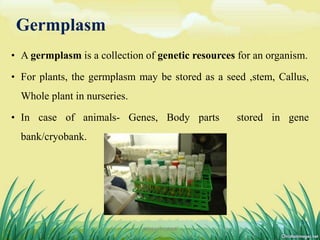
• A germplasm is a collection of genetic resources for an organism.
• For plants, the germplasm may be stored as a seed ,stem, Callus,
Whole plant in nurseries.
• In case of animals- Genes, Body parts stored in gene
bank/cryobank.
3
3DHIRAJ POWAR
Germplasm conservation
• Plant germplasm is genetic source material in the
form of Seeds, Cultured cells ,Callus, Pollens .
• The in-situ /ex-situ preservation of these material is
known as “Germplasm conservation”.
• Germplasm provide the raw material (genes) which
the breeder uses to develop commercial crop
varieties.
4DHIRAJ POWAR
What is the need of Preservation ?
• Preservation/Conservation of plant biodiversity is an important
issue.
• Storage of Economically important , endangered, rare species
and make them available when needed.
• The conventional methods of storage failed to prevent losses
caused due to various reasons.
5DHIRAJ POWAR
Methods of Germplasm conservation
1. In-situ Preservation 2. Ex-situ Preservation
6DHIRAJ POWAR
In-situ Preservation
1. Preservation of the germplasm in their natural habitat
2. The conservation of domesticated and cultivated species in the
farm or in the surroundings.
3. However, there is a heavy loss or decline of species, populations
and ecosystem composition, which can lead to a loss of
biodiversity, due to habitat destruction and the transformations of
these natural environments; therefore, in situ methods alone are
insufficient for saving endangered species.
7DHIRAJ POWAR
Ex-situ preservation
1. To maintain the biological material outside their natural habitats.
2. Storage in seed banks, field gene collections, in vitro collections
and botanical gardens
3. Ex situ conservation is a viable way for saving plants from
extinction, and in some cases, it is the only possible strategy to
conserve certain species
4. In vitro conservation is especially important for vegetatively
propagated and for non-orthodox seed plant species
8DHIRAJ POWAR
• In vitro techniques used to achieve medium-term conservation
allow the storage of biological material from several months to
2–3 years without subculture, depending on the technique used
and on the plant material.
• Growth reduction is generally attained by modifying the
culture medium and/or the environmental conditions.
• Modifications of the culture medium can include dilution of
mineral elements, reduction of sugar concentration, changes in
the nature and/or concentration of growth regulators and
addition of osmotically active compounds
9DHIRAJ POWAR
Disadvantages of Ex-situ Conservation
• Some plants do not produce fertile seeds.
• Loss of seed viability
• Seed destruction by pests, etc.
• Poor germination rate.
• This is only useful for seed propagating plants.
• It’s a costly process.
10DHIRAJ POWAR
Cryopreservation
• Cryopreservation is a non-lethal storage of biological material at
ultra-low temperature.
• At the temperature of liquid Nitrogen (-196 degree) almost all
metabolic activities of cells are ceased and preserved .
• Cryopreservation is the only technique that ensures the safe and
cost-efficient long-term conservation of various categories of plants,
including non-orthodox seed species, vegetatively propagated
plants, rare and endangered species and biotechnology products.
11DHIRAJ POWAR
Principle of Cryopreservation
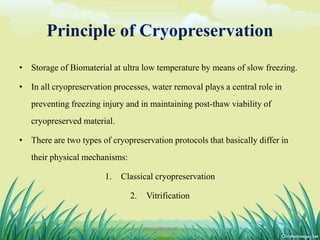
• Storage of Biomaterial at ultra low temperature by means of slow freezing.
• In all cryopreservation processes, water removal plays a central role in
preventing freezing injury and in maintaining post-thaw viability of
cryopreserved material.
• There are two types of cryopreservation protocols that basically differ in
their physical mechanisms:
1. Classical cryopreservation
2. Vitrification
12DHIRAJ POWAR
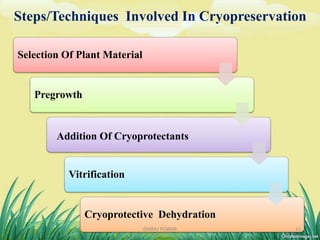
Selection Of Plant Material
Pregrowth
Addition Of Cryoprotectants
Vitrification
Cryoprotective Dehydration
Steps/Techniques Involved In Cryopreservation
13DHIRAJ POWAR
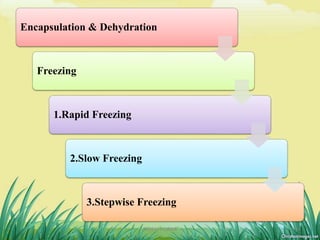
Encapsulation & Dehydration
Freezing
1.Rapid Freezing
2.Slow Freezing
3.Stepwise Freezing
14DHIRAJ POWAR
Storage
Thawing
Determination of
Survival or Viability
15DHIRAJ POWAR
Examples
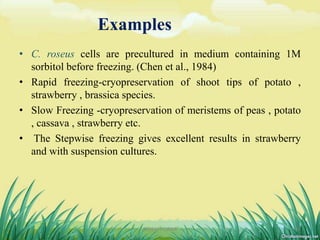
• C. roseus cells are precultured in medium containing 1M
sorbitol before freezing. (Chen et al., 1984)
• Rapid freezing-cryopreservation of shoot tips of potato ,
strawberry , brassica species.
• Slow Freezing -cryopreservation of meristems of peas , potato
, cassava , strawberry etc.
• The Stepwise freezing gives excellent results in strawberry
and with suspension cultures.
16DHIRAJ POWAR
Classical cryopreservation
• In this procedure, cooling is performed in the presence of ice.
• It involves cryoprotection by using different cryoprotective solutions
combined or not with pregrowth of material and followed by slow
cooling (0.5–2.0°C/min) to a determined prefreezing temperature
(usually around −40°C),rapid immersion of samples in liquid nitrogen,
storage, rapid thawing and recovery.
• They are generally operationally complex, since they require the use
of sophisticated and expensive programmable freezers.
• Cryopreservation following classical protocols induces a freeze-
dehydration process using a slow freezing regime.
17DHIRAJ POWAR
• As temperature decrease slowly, ice is initially formed in the
extracellular solution and this external crystallization promotes the
efflux of water from the cytoplasm and vacuoles to the outside of the
cells where it finally freezes.
• Therefore, cell dehydration will depend on the cooling rate and the
prefreezing temperature set up before immersion of samples to liquid
nitrogen.
• Classical cryopreservation techniques have been successfully applied
to undifferentiated culture systems of different plant species, such as
cell suspensions and calluses.
• Successful cryopreservation of apices from tropical species, such as
cassava (Manihot esculenta), is an exceptional example.
18DHIRAJ POWAR
Vitrification
• In this procedure, cooling normally takes place without ice
formation
• The process where formation of ice cannot take place
because of the Concentrated aqueous solution which permit
ice crystal nucleation. Instead, water solidifies into an
amorphous ‘glassy’ state.
• The vitrification-based procedures involve cell dehydration
prior to cooling by exposure of samples to highly concentrated
cryoprotective media (usually called plant vitrification
solutions, PVS) and/or by air desiccation.
19DHIRAJ POWAR
• Cooling rate may be rapid or ultra-rapid, depending on how samples
are immersed into liquid nitrogen.
• Vitrification per se is a physical process, defined as the transition of the
liquid phase to an amorphous glassy solid at the glass transition (Tg)
temperature .
• This glass may contribute to preventing tissue collapse, solute
concentration and pH alterations during dehydration.
• Therefore, the freeze-induced dehydration step characteristic of
classical procedures is eliminated and the slow freezing regime is
replaced by a rapid or ultra-rapid cooling process, characteristic of the
vitrification-based protocols.
20DHIRAJ POWAR
Case study of Mint Cryopreservation
• For initiating in vitro shoot cultures, apical shoots cut from in vivo
explants collected in the field were surface-sterilized in 70% ethanol for
30 s, followed by sodium hypochlorite solution with 2% active chlorine
for 5 min, and then rinsed twice in sterilized distilled water.
• After surface sterilization, shoot tips with basal parts were excised from
the shoots and cultured on 60 ml solid MS 6 media in culture bottles
containing 0.088 M sucrose and 0.4% (w/v) gallon gum without growth
regulators.
• After 30 days, shoots were transferred on solid MS medium as stock
plants, which were subcultured every 2 months on MS medium.
Cultures were incubated at 25±1°C with a 16 h light/8 h dark
photoperiod under white fluorescent light in culture flasks (standard
conditions).
• Then, shoot tips with basal parts were dissected from the shoots and
precultured for 1 day at 25°C on the MS medium with 0.088 M or 0.3
M sucrose. 21DHIRAJ POWAR
1. Pour sodium alginate solution (2 μl) in the wells of the aluminum plate using a
micropipette. The alginate solution contains 2% (w/v) sodium alginate in
calcium-free MS basal medium with or without 0.4 M sucrose.
2. Place the precultured shoot tips in the wells one by one with the tip of a scalpel
blade and slightly press the shoot tips to make them fit in the plate’s wells.
3. Pour the calcium chloride solution drop wise on the section of the aluminum
plate where the shoot tips are located until they are covered and wait for 15 min
to achieve complete polymerization. The calcium solution contains 0.1 M
calcium chloride in MS basal medium with or without 0.4 M sucrose.
4. Remove the calcium solution from the cryo-plate by sucking it gently with a
micropipette.
5. Place the cryo-plate with attached shoot tips in a 25 ml pipetting reservoir filled
with 20 ml loading solution (LS). Shoot tips are osmoprotected at 25°C for 30
min. The LS solution contains 2 M glycerol + 0.6 M to 1.2M sucrose in liquid
MS basal medium.
6. Remove the cryo-plate from LS and place it in a 25 ml pipetting reservoir filled
with PVS2 (about 20 ml). Shoot tips are dehydrated at 25°C for 10 min to 60
min.
7. After dehydration, transfer the cryo-plate in a 2 ml cryotube, which is held on a
cryo-cane, and directly plunge it in LN where it is kept for at least 30 min. 22DHIRAJ POWAR
• For regrowth, cryotubes were retrieved from LN. The cryo-
plates with shoot tips were transferred from the cryotubes and
immersed in 2 ml 1 M sucrose solution in MS basal medium
contained in another 2 ml cryotube.
• Shoot tips were incubated in this solution for 15 min at room
temperature and then transferred on solid MS medium.
• Post-rewarming regrowth(regrowth level) was evaluated after
2 weeks of culture at 25°C under standard conditions by
counting the number of explants that developed normal shoots
23DHIRAJ POWAR
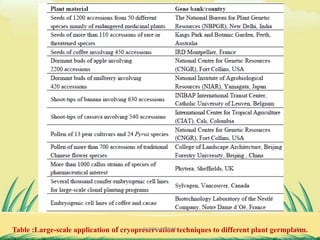
Table :Large-scale application of cryopreservation techniques to different plant germplasm.24DHIRAJ POWAR
Major advantages are :
1. Once the material is successfully conserved to particular
temperature it can be preserved indefinitely.
2. Once in storage no chance of new contamination of fungus or
bacteria.
3. Minimal space required.
4. Minimal labor required.
25DHIRAJ POWAR
Limitation of Germplasm
The expensive equipment needed to provide controlled and
variable rates of cooling/warming temperatures can however be a
limitation in the application of in vitro technology for large scale
germplasm conservation.
Formation of ice crystal inside the cell should be prevented as
they cause injury to the cell.
Sometimes certain solutes from the cell leak out during
freezing.
Cryoprotectant also effect the viability of cells.
26DHIRAJ POWAR
APPLICATIONS
• It is ideal method for long term conservation of material.
• Disease free plants can be conserved and propagated.
• Recalcitrant seeds can be maintained for long time.
• Endangered species can be maintained.
• Pollens can be maintained to increase longitivity.
• Rare germplasm and other genetic manipulations can be
stored.
27DHIRAJ POWAR
28
28DHIRAJ POWAR

Germ plasm conservation

  • 1.
    Germ-plasm Conservation By- Dhiraj Powar PRIYADARSHINIINSTITUTE ENGINEERING AND TECHNOLOGY NAGPUR DEPARTMENT OF BIOTECHNOLOGY 1DHIRAJ POWAR
  • 2.
    Germplasm Need Of Preservation Techniques Applications Cryopreservation TissueCulture Contents Seed bank Cryo-protectent Advantages Disadvantages Low-temperature 2DHIRAJ POWAR
  • 3.
    Germplasm • A germplasmis a collection of genetic resources for an organism. • For plants, the germplasm may be stored as a seed ,stem, Callus, Whole plant in nurseries. • In case of animals- Genes, Body parts stored in gene bank/cryobank. 3 3DHIRAJ POWAR
  • 4.
    Germplasm conservation • Plantgermplasm is genetic source material in the form of Seeds, Cultured cells ,Callus, Pollens . • The in-situ /ex-situ preservation of these material is known as “Germplasm conservation”. • Germplasm provide the raw material (genes) which the breeder uses to develop commercial crop varieties. 4DHIRAJ POWAR
  • 5.
    What is theneed of Preservation ? • Preservation/Conservation of plant biodiversity is an important issue. • Storage of Economically important , endangered, rare species and make them available when needed. • The conventional methods of storage failed to prevent losses caused due to various reasons. 5DHIRAJ POWAR
  • 6.
    Methods of Germplasmconservation 1. In-situ Preservation 2. Ex-situ Preservation 6DHIRAJ POWAR
  • 7.
    In-situ Preservation 1. Preservationof the germplasm in their natural habitat 2. The conservation of domesticated and cultivated species in the farm or in the surroundings. 3. However, there is a heavy loss or decline of species, populations and ecosystem composition, which can lead to a loss of biodiversity, due to habitat destruction and the transformations of these natural environments; therefore, in situ methods alone are insufficient for saving endangered species. 7DHIRAJ POWAR
  • 8.
    Ex-situ preservation 1. Tomaintain the biological material outside their natural habitats. 2. Storage in seed banks, field gene collections, in vitro collections and botanical gardens 3. Ex situ conservation is a viable way for saving plants from extinction, and in some cases, it is the only possible strategy to conserve certain species 4. In vitro conservation is especially important for vegetatively propagated and for non-orthodox seed plant species 8DHIRAJ POWAR
  • 9.
    • In vitrotechniques used to achieve medium-term conservation allow the storage of biological material from several months to 2–3 years without subculture, depending on the technique used and on the plant material. • Growth reduction is generally attained by modifying the culture medium and/or the environmental conditions. • Modifications of the culture medium can include dilution of mineral elements, reduction of sugar concentration, changes in the nature and/or concentration of growth regulators and addition of osmotically active compounds 9DHIRAJ POWAR
  • 10.
    Disadvantages of Ex-situConservation • Some plants do not produce fertile seeds. • Loss of seed viability • Seed destruction by pests, etc. • Poor germination rate. • This is only useful for seed propagating plants. • It’s a costly process. 10DHIRAJ POWAR
  • 11.
    Cryopreservation • Cryopreservation isa non-lethal storage of biological material at ultra-low temperature. • At the temperature of liquid Nitrogen (-196 degree) almost all metabolic activities of cells are ceased and preserved . • Cryopreservation is the only technique that ensures the safe and cost-efficient long-term conservation of various categories of plants, including non-orthodox seed species, vegetatively propagated plants, rare and endangered species and biotechnology products. 11DHIRAJ POWAR
  • 12.
    Principle of Cryopreservation •Storage of Biomaterial at ultra low temperature by means of slow freezing. • In all cryopreservation processes, water removal plays a central role in preventing freezing injury and in maintaining post-thaw viability of cryopreserved material. • There are two types of cryopreservation protocols that basically differ in their physical mechanisms: 1. Classical cryopreservation 2. Vitrification 12DHIRAJ POWAR
  • 13.
    Selection Of PlantMaterial Pregrowth Addition Of Cryoprotectants Vitrification Cryoprotective Dehydration Steps/Techniques Involved In Cryopreservation 13DHIRAJ POWAR
  • 14.
    Encapsulation & Dehydration Freezing 1.RapidFreezing 2.Slow Freezing 3.Stepwise Freezing 14DHIRAJ POWAR
  • 15.
  • 16.
    Examples • C. roseuscells are precultured in medium containing 1M sorbitol before freezing. (Chen et al., 1984) • Rapid freezing-cryopreservation of shoot tips of potato , strawberry , brassica species. • Slow Freezing -cryopreservation of meristems of peas , potato , cassava , strawberry etc. • The Stepwise freezing gives excellent results in strawberry and with suspension cultures. 16DHIRAJ POWAR
  • 17.
    Classical cryopreservation • Inthis procedure, cooling is performed in the presence of ice. • It involves cryoprotection by using different cryoprotective solutions combined or not with pregrowth of material and followed by slow cooling (0.5–2.0°C/min) to a determined prefreezing temperature (usually around −40°C),rapid immersion of samples in liquid nitrogen, storage, rapid thawing and recovery. • They are generally operationally complex, since they require the use of sophisticated and expensive programmable freezers. • Cryopreservation following classical protocols induces a freeze- dehydration process using a slow freezing regime. 17DHIRAJ POWAR
  • 18.
    • As temperaturedecrease slowly, ice is initially formed in the extracellular solution and this external crystallization promotes the efflux of water from the cytoplasm and vacuoles to the outside of the cells where it finally freezes. • Therefore, cell dehydration will depend on the cooling rate and the prefreezing temperature set up before immersion of samples to liquid nitrogen. • Classical cryopreservation techniques have been successfully applied to undifferentiated culture systems of different plant species, such as cell suspensions and calluses. • Successful cryopreservation of apices from tropical species, such as cassava (Manihot esculenta), is an exceptional example. 18DHIRAJ POWAR
  • 19.
    Vitrification • In thisprocedure, cooling normally takes place without ice formation • The process where formation of ice cannot take place because of the Concentrated aqueous solution which permit ice crystal nucleation. Instead, water solidifies into an amorphous ‘glassy’ state. • The vitrification-based procedures involve cell dehydration prior to cooling by exposure of samples to highly concentrated cryoprotective media (usually called plant vitrification solutions, PVS) and/or by air desiccation. 19DHIRAJ POWAR
  • 20.
    • Cooling ratemay be rapid or ultra-rapid, depending on how samples are immersed into liquid nitrogen. • Vitrification per se is a physical process, defined as the transition of the liquid phase to an amorphous glassy solid at the glass transition (Tg) temperature . • This glass may contribute to preventing tissue collapse, solute concentration and pH alterations during dehydration. • Therefore, the freeze-induced dehydration step characteristic of classical procedures is eliminated and the slow freezing regime is replaced by a rapid or ultra-rapid cooling process, characteristic of the vitrification-based protocols. 20DHIRAJ POWAR
  • 21.
    Case study ofMint Cryopreservation • For initiating in vitro shoot cultures, apical shoots cut from in vivo explants collected in the field were surface-sterilized in 70% ethanol for 30 s, followed by sodium hypochlorite solution with 2% active chlorine for 5 min, and then rinsed twice in sterilized distilled water. • After surface sterilization, shoot tips with basal parts were excised from the shoots and cultured on 60 ml solid MS 6 media in culture bottles containing 0.088 M sucrose and 0.4% (w/v) gallon gum without growth regulators. • After 30 days, shoots were transferred on solid MS medium as stock plants, which were subcultured every 2 months on MS medium. Cultures were incubated at 25±1°C with a 16 h light/8 h dark photoperiod under white fluorescent light in culture flasks (standard conditions). • Then, shoot tips with basal parts were dissected from the shoots and precultured for 1 day at 25°C on the MS medium with 0.088 M or 0.3 M sucrose. 21DHIRAJ POWAR
  • 22.
    1. Pour sodiumalginate solution (2 μl) in the wells of the aluminum plate using a micropipette. The alginate solution contains 2% (w/v) sodium alginate in calcium-free MS basal medium with or without 0.4 M sucrose. 2. Place the precultured shoot tips in the wells one by one with the tip of a scalpel blade and slightly press the shoot tips to make them fit in the plate’s wells. 3. Pour the calcium chloride solution drop wise on the section of the aluminum plate where the shoot tips are located until they are covered and wait for 15 min to achieve complete polymerization. The calcium solution contains 0.1 M calcium chloride in MS basal medium with or without 0.4 M sucrose. 4. Remove the calcium solution from the cryo-plate by sucking it gently with a micropipette. 5. Place the cryo-plate with attached shoot tips in a 25 ml pipetting reservoir filled with 20 ml loading solution (LS). Shoot tips are osmoprotected at 25°C for 30 min. The LS solution contains 2 M glycerol + 0.6 M to 1.2M sucrose in liquid MS basal medium. 6. Remove the cryo-plate from LS and place it in a 25 ml pipetting reservoir filled with PVS2 (about 20 ml). Shoot tips are dehydrated at 25°C for 10 min to 60 min. 7. After dehydration, transfer the cryo-plate in a 2 ml cryotube, which is held on a cryo-cane, and directly plunge it in LN where it is kept for at least 30 min. 22DHIRAJ POWAR
  • 23.
    • For regrowth,cryotubes were retrieved from LN. The cryo- plates with shoot tips were transferred from the cryotubes and immersed in 2 ml 1 M sucrose solution in MS basal medium contained in another 2 ml cryotube. • Shoot tips were incubated in this solution for 15 min at room temperature and then transferred on solid MS medium. • Post-rewarming regrowth(regrowth level) was evaluated after 2 weeks of culture at 25°C under standard conditions by counting the number of explants that developed normal shoots 23DHIRAJ POWAR
  • 24.
    Table :Large-scale applicationof cryopreservation techniques to different plant germplasm.24DHIRAJ POWAR
  • 25.
    Major advantages are: 1. Once the material is successfully conserved to particular temperature it can be preserved indefinitely. 2. Once in storage no chance of new contamination of fungus or bacteria. 3. Minimal space required. 4. Minimal labor required. 25DHIRAJ POWAR
  • 26.
    Limitation of Germplasm Theexpensive equipment needed to provide controlled and variable rates of cooling/warming temperatures can however be a limitation in the application of in vitro technology for large scale germplasm conservation. Formation of ice crystal inside the cell should be prevented as they cause injury to the cell. Sometimes certain solutes from the cell leak out during freezing. Cryoprotectant also effect the viability of cells. 26DHIRAJ POWAR
  • 27.
    APPLICATIONS • It isideal method for long term conservation of material. • Disease free plants can be conserved and propagated. • Recalcitrant seeds can be maintained for long time. • Endangered species can be maintained. • Pollens can be maintained to increase longitivity. • Rare germplasm and other genetic manipulations can be stored. 27DHIRAJ POWAR
  • 28.