Cleanrooms and GMP
Design of Pharmaceutical
Facilities
Cleanrooms
Process design
Layoutsand Flow Diagrams
OSD Facilities
By: Dr. Mohammed Abdeen
Pharm. PhD
Pharmaceutics VII
Current Good Manufacturing Practices
(cGM)
2
• c G MP is a set of regulations published by the US Food
and Drug Administration (FDA)
• Most national and international agencies regulating
pharma industry have similar regulations or guidelines
• cGMP regulations cover many aspects: organization
and personnel, building and facilities, equipment,
control of components, production controls,
packaging and labeling controls, laboratory controls
etc.
Clean Rooms
Classification and Design
4
• Cleanrooms provide for the control of airborne contamination to
levels appropriate for accomplishing contamination-sensitive
activities.
– Aerospace,
– Microelectronics,
– Pharmaceuticals,
– Medical devices,
– Healthcare (Hospitals)
– Food.
Introduction:
5
• Cleanroom can be defined through 2 areas:
 Control: A space where the number of
airborne particles are measured. A space
where other environmental factors are
controlled (humidity, temperature, pressure)
 Design: An enclosed space constructed in a
way to minimise the introduction, generation
and retention of particles.
What Is A Cleanroom?
6
• Particle: Solid or liquid object which, for purposes of
classification of air cleanliness, falls within a threshold size in the
range from 0.1 to 5μm
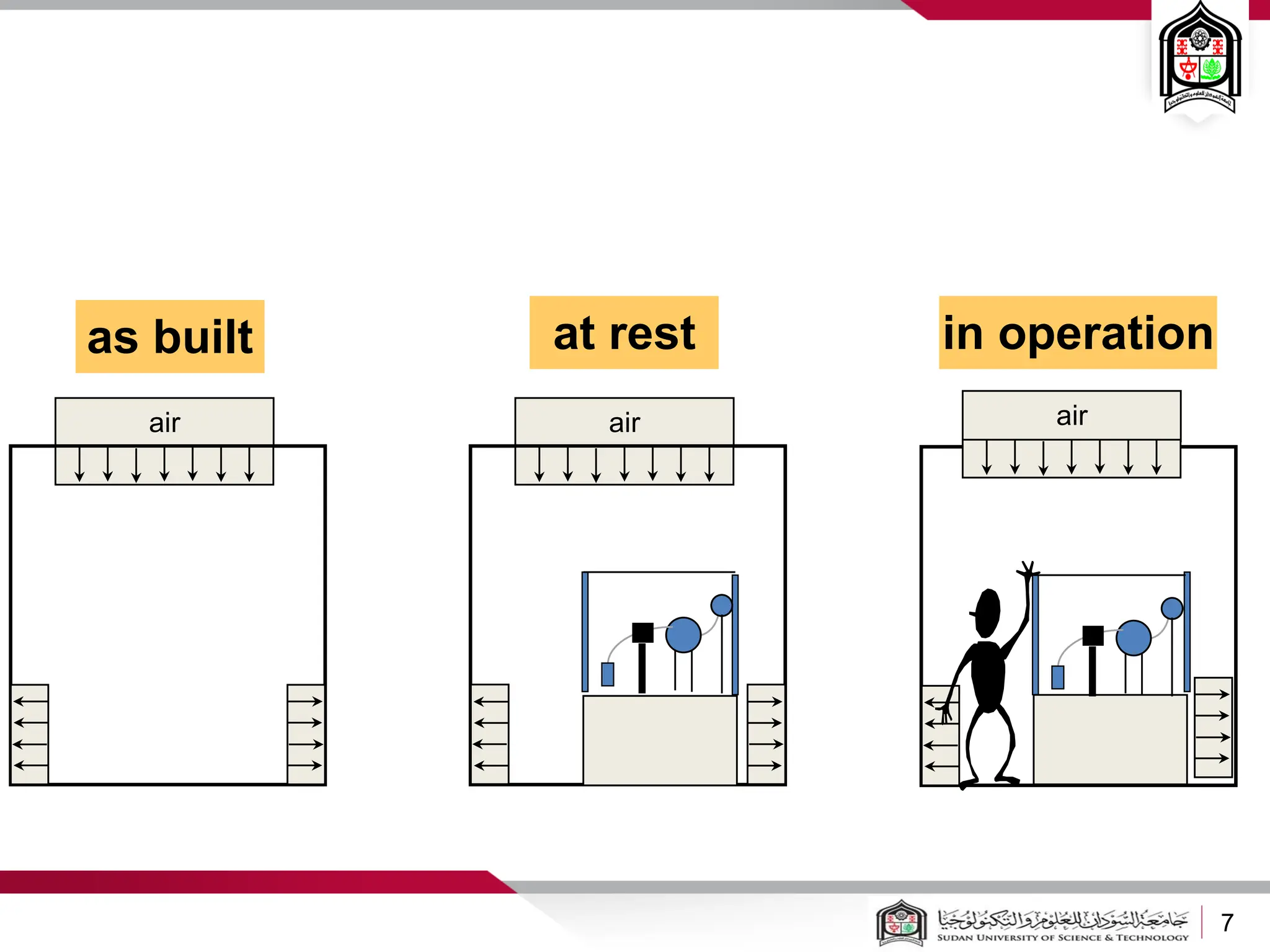
• Occupancy states:
• As-built: installation is complete, all services functioning, no
production equipment, materials, or personnel present
• At-rest: equipment installed and operating in a manner
agreed upon the customer and supplier, but with no
personnel present
• Operational: the installation is functioning in the specified
manner, specified number of personnel present and working
Definitions
7
air
as built
air air
at rest in operation
8
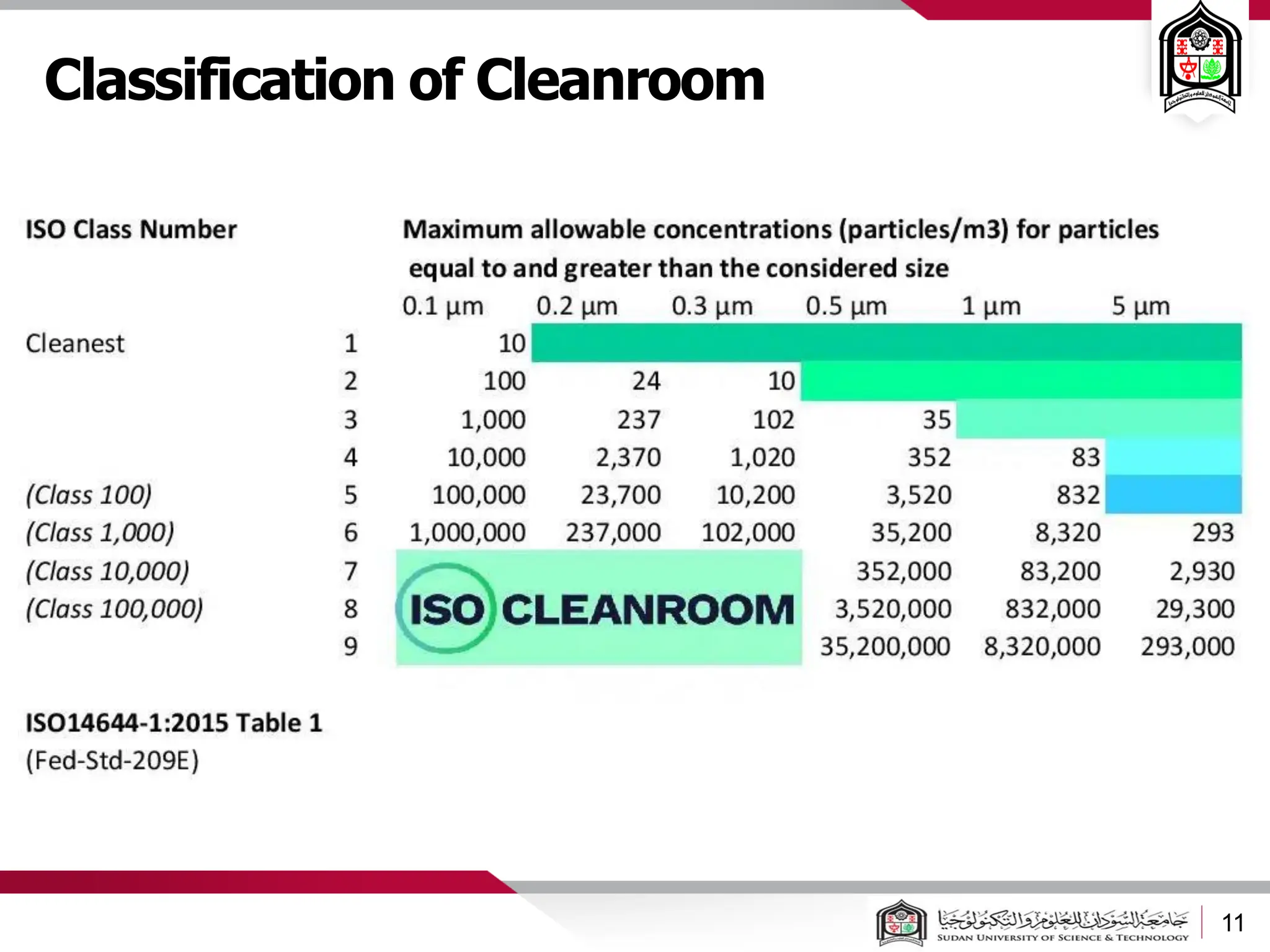
• Classification:
level of airborne particulate cleanliness, represents
maximum allowable concentrations (in particles
per cubic metre of air) for considered sizes of
particles
• There are 9 ISO classifications, ISO 1, ISO 2, ISO 3,
……, and ISO 9.
• ISO 1 is considered the cleanest while ISO 9 is
considered the dirtiest.
Classification of Cleanroom
9
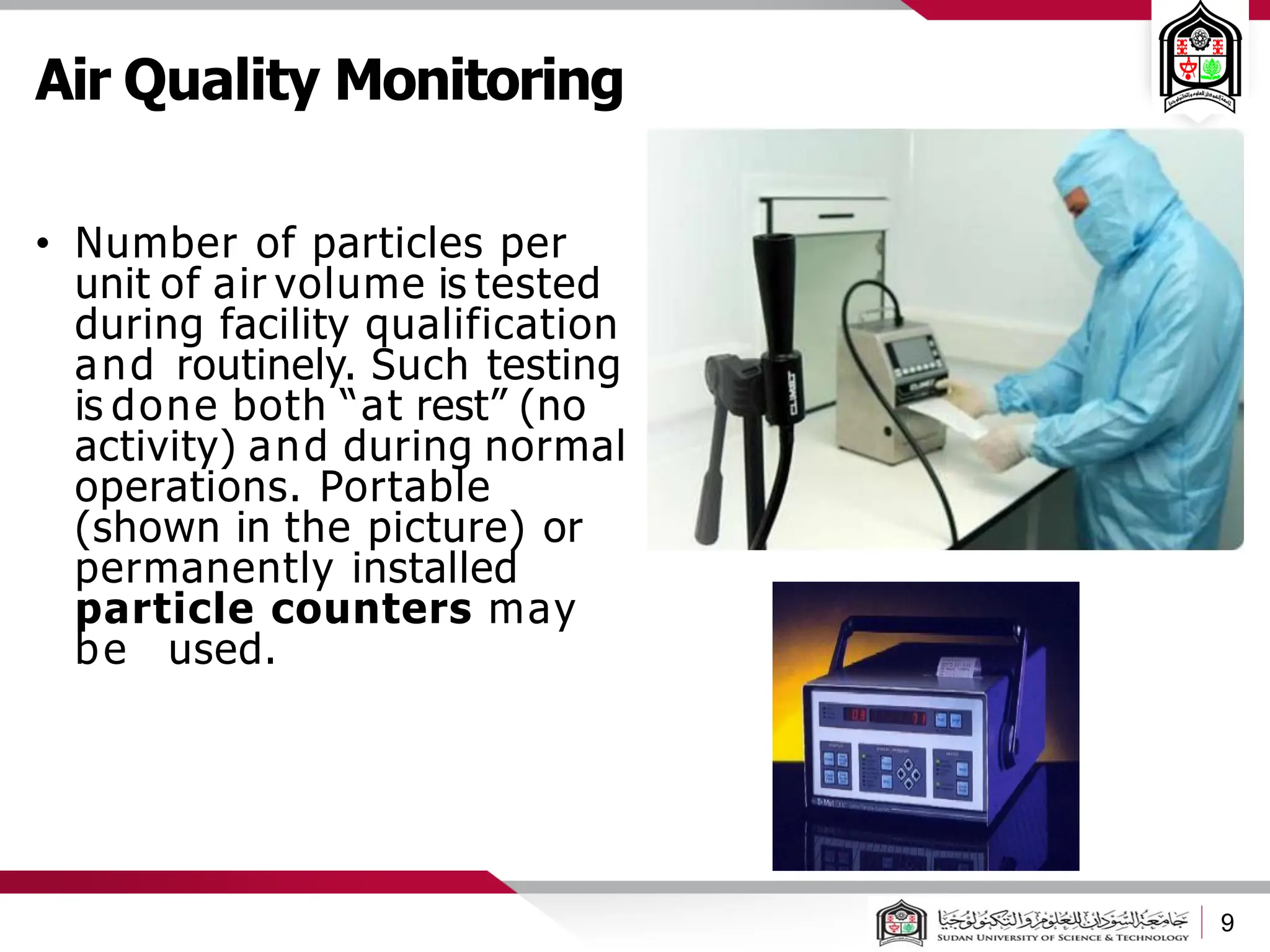
Air Quality Monitoring
• Number of particles per
unit of air volume is tested
during facility qualification
and routinely. Such testing
is done both “at rest” (no
activity) and during normal
operations. Portable
(shown in the picture) or
permanently installed
particle counters may
be used.
10
• The particulate cleanliness of air shall be defined in one
or more of three occupancy states, viz. “as-built”, “at-
rest”, or “operational”
• The maximum permitted concentration of particles, Cn,
for each considered particle size, D,
• In which, N is the ISO classification number, which shall
not exceed a value of 9. (ISO Class 1 to 9)
Classification of Cleanroom
11
Classification of Cleanroom
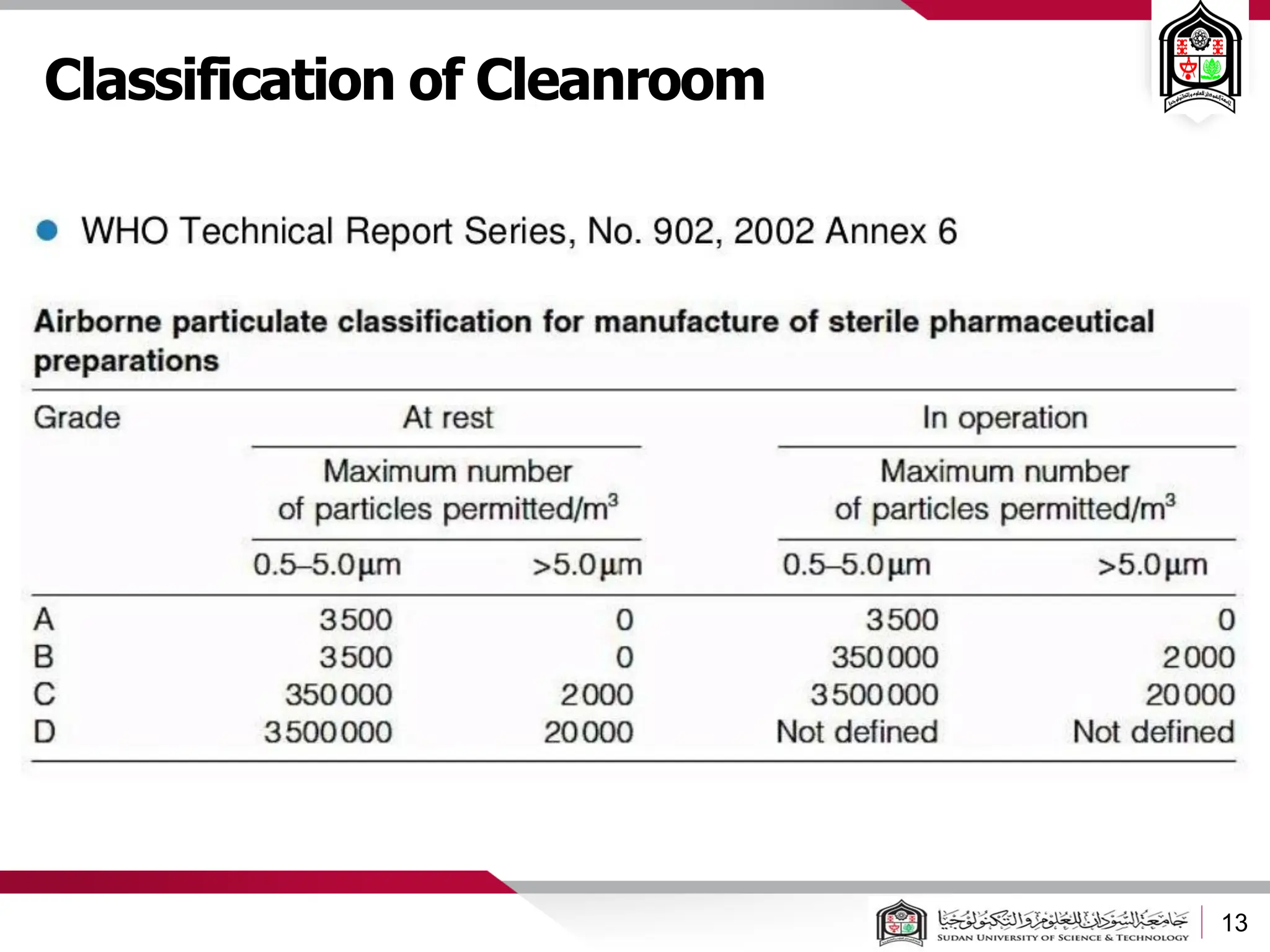
12
Classification of Cleanroom
13
Classification of Cleanroom
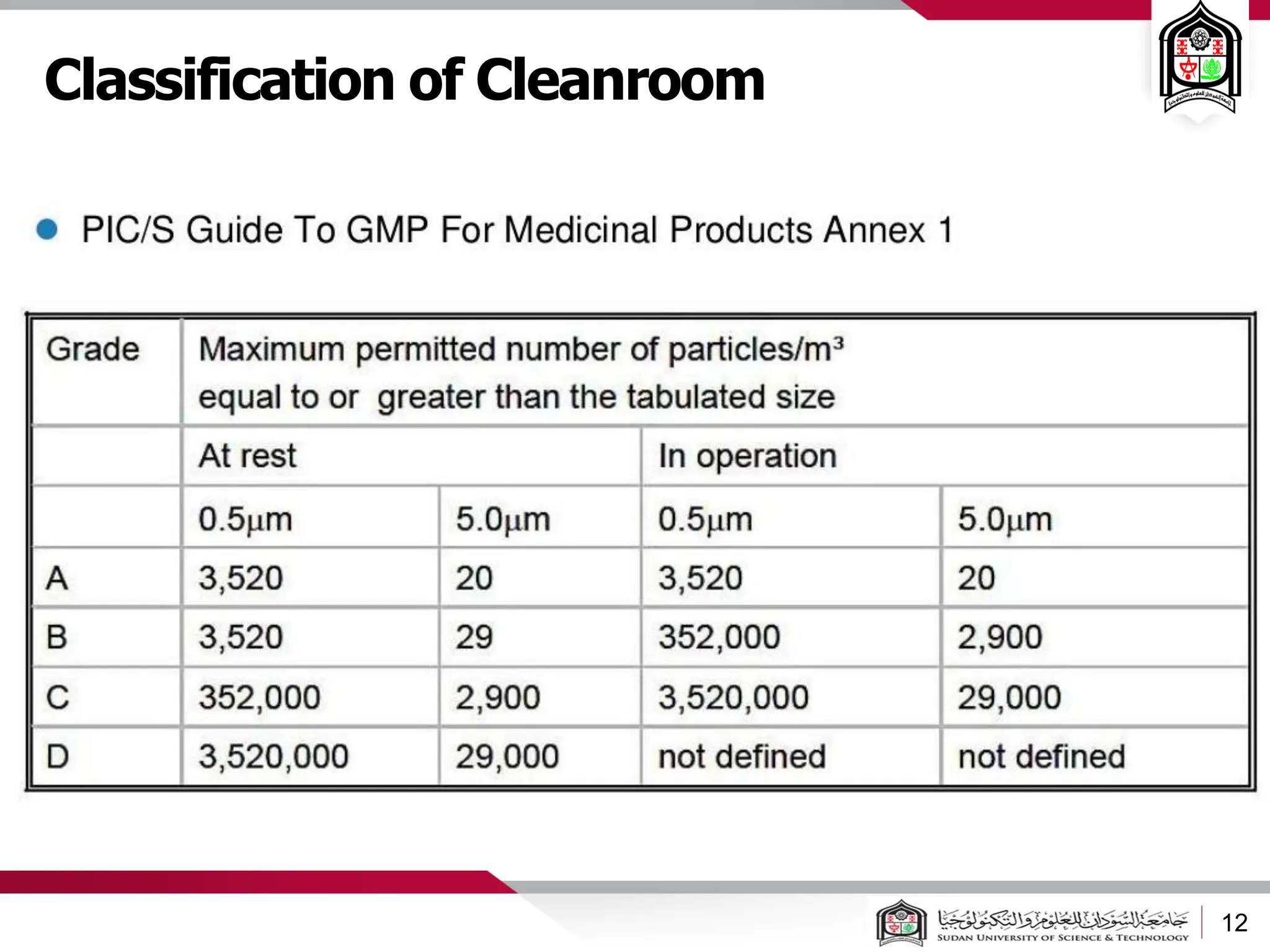
Classification of Clean Rooms
14
Grade Particles/m3 ≥
0.5 µm ISO Class
At rest In operation
A 3,520 3,520 5
B 3,520 352,000 5at rest
7in operation
C 352,000 3,520,000 7at rest
8in operation
D 3,520,000 Not defined 8at rest
Classification of Cleanroom
15
• Typically, semi conductor, advanced engineering,
optics, laser and electronics require an ISO 5
cleanroom along with pharmaceutical and
medical devise companies. The reasons that
companies require these facilities vary from yield
(money) to safety (regulation).
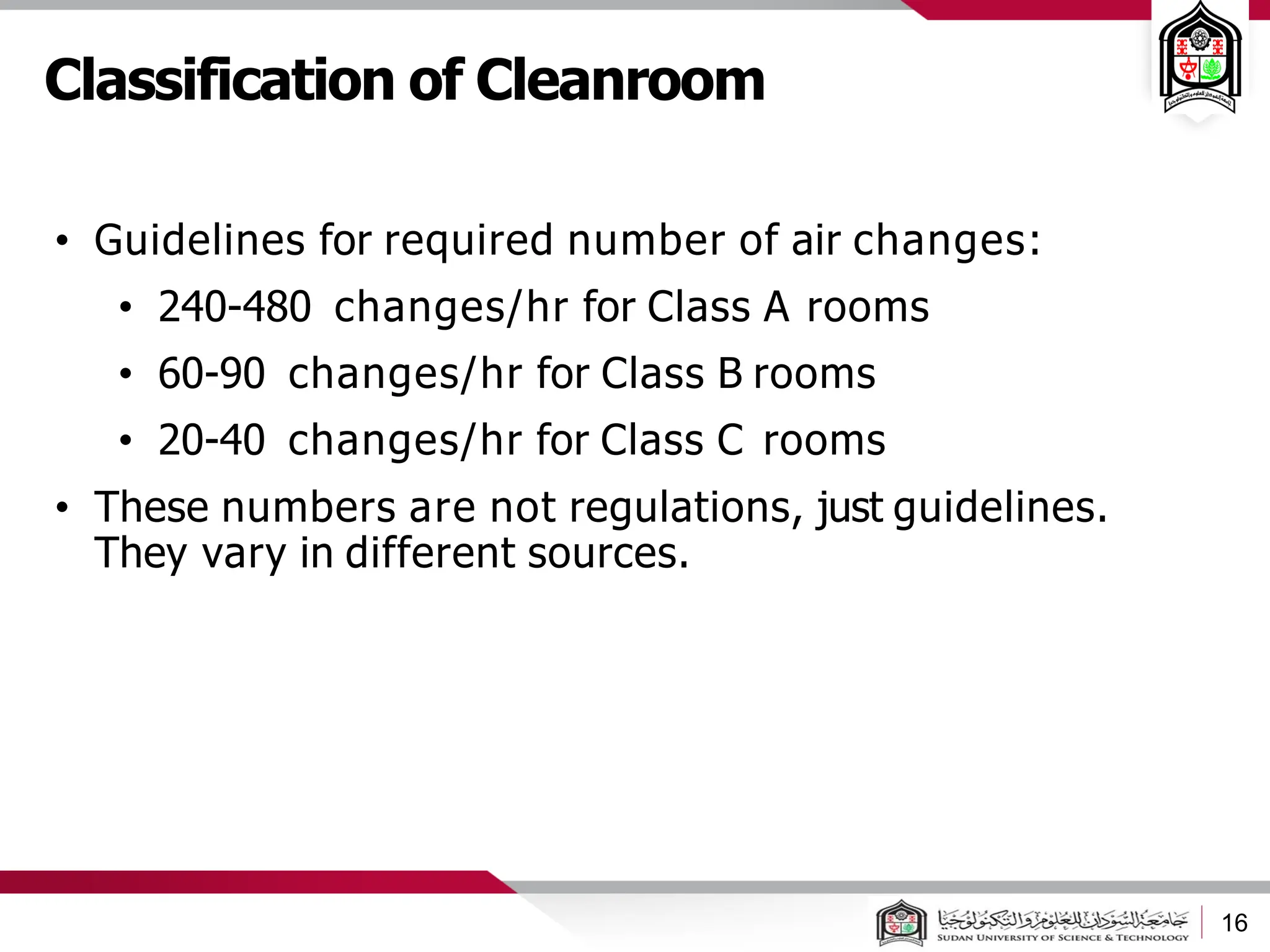
Classification of Cleanroom
16
• Guidelines for required number of air changes:
• 240-480 changes/hr for Class A rooms
• 60-90 changes/hr for Class B rooms
• 20-40 changes/hr for Class C rooms
• These numbers are not regulations, just guidelines.
They vary in different sources.
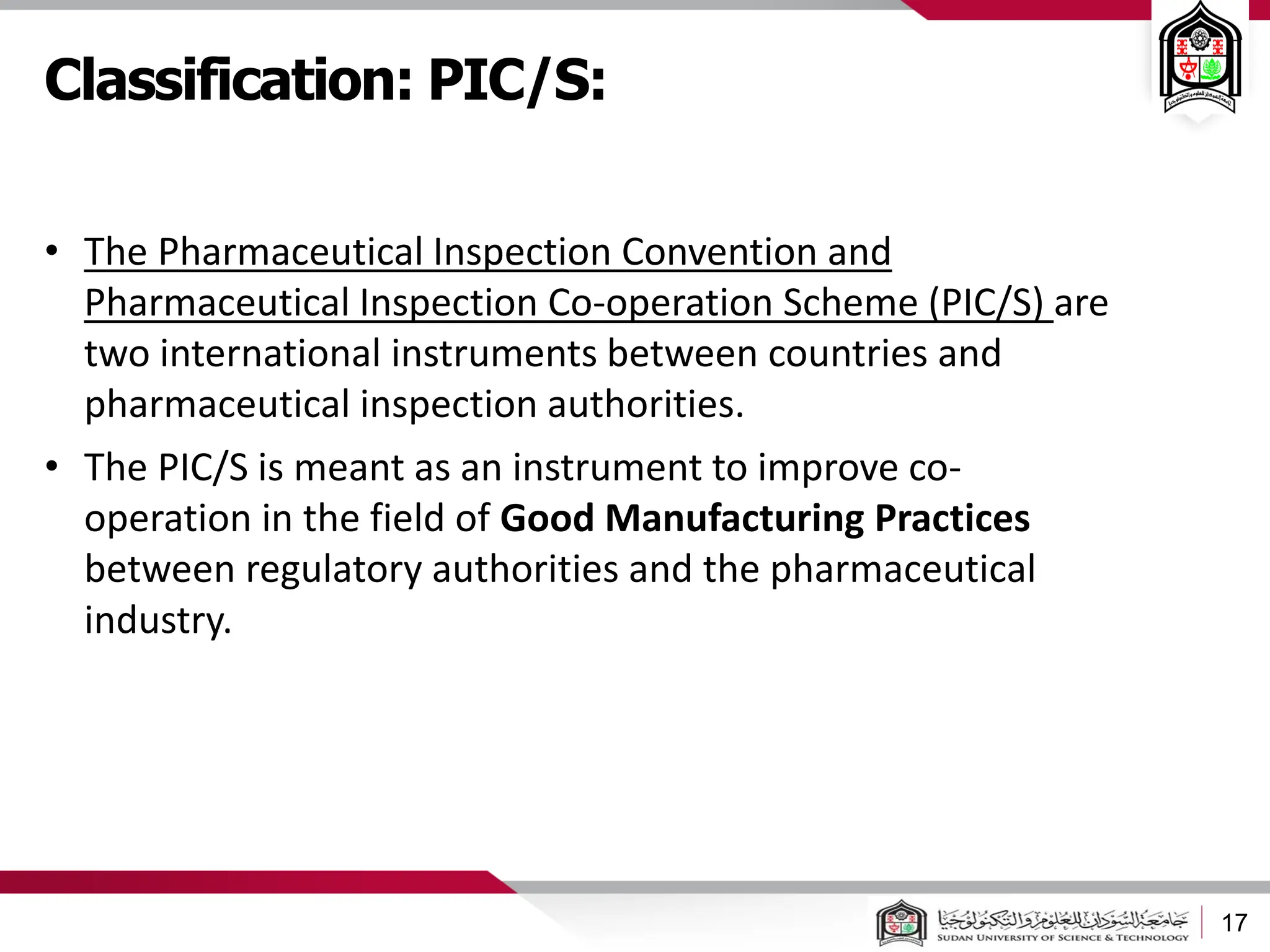
Classification: PIC/S:
17
• The Pharmaceutical Inspection Convention and
Pharmaceutical Inspection Co-operation Scheme (PIC/S) are
two international instruments between countries and
pharmaceutical inspection authorities.
• The PIC/S is meant as an instrument to improve co-
operation in the field of Good Manufacturing Practices
between regulatory authorities and the pharmaceutical
industry.
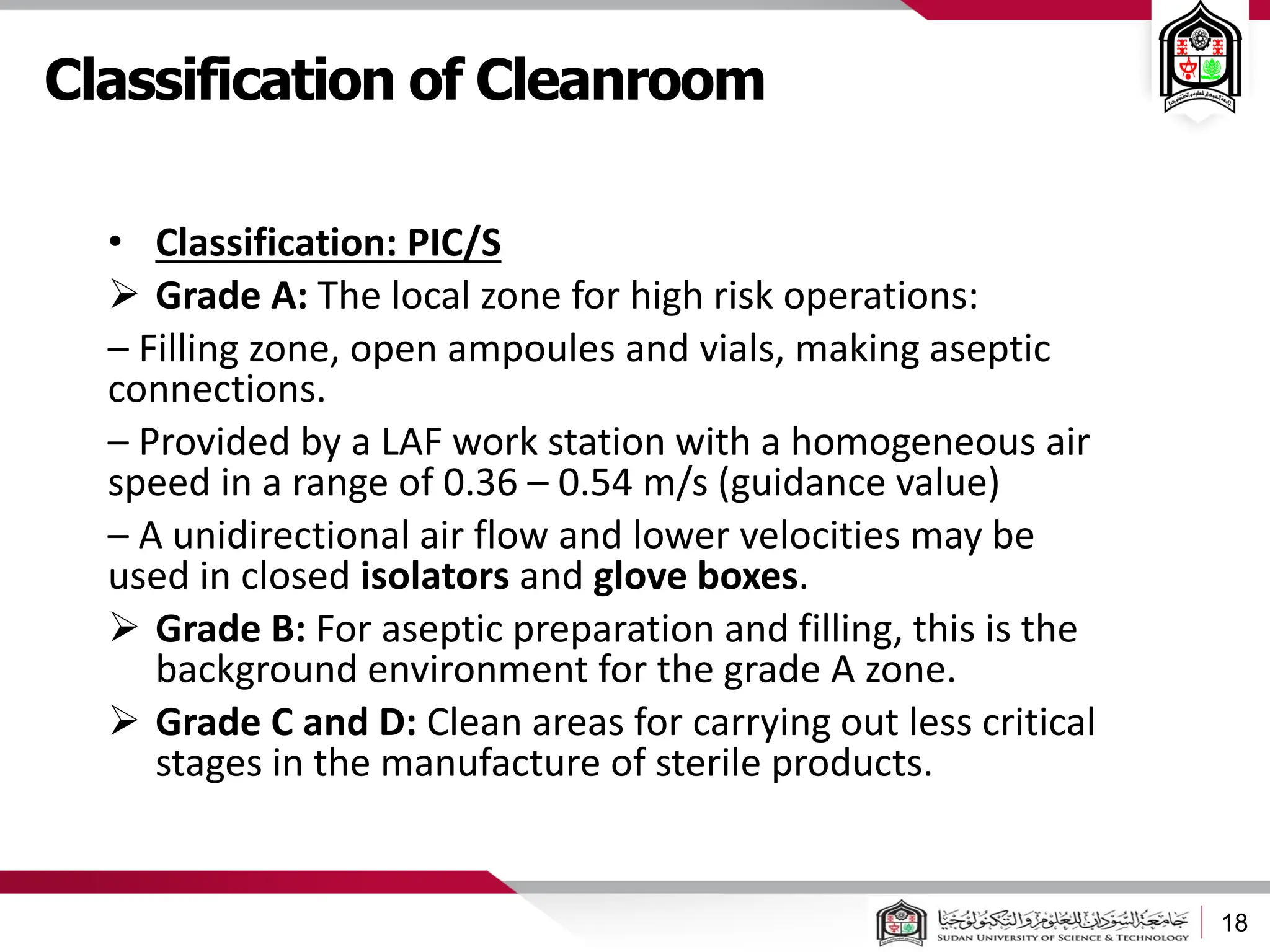
Classification of Cleanroom
18
• Classification: PIC/S
 Grade A: The local zone for high risk operations:
– Filling zone, open ampoules and vials, making aseptic
connections.
– Provided by a LAF work station with a homogeneous air
speed in a range of 0.36 – 0.54 m/s (guidance value)
– A unidirectional air flow and lower velocities may be
used in closed isolators and glove boxes.
 Grade B: For aseptic preparation and filling, this is the
background environment for the grade A zone.
 Grade C and D: Clean areas for carrying out less critical
stages in the manufacture of sterile products.
PIC/S General Paragraphs
19
 Clean Areas:
• Entry through airlocks for personnel and/or for
equipment and materials.
• Supplied with air has passed through filters of
an appropriate efficiency.
 The various operations of component preparation,
product preparation and filling in separate
areas within the clean area
 Manufacturing operations:
1. Product is terminally sterilized,
2. Conducted aseptically at some or all stages.
 In order to meet “in operation” conditions, areas
should be designed to reach certain air-cleanliness
levels in the “at rest” occupancy state.
PIC/S General Paragraphs
20
1- Terminally Sterilized Products
 Preparation of components and most products should be
done in at least a grade D environment
 Where the product is at a high or unusual risk of
microbial contamination Grade C
 Filling of products for terminal sterilization Grade C
• Where the product is at unusual risk of contamination
from the environment, filling Grade A with Grade C
background.
 Preparation and filling of ointments, creams, suspensions
and emulsions should grade C before terminal
sterilization
PIC/S General Paragraphs
21
2- Aseptic Preparation
 Components after washing Grade D
 Handling of sterile starting materials, unless
subjected to sterilization or filtration Grade A
with Grade B background.
 Otherwise Grade C
 Handling and filling of aseptically prepared
products Grade A
 Transfer of partially closed containers, as used in
freeze drying, either in a Grade A environment
with grade B background or in sealed transfer trays
in a grade B environment
Process and facility design
Layouts and Flow Diagrams
GMP Requirements Highlights
23
• Building shall be of suitable size, location
and construction, easily cleanable and
maintainable
• Building shall be designed to prevent equipment and
material mix-ups and contamination
• Separate areas shall be provided for different
operations
• Provide adequate control of air pressure,
microorganisms, dust, humidity and temperature as
appropriate
• Written procedures required for cleaning and sanitation
Process and Facility Design
24
• Facility design and layout must satisfy:
• Process requirements
• Personnel flows
• Material flows (raw materials and products)
• Equipment layout requirements
• Operational access requirements
• Maintenance access requirements
• Facility should be designed around process needs!
Planning and Design considerations
25
• A project plan shall be developed to define the requirements of
the products, the processes and the scope of the installation.
• A process equipment list shall be compiled, and shall include the
critical requirements for each piece of process equipment.
• Diversity factors shall be defined, considering peak and average
demand for each utility and environmental control system.
• A contamination control concept shall be developed for each
zone of an installation.
Planning and Design considerations
26
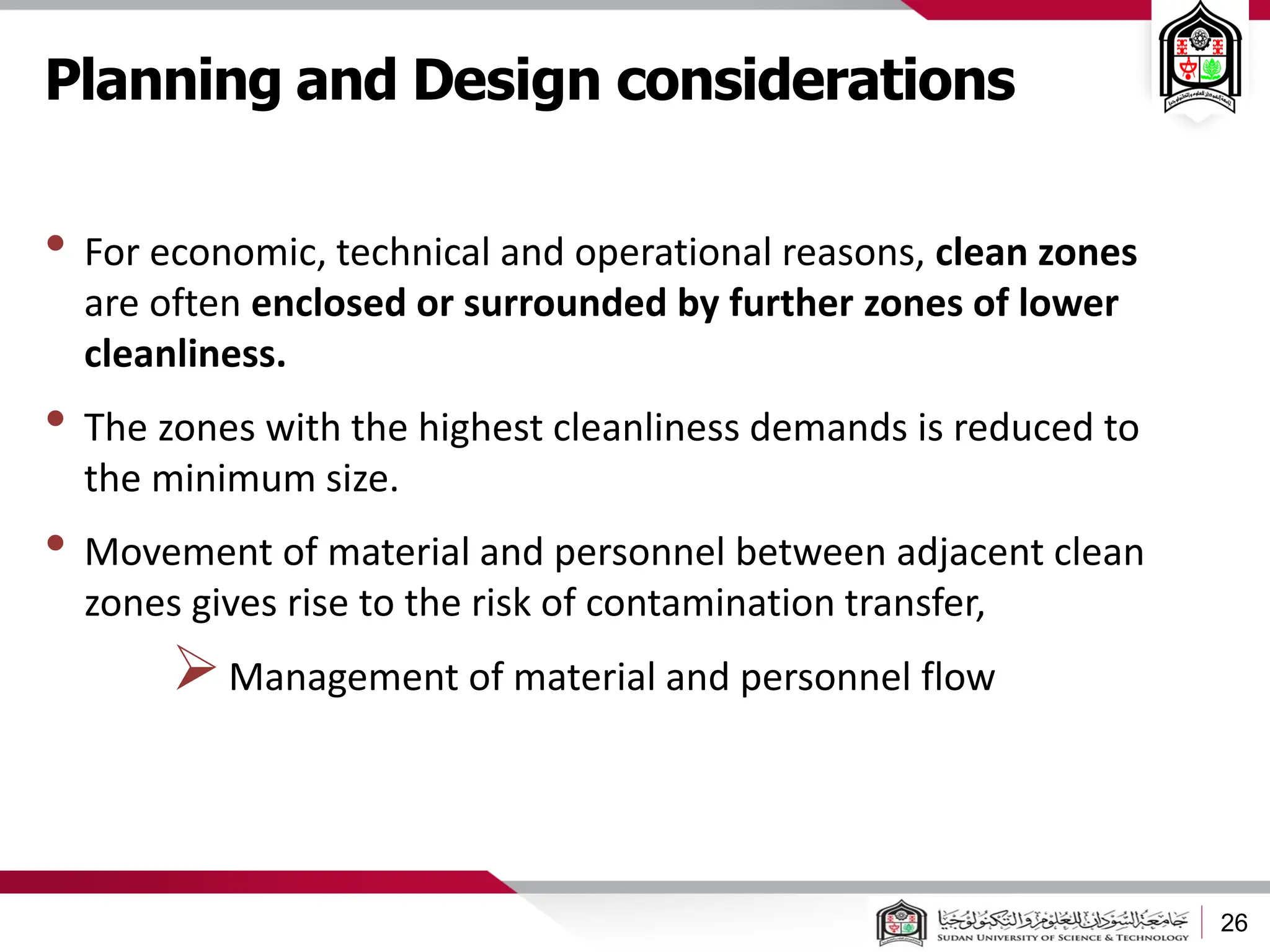
• For economic, technical and operational reasons, clean zones
are often enclosed or surrounded by further zones of lower
cleanliness.
• The zones with the highest cleanliness demands is reduced to
the minimum size.
• Movement of material and personnel between adjacent clean
zones gives rise to the risk of contamination transfer,
Management of material and personnel flow
27
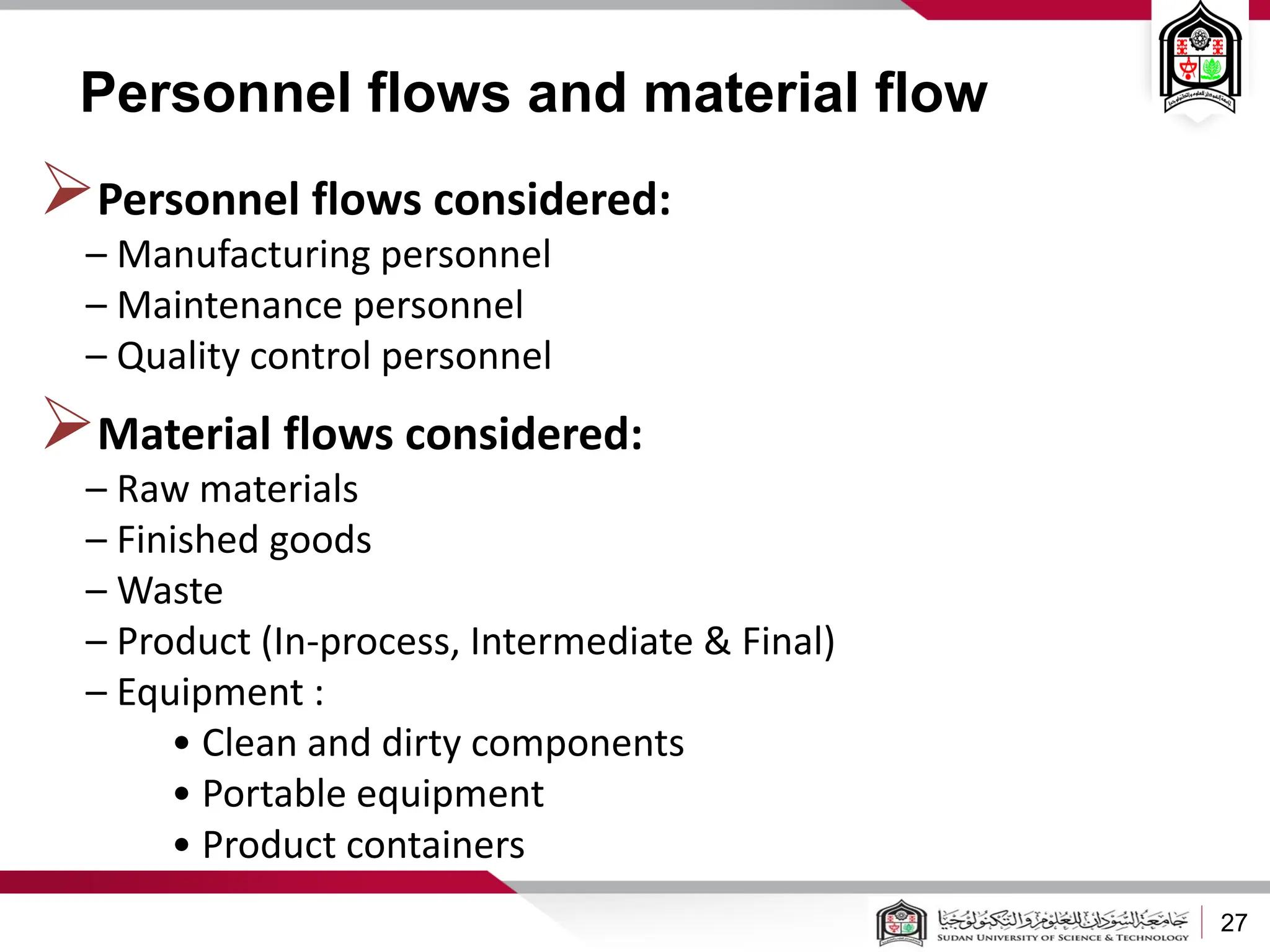
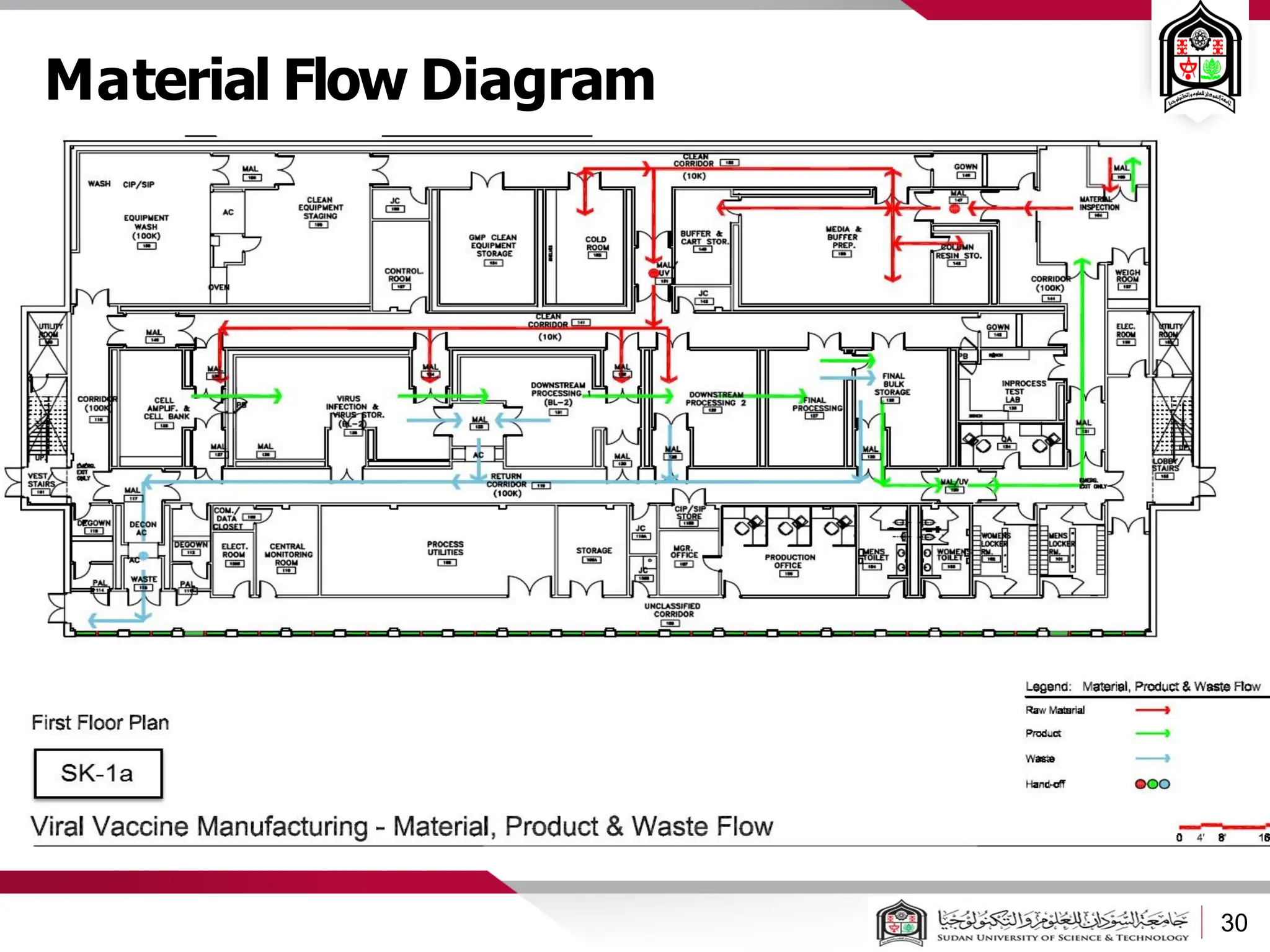
Personnel flows and material flow
Personnel flows considered:
– Manufacturing personnel
– Maintenance personnel
– Quality control personnel
Material flows considered:
– Raw materials
– Finished goods
– Waste
– Product (In-process, Intermediate & Final)
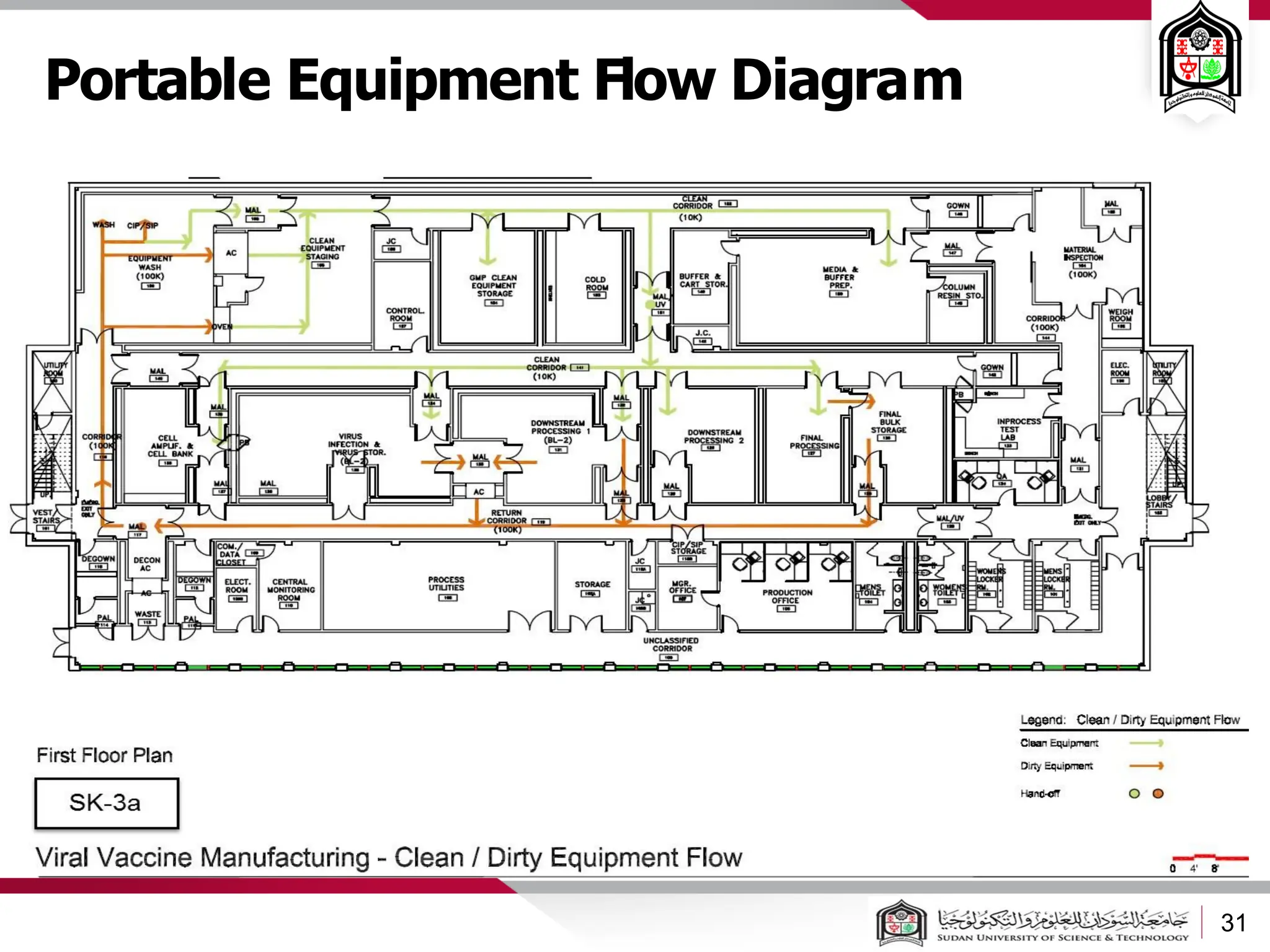
– Equipment :
• Clean and dirty components
• Portable equipment
• Product containers
28
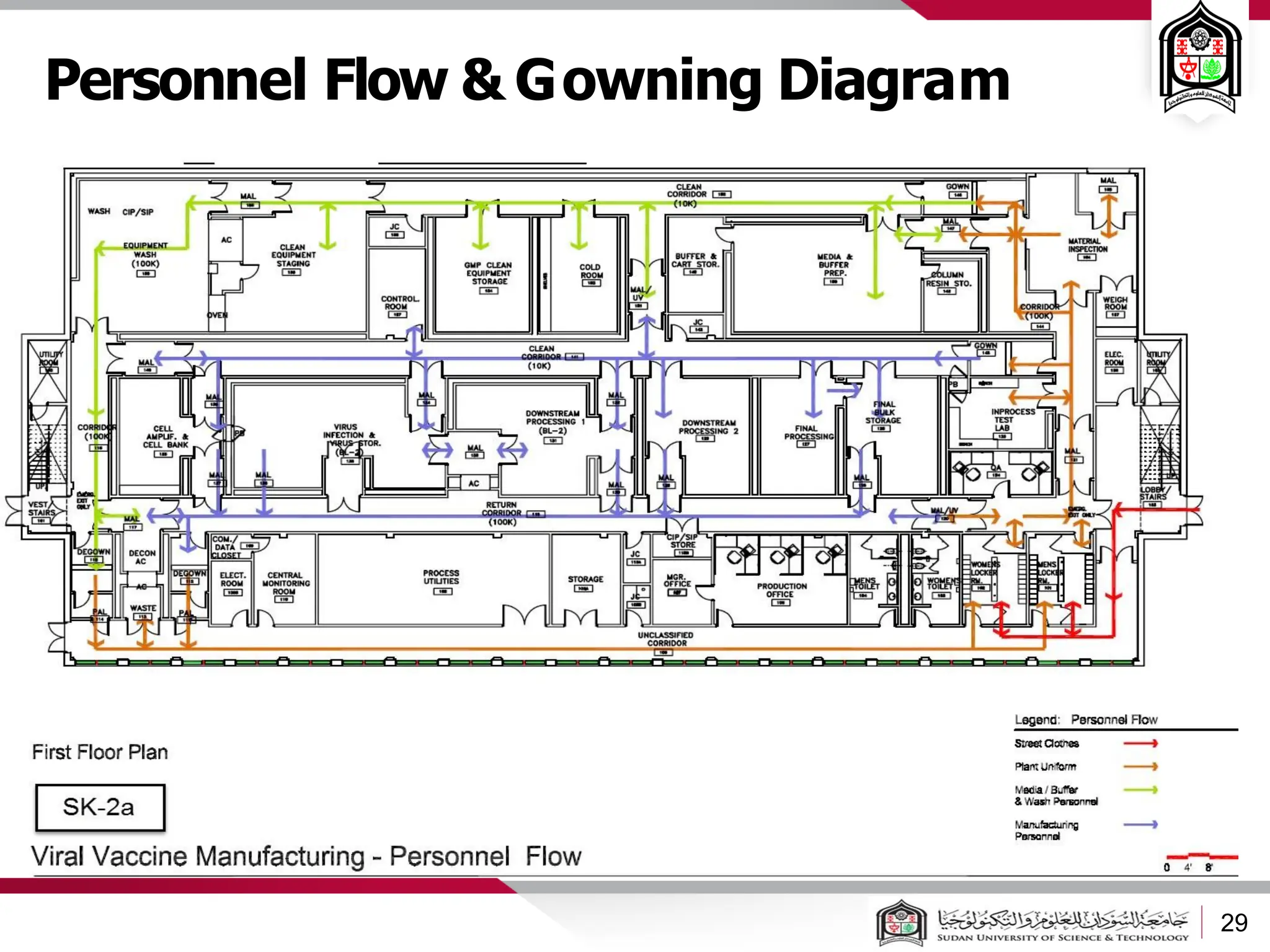
Personnel Flow & Gowning Diagram
29
Material Flow Diagram
30
Portable Equipment Flow Diagram
31
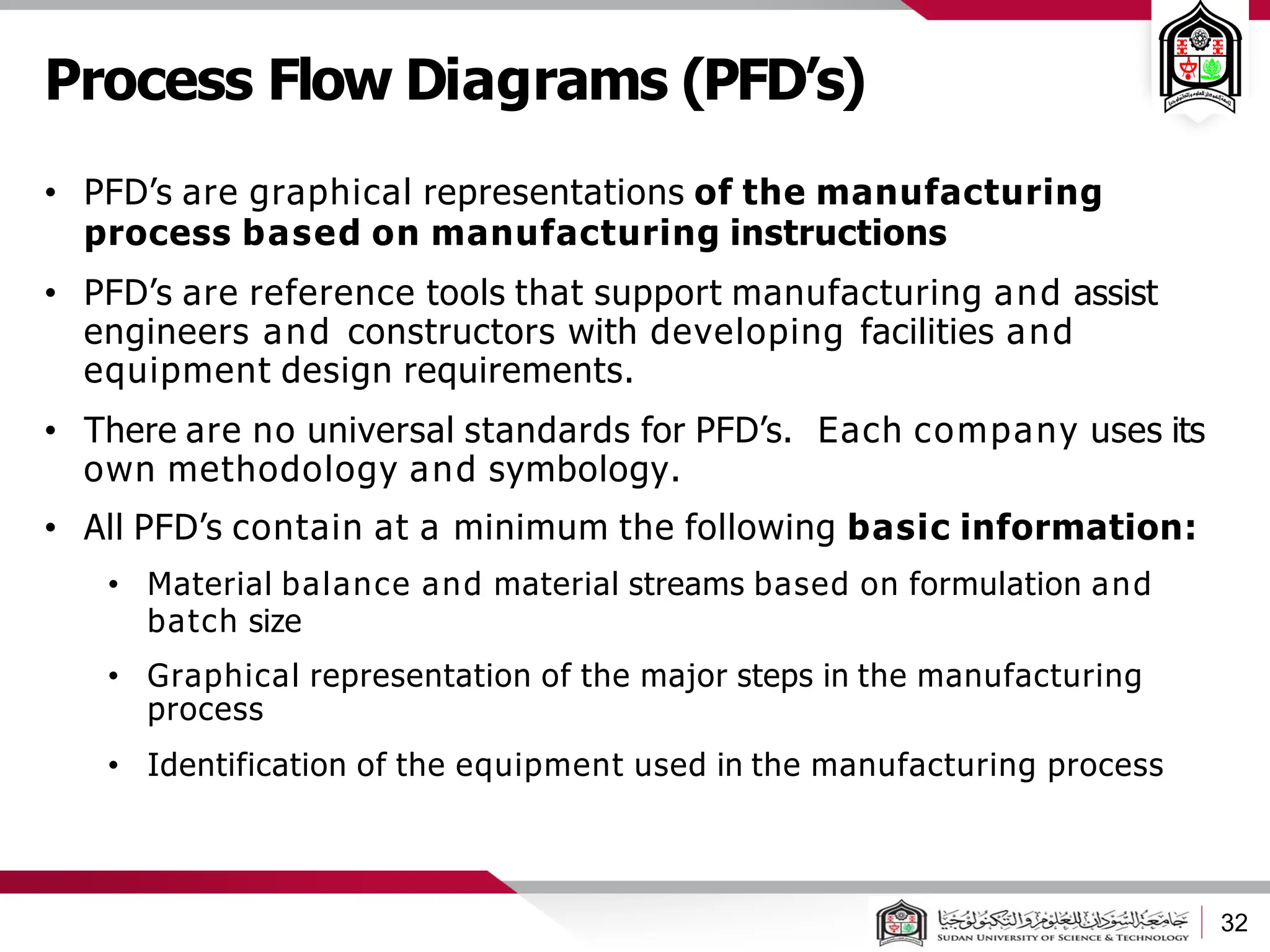
Process Flow Diagrams (PFD’s)
32
• PFD’s are graphical representations of the manufacturing
process based on manufacturing instructions
• PFD’s are reference tools that support manufacturing and assist
engineers and constructors with developing facilities and
equipment design requirements.
• There are no universal standards for PFD’s. Each company uses its
own methodology and symbology.
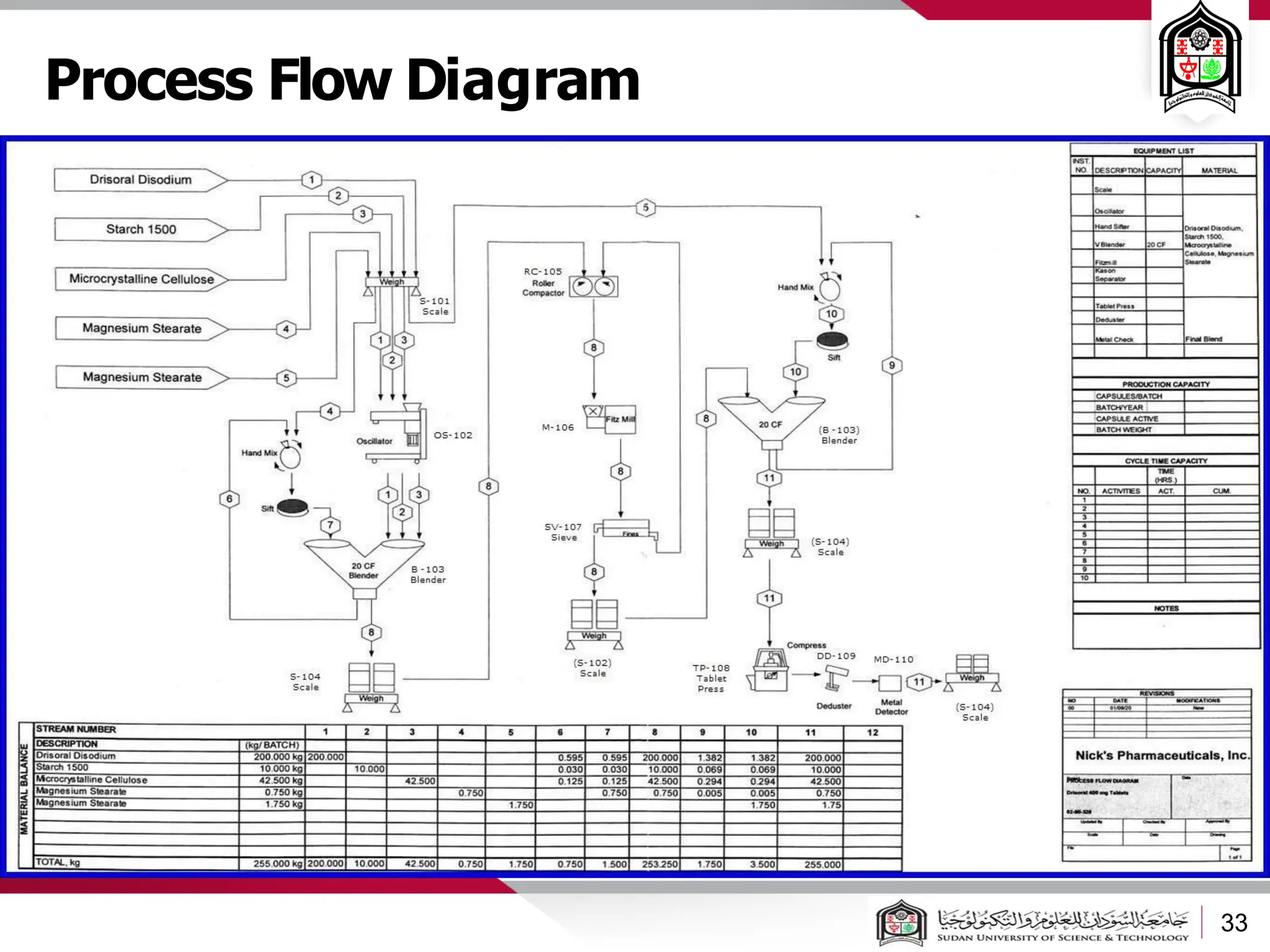
• All PFD’s contain at a minimum the following basic information:
• Material balance and material streams based on formulation and
batch size
• Graphical representation of the major steps in the manufacturing
process
• Identification of the equipment used in the manufacturing process
Process Flow Diagram
33
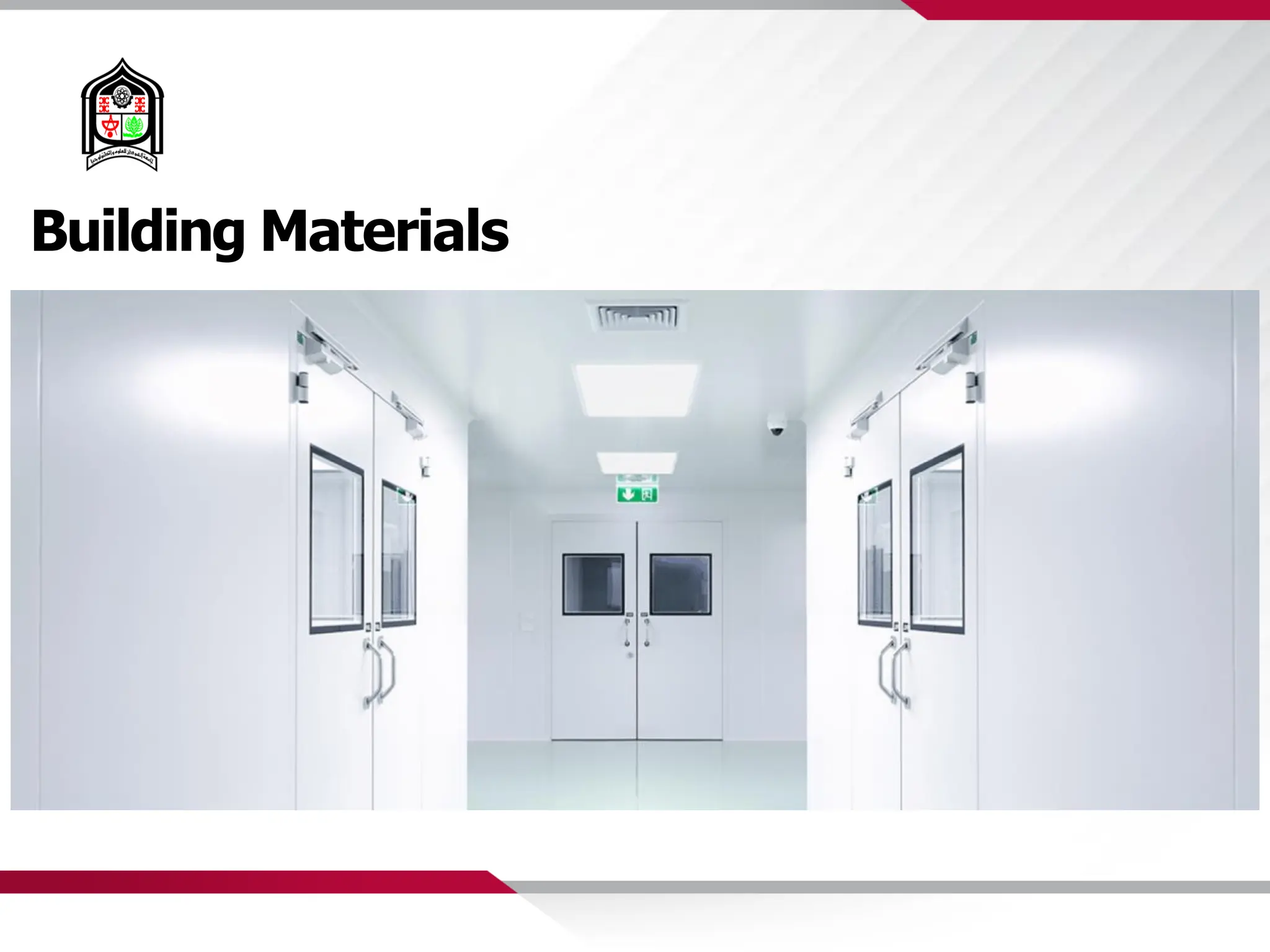
Building Materials
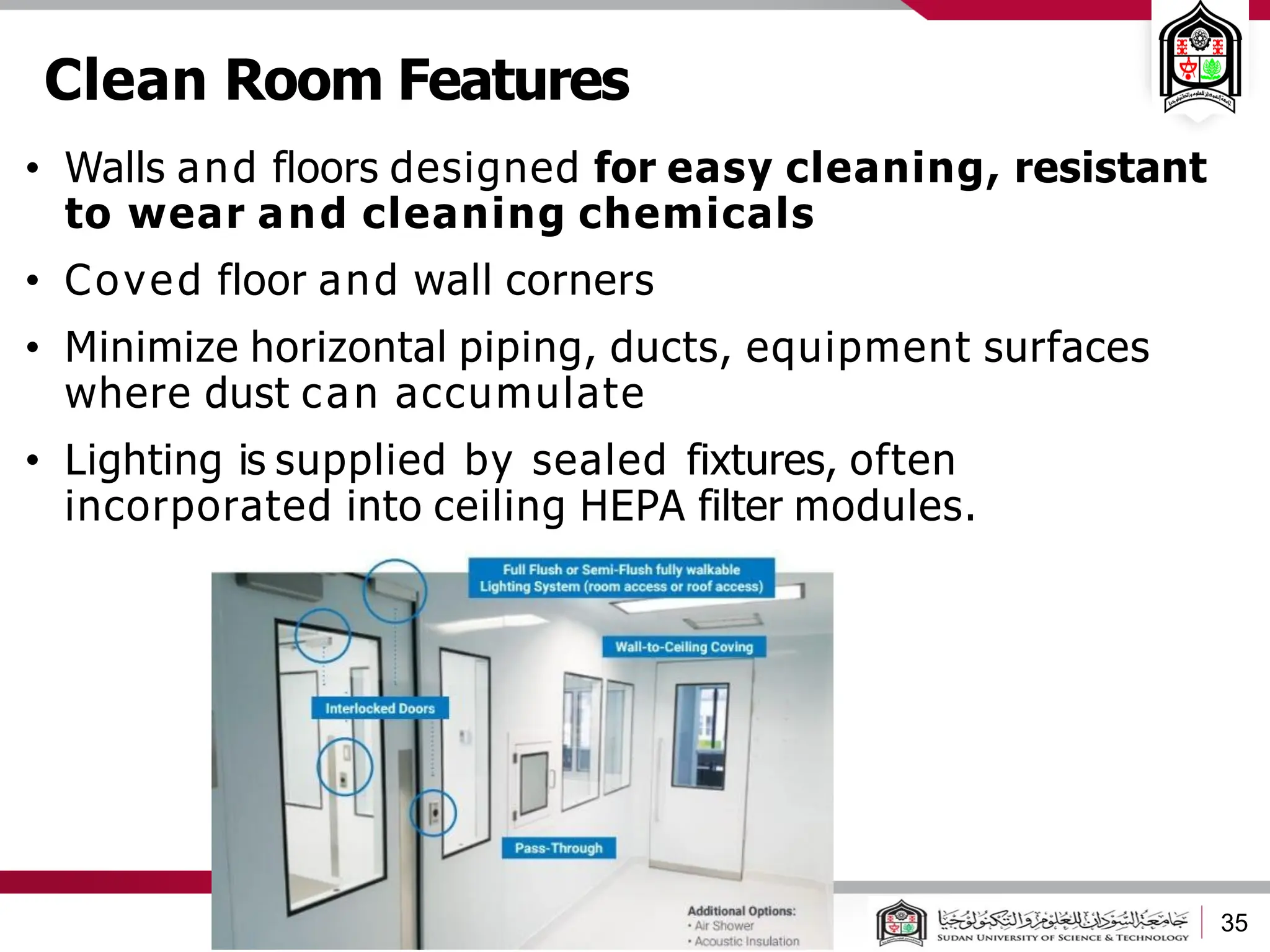
Clean Room Features
35
• Walls and floors designed for easy cleaning, resistant
to wear and cleaning chemicals
• Coved floor and wall corners
• Minimize horizontal piping, ducts, equipment surfaces
where dust can accumulate
• Lighting is supplied by sealed fixtures, often
incorporated into ceiling HEPA filter modules.
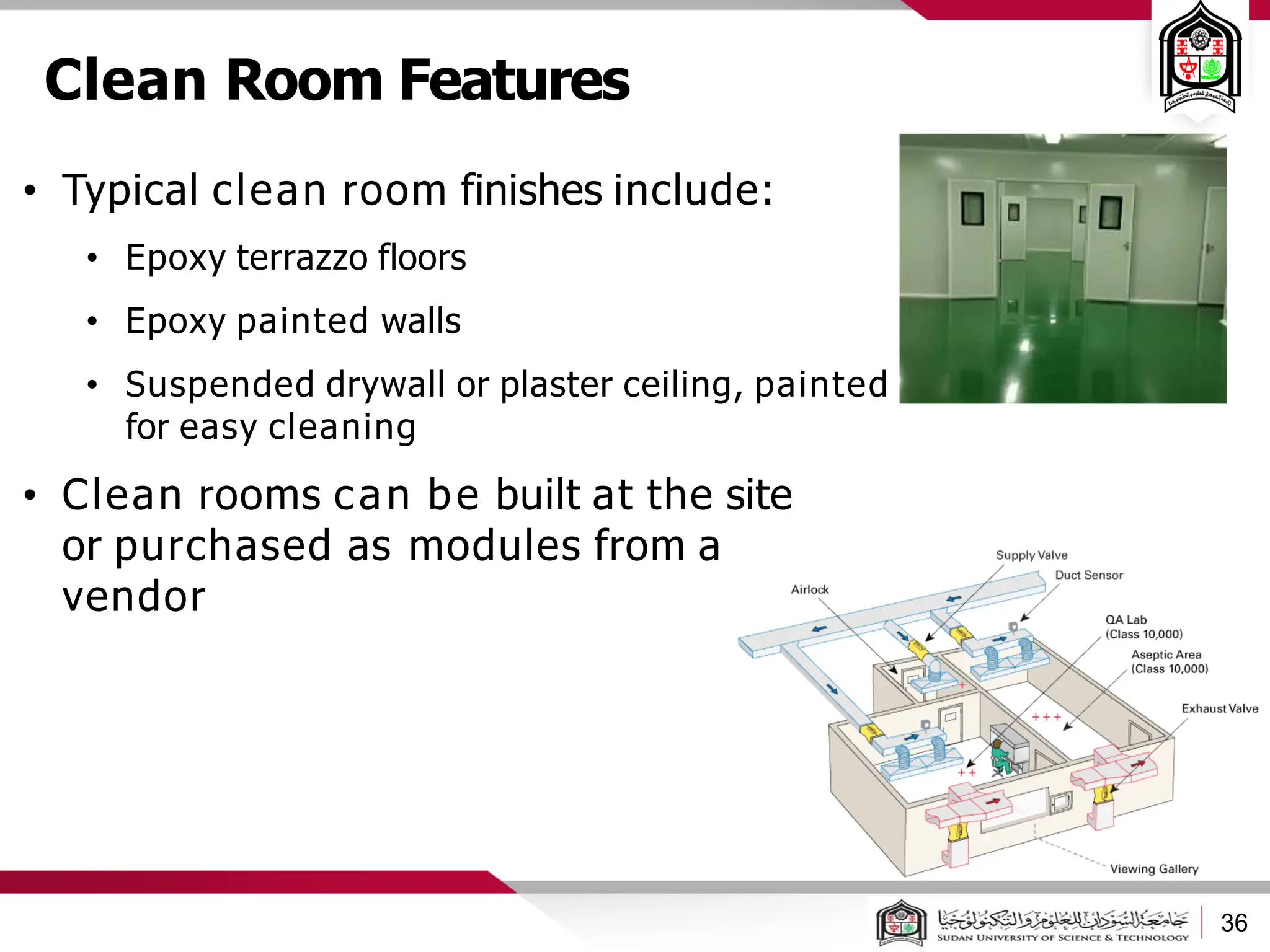
Clean Room Features
36
• Typical clean room finishes include:
• Epoxy terrazzo floors
• Epoxy painted walls
• Suspended drywall or plaster ceiling, painted
for easy cleaning
• Clean rooms can be built at the site
or purchased as modules from a
vendor
Clean Room Features
37
 Utility services and ancillary equipment:
– General: Utility services should be designed and installed such
that the cleanroom is not compromised by contamination.
– exposed piping, tubing and cable runs should be minimized,
– Vacuum-cleaning equipment
–– Communication systems: to reduce personnel movement
– Glazing: Avoid heat loss and solar gain, non-opening double
glaze
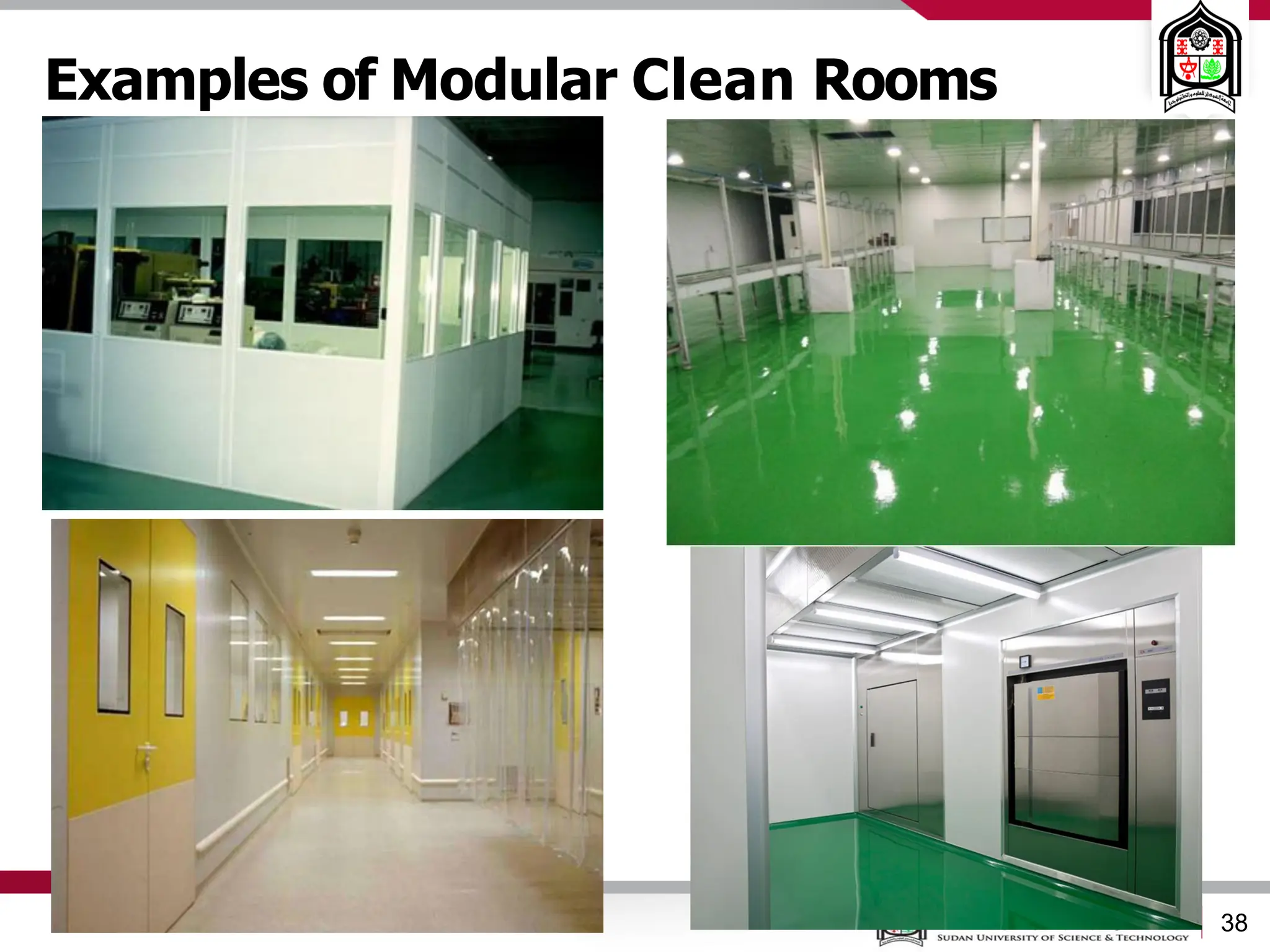
Examples of Modular Clean Rooms
38
Manufacturing of Solid Dosage
Products
Guiding Principles for Facility
Design
Unit Operations in Solid
Dosage Manufacturing
Unit Operations and Equipment
Applications
41
• Dispensing and Weighing
• Sifting and Classifying
• Milling
• Granulation
• Drying
• Blending
• Compression
• Encapsulation
• Coating
Dispensing
• Small Volume Dispensing
• Down Flow Laminar Flow Hoods
• Dedicated Rooms with
Environmental Controls
• Large Volume Dispensing
• Silos
• Super Sacks
• Pneumatic Conveyance and Weigh
Systems
• Gravity Transfer and Weigh Systems
42
Other Design Considerations
43
• Storage and handling of materials in bulk containers
(IBC), drums, bags, etc
• Material Handling Equipment
• Staging and Put Down Areas
• Wash Areas and Equipment Storage
• Pallet washers
• IBC washers
Sifting and Classifying
Purpose:
• De-lumping of powders
• Improve particle size
distribution - removal of
oversized and undersized
particles
Equipment:
• Vibratory screen sifters
• Manual sieves
44
Milling
• Used for:
• Particle size reduction
• Change particle shape
• De-lumping
45
Wet Granulation
• High Shear
Granulation
• High dispersion
• Improved
homogeneity
• Good for small
quantities of
actives
46
Wet Granulation cont’d
• Fluid Bed Granulation
• Control of particle size
• Materials that can not
withstand high shear
• Granules dried in same
machine
47
Drying
• Reduce moisture content
of granules to 2-5%
• Methods
• Fluid Bed Dryers
• Tray Dryers (ovens)
48
Blending
• Combine granulation with excipients and
lubricants
• Excipient - typically lactose
• Lubricants - typically magnesium stearate
added to improve flow properties
• Convection mixing
• Use of paddles or blades to achieve mixing
• Ribbon blenders, Orbital screw blenders,
planetary mixers, etc.
• Diffusion Blenders
• Use of Tumbling Action
• V Blenders, Cone Blenders, Bin Blenders
49
Tablet Compression
• Blend (powder or granules) is filled into die cavities
• Material is co mpressed into tablets
50
Encapsulation
• Capsules
• Hard gelatin capsules filled with
solids
• Final blend must be uniform
• Better for products with high API
content
• Filling done by volume, so
constant bulk density is important
51
Coating
• Coatings: Aqueous or Solvent Based
• Film coating
• Thin film ( 2 to 5 mils)
• Clear or with colorant
• Sugar coating
• Heavy - may reach 50%of tablet weight
• Enteric coatings
• Delay dissolution until the tablet reaches
the intestinal tract
• Bead Coating
• Time and sustained release products
52
Facility Layout
53
• Facility layout must:
• Provide short and logical routes for material and
personnel flow
• Avoid cross-flows whenever possible
• Provide means of separation for quarantined,
released and rejected materials
• Provide sufficient space for each operation,
including staging, washing and other ancillary
areas
• Help prevent cross-contamination
Layout of Mixing and Granulating
Areas
• Easy movement of materials
into separate processing
rooms
• Minimize cross-
contamination potential
• Air pressure in the corridor is
higher than in the process
rooms for product
containment
54
Sterile Dosage Forms
55
Ampoule
Vial Prefilled
syringe
Blow-fill-
seal vials
Bottles
12
. The Background Environment
6
. Wash Vials
7
.
Depyrogenate
Vials
8
. Fill Vials
8
. Check
Weigh Vials
8
. Stopper
Vials
1
. Prep Bulk
Product
3
. Wash &
Sterilize
Stoppers
2 Prep &
Sterilize Change
Parts
10
. Inspect
Vials
9
. Overseal
Vials
2
. Filter
Sterilize Bulk
Product
11
. Package
Vials
4
. Prep
Overseals
5
. Assemble
Change Parts
ISO 5
56
ISO 8
• Filling product into vials
• Checking vial weight
–Manual (destructive) versus automated → cost
impact
• Inserting vial stoppers
• fully
• partially (half way; used for freeze dried product)
• Over-sealing to secure the stopper
The Vial Filling Process
57
Vial Filling and Stoppering
Orienting stoppers
58
Vial Filling
Inspect Vials
•Every vial must undergo
inspection:
– manual or automatic
–may be done in line with
the filling process - less
scratches – fewer rejected
vials
59
The Vial Filling Process
60
• The aseptic processing steps (where the
product and product contact parts are
exposed) are performed in a Class A / ISO5
environment
• The other classes are used for areas with
other activities depending on the potential
impact of on the process
The Vial Filling Process
61
• All steps involving clean operators and materials
must be separated from dirty operators and
waste. This requires separate airlocks and
corridors for the clean and dirty activities
(unidirectional flows)
• Even with all of these precautions (room
pressurization, airflow, airlocks, garbing and
treatment of materials) the ISO5 environment is
under constant assault by the most contaminate
object in the building - the operator
• To minimize the impact of the operator on the
process, manufacturers are turning to a new
technology – isolators or RABS
The Vial Filling Process
62
The equipment may be located in:
– Clean Room Environment (Traditional)
– Clean Room Environment & Restricted
Access Barrier Systems (RABS)
– Aseptic Filling Isolator
Clean Room
63
The Vial Filling Process
• Isolators:
– box around the process
– access the process via
gloves
– must be
decontaminated using
automated technology
(VHP or H2O2) b ecause
the clean zone is very
small
64
The Vial Filling Process
66
• Advantages of isolators:
– The operator is removed from the process, so less product
risk
– Can be located in an ISO8 environment
• Reduced ISO5 area
• Reduced requirements for the sterile garb
• Fewer airlocks and material sanitization steps
– Material and people movement in the facility is simplified
– Cleaning and cleaning validation reduced
– Lower long term operation cost than traditional clean
room facility
RABS vs Isolator
The Vial Filling Process: Isolators or
RABS?
68
RABS
• Concept - to combine the
advantages of an isolator
with the flexibility of a clean
room
• In reality RABS has not solved
any of the perceived
disadvantages of an isolator.
Isolators are the future of aseptic processing.
Thank you for your attention

Clean Room Pharmaceutical_ GMP Procedures

  • 1.
    Cleanrooms and GMP Designof Pharmaceutical Facilities Cleanrooms Process design Layoutsand Flow Diagrams OSD Facilities By: Dr. Mohammed Abdeen Pharm. PhD Pharmaceutics VII
  • 2.
    Current Good ManufacturingPractices (cGM) 2 • c G MP is a set of regulations published by the US Food and Drug Administration (FDA) • Most national and international agencies regulating pharma industry have similar regulations or guidelines • cGMP regulations cover many aspects: organization and personnel, building and facilities, equipment, control of components, production controls, packaging and labeling controls, laboratory controls etc.
  • 3.
  • 4.
    4 • Cleanrooms providefor the control of airborne contamination to levels appropriate for accomplishing contamination-sensitive activities. – Aerospace, – Microelectronics, – Pharmaceuticals, – Medical devices, – Healthcare (Hospitals) – Food. Introduction:
  • 5.
    5 • Cleanroom canbe defined through 2 areas:  Control: A space where the number of airborne particles are measured. A space where other environmental factors are controlled (humidity, temperature, pressure)  Design: An enclosed space constructed in a way to minimise the introduction, generation and retention of particles. What Is A Cleanroom?
  • 6.
    6 • Particle: Solidor liquid object which, for purposes of classification of air cleanliness, falls within a threshold size in the range from 0.1 to 5μm • Occupancy states: • As-built: installation is complete, all services functioning, no production equipment, materials, or personnel present • At-rest: equipment installed and operating in a manner agreed upon the customer and supplier, but with no personnel present • Operational: the installation is functioning in the specified manner, specified number of personnel present and working Definitions
  • 7.
    7 air as built air air atrest in operation
  • 8.
    8 • Classification: level ofairborne particulate cleanliness, represents maximum allowable concentrations (in particles per cubic metre of air) for considered sizes of particles • There are 9 ISO classifications, ISO 1, ISO 2, ISO 3, ……, and ISO 9. • ISO 1 is considered the cleanest while ISO 9 is considered the dirtiest. Classification of Cleanroom
  • 9.
    9 Air Quality Monitoring •Number of particles per unit of air volume is tested during facility qualification and routinely. Such testing is done both “at rest” (no activity) and during normal operations. Portable (shown in the picture) or permanently installed particle counters may be used.
  • 10.
    10 • The particulatecleanliness of air shall be defined in one or more of three occupancy states, viz. “as-built”, “at- rest”, or “operational” • The maximum permitted concentration of particles, Cn, for each considered particle size, D, • In which, N is the ISO classification number, which shall not exceed a value of 9. (ISO Class 1 to 9) Classification of Cleanroom
  • 11.
  • 12.
  • 13.
  • 14.
    Classification of CleanRooms 14 Grade Particles/m3 ≥ 0.5 µm ISO Class At rest In operation A 3,520 3,520 5 B 3,520 352,000 5at rest 7in operation C 352,000 3,520,000 7at rest 8in operation D 3,520,000 Not defined 8at rest
  • 15.
    Classification of Cleanroom 15 •Typically, semi conductor, advanced engineering, optics, laser and electronics require an ISO 5 cleanroom along with pharmaceutical and medical devise companies. The reasons that companies require these facilities vary from yield (money) to safety (regulation).
  • 16.
    Classification of Cleanroom 16 •Guidelines for required number of air changes: • 240-480 changes/hr for Class A rooms • 60-90 changes/hr for Class B rooms • 20-40 changes/hr for Class C rooms • These numbers are not regulations, just guidelines. They vary in different sources.
  • 17.
    Classification: PIC/S: 17 • ThePharmaceutical Inspection Convention and Pharmaceutical Inspection Co-operation Scheme (PIC/S) are two international instruments between countries and pharmaceutical inspection authorities. • The PIC/S is meant as an instrument to improve co- operation in the field of Good Manufacturing Practices between regulatory authorities and the pharmaceutical industry.
  • 18.
    Classification of Cleanroom 18 •Classification: PIC/S  Grade A: The local zone for high risk operations: – Filling zone, open ampoules and vials, making aseptic connections. – Provided by a LAF work station with a homogeneous air speed in a range of 0.36 – 0.54 m/s (guidance value) – A unidirectional air flow and lower velocities may be used in closed isolators and glove boxes.  Grade B: For aseptic preparation and filling, this is the background environment for the grade A zone.  Grade C and D: Clean areas for carrying out less critical stages in the manufacture of sterile products.
  • 19.
    PIC/S General Paragraphs 19 Clean Areas: • Entry through airlocks for personnel and/or for equipment and materials. • Supplied with air has passed through filters of an appropriate efficiency.  The various operations of component preparation, product preparation and filling in separate areas within the clean area  Manufacturing operations: 1. Product is terminally sterilized, 2. Conducted aseptically at some or all stages.  In order to meet “in operation” conditions, areas should be designed to reach certain air-cleanliness levels in the “at rest” occupancy state.
  • 20.
    PIC/S General Paragraphs 20 1-Terminally Sterilized Products  Preparation of components and most products should be done in at least a grade D environment  Where the product is at a high or unusual risk of microbial contamination Grade C  Filling of products for terminal sterilization Grade C • Where the product is at unusual risk of contamination from the environment, filling Grade A with Grade C background.  Preparation and filling of ointments, creams, suspensions and emulsions should grade C before terminal sterilization
  • 21.
    PIC/S General Paragraphs 21 2-Aseptic Preparation  Components after washing Grade D  Handling of sterile starting materials, unless subjected to sterilization or filtration Grade A with Grade B background.  Otherwise Grade C  Handling and filling of aseptically prepared products Grade A  Transfer of partially closed containers, as used in freeze drying, either in a Grade A environment with grade B background or in sealed transfer trays in a grade B environment
  • 22.
    Process and facilitydesign Layouts and Flow Diagrams
  • 23.
    GMP Requirements Highlights 23 •Building shall be of suitable size, location and construction, easily cleanable and maintainable • Building shall be designed to prevent equipment and material mix-ups and contamination • Separate areas shall be provided for different operations • Provide adequate control of air pressure, microorganisms, dust, humidity and temperature as appropriate • Written procedures required for cleaning and sanitation
  • 24.
    Process and FacilityDesign 24 • Facility design and layout must satisfy: • Process requirements • Personnel flows • Material flows (raw materials and products) • Equipment layout requirements • Operational access requirements • Maintenance access requirements • Facility should be designed around process needs!
  • 25.
    Planning and Designconsiderations 25 • A project plan shall be developed to define the requirements of the products, the processes and the scope of the installation. • A process equipment list shall be compiled, and shall include the critical requirements for each piece of process equipment. • Diversity factors shall be defined, considering peak and average demand for each utility and environmental control system. • A contamination control concept shall be developed for each zone of an installation.
  • 26.
    Planning and Designconsiderations 26 • For economic, technical and operational reasons, clean zones are often enclosed or surrounded by further zones of lower cleanliness. • The zones with the highest cleanliness demands is reduced to the minimum size. • Movement of material and personnel between adjacent clean zones gives rise to the risk of contamination transfer, Management of material and personnel flow
  • 27.
    27 Personnel flows andmaterial flow Personnel flows considered: – Manufacturing personnel – Maintenance personnel – Quality control personnel Material flows considered: – Raw materials – Finished goods – Waste – Product (In-process, Intermediate & Final) – Equipment : • Clean and dirty components • Portable equipment • Product containers
  • 28.
  • 29.
    Personnel Flow &Gowning Diagram 29
  • 30.
  • 31.
  • 32.
    Process Flow Diagrams(PFD’s) 32 • PFD’s are graphical representations of the manufacturing process based on manufacturing instructions • PFD’s are reference tools that support manufacturing and assist engineers and constructors with developing facilities and equipment design requirements. • There are no universal standards for PFD’s. Each company uses its own methodology and symbology. • All PFD’s contain at a minimum the following basic information: • Material balance and material streams based on formulation and batch size • Graphical representation of the major steps in the manufacturing process • Identification of the equipment used in the manufacturing process
  • 33.
  • 34.
  • 35.
    Clean Room Features 35 •Walls and floors designed for easy cleaning, resistant to wear and cleaning chemicals • Coved floor and wall corners • Minimize horizontal piping, ducts, equipment surfaces where dust can accumulate • Lighting is supplied by sealed fixtures, often incorporated into ceiling HEPA filter modules.
  • 36.
    Clean Room Features 36 •Typical clean room finishes include: • Epoxy terrazzo floors • Epoxy painted walls • Suspended drywall or plaster ceiling, painted for easy cleaning • Clean rooms can be built at the site or purchased as modules from a vendor
  • 37.
    Clean Room Features 37 Utility services and ancillary equipment: – General: Utility services should be designed and installed such that the cleanroom is not compromised by contamination. – exposed piping, tubing and cable runs should be minimized, – Vacuum-cleaning equipment –– Communication systems: to reduce personnel movement – Glazing: Avoid heat loss and solar gain, non-opening double glaze
  • 38.
    Examples of ModularClean Rooms 38
  • 39.
    Manufacturing of SolidDosage Products Guiding Principles for Facility Design
  • 40.
    Unit Operations inSolid Dosage Manufacturing
  • 41.
    Unit Operations andEquipment Applications 41 • Dispensing and Weighing • Sifting and Classifying • Milling • Granulation • Drying • Blending • Compression • Encapsulation • Coating
  • 42.
    Dispensing • Small VolumeDispensing • Down Flow Laminar Flow Hoods • Dedicated Rooms with Environmental Controls • Large Volume Dispensing • Silos • Super Sacks • Pneumatic Conveyance and Weigh Systems • Gravity Transfer and Weigh Systems 42
  • 43.
    Other Design Considerations 43 •Storage and handling of materials in bulk containers (IBC), drums, bags, etc • Material Handling Equipment • Staging and Put Down Areas • Wash Areas and Equipment Storage • Pallet washers • IBC washers
  • 44.
    Sifting and Classifying Purpose: •De-lumping of powders • Improve particle size distribution - removal of oversized and undersized particles Equipment: • Vibratory screen sifters • Manual sieves 44
  • 45.
    Milling • Used for: •Particle size reduction • Change particle shape • De-lumping 45
  • 46.
    Wet Granulation • HighShear Granulation • High dispersion • Improved homogeneity • Good for small quantities of actives 46
  • 47.
    Wet Granulation cont’d •Fluid Bed Granulation • Control of particle size • Materials that can not withstand high shear • Granules dried in same machine 47
  • 48.
    Drying • Reduce moisturecontent of granules to 2-5% • Methods • Fluid Bed Dryers • Tray Dryers (ovens) 48
  • 49.
    Blending • Combine granulationwith excipients and lubricants • Excipient - typically lactose • Lubricants - typically magnesium stearate added to improve flow properties • Convection mixing • Use of paddles or blades to achieve mixing • Ribbon blenders, Orbital screw blenders, planetary mixers, etc. • Diffusion Blenders • Use of Tumbling Action • V Blenders, Cone Blenders, Bin Blenders 49
  • 50.
    Tablet Compression • Blend(powder or granules) is filled into die cavities • Material is co mpressed into tablets 50
  • 51.
    Encapsulation • Capsules • Hardgelatin capsules filled with solids • Final blend must be uniform • Better for products with high API content • Filling done by volume, so constant bulk density is important 51
  • 52.
    Coating • Coatings: Aqueousor Solvent Based • Film coating • Thin film ( 2 to 5 mils) • Clear or with colorant • Sugar coating • Heavy - may reach 50%of tablet weight • Enteric coatings • Delay dissolution until the tablet reaches the intestinal tract • Bead Coating • Time and sustained release products 52
  • 53.
    Facility Layout 53 • Facilitylayout must: • Provide short and logical routes for material and personnel flow • Avoid cross-flows whenever possible • Provide means of separation for quarantined, released and rejected materials • Provide sufficient space for each operation, including staging, washing and other ancillary areas • Help prevent cross-contamination
  • 54.
    Layout of Mixingand Granulating Areas • Easy movement of materials into separate processing rooms • Minimize cross- contamination potential • Air pressure in the corridor is higher than in the process rooms for product containment 54
  • 55.
    Sterile Dosage Forms 55 Ampoule VialPrefilled syringe Blow-fill- seal vials Bottles
  • 56.
    12 . The BackgroundEnvironment 6 . Wash Vials 7 . Depyrogenate Vials 8 . Fill Vials 8 . Check Weigh Vials 8 . Stopper Vials 1 . Prep Bulk Product 3 . Wash & Sterilize Stoppers 2 Prep & Sterilize Change Parts 10 . Inspect Vials 9 . Overseal Vials 2 . Filter Sterilize Bulk Product 11 . Package Vials 4 . Prep Overseals 5 . Assemble Change Parts ISO 5 56 ISO 8
  • 57.
    • Filling productinto vials • Checking vial weight –Manual (destructive) versus automated → cost impact • Inserting vial stoppers • fully • partially (half way; used for freeze dried product) • Over-sealing to secure the stopper The Vial Filling Process 57
  • 58.
    Vial Filling andStoppering Orienting stoppers 58 Vial Filling
  • 59.
    Inspect Vials •Every vialmust undergo inspection: – manual or automatic –may be done in line with the filling process - less scratches – fewer rejected vials 59
  • 60.
    The Vial FillingProcess 60 • The aseptic processing steps (where the product and product contact parts are exposed) are performed in a Class A / ISO5 environment • The other classes are used for areas with other activities depending on the potential impact of on the process
  • 61.
    The Vial FillingProcess 61 • All steps involving clean operators and materials must be separated from dirty operators and waste. This requires separate airlocks and corridors for the clean and dirty activities (unidirectional flows) • Even with all of these precautions (room pressurization, airflow, airlocks, garbing and treatment of materials) the ISO5 environment is under constant assault by the most contaminate object in the building - the operator • To minimize the impact of the operator on the process, manufacturers are turning to a new technology – isolators or RABS
  • 62.
    The Vial FillingProcess 62 The equipment may be located in: – Clean Room Environment (Traditional) – Clean Room Environment & Restricted Access Barrier Systems (RABS) – Aseptic Filling Isolator
  • 63.
  • 64.
    The Vial FillingProcess • Isolators: – box around the process – access the process via gloves – must be decontaminated using automated technology (VHP or H2O2) b ecause the clean zone is very small 64
  • 66.
    The Vial FillingProcess 66 • Advantages of isolators: – The operator is removed from the process, so less product risk – Can be located in an ISO8 environment • Reduced ISO5 area • Reduced requirements for the sterile garb • Fewer airlocks and material sanitization steps – Material and people movement in the facility is simplified – Cleaning and cleaning validation reduced – Lower long term operation cost than traditional clean room facility
  • 67.
  • 68.
    The Vial FillingProcess: Isolators or RABS? 68 RABS • Concept - to combine the advantages of an isolator with the flexibility of a clean room • In reality RABS has not solved any of the perceived disadvantages of an isolator. Isolators are the future of aseptic processing.
  • 69.
    Thank you foryour attention