This document summarizes guidelines for media fill validation and USFDA process validation approaches. It discusses media fill validation, including why it is required, how to conduct media fill tests, parameters that affect sterility, and requalification requirements. It provides details on media fill procedures for liquid, powder, and lyophilized products. Frequency of media fills depends on production batch size, with more runs required for initial qualification and after certain changes. The document also introduces the USFDA's process validation lifecycle approach, which focuses on validating processes throughout the product lifecycle rather than just at startup.
Sardar Patel University,Department of Pharmaceutical science,
VVN, Anand
Topic:
1. Aseptic Filling: Media Fill validation
2. USFDA guideline on Process Validation- A lifecycle Approach
1
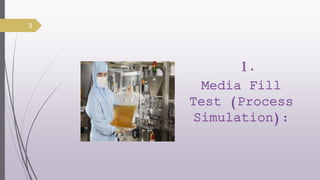
2.
Content:
MediaFill Validation:
Introduction
Why require in Pharmaceutical region
Issues to carry out Media fill test
When requalification is required
Parameters which affects the sterility
USFDA guideline on Process validation- lifecycle Approach:
Introduction:
Approach of Process Validation
Why it is Lifecycle Approach?
Is this really a new Approach?
2
What isa media fill?
A “media fill” is performance of an aseptic manufacturing procedure
using a sterile microbiological growth medium in place of the
solution whether the aseptic procedures are adequate to prevent
contamination during actual drug production.
Media fill validation is cGMP, FDA and ISO regulatory requirement
for validation of aseptic processing.
Conducted within manipulations normally performed in actual
processing
e.g. filling and closing operations, operational environment,
processing operations, number of personnel involved etc are
conducted under processing conditions that include worst case
considerations.
4
5.
What isthe media fill designed to evaluate?
Evaluate the
Aseptic assembly and operation of the critical (sterile)
equipment,
Qualify the operators and assess their technique, and
Demonstrate that environmental controls are
adequate to meet the basic requirements necessary
to produce a sterile drug by aseptic processing.
But,
Does not validate the ability of the filter to sterilize
growth media.
5
6.
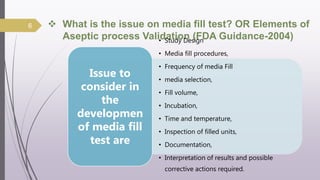
What isthe issue on media fill test? OR Elements of
Aseptic process Validation (FDA Guidance-2004)
• Study Design
• Media fill procedures,
• Frequency of media Fill
• media selection,
• Fill volume,
• Incubation,
• Time and temperature,
• Inspection of filled units,
• Documentation,
• Interpretation of results and possible
corrective actions required.
Issue to
consider in
the
developmen
of media fill
test are
6
7.
1. Study Design:
Objective:
Accurately assesses the state of process control.
Approach:
• Incorporate contamination risk factors that occur on a
production line.
• Closely Simulate aseptic manufacturing operations
incorporating worst-case activities and conditions that provide
a challenge to aseptic operations.
7
8.
2. Frequency ofMedia Fill:
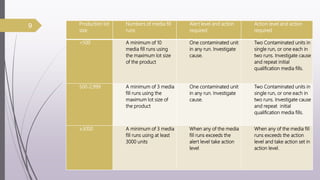
A. Initial performance qualification:
Conducted for new facility, item of equipment, filling line and
container design (Except for multiple sizes of the same
container design) etc.
For production batch sizes exceeding 3000 units, a minimum
of three media fill runs should be conducted on separate
days.
For production batch sizes of less than 3000 units.
Continue….
8
9.
9 Production lot
size
Numbersof media fill
runs
Alert level and action
required
Action level and action
required
<500 A minimum of 10
media fill runs using
the maximum lot size
of the product
One contaminated unit
in any run. Investigate
cause.
Two Contaminated units in
single run, or one each in
two runs. Investigate cause
and repeat initial
qualification media fills.
500-2,999 A minimum of 3 media
fill runs using the
maximum lot size of
the product
One contaminated unit
in any run. Investigate
cause.
Two Contaminated units in
single run, or one each in
two runs. Investigate cause
and repeat initial
qualification media fills.
≥3000 A minimum of 3 media
fill runs using at least
3000 units
When any of the media
fill runs exceeds the
alert level take action
level
When any of the media fill
runs exceeds the action
level and take action set in
action level.
10.
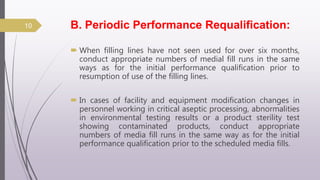
B. Periodic PerformanceRequalification:
When filling lines have not seen used for over six months,
conduct appropriate numbers of medial fill runs in the same
ways as for the initial performance qualification prior to
resumption of use of the filling lines.
In cases of facility and equipment modification changes in
personnel working in critical aseptic processing, abnormalities
in environmental testing results or a product sterility test
showing contaminated products, conduct appropriate
numbers of media fill runs in the same way as for the initial
performance qualification prior to the scheduled media fills.
10
11.
11
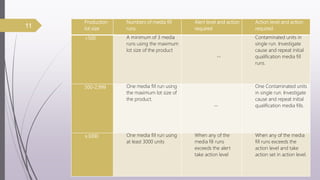
Production
lot size
Numbers ofmedia fill
runs
Alert level and action
required
Action level and action
required
<500 A minimum of 3 media
runs using the maximum
lot size of the product
--
Contaminated units in
single run. Investigate
cause and repeat initial
qualification media fill
runs.
500-2,999 One media fill run using
the maximum lot size of
the product.
--
One Contaminated units
in single run. Investigate
cause and repeat initial
qualification media fills.
≥3000 One media fill run using
at least 3000 units
When any of the
media fill runs
exceeds the alert
take action level
When any of the media
fill runs exceeds the
action level and take
action set in action level.
12.
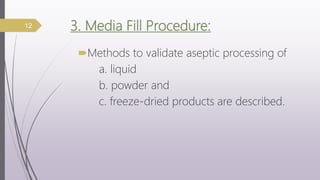
3. Media FillProcedure:
Methods to validate aseptic processing of
a. liquid
b. powder and
c. freeze-dried products are described.
12
13.
Media fillprocedure for liquid products:
Media fill should include normal facility/equipment operations and clean-up
routines. Containers, closures, parts of filling machine, trays etc. are washed and
sterilized according to the standard operating procedures.
Conducted under processing conditions that include “worst case” conditions e.g.
correction of line stoppage, repair or replacement of filling needles/tubes,
replacement of on-line filters, permitted interventions, duration and size of run,
number of personnel involved etc.
A predetermined volume of medium is filled into sterilized containers at a
predetermined filling speed and the containers are sealed.
The media are contracted contacted with all product contact surfaces in the
containers by an appropriate method, and then incubated at the predetermined
temperature.
13
14.
Media fillprocedure for Powder Drug Products:
Powder selection and antimicrobial activity test:
Actual products or placebo powder are used.
In general, lactose monohydrate, D-mannitol, Polyethylene glycol 6000,
carboxymethyl cellulose salts or media powder etc. are used as placebo
powders.
Prior to employing any of the powders, evaluate whether the powder has
antimicrobial activity.
Media powders are dissolved in water and other powders in liquid
medium and the solutions are inoculated with 10 to 100 viable
microorganisms of each kind for the growth promotion test.
If obvious growth appears in medium incubated at the predetermined
temperature for 5 days, the powder has no antimicrobial activity and is
available for the media fill test.
Continue…
14
15.
Sterilization ofpowders:
Dry powders are bagged in suitable containers and are subjected to
radiation sterilizations.
Sterility of filling powders:
The powders must pass the Sterility test. However, if the sterilization is
fully validated, sterility testing of the powders can be omitted.
b.4. Media fill Procedures:
Chose a suitable procedure from among the following procedures:
Fill sterilized liquid media into containers by suitable methods, and
then fill actual products or sterilized placebo powder with the powder
filling machine. If sterilised powder media are used as a placebo
powder, fill sterilized water instead of sterilized liquid media.
Distribute liquid media into containers, and then sterilize them in an
autoclave. Remove the containers to the filling area, and then fill
products or sterilized placebo powder into the containers with the
containers with the powder filling machine.
15
16.
Media fillprocedure for Lyophilized products:
In the case of lyophilized products, it may be impossible to conduct a
media fill run in the same way as used for actual processing of
lyophilized products.
The process of freezing and lyophilization of the solution may kill
contaminant organisms and change the characteristics of the media
too.
The use of inert gas as a blanket gas may inhibit the growth of aerobic
bacteria and fungi. Therefore, in general, the actual freezing and
lyophilization process should be avoided and air used as the blanket
gas.
Continue…
16
17.
After filling ofthe media into containers by the filling machine,
cap the containers loosely and collect them in pre-sterilized trays.
After placing the trays in the lyophilizer, close the chamber
door, and conduct lyophilization according to the procedures
for production operation. Hold them without freezing under
weak vacuum for the predetermined time.
After the vacuum process, break the vacuum, and seal the
stoppers.
Contact the media with all product contact surfaces in the
containers by appropriate methods, and then cultivate them at
the predetermined temperature.
17
18.
4. Incubation andInspection of Media
Fill Units:
Leaking or damaged media fill evaluation units should be
removed and recorded prior to incubation of media filled
units.
Incubate at 20°-25° C for 1 week, and then at 30°-35° for 1
week, or at 30°-35°C for 2 weeks.
Observe the media fills units for growth of microorganism
at least once between the third day and seventh day and
on the last day of the test period, twice in total.
18
19.
5. Number andfrequency of runs :
In start-up simulation at least three consecutive separate
successful runs should be performed (it is recommended
they are performed in different days).
For on-going simulation, a routine semi-annual
qualification is recommended (one run)
Extraordinary media fill should be performed after all
changes to a product or line changes evaluated as a
potential danger for the aseptic process.
19
20.
6. Medium Culture:
The medium needs to support the growth of a wide variety of
microorganisms, including aerobic bacteria, yeasts and moulds
(non-selective medium).
For aerobic conditions: Soybean Casein Digest Medium (SCD) also
known as tryptone soya broth (TSB).
For anaerobic conditions: usually in a nitrogen environment fluid
thioglycolate medium (FTM).
The media have to support the growth of microorganisms (growth
promotion test). The organisms to be tested are stated by
pharmacopoeia.
Generally, at the end of incubation period, some vials (taken from
the beginning, at half and at the end of the process) are inoculated
with < 100 CFU and incubated for 3 days (bacteria) and 5 days
(yeast and mould).
20
21.
7. Number ofunits filled:
Number of units filled should reflect the real batch size.
It is allowed to fill a lowest number of units provided that
the number of units filled is
o sufficient to reflect the effect of potential operator fatigue
o adequately represents the maximum number of
interventions.
Some regulations suggest the number of units to be filled in
consideration of batch production size.
21
22.
8. Fill Volume:
The volume of media filled into the containers need not the
routine fill volume.
It should be
o sufficient to contact the container-closure seal surfaces (when
the unit is inverted and swirled) and
o sufficient to allow visual detection of microbial growth post
incubation.
Smaller containers should not be over-filled as sufficient air must
be available in the container headspace to support the growth of
aerobic organisms (generally 25% of volume is not filled).
22
23.
9. Container size:
The largest container (often filled at the lowest speed because of its large
fill volume) often has the large opening, so the potential for microbial
entry from the environment should be the greatest for that size.
The smallest container (often filled at the highest speed for its lower fill
volume) represents the greatest handling difficulty; the smaller containers
are more fragile and less stable and be more subjected to breakage and
jamming in the equipment.
In the initial qualification two runs might be performed using the largest
container and the third run using the smallest container.
In routine evaluation of the line, any container should be included in the
validation program Clear containers should be used as a substitute for
amber containers to allow visual detection of microbial growth.
23
24.
10. Line (orfilling) speed:
The speed chosen for each batch during simulation should
be justified.
Use of high line speed is justified for manufacturing
processes characterized by frequent interventions or a
significant degree of manual manipulation.
Use of low speed is justified for manufacturing processes
characterized by prolonged exposure of sterile components
in the aseptic area.
24
25.
11. Duration offill:
Long enough to include all of the required interventions and
stoppage and should reflect the potential operator fatigue: a
typical media fill might be at least 3-4 hours long. Ideally a
media fill should use more units than are in the product
being simulated (for all batches up to 5000 units).
For very large batches or long campaigns, some blank units
(either empty or water filled) are used to maintain operating
conditions during the simulation: this technique can be used
to validate processes that may run for several days in order
to validate the full length of the longest approved campaign.
25
26.
12. Operators shifts:
Each operator performing aseptic processes are participate in
media fill.
Set-up and line operators should be part of not less than one
process simulation per year. Operators such as line mechanics
and environmental samplers should be managed in a similar
manner.
A maximum number of personnel present in the aseptic
processing room should be established.
When a firm operates on multiple shifts, the second and third
shift should be included in the media fill program.
In case of manual operations (filling), each line operator should
participate into all three initial validation runs and at least one run
in re-validation (every six months).
26
27.
13. Environmental monitoringactivities:
There are regulatory and pharmacopoeia references that
states the microbial conditions.
Air sampling using either active and passive sampling
methods should be performed during the execution of the
process.
Surface sampling is best performed at the end of aseptic
process. Also, personnel should be monitored.
Microbiological monitoring (air, surfaces, personnel) and
particle monitoring should be performed during media fill
employing the same procedure in force.
Sometimes the number of sampling locations might be
increased respect the routine procedure.
27
28.
14. Interventions:
Interventions:An aseptic manipulation or activity that occurs at
the critical area.
1. Routine interventions:
Aseptic line set-up in which sterilized parts are removed from
protective materials and installed is a potential danger; it is
common to identify the first containers filled as they may be
more indicative of potential problem with aseptic assembly.
Other routine interventions: stoppers bowl feeding, remove
fallen vials, remove jam stoppers, operators break, gloves
change, environmental monitoring.
2. Non routine interventions (occur randomly):
Glass breakage, change / reset of filling needles, interventions
on weight adjustments, sensor failure, rail adjustments.
28
29.
Grade A InterventionRule:
Make sure that machine is stopped first.
Always sanitize hands thoroughly before going to grade A
space.
Keep as much as your body out of Cabinet.
Never Lean over to top of an open vial, stopper/Cap bowl or
the filling needle.
Use sterile forceps to retrieve or remove unturned vials.
Do not intervene to remove stoppers, vials, caps that are not
interfering with processing-Clean up at the end.
Sample gloves post intervention.
Practice Good Aseptic technique EVERY TIME.
29
30.
15. Incubation methods:
Any filled units should be inspected prior to incubation; any
defects that compromise the container closure or non-
integral units are rejected and documented.
Divergence in industry practice: incubation is performed for
14 days at 20-35°C (+/- 2.5°C): it is performed for 7 days at
20-25°C and further 7 days at 30-35°C; it is performed for 7
days at 30-35°C and then move the filled containers to 20-
25°C
The lack of agreement suggest that the selection of
incubation conditions employed.
Units are incubated in an inverted position for the first half of
the incubation period and then returned to an upright
position for the remainder.
30
31.
Some Importantterms:
Alert Level:
An established microbial or airborne particle level giving early
warning of potential drift from normal operating conditions and
triggers appropriate scrutiny and follow-up to address the
potential problem. Alert levels are always lower than action levels.
Action Level:
An established microbial or airborne particle level that, when
exceeded, should trigger appropriate investigation and corrective
action based on the investigation.
31
32.
16. Acceptance criteria:
The target should be zero growth but a contamination rate
less than 0.10% with 95% confidence level is acceptable
(approx. 1 contaminated unit in 5000 filled units).
FDA agree that the target should be zero contaminated units
regardless of size of run.
The alert level is more than 0.05% but less than 0.1% and the
action level is more than 0.1% contamination rate at the
upper 95% confidence level.
32
33.
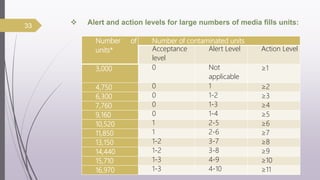
Alert andaction levels for large numbers of media fills units:
Units*: It is necessary to relate the
number of units with lot size of actual
products.
Number of
units*
Number of contaminated units
Acceptance
level
Alert Level Action Level
3,000 0 Not
applicable
≥1
4,750 0 1 ≥2
6,300 0 1-2 ≥3
7,760 0 1-3 ≥4
9,160 0 1-4 ≥5
10,520 1 2-5 ≥6
11,850 1 2-6 ≥7
13,150 1-2 3-7 ≥8
14,440 1-2 3-8 ≥9
15,710 1-3 4-9 ≥10
16,970 1-3 4-10 ≥11
33
34.
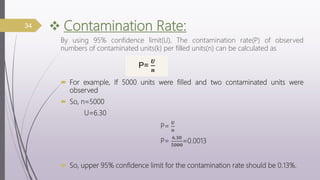
Contamination Rate:
Byusing 95% confidence limit(U), The contamination rate(P) of observed
numbers of contaminated units(k) per filled units(n) can be calculated as
For example, If 5000 units were filled and two contaminated units were
observed
So, n=5000
U=6.30
P=
𝑼
𝒏
P=
𝟔.𝟑𝟎
𝟓𝟎𝟎𝟎
=0.0013
So, upper 95% confidence limit for the contamination rate should be 0.13%.
34
P=
𝑼
𝒏
35.
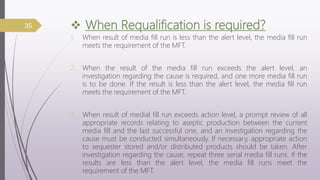
When Requalificationis required?
1. When result of media fill run is less than the alert level, the media fill run
meets the requirement of the MFT.
2. When the result of the media fill run exceeds the alert level, an
investigation regarding the cause is required, and one more media fill run
is to be done. If the result is less than the alert level, the media fill run
meets the requirement of the MFT.
3. When result of medial fill run exceeds action level, a prompt review of all
appropriate records relating to aseptic production between the current
media fill and the last successful one, and an investigation regarding the
cause must be conducted simultaneously. If necessary, appropriate action
to sequester stored and/or distributed products should be taken. After
investigation regarding the cause, repeat three serial media fill runs. If the
results are less than the alert level, the media fill runs meet the
requirement of the MFT.
35
36.
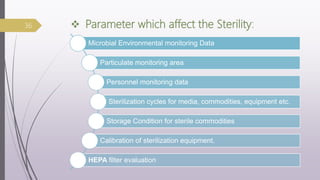
Parameter whichaffect the Sterility:
Microbial Environmental monitoring Data
Particulate monitoring area
Personnel monitoring data
Sterilization cycles for media, commodities, equipment etc.
Storage Condition for sterile commodities
Calibration of sterilization equipment.
HEPA filter evaluation
36
37.
Pre and postfilter integrity test data
Room air flow patterns and pressures
Unusual events that occurred during the media fill run
Characterization of contaminants
Hygienic control and training programs
Gowning procedures and training programs
Aseptic processing techniques and training programs
37
38.
Data guidancefor media fills:
Each media fill runs should be fully documented and the
following information recorded:
Date and time of media fill
Identification of filling room and filling line used
Container/closure type and size
Volume filled per container
Filling speed
Filter lot and catalogue number
Type of media filled
Number of units filled
38
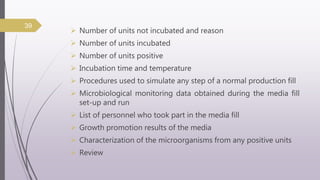
39.
Number ofunits not incubated and reason
Number of units incubated
Number of units positive
Incubation time and temperature
Procedures used to simulate any step of a normal production fill
Microbiological monitoring data obtained during the media fill
set-up and run
List of personnel who took part in the media fill
Growth promotion results of the media
Characterization of the microorganisms from any positive units
Review
39
Introduction:
Validation ofmanufacturing processes is a requirement of
the Current Good Manufacturing Practice (CGMP)
regulations for finished pharmaceuticals (21 CFR 211.100 and
211.110) and is considered as an enforceable element of
Current Good Manufacturing Practice for active
pharmaceutical ingredients (APIs) under the broader
statutory CGMP provisions of section 501(a)(2)(B) of the
Federal Food, Drug and Cosmetic Act.
Process validation involves a series of activities taking place
over the lifecycle of the product and process.”
41
42.
Definition ofProcess Validation:
Stated in the 2011 guidance is as follows:
“Process validation is defined as the collection and evaluation
of data, from the process design stage throughout production,
which establishes scientific evidence that a process is capable
of consistently delivering quality product”
1987 Definition :
“Establishing documented evidence which provides a high
degree of assurance that a specific process will consistently
produce a product meeting its predetermined specifications
and quality characteristics”
42
43.
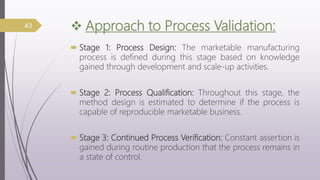
Approach toProcess Validation:
Stage 1: Process Design: The marketable manufacturing
process is defined during this stage based on knowledge
gained through development and scale-up activities.
Stage 2: Process Qualification: Throughout this stage, the
method design is estimated to determine if the process is
capable of reproducible marketable business.
Stage 3: Continued Process Verification: Constant assertion is
gained during routine production that the process remains in
a state of control.
43
44.
Stage1: Process Design:-
Constructing and Apprehending Process Knowledge and
Understanding:
The functionality and limits of commercial manufacturing
equipment should be considered in the process design.
Design of experiments (DOE) studies can help to develop
process knowledge by revealing relationships, including
multivariate interactions, between the variable inputs and the
resulting outputs.
44
45.
Stage 2:Process Qualification: -
Element (1): Design of a facility and qualification of utilities
and equipment
Ensure qualification of facility, utilities and equipment is completed
& documented prior to initiate process qualification.
Element (2): Process Performance Qualification (PPQ)
• The PPQ combines the actual facility, utilities, equipment’s and
the trained personnel with the commercial manufacturing
controls.
• A company must successfully complete PPQ before
commencing commercial distribution of the drug product.
Continue…….
45
46.
• Strongly recommendfirms employ objective measure (e.g.
Statistical Metrics) wherever feasible and meaningful to
achieve adequate assurance.
• The increased level of inspection, testing, and sampling
should continue through the process verification stage as
correct, to establish levels and occurrence of routine sampling
and checking for the particular product and process.
• Considerations for the duration of the intensified sampling &
checking period could include (not limited to):
Volume of production
Process Complexity
Level of process understanding
Experience with similar products and process.
46
47.
PPQ Protocol:
A written protocol that specifies the manufacturing conditions,
controls, testing, and expected outcomes is essential for this
stage of process validation. Protocol discuss the following
elements:
• The manufacturing conditions, including operating
parameters, processing limits, and component (raw material)
inputs.
• The data to be collected and when and how it will be
evaluated.
• Tests to be performed (in-process, release, characterization)
and acceptance criteria for each significant processing step.
47
48.
• The samplingplan, including sampling points, number of
samples, and the frequency of sampling for each unit
operation and attribute.
• The number of samples should be adequate to provide
sufficient statistical confidence of quality both within a
batch and between batches.
• The confidence level selected can be based on risk analysis
as it relates to the particular attribute under examination.
Sampling during this stage should be more extensive than
is typical during routine production.
48
49.
Criteria andprocess performance indicators that allow for a
science- and risk-based decision about the ability of the
process to consistently produce quality products. The criteria
should include:
1. A description of the statistical methods to be used in
analyzing all collected data (e.g., statistical metrics defining
both intra-batch and inter-batch variability).
2. Provision for addressing deviations from expected
conditions and handling of nonconforming data. Data should
not be excluded from further consideration in terms of PPQ
without a documented, science-based justification.
49
50.
• Design offacilities and the qualification of utilities and
equipment, personnel training and qualification, and
verification of material sources (components and
container/closures), if not previously accomplished.
• Status of the validation of analytical methods used in
measuring the process, in-process materials, and the product.
• Review and approval of the protocol by appropriate
departments and the quality unit.
50
51.
PPQ Report:
Tostate a clear conclusion as to whether the data indicates
the process meets the conditions established in the protocol.
If not the report should state what should be accomplished
before such a conclusion can be reached.
This conclusion should be based on entire compilation of
knowledge and information gained from the design stage
through the PPQ stage.
51
52.
Stage 3:Continued Process Verification: -
• To confirm that “the process remains in a state of control during
commercial manufacture.” An ongoing process to collect and
analyse product and process data that relate to product quality
must be established.
• The results obtained should be statistically trended and reviewed
by trained personnel. Recommend that a person with suitable
training in statistical process control techniques develop the data
collection plan and statistical methods.
• Good process design and development should anticipate
significant sources of variability and establish appropriate
detection, control and or qualification schemes, as well as suitable
alert and action limits.
52
53.
• Study ofintra-batch as well as inter-batch variation is part of a
comprehensive continued process verification program.
• Deviation can be detected by the timely assessment of
1. Defect complaints,
2. OOS findings,
3. Process deviation report,
4. Process yield variations,
5. Batch record & reports
• Manufacture line operatives and quality unit staff should be
encouraged to provide feedback on process performance.
53
54.
• Quality unitmeet periodically with production staff to evaluate
data, discuss possible trends and coordinate any correction or
follow-up actions by product.
• Data collected during this stage might recommend ways to
improve and/or optimize the process by altering some aspect of
the process or product, such as the operating conditions, process
controls, etc.
• Well justified rationale for the change, implementation plan, quality
unit approval before implementation.
54
55.
Documentation:
Documentationat each stage of the process validation lifecycle
is essential for effective statement in difficult, lengthy, and
multidisciplinary projects.
Documents is important so that knowledge gained about a
product and process is accessible and comprehensible to others
involved in each stage of the lifecycle.
The degree and type of records required by CGMP vary during
the validation lifecycle. Records requirements are greatest
during Stage 2, process requirement, and Stage 3, continued
process confirmation. Studies during these stages must conform
to CGMPs and must be approved by the quality unit in
accordance with the regulations.
55
56.
WHY THELIFECYCLE APPROACH?
For manufacturing processes to be truly validated, each of the stages
must be addressed and integrated. This integration of development
work, process conformance, and continuing verification provides
assurance that the product or process will consistently remain in
control throughout the entire product lifecycle.
Process validation must not be considered a one-time event or a
focused one-time task performed just prior to commercial launch
that emphasizes only the manufacture of three conformance lots.
Acceptable manufacture of three conformance batches must not be
interpreted as completion of validation.
56
57.
These lotscannot truly represent the future manufacturing process
with unexpected and unpredictable changes.
Conformance lots are often inadvertently biased (i.e., they may
utilize well-characterized and controlled API and excipients, be
manufactured under well controlled conditions, be monitored by
expert individuals, and performed by most experienced or well-
trained personnel—all “best-case” conditions).
It is highly unrealistic to contend that the manufacture of three
conformance lots under “best-case” conditions conclusively
predicts successful manufacturing over the product lifetime. True
process validation must be a process that is never completed and is
always ongoing.
57
58.
Positive AspectsOf Life Cycle Approach:
New life cycle validation model is a science and risk based
approach and consistent with the “Quality by Design”
approach that is articulated in ICH guidelines Q-8, Q-9, Q-
10 & Q11, positive aspects of the new approach are as
follows:
1. Robust process validation approach will lead to
consistent and reliable quality of product.
2.Reduction in cost of quality, time and energy.
3.Ongoing statistical evaluation of data will detect the
trending at early stage to avoid potential failures at later
stages.
58
59.
4. Right firsttime solutions can be offered in avoiding
reduction in rejections/recycles.
5. Continuous improvement overtime rather than
incidental based such as failures/OOS.
6. Increased into the machine efficiency in enhancing the
productivity outlet.
7. Implementation of real time release testing in lieu of
end product testing based on statistical evaluation.
8. Relief in drug application approval process and
reduction/fast approval in post approval changes.
59
60.
Conclusion:
By doingvalidation as per USFDA process validation
guideline, product and process understanding will be
improved and also reduction in waste, rejections, lead
time and any other failures.
This guideline also helps for continual improvement of
validation process through the product life cycle.
60
61.
References:
R.A. Nash and A. H. Wachter “Pharmaceutical Process validation”; Third edition
Agallo James, Carleton J. Fredric “Validation of Pharmaceutical Processes”; Third
edition
USP <797> ‘media fill testing’ / <71> ‘growth promotion test’
FDA “guidance for industry, sterile drug products produced by aseptic processing –
cGMP” 6. PIC/S PI 007-2 “recommendations on the validation of aseptic process
on 28/02/2020
https://www.fda.gov/media/81974/download on dated 07/02/2020
FDA (CDER and CBER), Process Validation: General Principles and Practices, Current
Good Manufacturing Practices (CGMP), Revision 1,January 2011.
61