1
VALIDATION OF HVAC
SYSTEM
1
2
CONTENTS
➢ Introduction
➢ AHU
➢ HVAC Qualification
➢ Validation parameter
INTRODUCTION
To understand:
➢ The need and reason for pharmaceutical air handling
systems.
➢ The technical requirements for air handling systems.
➢ Different types of air handling systems.
➢ Qualification and Validation requirements
3
WHAT IS CLEAN ROOM?
4
A room in which the concentration of airborne
particle is controlled and which is constructed and used in a
manner to minimize the introduction, generation and
retention of particles inside the room and in which other
relevant parameters.
➢ e.g.. Temperature, humidity and pressure, are controlled
as necessary.
(ISO 14644-1)
WHY CLEAN ROOM NECESSARY?
➢It controls 3 types of contamination transfer
✓Air borne contamination
✓Direct contamination by personnel, equipment etc.
✓Contamination from fluids like cleaning fluids,
solutions etc.
➢As airborne particulate are reduced, chances of particles
entry in the process reduced.
➢Protects product, personnel & environment.
➢Avoid rejection thereby heavy losses in terms of money &
time
5
HOW IT IS ACCOMPLISHED?
•A clean room is continuously flushed with highly
filtered air that is forced in through HEPA filters.
6
TYPES OF CLEAN ROOMS
➢ Horizontal Clean Room – Horizontal Laminar flow
(HEPA filters in a wall force clean air from one side of the room to
other.)
➢ Vertical Clean Room – Vertical Laminar flow
(HEPA filters on the ceilingpush cleanair down to the floor.)
7
FOUR BASIC PRINCIPLES OF CLEAN ROOM
➢Not To Bring Any Dust
➢Not To Accumulate Any Dust
➢Not To Generate Any Dust
➢To Remove Any Dust Quickly
8
INTRODUCTION
Air handling systems,
➢ Play a major role in the quality of pharmaceuticals.
➢ Must be designed properly, by professionals.
➢ Must be treated as a critical system.
9
INTRODUCTION
The manufacturing environment is critical for product quality.
Environmentconsistsof,
➢ Light
➢ Temperature
➢ Humidity
➢ Air movement
➢ Microbial contamination
➢ Particulate contamination
Uncontrolledenvironmentcan lead to productdegradation
➢ product contamination
➢ loss of product and profit
10
INTRODUCTION
HVAC consists of,
1. Air conditioner
2. AHUs
3. Dehumidifier / Heater
4. Filters (Pre & HEPA)
5. Dust Extractors
6. Ducting (For delivery of controlled air)
7. Supply Fans
8. Smoke Detector
9. Dampers
10. Humidity / Temperature / Pressure sensors
11. Bag Filters
12. Heating / Cooling Coils
11
US FDA
21 CFR part 211
(Requirement for building & Facilities)
Under 211.42 (c)
➢Operation shall be performed within the specifically defined areas and
such other controls, necessary to prevent contamination or mix ups.
➢Temperature and Humidity controlled.
➢An air supply filtered through HEPA filter under positive pressure.
➢A system of monitoring environmental conditions.
Under 211.46 (C)
➢Air filtration system, including pre-filters and particulate matter air
filtration shall be used when appropriate on air supplies to production
areas.
12
EU GUIDELINES
(PREMISES & EQUIPMENT)
Under 3.12,
➢ Production areas shall be effectively ventilated with air control
facilities including temperature & where necessary humidity and
filtration.
13
SCHEDULE – M
PART – 1 (GMP FOR PREMISES AND
MATERIALS)
Under point 8.21,
➢The licensee shall prevent mix-ups and cross contamination
of Drug Materials and Drug Products (from environment
dust) by proper air handling system.
Part 1A (GMP for Sterilepreparation)
Section3 – Details of HVAC system
Section4 – Parameterrsfor Validation and
Frequencyof Monitoring
14
INTRODUCTION
HVAC (AHU) is
HEART
of Pharmaceutical Industries
15
INTRODUCTION
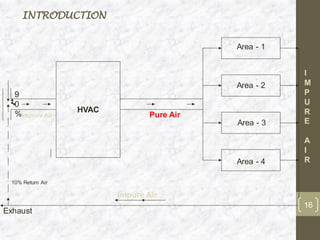
HVAC
Area - 1
Area - 2
Area - 3
Area - 4
Impure Air
I
M
P
U
R
E
A
I
R
Impure Air
Pure Air
9
0
%
10% Return Air
Exhaust
16
CONTAMINATION
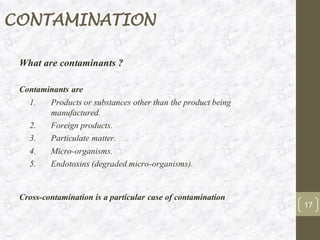
What are contaminants ?
Contaminants are
1. Products or substances other than the product being
manufactured.
2. Foreign products.
3. Particulate matter.
4. Micro-organisms.
5. Endotoxins (degraded micro-organisms).
Cross-contamination is a particular case of contamination
17
CONTAMINATION
Cross-Contamination
From where does Cross-Contamination originate?
1. Poorly designed air handling systems and dust
extraction systems
2. Poorly operated and maintained air handling systems
and dust extraction systems
3. Inadequate procedures for personnel and equipment
4. Insufficiently cleaned equipment 18
CONTAMINATION
Cross-contamination can be minimized by:
1. Personnel procedures
2. Adequate premises
3. Use of closed production systems
4. Adequate, validated cleaning procedures
5. Appropriate levels of protection of product
6. Correct air pressure cascade
19
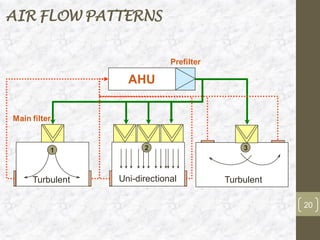
AIR FLOW PATTERNS
Prefilter
AHU
Main filter
Uni-directional Turbulent
Turbulent
1 2 3
20
21
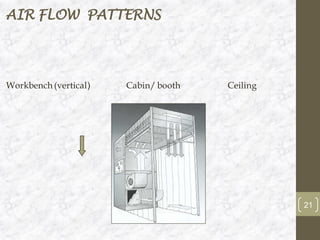
Workbench (vertical) Cabin/ booth Ceiling
AIR FLOW PATTERNS
HVAC QUALIFICATION
➢To ensure that equipment is designed as per requirement,
installed properly.
➢Action of proving that any equipment works correctly and leads
to the expected results.
22
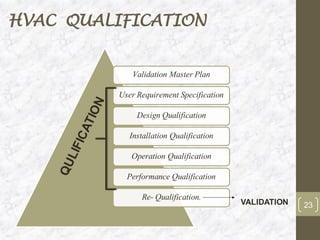
HVAC QUALIFICATION
Validation Master Plan
User Requirement Specification
Design Qualification
Installation Qualification
Operation Qualification
Performance Qualification
Re- Qualification. VALIDATION 23
•
This document should contain
➢ Validation policy
➢ Organizational structure of validation activities
➢ Summary of facilities, systems, equipment and processes to
be validated
➢ Documentation format to be used for protocols and
reports
➢ Planning and scheduling
➢ Change control
➢ References to documents
THE VALIDATION MASTER PLAN
24
USER REQUIREMENT SPECIFICATION
It mainly requires:
➢Room temperatures and relative humidities
➢Clean room classifications for the areas i.e. B. C. or D.
➢Single pass or re-circulated HVAC systems ?
➢Room pressures / Air flow directions
➢GMP requirements.
25
USER REQUIREMENT SPECIFICATION
Capacity of HVAC depends on,
1.Room Volume.
2.No. of Air Changes Required.
3.Production / Consumption Data
4.Seasonal fluctuation.
5.Air Classification of Rooms.
6.Future Development.
26
USER REQUIREMENT SPECIFICATION
Parameters to be defined in Levels of Protection :
Air cleanliness requirements
1. filters type and position,
2. air changes,
3. air flow patterns,
4. pressure differentials,
5. contamination levels by particulate matter & micro-
organisms.
• User Requirement Specification should be approved by
Production, Engineering and QA Heads.
27
Based on the URS supplier designs the equipment-First step
in the qualification of new HVAC systems.
➢ It documents the design of the system and will include :
1. Functional Specification.
2. Technical / Performance specification for equipment.
3. Detailed Air Flow Schematics.
4. Detailed layout drawing of the system.
28
DESIGN QUALIFICATION
➢Compliance with GMPs and other regulatory requirements.
➢Ensures that design,
1. meets the user requirements.
2. details facility airflow and pressure cascade philosophy.
3. takes into account process and personnel flow (cross-
contamination issues)
4. Details materials of construction.
5. Details safety requirements.
6. Full details of the intended construction prior to
implementation.
7. Details all equipment that must be ordered.
29
INSTALLATION QUALIFICATION
➢ System Description
➢ Equipment Delivery
➢ Utilities / Facility / Environment
➢ Assembly & Installation
30
INSTALLATION QUALIFICATION
IQ Should include,
➢ Instrumentation checked against current engineering
drawings and specifications
➢ Verification of materials of construction
➢ Installation of equipment and with piping
➢ Calibration of measuring instruments requirements
➢ Collection and collation of supplier operating and
working instructions and maintenance requirements
31
INSTALLATION QUALIFICATION
Practical aspect of IQ(Cont….)
➢ Calibration of measuring instruments.
➢ Calibration of additionally used instruments.
➢ Initial cleaning records.
➢ Basic commissioning checks.
➢ Maintenance requirements.
➢ IQ process checks that the correct components are installed in
the correct location.
➢ Materials of construction
➢ Spare parts
➢ Change controls
32
INSTALLATION QUALIFICATION
IQ Document should contain,
➢ Instrument name, model, I.D. No., Personnel responsible for
activities and Date.
➢ A fully verified installation that complies with the documented
design. (all deviations will have been recorded and assessed.)
➢ All equipment documentation and maintenance requirements
would be documented.
➢ Completed calibration of measuring instruments.
➢ Verification of Materials of construction.
33
OPERATION QUALIFICATION
➢ISPE definition : The purpose of OQ is to establish, through
documented testing, that all critical components are capable of
operating within established limits and tolerances.
➢The purpose of OQ is to verify and document that an HVAC
system provides acceptable operational control under “at-rest”
conditions.
34
OPERATION QUALIFICATION
Operation Qualification Checks,
➢Ability to provide air of sufficient quality and quantity to
ensure achievement of specified clean room conditions.
➢Ability to maintain temperature, relative humidity and
pressure set points.
➢Ability to maintain any critical parameters stated in the DQ
consistently.
35
OPERATION QUALIFICATION
➢Includes the tests that have been developed from knowledge
of processes, systems and equipment.
➢Tests to include a condition or a set of conditions
encompassing upper and lower operating limits, sometimes
referred to as ‘worst case’ conditions.
36
OPERATION QUALIFICATION
➢IQ reports must be completed and signed off.
➢OQ protocols to be written and approved prior to completion.
➢ Measurement reports are required to demonstrate achievement
of critical parameters as detailed in DQ.
Eg: * All relevant SOPs should be in place
* Temperature measurement report
* Humidity measurement report
* Differential pressure measurement report
* Air flow direction measurement report
* Room particle count measurement report
* All drawings etc. – done in ‘as-built’ status
* All maintenance/ cleaning instructions available
* All O & M staff to be trained to use and maintain the system.
* Sign off. (Compliance Certificate by Engineering Dept & QA)
37
PERFORMANCE QUALIFICATION
➢The purpose of PQ is to verify and document that an HVAC
system provides acceptable control under ‘ Full Operational ‘
conditions.
➢PQ should follow successful completion of IQ and OQ.
➢PQ verifies that over time, the critical parameters, as defined
in the DQ are being achieved.
38
PERFORMANCE QUALIFICATION
PQ Should include,
➢Tests, using production materials, qualified substitutes or
simulated product, that have been developed from knowledge
of the process and facilities, systems or equipment.
➢Test to include a condition or set of conditions encompassing
upper and lower operating limits.
➢PQ is used to demonstrate consistent achievement of critical
parameters over time. ( under manufacturing conditions)
➢PQ is ongoing.
39
QUALIFICATION
COMPLETE DOCUMENTATION
➢Verification of design documentation, including
✓ Description of installation and functions
✓ Specification of the requirements
➢Instructions for performance control
➢Operating procedures
➢Maintenance instructions
➢Maintenance records
➢Training of personnel (program and records)
➢Environmental records
➢Discussion on actions if OOS values
➢Walking around the plant
Finally certification (Sign Off) by Engineering, User
(Production) and QA Heads.
40
VALIDATION
➢Document act of proving that any procedure, process, system /
equipment ACTUALLY leads to expected results.
➢ To ensure that system provides continuously required
environmental conditions.
41
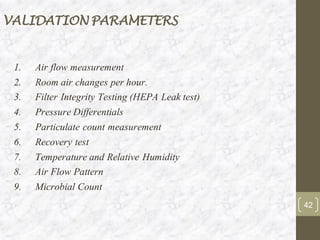
VALIDATION PARAMETERS
1. Air flow measurement
2. Room air changes per hour.
3. Filter Integrity Testing (HEPA Leak test)
4. Pressure Differentials
5. Particulate count measurement
6. Recovery test
7. Temperature and Relative Humidity
8. Air Flow Pattern
9. Microbial Count
42
VALIDATION PARAMETERS
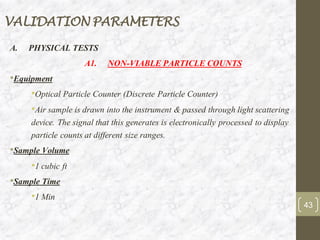
A. PHYSICAL TESTS
A1. NON-VIABLE PARTICLE COUNTS
•Equipment
•Optical Particle Counter (Discrete Particle Counter)
•Air sample is drawn into the instrument & passed through light scattering
device. The signal that this generates is electronically processed to display
particle counts at different size ranges.
•Sample Volume
•1 cubic ft
•Sample Time
•1 Min
43
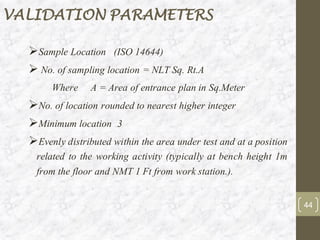
➢Sample Location (ISO 14644)
➢ No. of sampling location = NLT Sq. Rt.A
Where A = Area of entrance plan in Sq.Meter
➢No. of location rounded to nearest higher integer
➢Minimum location 3
➢Evenly distributed within the area under test and at a position
related to the working activity (typically at bench height 1m
from the floor and NMT 1 Ft from work station.).
VALIDATION PARAMETERS
44
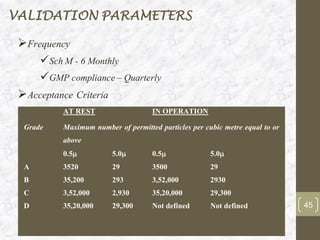
➢Frequency
✓Sch M - 6 Monthly
✓GMP compliance – Quarterly
➢Acceptance Criteria
AT REST IN OPERATION
Grade Maximum number of permitted particles per cubic metre equal to or
above
0.5 5.0 0.5 5.0
A 3520 29 3500 29
B 35,200 293 3,52,000 2930
C 3,52,000 2,930 35,20,000 29,300
D 35,20,000 29,300 Not defined Not defined
VALIDATION PARAMETERS
45
A2. PRESSUREDIFFERENTIALS
Introduction
➢ Correctdegree of overpressurecan be maintained relativeto
the adjacentareas of lower classificationto ensure that air
moves from clean areas to less cleanareas.
Equipment
➢ Electronicmanometer (portable and easy to use),
➢ Incline manometer
Sample Location
➢ Betweenadjacent areas connectedeitherby a door or grille.
➢ Frequencyof sampling
➢ Continuously by gauges / manometer& recordeddaily.
VALIDATION PARAMETERS
46
–Acceptance Criteria
➢> 10 Pa betweenclassifiedarea & adjacentarea of
lower classification
➢> 15 Pa betweenclassifiedarea & unclassifiedarea
–Action
➢HEPA filter blockage
➢Increase fan speed
➢Increase air flow to specific area by altering dampers
VALIDATION PARAMETERS
47
A3. AIRFLOW VELOCITY
Equipment :- Anemometer.
➢ Reading should be taken 10cm from the surface of filter.
➢ Record velocity reading from all the four corners and the Centre
of the filter surface.
➢ Repeat twice at each location
➢ For Grade A laminar flow workstations, the air flow rates shall
be 0.3 meter per second + 20% (for vertical flows) and 0.45 +
20% (for Horizontal flows)
 * No value may deviate from the mean by more than + 20 %
VALIDATION PARAMETERS
48
➢Air velocity exceeding the stated value may cause excessive air
movement & affect work zone protection.
➢Air velocity below the limit may be insufficient to maintain
critical work zone protection.
Action: Deviation indicates blockage of filter
Solution : Alteration of fan speed
HEPA filter replacement
VALIDATION PARAMETERS
49
A4. HEPA FILTER INTEGRITY TEST
(DOP Test)
Purpose : To confirm that there is no damage to filter, seals and
there is no leakage of particles.
Equipment : 1. Aerosol generator (Using Dioctylphthalate)
2. Photometer
Scan at 1 inch from filter surface. Traverse at NMT 10Ft. Min.
Cover entire range.
Make separate passes at peripheries.
50
VALIDATION PARAMETERS
A5. TEMPERATURE & RELATIVE HUMIDITY
➢ Use a sling psycrometer to measure the dry bulb and wet bulb
temperature of the air.
➢ Check the wick of the sling psycrometer, it should be always in
wet conditions in order to record correct wet bulb temperature.
➢ Sling the psycrometer in air for about a minute’s time and
record the dry bulb and wet bulb temperature.
➢ Check the wet bulb depression i.e. difference between dry bulb
and wet bulb temperature.
➢ Refer the psycrometric chart to check the relative humidity
corresponding to the dry bulb temperature and wet bulb
depression.
51
VALIDATION PARAMETERS
ACCEPTANCE CRITERIA
➢Temperature : NMT 27 degree centigrade
➢Humidity : NMT 55 %
➢FREQUENCY :Daily
52
VALIDATION PARAMETERS
A6. AIR CHANGE RATE (ACR)
Introduction
➢ Conventional clean rooms operate on the principle that the air
supplied to the room is of sufficient quantity to dilute or remove the
contamination generated within the room.
➢ Measurement of the air supply volume and determination of the air
change rate (ACR) is a measure of the frequency of air turnover in the
clean room.
➢ This gives some idea as to how quickly contamination may be removed
from the clean room provided there is acceptable mixing of air in the
room.
➢ The ACR can be determined by measuring the mean air velocity at the
supply HEPAs or grilles and calculating the air change rate based on
the mean air supply volume or by using a flow measuring hood which
collects all of the air from the supply and gives an air supply volume
directly.
53
VALIDATION PARAMETERS
Equipment
➢Anemometer
Sample locations
➢At least four positions are tested across the filter or grille
face to obtain the mean supply air velocity.
Frequency of sampling
➢Sch M - 6 Monthly
➢GMP compliance – Quarterly
54
VALIDATION PARAMETERS
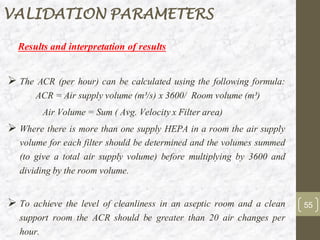
Results and interpretation of results
➢ The ACR (per hour) can be calculated using the following formula:
ACR = Air supply volume (m³/s) x 3600/ Room volume (m³)
Air Volume = Sum ( Avg. Velocityx Filter area)
➢ Where there is more than one supply HEPA in a room the air supply
volume for each filter should be determined and the volumes summed
(to give a total air supply volume) before multiplying by 3600 and
dividing by the room volume.
➢ To achieve the level of cleanliness in an aseptic room and a clean
support room the ACR should be greater than 20 air changes per
hour.
55
VALIDATION PARAMETERS
Requirement : Class B = 60, C & D = 20 ACPH
Action
• Change the filter
• ACR to be rebalanced
B. MICROBIOLOGICAL TESTS
➢ Solid growth media (e.g. settle and contact plates) Soybean
Casein Digest Agar medium can be used for both Bacteria &
Fungi tested.
➢ The recommended size of solid media is 90 mm in diameter
(for settle plates)
➢ 55 mm (surface area 25 cm²) for contact plates.
56
• Sampling conditions
➢Sampling in the at rest condition may be continued at an
agreed frequency to monitor baseline contamination levels.
➢The operational conditions and the activities being performed
at the time of testing should be recorded.
• Incubation conditions
➢Incubation of samples, inverted, at 20 - 25C for at least 5 days
is suitable for the growth of mould and fungi.
➢Incubation of samples, inverted, at 30 - 35C for at least 2 days
is suitable for the growth of bacteria.
VALIDATION PARAMETERS
57
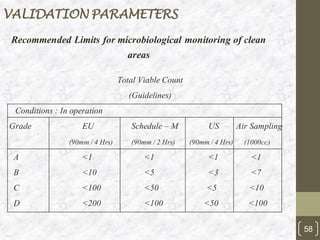
VALIDATION PARAMETERS
Total Viable Count
(Guidelines)
Conditions : In operation
Grade EU Schedule – M US Air Sampling
(90mm / 4 Hrs) (90mm / 2 Hrs) (90mm / 4 Hrs) (1000cc)
A <1 <1 <1 <1
B <10 <5 <3 <7
C <100 <50 <5 <10
D <200 <100 <50 <100
58
Recommended Limits for microbiological monitoring of clean
areas

HVAC Validation (Air Handling Units).pdf

  • 1.
  • 2.
    2 CONTENTS ➢ Introduction ➢ AHU ➢HVAC Qualification ➢ Validation parameter
  • 3.
    INTRODUCTION To understand: ➢ Theneed and reason for pharmaceutical air handling systems. ➢ The technical requirements for air handling systems. ➢ Different types of air handling systems. ➢ Qualification and Validation requirements 3
  • 4.
    WHAT IS CLEANROOM? 4 A room in which the concentration of airborne particle is controlled and which is constructed and used in a manner to minimize the introduction, generation and retention of particles inside the room and in which other relevant parameters. ➢ e.g.. Temperature, humidity and pressure, are controlled as necessary. (ISO 14644-1)
  • 5.
    WHY CLEAN ROOMNECESSARY? ➢It controls 3 types of contamination transfer ✓Air borne contamination ✓Direct contamination by personnel, equipment etc. ✓Contamination from fluids like cleaning fluids, solutions etc. ➢As airborne particulate are reduced, chances of particles entry in the process reduced. ➢Protects product, personnel & environment. ➢Avoid rejection thereby heavy losses in terms of money & time 5
  • 6.
    HOW IT ISACCOMPLISHED? •A clean room is continuously flushed with highly filtered air that is forced in through HEPA filters. 6
  • 7.
    TYPES OF CLEANROOMS ➢ Horizontal Clean Room – Horizontal Laminar flow (HEPA filters in a wall force clean air from one side of the room to other.) ➢ Vertical Clean Room – Vertical Laminar flow (HEPA filters on the ceilingpush cleanair down to the floor.) 7
  • 8.
    FOUR BASIC PRINCIPLESOF CLEAN ROOM ➢Not To Bring Any Dust ➢Not To Accumulate Any Dust ➢Not To Generate Any Dust ➢To Remove Any Dust Quickly 8
  • 9.
    INTRODUCTION Air handling systems, ➢Play a major role in the quality of pharmaceuticals. ➢ Must be designed properly, by professionals. ➢ Must be treated as a critical system. 9
  • 10.
    INTRODUCTION The manufacturing environmentis critical for product quality. Environmentconsistsof, ➢ Light ➢ Temperature ➢ Humidity ➢ Air movement ➢ Microbial contamination ➢ Particulate contamination Uncontrolledenvironmentcan lead to productdegradation ➢ product contamination ➢ loss of product and profit 10
  • 11.
    INTRODUCTION HVAC consists of, 1.Air conditioner 2. AHUs 3. Dehumidifier / Heater 4. Filters (Pre & HEPA) 5. Dust Extractors 6. Ducting (For delivery of controlled air) 7. Supply Fans 8. Smoke Detector 9. Dampers 10. Humidity / Temperature / Pressure sensors 11. Bag Filters 12. Heating / Cooling Coils 11
  • 12.
    US FDA 21 CFRpart 211 (Requirement for building & Facilities) Under 211.42 (c) ➢Operation shall be performed within the specifically defined areas and such other controls, necessary to prevent contamination or mix ups. ➢Temperature and Humidity controlled. ➢An air supply filtered through HEPA filter under positive pressure. ➢A system of monitoring environmental conditions. Under 211.46 (C) ➢Air filtration system, including pre-filters and particulate matter air filtration shall be used when appropriate on air supplies to production areas. 12
  • 13.
    EU GUIDELINES (PREMISES &EQUIPMENT) Under 3.12, ➢ Production areas shall be effectively ventilated with air control facilities including temperature & where necessary humidity and filtration. 13
  • 14.
    SCHEDULE – M PART– 1 (GMP FOR PREMISES AND MATERIALS) Under point 8.21, ➢The licensee shall prevent mix-ups and cross contamination of Drug Materials and Drug Products (from environment dust) by proper air handling system. Part 1A (GMP for Sterilepreparation) Section3 – Details of HVAC system Section4 – Parameterrsfor Validation and Frequencyof Monitoring 14
  • 15.
    INTRODUCTION HVAC (AHU) is HEART ofPharmaceutical Industries 15
  • 16.
    INTRODUCTION HVAC Area - 1 Area- 2 Area - 3 Area - 4 Impure Air I M P U R E A I R Impure Air Pure Air 9 0 % 10% Return Air Exhaust 16
  • 17.
    CONTAMINATION What are contaminants? Contaminants are 1. Products or substances other than the product being manufactured. 2. Foreign products. 3. Particulate matter. 4. Micro-organisms. 5. Endotoxins (degraded micro-organisms). Cross-contamination is a particular case of contamination 17
  • 18.
    CONTAMINATION Cross-Contamination From where doesCross-Contamination originate? 1. Poorly designed air handling systems and dust extraction systems 2. Poorly operated and maintained air handling systems and dust extraction systems 3. Inadequate procedures for personnel and equipment 4. Insufficiently cleaned equipment 18
  • 19.
    CONTAMINATION Cross-contamination can beminimized by: 1. Personnel procedures 2. Adequate premises 3. Use of closed production systems 4. Adequate, validated cleaning procedures 5. Appropriate levels of protection of product 6. Correct air pressure cascade 19
  • 20.
    AIR FLOW PATTERNS Prefilter AHU Mainfilter Uni-directional Turbulent Turbulent 1 2 3 20
  • 21.
    21 Workbench (vertical) Cabin/booth Ceiling AIR FLOW PATTERNS
  • 22.
    HVAC QUALIFICATION ➢To ensurethat equipment is designed as per requirement, installed properly. ➢Action of proving that any equipment works correctly and leads to the expected results. 22
  • 23.
    HVAC QUALIFICATION Validation MasterPlan User Requirement Specification Design Qualification Installation Qualification Operation Qualification Performance Qualification Re- Qualification. VALIDATION 23
  • 24.
    • This document shouldcontain ➢ Validation policy ➢ Organizational structure of validation activities ➢ Summary of facilities, systems, equipment and processes to be validated ➢ Documentation format to be used for protocols and reports ➢ Planning and scheduling ➢ Change control ➢ References to documents THE VALIDATION MASTER PLAN 24
  • 25.
    USER REQUIREMENT SPECIFICATION Itmainly requires: ➢Room temperatures and relative humidities ➢Clean room classifications for the areas i.e. B. C. or D. ➢Single pass or re-circulated HVAC systems ? ➢Room pressures / Air flow directions ➢GMP requirements. 25
  • 26.
    USER REQUIREMENT SPECIFICATION Capacityof HVAC depends on, 1.Room Volume. 2.No. of Air Changes Required. 3.Production / Consumption Data 4.Seasonal fluctuation. 5.Air Classification of Rooms. 6.Future Development. 26
  • 27.
    USER REQUIREMENT SPECIFICATION Parametersto be defined in Levels of Protection : Air cleanliness requirements 1. filters type and position, 2. air changes, 3. air flow patterns, 4. pressure differentials, 5. contamination levels by particulate matter & micro- organisms. • User Requirement Specification should be approved by Production, Engineering and QA Heads. 27
  • 28.
    Based on theURS supplier designs the equipment-First step in the qualification of new HVAC systems. ➢ It documents the design of the system and will include : 1. Functional Specification. 2. Technical / Performance specification for equipment. 3. Detailed Air Flow Schematics. 4. Detailed layout drawing of the system. 28 DESIGN QUALIFICATION
  • 29.
    DESIGN QUALIFICATION ➢Compliance withGMPs and other regulatory requirements. ➢Ensures that design, 1. meets the user requirements. 2. details facility airflow and pressure cascade philosophy. 3. takes into account process and personnel flow (cross- contamination issues) 4. Details materials of construction. 5. Details safety requirements. 6. Full details of the intended construction prior to implementation. 7. Details all equipment that must be ordered. 29
  • 30.
    INSTALLATION QUALIFICATION ➢ SystemDescription ➢ Equipment Delivery ➢ Utilities / Facility / Environment ➢ Assembly & Installation 30
  • 31.
    INSTALLATION QUALIFICATION IQ Shouldinclude, ➢ Instrumentation checked against current engineering drawings and specifications ➢ Verification of materials of construction ➢ Installation of equipment and with piping ➢ Calibration of measuring instruments requirements ➢ Collection and collation of supplier operating and working instructions and maintenance requirements 31
  • 32.
    INSTALLATION QUALIFICATION Practical aspectof IQ(Cont….) ➢ Calibration of measuring instruments. ➢ Calibration of additionally used instruments. ➢ Initial cleaning records. ➢ Basic commissioning checks. ➢ Maintenance requirements. ➢ IQ process checks that the correct components are installed in the correct location. ➢ Materials of construction ➢ Spare parts ➢ Change controls 32
  • 33.
    INSTALLATION QUALIFICATION IQ Documentshould contain, ➢ Instrument name, model, I.D. No., Personnel responsible for activities and Date. ➢ A fully verified installation that complies with the documented design. (all deviations will have been recorded and assessed.) ➢ All equipment documentation and maintenance requirements would be documented. ➢ Completed calibration of measuring instruments. ➢ Verification of Materials of construction. 33
  • 34.
    OPERATION QUALIFICATION ➢ISPE definition: The purpose of OQ is to establish, through documented testing, that all critical components are capable of operating within established limits and tolerances. ➢The purpose of OQ is to verify and document that an HVAC system provides acceptable operational control under “at-rest” conditions. 34
  • 35.
    OPERATION QUALIFICATION Operation QualificationChecks, ➢Ability to provide air of sufficient quality and quantity to ensure achievement of specified clean room conditions. ➢Ability to maintain temperature, relative humidity and pressure set points. ➢Ability to maintain any critical parameters stated in the DQ consistently. 35
  • 36.
    OPERATION QUALIFICATION ➢Includes thetests that have been developed from knowledge of processes, systems and equipment. ➢Tests to include a condition or a set of conditions encompassing upper and lower operating limits, sometimes referred to as ‘worst case’ conditions. 36
  • 37.
    OPERATION QUALIFICATION ➢IQ reportsmust be completed and signed off. ➢OQ protocols to be written and approved prior to completion. ➢ Measurement reports are required to demonstrate achievement of critical parameters as detailed in DQ. Eg: * All relevant SOPs should be in place * Temperature measurement report * Humidity measurement report * Differential pressure measurement report * Air flow direction measurement report * Room particle count measurement report * All drawings etc. – done in ‘as-built’ status * All maintenance/ cleaning instructions available * All O & M staff to be trained to use and maintain the system. * Sign off. (Compliance Certificate by Engineering Dept & QA) 37
  • 38.
    PERFORMANCE QUALIFICATION ➢The purposeof PQ is to verify and document that an HVAC system provides acceptable control under ‘ Full Operational ‘ conditions. ➢PQ should follow successful completion of IQ and OQ. ➢PQ verifies that over time, the critical parameters, as defined in the DQ are being achieved. 38
  • 39.
    PERFORMANCE QUALIFICATION PQ Shouldinclude, ➢Tests, using production materials, qualified substitutes or simulated product, that have been developed from knowledge of the process and facilities, systems or equipment. ➢Test to include a condition or set of conditions encompassing upper and lower operating limits. ➢PQ is used to demonstrate consistent achievement of critical parameters over time. ( under manufacturing conditions) ➢PQ is ongoing. 39
  • 40.
    QUALIFICATION COMPLETE DOCUMENTATION ➢Verification ofdesign documentation, including ✓ Description of installation and functions ✓ Specification of the requirements ➢Instructions for performance control ➢Operating procedures ➢Maintenance instructions ➢Maintenance records ➢Training of personnel (program and records) ➢Environmental records ➢Discussion on actions if OOS values ➢Walking around the plant Finally certification (Sign Off) by Engineering, User (Production) and QA Heads. 40
  • 41.
    VALIDATION ➢Document act ofproving that any procedure, process, system / equipment ACTUALLY leads to expected results. ➢ To ensure that system provides continuously required environmental conditions. 41
  • 42.
    VALIDATION PARAMETERS 1. Airflow measurement 2. Room air changes per hour. 3. Filter Integrity Testing (HEPA Leak test) 4. Pressure Differentials 5. Particulate count measurement 6. Recovery test 7. Temperature and Relative Humidity 8. Air Flow Pattern 9. Microbial Count 42
  • 43.
    VALIDATION PARAMETERS A. PHYSICALTESTS A1. NON-VIABLE PARTICLE COUNTS •Equipment •Optical Particle Counter (Discrete Particle Counter) •Air sample is drawn into the instrument & passed through light scattering device. The signal that this generates is electronically processed to display particle counts at different size ranges. •Sample Volume •1 cubic ft •Sample Time •1 Min 43
  • 44.
    ➢Sample Location (ISO14644) ➢ No. of sampling location = NLT Sq. Rt.A Where A = Area of entrance plan in Sq.Meter ➢No. of location rounded to nearest higher integer ➢Minimum location 3 ➢Evenly distributed within the area under test and at a position related to the working activity (typically at bench height 1m from the floor and NMT 1 Ft from work station.). VALIDATION PARAMETERS 44
  • 45.
    ➢Frequency ✓Sch M -6 Monthly ✓GMP compliance – Quarterly ➢Acceptance Criteria AT REST IN OPERATION Grade Maximum number of permitted particles per cubic metre equal to or above 0.5 5.0 0.5 5.0 A 3520 29 3500 29 B 35,200 293 3,52,000 2930 C 3,52,000 2,930 35,20,000 29,300 D 35,20,000 29,300 Not defined Not defined VALIDATION PARAMETERS 45
  • 46.
    A2. PRESSUREDIFFERENTIALS Introduction ➢ Correctdegreeof overpressurecan be maintained relativeto the adjacentareas of lower classificationto ensure that air moves from clean areas to less cleanareas. Equipment ➢ Electronicmanometer (portable and easy to use), ➢ Incline manometer Sample Location ➢ Betweenadjacent areas connectedeitherby a door or grille. ➢ Frequencyof sampling ➢ Continuously by gauges / manometer& recordeddaily. VALIDATION PARAMETERS 46
  • 47.
    –Acceptance Criteria ➢> 10Pa betweenclassifiedarea & adjacentarea of lower classification ➢> 15 Pa betweenclassifiedarea & unclassifiedarea –Action ➢HEPA filter blockage ➢Increase fan speed ➢Increase air flow to specific area by altering dampers VALIDATION PARAMETERS 47
  • 48.
    A3. AIRFLOW VELOCITY Equipment:- Anemometer. ➢ Reading should be taken 10cm from the surface of filter. ➢ Record velocity reading from all the four corners and the Centre of the filter surface. ➢ Repeat twice at each location ➢ For Grade A laminar flow workstations, the air flow rates shall be 0.3 meter per second + 20% (for vertical flows) and 0.45 + 20% (for Horizontal flows)  * No value may deviate from the mean by more than + 20 % VALIDATION PARAMETERS 48
  • 49.
    ➢Air velocity exceedingthe stated value may cause excessive air movement & affect work zone protection. ➢Air velocity below the limit may be insufficient to maintain critical work zone protection. Action: Deviation indicates blockage of filter Solution : Alteration of fan speed HEPA filter replacement VALIDATION PARAMETERS 49
  • 50.
    A4. HEPA FILTERINTEGRITY TEST (DOP Test) Purpose : To confirm that there is no damage to filter, seals and there is no leakage of particles. Equipment : 1. Aerosol generator (Using Dioctylphthalate) 2. Photometer Scan at 1 inch from filter surface. Traverse at NMT 10Ft. Min. Cover entire range. Make separate passes at peripheries. 50 VALIDATION PARAMETERS
  • 51.
    A5. TEMPERATURE &RELATIVE HUMIDITY ➢ Use a sling psycrometer to measure the dry bulb and wet bulb temperature of the air. ➢ Check the wick of the sling psycrometer, it should be always in wet conditions in order to record correct wet bulb temperature. ➢ Sling the psycrometer in air for about a minute’s time and record the dry bulb and wet bulb temperature. ➢ Check the wet bulb depression i.e. difference between dry bulb and wet bulb temperature. ➢ Refer the psycrometric chart to check the relative humidity corresponding to the dry bulb temperature and wet bulb depression. 51 VALIDATION PARAMETERS
  • 52.
    ACCEPTANCE CRITERIA ➢Temperature :NMT 27 degree centigrade ➢Humidity : NMT 55 % ➢FREQUENCY :Daily 52 VALIDATION PARAMETERS
  • 53.
    A6. AIR CHANGERATE (ACR) Introduction ➢ Conventional clean rooms operate on the principle that the air supplied to the room is of sufficient quantity to dilute or remove the contamination generated within the room. ➢ Measurement of the air supply volume and determination of the air change rate (ACR) is a measure of the frequency of air turnover in the clean room. ➢ This gives some idea as to how quickly contamination may be removed from the clean room provided there is acceptable mixing of air in the room. ➢ The ACR can be determined by measuring the mean air velocity at the supply HEPAs or grilles and calculating the air change rate based on the mean air supply volume or by using a flow measuring hood which collects all of the air from the supply and gives an air supply volume directly. 53 VALIDATION PARAMETERS
  • 54.
    Equipment ➢Anemometer Sample locations ➢At leastfour positions are tested across the filter or grille face to obtain the mean supply air velocity. Frequency of sampling ➢Sch M - 6 Monthly ➢GMP compliance – Quarterly 54 VALIDATION PARAMETERS
  • 55.
    Results and interpretationof results ➢ The ACR (per hour) can be calculated using the following formula: ACR = Air supply volume (m³/s) x 3600/ Room volume (m³) Air Volume = Sum ( Avg. Velocityx Filter area) ➢ Where there is more than one supply HEPA in a room the air supply volume for each filter should be determined and the volumes summed (to give a total air supply volume) before multiplying by 3600 and dividing by the room volume. ➢ To achieve the level of cleanliness in an aseptic room and a clean support room the ACR should be greater than 20 air changes per hour. 55 VALIDATION PARAMETERS
  • 56.
    VALIDATION PARAMETERS Requirement :Class B = 60, C & D = 20 ACPH Action • Change the filter • ACR to be rebalanced B. MICROBIOLOGICAL TESTS ➢ Solid growth media (e.g. settle and contact plates) Soybean Casein Digest Agar medium can be used for both Bacteria & Fungi tested. ➢ The recommended size of solid media is 90 mm in diameter (for settle plates) ➢ 55 mm (surface area 25 cm²) for contact plates. 56
  • 57.
    • Sampling conditions ➢Samplingin the at rest condition may be continued at an agreed frequency to monitor baseline contamination levels. ➢The operational conditions and the activities being performed at the time of testing should be recorded. • Incubation conditions ➢Incubation of samples, inverted, at 20 - 25C for at least 5 days is suitable for the growth of mould and fungi. ➢Incubation of samples, inverted, at 30 - 35C for at least 2 days is suitable for the growth of bacteria. VALIDATION PARAMETERS 57
  • 58.
    VALIDATION PARAMETERS Total ViableCount (Guidelines) Conditions : In operation Grade EU Schedule – M US Air Sampling (90mm / 4 Hrs) (90mm / 2 Hrs) (90mm / 4 Hrs) (1000cc) A <1 <1 <1 <1 B <10 <5 <3 <7 C <100 <50 <5 <10 D <200 <100 <50 <100 58 Recommended Limits for microbiological monitoring of clean areas