World Health OrganizationWorld Health Organization
Supplementary Guidelines on
Good Manufacturing Practices for
Heating,Ventilation and Air conditioning (HVAC) Systems
for Non-sterile Dosage Forms
Working document QAS/02.048/Rev.1 (2004)
Praphon Angtrakool
Food and Drug Administration
1. Introduction1. Introduction
HVAC systems assists in ensuring the manufacture of quality
products and also result in operator comfort.
HVAC systems design influences architectural layouts, with
regard to items such as airlock positions, doorways and lobbies.
The prevention of the contamination and cross-contamination is
an essential design consideration of the HVAC system.
The design of the HVAC system should be considered at the
concept design stage.
1
2. Glossary (1)
Cleanroom : A room or area with defined environmental control
of particulate and microbial contamination, constructed and
used in such a way as to reduce the introduction, generation
and retention of contaminants within the area, and in which
other relevant parameters (e.g. temperature, humidity and
pressure) are controlled as necessary.
Containment : A process or device to contain product, dust or
contamination in one zone, preventing it from escaping to
another zone.
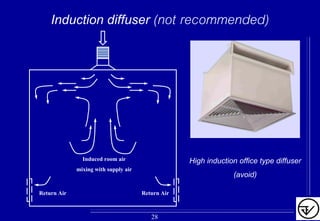
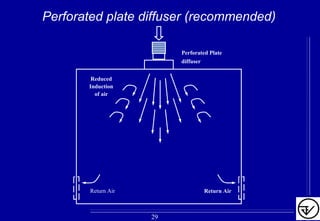
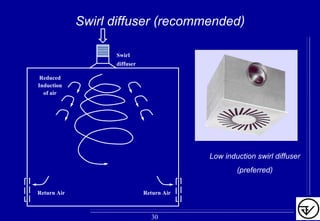
2
2. Glossary (2)
Contamination : The undesired introduction of impurities of a
chemical or microbial nature, or of foreign matter, into or on to a
starting material or intermediated, during processing, sampling,
packaging or repackaging, storage or transport.
Cross-contamination : Contamination of starting material,
intermediated product or finished product with another starting
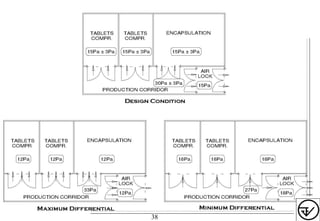
material or material during production.
3
3.3. ScopeScope
HVAC systems for oral solid dosage facilities
The three primary aspects addressed in this manual are the
role that the HVAC system play in
product protection
personnel protection
enviromental protection
4
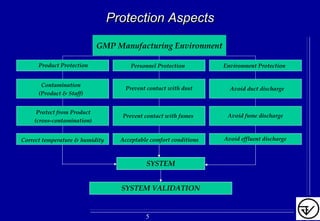
Protection AspectsProtection Aspects
SYSTEM VALIDATION
SYSTEM
Correct temperature & humidity
Protect from Product
(cross-contamination)
Contamination
(Product & Staff)
Product Protection
Acceptable comfort conditions
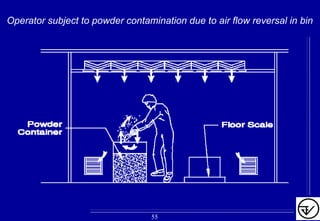
Prevent contact with fumes
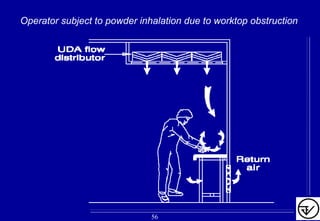
Prevent contact with dust
Personnel Protection
Avoid fume discharge
Avoid duct discharge
Environment Protection
GMP Manufacturing Environment
Avoid effluent discharge
5
4. Product Protection4. Product Protection (1)(1)
4.1 Contamination control
4.1.1 Cleanroom concept
4.1.2 Level of protection
4.1.3 Air filtration to control contamination
4.1.4 Contamination by HVAC plant
4.1.5 Contamination by staff
4.1.6 Airflow patterns
4.1.7 Uni-directional flow protection
4.1.8 Infiltration
6
4. Product Protection4. Product Protection (2)(2)
4.2 Cross-contamination protection
4.2.1 Directional air movement
- Displacement concept
- Pressure differential concept
- Physical barrier concept
- Selecting the segregation concept
4.2.2 Uni-directional flow protection
4.2.3 Cross-contamination via HVAC supply air
4.2.4 Cross-contamination due to fan failure
7
4. Product Protection4. Product Protection (3)(3)
4.3 Temperature and Humidity
4.3.1 General requirements
4.3.2 Product temperature requirements
4.3.3 Product humidity requirements
4.3.4 Microbial growth
8
5. Personnel Protection5. Personnel Protection
5.1 Protection from dust
5.2 Dust classification
5.3 Uni-directional flow protection
5.4 Point extraction
5.5 Directional airflow
5.6 Air shower
5.7 Protection enclosures
5.8 Operator comfort
9
6.1 Extraction air dust
6.2 Fume removal
6.3 Effluent discharge
6. Protection of the Environment6. Protection of the Environment
10
7.1 Air distribution
7.2 Air handling unit configurations
7.2.1 Re-circulation system
7.2.2 Full fresh air systems
7.2.3 Additional system components
7. System and components7. System and components
11
4.1 Contamination control4.1 Contamination control
Through all stages of processing, product should be
protected from contamination and cross-contamination.
These include contamination resulting from
inappropriate building finishes
plant layout
poor cleaning procedures
lack of staff discipline
poor HVAC system
4. Product Protection4. Product Protection (1)(1)
12
4.1.1 Cleanroom concept4.1.1 Cleanroom concept
Pharmaceutical manufacturing facilities where pharmaceutical
products, utensils and manufacturing equipment are exposed
to the environment, should be classified as “cleanrooms”.
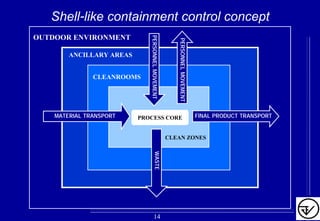
The shell-like containment control concept : The process core
is regarded as the most stringently controlled clean zone
which is protected by being surrounded by cleanrooms of a
lower classification.
Internal contaminants should be removed by dilution and
flushing of contaminants in the room, or by displacement
airflow.
13
OUTDOOR ENVIRONMENT
Shell-like containment control concept
PERSONNELMOVEMENT
PROCESS CORE FINAL PRODUCT TRANSPORT
PERSONNELMOVEMENT
MATERIAL TRANSPORT
WASTE
CLEAN ZONES
CLEANROOMS
ANCILLARY AREAS
14
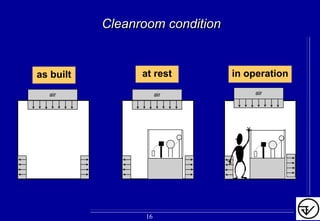
Cleanroom conditionCleanroom condition
as built : condition where the installation is complete with all
services connected and functioning but with no production
equipment, materials, or personnel present
at rest : condition where the installation is complete with
equipment installed and operation in a manner agree upon by
the customer and supplier, but with no personnel present
operational : condition where the installation is functioning in
the specified manner, with the specified number of personnel
and working in the manner agreed upon
915
Cleanroom conditionCleanroom condition
air
as built
air air
at rest in operation
16
4.1.1 Cleanroom concept4.1.1 Cleanroom concept (cont.)(cont.)
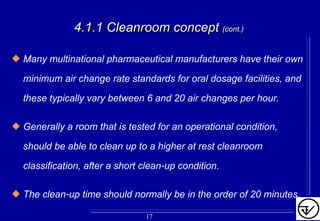
Many multinational pharmaceutical manufacturers have their own
minimum air change rate standards for oral dosage facilities, and
these typically vary between 6 and 20 air changes per hour.
Generally a room that is tested for an operational condition,
should be able to clean up to a higher at rest cleanroom
classification, after a short clean-up condition.
The clean-up time should normally be in the order of 20 minutes.
17
4.1.2 Level of Protection4.1.2 Level of Protection (1)(1)
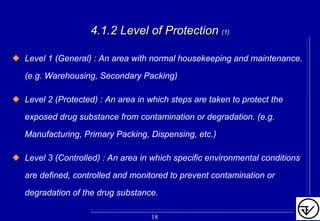
Level 1 (General) : An area with normal housekeeping and maintenance.
(e.g. Warehousing, Secondary Packing)
Level 2 (Protected) : An area in which steps are taken to protect the
exposed drug substance from contamination or degradation. (e.g.
Manufacturing, Primary Packing, Dispensing, etc.)
Level 3 (Controlled) : An area in which specific environmental conditions
are defined, controlled and monitored to prevent contamination or
degradation of the drug substance.
18
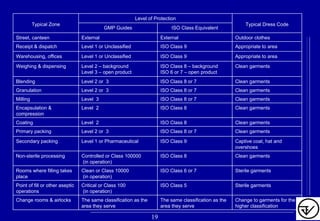
Change to garments for the
higher classification
The same classification as the
area they serve
The same classification as the
area they serve
Change rooms & airlocks
Sterile garmentsISO Class 5Critical or Class 100
(in operation)
Point of fill or other aseptic
operations
Sterile garmentsISO Class 6 or 7Clean or Class 10000
(in operation)
Rooms where filling takes
place
Clean garmentsISO Class 8Controlled or Class 100000
(in operation)
Non-sterile processing
Captive coat, hat and
overshoes
ISO Class 9Level 1 or PharmaceuticalSecondary packing
Clean garmentsISO Class 8 or 7Level 2 or 3Primary packing
Clean garmentsISO Class 8Level 2Coating
Clean garmentsISO Class 8Level 2Encapsulation &
compression
Clean garmentsISO Class 8 or 7Level 3Milling
Clean garmentsISO Class 8 or 7Level 2 or 3Granulation
Clean garmentsISO Class 8 or 7Level 2 or 3Blending
Clean garmentsISO Class 8 – background
ISO 6 or 7 – open product
Level 2 – background
Level 3 – open product
Weighing & dispensing
Appropriate to areaISO Class 9Level 1 or UnclassifiedWarehousing, offices
Appropriate to areaISO Class 9Level 1 or UnclassifiedReceipt & dispatch
Outdoor clothesExternalExternalStreet, canteen
ISO Class EquivalentGMP Guides
Typical Dress Code
Level of Protection
Typical Zone
19
4.1.2 Level of Protection4.1.2 Level of Protection (3)(3)
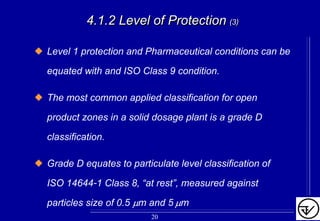
Level 1 protection and Pharmaceutical conditions can be
equated with and ISO Class 9 condition.
The most common applied classification for open
product zones in a solid dosage plant is a grade D
classification.
Grade D equates to particulate level classification of
ISO 14644-1 Class 8, “at rest”, measured against
particles size of 0.5 µm and 5µm
20
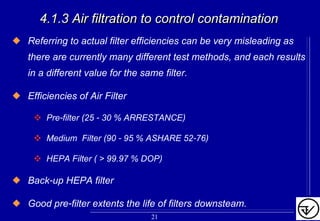
4.1.3 Air filtration to control contamination4.1.3 Air filtration to control contamination
Referring to actual filter efficiencies can be very misleading as
there are currently many different test methods, and each results
in a different value for the same filter.
Efficiencies of Air Filter
Pre-filter (25 - 30 % ARRESTANCE)
Medium Filter (90 - 95 % ASHARE 52-76)
HEPA Filter ( > 99.97 % DOP)
Back-up HEPA filter
Good pre-filter extents the life of filters downsteam.
21
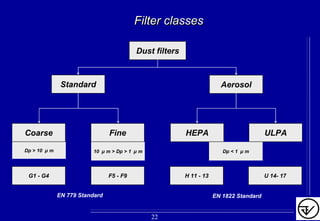
Filter classesFilter classes
FineCoarse
Dust filters
Standard Aerosol
ULPAHEPA
10 µ m > Dp > 1 µ mDp > 10 µ m Dp < 1 µ m
F5 - F9G1 - G4 U 14- 17H 11 - 13
EN 1822 StandardEN 779 Standard
22
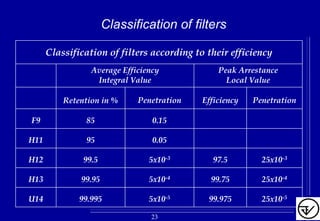
Classification of filters
25x10-599.9755x10-599.995U14
25x10-499.755x10-499.95H13
25x10-397.55x10-399.5H12
0.0595H11
0.1585F9
PenetrationEfficiencyPenetrationRetention in %
Peak Arrestance
Local Value
Average Efficiency
Integral Value
Classification of filters according to their efficiency
23
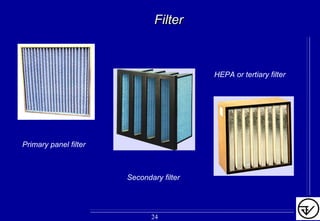
FilterFilter
Secondary filter
HEPA or tertiary filter
24
Primary panel filter
4.1.4 Contamination by HVAC plant4.1.4 Contamination by HVAC plant
Materials for components of an HVAC system should be
selected with care
Contamination into the air steam should be located upsteam
of the final filters
Services are accessible from outside the processing area
25
4.1.5 Contamination by staff4.1.5 Contamination by staff
Airflows should be planned in conjunction with operator
locations, so as to minimize operator contamination of the
product and also to protect the operator from dust inhalation.
Where the product could be harmful to the operator, an
alternative arrangement should be made.
Cosmetics such as facial make-up are a major source of
contamination
26
4.1.6 Air flow patterns4.1.6 Air flow patterns
Supply air diffusers of the high induction type should not
be used in a cleanroom
Air should be exhausted from rooms at a low level.
Recommended supply air diffuser
Perforated plate diffuser
Swirl diffuser
27
Induction diffuser (not recommended)
Induced room air
mixing with supply air
Return Air Return Air
High induction office type diffuser
(avoid)
28
Perforated plate diffuser (recommended)
Perforated Plate
diffuser
Return Air Return Air
Reduced
Induction
of air
29
Swirl diffuser (recommended)
Return Air Return Air
Swirl
diffuser
Reduced
Induction
of air
Low induction swirl diffuser
(preferred)
30
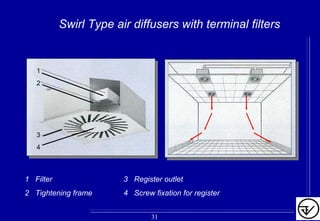
Swirl Type air diffusers with terminal filters
1 Filter 3 Register outlet
2 Tightening frame 4 Screw fixation for register
1
2
3
4
31
4.1.7 Uni4.1.7 Uni--directionaldirectional airairflow protectionflow protection
Sampling should be carried out in the same environmental class
that is required for the further processing of the product.
Sampling should normally be carried out under a uni-directional
airflow sceen.
Uni-directional flow can be
Vertical flow (0.3 m/s + 20 %)
Horizontal flow (0.45 m/s + 20 %)
32
4.1.8 Infiltration4.1.8 Infiltration
Manufacturing facilities should be maintained at a positive
pressure relative to the outside, to limit the ingress of
contaminants.
Where facilities are to be maintained at negative pressures
relative to ambient, in order to prevent the escape of harmful
products to the outside (such as penicillin and hormones),
then special precaution should be taken.
Negative pressure zone should, as far as possible, be
encapsulated by surrounding area with clean air supplies, so
that only clean air can filtrate into the controlled zone.
33
4.2 Cross4.2 Cross--contamination protectioncontamination protection
Through all stages of processing, products should be protect from
cross-contamination
This can achieved with the aid of the following methods.
4.2.1 Directional air movement4.2.1 Directional air movement
The pressure cascade should be such that air flow from the corridor
into cubicles, resulting in dust containment
34
4.2.1 Directional air movement4.2.1 Directional air movement (2)(2)
In multi-product OSD manufacturing area, the layout normally consists
of a corridor with production cubicles located on either side of it.
Cross-contamination between products within a single room will not be
addressed, as different products should never be processed in the
same area at the same time.
The corridor should be maintained at a higher pressure than the
cubicles, and than cubicles at a higher pressure than atmospheric
pressure (negative pressure relative to atmosphere, in order to contain
hazardous substances, such as penicillin or hormones, etc.)
35
4.2.1 Directional air movement4.2.1 Directional air movement(3)(3)
4.2.1.1 Displacement concept (low pressure differential, high airflow)
A low pressure differential can effectively separate clean and
less clean adjacent zone, by means of a low turbulent
displacement airflow velocity greater than 0.2 m/s.
The air should supplied to the corridor, flow through the doorway,
and should be extracted from the back of the cubicle.
The door containment airflow velocity should be considered a
critical parameter.
36
4.2.1 Directional air movement4.2.1 Directional air movement (4)(4)
4.2.1.2 Pressure differential concept (high pressure differential, low airflow)
The most widely accepted pressure differential between the two
adjacent zones is 15 Pa.
But pressure differentials of between 5 Pa and 20 Pa could be
acceptable.
A control tolerance of ± 3 Pa is achievable.
The pressure differential between adjacent rooms should be
considered a critical parameter.
37
38
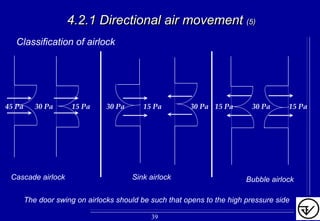
4.2.1 Directional air movement4.2.1 Directional air movement (5)(5)
Bubble airlockSink airlock
45 Pa 30 Pa 30 Pa 30 Pa15 Pa15 Pa 30 Pa 15 Pa 15 Pa
Classification of airlock
The door swing on airlocks should be such that opens to the high pressure side
39
Cascade airlock
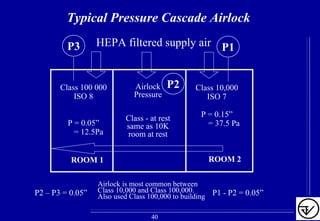
Typical Pressure Cascade Airlock
P1 - P2 = 0.05”
Class 10,000
ISO 7
P = 0.15”
= 37.5 Pa
HEPA filtered supply air
Class 100 000
ISO 8
P = 0.05”
= 12.5Pa
Airlock
Pressure
Class - at rest
same as 10K
room at rest
ROOM 1 ROOM 2
P3 P1
P2
P2 – P3 = 0.05”
Airlock is most common between
Class 10,000 and Class 100,000.
Also used Class 100,000 to building
40
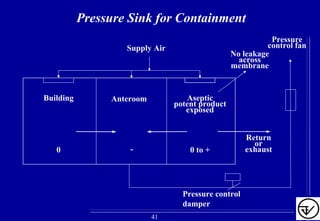
Pressure Sink for Containment
Pressure
control fan
Building Anteroom Aseptic
potent product
exposed
0 - 0 to +
Supply Air
Pressure control
damper
Return
or
exhaust
No leakage
across
membrane
41
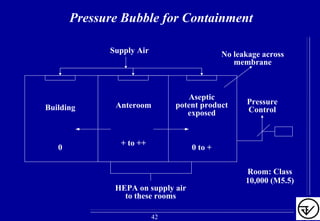
Pressure Bubble for Containment
Supply Air
Pressure
ControlBuilding Anteroom
Aseptic
potent product
exposed
0
+ to ++
0 to +
No leakage across
membrane
HEPA on supply air
to these rooms
Room: Class
10,000 (M5.5)
42
4.2.1 Directional air movement4.2.1 Directional air movement (6)(6)
4.2.1.3 Physical barrier concept (barrier isolator)
The used of impervious barrier to prevent cross-
contamination between two zones is the third
segregation concept (the case where a barrier isolator,
or pumped transfer of materials, is used)
Not practical in an oral solid dosage facility.
43
4.2.1 Directional air movement4.2.1 Directional air movement (7)(7)
4.2.1.4 Selecting the segregation concept
The displacement concept should ideally be used in production
process where large amounts of dust are generated.
The pressure differential may normally be used in zones where
there is little or no dust being generated.
High potent products should be manufactured under a pressure
cascade regime that is negative to atmospheric pressure
44
A dispensary weigh booth should be provided with
unidirectional airflow for product and operator protection
Sampling and dispensary booth for oral solid dosage form may
not be required unidirectional flow provides Class A (ISO 5)
4.2.2 Unidirectional airflow protection4.2.2 Unidirectional airflow protection
45
Dust laden air, returned to air handling unit, increases the
possibility of cross-contamination in a multi-product plant.
A re-circulation system may be acceptable, provided that suitable
filtration and there are no contaminants (such as fumes and
volatile) which cannot be removed by normal filtration.
A re-circulation system should be provided with HEPA filters to
ensure the removal of return air contaminations.
4.2.3 Cross4.2.3 Cross--contamination via HVAC supply aircontamination via HVAC supply air
46
4.2.4 Cross4.2.4 Cross--contamination due to fan failurecontamination due to fan failure
Appropriate airflow alarm system.
Central dust extraction systems should be interlocked with the
appropriate air handling systems.
Air should not flow from the room with the higher pressure to
the room with the lower pressure, via the dust extract ducting.
47
4.3 Temperature and Humidity4.3 Temperature and Humidity (1)(1)
General requirements
product manufacturing requirements
operator comfort
Product temperature requirements
minimum and maximum should not be made too close
48
4.3 Temperature and Humidity4.3 Temperature and Humidity (2)(2)
Product humidity requirement
< 45 % RH at 22
o
C may require chemical driers
Humidifiers should be avioded (microbial growth)
Siliga gel or Lithium chloride
Microbial growth
High T o
and % RH cause perspiration from operator
49
5. Personnel Protection5. Personnel Protection (1)(1)
5.1 Protection from dust
Operator health should not be put at risk by being exposed to
harmful products.
Airflow should be carefully planned, to ensure that
the operator does not contaminate the product
the operator is not put at risk by the product.
50
5.2 Dust classification5.2 Dust classification
Dust can be roughly classified by size according to :
Coarse dust with size range of 50 to 500 µm (settles rapidly)
Fine dust with size range of 1.0 to 50 µm (settles slowly)
Ultra fine dust with size range < 0.5 µm to 1.0 µm (remains
constantly suspended)
Particles < 0.05 µm are considered to be vapors and not dust
Only dust particles that are greater than 10 µm are visible to the
naked eye with good lighting and good eyesight
51
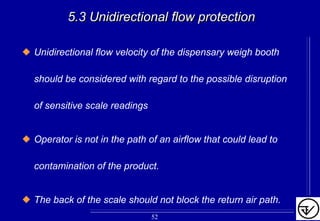
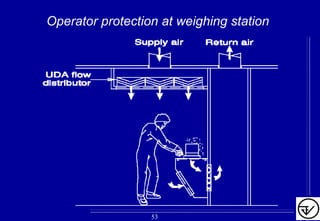
5.3 Unidirectional flow protection5.3 Unidirectional flow protection
Unidirectional flow velocity of the dispensary weigh booth
should be considered with regard to the possible disruption
of sensitive scale readings
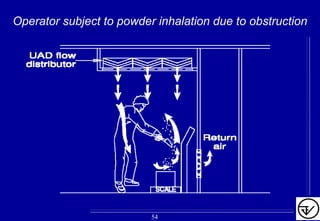
Operator is not in the path of an airflow that could lead to
contamination of the product.
The back of the scale should not block the return air path.
52
Operator protection at weighing station
53
Operator subject to powder inhalation due to obstruction
54
Operator subject to powder contamination due to air flow reversal in bin
55
Operator subject to powder inhalation due to worktop obstruction
56
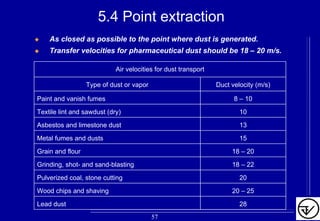
5.4 Point extraction
As closed as possible to the point where dust is generated.
Transfer velocities for pharmaceutical dust should be 18 – 20 m/s.
28Lead dust
20 – 25Wood chips and shaving
20Pulverized coal, stone cutting
18 – 22Grinding, shot- and sand-blasting
18 – 20Grain and flour
15Metal fumes and dusts
13Asbestos and limestone dust
10Textile lint and sawdust (dry)
8 – 10Paint and vanish fumes
Duct velocity (m/s)Type of dust or vapor
Air velocities for dust transport
57
5.5 Directional airflow5.5 Directional airflow
The air should be introduced from ceiling diffusers and is
extracted from the room at low level. (Turbulent airflow)
Vapor is lighter than air, extract grilles should be at high level.
5.6 Air shower5.6 Air shower
Operators could pass through an air shower, prior to entering
the change room, on leaving the production area.
Should be validated
58
5.7 Protection enclosures5.7 Protection enclosures
For products such as hormones or highly potent, operators
should wear totally enclosed garments.
Breathing air system should be provide a supply of filter.
5.8 Operator comfort5.8 Operator comfort
Recommended humidity comfort level of 20 - 60 % RH should
be maintained where required.
Typically comfort condition of 21 to 22 oC should be applicable
in oral solid dosage facility.
59
6.1 Extraction air dust
On systems where harmful substances such as penicillin,
hormones, toxic powders and enzymes are exhausted, the
final filters should be HEPA filters.
When handling hazardous compounds, safe change filter
housing, also calls “bag-in-bag-out” filters, should be used
All filter banks should be provided with pressure differential
indication gauges, to indicate the filter dust loading.
6. Protection of the Environment6. Protection of the Environment (1)(1)
60
6.2 Fume removal
Wet scrubbers (chemicals added to water to increase the
adsorption efficiency)
Dry chemical scrubbers or deep bed scrubbers (activated carbon
filters, chemical adsorption granular media)
6.3 Effluent discharge
Should be design to ensure the systems like wet scrubbers, which
could discharge contaminants into the drainage system, do not
become sources of possible risk or contamination.
6. Protection of the Environment6. Protection of the Environment (2)(2)
61
7.1 Air distribution
HEPA filter may be located in the air handling unit or terminally
Normally, system having Class A or B and possibly C should have final
filters terminally located.
A cleanroom should be designed with low-level return.
Where ceiling return air grilles are used a higher air change rate may be
required to achieve a specified cleanroom classification.
7. Systems and components7. Systems and components (1)(1)
62
7. Systems and components7. Systems and components (2)(2)
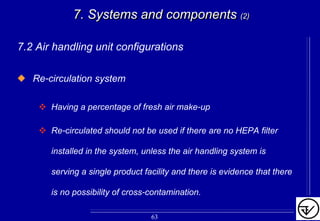
7.2 Air handling unit configurations
Re-circulation system
Having a percentage of fresh air make-up
Re-circulated should not be used if there are no HEPA filter
installed in the system, unless the air handling system is
serving a single product facility and there is evidence that there
is no possibility of cross-contamination.
63
7. System and components7. System and components (3)(3)
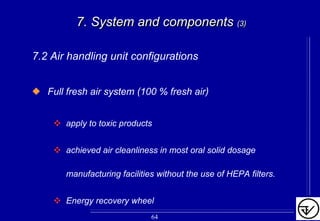
7.2 Air handling unit configurations
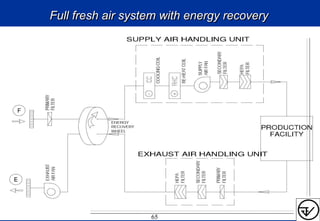
Full fresh air system (100 % fresh air)
apply to toxic products
achieved air cleanliness in most oral solid dosage
manufacturing facilities without the use of HEPA filters.
Energy recovery wheel
64
Full fresh air system with energy recoveryFull fresh air system with energy recovery
65
7. System and components7. System and components (4)(4)
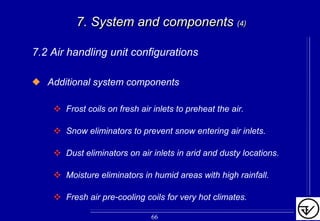
7.2 Air handling unit configurations
Additional system components
Frost coils on fresh air inlets to preheat the air.
Snow eliminators to prevent snow entering air inlets.
Dust eliminators on air inlets in arid and dusty locations.
Moisture eliminators in humid areas with high rainfall.
Fresh air pre-cooling coils for very hot climates.
66
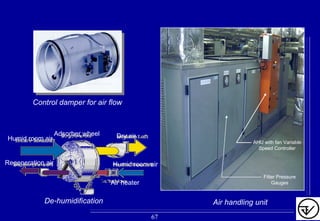
Control damper for air flow
De-humidification
Filter Pressure
Gauges
AHU with fan Variable
Speed Controller
Humid room air
Air heater
Regeneration air
Humid room air
Adsorber wheel Dry air
Air handling unit
67
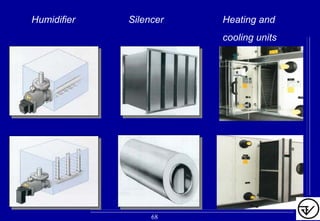
Humidifier Silencer Heating and
cooling units
68
8.8. CommissionCommission,, Validation and MaintenanceValidation and Maintenance (1)
A good design is essential, but it has to be complemented by
Qualification of air handling systems
Process validation
Maintenance and periodic re-qualification
Adequate documentation
69
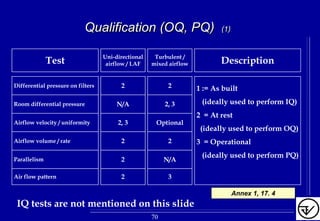
1 := As built
(ideally used to perform IQ)
2 = At rest
(ideally used to perform OQ)
3 = Operational
(ideally used to perform PQ)
Test
Differential pressure on filters
Turbulent /
mixed airflow DescriptionUni-directional
airflow / LAF
Room differential pressure
Airflow velocity / uniformity
Airflow volume / rate
Parallelism
Air flow pattern
2 2
N/A 2, 3
2, 3 Optional
2 2
2 N/A
2 3
IQ tests are not mentioned on this slide
Annex 1, 17. 4
70
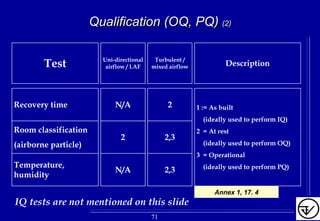
Qualification (OQ, PQ)Qualification (OQ, PQ) (1)(1)
Qualification (OQ, PQ)Qualification (OQ, PQ) (2)(2)
1 := As built
(ideally used to perform IQ)
2 = At rest
(ideally used to perform OQ)
3 = Operational
(ideally used to perform PQ)
Test Turbulent /
mixed airflow Description
Uni-directional
airflow / LAF
Recovery time
Room classification
(airborne particle)
Temperature,
humidity
N/A 2
2 2,3
N/A 2,3
Annex 1, 17. 4
IQ tests are not mentioned on this slide
71
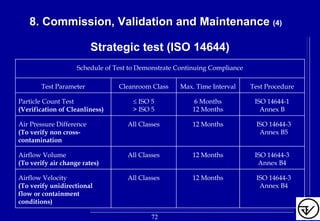
8.8. CommissionCommission,, Validation andValidation and MaintenanceMaintenance (4)
Strategic test (ISO 14644)
ISO 14644-3
Annex B4
12 MonthsAll ClassesAirflow Velocity
(To verify unidirectional
flow or containment
conditions)
ISO 14644-3
Annex B4
12 MonthsAll ClassesAirflow Volume
(To verify air change rates)
ISO 14644-3
Annex B5
12 MonthsAll ClassesAir Pressure Difference
(To verify non cross-
contamination
ISO 14644-1
Annex B
6 Months
12 Months
≤ ISO 5
> ISO 5
Particle Count Test
(Verification of Cleanliness)
Test ProcedureMax. Time IntervalCleanroom ClassTest Parameter
Schedule of Test to Demonstrate Continuing Compliance
72
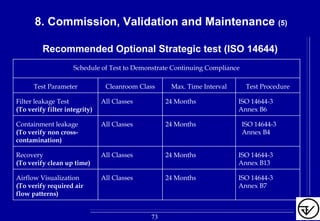
8. Commission, Validation and Maintenance (5)
Recommended Optional Strategic test (ISO 14644)
ISO 14644-3
Annex B7
24 MonthsAll ClassesAirflow Visualization
(To verify required air
flow patterns)
ISO 14644-3
Annex B13
24 MonthsAll ClassesRecovery
(To verify clean up time)
ISO 14644-3
Annex B4
24 MonthsAll ClassesContainment leakage
(To verify non cross-
contamination)
ISO 14644-3
Annex B6
24 MonthsAll ClassesFilter leakage Test
(To verify filter integrity)
Test ProcedureMax. Time IntervalCleanroom ClassTest Parameter
Schedule of Test to Demonstrate Continuing Compliance
73
ReferenceReference
1. Deryck S. Supplementary guidelines on Good manufacturing practices for
Heating, Ventilation and Air Condition (HVAC) Systems. Working document
QAS/02.048/Rev.1. Geneva, World Health Organization, 2003 (unpublished
document)
2. Good manufacturing practices for pharmaceutical products : main
principles. In : WHO Expert Committee on Specification for Pharmaceutical
Preparations. Thirty-seventh report. Geneva, World Health Organization,
2003, Annex 4 (WHO Technical Report Series, No. 908)
3. Guide to Good Manufacturing Practice for Medicinal Products. PE 009-2,
Pharmaceutical Inspection Co-operation Scheme (PIC/S),1 July 2004.
4. Pharmaceutical Engineering Guides for New Renovated Facilities Volume 2
Oral Solid Dosage Forms, First Edition. International Society for
Pharmaceutical Engineering, 1998
74

Solid

  • 1.
    World Health OrganizationWorldHealth Organization Supplementary Guidelines on Good Manufacturing Practices for Heating,Ventilation and Air conditioning (HVAC) Systems for Non-sterile Dosage Forms Working document QAS/02.048/Rev.1 (2004) Praphon Angtrakool Food and Drug Administration
  • 2.
    1. Introduction1. Introduction HVACsystems assists in ensuring the manufacture of quality products and also result in operator comfort. HVAC systems design influences architectural layouts, with regard to items such as airlock positions, doorways and lobbies. The prevention of the contamination and cross-contamination is an essential design consideration of the HVAC system. The design of the HVAC system should be considered at the concept design stage. 1
  • 3.
    2. Glossary (1) Cleanroom: A room or area with defined environmental control of particulate and microbial contamination, constructed and used in such a way as to reduce the introduction, generation and retention of contaminants within the area, and in which other relevant parameters (e.g. temperature, humidity and pressure) are controlled as necessary. Containment : A process or device to contain product, dust or contamination in one zone, preventing it from escaping to another zone. 2
  • 4.
    2. Glossary (2) Contamination: The undesired introduction of impurities of a chemical or microbial nature, or of foreign matter, into or on to a starting material or intermediated, during processing, sampling, packaging or repackaging, storage or transport. Cross-contamination : Contamination of starting material, intermediated product or finished product with another starting material or material during production. 3
  • 5.
    3.3. ScopeScope HVAC systemsfor oral solid dosage facilities The three primary aspects addressed in this manual are the role that the HVAC system play in product protection personnel protection enviromental protection 4
  • 6.
    Protection AspectsProtection Aspects SYSTEMVALIDATION SYSTEM Correct temperature & humidity Protect from Product (cross-contamination) Contamination (Product & Staff) Product Protection Acceptable comfort conditions Prevent contact with fumes Prevent contact with dust Personnel Protection Avoid fume discharge Avoid duct discharge Environment Protection GMP Manufacturing Environment Avoid effluent discharge 5
  • 7.
    4. Product Protection4.Product Protection (1)(1) 4.1 Contamination control 4.1.1 Cleanroom concept 4.1.2 Level of protection 4.1.3 Air filtration to control contamination 4.1.4 Contamination by HVAC plant 4.1.5 Contamination by staff 4.1.6 Airflow patterns 4.1.7 Uni-directional flow protection 4.1.8 Infiltration 6
  • 8.
    4. Product Protection4.Product Protection (2)(2) 4.2 Cross-contamination protection 4.2.1 Directional air movement - Displacement concept - Pressure differential concept - Physical barrier concept - Selecting the segregation concept 4.2.2 Uni-directional flow protection 4.2.3 Cross-contamination via HVAC supply air 4.2.4 Cross-contamination due to fan failure 7
  • 9.
    4. Product Protection4.Product Protection (3)(3) 4.3 Temperature and Humidity 4.3.1 General requirements 4.3.2 Product temperature requirements 4.3.3 Product humidity requirements 4.3.4 Microbial growth 8
  • 10.
    5. Personnel Protection5.Personnel Protection 5.1 Protection from dust 5.2 Dust classification 5.3 Uni-directional flow protection 5.4 Point extraction 5.5 Directional airflow 5.6 Air shower 5.7 Protection enclosures 5.8 Operator comfort 9
  • 11.
    6.1 Extraction airdust 6.2 Fume removal 6.3 Effluent discharge 6. Protection of the Environment6. Protection of the Environment 10
  • 12.
    7.1 Air distribution 7.2Air handling unit configurations 7.2.1 Re-circulation system 7.2.2 Full fresh air systems 7.2.3 Additional system components 7. System and components7. System and components 11
  • 13.
    4.1 Contamination control4.1Contamination control Through all stages of processing, product should be protected from contamination and cross-contamination. These include contamination resulting from inappropriate building finishes plant layout poor cleaning procedures lack of staff discipline poor HVAC system 4. Product Protection4. Product Protection (1)(1) 12
  • 14.
    4.1.1 Cleanroom concept4.1.1Cleanroom concept Pharmaceutical manufacturing facilities where pharmaceutical products, utensils and manufacturing equipment are exposed to the environment, should be classified as “cleanrooms”. The shell-like containment control concept : The process core is regarded as the most stringently controlled clean zone which is protected by being surrounded by cleanrooms of a lower classification. Internal contaminants should be removed by dilution and flushing of contaminants in the room, or by displacement airflow. 13
  • 15.
    OUTDOOR ENVIRONMENT Shell-like containmentcontrol concept PERSONNELMOVEMENT PROCESS CORE FINAL PRODUCT TRANSPORT PERSONNELMOVEMENT MATERIAL TRANSPORT WASTE CLEAN ZONES CLEANROOMS ANCILLARY AREAS 14
  • 16.
    Cleanroom conditionCleanroom condition asbuilt : condition where the installation is complete with all services connected and functioning but with no production equipment, materials, or personnel present at rest : condition where the installation is complete with equipment installed and operation in a manner agree upon by the customer and supplier, but with no personnel present operational : condition where the installation is functioning in the specified manner, with the specified number of personnel and working in the manner agreed upon 915
  • 17.
    Cleanroom conditionCleanroom condition air asbuilt air air at rest in operation 16
  • 18.
    4.1.1 Cleanroom concept4.1.1Cleanroom concept (cont.)(cont.) Many multinational pharmaceutical manufacturers have their own minimum air change rate standards for oral dosage facilities, and these typically vary between 6 and 20 air changes per hour. Generally a room that is tested for an operational condition, should be able to clean up to a higher at rest cleanroom classification, after a short clean-up condition. The clean-up time should normally be in the order of 20 minutes. 17
  • 19.
    4.1.2 Level ofProtection4.1.2 Level of Protection (1)(1) Level 1 (General) : An area with normal housekeeping and maintenance. (e.g. Warehousing, Secondary Packing) Level 2 (Protected) : An area in which steps are taken to protect the exposed drug substance from contamination or degradation. (e.g. Manufacturing, Primary Packing, Dispensing, etc.) Level 3 (Controlled) : An area in which specific environmental conditions are defined, controlled and monitored to prevent contamination or degradation of the drug substance. 18
  • 20.
    Change to garmentsfor the higher classification The same classification as the area they serve The same classification as the area they serve Change rooms & airlocks Sterile garmentsISO Class 5Critical or Class 100 (in operation) Point of fill or other aseptic operations Sterile garmentsISO Class 6 or 7Clean or Class 10000 (in operation) Rooms where filling takes place Clean garmentsISO Class 8Controlled or Class 100000 (in operation) Non-sterile processing Captive coat, hat and overshoes ISO Class 9Level 1 or PharmaceuticalSecondary packing Clean garmentsISO Class 8 or 7Level 2 or 3Primary packing Clean garmentsISO Class 8Level 2Coating Clean garmentsISO Class 8Level 2Encapsulation & compression Clean garmentsISO Class 8 or 7Level 3Milling Clean garmentsISO Class 8 or 7Level 2 or 3Granulation Clean garmentsISO Class 8 or 7Level 2 or 3Blending Clean garmentsISO Class 8 – background ISO 6 or 7 – open product Level 2 – background Level 3 – open product Weighing & dispensing Appropriate to areaISO Class 9Level 1 or UnclassifiedWarehousing, offices Appropriate to areaISO Class 9Level 1 or UnclassifiedReceipt & dispatch Outdoor clothesExternalExternalStreet, canteen ISO Class EquivalentGMP Guides Typical Dress Code Level of Protection Typical Zone 19
  • 21.
    4.1.2 Level ofProtection4.1.2 Level of Protection (3)(3) Level 1 protection and Pharmaceutical conditions can be equated with and ISO Class 9 condition. The most common applied classification for open product zones in a solid dosage plant is a grade D classification. Grade D equates to particulate level classification of ISO 14644-1 Class 8, “at rest”, measured against particles size of 0.5 µm and 5µm 20
  • 22.
    4.1.3 Air filtrationto control contamination4.1.3 Air filtration to control contamination Referring to actual filter efficiencies can be very misleading as there are currently many different test methods, and each results in a different value for the same filter. Efficiencies of Air Filter Pre-filter (25 - 30 % ARRESTANCE) Medium Filter (90 - 95 % ASHARE 52-76) HEPA Filter ( > 99.97 % DOP) Back-up HEPA filter Good pre-filter extents the life of filters downsteam. 21
  • 23.
    Filter classesFilter classes FineCoarse Dustfilters Standard Aerosol ULPAHEPA 10 µ m > Dp > 1 µ mDp > 10 µ m Dp < 1 µ m F5 - F9G1 - G4 U 14- 17H 11 - 13 EN 1822 StandardEN 779 Standard 22
  • 24.
    Classification of filters 25x10-599.9755x10-599.995U14 25x10-499.755x10-499.95H13 25x10-397.55x10-399.5H12 0.0595H11 0.1585F9 PenetrationEfficiencyPenetrationRetentionin % Peak Arrestance Local Value Average Efficiency Integral Value Classification of filters according to their efficiency 23
  • 25.
    FilterFilter Secondary filter HEPA ortertiary filter 24 Primary panel filter
  • 26.
    4.1.4 Contamination byHVAC plant4.1.4 Contamination by HVAC plant Materials for components of an HVAC system should be selected with care Contamination into the air steam should be located upsteam of the final filters Services are accessible from outside the processing area 25
  • 27.
    4.1.5 Contamination bystaff4.1.5 Contamination by staff Airflows should be planned in conjunction with operator locations, so as to minimize operator contamination of the product and also to protect the operator from dust inhalation. Where the product could be harmful to the operator, an alternative arrangement should be made. Cosmetics such as facial make-up are a major source of contamination 26
  • 28.
    4.1.6 Air flowpatterns4.1.6 Air flow patterns Supply air diffusers of the high induction type should not be used in a cleanroom Air should be exhausted from rooms at a low level. Recommended supply air diffuser Perforated plate diffuser Swirl diffuser 27
  • 29.
    Induction diffuser (notrecommended) Induced room air mixing with supply air Return Air Return Air High induction office type diffuser (avoid) 28
  • 30.
    Perforated plate diffuser(recommended) Perforated Plate diffuser Return Air Return Air Reduced Induction of air 29
  • 31.
    Swirl diffuser (recommended) ReturnAir Return Air Swirl diffuser Reduced Induction of air Low induction swirl diffuser (preferred) 30
  • 32.
    Swirl Type airdiffusers with terminal filters 1 Filter 3 Register outlet 2 Tightening frame 4 Screw fixation for register 1 2 3 4 31
  • 33.
    4.1.7 Uni4.1.7 Uni--directionaldirectionalairairflow protectionflow protection Sampling should be carried out in the same environmental class that is required for the further processing of the product. Sampling should normally be carried out under a uni-directional airflow sceen. Uni-directional flow can be Vertical flow (0.3 m/s + 20 %) Horizontal flow (0.45 m/s + 20 %) 32
  • 34.
    4.1.8 Infiltration4.1.8 Infiltration Manufacturingfacilities should be maintained at a positive pressure relative to the outside, to limit the ingress of contaminants. Where facilities are to be maintained at negative pressures relative to ambient, in order to prevent the escape of harmful products to the outside (such as penicillin and hormones), then special precaution should be taken. Negative pressure zone should, as far as possible, be encapsulated by surrounding area with clean air supplies, so that only clean air can filtrate into the controlled zone. 33
  • 35.
    4.2 Cross4.2 Cross--contaminationprotectioncontamination protection Through all stages of processing, products should be protect from cross-contamination This can achieved with the aid of the following methods. 4.2.1 Directional air movement4.2.1 Directional air movement The pressure cascade should be such that air flow from the corridor into cubicles, resulting in dust containment 34
  • 36.
    4.2.1 Directional airmovement4.2.1 Directional air movement (2)(2) In multi-product OSD manufacturing area, the layout normally consists of a corridor with production cubicles located on either side of it. Cross-contamination between products within a single room will not be addressed, as different products should never be processed in the same area at the same time. The corridor should be maintained at a higher pressure than the cubicles, and than cubicles at a higher pressure than atmospheric pressure (negative pressure relative to atmosphere, in order to contain hazardous substances, such as penicillin or hormones, etc.) 35
  • 37.
    4.2.1 Directional airmovement4.2.1 Directional air movement(3)(3) 4.2.1.1 Displacement concept (low pressure differential, high airflow) A low pressure differential can effectively separate clean and less clean adjacent zone, by means of a low turbulent displacement airflow velocity greater than 0.2 m/s. The air should supplied to the corridor, flow through the doorway, and should be extracted from the back of the cubicle. The door containment airflow velocity should be considered a critical parameter. 36
  • 38.
    4.2.1 Directional airmovement4.2.1 Directional air movement (4)(4) 4.2.1.2 Pressure differential concept (high pressure differential, low airflow) The most widely accepted pressure differential between the two adjacent zones is 15 Pa. But pressure differentials of between 5 Pa and 20 Pa could be acceptable. A control tolerance of ± 3 Pa is achievable. The pressure differential between adjacent rooms should be considered a critical parameter. 37
  • 39.
  • 40.
    4.2.1 Directional airmovement4.2.1 Directional air movement (5)(5) Bubble airlockSink airlock 45 Pa 30 Pa 30 Pa 30 Pa15 Pa15 Pa 30 Pa 15 Pa 15 Pa Classification of airlock The door swing on airlocks should be such that opens to the high pressure side 39 Cascade airlock
  • 41.
    Typical Pressure CascadeAirlock P1 - P2 = 0.05” Class 10,000 ISO 7 P = 0.15” = 37.5 Pa HEPA filtered supply air Class 100 000 ISO 8 P = 0.05” = 12.5Pa Airlock Pressure Class - at rest same as 10K room at rest ROOM 1 ROOM 2 P3 P1 P2 P2 – P3 = 0.05” Airlock is most common between Class 10,000 and Class 100,000. Also used Class 100,000 to building 40
  • 42.
    Pressure Sink forContainment Pressure control fan Building Anteroom Aseptic potent product exposed 0 - 0 to + Supply Air Pressure control damper Return or exhaust No leakage across membrane 41
  • 43.
    Pressure Bubble forContainment Supply Air Pressure ControlBuilding Anteroom Aseptic potent product exposed 0 + to ++ 0 to + No leakage across membrane HEPA on supply air to these rooms Room: Class 10,000 (M5.5) 42
  • 44.
    4.2.1 Directional airmovement4.2.1 Directional air movement (6)(6) 4.2.1.3 Physical barrier concept (barrier isolator) The used of impervious barrier to prevent cross- contamination between two zones is the third segregation concept (the case where a barrier isolator, or pumped transfer of materials, is used) Not practical in an oral solid dosage facility. 43
  • 45.
    4.2.1 Directional airmovement4.2.1 Directional air movement (7)(7) 4.2.1.4 Selecting the segregation concept The displacement concept should ideally be used in production process where large amounts of dust are generated. The pressure differential may normally be used in zones where there is little or no dust being generated. High potent products should be manufactured under a pressure cascade regime that is negative to atmospheric pressure 44
  • 46.
    A dispensary weighbooth should be provided with unidirectional airflow for product and operator protection Sampling and dispensary booth for oral solid dosage form may not be required unidirectional flow provides Class A (ISO 5) 4.2.2 Unidirectional airflow protection4.2.2 Unidirectional airflow protection 45
  • 47.
    Dust laden air,returned to air handling unit, increases the possibility of cross-contamination in a multi-product plant. A re-circulation system may be acceptable, provided that suitable filtration and there are no contaminants (such as fumes and volatile) which cannot be removed by normal filtration. A re-circulation system should be provided with HEPA filters to ensure the removal of return air contaminations. 4.2.3 Cross4.2.3 Cross--contamination via HVAC supply aircontamination via HVAC supply air 46
  • 48.
    4.2.4 Cross4.2.4 Cross--contaminationdue to fan failurecontamination due to fan failure Appropriate airflow alarm system. Central dust extraction systems should be interlocked with the appropriate air handling systems. Air should not flow from the room with the higher pressure to the room with the lower pressure, via the dust extract ducting. 47
  • 49.
    4.3 Temperature andHumidity4.3 Temperature and Humidity (1)(1) General requirements product manufacturing requirements operator comfort Product temperature requirements minimum and maximum should not be made too close 48
  • 50.
    4.3 Temperature andHumidity4.3 Temperature and Humidity (2)(2) Product humidity requirement < 45 % RH at 22 o C may require chemical driers Humidifiers should be avioded (microbial growth) Siliga gel or Lithium chloride Microbial growth High T o and % RH cause perspiration from operator 49
  • 51.
    5. Personnel Protection5.Personnel Protection (1)(1) 5.1 Protection from dust Operator health should not be put at risk by being exposed to harmful products. Airflow should be carefully planned, to ensure that the operator does not contaminate the product the operator is not put at risk by the product. 50
  • 52.
    5.2 Dust classification5.2Dust classification Dust can be roughly classified by size according to : Coarse dust with size range of 50 to 500 µm (settles rapidly) Fine dust with size range of 1.0 to 50 µm (settles slowly) Ultra fine dust with size range < 0.5 µm to 1.0 µm (remains constantly suspended) Particles < 0.05 µm are considered to be vapors and not dust Only dust particles that are greater than 10 µm are visible to the naked eye with good lighting and good eyesight 51
  • 53.
    5.3 Unidirectional flowprotection5.3 Unidirectional flow protection Unidirectional flow velocity of the dispensary weigh booth should be considered with regard to the possible disruption of sensitive scale readings Operator is not in the path of an airflow that could lead to contamination of the product. The back of the scale should not block the return air path. 52
  • 54.
    Operator protection atweighing station 53
  • 55.
    Operator subject topowder inhalation due to obstruction 54
  • 56.
    Operator subject topowder contamination due to air flow reversal in bin 55
  • 57.
    Operator subject topowder inhalation due to worktop obstruction 56
  • 58.
    5.4 Point extraction Asclosed as possible to the point where dust is generated. Transfer velocities for pharmaceutical dust should be 18 – 20 m/s. 28Lead dust 20 – 25Wood chips and shaving 20Pulverized coal, stone cutting 18 – 22Grinding, shot- and sand-blasting 18 – 20Grain and flour 15Metal fumes and dusts 13Asbestos and limestone dust 10Textile lint and sawdust (dry) 8 – 10Paint and vanish fumes Duct velocity (m/s)Type of dust or vapor Air velocities for dust transport 57
  • 59.
    5.5 Directional airflow5.5Directional airflow The air should be introduced from ceiling diffusers and is extracted from the room at low level. (Turbulent airflow) Vapor is lighter than air, extract grilles should be at high level. 5.6 Air shower5.6 Air shower Operators could pass through an air shower, prior to entering the change room, on leaving the production area. Should be validated 58
  • 60.
    5.7 Protection enclosures5.7Protection enclosures For products such as hormones or highly potent, operators should wear totally enclosed garments. Breathing air system should be provide a supply of filter. 5.8 Operator comfort5.8 Operator comfort Recommended humidity comfort level of 20 - 60 % RH should be maintained where required. Typically comfort condition of 21 to 22 oC should be applicable in oral solid dosage facility. 59
  • 61.
    6.1 Extraction airdust On systems where harmful substances such as penicillin, hormones, toxic powders and enzymes are exhausted, the final filters should be HEPA filters. When handling hazardous compounds, safe change filter housing, also calls “bag-in-bag-out” filters, should be used All filter banks should be provided with pressure differential indication gauges, to indicate the filter dust loading. 6. Protection of the Environment6. Protection of the Environment (1)(1) 60
  • 62.
    6.2 Fume removal Wetscrubbers (chemicals added to water to increase the adsorption efficiency) Dry chemical scrubbers or deep bed scrubbers (activated carbon filters, chemical adsorption granular media) 6.3 Effluent discharge Should be design to ensure the systems like wet scrubbers, which could discharge contaminants into the drainage system, do not become sources of possible risk or contamination. 6. Protection of the Environment6. Protection of the Environment (2)(2) 61
  • 63.
    7.1 Air distribution HEPAfilter may be located in the air handling unit or terminally Normally, system having Class A or B and possibly C should have final filters terminally located. A cleanroom should be designed with low-level return. Where ceiling return air grilles are used a higher air change rate may be required to achieve a specified cleanroom classification. 7. Systems and components7. Systems and components (1)(1) 62
  • 64.
    7. Systems andcomponents7. Systems and components (2)(2) 7.2 Air handling unit configurations Re-circulation system Having a percentage of fresh air make-up Re-circulated should not be used if there are no HEPA filter installed in the system, unless the air handling system is serving a single product facility and there is evidence that there is no possibility of cross-contamination. 63
  • 65.
    7. System andcomponents7. System and components (3)(3) 7.2 Air handling unit configurations Full fresh air system (100 % fresh air) apply to toxic products achieved air cleanliness in most oral solid dosage manufacturing facilities without the use of HEPA filters. Energy recovery wheel 64
  • 66.
    Full fresh airsystem with energy recoveryFull fresh air system with energy recovery 65
  • 67.
    7. System andcomponents7. System and components (4)(4) 7.2 Air handling unit configurations Additional system components Frost coils on fresh air inlets to preheat the air. Snow eliminators to prevent snow entering air inlets. Dust eliminators on air inlets in arid and dusty locations. Moisture eliminators in humid areas with high rainfall. Fresh air pre-cooling coils for very hot climates. 66
  • 68.
    Control damper forair flow De-humidification Filter Pressure Gauges AHU with fan Variable Speed Controller Humid room air Air heater Regeneration air Humid room air Adsorber wheel Dry air Air handling unit 67
  • 69.
    Humidifier Silencer Heatingand cooling units 68
  • 70.
    8.8. CommissionCommission,, Validationand MaintenanceValidation and Maintenance (1) A good design is essential, but it has to be complemented by Qualification of air handling systems Process validation Maintenance and periodic re-qualification Adequate documentation 69
  • 71.
    1 := Asbuilt (ideally used to perform IQ) 2 = At rest (ideally used to perform OQ) 3 = Operational (ideally used to perform PQ) Test Differential pressure on filters Turbulent / mixed airflow DescriptionUni-directional airflow / LAF Room differential pressure Airflow velocity / uniformity Airflow volume / rate Parallelism Air flow pattern 2 2 N/A 2, 3 2, 3 Optional 2 2 2 N/A 2 3 IQ tests are not mentioned on this slide Annex 1, 17. 4 70 Qualification (OQ, PQ)Qualification (OQ, PQ) (1)(1)
  • 72.
    Qualification (OQ, PQ)Qualification(OQ, PQ) (2)(2) 1 := As built (ideally used to perform IQ) 2 = At rest (ideally used to perform OQ) 3 = Operational (ideally used to perform PQ) Test Turbulent / mixed airflow Description Uni-directional airflow / LAF Recovery time Room classification (airborne particle) Temperature, humidity N/A 2 2 2,3 N/A 2,3 Annex 1, 17. 4 IQ tests are not mentioned on this slide 71
  • 73.
    8.8. CommissionCommission,, ValidationandValidation and MaintenanceMaintenance (4) Strategic test (ISO 14644) ISO 14644-3 Annex B4 12 MonthsAll ClassesAirflow Velocity (To verify unidirectional flow or containment conditions) ISO 14644-3 Annex B4 12 MonthsAll ClassesAirflow Volume (To verify air change rates) ISO 14644-3 Annex B5 12 MonthsAll ClassesAir Pressure Difference (To verify non cross- contamination ISO 14644-1 Annex B 6 Months 12 Months ≤ ISO 5 > ISO 5 Particle Count Test (Verification of Cleanliness) Test ProcedureMax. Time IntervalCleanroom ClassTest Parameter Schedule of Test to Demonstrate Continuing Compliance 72
  • 74.
    8. Commission, Validationand Maintenance (5) Recommended Optional Strategic test (ISO 14644) ISO 14644-3 Annex B7 24 MonthsAll ClassesAirflow Visualization (To verify required air flow patterns) ISO 14644-3 Annex B13 24 MonthsAll ClassesRecovery (To verify clean up time) ISO 14644-3 Annex B4 24 MonthsAll ClassesContainment leakage (To verify non cross- contamination) ISO 14644-3 Annex B6 24 MonthsAll ClassesFilter leakage Test (To verify filter integrity) Test ProcedureMax. Time IntervalCleanroom ClassTest Parameter Schedule of Test to Demonstrate Continuing Compliance 73
  • 75.
    ReferenceReference 1. Deryck S.Supplementary guidelines on Good manufacturing practices for Heating, Ventilation and Air Condition (HVAC) Systems. Working document QAS/02.048/Rev.1. Geneva, World Health Organization, 2003 (unpublished document) 2. Good manufacturing practices for pharmaceutical products : main principles. In : WHO Expert Committee on Specification for Pharmaceutical Preparations. Thirty-seventh report. Geneva, World Health Organization, 2003, Annex 4 (WHO Technical Report Series, No. 908) 3. Guide to Good Manufacturing Practice for Medicinal Products. PE 009-2, Pharmaceutical Inspection Co-operation Scheme (PIC/S),1 July 2004. 4. Pharmaceutical Engineering Guides for New Renovated Facilities Volume 2 Oral Solid Dosage Forms, First Edition. International Society for Pharmaceutical Engineering, 1998 74