Present By- Mr. Akshay Gulabrao Kakde .
Roll no 531 M. Pharm -IInd sem
Guide By- Dr. Rupali Kale.
Dr. D. Y. Patil IPSR Pimpri, Pune - 411018.
1
1. Introduction.
2. Objective.
3. Why Purification.
4. Component of Water system.
5. Validation Concept.
6. Flow for Water System Qualification.
7. Design Qualification.
8. Installation Qualification.
9. Operation Qualification.
10. Performance Qualification.
11. Warring letter.
12. Conclusion.
13. Reference.
2
 High-quality water is essential for the manufacturing
of pharmaceuticals.
 Water is directly or indirectly used in the
pharmaceutical manufacturing such as a major
component in injectable products and in cleaning.
3
To understand:
1. The need for water quality manual.
2. Reason for usage of pharmaceutical water supply
systems.
3. The technical requirements for water supply systems.
4. Different types of water sources.
5. Validation requirements.
6. Qualification & Inspection requirement.
4
 Tap water is always variable due to seasonal or regional
variation in quality.
 One must remove impurities and control microbes to avoid
contamination of products.
 Quality of water should be specific for product quality.
 Water contains,
 Organic and inorganic impurities
 Microbial contamination
 Endotoxin
 Particulate contamination
 Low quality of water can lead to
 Product degradation
 Product contamination
 Loss of product and profit.
5
 Different grades of
water
1. Potable water.
2. Purified water.
3. Sterile water for
injection(WFI).
4. Sterile water for injection,
Irrigation.
5. Sterile bacteriostatic water for
injection.
 Different techniques for
water Purification
1. Chlorination.
2. De-chlorination.
3. Filtration.
4. Distillation
5. Softening
6. Revers Osmosis
7. UV treatment
8. Ozonisation.
6
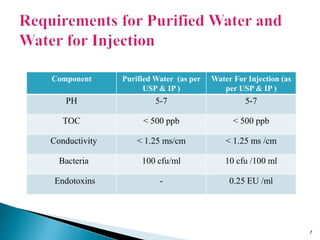
Component Purified Water (as per
USP & IP )
Water For Injection (as
per USP & IP )
PH 5-7 5-7
TOC < 500 ppb < 500 ppb
Conductivity < 1.25 ms/cm < 1.25 ms /cm
Bacteria 100 cfu/ml 10 cfu /100 ml
Endotoxins - 0.25 EU /ml
7
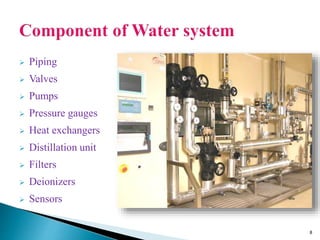
 Piping
 Valves
 Pumps
 Pressure gauges
 Heat exchangers
 Distillation unit
 Filters
 Deionizers
 Sensors
8
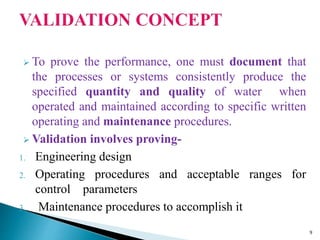
 To prove the performance, one must document that
the processes or systems consistently produce the
specified quantity and quality of water when
operated and maintained according to specific written
operating and maintenance procedures.
 Validation involves proving-
1. Engineering design
2. Operating procedures and acceptable ranges for
control parameters
3. Maintenance procedures to accomplish it
9
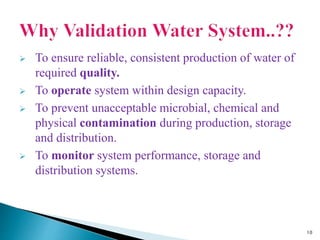
 To ensure reliable, consistent production of water of
required quality.
 To operate system within design capacity.
 To prevent unacceptable microbial, chemical and
physical contamination during production, storage
and distribution.
 To monitor system performance, storage and
distribution systems.
10
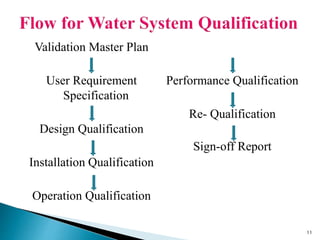
Validation Master Plan
User Requirement
Specification
Design Qualification
Installation Qualification
Operation Qualification
Performance Qualification
Re- Qualification
Sign-off Report
11
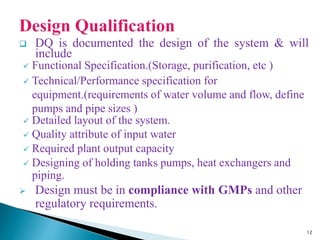
 DQ is documented the design of the system & will
include
 Functional Specification.(Storage, purification, etc )
 Technical/Performance specification for
equipment.(requirements of water volume and flow, define
pumps and pipe sizes )
 Detailed layout of the system.
 Quality attribute of input water
 Required plant output capacity
 Designing of holding tanks pumps, heat exchangers and
piping.
 Design must be in compliance with GMPs and other
regulatory requirements.
12
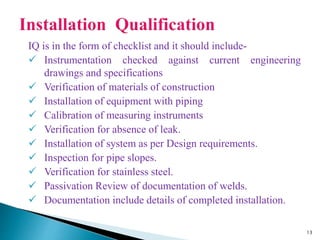
IQ is in the form of checklist and it should include-
 Instrumentation checked against current engineering
drawings and specifications
 Verification of materials of construction
 Installation of equipment with piping
 Calibration of measuring instruments
 Verification for absence of leak.
 Installation of system as per Design requirements.
 Inspection for pipe slopes.
 Verification for stainless steel.
 Passivation Review of documentation of welds.
 Documentation include details of completed installation.
13
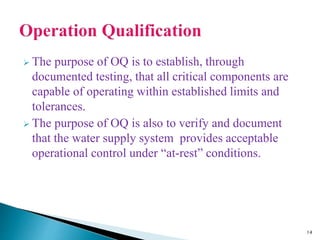
 The purpose of OQ is to establish, through
documented testing, that all critical components are
capable of operating within established limits and
tolerances.
 The purpose of OQ is also to verify and document
that the water supply system provides acceptable
operational control under “at-rest” conditions.
14
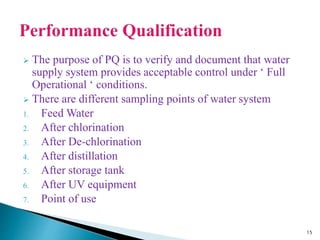
 The purpose of PQ is to verify and document that water
supply system provides acceptable control under ‘ Full
Operational ‘ conditions.
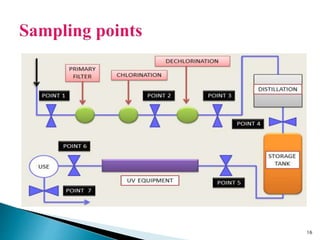
 There are different sampling points of water system
1. Feed Water
2. After chlorination
3. After De-chlorination
4. After distillation
5. After storage tank
6. After UV equipment
7. Point of use
15
16
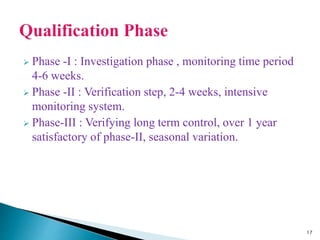
 Phase -I : Investigation phase , monitoring time period
4-6 weeks.
 Phase -II : Verification step, 2-4 weeks, intensive
monitoring system.
 Phase-III : Verifying long term control, over 1 year
satisfactory of phase-II, seasonal variation.
17
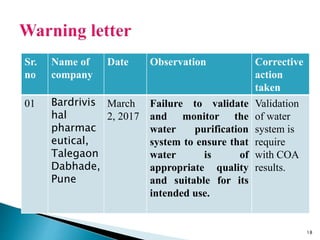
Sr.
no
Name of
company
Date Observation Corrective
action
taken
01 Bardrivis
hal
pharmac
eutical,
Talegaon
Dabhade,
Pune
March
2, 2017
Failure to validate
and monitor the
water purification
system to ensure that
water is of
appropriate quality
and suitable for its
intended use.
Validation
of water
system is
require
with COA
results.
18
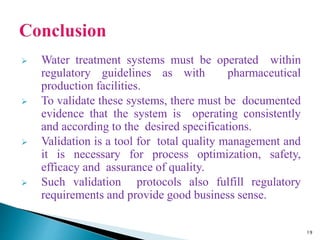
 Water treatment systems must be operated within
regulatory guidelines as with pharmaceutical
production facilities.
 To validate these systems, there must be documented
evidence that the system is operating consistently
and according to the desired specifications.
 Validation is a tool for total quality management and
it is necessary for process optimization, safety,
efficacy and assurance of quality.
 Such validation protocols also fulfill regulatory
requirements and provide good business sense.
19
1. Nash R. A. and Wachter A. H. “Pharmaceuticals
Process Validation”; An international 3rd edition
page no. 401-442
2. Quality Assurance of Pharmaceuticals volume-II
GMP & Inspection WHO.
3. United State Pharmacopeia, NF-22, Asian edition-
2004, page no :1949-1950.
4. Indian Pharmacopeia, volume – III, Page no: 2988-
2990
5. www.fda.gov.in (warring letter referred date- April
12,2017)
20
Thank You...‼‼
21

Water system validation by- Akshay kakde

  • 1.
    Present By- Mr.Akshay Gulabrao Kakde . Roll no 531 M. Pharm -IInd sem Guide By- Dr. Rupali Kale. Dr. D. Y. Patil IPSR Pimpri, Pune - 411018. 1
  • 2.
    1. Introduction. 2. Objective. 3.Why Purification. 4. Component of Water system. 5. Validation Concept. 6. Flow for Water System Qualification. 7. Design Qualification. 8. Installation Qualification. 9. Operation Qualification. 10. Performance Qualification. 11. Warring letter. 12. Conclusion. 13. Reference. 2
  • 3.
     High-quality wateris essential for the manufacturing of pharmaceuticals.  Water is directly or indirectly used in the pharmaceutical manufacturing such as a major component in injectable products and in cleaning. 3
  • 4.
    To understand: 1. Theneed for water quality manual. 2. Reason for usage of pharmaceutical water supply systems. 3. The technical requirements for water supply systems. 4. Different types of water sources. 5. Validation requirements. 6. Qualification & Inspection requirement. 4
  • 5.
     Tap wateris always variable due to seasonal or regional variation in quality.  One must remove impurities and control microbes to avoid contamination of products.  Quality of water should be specific for product quality.  Water contains,  Organic and inorganic impurities  Microbial contamination  Endotoxin  Particulate contamination  Low quality of water can lead to  Product degradation  Product contamination  Loss of product and profit. 5
  • 6.
     Different gradesof water 1. Potable water. 2. Purified water. 3. Sterile water for injection(WFI). 4. Sterile water for injection, Irrigation. 5. Sterile bacteriostatic water for injection.  Different techniques for water Purification 1. Chlorination. 2. De-chlorination. 3. Filtration. 4. Distillation 5. Softening 6. Revers Osmosis 7. UV treatment 8. Ozonisation. 6
  • 7.
    Component Purified Water(as per USP & IP ) Water For Injection (as per USP & IP ) PH 5-7 5-7 TOC < 500 ppb < 500 ppb Conductivity < 1.25 ms/cm < 1.25 ms /cm Bacteria 100 cfu/ml 10 cfu /100 ml Endotoxins - 0.25 EU /ml 7
  • 8.
     Piping  Valves Pumps  Pressure gauges  Heat exchangers  Distillation unit  Filters  Deionizers  Sensors 8
  • 9.
     To provethe performance, one must document that the processes or systems consistently produce the specified quantity and quality of water when operated and maintained according to specific written operating and maintenance procedures.  Validation involves proving- 1. Engineering design 2. Operating procedures and acceptable ranges for control parameters 3. Maintenance procedures to accomplish it 9
  • 10.
     To ensurereliable, consistent production of water of required quality.  To operate system within design capacity.  To prevent unacceptable microbial, chemical and physical contamination during production, storage and distribution.  To monitor system performance, storage and distribution systems. 10
  • 11.
    Validation Master Plan UserRequirement Specification Design Qualification Installation Qualification Operation Qualification Performance Qualification Re- Qualification Sign-off Report 11
  • 12.
     DQ isdocumented the design of the system & will include  Functional Specification.(Storage, purification, etc )  Technical/Performance specification for equipment.(requirements of water volume and flow, define pumps and pipe sizes )  Detailed layout of the system.  Quality attribute of input water  Required plant output capacity  Designing of holding tanks pumps, heat exchangers and piping.  Design must be in compliance with GMPs and other regulatory requirements. 12
  • 13.
    IQ is inthe form of checklist and it should include-  Instrumentation checked against current engineering drawings and specifications  Verification of materials of construction  Installation of equipment with piping  Calibration of measuring instruments  Verification for absence of leak.  Installation of system as per Design requirements.  Inspection for pipe slopes.  Verification for stainless steel.  Passivation Review of documentation of welds.  Documentation include details of completed installation. 13
  • 14.
     The purposeof OQ is to establish, through documented testing, that all critical components are capable of operating within established limits and tolerances.  The purpose of OQ is also to verify and document that the water supply system provides acceptable operational control under “at-rest” conditions. 14
  • 15.
     The purposeof PQ is to verify and document that water supply system provides acceptable control under ‘ Full Operational ‘ conditions.  There are different sampling points of water system 1. Feed Water 2. After chlorination 3. After De-chlorination 4. After distillation 5. After storage tank 6. After UV equipment 7. Point of use 15
  • 16.
  • 17.
     Phase -I: Investigation phase , monitoring time period 4-6 weeks.  Phase -II : Verification step, 2-4 weeks, intensive monitoring system.  Phase-III : Verifying long term control, over 1 year satisfactory of phase-II, seasonal variation. 17
  • 18.
    Sr. no Name of company Date ObservationCorrective action taken 01 Bardrivis hal pharmac eutical, Talegaon Dabhade, Pune March 2, 2017 Failure to validate and monitor the water purification system to ensure that water is of appropriate quality and suitable for its intended use. Validation of water system is require with COA results. 18
  • 19.
     Water treatmentsystems must be operated within regulatory guidelines as with pharmaceutical production facilities.  To validate these systems, there must be documented evidence that the system is operating consistently and according to the desired specifications.  Validation is a tool for total quality management and it is necessary for process optimization, safety, efficacy and assurance of quality.  Such validation protocols also fulfill regulatory requirements and provide good business sense. 19
  • 20.
    1. Nash R.A. and Wachter A. H. “Pharmaceuticals Process Validation”; An international 3rd edition page no. 401-442 2. Quality Assurance of Pharmaceuticals volume-II GMP & Inspection WHO. 3. United State Pharmacopeia, NF-22, Asian edition- 2004, page no :1949-1950. 4. Indian Pharmacopeia, volume – III, Page no: 2988- 2990 5. www.fda.gov.in (warring letter referred date- April 12,2017) 20
  • 21.