CLAVICLE AND SCAPULAR
NAME- Dr. KULDEEP SINGH
Ortho Resident
AIIMS Bhopal
Clavicle fracture
• Clavicle fractures are common injuries
• Account for 2.6% of all fractures
• Up to 44% of injuries to the shoulder girdle
• Easy to recognize
• Majority unite uneventfully
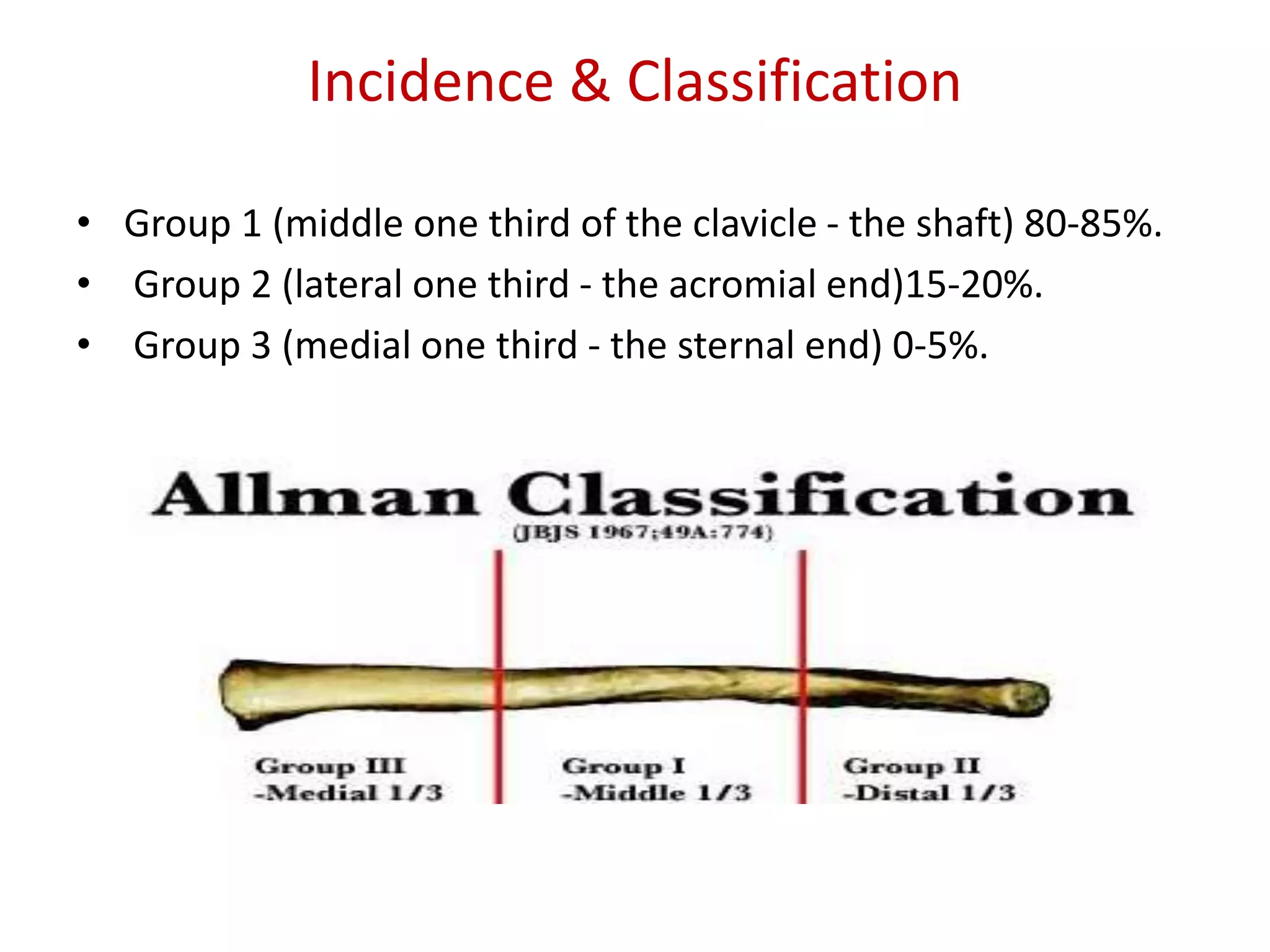
Incidence & Classification
• Group 1 (middle one third of the clavicle - the shaft) 80-85%.
• Group 2 (lateral one third - the acromial end)15-20%.
• Group 3 (medial one third - the sternal end) 0-5%.
Mechanism of Injury
• Trauma
– Fall against lateral shoulder (90%)
– Fall on Outstretched Hand (5%)
– Direct blow to clavicle (5%)
• Non traumatic (in children)
– Tumor
– Rickets
– Osteogenesis imperfecta
– Physical Abuse
Displacement mechanism
Diagnosis
 C/F-
• Symptoms- Pain and swelling , decreased movement of the
affected limb.
• Sign-
 Bruising,
 Tenderness
 Crepitation,
 Pressure on the overlying skin & palpable deformity.
Radiographs
 Different angles:
• AP – evaluate superior-inferior displacement
• 45’ cephalic tilt(Serendipity view) view
» Evaluate AP displacement
• Stress views useful in lateral 1/3 fractures
to assess AC & CC ligaments injury.
• Chest x-ray
• CT
Classification
Based on the position of the fracture:[“Allman”]
1. Distal third (Group II)
2. Middle third (Group I)
3. Proximal (Group III).
• “Neer” divided distal clavicle fractures into three subgroups,
based on their ligamentous attachments and degree of
displacement.
Classifications
Group-II:
Type I: Distal clavicle fracture with the intact coracoclavicular
ligaments.
Classifications
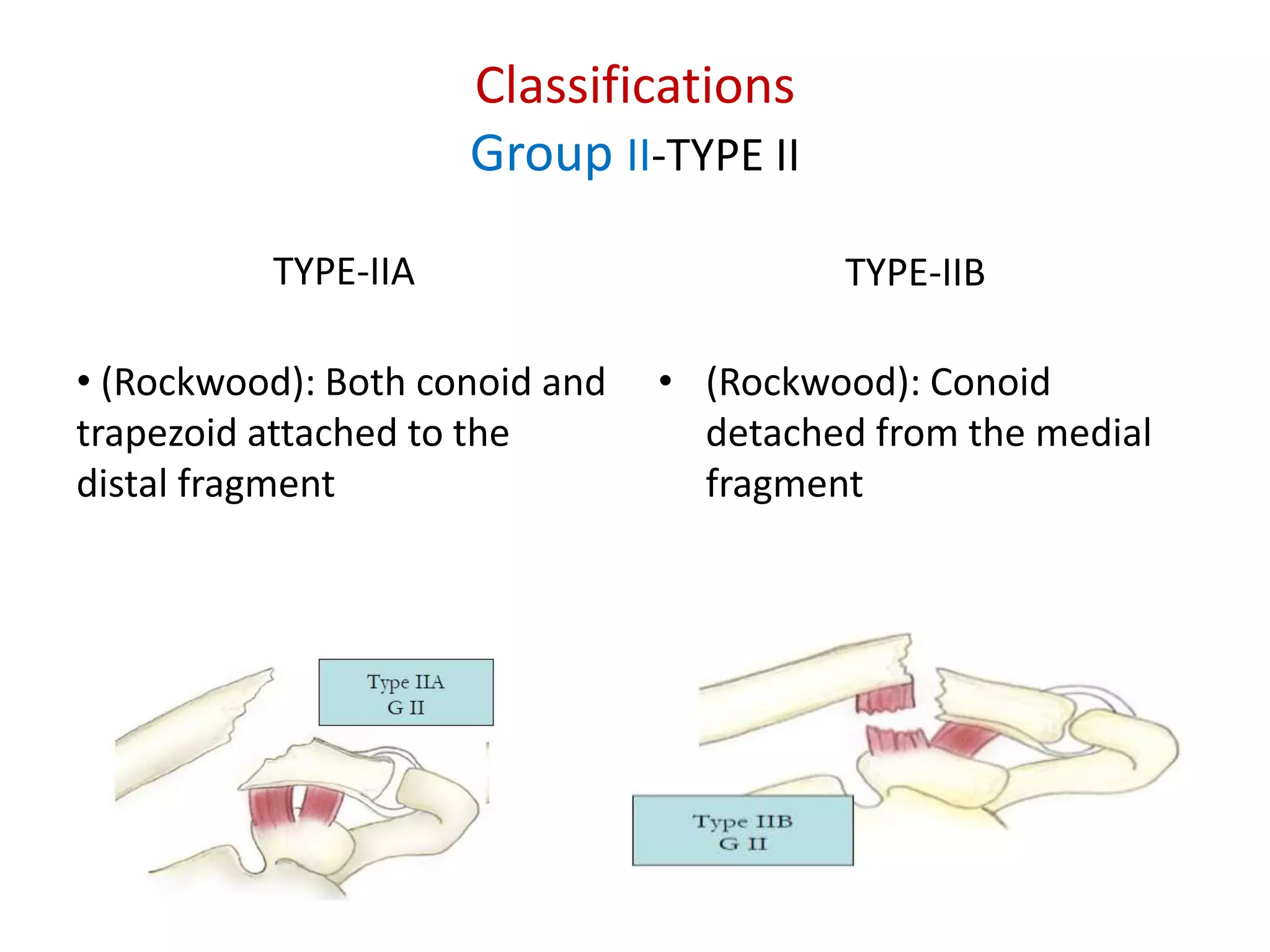
Group II-TYPE II
TYPE-IIA TYPE-IIB
• (Rockwood): Conoid
detached from the medial
fragment
• (Rockwood): Both conoid and
trapezoid attached to the
distal fragment
• Group II:
• Type III: Distal clavicle fracture with extension into the AC
joint.
• Group III: Medial clavicular fracture- subgroups are
• Type 1 :Minimal displacement
• Type 2: Displaced
• Type-3: Intra-articular
• Type-4: Epiphyseal seperation
• Type-5: Comminuted
Other Classifications
1. AO/OTA classification scheme of clavicle fractures.
2. Robinson classification scheme of clavicle fractures.
Non-operative Treatment
 Indications: Majority cases
– Non-displaced Group I (middle
third)
– Stable Group II fractures
– Group III (medial third)
 Technique
– Sling or figure-of-8
– 2-4 weeks-gentle ROM exercises.
– No attempt at reduction should
be made.
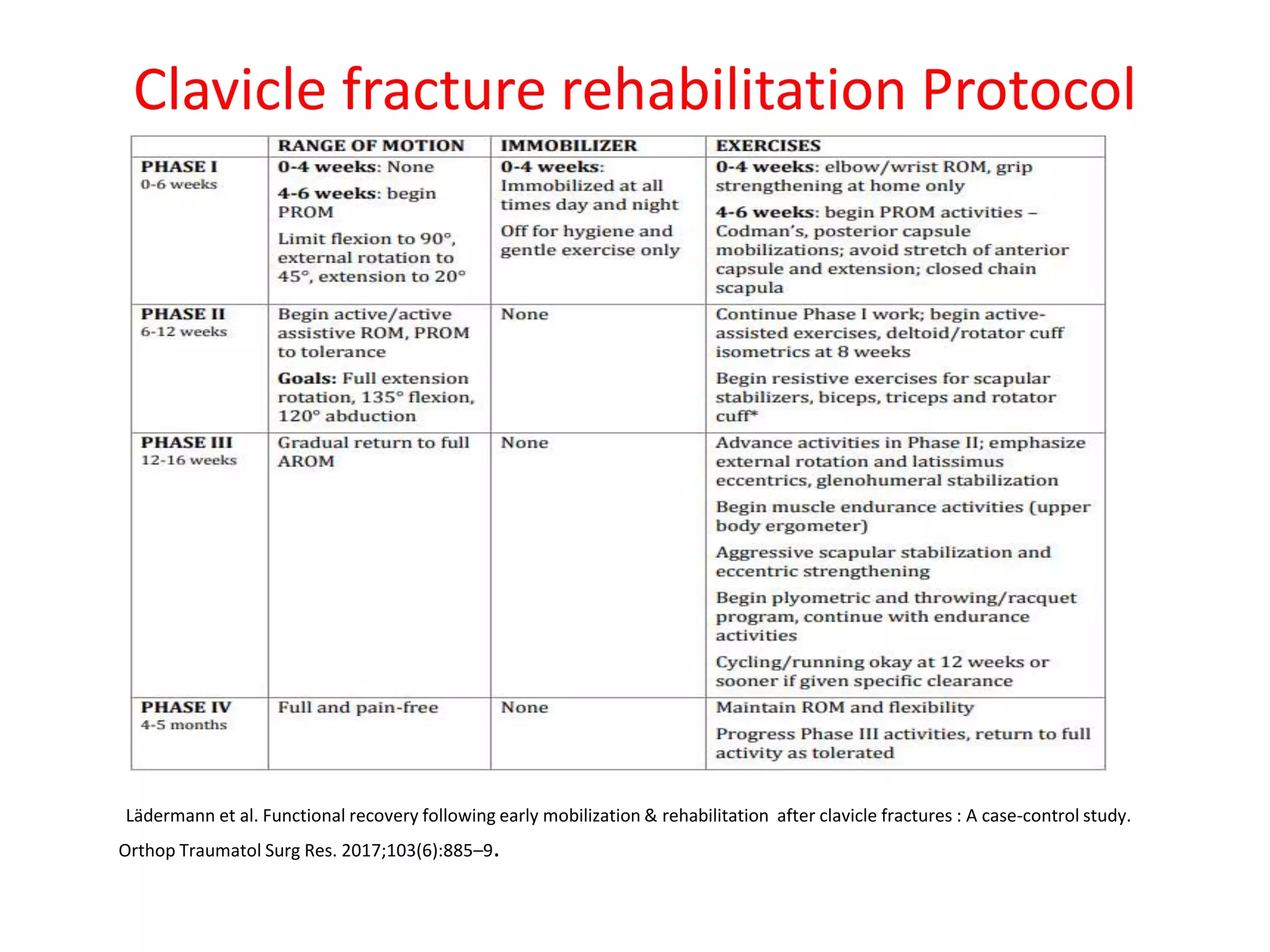
Clavicle fracture rehabilitation Protocol
Lädermann et al. Functional recovery following early mobilization & rehabilitation after clavicle fractures : A case-control study.
Orthop Traumatol Surg Res. 2017;103(6):885–9.
Operative management
• Stabilization techniques include
– Plate fixation
– Intramedullary fixation
– External fixation
– Coracoclavicular ligament repair or reconstruction in Group II
• Postoperative rehabilitation
– Sling for 2wk followed by active motion
– Strengthening exercise at 6-8 weeks when pain free motion
and radiographic evidence of union
– Full activity including sports at ~ 3 months
MID CLAVICULAR FRACTURE
DISTAL CLAVICULAR FRACTURE
Direct fixation of the fracture site without
coraco-clavicular stabilization
1.Plate Fixation
• The distal fragment is large enough to hold a minimum of two,
and ideally three, bi-cortical screws
2.The clavicular hook plate:
 If distal fragment is too small .
 Usually removal at 3 month post-op.
3. intramedullary nailing-
• Completely displaced transverse fracture.
• Advantages- smaller, more cosmetic skin incision
less soft tissue stripping at fracture site
decreased hardware prominence
• Disadvantages- 1.inferior in resisting displacement as compare
to plate fixation
2.Implant failure
3. Infection
4. nail protrusion/irritation on the medial side
4.Kirschner Wire Fixation
Inherent risk of wire breakage and migration.
High nonunion and infection rates.
So not used now a days.
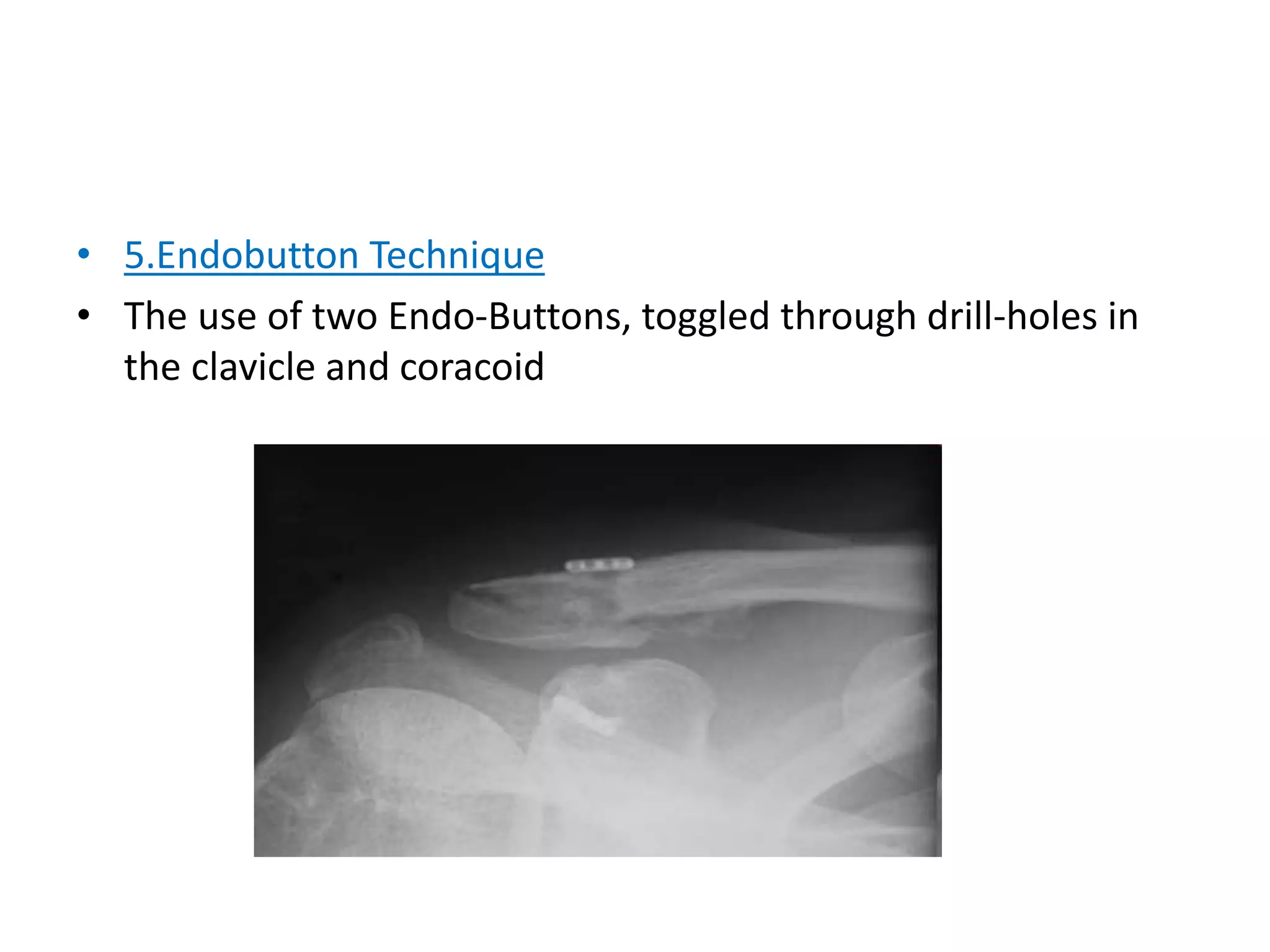
• 5.Endobutton Technique
• The use of two Endo-Buttons, toggled through drill-holes in
the clavicle and coracoid
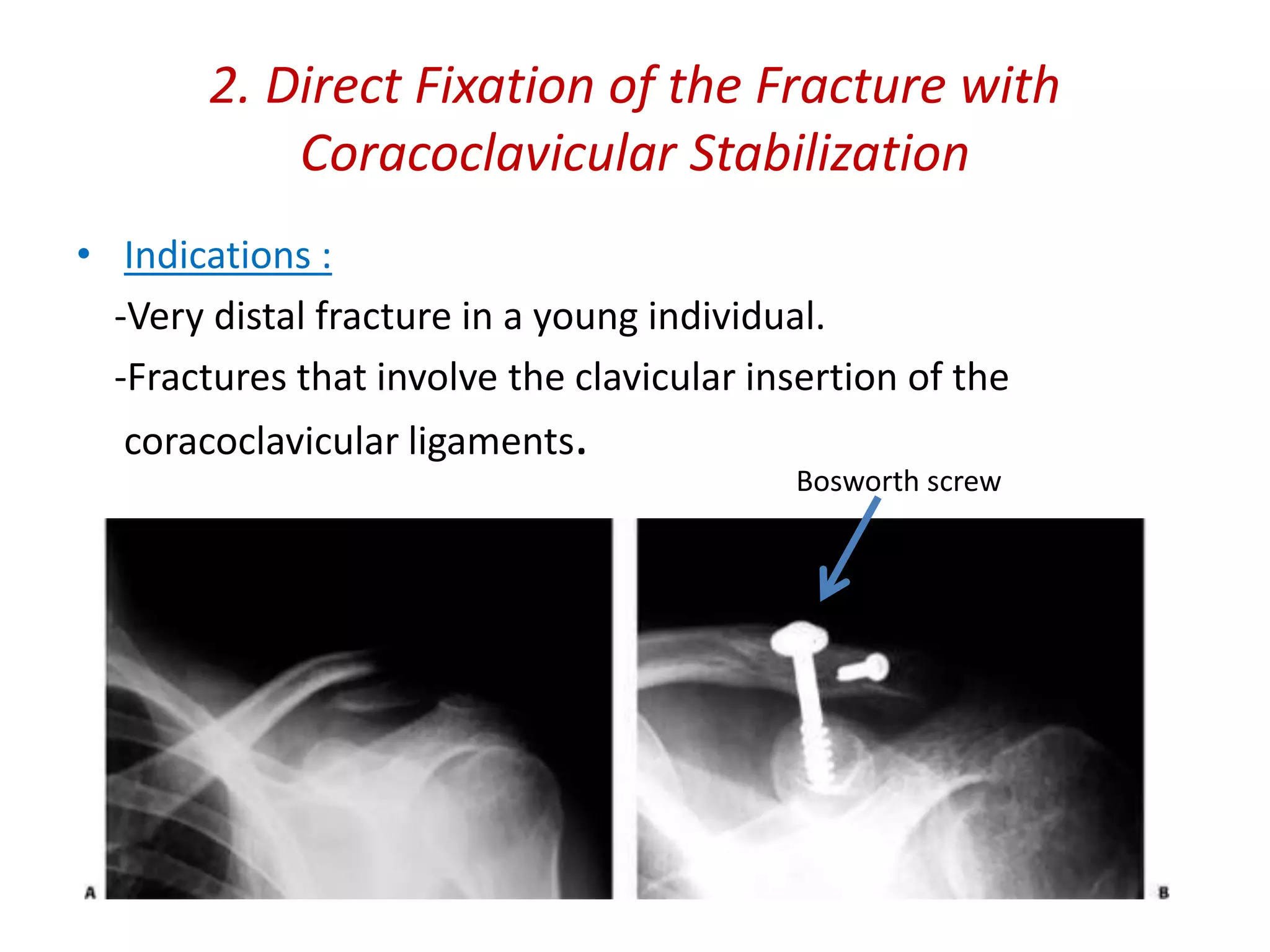
2. Direct Fixation of the Fracture with
Coracoclavicular Stabilization
• Indications :
-Very distal fracture in a young individual.
-Fractures that involve the clavicular insertion of the
coracoclavicular ligaments.
Bosworth screw
MEDIAL CLAVICULAR FRACTURES
TREATMENT
• Usually managed non-operatively.
• Except-
fracture displacement which produces superior
mediastinal compromise require urgent attempt at closed
reduction
or open reduction next if this is unsuccessful.
Complications
Complications of nonoperative treatment
- Nonunion (1-5%)
-Decreased shoulder strength and endurance
Complications of operative treatment(10%- 30%)
– Hardware complications : 30% request for plate removal.
– Infection (~4.8%)
– Mechanical failure (~1.4%)
Conclusion
• Completely displaced midshaft fractures: superior results with
primary fracture fixation.
• Anteroinferior plating- may reduce risk of symptomatic
hardware compared to superior plating.
• Outcome: No difference between regular sling & figure-of-
eight bandage.
• Outcome: No difference between plating & intramedullary
nailing of displaced midshaft fractures.
SCAPULAR FRACTURE
SCAPULA
• Is a flat triangular bone that lies on the posterior thorax wall
between 2-7 rib.
• It enveloped by :
 supraspinatus muscle
 Infraspinatus muscle
 Subscapularis muscle
• Attached to clavicle at acromioclavicular.
• Articulate with humerus at glenohumeral joint .
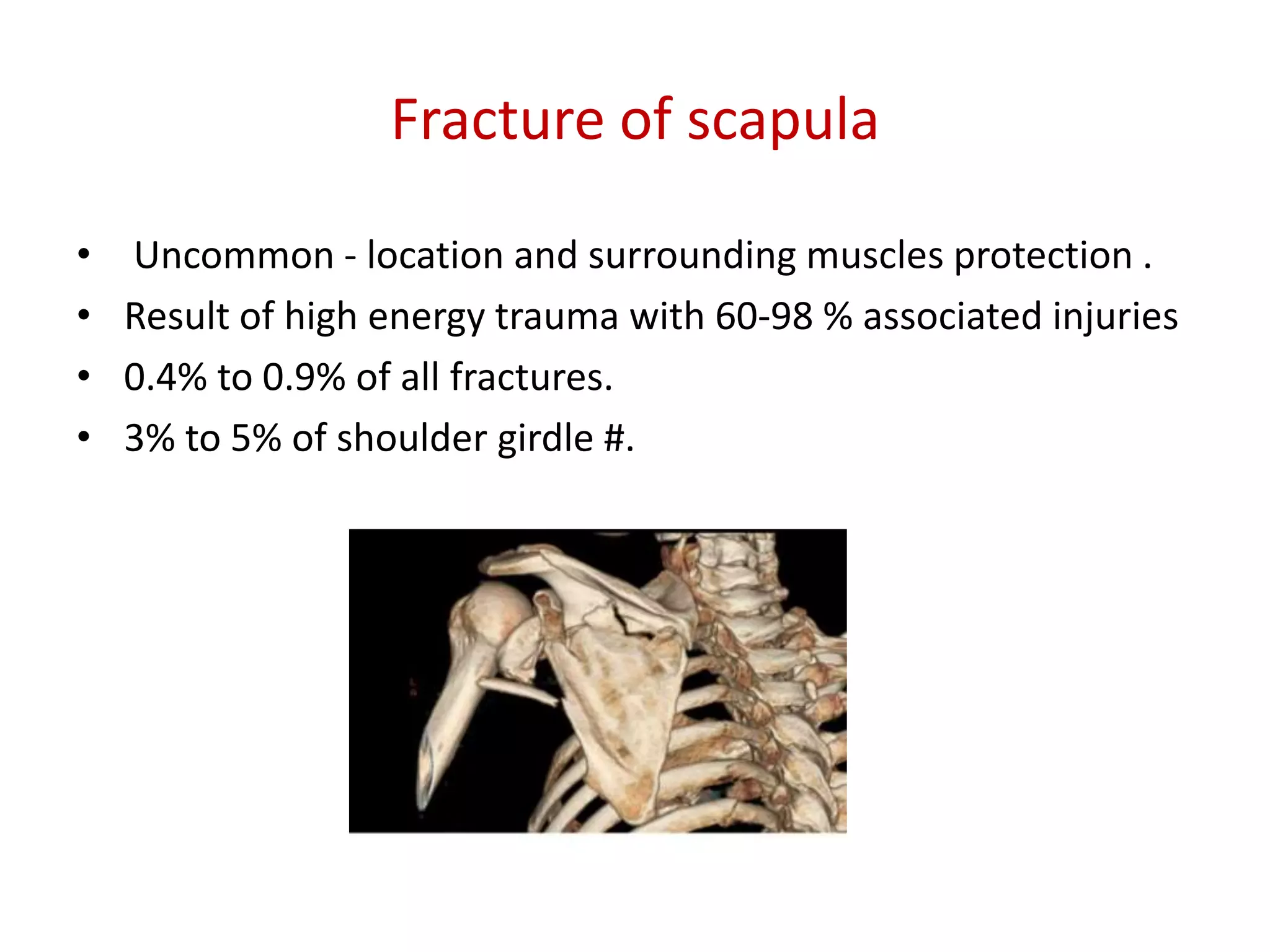
Fracture of scapula
• Uncommon - location and surrounding muscles protection .
• Result of high energy trauma with 60-98 % associated injuries
• 0.4% to 0.9% of all fractures.
• 3% to 5% of shoulder girdle #.
Associated life threatening injuries
• Pneumothorax
• Pulmonary contusion
• Arterial injury
• Abdominal injury
• Head injury (10% to 42% of all cases of scapula fracture.)
• Brachial plexus injury
Mechanism of injury
 From severe direct trauma
 Fall from height with direct landing on posterior aspect of
trunk.
 Fall on shoulder
 Fall on outstretched hand
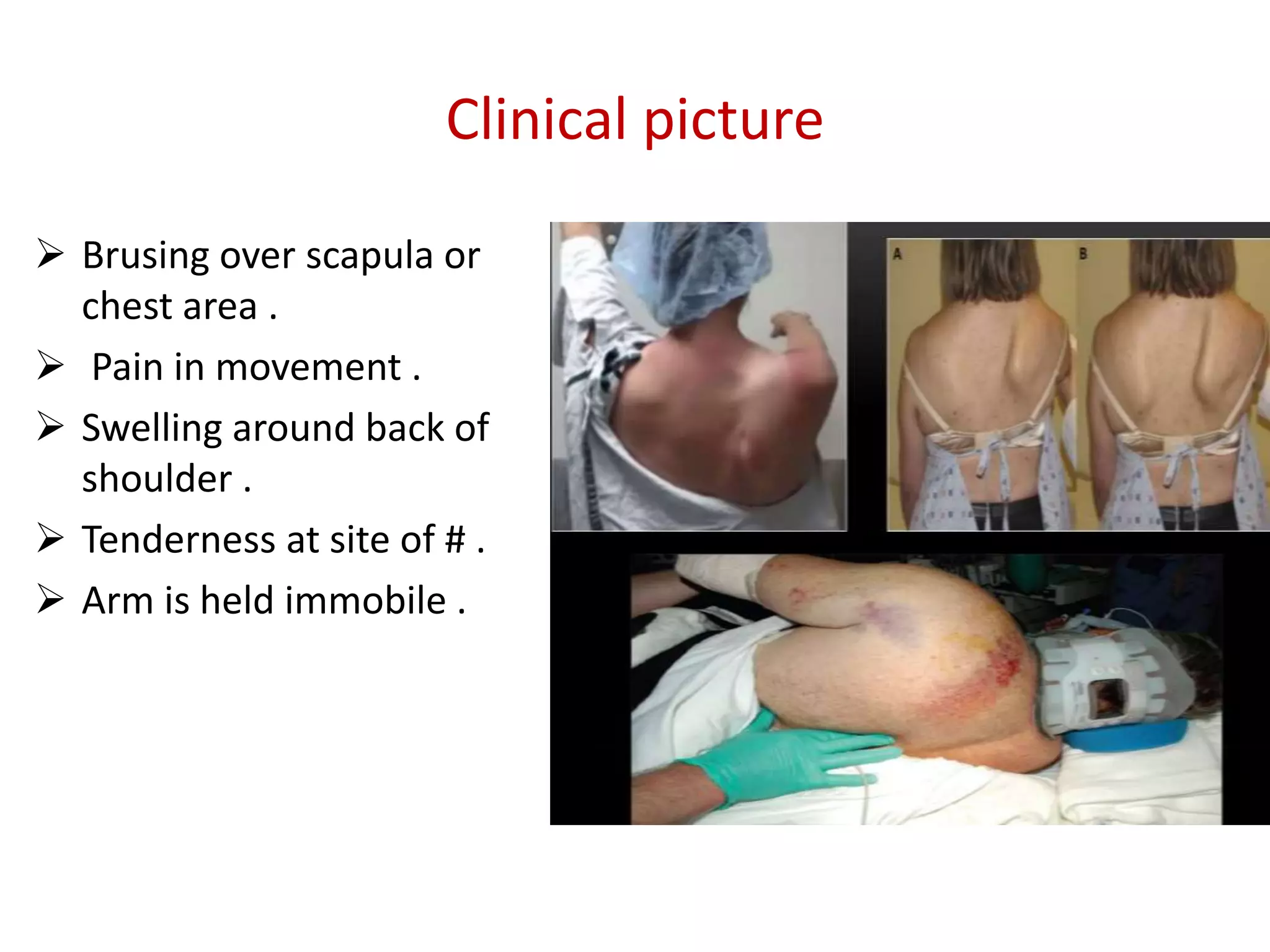
Clinical picture
 Brusing over scapula or
chest area .
 Pain in movement .
 Swelling around back of
shoulder .
 Tenderness at site of # .
 Arm is held immobile .
Diagnosis
• X – ray : Anteroposterior view  lateral  axillary view.
 Neer I projection: true AP
 To assess glenohumeral joint space
 Displacement of the glenoid in relation to the lateral border
of the scapula
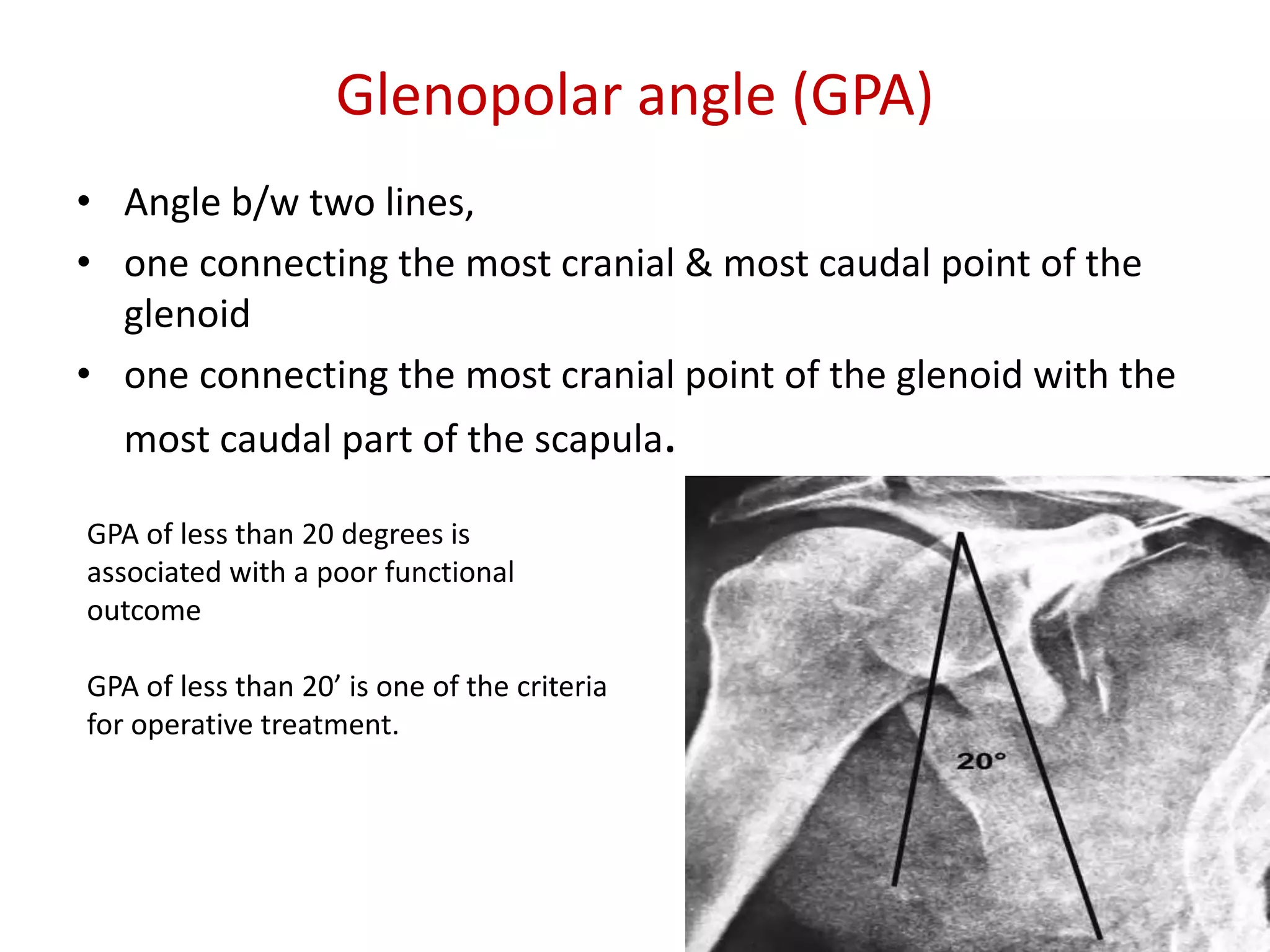
 To measure the glenopolar angle (GPA).
Diagnosis
 Neer II projection :Y-view- true lateral scapular projection.
 Allows-
 Assessment of scapular body fractures in terms of translation,
angulation, and overlap of fragments
 Displays relationship between the acromion and the lateral
clavicle
 To identify any avulsion of the anterior rim of the glenoid.
• CT scan : Useful in glenoid or body fracture.
Glenopolar angle (GPA)
• Angle b/w two lines,
• one connecting the most cranial & most caudal point of the
glenoid
• one connecting the most cranial point of the glenoid with the
most caudal part of the scapula.
GPA of less than 20 degrees is
associated with a poor functional
outcome
GPA of less than 20’ is one of the criteria
for operative treatment.
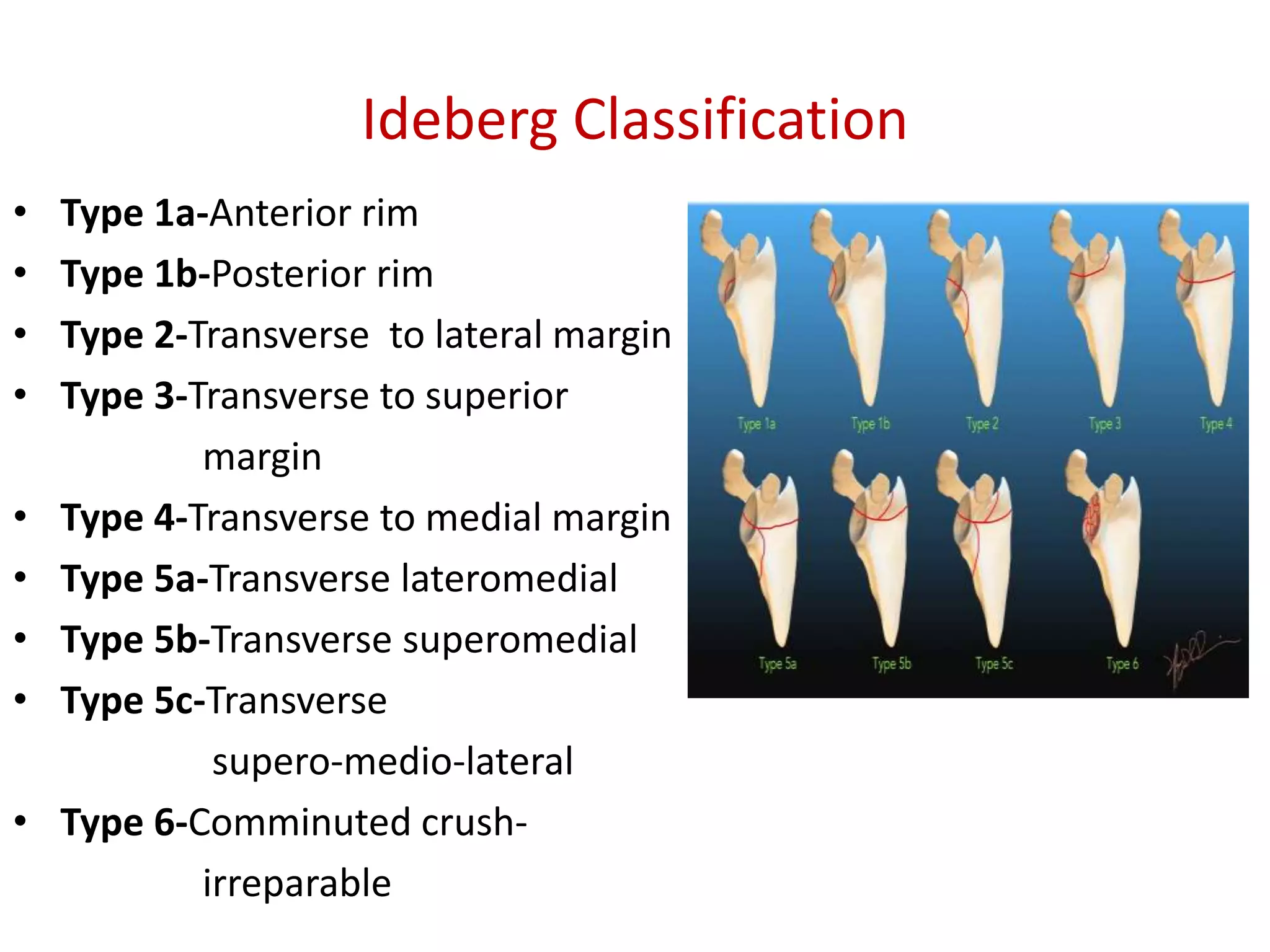
Ideberg Classification
• Type 1a-Anterior rim
• Type 1b-Posterior rim
• Type 2-Transverse to lateral margin
• Type 3-Transverse to superior
margin
• Type 4-Transverse to medial margin
• Type 5a-Transverse lateromedial
• Type 5b-Transverse superomedial
• Type 5c-Transverse
supero-medio-lateral
• Type 6-Comminuted crush-
irreparable
Classification (Tscherne and Christ )
1. Fractures of processes
2. Fractures of the scapular
body(~50%)
3. Fractures of the scapular neck
4. Fractures of the glenoid fossa
5. Combined and comminuted
fractures.
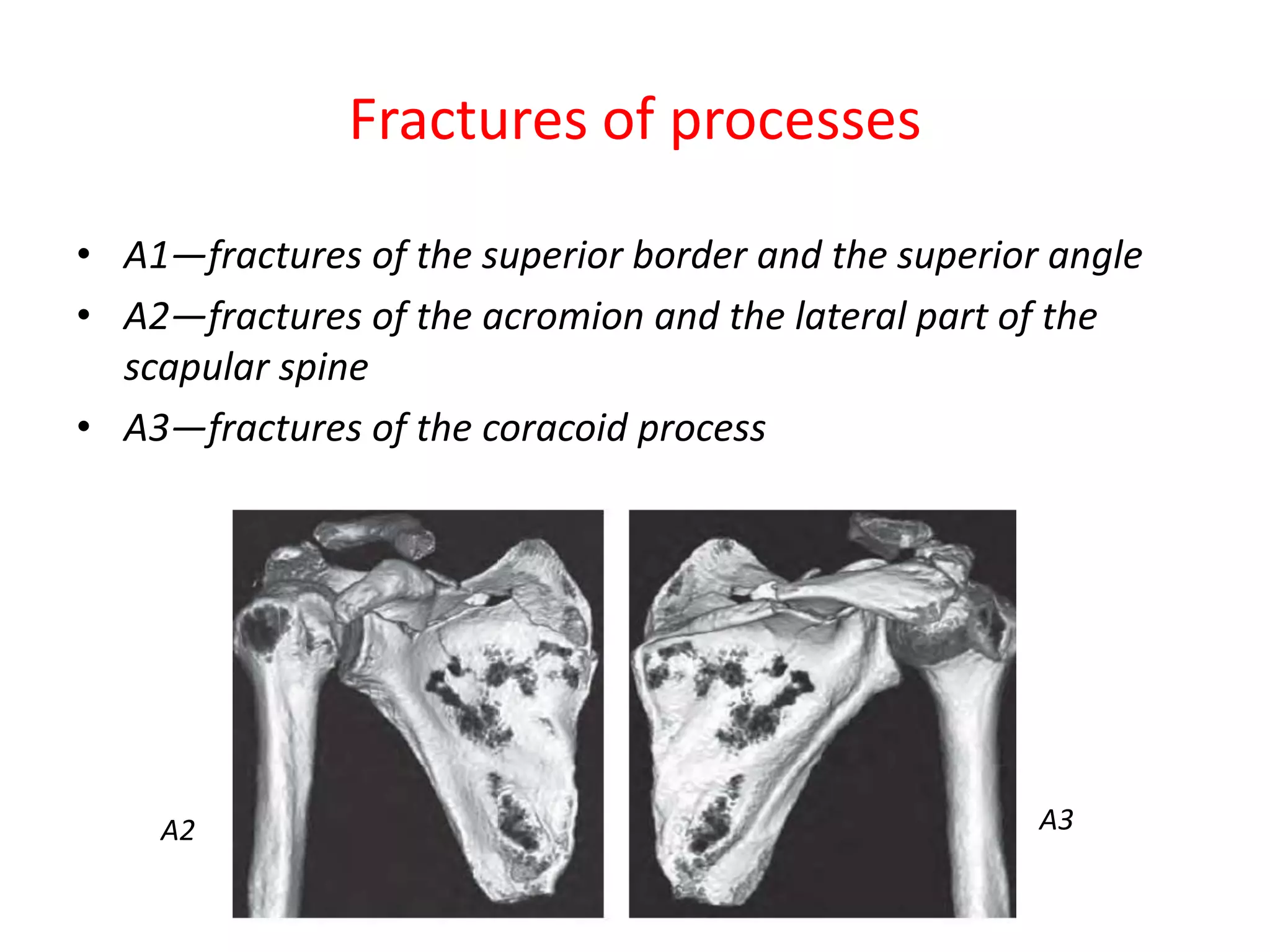
Fractures of processes
• A1—fractures of the superior border and the superior angle
• A2—fractures of the acromion and the lateral part of the
scapular spine
• A3—fractures of the coracoid process
A2 A3
Fracture of body :
• B1—anatomical body( fracture lines pass from the
supraspinous fossa-scapular spine-infraspinous fossa)
• B2—biomechanical body(only infraspinous fossa)
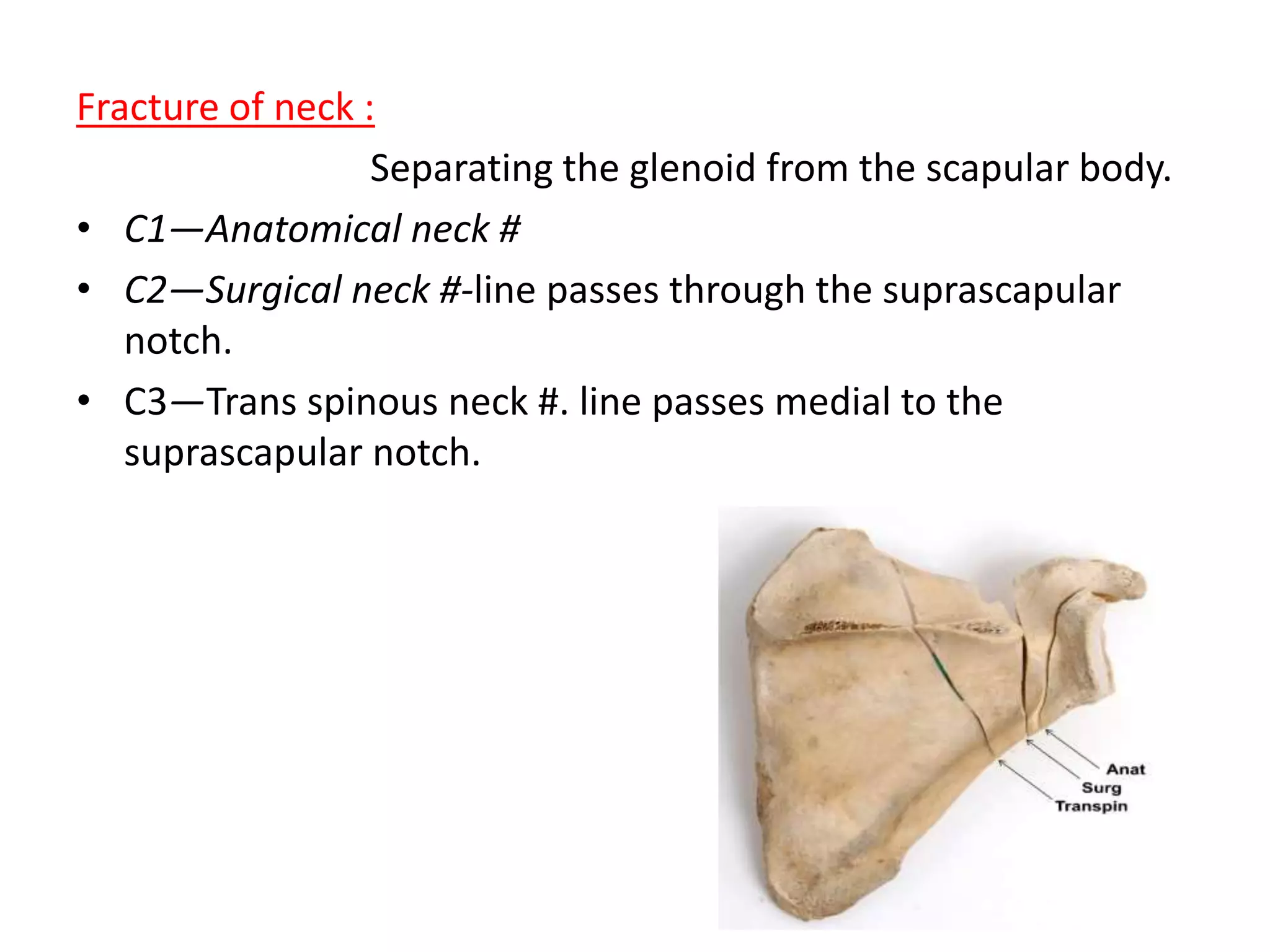
Fracture of neck :
Separating the glenoid from the scapular body.
• C1—Anatomical neck #
• C2—Surgical neck #-line passes through the suprascapular
notch.
• C3—Trans spinous neck #. line passes medial to the
suprascapular notch.
C3
Glenoid Fossa Fractures
• D1—superior glenoid #- d/t avulsion of the coracoid base.
• D2—avulsion of the anteroinferior rim of the glenoid +
anterior dislocation of the humeral head.
• D3—fractures of the inferior glenoid
Treatment
• Reduction is usually unnecessary .
• Sling for comfort and from start movement.
• Check repeatedly for dislocation of the shoulder.
Indications for operative treatment
• Scapular body and neck #-
 100% translation or 30’ to 40’ degree angulation of fragments of
the lateral border.
 Mediolateral displacement of the glenoid in relation to the
lateral border of the scapular body of >1-2 cm.
 GPA less than 20 degrees.
• Acromion or Coracoid #- Displacement of fragments of >1 cm
• Glenoid fractures- if displacement is, a gap/step off of ≥3 to 10
mm, with 20% to 30% involvement of the articular surface.
Surgical approach
• Judet posterior
• Anterior deltopectoral
 Judet approach provides an excellent exposure to
 Infraspinous fossa,
 Lateral and medial borders of the scapula
 Scapular spine
 Scapular neck
 Posterior and inferior rims of the glenoid.
Judet approach
• Skin incision along the scapular spine and the medial border
of the scapula. A skin flap is then raised and the posterior
border of the deltoid identified.
• Posterior deltoid is detached from the scapular spine and
turned back laterally and distally.
• Infraspinatus is mobilized and retracted proximally.
Complication
 Malunion –M/c
 Non-union : rare
 Glenohumeral arthritis . Limitation in range of motion.
 Post-op :
 Limited range of motion of the shoulder- quite common
 Infection
 Failure of internal fixation frequently requires reoperation
 Post traumatic arthritis
 Rotator cuff dysfunction
Associated injuries
Floating Shoulder
• Ipsilateral clavicle + scapular neck fracture.
• Unstable injury-may require operative fixation.
• Subgroup/ commonest type of the “double disruption of the
superior shoulder suspensory complex (SSSC).
Superior shoulder suspensory complex
(SSSC)
• Maintains anatomic relationship b/w upper extremity & axial
skeleton.
• Clavicle-only bony connection b/w the two
• Scapula is suspended from it by coracoclavicular and AC
ligaments.
Classification
• Williams GR et al. The floating shoulder: a biomechanical basis for classification and management. J Bone
Joint Surg Am. 2001 Aug;83(8):1182–7.
Classification
Williams GR et al. The floating shoulder: a biomechanical basis for classification and management. J Bone
Joint Surg Am. 2001 Aug;83(8):1182–7.
Classification
Williams GR et al. The floating shoulder: a biomechanical basis for classification and management. J
Bone Joint Surg Am. 2001 Aug;83(8):1182–7.
Treatment
• Indications for operative management-
1. Clavicle fracture that warrants, in isolation, fixation
2. Glenoid displacement > 2.5 to 3 cm
3. Patient-associated (Requirement for early upper extremity
wt bearing)
4. Severe glenoid angulation(retroversion/anteversion >40’)
5. Documented ipsilateral coracoacromial and/or AC ligament
disruption
Treatment
• If operative intervention is chosen;
o anatomic reduction and internal fixation of the clavicle
o Shoulder reimaged to see alignment of glenoid
Alignment is acceptable
No further intervention is
required
“Unacceptable "position
fixation of the glenoid
neck
Scapulothoracic Dissociation
 Separation of scapula from the thorax along with the upper
extremity.
 Characterized by a wide range of concomitant injuries
including-
 Clavicle fracture
 Sterno-clavicular dislocation
 Acromio-clavicular dislocation
 Tears of the levator scapulae, rhomboids,trapezius, latissimus
dorsi, pectoralis minor and deltoid muscles.
 Partial or complete avulsion of brachial plexus
 Vascular injuries to subclavian or axillary artery
Caused by-
 violent lateral distraction of the shoulder girdle
 rotational displacement of the shoulder girdle
Treatment
 scapulo-thoracic dissociation requires
• Internal fixation of clavicular fractures + Stabilization of
disrupted AC or SC joints.
 To prevent brachial plexus, Subclavian, and Axillary vessels
injury.
 To restore stability to the shoulder girdle.
Take Home Message
o Scapular fracture should alert the surgeon to presence of
other injuries .
o Sever chest injury should also raise suspicion of possible
scapular injury .
Clavicle and scapular fracture

Clavicle and scapular fracture

  • 1.
    CLAVICLE AND SCAPULAR NAME-Dr. KULDEEP SINGH Ortho Resident AIIMS Bhopal
  • 2.
    Clavicle fracture • Claviclefractures are common injuries • Account for 2.6% of all fractures • Up to 44% of injuries to the shoulder girdle • Easy to recognize • Majority unite uneventfully
  • 3.
    Incidence & Classification •Group 1 (middle one third of the clavicle - the shaft) 80-85%. • Group 2 (lateral one third - the acromial end)15-20%. • Group 3 (medial one third - the sternal end) 0-5%.
  • 4.
    Mechanism of Injury •Trauma – Fall against lateral shoulder (90%) – Fall on Outstretched Hand (5%) – Direct blow to clavicle (5%) • Non traumatic (in children) – Tumor – Rickets – Osteogenesis imperfecta – Physical Abuse
  • 5.
  • 6.
    Diagnosis  C/F- • Symptoms-Pain and swelling , decreased movement of the affected limb. • Sign-  Bruising,  Tenderness  Crepitation,  Pressure on the overlying skin & palpable deformity.
  • 7.
    Radiographs  Different angles: •AP – evaluate superior-inferior displacement • 45’ cephalic tilt(Serendipity view) view » Evaluate AP displacement • Stress views useful in lateral 1/3 fractures to assess AC & CC ligaments injury. • Chest x-ray • CT
  • 8.
    Classification Based on theposition of the fracture:[“Allman”] 1. Distal third (Group II) 2. Middle third (Group I) 3. Proximal (Group III). • “Neer” divided distal clavicle fractures into three subgroups, based on their ligamentous attachments and degree of displacement.
  • 9.
    Classifications Group-II: Type I: Distalclavicle fracture with the intact coracoclavicular ligaments.
  • 10.
    Classifications Group II-TYPE II TYPE-IIATYPE-IIB • (Rockwood): Conoid detached from the medial fragment • (Rockwood): Both conoid and trapezoid attached to the distal fragment
  • 11.
    • Group II: •Type III: Distal clavicle fracture with extension into the AC joint. • Group III: Medial clavicular fracture- subgroups are • Type 1 :Minimal displacement • Type 2: Displaced • Type-3: Intra-articular • Type-4: Epiphyseal seperation • Type-5: Comminuted
  • 12.
    Other Classifications 1. AO/OTAclassification scheme of clavicle fractures. 2. Robinson classification scheme of clavicle fractures.
  • 13.
    Non-operative Treatment  Indications:Majority cases – Non-displaced Group I (middle third) – Stable Group II fractures – Group III (medial third)  Technique – Sling or figure-of-8 – 2-4 weeks-gentle ROM exercises. – No attempt at reduction should be made.
  • 14.
    Clavicle fracture rehabilitationProtocol Lädermann et al. Functional recovery following early mobilization & rehabilitation after clavicle fractures : A case-control study. Orthop Traumatol Surg Res. 2017;103(6):885–9.
  • 16.
    Operative management • Stabilizationtechniques include – Plate fixation – Intramedullary fixation – External fixation – Coracoclavicular ligament repair or reconstruction in Group II • Postoperative rehabilitation – Sling for 2wk followed by active motion – Strengthening exercise at 6-8 weeks when pain free motion and radiographic evidence of union – Full activity including sports at ~ 3 months
  • 17.
  • 19.
  • 20.
    Direct fixation ofthe fracture site without coraco-clavicular stabilization 1.Plate Fixation • The distal fragment is large enough to hold a minimum of two, and ideally three, bi-cortical screws
  • 21.
    2.The clavicular hookplate:  If distal fragment is too small .  Usually removal at 3 month post-op.
  • 22.
    3. intramedullary nailing- •Completely displaced transverse fracture. • Advantages- smaller, more cosmetic skin incision less soft tissue stripping at fracture site decreased hardware prominence • Disadvantages- 1.inferior in resisting displacement as compare to plate fixation 2.Implant failure 3. Infection 4. nail protrusion/irritation on the medial side
  • 24.
    4.Kirschner Wire Fixation Inherentrisk of wire breakage and migration. High nonunion and infection rates. So not used now a days.
  • 25.
    • 5.Endobutton Technique •The use of two Endo-Buttons, toggled through drill-holes in the clavicle and coracoid
  • 26.
    2. Direct Fixationof the Fracture with Coracoclavicular Stabilization • Indications : -Very distal fracture in a young individual. -Fractures that involve the clavicular insertion of the coracoclavicular ligaments. Bosworth screw
  • 27.
  • 28.
    TREATMENT • Usually managednon-operatively. • Except- fracture displacement which produces superior mediastinal compromise require urgent attempt at closed reduction or open reduction next if this is unsuccessful.
  • 29.
    Complications Complications of nonoperativetreatment - Nonunion (1-5%) -Decreased shoulder strength and endurance Complications of operative treatment(10%- 30%) – Hardware complications : 30% request for plate removal. – Infection (~4.8%) – Mechanical failure (~1.4%)
  • 30.
    Conclusion • Completely displacedmidshaft fractures: superior results with primary fracture fixation. • Anteroinferior plating- may reduce risk of symptomatic hardware compared to superior plating. • Outcome: No difference between regular sling & figure-of- eight bandage. • Outcome: No difference between plating & intramedullary nailing of displaced midshaft fractures.
  • 31.
  • 32.
    SCAPULA • Is aflat triangular bone that lies on the posterior thorax wall between 2-7 rib. • It enveloped by :  supraspinatus muscle  Infraspinatus muscle  Subscapularis muscle • Attached to clavicle at acromioclavicular. • Articulate with humerus at glenohumeral joint .
  • 33.
    Fracture of scapula •Uncommon - location and surrounding muscles protection . • Result of high energy trauma with 60-98 % associated injuries • 0.4% to 0.9% of all fractures. • 3% to 5% of shoulder girdle #.
  • 34.
    Associated life threateninginjuries • Pneumothorax • Pulmonary contusion • Arterial injury • Abdominal injury • Head injury (10% to 42% of all cases of scapula fracture.) • Brachial plexus injury
  • 35.
    Mechanism of injury From severe direct trauma  Fall from height with direct landing on posterior aspect of trunk.  Fall on shoulder  Fall on outstretched hand
  • 36.
    Clinical picture  Brusingover scapula or chest area .  Pain in movement .  Swelling around back of shoulder .  Tenderness at site of # .  Arm is held immobile .
  • 37.
    Diagnosis • X –ray : Anteroposterior view lateral axillary view.  Neer I projection: true AP  To assess glenohumeral joint space  Displacement of the glenoid in relation to the lateral border of the scapula  To measure the glenopolar angle (GPA).
  • 38.
    Diagnosis  Neer IIprojection :Y-view- true lateral scapular projection.  Allows-  Assessment of scapular body fractures in terms of translation, angulation, and overlap of fragments  Displays relationship between the acromion and the lateral clavicle  To identify any avulsion of the anterior rim of the glenoid. • CT scan : Useful in glenoid or body fracture.
  • 39.
    Glenopolar angle (GPA) •Angle b/w two lines, • one connecting the most cranial & most caudal point of the glenoid • one connecting the most cranial point of the glenoid with the most caudal part of the scapula. GPA of less than 20 degrees is associated with a poor functional outcome GPA of less than 20’ is one of the criteria for operative treatment.
  • 40.
    Ideberg Classification • Type1a-Anterior rim • Type 1b-Posterior rim • Type 2-Transverse to lateral margin • Type 3-Transverse to superior margin • Type 4-Transverse to medial margin • Type 5a-Transverse lateromedial • Type 5b-Transverse superomedial • Type 5c-Transverse supero-medio-lateral • Type 6-Comminuted crush- irreparable
  • 41.
    Classification (Tscherne andChrist ) 1. Fractures of processes 2. Fractures of the scapular body(~50%) 3. Fractures of the scapular neck 4. Fractures of the glenoid fossa 5. Combined and comminuted fractures.
  • 42.
    Fractures of processes •A1—fractures of the superior border and the superior angle • A2—fractures of the acromion and the lateral part of the scapular spine • A3—fractures of the coracoid process A2 A3
  • 43.
    Fracture of body: • B1—anatomical body( fracture lines pass from the supraspinous fossa-scapular spine-infraspinous fossa) • B2—biomechanical body(only infraspinous fossa)
  • 44.
    Fracture of neck: Separating the glenoid from the scapular body. • C1—Anatomical neck # • C2—Surgical neck #-line passes through the suprascapular notch. • C3—Trans spinous neck #. line passes medial to the suprascapular notch. C3
  • 45.
    Glenoid Fossa Fractures •D1—superior glenoid #- d/t avulsion of the coracoid base. • D2—avulsion of the anteroinferior rim of the glenoid + anterior dislocation of the humeral head. • D3—fractures of the inferior glenoid
  • 46.
    Treatment • Reduction isusually unnecessary . • Sling for comfort and from start movement. • Check repeatedly for dislocation of the shoulder.
  • 47.
    Indications for operativetreatment • Scapular body and neck #-  100% translation or 30’ to 40’ degree angulation of fragments of the lateral border.  Mediolateral displacement of the glenoid in relation to the lateral border of the scapular body of >1-2 cm.  GPA less than 20 degrees. • Acromion or Coracoid #- Displacement of fragments of >1 cm • Glenoid fractures- if displacement is, a gap/step off of ≥3 to 10 mm, with 20% to 30% involvement of the articular surface.
  • 48.
    Surgical approach • Judetposterior • Anterior deltopectoral  Judet approach provides an excellent exposure to  Infraspinous fossa,  Lateral and medial borders of the scapula  Scapular spine  Scapular neck  Posterior and inferior rims of the glenoid.
  • 49.
    Judet approach • Skinincision along the scapular spine and the medial border of the scapula. A skin flap is then raised and the posterior border of the deltoid identified. • Posterior deltoid is detached from the scapular spine and turned back laterally and distally. • Infraspinatus is mobilized and retracted proximally.
  • 50.
    Complication  Malunion –M/c Non-union : rare  Glenohumeral arthritis . Limitation in range of motion.  Post-op :  Limited range of motion of the shoulder- quite common  Infection  Failure of internal fixation frequently requires reoperation  Post traumatic arthritis  Rotator cuff dysfunction
  • 51.
  • 52.
    Floating Shoulder • Ipsilateralclavicle + scapular neck fracture. • Unstable injury-may require operative fixation. • Subgroup/ commonest type of the “double disruption of the superior shoulder suspensory complex (SSSC).
  • 53.
    Superior shoulder suspensorycomplex (SSSC) • Maintains anatomic relationship b/w upper extremity & axial skeleton. • Clavicle-only bony connection b/w the two • Scapula is suspended from it by coracoclavicular and AC ligaments.
  • 54.
    Classification • Williams GRet al. The floating shoulder: a biomechanical basis for classification and management. J Bone Joint Surg Am. 2001 Aug;83(8):1182–7.
  • 55.
    Classification Williams GR etal. The floating shoulder: a biomechanical basis for classification and management. J Bone Joint Surg Am. 2001 Aug;83(8):1182–7.
  • 56.
    Classification Williams GR etal. The floating shoulder: a biomechanical basis for classification and management. J Bone Joint Surg Am. 2001 Aug;83(8):1182–7.
  • 57.
    Treatment • Indications foroperative management- 1. Clavicle fracture that warrants, in isolation, fixation 2. Glenoid displacement > 2.5 to 3 cm 3. Patient-associated (Requirement for early upper extremity wt bearing) 4. Severe glenoid angulation(retroversion/anteversion >40’) 5. Documented ipsilateral coracoacromial and/or AC ligament disruption
  • 58.
    Treatment • If operativeintervention is chosen; o anatomic reduction and internal fixation of the clavicle o Shoulder reimaged to see alignment of glenoid Alignment is acceptable No further intervention is required “Unacceptable "position fixation of the glenoid neck
  • 59.
    Scapulothoracic Dissociation  Separationof scapula from the thorax along with the upper extremity.  Characterized by a wide range of concomitant injuries including-  Clavicle fracture  Sterno-clavicular dislocation  Acromio-clavicular dislocation  Tears of the levator scapulae, rhomboids,trapezius, latissimus dorsi, pectoralis minor and deltoid muscles.  Partial or complete avulsion of brachial plexus  Vascular injuries to subclavian or axillary artery
  • 60.
    Caused by-  violentlateral distraction of the shoulder girdle  rotational displacement of the shoulder girdle
  • 61.
    Treatment  scapulo-thoracic dissociationrequires • Internal fixation of clavicular fractures + Stabilization of disrupted AC or SC joints.  To prevent brachial plexus, Subclavian, and Axillary vessels injury.  To restore stability to the shoulder girdle.
  • 62.
    Take Home Message oScapular fracture should alert the surgeon to presence of other injuries . o Sever chest injury should also raise suspicion of possible scapular injury .