PRINCIPLES OF AMPUTATION
Dr Umar M Aminu
Department of Surgery
ATBUTH Bauchi
Outline
• Introduction
– Definition
– History
– Epidemiology
• Indications
• Principles
– Preoperative
– Intraoperative
– Postoperative
• Amputation in Children
• Complications
• Prosthesis
• Conclusion
Introduction
Definition
• Removal of part of or an entire limb through
one or more bones
• When it is through a joint= disarticulation
Introduction
• Not a failure of surgery but a reconstructive
procedure
• Goal is surgical reconstruction that maintains
most functional limb possible
Introduction
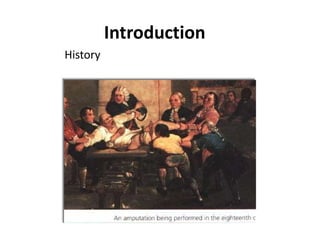
History
• Earliest reference in Babylonian code of
Hammurabi-1700BC
• Hippocrates in De Articularis-385BC
• William Cloves did first successful AKA-1588
• Botallus and Fabricus Holdani describe use of
torniquet-16th century
• Norman Kick used Guillotine amputation during
World War-1943
Introduction
History
Introduction
Epidemiology
• 350,000-1 mil amputees
• 20,000-30,000 new amputees a yr
• >> age 50-75yrs
• >> Lower limbs
• >> Males
Introduction
Epidemiology
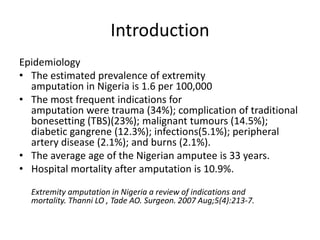
• The estimated prevalence of extremity
amputation in Nigeria is 1.6 per 100,000
• The most frequent indications for
amputation were trauma (34%); complication of traditional
bonesetting (TBS)(23%); malignant tumours (14.5%);
diabetic gangrene (12.3%); infections(5.1%); peripheral
artery disease (2.1%); and burns (2.1%).
• The average age of the Nigerian amputee is 33 years.
• Hospital mortality after amputation is 10.9%.
Extremity amputation in Nigeria a review of indications and
mortality. Thanni LO , Tade AO. Surgeon. 2007 Aug;5(4):213-7.
Introduction
Epidemiology
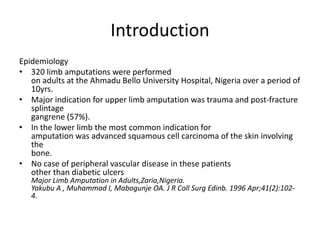
• 320 limb amputations were performed
on adults at the Ahmadu Bello University Hospital, Nigeria over a period of
10yrs.
• Major indication for upper limb amputation was trauma and post-fracture
splintage
gangrene (57%).
• In the lower limb the most common indication for
amputation was advanced squamous cell carcinoma of the skin involving
the
bone.
• No case of peripheral vascular disease in these patients
other than diabetic ulcers
Major Limb Amputation in Adults,Zaria,Nigeria.
Yakubu A , Muhammad I, Mabogunje OA. J R Coll Surg Edinb. 1996 Apr;41(2):102-
4.
Introduction
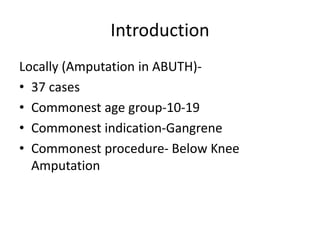
Locally (Amputation in ABUTH)-
• 37 cases
• Commonest age group-10-19
• Commonest indication-Gangrene
• Commonest procedure- Below Knee
Amputation
Introduction
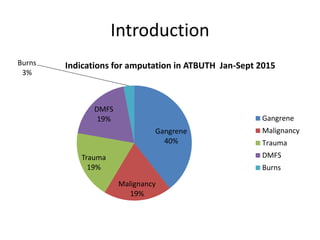
Gangrene
40%
Malignancy
19%
Trauma
19%
DMFS
19%
Burns
3%
Indications for amputation in ATBUTH Jan-Sept 2015
Gangrene
Malignancy
Trauma
DMFS
Burns
Introduction
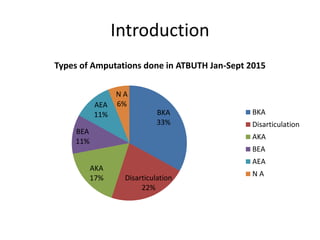
BKA
33%
Disarticulation
22%
AKA
17%
BEA
11%
AEA
11%
N A
6%
Types of Amputations done in ATBUTH Jan-Sept 2015
BKA
Disarticulation
AKA
BEA
AEA
N A
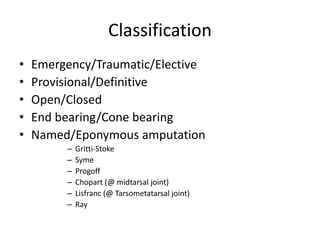
Classification
• Emergency/Traumatic/Elective
• Provisional/Definitive
• Open/Closed
• End bearing/Cone bearing
• Named/Eponymous amputation
– Gritti-Stoke
– Syme
– Progoff
– Chopart (@ midtarsal joint)
– Lisfranc (@ Tarsometatarsal joint)
– Ray
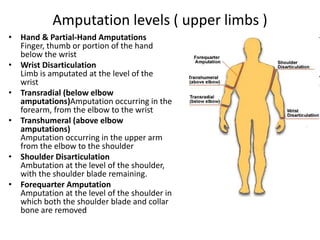
Amputation levels ( upper limbs )
• Hand & Partial-Hand Amputations
Finger, thumb or portion of the hand
below the wrist
• Wrist Disarticulation
Limb is amputated at the level of the
wrist
• Transradial (below elbow
amputations)Amputation occurring in the
forearm, from the elbow to the wrist
• Transhumeral (above elbow
amputations)
Amputation occurring in the upper arm
from the elbow to the shoulder
• Shoulder Disarticulation
Ambutation at the level of the shoulder,
with the shoulder blade remaining.
• Forequarter Amputation
Amputation at the level of the shoulder in
which both the shoulder blade and collar
bone are removed
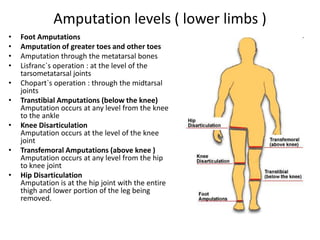
Amputation levels ( lower limbs )
• Foot Amputations
• Amputation of greater toes and other toes
• Amputation through the metatarsal bones
• Lisfranc`s operation : at the level of the
tarsometatarsal joints
• Chopart`s operation : through the midtarsal
joints
• Transtibial Amputations (below the knee)
Amputation occurs at any level from the knee
to the ankle
• Knee Disarticulation
Amputation occurs at the level of the knee
joint
• Transfemoral Amputations (above knee )
Amputation occurs at any level from the hip
to knee joint
• Hip Disarticulation
Amputation is at the hip joint with the entire
thigh and lower portion of the leg being
removed.
Indications
• Congenital/ Acquired
• 3 Ds
Indications
Congenital
• Hemimalia
• Polydactly
• Congenital
pseudoarthrosis
• PFFD
• Gross congenital
malfiormations
Acquired
– Trauma- Mangled limb,
Crush injury
– Vascular- D M
angiopathy, PVD
– Infectivce-COM,
Clostridia
• Neoplasm-
Osteosarcoma,
• Frost bite
• Burns
Indications
3 Ds
• Dead/ limb-Gangrene
• Dying/Deadly/Dangerous limb- Crush injury,
Osteosarcoma, Melanoma
• Damn nuisance-Gross congenital anomalies,
Goals of amputation
• To get rid of all necrotic, infected & painful
tissue.
• To have a wound that heals successfully.
• To have an appropriate remnant stump that
is able to accommodate a prosthetic.
Pre-Operative Assessment
To:
• Ascertain indication
• Site of amputation
• General medical condition
• Rehabilitation potential
• Counselling
• Consent
• Optimisation
Pre Operative Assessment
• Assessment of –
– The affected limb
– The unaffected limb &
– The patient as a whole is conducted thoroughly.
• Assessment of physical, social & psychological status
of the patient should be made.
Pre-operative Evaluation
• History
o Aetiology
o Comorbidities
• Physical examination
o MSS-MESS ≥ 7
Removes subjectivity from decision making in
trauma cases.
No scoring system can replace experience & good clinical judgment.
o CVS, Renal &
o Nervous system
Pre-operative Evaluation
• Investigation
– To confirm Diagnosis
o Doppler
o X-Ray
o FBS
o Technitium 99 Pyrophosphate bone scan
– Capability of Wound Healing
o Transcutaneous Oxygen
o Hemoglobin
o Serum Albumin
o Absolute lymphocyte count
Pre-operative Evaluation…
• Optimization:
Anaemia, hypotension, infection, nutrition
• Consultations:
Nephrologist, Cardiologist, Neurologist
If vascular dx has progress to the point of amputation, most patients also
have concomitant dx process in the cerebral, renal & coronary
vasculatures.
Social assessment includes
• Family & friends supports
• Living accommodation –
– Stairs, ramps, rails, width of door, wheelchair accessibility
• Proximity of shops
Pre-operative Evaluation…
• Counseling & consent
Procedure, anaesthesia, complications,
prosthesis & limitations.
• Involvement of support groups
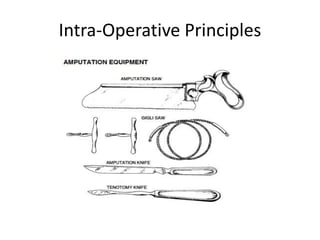
Intra-operative Principles
• Determine outcome of function and
rehabilitation
• Meticulous attention to detail and careful soft
tissue handling
• Effort to be directed at achieving ideal stump
Ideal stump
1) It should be of optimum length
2) The end of stump should be smooth &
rounded
3) It should be firm
4) The opposing group of muscles should be
sutured together over the end of the bone.
5) The muscles are sutured in such a way that
they will be converted into fibrous tissue &
serve as an effective cushion.
Ideal stump
6) Vascularity of the flaps should be normal
7) There should be no projecting spur of bone.
8) The stump shouldn't’t be under tension.
9) The position of the scar should be avoided
of pressure n should be transverse to avoid
pulling up between 2 bones in ap scar.
10) In case of U.L the scar can be terminal, but
in L.L a posterior scar is desirable to avoid
pressure of weight of artificial limb.
Traditional Sites of Election
Upperlimb
• A/E – 20cm from Acromion
• B/E – 18cm from Olecranon
Lowerlimb
• A/ K – 12cm from Joint line
• B/ K – 14cm from Joint line
Site of Selection
Examination
• Skin color
• Hair growth
• Lowest palpable pulse
• Skin temperature
Investigation
• Doppler USS
INTRA - OPERATIVE
• Anaesthesia: GA or Regional
• Position: Supine
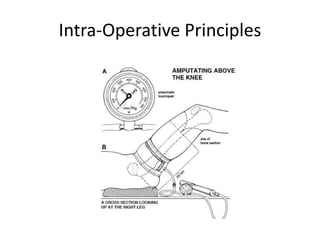
• Tourniquet +/_ Exsanguination
Intra-Operative Principles
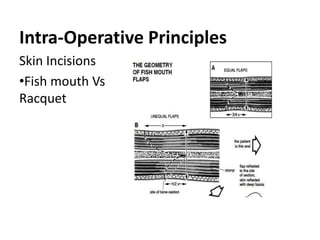
Skin Incisions
•Fish mouth Vs
Racquet
Intra-Operative Principles
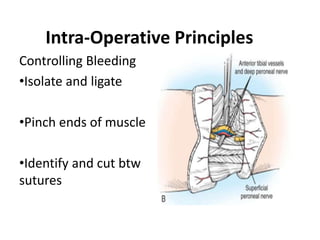
Controlling Bleeding
• Isolate and ligate
• Pinch ends of muscle
• Identify and cut btw sutures
Intra-Operative Principles
Controlling Bleeding
•Isolate and ligate
•Pinch ends of muscle
•Identify and cut btw
sutures
Intra-Operative Principles
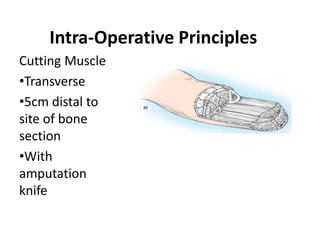
Cutting Muscle
•Transverse
•5cm distal to
site of bone
section
•With
amputation
knife
Intra-Operative Principles
Nerves
• Isolated, gently pulled distally into wound and
divided sharply
• Large nerves should be ligated
• Prevent painful neuroma
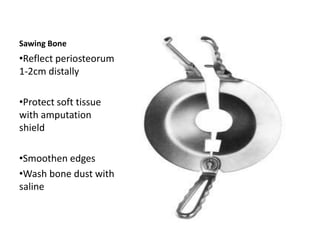
Sawing Bone
•Reflect periosteorum
1-2cm distally
•Protect soft tissue
with amputation
shield
•Smoothen edges
•Wash bone dust with
saline
Intra-Operative Principles
Closing the Wound
• Hemostasis is secured
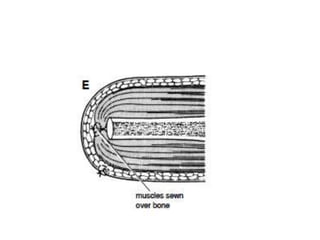
• Opposing group of muscles are sutured across
both the ends with interrupted stitches.
• Fascia & skin are sutured over the muscle without
tension.
• Preferably a suction drain is placed.
• Wound is covered with gauze & roller bandages
tightly from below upwards.
Intra-Operative Principles
Open Amputation
• Indications-
• infected limb
• Battle injuries
• Soft tissue injury/contamination
• Uncertain blood ss
• Types-
– Inverted edges
– Circular
Intra-Operative Principles
Wound Dressing
• Soft vs Rigid
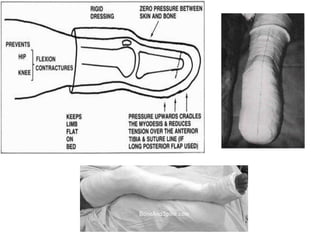
• Rigid dressing : decreses edema, decreases
post operative pain, protect limb from
trauma, early mobilsation. Good bandaging
to mold the stump into Conical shape to
accept the prosthesis
• Soft dressing concept: The stump is dressed
with the sterile dressing & crepe bandage
applied over it.
Post-operative Care
• General-
» Analgesia
» Antibiotics
» DVT prophylaxis
• Specific-
» Joint Positioning+excercise
» Drain removal
» Mobilisation
» Rehabilitation-prosthetic fittiing, home, occupation &
hobby
Complications
• General vs Specific
• Early vs Late
Complications
General
• Haemorrhage-
Reactionary/ 2o
• Infection
Specific
• Flap breakdown
• Flexion contracture
• Residual pain
• Stump ulceration
• Phantom sensation
• Phantom limb pain
• Dermatologic
complications
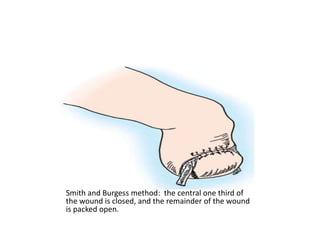
Smith and Burgess method: the central one third of
the wound is closed, and the remainder of the wound
is packed open.
Phantom sensation
• The phantom is the sensation of the limb that is no
longer there. The phantom, which usually occurs
initially immediately after surgery, is often described as
a tingling, burning, itching or pressure, sensation,
sometimes a numbness.
• Phantom sensation may be painless although, most
people find it uncomfortable & often report it as pain;
it usually does not interfere with prosthetic
rehabilitation.
(Physical rehabilitation;Susan B O’ Sullivan; 5th )
Phantom Limb Pain
• Phantom pain and sensations are defined as
perceptions ranging from slight tingling to
sharp, throbbing pain or aching that patients
perceive relating to an extremity or an organ
that is physically no longer a part of the body.
• It has been reported in various trials that the
estimated prevalence of phantom pain varies
from 49% to 83%.
Rehabilitation
• Residual Limb Shrinkage and Shaping
• Limb Desensitization
• Maintain joint range of motion
• Strengthen residual limb
• Maximize Self reliance
• Patient education: Future goals and prosthetic
options
Psychological stress
• Up to 2/3 of amputees will manifest
postoperative psychiatric symptoms
– Depression
– Anxiety
– Crying spells
– Insomnia
– Loss of appetite
– Suicidal ideation
AMPUTATIONS IN CHILDREN
• Amputations in children is divided into two
general categories—congenital (60%) and
acquired (40%)
Amputations In Children
Congenital
 Congenital deficiencies of
the long bones
 Amniotic band syndrome
 Exposure to teratogens (
thalidomide )
 Polydactyly
 Macrodactyly
 Congenital pseudoarthrosis
of the tibia and fibula,
radius and ulna
Acquired
• Secondary to trauma
• Neoplasm
• Infection.
• Vascular disease
• Preserve length
• Preserve important growth plates
• Perform disarticulation rather than
transosseous amputation whenever possible
• Preserve the knee joint whenever possible
• Stabilize and normalize the proximal portion of
the limb
• Be prepared to deal with issues in addition to
limb deficiency in children with other clinically
important conditions.
Principles Of Childhood Amputation
Because of growth issues and increased body
metabolism, children often can tolerate
procedures on amputation stumps that are
not tolerated by adults, which includes
• More forceful skin traction
• Application of extensive skin grafts
• Closure of skin flaps under moderate tension.
Advantages Of Amputation In Children
In Comparison To Adults
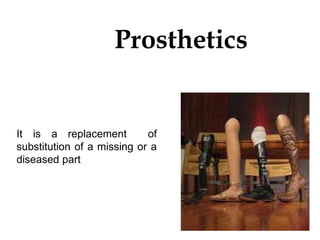
Prosthetics
It is a replacement of
substitution of a missing or a
diseased part
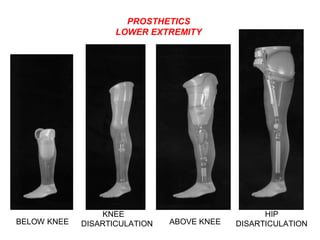
Types of Prosthesis
BELOW KNEE
KNEE
DISARTICULATION ABOVE KNEE
HIP
DISARTICULATION
PROSTHETICS
LOWER EXTREMITY
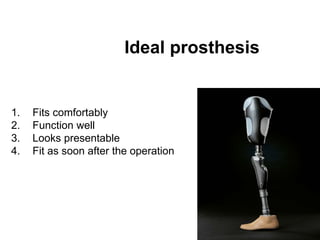
Ideal prosthesis
1. Fits comfortably
2. Function well
3. Looks presentable
4. Fit as soon after the operation
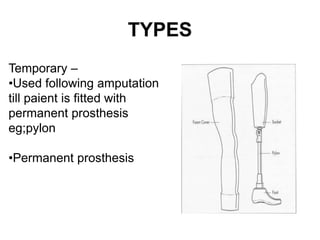
Temporary –
•Used following amputation
till paient is fitted with
permanent prosthesis
eg;pylon
•Permanent prosthesis
Conclusion
• Goal is to achieve useful residual limb in an
individual who is active with a positive
attitude an continues to be a productive
member of society
Reference
• Current Diagnosis & Treatment in Orthopedics
3rd edition: by Harry Skinner (Editor)
Publisher: Appleton & Lange (June 20, 2003)
• Campbel Operative Orthopedics, 11th Edition
Thank you for Listening

Principles of amputation

  • 1.
    PRINCIPLES OF AMPUTATION DrUmar M Aminu Department of Surgery ATBUTH Bauchi
  • 2.
    Outline • Introduction – Definition –History – Epidemiology • Indications • Principles – Preoperative – Intraoperative – Postoperative • Amputation in Children • Complications • Prosthesis • Conclusion
  • 3.
    Introduction Definition • Removal ofpart of or an entire limb through one or more bones • When it is through a joint= disarticulation
  • 4.
    Introduction • Not afailure of surgery but a reconstructive procedure • Goal is surgical reconstruction that maintains most functional limb possible
  • 5.
    Introduction History • Earliest referencein Babylonian code of Hammurabi-1700BC • Hippocrates in De Articularis-385BC • William Cloves did first successful AKA-1588 • Botallus and Fabricus Holdani describe use of torniquet-16th century • Norman Kick used Guillotine amputation during World War-1943
  • 6.
  • 7.
    Introduction Epidemiology • 350,000-1 milamputees • 20,000-30,000 new amputees a yr • >> age 50-75yrs • >> Lower limbs • >> Males
  • 8.
    Introduction Epidemiology • The estimatedprevalence of extremity amputation in Nigeria is 1.6 per 100,000 • The most frequent indications for amputation were trauma (34%); complication of traditional bonesetting (TBS)(23%); malignant tumours (14.5%); diabetic gangrene (12.3%); infections(5.1%); peripheral artery disease (2.1%); and burns (2.1%). • The average age of the Nigerian amputee is 33 years. • Hospital mortality after amputation is 10.9%. Extremity amputation in Nigeria a review of indications and mortality. Thanni LO , Tade AO. Surgeon. 2007 Aug;5(4):213-7.
  • 9.
    Introduction Epidemiology • 320 limbamputations were performed on adults at the Ahmadu Bello University Hospital, Nigeria over a period of 10yrs. • Major indication for upper limb amputation was trauma and post-fracture splintage gangrene (57%). • In the lower limb the most common indication for amputation was advanced squamous cell carcinoma of the skin involving the bone. • No case of peripheral vascular disease in these patients other than diabetic ulcers Major Limb Amputation in Adults,Zaria,Nigeria. Yakubu A , Muhammad I, Mabogunje OA. J R Coll Surg Edinb. 1996 Apr;41(2):102- 4.
  • 10.
    Introduction Locally (Amputation inABUTH)- • 37 cases • Commonest age group-10-19 • Commonest indication-Gangrene • Commonest procedure- Below Knee Amputation
  • 11.
  • 12.
    Introduction BKA 33% Disarticulation 22% AKA 17% BEA 11% AEA 11% N A 6% Types ofAmputations done in ATBUTH Jan-Sept 2015 BKA Disarticulation AKA BEA AEA N A
  • 13.
    Classification • Emergency/Traumatic/Elective • Provisional/Definitive •Open/Closed • End bearing/Cone bearing • Named/Eponymous amputation – Gritti-Stoke – Syme – Progoff – Chopart (@ midtarsal joint) – Lisfranc (@ Tarsometatarsal joint) – Ray
  • 14.
    Amputation levels (upper limbs ) • Hand & Partial-Hand Amputations Finger, thumb or portion of the hand below the wrist • Wrist Disarticulation Limb is amputated at the level of the wrist • Transradial (below elbow amputations)Amputation occurring in the forearm, from the elbow to the wrist • Transhumeral (above elbow amputations) Amputation occurring in the upper arm from the elbow to the shoulder • Shoulder Disarticulation Ambutation at the level of the shoulder, with the shoulder blade remaining. • Forequarter Amputation Amputation at the level of the shoulder in which both the shoulder blade and collar bone are removed
  • 15.
    Amputation levels (lower limbs ) • Foot Amputations • Amputation of greater toes and other toes • Amputation through the metatarsal bones • Lisfranc`s operation : at the level of the tarsometatarsal joints • Chopart`s operation : through the midtarsal joints • Transtibial Amputations (below the knee) Amputation occurs at any level from the knee to the ankle • Knee Disarticulation Amputation occurs at the level of the knee joint • Transfemoral Amputations (above knee ) Amputation occurs at any level from the hip to knee joint • Hip Disarticulation Amputation is at the hip joint with the entire thigh and lower portion of the leg being removed.
  • 16.
  • 17.
    Indications Congenital • Hemimalia • Polydactly •Congenital pseudoarthrosis • PFFD • Gross congenital malfiormations Acquired – Trauma- Mangled limb, Crush injury – Vascular- D M angiopathy, PVD – Infectivce-COM, Clostridia • Neoplasm- Osteosarcoma, • Frost bite • Burns
  • 18.
    Indications 3 Ds • Dead/limb-Gangrene • Dying/Deadly/Dangerous limb- Crush injury, Osteosarcoma, Melanoma • Damn nuisance-Gross congenital anomalies,
  • 19.
    Goals of amputation •To get rid of all necrotic, infected & painful tissue. • To have a wound that heals successfully. • To have an appropriate remnant stump that is able to accommodate a prosthetic.
  • 20.
    Pre-Operative Assessment To: • Ascertainindication • Site of amputation • General medical condition • Rehabilitation potential • Counselling • Consent • Optimisation
  • 21.
    Pre Operative Assessment •Assessment of – – The affected limb – The unaffected limb & – The patient as a whole is conducted thoroughly. • Assessment of physical, social & psychological status of the patient should be made.
  • 22.
    Pre-operative Evaluation • History oAetiology o Comorbidities • Physical examination o MSS-MESS ≥ 7 Removes subjectivity from decision making in trauma cases. No scoring system can replace experience & good clinical judgment. o CVS, Renal & o Nervous system
  • 23.
    Pre-operative Evaluation • Investigation –To confirm Diagnosis o Doppler o X-Ray o FBS o Technitium 99 Pyrophosphate bone scan – Capability of Wound Healing o Transcutaneous Oxygen o Hemoglobin o Serum Albumin o Absolute lymphocyte count
  • 24.
    Pre-operative Evaluation… • Optimization: Anaemia,hypotension, infection, nutrition • Consultations: Nephrologist, Cardiologist, Neurologist If vascular dx has progress to the point of amputation, most patients also have concomitant dx process in the cerebral, renal & coronary vasculatures.
  • 25.
    Social assessment includes •Family & friends supports • Living accommodation – – Stairs, ramps, rails, width of door, wheelchair accessibility • Proximity of shops
  • 26.
    Pre-operative Evaluation… • Counseling& consent Procedure, anaesthesia, complications, prosthesis & limitations. • Involvement of support groups
  • 27.
    Intra-operative Principles • Determineoutcome of function and rehabilitation • Meticulous attention to detail and careful soft tissue handling • Effort to be directed at achieving ideal stump
  • 28.
    Ideal stump 1) Itshould be of optimum length 2) The end of stump should be smooth & rounded 3) It should be firm 4) The opposing group of muscles should be sutured together over the end of the bone. 5) The muscles are sutured in such a way that they will be converted into fibrous tissue & serve as an effective cushion.
  • 29.
    Ideal stump 6) Vascularityof the flaps should be normal 7) There should be no projecting spur of bone. 8) The stump shouldn't’t be under tension. 9) The position of the scar should be avoided of pressure n should be transverse to avoid pulling up between 2 bones in ap scar. 10) In case of U.L the scar can be terminal, but in L.L a posterior scar is desirable to avoid pressure of weight of artificial limb.
  • 30.
    Traditional Sites ofElection Upperlimb • A/E – 20cm from Acromion • B/E – 18cm from Olecranon Lowerlimb • A/ K – 12cm from Joint line • B/ K – 14cm from Joint line
  • 31.
    Site of Selection Examination •Skin color • Hair growth • Lowest palpable pulse • Skin temperature Investigation • Doppler USS
  • 32.
    INTRA - OPERATIVE •Anaesthesia: GA or Regional • Position: Supine • Tourniquet +/_ Exsanguination
  • 33.
  • 34.
  • 35.
    Intra-Operative Principles Controlling Bleeding •Isolate and ligate • Pinch ends of muscle • Identify and cut btw sutures
  • 36.
    Intra-Operative Principles Controlling Bleeding •Isolateand ligate •Pinch ends of muscle •Identify and cut btw sutures
  • 37.
    Intra-Operative Principles Cutting Muscle •Transverse •5cmdistal to site of bone section •With amputation knife
  • 38.
    Intra-Operative Principles Nerves • Isolated,gently pulled distally into wound and divided sharply • Large nerves should be ligated • Prevent painful neuroma
  • 39.
    Sawing Bone •Reflect periosteorum 1-2cmdistally •Protect soft tissue with amputation shield •Smoothen edges •Wash bone dust with saline
  • 40.
  • 41.
    Intra-Operative Principles Closing theWound • Hemostasis is secured • Opposing group of muscles are sutured across both the ends with interrupted stitches. • Fascia & skin are sutured over the muscle without tension. • Preferably a suction drain is placed. • Wound is covered with gauze & roller bandages tightly from below upwards.
  • 44.
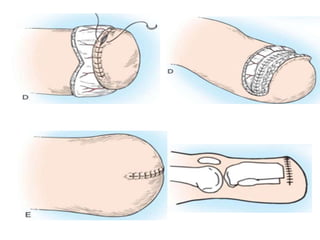
    Intra-Operative Principles Open Amputation •Indications- • infected limb • Battle injuries • Soft tissue injury/contamination • Uncertain blood ss • Types- – Inverted edges – Circular
  • 45.
    Intra-Operative Principles Wound Dressing •Soft vs Rigid • Rigid dressing : decreses edema, decreases post operative pain, protect limb from trauma, early mobilsation. Good bandaging to mold the stump into Conical shape to accept the prosthesis • Soft dressing concept: The stump is dressed with the sterile dressing & crepe bandage applied over it.
  • 47.
    Post-operative Care • General- »Analgesia » Antibiotics » DVT prophylaxis • Specific- » Joint Positioning+excercise » Drain removal » Mobilisation » Rehabilitation-prosthetic fittiing, home, occupation & hobby
  • 48.
    Complications • General vsSpecific • Early vs Late
  • 49.
    Complications General • Haemorrhage- Reactionary/ 2o •Infection Specific • Flap breakdown • Flexion contracture • Residual pain • Stump ulceration • Phantom sensation • Phantom limb pain • Dermatologic complications
  • 50.
    Smith and Burgessmethod: the central one third of the wound is closed, and the remainder of the wound is packed open.
  • 51.
    Phantom sensation • Thephantom is the sensation of the limb that is no longer there. The phantom, which usually occurs initially immediately after surgery, is often described as a tingling, burning, itching or pressure, sensation, sometimes a numbness. • Phantom sensation may be painless although, most people find it uncomfortable & often report it as pain; it usually does not interfere with prosthetic rehabilitation. (Physical rehabilitation;Susan B O’ Sullivan; 5th )
  • 52.
    Phantom Limb Pain •Phantom pain and sensations are defined as perceptions ranging from slight tingling to sharp, throbbing pain or aching that patients perceive relating to an extremity or an organ that is physically no longer a part of the body. • It has been reported in various trials that the estimated prevalence of phantom pain varies from 49% to 83%.
  • 53.
    Rehabilitation • Residual LimbShrinkage and Shaping • Limb Desensitization • Maintain joint range of motion • Strengthen residual limb • Maximize Self reliance • Patient education: Future goals and prosthetic options
  • 54.
    Psychological stress • Upto 2/3 of amputees will manifest postoperative psychiatric symptoms – Depression – Anxiety – Crying spells – Insomnia – Loss of appetite – Suicidal ideation
  • 55.
  • 56.
    • Amputations inchildren is divided into two general categories—congenital (60%) and acquired (40%) Amputations In Children
  • 57.
    Amputations In Children Congenital Congenital deficiencies of the long bones  Amniotic band syndrome  Exposure to teratogens ( thalidomide )  Polydactyly  Macrodactyly  Congenital pseudoarthrosis of the tibia and fibula, radius and ulna Acquired • Secondary to trauma • Neoplasm • Infection. • Vascular disease
  • 58.
    • Preserve length •Preserve important growth plates • Perform disarticulation rather than transosseous amputation whenever possible • Preserve the knee joint whenever possible • Stabilize and normalize the proximal portion of the limb • Be prepared to deal with issues in addition to limb deficiency in children with other clinically important conditions. Principles Of Childhood Amputation
  • 59.
    Because of growthissues and increased body metabolism, children often can tolerate procedures on amputation stumps that are not tolerated by adults, which includes • More forceful skin traction • Application of extensive skin grafts • Closure of skin flaps under moderate tension. Advantages Of Amputation In Children In Comparison To Adults
  • 60.
    Prosthetics It is areplacement of substitution of a missing or a diseased part
  • 61.
    Types of Prosthesis BELOWKNEE KNEE DISARTICULATION ABOVE KNEE HIP DISARTICULATION PROSTHETICS LOWER EXTREMITY
  • 62.
    Ideal prosthesis 1. Fitscomfortably 2. Function well 3. Looks presentable 4. Fit as soon after the operation
  • 63.
    Temporary – •Used followingamputation till paient is fitted with permanent prosthesis eg;pylon •Permanent prosthesis
  • 64.
    Conclusion • Goal isto achieve useful residual limb in an individual who is active with a positive attitude an continues to be a productive member of society
  • 65.
    Reference • Current Diagnosis& Treatment in Orthopedics 3rd edition: by Harry Skinner (Editor) Publisher: Appleton & Lange (June 20, 2003) • Campbel Operative Orthopedics, 11th Edition
  • 66.
    Thank you forListening

Editor's Notes

  • #61 Leg Prosthesis (2 types): An exoskeletal prosthesis has a hard outer shell made primarily of plastics and laminates. An endoskeletal or modular prosthesis has the tube or pylon frame that acts as a type of “skeleton.” A soft foam cover is usually applied over the prosthesis. The foam cover is shaped to match the remaining sound limb. Arm: A myoelectric arm, in which signals from muscles in the residual limb are sent via electrodes to the prosthetic hand to open or close it, is powered by a battery The cheetah prosthetic which is pictured above has been riddled with controversy. Oscar Pistorius is a double below-knee amputee from South Africa who recently won the silver medal in the 400m at the South African senior athletics championships against an entirely able-bodied field. However, he may be excluded from further competing in "able-bodied" events because some feel that his artificial legs give him an unfair advantage by virtue of being longer then natural legs. Others say that his legs are a disadvantage, since unlike natural legs, they are merely akin to springs and can not generate energy like a natural leg. It is important to consider culture and ethnic origin when discussing a prosthetic with patients. When I was in Haiti it was common for prosthetics to go unused as they were not made to match the skin tone of their wearer!