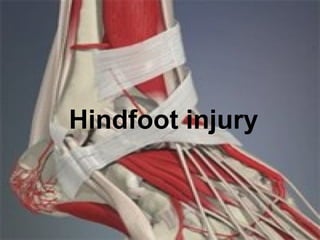

Hindfoot injury
The important structures of the foot can be
divided into several categories. These
include:
• bones and joints
• ligaments and tendons
• muscles
• nerves
• blood vessels
Anatomy of foot
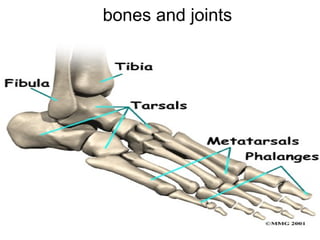
bones and joints
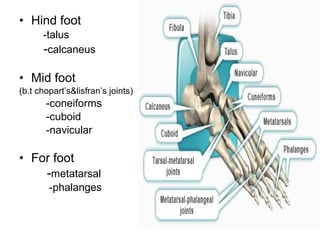
• Hind foot
-talus
-calcaneus
• Mid foot
(b.t chopart’s&lisfran’s joints)
-coneiforms
-cuboid
-navicular
• For foot
-metatarsal
-phalanges
foot consists of 28 bones. These are
• 7 tarsal bones
– calcaneus
– talus
– medial cuneiform
– intermediate cuneiform
– lateral cuneiform
– cuboid
– navicular
• 5 metacarpal bones (1st, 2nd, 3rd, 4th, 5th from great toe to
little toe respectively)
• 5 proximal phalanges (1st, 2nd, 3rd, 4th, 5th from great toe to
little toe respectively)
• 4 middle phalanges (2nd, 3rd, 4th, 5th from second toe to little
toe respectively)
• 5 distal phalanges (1st, 2nd, 3rd, 4th, 5th from great toe to little
toe respectively)
• 2 sesamoid bones below the 1st metatarsal head
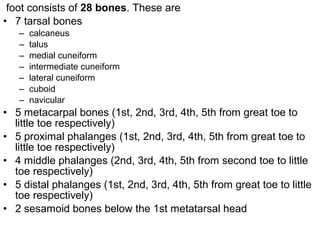
Joint
The joint between the metatarsals and the first phalanx
is called the metatarsal phalangeal joint (MTP)
movement in these joints is very important for a
normal walking pattern.
• Not much motion occurs at the joints between the
bones of the toes. The big toe, or hallux, is the most
important toe for walking, and the first MTP joint is a
common area for problems in the foot.
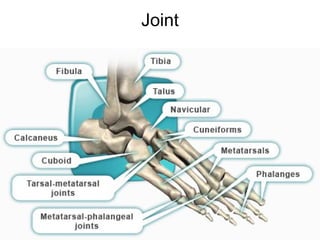
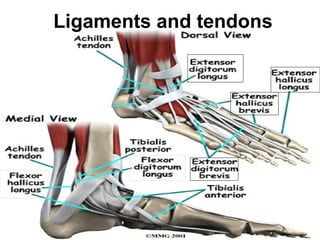
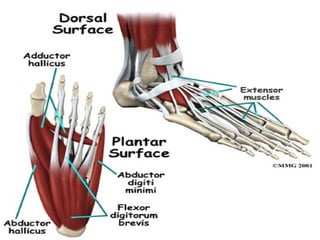
Ligaments and tendons
Nerves
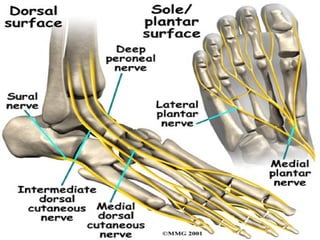
• The main nerve to the foot, the posterior tibial
nerve, enters the sole of the foot by running
behind the inside bump on the ankle (medial
malleolus). This nerve supplies sensation to the
toes and sole of the foot and controls the
muscles of the sole of the foot. Several other
nerves run into the foot on the outside of the foot
and down the top of the foot. These nerves
primarily provide sensation to different areas on
the top and outside edge of the foot.
Vessels
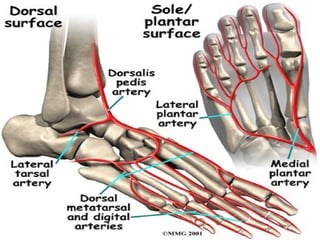
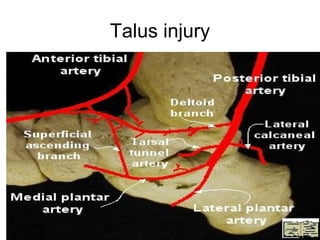
• The main blood supply to the foot, the posterior tibial artery, runs
right beside the nerve of the same name.
• The posterior tibial artery passes behind the ankle then winds
down to the inner side. Here its pulse can be felt behind the medial
malleoli. Moving towards the sole of the foot it divides into two
branches called the lateral and medial plantar arteries that supply
the sole.
• Anterior tibial artery its pulse can be palpated in front of the ankle
joint. In the foot it continues as the
• dorsalis pedis artery. Pulse of this artery can be felt just proximal
to the first web space. Dorsalis pedis artery gives off a arcuate
artery that along with its branches supplies the outer four toes. The
dorsalis pedis artery continues down to supply the great toe.
• The peroneal artery descends down and divides into branches that
supply the posterior and outer aspect of the heel
Talus injury
Mechanism of injury
Direct injury : usually high-impact trauma
as road traffic accidents, gun shot injury.
Indirect injury : usually low-impact trauma
as falling , increase in training
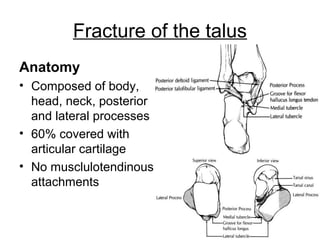
Fracture of the talus
Anatomy
• Composed of body,
head, neck, posterior
and lateral processes
• 60% covered with
articular cartilage
• No musclulotendinous
attachments
Features of talus
injury
•Pain , swelling , deformity and tenting
•Tenting may cause sloughing of skin and
infection
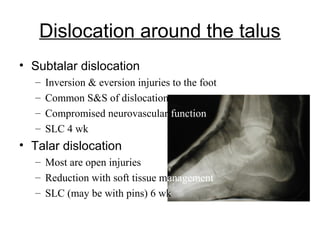
Dislocation around the talus
• Subtalar dislocation
– Inversion & eversion injuries to the foot
– Common S&S of dislocation
– Compromised neurovascular function
– SLC 4 wk
• Talar dislocation
– Most are open injuries
– Reduction with soft tissue management
– SLC (may be with pins) 6 wk
X-ray
•Not always easy to see
•CT may be helpful
•
Treatment of talus fracture
No displacement : split plaster ,when
swelling subsides complete plaster for 6-8
weeks
Displaced : closed reduction
Open reduction
Stabilization with 1 or 2 screws
Below knee plaster for6-8 weeks
complications
Avascular necrosis
due to poor blood supply
posterior half of body may
collapse and ankle may need
arthrodesis
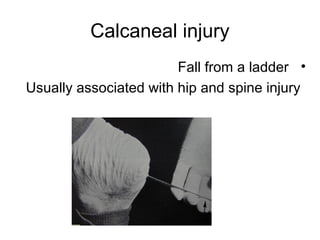
Calcaneal injury
•Fall from a ladder
Usually associated with hip and spine injury
•Extra articular injury affects processes and
post. Part of bone
•Easy to manage , good prognosis
Intra articular:
Cleavage of bone obliquely
Severe comminution
•Pain , swelling , bruising , wide heel , thick
tissue , loss of concavity below lateral
malleolus
•
•Subtalar joint is stiff but ankle joint is still
movable
•Check for compatment syndrome of foot
•‘’severe pain, intensive bruising and
decreased sensibility‘’
TREATMENT
elevation and icepacks till swelling
subsides
Undisplaced: closed treatment ,exercise ,
when swelling subsides , firm bandage,
non wt bearing on crutches for4-6 weeks
Displaced : reduction and fixation with
screws , immobilization in slight equinus to
relieve tension on achillis tendon , wt
bearing is permitted after 4-6 weeks
treatment
•Displaced , intra articular : open reduction
and internal fixation with plates and
screws . Bone grafts to fill defects ,
drainage of blood
•It is a difficult surgery that requires
complete familiarity with local anatomy
•
Post operatively. . .
•Light splint + elevation
as
pain subsides , exercise should begin
•2-3weeks later , let the pt out
8 weeks….partial weight bearing , 4
more weeks for complete wt bearing
•
complications
•Problems in shoe fitting
talocalcaneal stiffness and osteoarthritis
… ARTHRODESIS…….
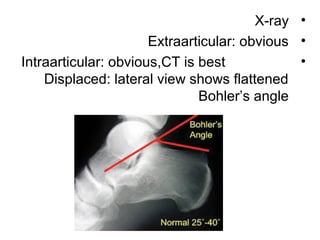
•X-ray
•Extraarticular: obvious
•Intraarticular: obvious,CT is best
Displaced: lateral view shows flattened
Bohler’s angle
Thanks
Done by :
Lamees Abdulrahman

Hindfoot injury

  • 1.
  • 2.
    The important structuresof the foot can be divided into several categories. These include: • bones and joints • ligaments and tendons • muscles • nerves • blood vessels Anatomy of foot
  • 3.
  • 4.
    • Hind foot -talus -calcaneus •Mid foot (b.t chopart’s&lisfran’s joints) -coneiforms -cuboid -navicular • For foot -metatarsal -phalanges
  • 5.
    foot consists of28 bones. These are • 7 tarsal bones – calcaneus – talus – medial cuneiform – intermediate cuneiform – lateral cuneiform – cuboid – navicular • 5 metacarpal bones (1st, 2nd, 3rd, 4th, 5th from great toe to little toe respectively) • 5 proximal phalanges (1st, 2nd, 3rd, 4th, 5th from great toe to little toe respectively) • 4 middle phalanges (2nd, 3rd, 4th, 5th from second toe to little toe respectively) • 5 distal phalanges (1st, 2nd, 3rd, 4th, 5th from great toe to little toe respectively) • 2 sesamoid bones below the 1st metatarsal head
  • 6.
    Joint The joint betweenthe metatarsals and the first phalanx is called the metatarsal phalangeal joint (MTP) movement in these joints is very important for a normal walking pattern. • Not much motion occurs at the joints between the bones of the toes. The big toe, or hallux, is the most important toe for walking, and the first MTP joint is a common area for problems in the foot.
  • 7.
  • 9.
    Nerves • The mainnerve to the foot, the posterior tibial nerve, enters the sole of the foot by running behind the inside bump on the ankle (medial malleolus). This nerve supplies sensation to the toes and sole of the foot and controls the muscles of the sole of the foot. Several other nerves run into the foot on the outside of the foot and down the top of the foot. These nerves primarily provide sensation to different areas on the top and outside edge of the foot.
  • 11.
    Vessels • The mainblood supply to the foot, the posterior tibial artery, runs right beside the nerve of the same name. • The posterior tibial artery passes behind the ankle then winds down to the inner side. Here its pulse can be felt behind the medial malleoli. Moving towards the sole of the foot it divides into two branches called the lateral and medial plantar arteries that supply the sole. • Anterior tibial artery its pulse can be palpated in front of the ankle joint. In the foot it continues as the • dorsalis pedis artery. Pulse of this artery can be felt just proximal to the first web space. Dorsalis pedis artery gives off a arcuate artery that along with its branches supplies the outer four toes. The dorsalis pedis artery continues down to supply the great toe. • The peroneal artery descends down and divides into branches that supply the posterior and outer aspect of the heel
  • 13.
  • 14.
    Mechanism of injury Directinjury : usually high-impact trauma as road traffic accidents, gun shot injury. Indirect injury : usually low-impact trauma as falling , increase in training
  • 15.
    Fracture of thetalus Anatomy • Composed of body, head, neck, posterior and lateral processes • 60% covered with articular cartilage • No musclulotendinous attachments
  • 16.
    Features of talus injury •Pain, swelling , deformity and tenting •Tenting may cause sloughing of skin and infection
  • 17.
    Dislocation around thetalus • Subtalar dislocation – Inversion & eversion injuries to the foot – Common S&S of dislocation – Compromised neurovascular function – SLC 4 wk • Talar dislocation – Most are open injuries – Reduction with soft tissue management – SLC (may be with pins) 6 wk
  • 18.
    X-ray •Not always easyto see •CT may be helpful •
  • 19.
    Treatment of talusfracture No displacement : split plaster ,when swelling subsides complete plaster for 6-8 weeks Displaced : closed reduction Open reduction Stabilization with 1 or 2 screws Below knee plaster for6-8 weeks
  • 20.
  • 21.
    Avascular necrosis due topoor blood supply posterior half of body may collapse and ankle may need arthrodesis
  • 22.
    Calcaneal injury •Fall froma ladder Usually associated with hip and spine injury
  • 23.
    •Extra articular injuryaffects processes and post. Part of bone •Easy to manage , good prognosis
  • 24.
    Intra articular: Cleavage ofbone obliquely Severe comminution
  • 25.
    •Pain , swelling, bruising , wide heel , thick tissue , loss of concavity below lateral malleolus • •Subtalar joint is stiff but ankle joint is still movable
  • 26.
    •Check for compatmentsyndrome of foot •‘’severe pain, intensive bruising and decreased sensibility‘’
  • 27.
    TREATMENT elevation and icepackstill swelling subsides Undisplaced: closed treatment ,exercise , when swelling subsides , firm bandage, non wt bearing on crutches for4-6 weeks Displaced : reduction and fixation with screws , immobilization in slight equinus to relieve tension on achillis tendon , wt bearing is permitted after 4-6 weeks
  • 28.
    treatment •Displaced , intraarticular : open reduction and internal fixation with plates and screws . Bone grafts to fill defects , drainage of blood •It is a difficult surgery that requires complete familiarity with local anatomy •
  • 29.
    Post operatively. .. •Light splint + elevation as pain subsides , exercise should begin •2-3weeks later , let the pt out 8 weeks….partial weight bearing , 4 more weeks for complete wt bearing •
  • 30.
    complications •Problems in shoefitting talocalcaneal stiffness and osteoarthritis … ARTHRODESIS…….
  • 31.
    •X-ray •Extraarticular: obvious •Intraarticular: obvious,CTis best Displaced: lateral view shows flattened Bohler’s angle
  • 32.